REVIEW 2 major objections 5 minor 72 references
Critical Casimir interaction between colloidal Janus-type particles in two spatial dimensions
T0 review · 2 major / 5 minor · reviewed 2026-08-14 · deepseek-v4-flash
Pith's one-line read The paper derives exact order-parameter, energy-density, and stress-tensor profiles around Janus-type particles in a critical two-dimensional Ising fluid and uses them to obtain asymptotically exact, orientation-dependent critical Casimir…
desk verdict Exact 2D CFT profiles and SPOE asymptotics for Janus/quadrupole colloids are credible and worth refereeing; the SPOE completeness caveat is real but not fatal. read the letter →
The pith
A machine-rendered reading of the paper's core claim, the machinery that carries it, and where it could break.
The reading
What carries the argument
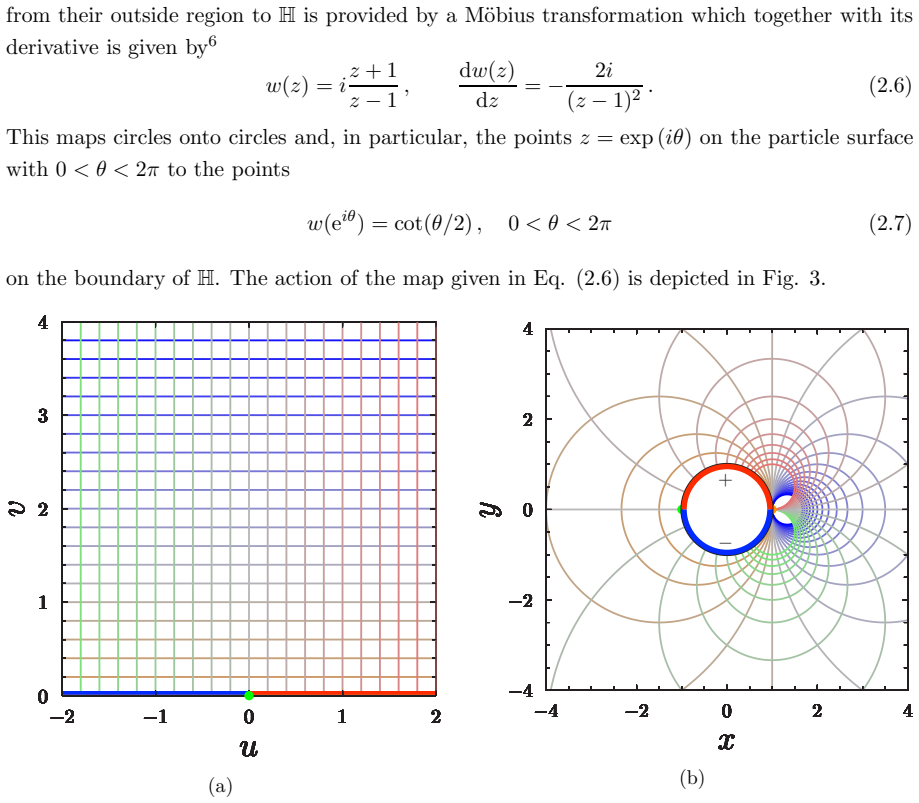
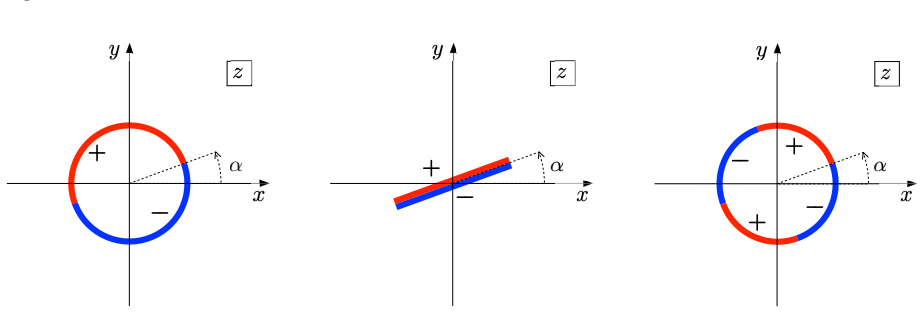
The central object is the conformal transformation from the exterior of the particle to the upper half plane; for a unit circle it is $w(z)=i(z+1)/(z-1)$, with the particle's + and - arcs becoming + and - half-lines on the real axis. The paper combines exact half-plane one- and two-point functions for such alternating boundary patterns with the conformal transformation laws for primary operators, involving the factor $|dw/dz|^{x_O}$, and for the stress tensor, which includes the Schwarzian derivative. The small particle operator expansion is the second engine: it encodes the particle's distant effect as $1+s_P$, with $s_P$ a series of descendants of the energy, order-parameter, and identity operators located at the particle center, and its prefactors are fixed by matching the exact isolated-particle profiles and selected two-point functions. This reduces confinement and pair interactions to a handful of bulk or confined correlation-function averages and produces the explicit orientation dependence through the spin of each descendant.
What would settle it
An exact transfer-matrix calculation of the critical Casimir free energy of a Janus circle in an annulus with an inhomogeneous boundary would settle the main claim: the expansion predicted by the small particle operator expansion must match the exact large-distance series in the size-to-distance ratio through the quoted orders. A mismatch in the leading orientation-dependent term would show that the undetermined, critical-point-vanishing operators are not subleading.
Extended reading notes
Core claim
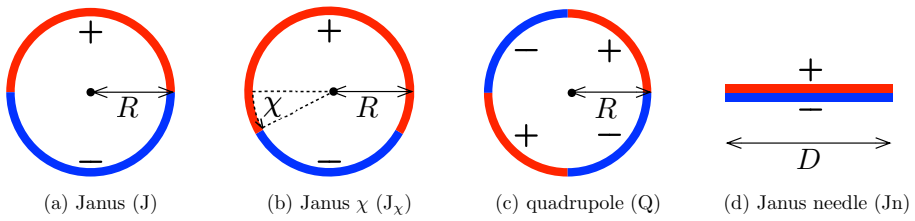
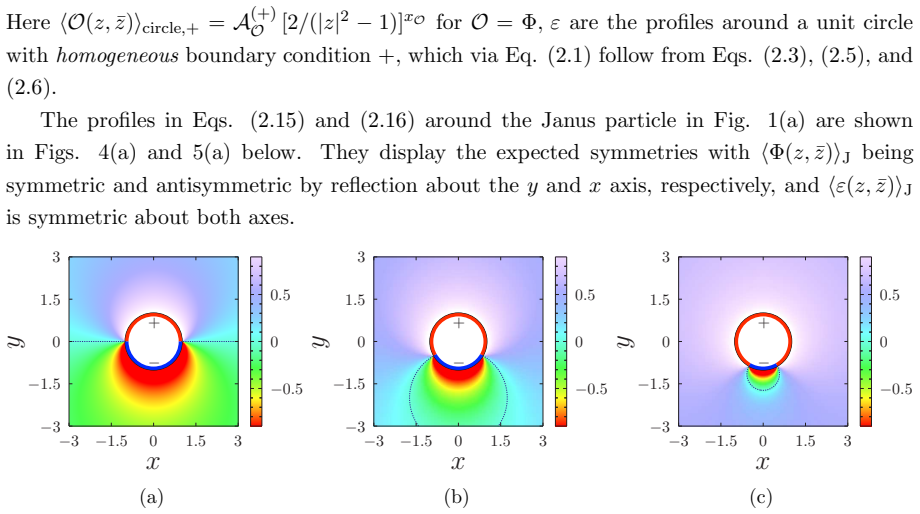
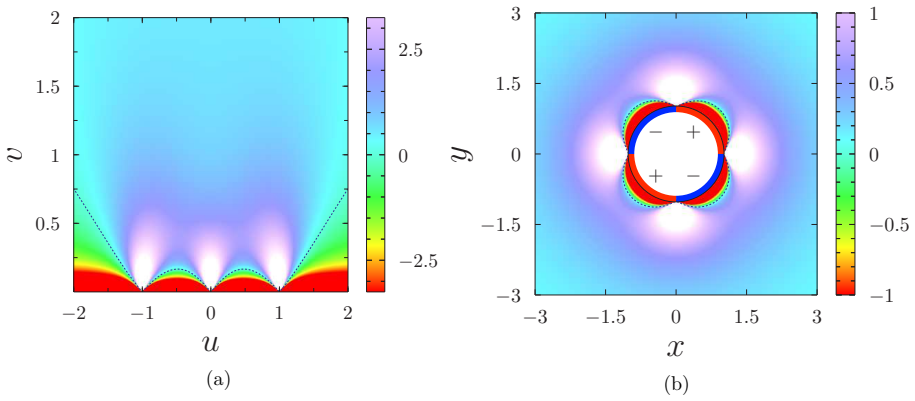
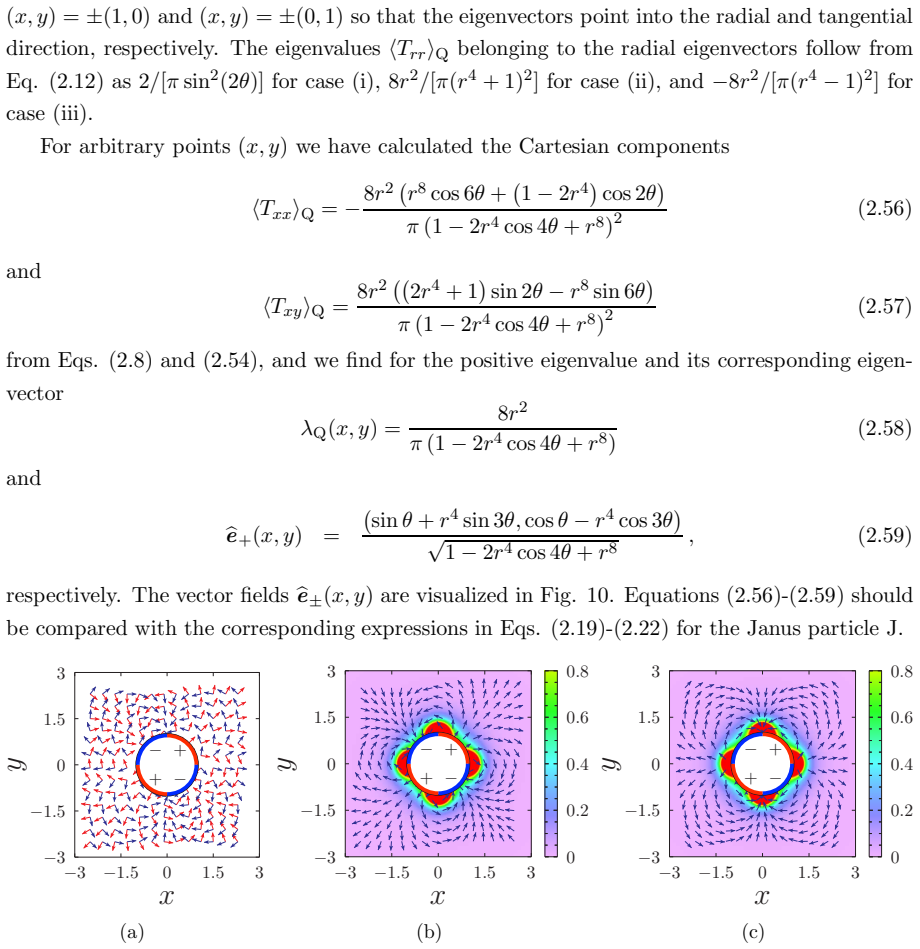
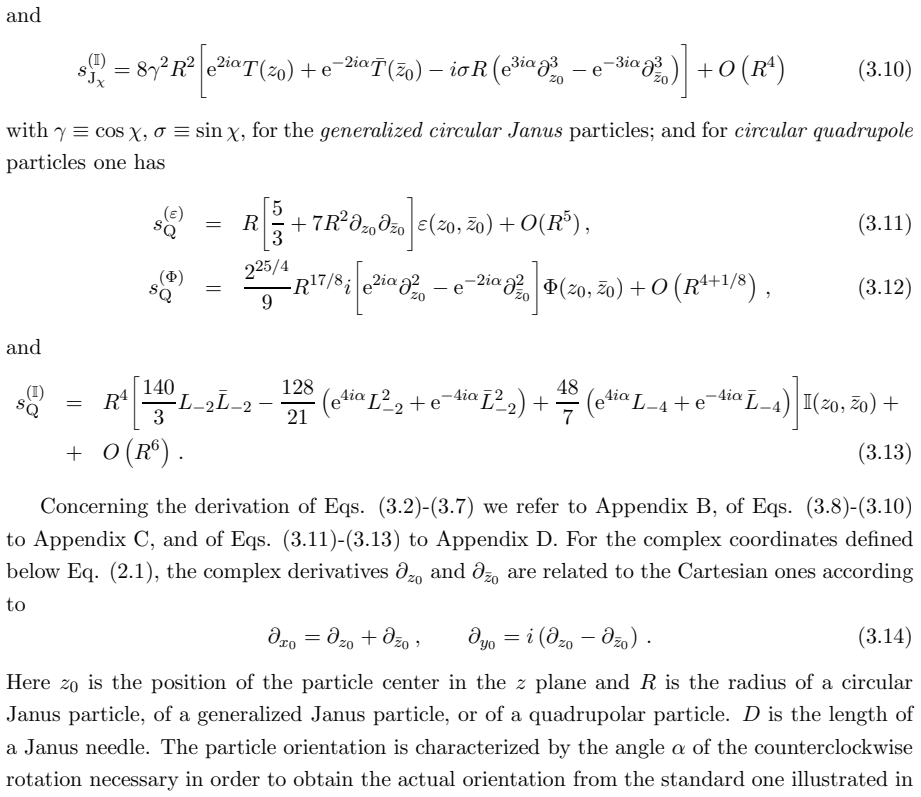
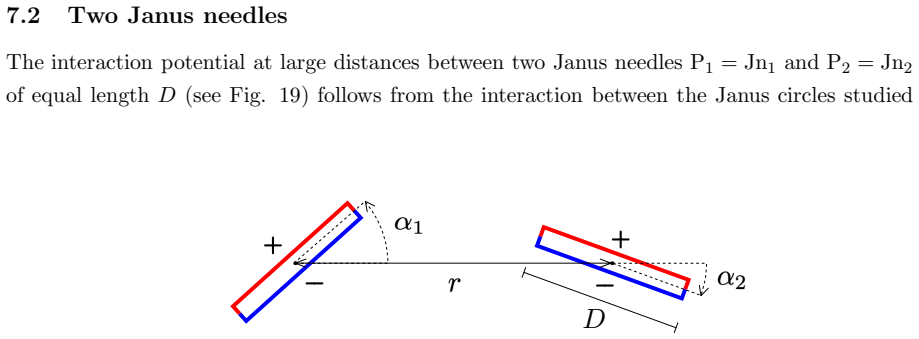
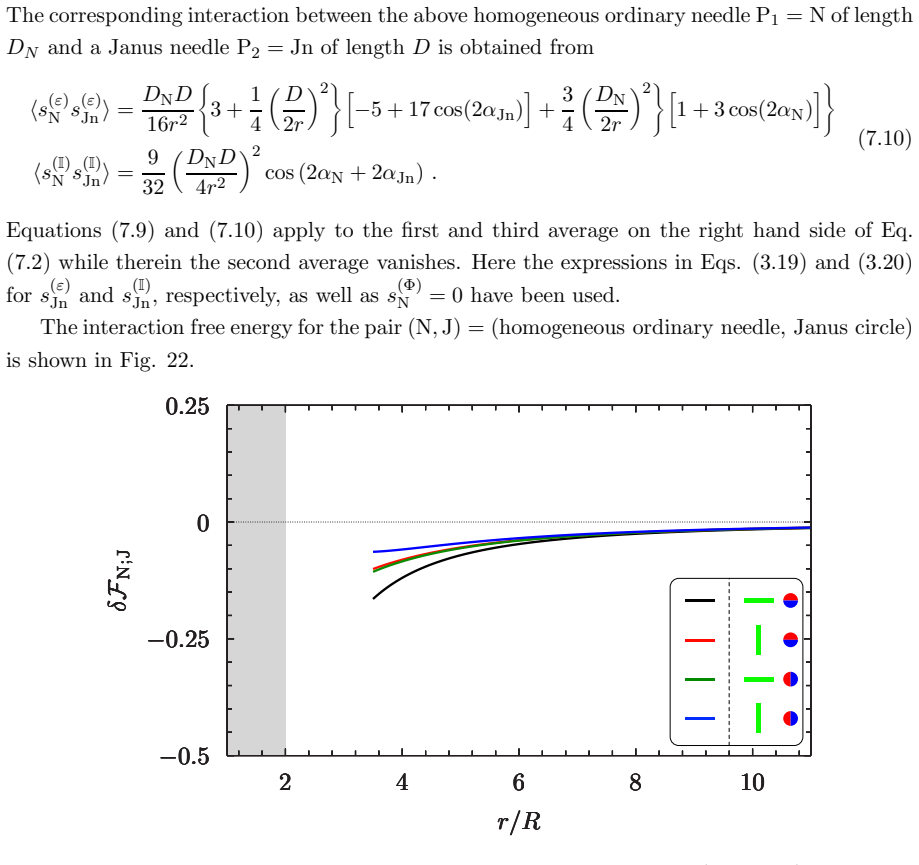
For a patchy particle in the plane at the bulk critical point, the paper establishes that every one-point function outside the particle is obtained exactly by mapping the exterior to the upper half plane and reading off the known half-plane profile for the corresponding alternating boundary pattern. For a unit Janus circle this gives the order-parameter profile in Eq. (2.15), the energy profile in Eq. (2.16), and the stress profile in Eq. (2.18); analogous exact results hold for generalized Janus circles, quadrupoles, and Janus needles. The same conformal data fix every prefactor in the small particle operator expansion, so that the free energy of transfer into a half plane, strip, or wedge, and the interaction between two distant particles, are exact through the quoted orders in the relevant small size-to-distance ratios, with the orientation angle entering through the spins of the descendant operators. Consequences include non-monotonic insertion free energies, orientation-selecting torques, and a stitch-together Derjaguin rule for near-contact Janus circles.
Load-bearing premise
The load-bearing premise is that the small particle operator expansion, with its prefactors fixed at the critical point, is complete enough that the undetermined off-critical operator terms never enter at the order of the leading or next-to-leading interactions kept in the paper; if they do, the predicted free energies and preferred orientations could change.
Editorial extensions
If this is right
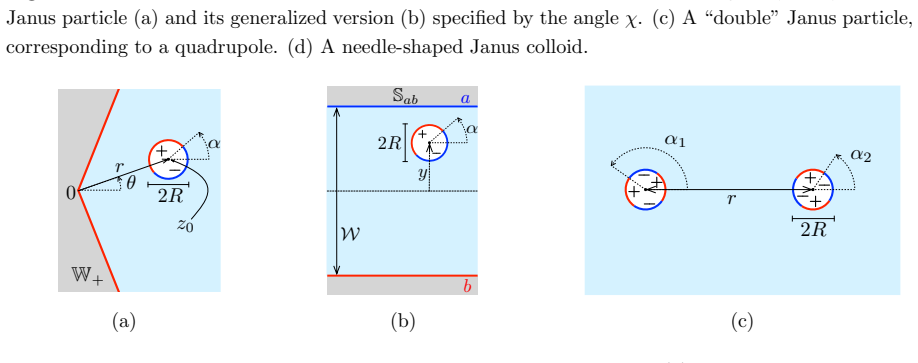
- A Janus particle in an ordinary half-plane orients so that its switching points face the wall, while in an ordinary strip its dipole aligns parallel to the strip axis.
- For a Janus circle facing a + wall, the insertion free energy is repulsive at large distances and attractive at short distances, implying a maximum in between; for an ordinary wall the opposite trend implies a minimum and a stable standoff distance.
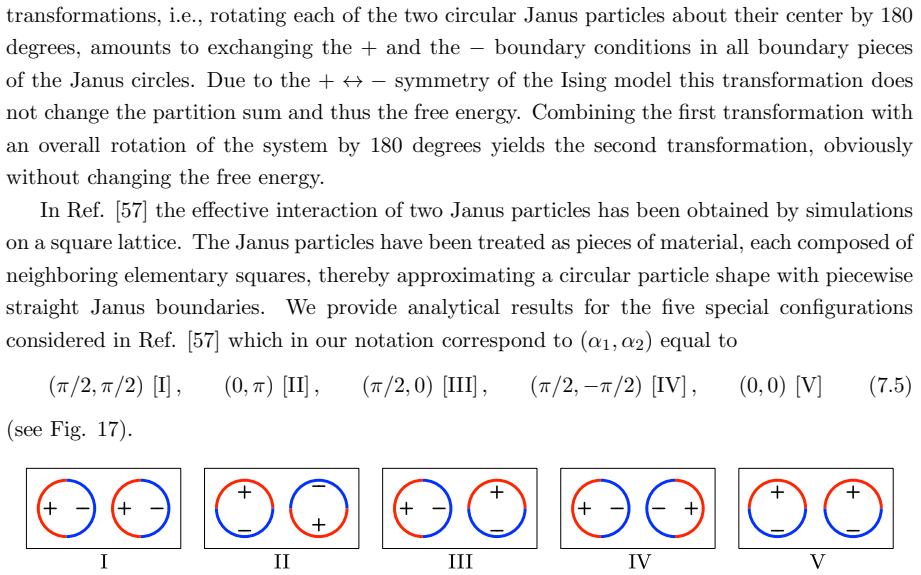
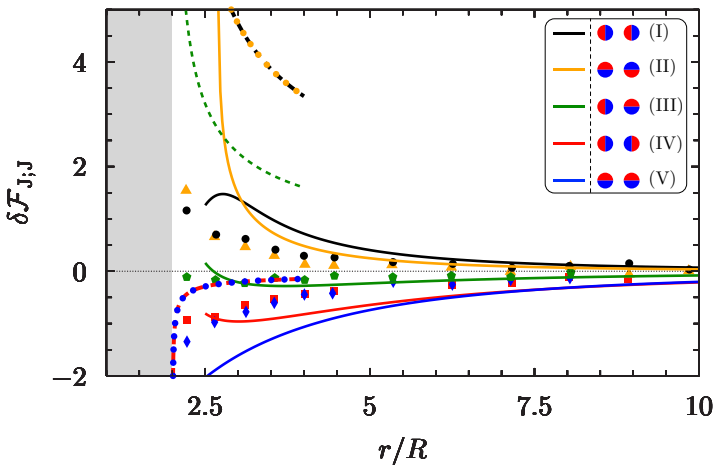
- Two Janus circles attract or repel depending on relative orientation, and near contact the leading Derjaguin force is the arithmetic mean of the forces for the two homogeneous boundary pairs, with a next-to-leading correction of order $(C/R)^{1/2}$.
- A quadrupolar particle in a + wedge switches its preferred orientation at a wedge opening angle of about $123.5^\circ$, giving a concrete geometry-controlled orientational transition.
- The same expansion produces explicit higher-body contributions, such as the subleading three-body term between two Janus circles and an ordinary circle, showing that critical Casimir many-body forces are accessible in this framework.
Reading between the lines
- The paper leaves implicit that the explicit orientation dependence of the free energy directly yields a Casimir torque, the negative derivative of the free energy with respect to the orientation angle; extracting this torque as a function of distance and boundary type gives a concrete prediction for orientational ordering of Janus colloids.
- Since conformal invariance is special to two dimensions, the quantitative profiles will not transfer to three-dimensional Janus spheres, but the small particle operator expansion logic suggests that analogous expansions built from exact single-sphere profiles could supply the leading orientation-dependent Casimir terms in $d=3$.
- The decreasing energy-prefactor across Janus, quadrupolar, and ordinary circular boundaries hints that particles with many alternating patches cross over to effectively free-boundary behavior; computing profiles for particles with more switches would test this crossover directly.
- A lattice-simulation test in the Janus-needle geometry, which suffers fewer shape-discretization artifacts than circular particles on a square lattice, would cleanly isolate the predicted leading $R^{9/8}$ orientation-dependent term near a symmetry-breaking wall.
Signed reviews
Editorial analysis
A structured set of objections, weighed in public.
Referee Report
Summary. The paper studies colloidal particles with chemically inhomogeneous surfaces suspended in a two-dimensional critical Ising fluid at its bulk critical point. Using conformal maps from the upper half plane with alternating +/− boundary conditions, it derives exact single-particle profiles of the order parameter, the energy density, and the stress tensor for symmetric and generalized Janus circles, Janus needles, and quadrupolar particles (Sec. 2). It then constructs a small-particle operator expansion (SPOE) whose prefactors are fixed by matching isolated-particle one- and two-point functions (Sec. 3 and Appendices B–D), and uses this SPOE to compute insertion free energies in half planes, strips, and wedges (Secs. 5–6) as well as pair interactions between distant particles (Sec. 7). The paper also compares the large-distance results with Derjaguin-type short-distance expressions and with simulation data from Ref. [57].
Significance. If the SPOE completeness and transferability assumptions hold, the paper delivers parameter-free universal predictions for position- and orientation-dependent critical Casimir interactions, including torques, that go beyond earlier homogeneous-particle results. The single-particle profiles in Sec. 2 are exact at all distances outside the particle and constitute a useful resource in their own right. The disentanglement of the third-order order-parameter descendants in Appendix B and the reproduction of the quadrupole stress-tensor profile from the identity-descendant sector in Appendix D are nontrivial consistency checks. The main open risk is that the interaction free energies are only as reliable as the truncated SPOE, whose completeness is asserted rather than proved; this is the load-bearing premise for the central claims of asymptotic exactness.
major comments (2)
- [Sec. 3, Eq. (3.18); footnote 3] The interaction free energies in Secs. 5–7 are described as asymptotically exact, but the only justification for the truncated SPOE is the matching condition in Eq. (3.18). The prefactors are fixed so that the expansion reproduces the isolated-particle one-point functions and the selected two-point functions treated in Appendices B and D; operators that do not enter these correlators are left unconstrained. Footnote 3 explicitly concedes the existence of operator contributions with prefactors that vanish at the critical point and 'cannot be determined as described,' with the assumption that they are higher order. A missed operator of this kind, or a higher-spin identity descendant omitted from Eqs. (3.2)–(3.13), could acquire a nonvanishing average in a strip, wedge, or two-particle geometry at the same order as the retained R^3, R^{25/8}, or R^4 terms, thereby changing the predicted equilibrium orientations in Eqs. (5.26), (5.31), (6.8), and the pair potentials in Eq. (7.3). Since this is the step that carries the claim of asymptotic exactness, the manuscript should either provide a concrete argument (or an independent check, e.g., against an exact free-fermion solution in a special confined geometry) that all omitted operators are strictly higher order in every geometry considered, or explicitly downgrade the claims to leading-order asymptotics with an estimate of the omitted contributions.
- [Sec. 4, Eqs. (4.1)–(4.3)] The transition from the solitary particle to a confined or two-particle geometry assumes that the SPOE operator series, with prefactors fixed from bulk-fitted isolated-particle data, persists unchanged in the presence of distant boundaries or a second particle. This is plausible for a local effective Hamiltonian, but it is an assumption that is not tested by the exact profiles of Sec. 2, which are the paper's strongest results. The manuscript contains no check of the SPOE in a geometry where independent results are available, even though exact strip data for homogeneous inclusions are available from Eqs. (5.21)–(5.22) and the literature cited there. Please add such a check, or state explicitly that this transferability is part of the SPOE ansatz and that the interaction results inherit this assumption; as written, the phrase 'asymptotically exact' in the abstract overstates what has been established.
minor comments (5)
- [Abstract] The phrase 'in two spatial dimension' should be 'in two spatial dimensions.'
- [Sec. 5.2.2, text after Eq. (5.25)] The sentence reporting the orientation for a ++ strip says 'α = 0 for Y0 < 0 and α = π for Y0 < 0'; the second inequality should presumably be Y0 > 0, since otherwise no orientation is predicted for Y0 > 0.
- [Eq. (5.8) and surrounding text] The notation D ≡ D/(2x0) reuses the symbol D for both the needle length and a dimensionless ratio; this is confusing and should be replaced by a distinct symbol such as \tilde D.
- [Eq. (2.49)] The symbol 'cc' is used to denote the complex conjugate without being defined in the text or in the glossary of Appendix A; please define it explicitly.
- [Appendix B, Eq. (B.10)] The derivation of the prefactors A, B, and C is summarized very briefly; since this is the key step that disentangles the third-order descendants, please state explicitly that the expansion of Eq. (B.5) was matched to Eq. (B.3) (for example, by symbolic computation) so that the result is auditable.
Circularity Check
No circular step: exact profiles come from external conformal inputs, SPOE coefficients are fitted to those profiles, and the wall, strip, wedge, and two-particle free energies are genuinely different geometric averages; footnote 3 is a stated completeness caveat rather than a circular reduction.
full rationale
The claimed exact single-particle profiles are not circular. They are obtained by applying the conformal transformation formula in Eq. (2.1), with the M\"obius maps in Eqs. (2.6) and (2.35), to half-plane one-point functions taken from Burkhardt, Guim, and Xue (Refs. [42], [55], [56]); the target interaction free energies never enter this construction. The SPOE coefficients are indeed fixed by requiring Eq. (3.18) to reproduce the isolated-particle profiles and selected two-point functions, as stated in Sec. 3 and Appendices B-D. That is a coefficient fit for an operator expansion, not a prediction of the quantities being matched. The subsequent interaction free energies are obtained from wall, strip, wedge, or two-particle averages of those operators via Eqs. (4.2), (4.3), and (7.2), which involve conformal data different from the fitted isolated-particle correlators; the distance and orientation dependences are therefore new content, not the fit themselves. Footnote 3 explicitly concedes that additional operators with prefactors vanishing at the critical point cannot be determined and are expected to give only higher-order corrections. This is an unproven completeness assumption that limits the force of the phrase 'asymptotically exact', but it is a correctness or rigor caveat, not an equation-level circular reduction: no displayed equation makes a target interaction equal by construction to an input used to fix the SPOE. The paper also cites earlier SPOE work by the same authors, but the expansion is re-validated internally against exact two-point functions and against independent simulation data, so the self-citations are not load-bearing unverified assumptions. I therefore find no significant circularity.
Assumptions & free parameters
assumptions (5)
- domain assumption The 2D critical binary mixture belongs to the Ising universality class and is conformally invariant at the bulk critical point.
- domain assumption Exact correlation functions for the upper half plane with alternating +/− boundary segments (Burkhardt-Guin-Xue, Refs [42,55,56]) are correct and are used as input without re-derivation.
- domain assumption Surface patches act as infinitely strong + or − surface fields (normal boundary conditions), and free boundaries act as ordinary (O) boundary conditions.
- ad hoc to paper The small-particle operator expansion provides a complete basis of conformal operators at the particle position, and prefactors determined from the isolated particle persist in the presence of distant boundaries.
- standard math Level-2 degeneracy of primary operators in minimal models (Eq. (3.17), Appendix F) holds.
Cite this review
Pith. "Pith review of Critical Casimir interaction between colloidal Janus-type particles in two spatial dimensions." pith.science (2026). https://pith.science/paper/5ZN4WBDI
@misc{pith2026190806950,
  author       = {Pith},
  title        = {Pith review of: Critical Casimir interaction between colloidal Janus-type particles in two spatial dimensions},
  year         = {2026},
  howpublished = {\url{https://pith.science/paper/5ZN4WBDI}},
  note         = {Machine review of arXiv:1908.06950}
}
read the original abstract
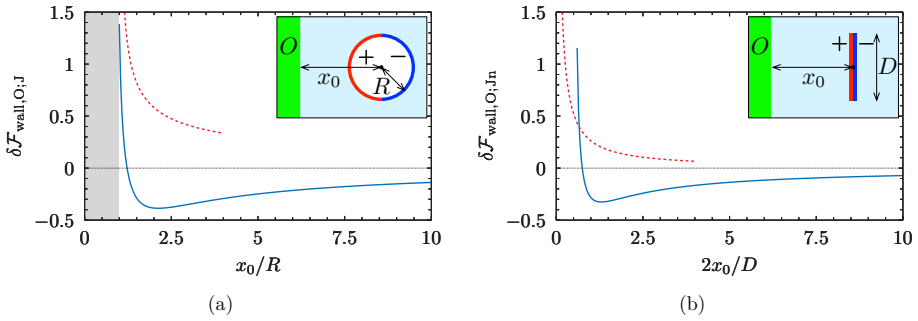
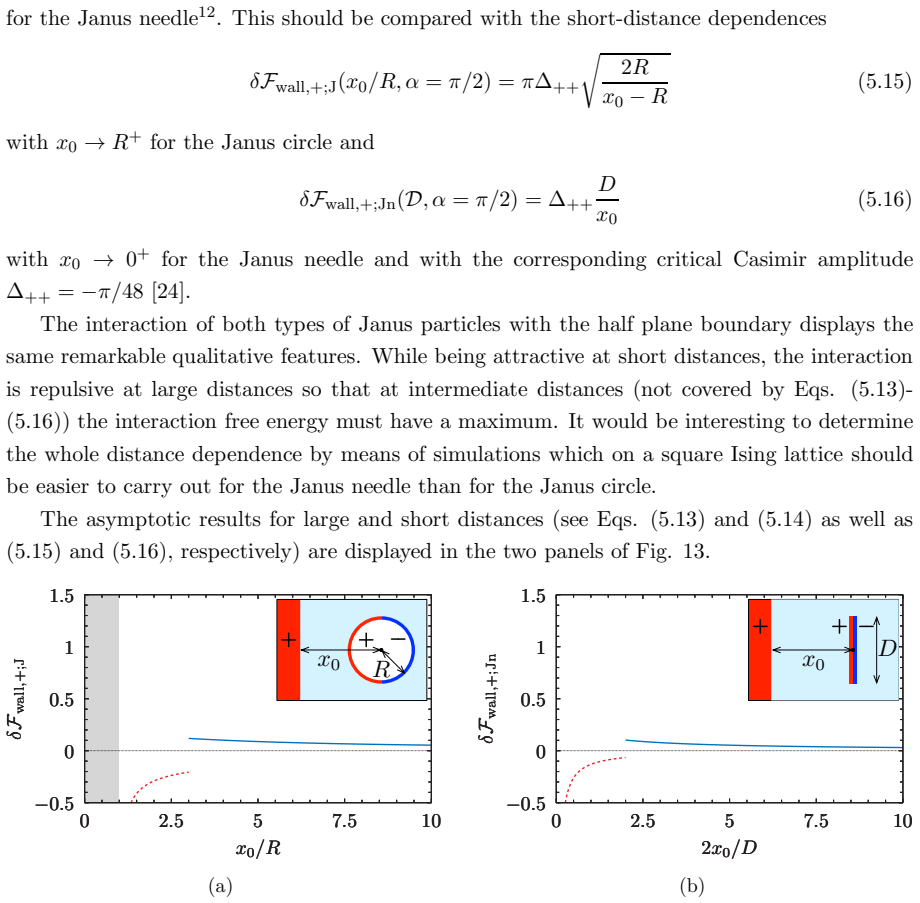
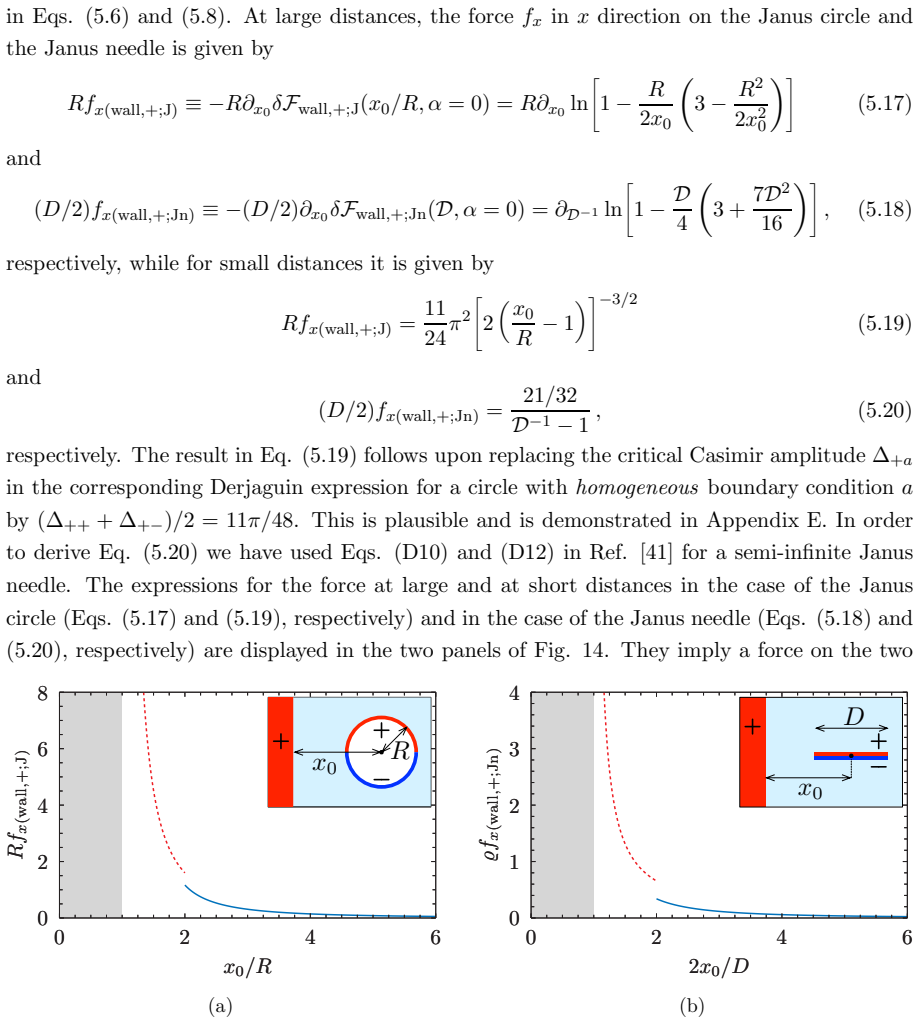
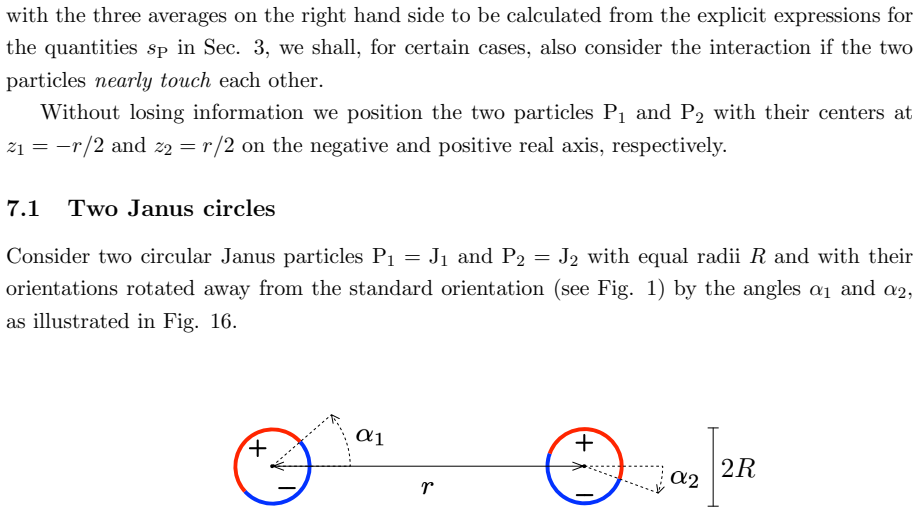
We study colloidal particles with chemically inhomogeneous surfaces suspended in a critical binary liquid mixture. The inhomogeneous particle surface is composed of patches with alternating adsorption preferences for the two components of the binary solvent. By describing the binary liquid mixture \emph{at} its consolute point in terms of the critical Ising model we exploit its conformal invariance in two spatial dimension. This allows us to determine exactly the universal profiles of the order parameter, the energy density, and the stress tensor as well as some of their correlation functions around a single particle for various shapes and configurations of the surface patches. The formalism encompasses several interesting configurations, including Janus particles of circular and needle shapes with dipolar symmetry and a circular particle with quadrupolar symmetry. From these single-particle properties we construct the so-called small particle operator expansion (SPOE), which enables us to obtain asymptotically exact expressions for the position- and orientation-dependent critical Casimir interactions of the particles with distant objects, such as another particle or the confining walls of a half plane, strip, or wedge, with various boundary conditions for the order parameter. In several cases we compare the interactions at large distances with the ones at close distance (but still large on the molecular scale). We also compare our analytical results for two Janus particles with recent simulation data.
Figures
Figures from the paper (23 more)




Reference graph
Works this paper leans on
-
[57]
Benet J, Paillusson F and Kusumaatmaja H 2017 Phys. Chem. Chem. Phys. 19 24188
work page 2017
-
[1]
Kim J W, Larsen R J and Weitz D A 2006 J. Am. Chem. Soc. 128 14374
work page 2006
-
[2]
Kraft D J, Hilhorst J, Heinen M A P, Hoogenraad M J, Luigjes B and Kegel W K 2011 J. Phys. Chem. B 115 7175
work page 2011
-
[3]
Visaveliya N R and K¨ ohler J M 2018Biomacromolecules 19 1047–1064
-
[4]
Sacanna S, Korpics M, Rodriguez K, Col´ on-Mel´ endez L, Kim S H, Pine D J and Yi G R 2013 Nature Communications 4 1688
work page 2013
-
[5]
Nguyen T A, Newton A, Veen S J, Kraft D J, Bolhuis P G and Scha ll P 2017 Advanced Materials 29 1700819
work page 2017
-
[6]
Nguyen T A, Newton A, Kraft D J, Bolhuis P G and Schall P 2017 Materials 10 1265
work page 2017
-
[7]
Chen Q, Whitmer J K, Jiang S, Bae S C, Luijten E and Granick S 2011 Science 331 199
work page 2011
Show all 72 references
-
[8]
Iwashita Y and Kimura Y 2013 Soft Matter 9 10694
2013
-
[9]
Iwashita Y and Kimura Y 2014 Soft Matter 10 7170
2014
-
[10]
Beysens D and Est` eve D 1985Phys. Rev. Lett. 54 2123
-
[11]
Phys.: Condens
Nguyen V D, Dang M T, Nguyen T A and Schall P 2016 J. Phys.: Condens. Matter 28 04301 54
2016
-
[12]
Macio/suppress lek A and Dietrich S 2018Rev. Mod. Phys. 90 045001
-
[13]
Fisher M E and de Gennes P G 1978 C. R. Acad. Sci. Paris B 287 207
1978
-
[14]
Gambassi A, Macio/suppress lek A, Hertlein C, Nellen U, Helden L,Bechinger C and Dietrich S 2009 Phys. Rev. E 80 061143
2009
-
[15]
Hertlein C, Helden L, Gambassi A, Dietrich S and Beching er C 2008 Nature 451 172
2008
-
[16]
Kondrat S, Harnau L and Dietrich S 2009 J. Chem. Phys. 131 204902
2009
-
[17]
Bianchi E, Doppelbauer G, Filion L, Dijkstra M and Kahl G 2012 J. Chem. Phys. 136 214102
2012
-
[18]
Kern N and Frenkel D 2003 J. Chem. Phys. 118 9882
2003
-
[19]
Newton A C, Nguyen T A, Veen S J, Kraft D, Schall P and Bolhu is P G 2017 Soft Matter 13 4903
2017
-
[20]
Nellen U, Helden L and Bechinger C 2009 EPL 88 26001
2009
-
[21]
Binder K 1983 Critical behaviour at surfaces Phase transitions and critical phenomena vol 8 ed Domb C and Lebowitz J L (London: Academic Press) chap 1, p 1
1983
-
[22]
Diehl H W 1986 Field-theoretical approach to critical b ehaviour at surfaces Phase tran- sitions and critical phenomena vol 10 ed Domb C and Lebowitz J L (London: Academic Press) chap 2, p 76
1986
-
[23]
Diehl H W 1997 Int. J. Mod. Phys. B 11 3503
1997
-
[24]
Cardy J L 1987 Conformal invariance Phase Transitions and Critical Phenomena vol 11 ed Domb C and Lebowitz J L (London: Academic Press) chap 2, p 55
1987
-
[25]
Burkhardt T W and Eisenriegler E 1985 J. Phys. A: Math. Gen. 18 L83
1985
-
[26]
Krech M and Dietrich S 1992 Phys. Rev. A 46 1886
1992
-
[27]
Krech M 1994 The Casimir effect in critical systems (Singapore: World Scientific)
1994
-
[28]
Abraham D B and Macio/suppress lek A 2010Phys. Rev. Lett. 105 055701
-
[29]
Rudnick J, Zandi R, Shackell A and Abraham D B 2010 Phys. Rev. E 82 041118
2010
-
[30]
Abraham D B and Macio/suppress lek A 2013EPL 101 20006
-
[31]
Kenneth O and Klich I 2006 Phys. Rev. Lett. 97 160401
2006
-
[32]
Bachas C P 2007 J. Phys. A: Math. Gen. 40 9089
2007
-
[33]
Evans R and Stecki J 1994 Phys. Rev. B 49 8842 55
1994
-
[34]
Delfino G and Squarcini A 2015 Europhys. Lett. 109 16001
2015
-
[35]
Belavin A A, Polyakov A M and Zamolodchikov A B 1984 J. Stat. Phys. 34 763
1984
-
[36]
Belavin A A, Polyakov A M and Zamolodchikov A B 1984 Nucl. Phys. B 241 333
1984
-
[37]
Bl¨ ote H W J, Cardy J L and Nightingale M P 1986 Phys. Rev. Lett. 56 742
1986
-
[38]
Cardy J L 1984 Nucl. Phys. B 240 514
1984
-
[39]
Cardy J L 1986 Nucl. Phys. B 275 200
1986
-
[40]
Cardy J L and Redner S 1984 J. Phys. A: Math. Gen. 17 L933
1984
-
[41]
Eisenriegler E and Burkhardt T W 2016 Phys. Rev. E 94 032130
2016
-
[42]
Burkhardt T W and Guim I 1993 Phys. Rev. B 47 14306
1993
-
[43]
Dubail J, Santachiara R and Emig T 2015 EPL 112 66004
2015
-
[44]
Burkhardt T W and Eisenriegler E 1995 Phys. Rev. Lett. 74 3189 [Erratum, Phys. Rev. Lett. 78, 2867 (1997)]
1997
-
[45]
Machta B B, Veatch S L and Sethna J P 2012 Phys. Rev. Lett. 109 138101
2012
-
[46]
Bimonte G, Emig T and Kardar M 2013 EPL 104 21001
2013
-
[47]
Vasilyev O A, Eisenriegler E and Dietrich S 2013 Phys. Rev. E 88 012137
2013
-
[48]
Wilson K G and Kogut J 1974 Phys. Rep. C 12 75
1974
-
[49]
Patashinskii A Z and Pokrovskii V L 1979 Fluctuation Theory of Phase Transitions (Inter- national Series in Natural Philosophy vol 98) (New York: Pergamon Press)
1979
-
[50]
12 381 [Zh
Polyakov A M 1970 JETP Lett. 12 381 [Zh. Eskp. Teor. Fiz. Pis. Red. 12, 538–541 (1970)]
1970
-
[51]
Eisenriegler E and Ritschel U 1995 Phys. Rev. B 51 13717
1995
-
[52]
Eisenriegler E 2004 J. Chem. Phys. 121 3299
2004
-
[53]
Eisenriegler E 2006 J. Chem. Phys. 124 144912
2006
-
[54]
Eisenriegler E, Bringer A and Maassen R 2003 J. Chem. Phys. 118 8093
2003
-
[55]
Burkhardt T W and Xue T 1991 Phys. Rev. Lett. 66 895
1991
-
[56]
Burkhardt T W and Xue T 1991 Nucl. Phys. B 354 653–665
1991
-
[58]
Di Francesco P, Mathieu P and S´ en´ echal D 1997 Conformal Field Theory (New York: Springer-Verlag) 56
1997
-
[59]
Henkel M 1999 Conformal Invariance and Critical Phenomena (Berlin: Springer-Verlag)
1999
-
[60]
Dietrich S and Diehl H W 1981 Z. Phys. B - Condensed Matter 43 315
1981
-
[61]
Kober H 1957 Dictionary of Conformal Representations (New York: Dover)
1957
-
[62]
Cardy J L 1986 Physica A 140 219
1986
-
[63]
Walther A, Drechsler M, Rosenfeldt S, Harnau L, Ballauff M, Abetz V and M¨ uller A H E 2009 J. Am. Chem. Soc. 131 4720
2009
-
[64]
Prasad N, Perumal J, Choi C H, Lee C S and Kim D P 2009 Adv. Funct. Mater. 19 1656
2009
-
[65]
Phys.: Condens
Yi G R, Pine D J and Sacanna S 2013 J. Phys.: Condens. Matter 25 193101
2013
-
[66]
Labb´ e-Laurent M and Dietrich S 2016Soft Matter 12 6621
-
[67]
Biggs N L 2002 Discrete Mathematics (Oxford: Oxford University Press)
2002
-
[68]
Derjaguin B 1934 Kolloid-Zeitschrift 69 155
1934
-
[69]
circle,+
Burkhardt T W and Eisenriegler E unpublished material 57 Appendix A Glossary and list of symbols In order to make the reading of the manuscript easier, here we summarize the mathematical symbols and abbreviations used throughout the main text of t his work. Certain extra symbo...
-
[70]
(5.3), the wedge average⟨T (z)⟩Waa = ( 1− Ξ2) /(48z2) of T , which follows from Eq
Here we use the transformation in Eq. (5.3), the wedge average⟨T (z)⟩Waa = ( 1− Ξ2) /(48z2) of T , which follows from Eq. (5.27), and the averages in Eqs. (D.22) and (D.24) of T ¯T, L2 −2I, and L−4I. Further confirmation of the expression in Eq. (D.25) stems fr om the bulk thre...
-
[71]
actually is exact right at the critical point. Here we extend this reasoning to close circles with inhomogeneous boundary conditions, such as the circular Janus particles c onsidered here, realizing that the stress tensor in the corresponding strip can be calculated rather eas...
-
[72]
fit together
In this case Eqs. (E.3) and (E.2) imply C R = ñÅ R> R< ã1/ 4 − Å R< R> ã1/ 4ô2 , 2 R = 1 R< − 1 R> . (E.4) (ii) For R> = R0, circle 2 reduces to the imaginary axis, forming the boundar y of the right half z plane, which contains circle 1 with radius R1≡ R and its center at z =...
Reviewed August 14, 2026 · model on record in the stance chip above.
Discussion (0). Continue with ORCID to comment.