REVIEW 4 major objections 4 minor 45 references
Camera-only 3D occupancy improves by modeling each ray as a non-normalized Gaussian mixture intensity, letting multiple occluded surfaces coexist per pixel, reaching 34.84 IoU on nuScenes.
Reviewed by Pith at T0; open to challenge. T0 means a machine referee read the full paper against a public rubric. the ladder, T0–T4 →
T0 review · deepseek-v4-flash
2026-08-01 17:21 UTC pith:5ZOHNKEC
load-bearing objection RayOcc has a clean non-normalized Gaussian-mixture ray formulation, but the paper doesn't isolate that formulation in experiments; the small gain over VG3T could come from other changes. the 4 major comments →
RayOcc: Occlusion-Aware Ray Occupancy Estimation via Gaussian Mixture Intensity
The pith
A machine-rendered reading of the paper's core claim, the machinery that carries it, and where it could break.
Core claim
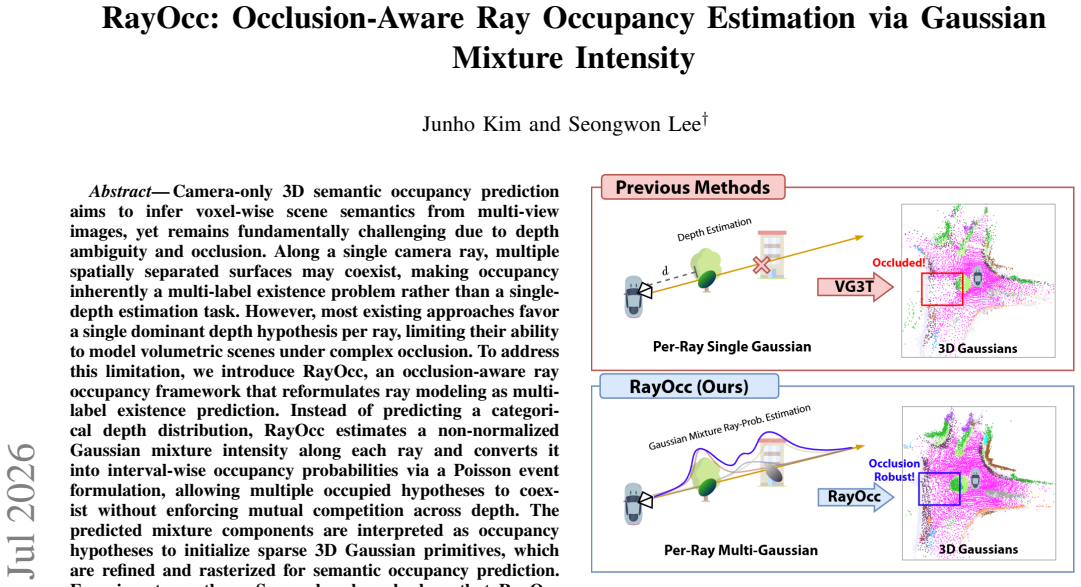
The paper claims that occupancy along a camera ray is a multi-label existence problem, and that the right model is a non-normalized Gaussian mixture intensity rather than a categorical depth distribution. A Mixture Intensity Network predicts K components per ray; the integrated intensity in each depth bin is fed through 1 − exp(−Λ), giving bin-wise existence probabilities that do not compete. Component amplitudes become activation probabilities to spawn 3D Gaussian primitives at multiple depths, refined and rasterized into voxel occupancy. On nuScenes this reaches IoU 34.84 and mIoU 22.03 among compared Gaussian-based methods, with 61% of initialized Gaussians inside occupied voxels.
What carries the argument
The load-bearing object is the non-normalized Gaussian mixture intensity function λ_r(d) = Σ a_k N(d; μ_k, σ_k²) with no constraint on the amplitudes, together with the Poisson event conversion p_i = 1 − exp(−∫λ). The mixture allows multiple occupancy hypotheses to carry high intensity simultaneously; the exponential map turns integrated intensity into a per-bin existence probability that does not sum to one; and adaptive component-wise sampling (Bernoulli gate with probability 1 − exp(−βa)) converts predicted components into a variable number of 3D Gaussian primitives, which are refined by a sparse convolutional network and rasterized through probabilistic splatting to produce the semantic
Load-bearing premise
The ground-truth ray label for each depth bin is obtained by sampling a single 3D point at the bin center and querying a 0.5 m voxel grid; if that point misses an occupied voxel or lands near a boundary, the label is wrong, and that noise supervises the mixture intensity that the entire method rests on.
What would settle it
Re-derive ray labels by sampling multiple points per depth bin (e.g., 5 or 9 stratified samples) and retrain RayOcc with the same settings; if the IoU and the 61% placement metric shift significantly, the reported improvements depend on the single-sample labeling assumption rather than on multi-hypothesis modeling.
If this is right
- If the formulation is correct, any camera-based occupancy pipeline that currently predicts a softmax depth distribution can be switched to a non-normalized intensity head without architectural changes, gaining multi-surface support for free.
- The Poisson conversion introduces no extra trainable parameters, so the method should generalize to other multi-label per-ray problems such as transparent object layout or multi-surface depth estimation.
- Because the threshold sweep (τ = 0.7–0.9) leaves occupancy accuracy nearly flat, the model can be tuned at deployment to trade primitive count against latency with little accuracy cost.
- The efficiency comparison suggests multi-hypothesis initialization plus sparse refinement can run faster and use less memory than single-hypothesis iterative methods, pointing toward real-time camera-only occupancy.
Where Pith is reading between the lines
- A one-point-per-bin labeling scheme likely mislabels thin structures and bin-boundary surfaces; retraining with multi-point or volume-based ray labels could either strengthen or erode the reported gains, and would clarify whether the mixture model is genuinely learning multi-surface existence.
- The paper's advantage over single-depth baselines should be most pronounced in highly occluded urban scenes and should shrink on sparse scenes; a per-scene occlusion-difficulty analysis would provide a direct test of the mechanism.
- The connection to NeRF-style transmittance is left largely implicit; using the same intensity for self-supervised depth or appearance prediction could extend RayOcc to settings without dense occupancy labels.
- The stochastic Bernoulli gate used in training with deterministic thresholding at inference suggests a Gumbel-softmax reparameterization might deliver lower-variance gradients and further reduce the number of primitives needed.
Editorial analysis
A structured set of objections, weighed in public.
Referee Report
Summary. RayOcc proposes to model each camera ray's occupancy as a non-normalized Gaussian mixture intensity, converts integrated intensity into interval-wise occupancy probabilities via a Poisson event model (Section III-B, Eqs. 3-6), and uses component amplitudes to adaptively initialize 3D Gaussian primitives for semantic occupancy rasterization. On nuScenes with SurroundOcc annotations, it reports IoU 34.84 and mIoU 22.03, exceeding the VG3T baseline. Ablations show that component-wise sampling improves Gaussian initialization position metrics (Table II) and that the activation threshold has modest impact on occupancy accuracy (Table IV).
Significance. If the causal claim holds, this is a useful conceptual correction: replacing softmax-normalized categorical depth with multi-label intensity aligns ray supervision with the multi-surface nature of volumetric occupancy. The Poisson derivation from intensity to interval existence is clean, and the auxiliary ray loss is well motivated. The use of dense occupancy annotations to generate ray labels is standard supervised training, not circularity. However, the evidence for the central claim is incomplete: no experiment isolates the intensity-to-probability mapping from the rest of the pipeline, and the main comparison with VG3T is close and lacks uncertainty. A carefully controlled ablation and variance reporting would substantially strengthen the paper.
major comments (4)
- [Section III-B / Section IV-E] The central claim -- that non-normalized intensity converted by Eq. (6) avoids mutual depth competition and thereby improves occupancy -- is not isolated by any experiment. Table IV varies only the activation threshold and Bernoulli sampling; no variant replaces Eq. (6) with a normalized categorical distribution (e.g., softmax over integrated bin intensities) or removes the auxiliary ray loss while holding the backbone and refinement fixed. Since the compared VG3T baseline differs in depth regression, network details, and training, the reported +0.78 IoU / +0.29 mIoU could plausibly come from the VGGT backbone, the extra Gaussians, or lambda_ray. Please add an ablation that swaps only the ray probability model.
- [Section III-E, Eq. (14)] Ray labels are generated by sampling a single 3D point at the center of each depth bin. With S=128 bins over [1,71] m, the bin width is ~0.55 m, comparable to the 0.5 m voxel size. A ray can pass through an occupied voxel without containing that voxel's bin-center point, so thin structures and partial voxels will acquire false-negative labels. Since these labels supervise the mixture intensity via L_ray, the bias propagates into the multi-label hypotheses that are the paper's main contribution. Please quantify the label noise, use multiple samples per bin, or derive ray-voxel intersection labels directly.
- [Table I / Abstract] The abstract and main results claim state-of-the-art performance, but Table I omits several strong baselines that are cited in Related Work, including VoxFormer, FB-Occ, SelfOcc, and FlashOcc. If the claim is restricted to Gaussian-based methods, this should be stated more precisely. More importantly, VG3T, the closest baseline and the main comparison, appears to be the authors' own prior work, and the reported gain over it is 0.78 IoU / 0.29 mIoU with no error bars or multiple-run statistics. Please include the missing baselines or justify their exclusion, and report variance.
- [Section III-C, Eq. (7)] The component activation probability q_{r,k}=1-exp(-beta a_{r,k}) depends only on the amplitude, while the interval probabilities p_{r,i}=1-exp(-Lambda_{r,i}) depend on integrated intensity over a bin. The relationship is not established: a narrow, high-amplitude component can have small integrated intensity but high activation probability, producing Gaussians that are inconsistent with the ray occupancy output. Specify how a_{r,k} relates to Lambda_{r,i}, or define q from the integrated bin probability, so that the adaptive sampling follows the Poisson formulation.
minor comments (4)
- [Table II] The abbreviations 'Perc.' and 'Dist.' are used without definitions in the caption or text; please define them at first use.
- [Eq. (16)] The mIoU formula uses C' without explicitly stating that the average is over non-empty classes and that unknown/empty classes are excluded; a clarifying sentence would help reproducibility.
- [Section IV-C] K=3 and beta=1 are fixed hyperparameters but no sensitivity analysis is reported. Given that the method's flexibility depends on these choices, a brief study (e.g., K=1,2,4 or beta in {0.5,2}) would strengthen the robustness argument.
- [Section III-D] The probabilistic Gaussian superposition operator is only cited to GaussianFormer-2; a short equation or precise reference to the formulation would make the rasterization step self-contained.
Circularity Check
No significant circularity: the mixture-intensity/Poisson model is an independent modeling choice, and the VG3T self-citation is not load-bearing.
full rationale
The central derivation is not circular. Eq. 6, p_{r,i}=1-exp(-Lambda_{r,i}), is a defined intensity-to-probability mapping, not a quantity fitted to its own prediction. The mixture parameters (a, mu, sigma) are learned from ray labels (Eq. 14) plus the occupancy loss on the final voxel output, and the final occupancy is produced by a separate probabilistic Gaussian splatting operator (Eq. 11, adopted from GaussianFormer-2), so the reported IoU is not an algebraic consequence of Eq. 6. Training ray labels from the same dense occupancy grid used for evaluation is standard supervised training: the validation split is held out, and generalization must still be demonstrated. The one-point-per-bin label construction is a possible data-quality/accuracy concern, but it does not make the prediction reduce to the input by construction. The only self-citation, VG3T [34], is used to justify the VGGT adaptation and as a comparison baseline; it supplies no uniqueness theorem or proof on which the proposed formulation depends. The lack of a targeted ablation isolating the multi-label Poisson formulation from the extra Gaussians/VGGT backbone is an empirical underdetermination, not circularity.
Axiom & Free-Parameter Ledger
free parameters (5)
- K (number of mixture components) =
3
- β (Poisson activation parameter) =
1
- τ (inference activation threshold) =
0.8
- λ_occ and λ_ray (loss weights) =
not reported
- Grid subsampling cell size =
0.5 m
axioms (4)
- domain assumption Occupancy events along a ray follow a Poisson process with intensity λ_r
- domain assumption A single point sample at each bin center is a reliable indicator of bin occupancy
- domain assumption The probabilistic Gaussian superposition rasterizer (from GaussianFormer-2) correctly maps Gaussians to voxel occupancy
- domain assumption VGGT backbone and DPT head provide sufficiently rich per-ray features
read the original abstract
Camera-only 3D semantic occupancy prediction aims to infer voxel-wise scene semantics from multi-view images, yet remains fundamentally challenging due to depth ambiguity and occlusion. Along a single camera ray, multiple spatially separated surfaces may coexist, making occupancy inherently a multi-label existence problem rather than a single-depth estimation task. However, most existing approaches favor a single dominant depth hypothesis per ray, limiting their ability to model volumetric scenes under complex occlusion. To address this limitation, we introduce RayOcc, an occlusion-aware ray occupancy framework that reformulates ray modeling as multi-label existence prediction. Instead of predicting a categorical depth distribution, RayOcc estimates a non-normalized Gaussian mixture intensity along each ray and converts it into interval-wise occupancy probabilities via a Poisson event formulation, allowing multiple occupied hypotheses to coexist without enforcing mutual competition across depth. The predicted mixture components are interpreted as occupancy hypotheses to initialize sparse 3D Gaussian primitives, which are refined and rasterized for semantic occupancy prediction. Experiments on the nuScenes benchmark show that RayOcc achieves state-of-the-art overall IoU and mIoU among the compared Gaussian-based occupancy methods.
Figures


Reference graph
Works this paper leans on
-
[1]
Goal-Oriented Autonomous Driving,
Y . Hu, J. Yang, L. Chen, K. Li, C. Sima, X. Zhu, S. Chai, S. Du, T. Lin, W. Wang, and et al., “Goal-Oriented Autonomous Driving,” arXiv preprint arXiv:2212.10156, 2022
Pith/arXiv arXiv 2022
-
[2]
Bevdepth: Acquisition of reliable depth for multi-view 3d object detection,
Y . Li, Z. Ge, G. Yu, J. Yang, Z. Wang, Y . Shi, J. Sun, and Z. Li, “Bevdepth: Acquisition of reliable depth for multi-view 3d object detection,” 2022. [Online]. Available: https://arxiv.org/abs/2206.10092
Pith/arXiv arXiv 2022
-
[3]
Multi-View 3D Object Detection Network for Autonomous Driving,
X. Chen, H. Ma, J. Wan, B. Li, and T. Xia, “Multi-View 3D Object Detection Network for Autonomous Driving,” inCVPR, 2017, pp. 1907–1915
2017
-
[4]
Lift, Splat, Shoot: Encoding Images from Arbitrary Camera Rigs by Implicitly Unprojecting to 3D,
J. Philion and S. Fidler, “Lift, Splat, Shoot: Encoding Images from Arbitrary Camera Rigs by Implicitly Unprojecting to 3D,” inECCV, 2020
2020
-
[5]
Monoscene: Monocular 3D Semantic Scene Completion,
A.-Q. Cao and R. de Charette, “Monoscene: Monocular 3D Semantic Scene Completion,” inCVPR, 2022, pp. 3991–4001
2022
-
[6]
Sym- phonize 3D Semantic Scene Completion with Contextual Instance Queries,
H. Jiang, T. Cheng, N. Gao, H. Zhang, W. Liu, and X. Wang, “Sym- phonize 3D Semantic Scene Completion with Contextual Instance Queries,” arXiv preprint arXiv:2306.15670, 2023
Pith/arXiv arXiv 2023
-
[7]
V oxFormer: Sparse V oxel Transformer for Camera- Based 3D Semantic Scene Completion,
Y . Li, Z. Yu, C. Choy, C. Xiao, J. M. Alvarez, S. Fidler, C. Feng, and A. Anandkumar, “V oxFormer: Sparse V oxel Transformer for Camera- Based 3D Semantic Scene Completion,” inCVPR, 2023, pp. 9087– 9098
2023
-
[8]
FB-Occ: 3D Occupancy Prediction Based on Forward-Backward View Transformation,
Z. Li, Z. Yu, D. Austin, M. Fang, S. Lan, J. Kautz, and J. M. Alvarez, “FB-Occ: 3D Occupancy Prediction Based on Forward-Backward View Transformation,” arXiv preprint arXiv:2307.01492, 2023
Pith/arXiv arXiv 2023
-
[9]
SelfOcc: Self- Supervised Vision-Based 3D Occupancy Prediction,
Y . Huang, W. Zheng, B. Zhang, J. Zhou, and J. Lu, “SelfOcc: Self- Supervised Vision-Based 3D Occupancy Prediction,” inCVPR, 2024
2024
-
[10]
Scene as Occupancy,
W. Tong, C. Sima, T. Wang, L. Chen, S. Wu, H. Deng, Y . Gu, L. Lu, P. Luo, D. Lin, and et al., “Scene as Occupancy,” inICCV, 2023, pp. 8406–8415
2023
-
[11]
SurroundOcc: Multi-Camera 3D Occupancy Prediction for Autonomous Driving,
Y . Wei, L. Zhao, W. Zheng, Z. Zhu, J. Zhou, and J. Lu, “SurroundOcc: Multi-Camera 3D Occupancy Prediction for Autonomous Driving,” in ICCV, 2023, pp. 21 729–21 740
2023
-
[12]
OccFormer: Dual-Path Transformer for Vision-Based 3D Semantic Occupancy Prediction,
Y . Zhang, Z. Zhu, and D. Du, “OccFormer: Dual-Path Transformer for Vision-Based 3D Semantic Occupancy Prediction,” arXiv preprint arXiv:2304.05316, 2023
Pith/arXiv arXiv 2023
-
[13]
FlashOcc: Fast and Memory-Efficient Occupancy Predic- tion via Channel-to-Height Plugin,
Z. Yu, C. Shu, J. Deng, K. Lu, Z. Liu, J. Yu, D. Yang, H. Li, and Y . Chen, “FlashOcc: Fast and Memory-Efficient Occupancy Predic- tion via Channel-to-Height Plugin,” arXiv preprint arXiv:2311.12058, 2023
Pith/arXiv arXiv 2023
-
[14]
Pointnet++: Deep hierarchical feature learning on point sets in a metric space,
C. R. Qi, L. Yi, H. Su, and L. J. Guibas, “Pointnet++: Deep hierarchical feature learning on point sets in a metric space,” 2017. [Online]. Available: https://arxiv.org/abs/1706.02413
Pith/arXiv arXiv 2017
-
[15]
Pointnet: Deep learning on point sets for 3d classification and segmentation,
C. R. Qi, H. Su, K. Mo, and L. J. Guibas, “Pointnet: Deep learning on point sets for 3d classification and segmentation,” 2017. [Online]. Available: https://arxiv.org/abs/1612.00593
Pith/arXiv arXiv 2017
-
[16]
Pointpillars: Fast encoders for object detection from point clouds,
A. H. Lang, S. V ora, H. Caesar, L. Zhou, J. Yang, and O. Beijbom, “Pointpillars: Fast encoders for object detection from point clouds,”
-
[17]
V oxelNet: End-to-End Learning for Point Cloud Based 3D Object Detection,
Y . Zhou and O. Tuzel, “V oxelNet: End-to-End Learning for Point Cloud Based 3D Object Detection,” inCVPR, 2018, pp. 4490–4499
2018
-
[18]
BEVFusion: A Simple and Robust Lidar-Camera Fusion Framework,
T. Liang, H. Xie, K. Yu, Z. Xia, Z. Lin, Y . Wang, T. Tang, B. Wang, and Z. Tang, “BEVFusion: A Simple and Robust Lidar-Camera Fusion Framework,”NIPS, vol. 35, pp. 10 421–10 434, 2022
2022
-
[19]
BEVFusion: Multi-Task Multi-Sensor Fusion with Unified Bird’s-Eye View Representation,
Z. Liu, H. Tang, A. Amini, X. Yang, H. Mao, D. L. Rus, and S. Han, “BEVFusion: Multi-Task Multi-Sensor Fusion with Unified Bird’s-Eye View Representation,” inICRA, 2023, pp. 2774–2781
2023
-
[20]
LidarMultiNet: Towards a Unified Multi-Task Network for Lidar Perception,
D. Ye, Z. Zhou, W. Chen, Y . Xie, Y . Wang, P. Wang, and H. Foroosh, “LidarMultiNet: Towards a Unified Multi-Task Network for Lidar Perception,” inAAAI, 2023, pp. 3231–3240
2023
-
[21]
Unsupervised monoc- ular depth estimation with left-right consistency,
C. Godard, O. Mac Aodha, and G. J. Brostow, “Unsupervised monoc- ular depth estimation with left-right consistency,” inCVPR, 2017
2017
-
[22]
L. Yang, B. Kang, Z. Huang, Z. Zhao, X. Xu, J. Feng, and H. Zhao, “Depth anything v2,”arXiv:2406.09414, 2024
Pith/arXiv arXiv 2024
-
[23]
Gaussianformer-2: Probabilistic gaussian superposition for efficient 3d occupancy prediction,
Y . Huang, A. Thammatadatrakoon, W. Zheng, Y . Zhang, D. Du, and J. Lu, “Gaussianformer-2: Probabilistic gaussian superposition for efficient 3d occupancy prediction,”arXiv preprint arXiv:2412.04384, 2024
Pith/arXiv arXiv 2024
-
[24]
Bevdet: High-Performance Multi-Camera 3D Object Detection in Bird-Eye-View,
J. Huang, G. Huang, Z. Zhu, and D. Du, “Bevdet: High-Performance Multi-Camera 3D Object Detection in Bird-Eye-View,” arXiv preprint arXiv:2112.11790, 2021
Pith/arXiv arXiv 2021
-
[25]
Toward real-world bev per- ception: Depth uncertainty estimation via gaussian splatting,
S.-W. Lu, Y .-H. Tsai, and Y .-T. Chen, “Toward real-world bev per- ception: Depth uncertainty estimation via gaussian splatting,” inPro- ceedings of the Computer Vision and Pattern Recognition Conference (CVPR), June 2025, pp. 17 124–17 133
2025
-
[26]
nuScenes: A Multimodal Dataset for Autonomous Driving,
H. Caesar, V . Bankiti, A. H. Lang, S. V ora, V . E. Liong, Q. Xu, A. Krishnan, Y . Pan, G. Baldan, and O. Beijbom, “nuScenes: A Multimodal Dataset for Autonomous Driving,” inCVPR, 2020
2020
-
[27]
Z. Li, W. Wang, H. Li, E. Xie, C. Sima, T. Lu, Q. Yu, and J. Dai, “BEVFormer: Learning Bird’s-Eye-View Representation from Multi- Camera Images via Spatiotemporal Transformers,” arXiv preprint arXiv:2203.17270, 2022
Pith/arXiv arXiv 2022
-
[28]
Tri-Perspective View for Vision-Based 3D Semantic Occupancy Prediction,
Y . Huang, W. Zheng, Y . Zhang, J. Zhou, and J. Lu, “Tri-Perspective View for Vision-Based 3D Semantic Occupancy Prediction,” inCVPR, 2023, pp. 9223–9232
2023
-
[29]
Location-aware transformer network for bird’s eye view semantic segmentation,
S. Woo, M. Park, Y . Lee, S. Lee, and E. Kim, “Location-aware transformer network for bird’s eye view semantic segmentation,”IEEE Transactions on Intelligent Vehicles, 2024
2024
-
[30]
Occupancy as Set of Points,
Y . Shi, T. Cheng, Q. Zhang, W. Liu, and X. Wang, “Occupancy as Set of Points,” inECCV, 2024
2024
-
[31]
Opus: Occupancy Prediction Using a Sparse Set,
J. Wang, Z. Liu, Q. Meng, L. Yan, K. Wang, J. Yang, W. Liu, Q. Hou, and M. Cheng, “Opus: Occupancy Prediction Using a Sparse Set,” in NIPS, 2024
2024
-
[32]
Rethinking pose refinement in 3d gaussian splatting under pose prior and geometric uncertainty,
M. Kong, J. Lee, S. Lee, and E. Kim, “Rethinking pose refinement in 3d gaussian splatting under pose prior and geometric uncertainty,” inProceedings of the IEEE/CVF Conference on Computer Vision and Pattern Recognition, 2026, pp. 25 958–25 968
2026
-
[33]
Gaussianformer: Scene as gaussians for vision-based 3d semantic occupancy predic- tion,
Y . Huang, W. Zheng, Y . Zhang, J. Zhou, and J. Lu, “Gaussianformer: Scene as gaussians for vision-based 3d semantic occupancy predic- tion,”arXiv preprint arXiv:2405.17429, 2024
Pith/arXiv arXiv 2024
-
[34]
Vg3t: Visual geometry grounded gaussian trans- former,
J. Kim and S. Lee, “Vg3t: Visual geometry grounded gaussian trans- former,”IEEE International Conference on Robotics and Automation (ICRA), 2026
2026
-
[35]
Nerf: Representing scenes as neural radiance fields for view synthesis,
B. Mildenhall, P. P. Srinivasan, M. Tancik, J. T. Barron, R. Ramamoor- thi, and R. Ng, “Nerf: Representing scenes as neural radiance fields for view synthesis,” inECCV, 2020
2020
-
[36]
Roomnerf: Representing empty room as neural radiance fields for view synthesis
M. Kong, S. Lee, and E. Kim, “Roomnerf: Representing empty room as neural radiance fields for view synthesis.” inBMVC, 2023, pp. 825–827
2023
-
[37]
Mixture density networks,
C. M. Bishop, “Mixture density networks,” 1994
1994
-
[38]
Smd-nets: Stereo mixture density networks,
F. Tosi, Y . Liao, C. Schmitt, and A. Geiger, “Smd-nets: Stereo mixture density networks,” inProceedings of the IEEE/CVF Conference on Computer Vision and Pattern Recognition, 2021, pp. 8942–8952
2021
-
[39]
Mixnerf: Modeling a ray with mixture density for novel view synthesis from sparse inputs,
S. Seo, D. Han, Y . Chang, and N. Kwak, “Mixnerf: Modeling a ray with mixture density for novel view synthesis from sparse inputs,” in Proceedings of the IEEE/CVF Conference on Computer Vision and Pattern Recognition (CVPR), June 2023, pp. 20 659–20 668
2023
-
[40]
Vggt: Visual geometry grounded transformer,
J. Wang, M. Chen, N. Karaev, A. Vedaldi, C. Rupprecht, and D. Novotny, “Vggt: Visual geometry grounded transformer,” 2025. [Online]. Available: https://arxiv.org/abs/2503.11651
Pith/arXiv arXiv 2025
-
[41]
Vision transformers for dense prediction,
R. Ranftl, A. Bochkovskiy, and V . Koltun, “Vision transformers for dense prediction,” 2021. [Online]. Available: https://arxiv.org/abs/2103.13413
Pith/arXiv arXiv 2021
-
[42]
Atlas: End-to-End 3D Scene Reconstruction from Posed Images,
Z. Murez, T. V . As, J. Bartolozzi, A. Sinha, V . Badrinarayanan, and A. Rabinovich, “Atlas: End-to-End 3D Scene Reconstruction from Posed Images,” inECCV, 2020, pp. 414–431
2020
-
[43]
Decoupled Weight Decay Regulariza- tion,
I. Loshchilov and F. Hutter, “Decoupled Weight Decay Regulariza- tion,” arXiv preprint arXiv:1711.05101, 2017
Pith/arXiv arXiv 2017
-
[44]
Flashattention-2: Faster attention with better parallelism and work partitioning,
T. Dao, “Flashattention-2: Faster attention with better parallelism and work partitioning,” 2023. [Online]. Available: https://arxiv.org/abs/2307.08691
Pith/arXiv arXiv 2023
-
[2019]
Available: https://arxiv.org/abs/1812.05784
[Online]. Available: https://arxiv.org/abs/1812.05784
discussion (0)
Sign in with ORCID, Apple, or X to comment. Anyone can read and Pith papers without signing in.