Local Is Not a Sufficient Privacy Boundary: Governing OS-Integrated On-Device AI
Pith reviewed 2026-06-27 15:56 UTC · model grok-4.3
The pith
Local inference does not suffice as a privacy boundary for AI integrated into operating systems.
A machine-rendered reading of the paper's core claim, the machinery that carries it, and where it could break.
Core claim
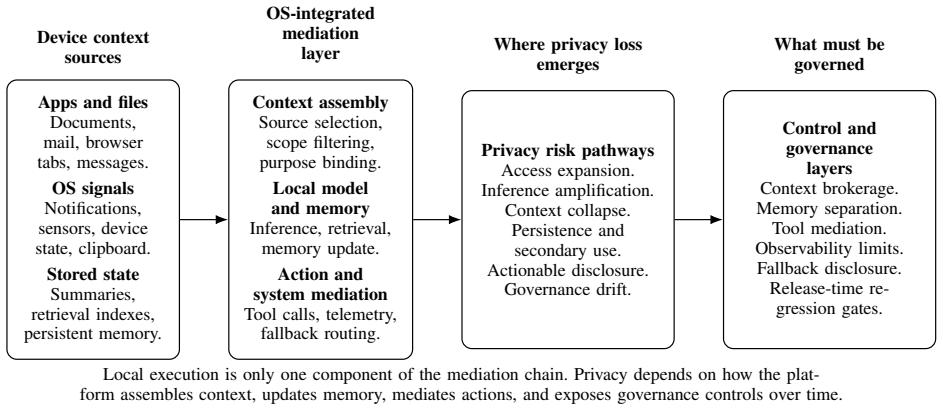
Meaningful privacy in on-device AI depends on constrained information flow, bounded authority, visible user control, and auditable governance across the operating-system lifecycle. The framework specifies a threat model, a six-part privacy risk taxonomy, privacy-by-architecture controls, and a four-level audit rubric demonstrated on Apple Intelligence, Android AICore, and Microsoft Recall.
What carries the argument
The OS-centered privacy framework that includes a threat model, six-part risk taxonomy, privacy-by-architecture controls, and four-level audit rubric to evaluate institutional accountability.
If this is right
- Local computation answers only where processing occurs, not who assembles context or what state persists.
- System updates can alter authority without corresponding user visibility or consent.
- The four-level audit rubric enables systematic comparison of different on-device AI implementations.
- Privacy-by-architecture controls must address information flow and tool invocation at the OS level.
Where Pith is reading between the lines
- Regulators could require OS vendors to publish information flow diagrams for AI components.
- Users might demand granular controls over what data the AI can access across apps.
- Future work could extend the rubric to evaluate real-time behavior rather than documentation alone.
Load-bearing premise
Privacy in on-device AI is primarily an institutional accountability problem rather than determined by the location of computation.
What would settle it
A demonstration of a purely local on-device AI system that prevents unauthorized context assembly, persistent derived state, and unauthorized tool use without the framework's controls would challenge the claim.
Figures
read the original abstract
As AI systems move into operating systems, privacy no longer turns only on whether a model runs locally. A local assistant may assemble email, calendar entries, files, screenshots, notifications, and app intents; retain embeddings or summaries; invoke tools; emit telemetry; or route difficult requests to cloud infrastructure. Local inference reduces some exposure, but it answers only one question: where computation occurs. It does not answer who may assemble context, what derived state persists, which actions are authorized, or how updates change the system's authority. We develop an OS-centered privacy framework for on-device AI that treats privacy as an institutional accountability problem rather than a deployment attribute. The framework specifies a threat model, a six-part privacy risk taxonomy, privacy-by-architecture controls, and a four-level audit rubric. We demonstrate the rubric through a documentation-bounded comparison of Apple Intelligence/Foundation Models, Android AICore/Gemini Nano, and Microsoft Recall. Meaningful privacy in on-device AI depends on constrained information flow, bounded authority, visible user control, and auditable governance across the operating-system lifecycle.
Editorial analysis
A structured set of objections, weighed in public.
Referee Report
Summary. The paper claims that privacy for OS-integrated on-device AI cannot be ensured by local inference alone, since such systems assemble personal context (email, files, screenshots), retain embeddings/summaries, invoke tools, emit telemetry, and may route to cloud. It develops an OS-centered framework treating privacy as institutional accountability rather than a deployment attribute, specifying a threat model, six-part privacy risk taxonomy, privacy-by-architecture controls, and four-level audit rubric. The rubric is demonstrated via documentation-bounded comparison of Apple Intelligence/Foundation Models, Android AICore/Gemini Nano, and Microsoft Recall, concluding that meaningful privacy requires constrained information flow, bounded authority, visible user control, and auditable governance across the OS lifecycle.
Significance. If the framework and its controls hold under scrutiny, the work could shift on-device AI privacy research and policy from locality-centric arguments toward lifecycle governance and accountability mechanisms. The structured taxonomy and rubric provide a concrete lens for auditing vendor claims, which is timely amid widespread deployment of OS-level AI features. Credit is due for the explicit framing of privacy as an institutional problem and the attempt to operationalize it via an audit rubric, though the documentation-only demonstration limits immediate applicability.
major comments (2)
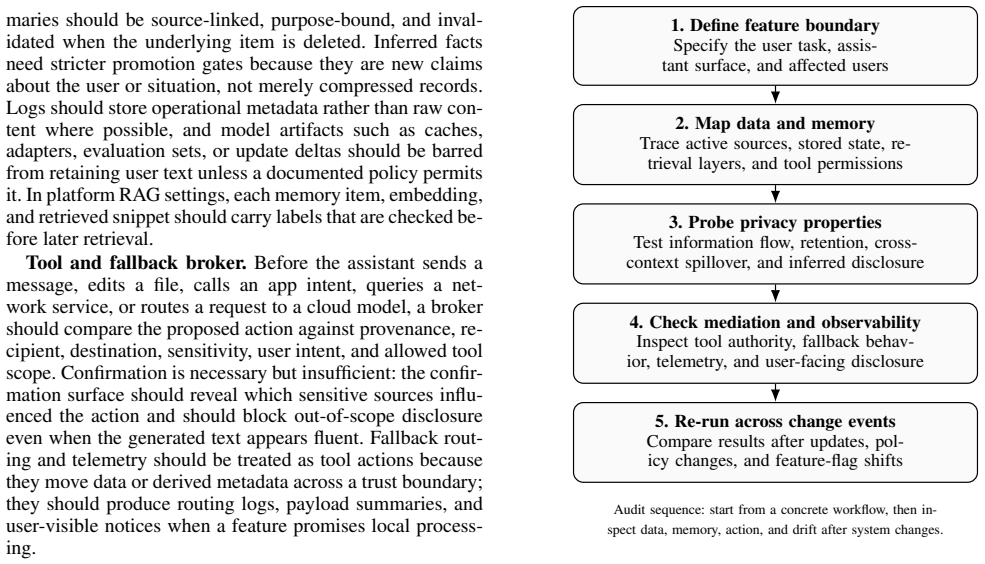
- [Demonstration (documentation-bounded comparison)] Demonstration section: The four-level audit rubric is applied solely to vendor documentation for Apple Intelligence, Android AICore/Gemini Nano, and Microsoft Recall. Without runtime tracing, code inspection, or measurement of actual information flows (e.g., embedding retention or telemetry emission), the rubric's ability to detect real discrepancies between stated and implemented behaviors remains unshown. This is load-bearing for the central claim that the framework identifies shortfalls beyond what locality addresses.
- [Framework definition (threat model, taxonomy, controls)] Framework sections (threat model, taxonomy, controls): The six-part privacy risk taxonomy and four-level audit rubric are introduced as novel constructs without derivation from existing literature, empirical data, or falsifiable tests against system behavior. The claim that privacy depends on constrained flow, bounded authority, visible control, and auditable governance therefore rests on the framework's internal logic rather than demonstrated identification of actual privacy shortfalls in the three platforms.
minor comments (1)
- [Abstract] Abstract and introduction: The high-level description of the six-part taxonomy and four-level rubric does not enumerate their components or scoring criteria, which would improve clarity for readers evaluating the demonstration.
Simulated Author's Rebuttal
We thank the referee for the constructive and detailed review. The comments correctly identify the scope of our demonstration and the need for clearer grounding of the framework. We address each major comment below and outline targeted revisions.
read point-by-point responses
-
Referee: Demonstration (documentation-bounded comparison): The four-level audit rubric is applied solely to vendor documentation for Apple Intelligence, Android AICore/Gemini Nano, and Microsoft Recall. Without runtime tracing, code inspection, or measurement of actual information flows (e.g., embedding retention or telemetry emission), the rubric's ability to detect real discrepancies between stated and implemented behaviors remains unshown. This is load-bearing for the central claim that the framework identifies shortfalls beyond what locality addresses.
Authors: We agree that the demonstration relies exclusively on documentation analysis and does not include runtime verification or code inspection. This approach was selected because the framework is intended to offer an externally usable audit method based on publicly available information, given the closed-source nature of the evaluated systems. We recognize that this limits direct evidence of discrepancy detection. We will revise the manuscript to add an explicit limitations subsection in the demonstration, clarifying the documentation-bounded scope and outlining how the rubric could be extended with empirical methods in follow-on work. revision: partial
-
Referee: Framework definition (threat model, taxonomy, controls): The six-part privacy risk taxonomy and four-level audit rubric are introduced as novel constructs without derivation from existing literature, empirical data, or falsifiable tests against system behavior. The claim that privacy depends on constrained flow, bounded authority, visible control, and auditable governance therefore rests on the framework's internal logic rather than demonstrated identification of actual privacy shortfalls in the three platforms.
Authors: The taxonomy and rubric were constructed by applying the threat model to the concrete behaviors described in the three platforms' documentation, synthesizing elements from established privacy concepts such as information flow control and accountability. We will revise the framework sections to include an explicit derivation subsection that traces each taxonomy category and rubric level back to the threat model, with additional citations to relevant privacy-by-design and contextual integrity literature. This will make the logical grounding transparent. revision: yes
Circularity Check
Framework proposal is self-contained with no derivation chain
full rationale
The paper introduces an original OS-centered privacy framework consisting of a threat model, six-part taxonomy, privacy-by-architecture controls, and four-level audit rubric. It then applies the rubric in a documentation-bounded comparison of three commercial systems. No equations, fitted parameters, self-citations, or uniqueness theorems appear. The central claim that meaningful privacy requires constrained flow, bounded authority, visible control, and auditable governance is presented as a definitional premise of the new framework rather than derived from prior inputs or self-referential steps. The demonstration does not reduce to the framework by construction; it is an external application. This is a standard non-circular conceptual contribution.
Axiom & Free-Parameter Ledger
axioms (1)
- domain assumption Privacy in on-device AI is best addressed as an institutional accountability problem rather than solely a deployment attribute.
invented entities (2)
-
Six-part privacy risk taxonomy
no independent evidence
-
Four-level audit rubric
no independent evidence
Reference graph
Works this paper leans on
-
[1]
M.; and Such, J
Abdi, N.; Ramokapane, K. M.; and Such, J. M. 2019. More than Smart Speakers: Security and Privacy Perceptions of Smart Home Personal Assistants. In Proceedings of the Symposium on Usable Privacy and Security, 451--466
2019
-
[2]
Android Developers Blog . 2024. An Introduction to Privacy and Safety for Gemini Nano. https://android-developers.googleblog.com/2024/10/introduction-to-privacy-and-safety-gemini-nano.html. Developer blog, accessed May 5, 2026
2024
-
[3]
Apple Developer . 2026 a . Acceptable Use Requirements for the Foundation Models Framework. https://developer.apple.com/apple-intelligence/acceptable-use-requirements-for-the-foundation-models-framework/. Developer documentation, accessed May 5, 2026
2026
-
[4]
Apple Developer . 2026 b . Foundation Models. https://developer.apple.com/documentation/FoundationModels. Developer documentation, accessed May 5, 2026
2026
-
[5]
Apple Security Research . 2024. Private Cloud Compute: A New Frontier for AI Privacy in the Cloud. https://security.apple.com/blog/private-cloud-compute/. Security documentation, accessed May 5, 2026
2024
-
[6]
Apple Support . 2026 a . Apple Intelligence and Privacy on iPhone. https://support.apple.com/guide/iphone/apple-intelligence-and-privacy-iphe3f499e0e/ios. Support documentation, accessed May 5, 2026
2026
-
[7]
Apple Support . 2026 b . Review Device Management Restrictions for Apple Devices. https://support.apple.com/guide/deployment/review-device-management-restrictions-dep739685973/web. Accessed May 7, 2026
2026
-
[8]
Cavoukian, A. 2011. Privacy by Design: The 7 Foundational Principles. Information and Privacy Commissioner of Ontario
2011
-
[9]
Deng, M.; Wuyts, K.; Scandariato, R.; Preneel, B.; and Joosen, W. 2011. A Privacy Threat Analysis Framework: Supporting the Elicitation and Fulfillment of Privacy Requirements. Requirements Engineering, 16(1): 3--32
2011
-
[10]
Diakopoulos, N. 2015. Algorithmic Accountability: Journalistic Investigation of Computational Power Structures. Digital Journalism, 3(3): 398--415
2015
- [11]
-
[12]
P.; Jung, J.; McDaniel, P.; and Sheth, A
Enck, W.; Gilbert, P.; Chun, B.-G.; Cox, L. P.; Jung, J.; McDaniel, P.; and Sheth, A. N. 2010. TaintDroid: An Information-Flow Tracking System for Realtime Privacy Monitoring on Smartphones. In Proceedings of OSDI
2010
-
[13]
European Union . 2016. Regulation (EU) 2016/679, Article 35: Data Protection Impact Assessment . https://eur-lex.europa.eu/eli/reg/2016/679/oj. Accessed May 7, 2026
2016
-
[14]
European Union . 2024. Regulation Laying Down Harmonised Rules on Artificial Intelligence. EU AI Act
2024
-
[15]
P.; Ha, E.; Egelman, S.; Haney, A.; Chin, E.; and Wagner, D
Felt, A. P.; Ha, E.; Egelman, S.; Haney, A.; Chin, E.; and Wagner, D. 2012. Android Permissions: User Attention, Comprehension, and Behavior. In Proceedings of the Symposium on Usable Privacy and Security
2012
-
[16]
Google Android Developers . 2026. Gemini Nano. https://developer.android.com/ai/gemini-nano. Developer documentation, accessed May 5, 2026
2026
- [17]
-
[18]
Greshake, K.; Abdelnabi, S.; Mishra, S.; Endres, C.; Holz, T.; and Fritz, M. 2023. Not What You've Signed Up For: Compromising Real-World LLM-Integrated Applications with Indirect Prompt Injection. In Proceedings of the ACM Workshop on Artificial Intelligence and Security
2023
-
[19]
Information Commissioner's Office . 2023 a . Data Protection by Design and Default. Regulatory guidance
2023
-
[20]
Information Commissioner's Office . 2023 b . Employment Practices and Data Protection: Monitoring Workers. https://ico.org.uk/for-organisations/uk-gdpr-guidance-and-resources/employment/monitoring-workers/. Accessed May 7, 2026
2023
-
[21]
Information Commissioner's Office . 2026. Data Protection Impact Assessments. https://ico.org.uk/for-organisations/uk-gdpr-guidance-and-resources/accountability-and-governance/data-protection-impact-assessments-dpias/. Accessed May 7, 2026
2026
- [22]
-
[23]
Malkin, N.; Deatrick, J.; Tong, A.; Wijesekera, P.; Egelman, S.; and Wagner, D. 2019. Privacy Attitudes of Smart Speaker Users. Proceedings on Privacy Enhancing Technologies, 2019(4): 250--271
2019
- [24]
-
[25]
Microsoft Learn . 2026 a . Manage Recall for Windows Clients. https://learn.microsoft.com/en-us/windows/client-management/manage-recall. Product documentation, accessed May 5, 2026
2026
-
[26]
Microsoft Learn . 2026 b . Microsoft.Windows.AI Namespace: Phi Silica API Reference. https://learn.microsoft.com/en-us/windows/ai/apis/phi-silica-api-ref. Developer documentation, accessed May 5, 2026
2026
-
[27]
Microsoft Learn . 2026 c . Platform Card: Microsoft Foundry on Windows -- Phi Silica (Language Model). https://learn.microsoft.com/en-us/windows/ai/cards/phi-silica-platform-card. Platform documentation, accessed May 5, 2026
2026
-
[28]
Microsoft Support . 2026. Privacy and Control over Your Recall Experience. https://support.microsoft.com/windows/privacy-and-control-over-your-recall-experience-d404f672-7647-41e5-886c-a3c59680af15. Support documentation, accessed May 5, 2026
2026
-
[29]
Microsoft Windows Experience Blog . 2024. Update on Recall Security and Privacy Architecture. https://blogs.windows.com/windowsexperience/2024/09/27/update-on-recall-security-and-privacy-architecture/. Accessed May 7, 2026
2024
-
[30]
X.; Kuleshov, V.; Shmatikov, V.; and Rush, A
Morris, J. X.; Kuleshov, V.; Shmatikov, V.; and Rush, A. M. 2023. Text Embeddings Reveal (Almost) As Much As Text. ArXiv:2310.06816
-
[31]
National Institute of Standards and Technology . 2020. NIST Privacy Framework: A Tool for Improving Privacy through Enterprise Risk Management, Version 1.0 . https://www.nist.gov/privacy-framework. NIST CSWP 01162020, accessed May 7, 2026
2020
-
[32]
National Institute of Standards and Technology . 2024. Artificial Intelligence Risk Management Framework: Generative Artificial Intelligence Profile. NIST AI 600-1
2024
-
[33]
Nissenbaum, H. 2004. Privacy as Contextual Integrity. Washington Law Review, 79(1): 119--158
2004
-
[34]
A.; and Oeldorf-Hirsch, A
Obar, J. A.; and Oeldorf-Hirsch, A. 2020. The Biggest Lie on the Internet: Ignoring the Privacy Policies and Terms of Service Policies of Social Networking Services. Information, Communication & Society, 23(1): 128--147
2020
-
[35]
OECD . 2019. OECD Principles on Artificial Intelligence. Policy framework
2019
-
[36]
N.; and Sandvig, C
Plantin, J.-C.; Lagoze, C.; Edwards, P. N.; and Sandvig, C. 2018. Infrastructure Studies Meet Platform Studies in the Age of Google and Facebook. New Media & Society, 20(1): 293--310
2018
-
[37]
D.; Smart, A.; White, R
Raji, I. D.; Smart, A.; White, R. N.; Mitchell, M.; Gebru, T.; Hutchinson, B.; Smith-Loud, J.; Theron, D.; and Barnes, P. 2020. Closing the AI Accountability Gap: Defining an End-to-End Framework for Internal Algorithmic Auditing. In Proceedings of FAT*, 33--44
2020
-
[38]
J.; and Cowan, C
Roesner, F.; Kohno, T.; Moshchuk, A.; Parno, B.; Wang, H. J.; and Cowan, C. 2012. User-Driven Access Control: Rethinking Permission Granting in Modern Operating Systems. In Proceedings of the IEEE Symposium on Security and Privacy, 224--238
2012
-
[39]
L.; and Cranor, L
Schaub, F.; Balebako, R.; Durity, A. L.; and Cranor, L. F. 2015. A Design Space for Effective Privacy Notices. In Proceedings of the Symposium on Usable Privacy and Security, 1--17
2015
-
[40]
Seaver, N. 2017. Knowing Algorithms. Media in Action, 2(1): 412--422
2017
-
[41]
D.; Boyd, D.; Friedler, S
Selbst, A. D.; Boyd, D.; Friedler, S. A.; Venkatasubramanian, S.; and Vertesi, J. 2019. Fairness and Abstraction in Sociotechnical Systems. In Proceedings of FAT*, 59--68
2019
-
[42]
Prompt Injection Attack to Tool Selection in LLM Agents
Shi, J.; Yuan, Z.; Tie, G.; Zhou, P.; Gong, N. Z.; and Sun, L. 2026. Prompt Injection Attack to Tool Selection in LLM Agents. In Proceedings of NDSS. ArXiv:2504.19793
work page internal anchor Pith review Pith/arXiv arXiv 2026
-
[43]
Solove, D. J. 2006. A Taxonomy of Privacy. University of Pennsylvania Law Review, 154(3): 477--560
2006
- [44]
discussion (0)
Sign in with ORCID, Apple, or X to comment. Anyone can read and Pith papers without signing in.