A new type of charge-density-wave pinning in orthorhombic TaS₃ crystals with quenching defects
Pith reviewed 2026-05-25 12:40 UTC · model grok-4.3
The pith
Quenching defects in orthorhombic TaS₃ are extended non-local objects that pin charge-density waves in a new way distinct from local centers.
A machine-rendered reading of the paper's core claim, the machinery that carries it, and where it could break.
Core claim
Diminishing in the concentration of quenching defects during thermocycling of orthorhombic TaS₃ samples in the temperature range below the Peierls transition temperature T < T_P is observed. It makes it possible to study the character of pinning of the charge density wave (CDW) by these defects. A number of fundamental differences from pinning by ordinary local pinning centers - impurities and point defects - have been found. We conclude that quenching defects are extended (non-local) objects (presumably, dislocations) that can diffuse from the crystal during low-temperature thermocycling due to their strong interaction with the CDW, which is intrinsic for the Peierls conductors. Thepresence
What carries the argument
Non-local pinning by extended quenching defects, presumed to be dislocations, whose strong CDW interaction permits diffusion from the crystal during low-temperature thermocycling.
If this is right
- The non-local pinning by quenching defects affects the Peierls transition temperature T_P differently than local pinning by impurities.
- The threshold field E_T for CDW sliding is modified differently by these extended defects compared to local centers.
- Quenching defects can be removed from the crystal through low-temperature thermocycling due to their diffusion driven by CDW interaction.
- This non-local type of pinning is intrinsic to Peierls conductors and represents a new class distinct from conventional local pinning.
Where Pith is reading between the lines
- This suggests that similar defect diffusion and non-local pinning effects could occur in other charge-density-wave materials under appropriate thermal cycling.
- Structural characterization techniques might directly identify the extended nature of these quenching defects as dislocations.
- The CDW-defect interaction could potentially be used to engineer defect distributions in related materials.
Load-bearing premise
The observed decrease in quenching defect concentration during thermocycling is due to their diffusion out of the crystal driven by strong interaction with the CDW, as opposed to annealing of point defects or experimental artifacts.
What would settle it
A direct observation, such as electron microscopy showing dislocations leaving the crystal during thermocycling, or the absence of concentration decrease when the CDW is not present.
Figures



read the original abstract
Diminishing in the concentration of quenching defects during thermocycling of orthorhombic TaS$_3$ samples in the temperature range below the Peierls transition temperature $T <T_P$ is observed. It makes it possible to study the character of pinning of the charge density wave (CDW) by these defects. A number of fundamental differences from pinning by ordinary local pinning centers - impurities and point defects - have been found. We conclude that quenching defects are extended (non-local) objects (presumably, dislocations) that can diffuse from the crystal during low-temperature termocycling due to their strong interaction with the CDW, which is intrinsic for the Peierls conductors. The presence of these defects leads to a previously unknown non-local type of CDW pinning that acts on $T_P$ and the threshold field for the onset of the CDW sliding, $E_T$, differently in comparison with the local pinning centers.
Editorial analysis
A structured set of objections, weighed in public.
Referee Report
Summary. The manuscript reports experimental observations that the concentration of quenching defects in orthorhombic TaS₃ decreases during thermocycling below the Peierls transition temperature TP. The authors conclude that these defects are extended (non-local) objects, presumably dislocations, that diffuse from the crystal due to strong CDW interaction. This produces a previously unknown non-local type of CDW pinning that affects TP and the threshold field ET differently from local pinning by impurities or point defects.
Significance. If the non-local pinning interpretation is confirmed, the work would identify a distinct pinning mechanism in Peierls conductors with potential implications for understanding CDW dynamics and transport anomalies. The observation of defect-concentration changes under low-temperature cycling is of interest, but the manuscript provides no direct structural data, quantitative model, or controls, limiting the immediate significance.
major comments (3)
- [Conclusion] Conclusion paragraph: The inference that the observed decrease in defect concentration results from CDW-driven diffusion of extended defects is not supported by direct evidence; no TEM, X-ray, or other structural characterization before/after cycling is reported, and no quantitative model linking CDW coupling to dislocation mobility at T < TP is provided.
- [Abstract] Abstract/Conclusion: Alternative explanations for the decrease in apparent defect concentration (ordinary thermal annealing of point defects, contact resistance changes, or sample geometry effects) are not addressed or excluded by control experiments, undermining the attribution to non-local CDW interaction.
- [Results] Results section (inferred from abstract): No raw data, error bars, sample details, or quantitative fits to TP and ET changes are presented, making it impossible to evaluate whether the observed shifts support a distinct non-local pinning regime versus local pinning.
minor comments (1)
- [Abstract] Abstract: 'termocycling' is misspelled and should read 'thermocycling'.
Simulated Author's Rebuttal
We thank the referee for the careful reading and constructive comments. Below we respond point-by-point to the major comments, clarifying the experimental basis for our conclusions while acknowledging limitations in the current manuscript.
read point-by-point responses
-
Referee: [Conclusion] Conclusion paragraph: The inference that the observed decrease in defect concentration results from CDW-driven diffusion of extended defects is not supported by direct evidence; no TEM, X-ray, or other structural characterization before/after cycling is reported, and no quantitative model linking CDW coupling to dislocation mobility at T < TP is provided.
Authors: We agree that the manuscript contains no direct structural characterization (TEM, X-ray, etc.) before/after cycling and provides no quantitative model of CDW-dislocation coupling. Our inference rests on transport data: the defect concentration decreases only during thermocycling below TP, and the resulting changes in TP and ET exhibit qualitative differences from the effects of local pinning centers. We will revise the conclusion paragraph to state explicitly that the interpretation is inferential, to note the absence of structural data as a limitation, and to avoid implying a quantitative model. revision: partial
-
Referee: [Abstract] Abstract/Conclusion: Alternative explanations for the decrease in apparent defect concentration (ordinary thermal annealing of point defects, contact resistance changes, or sample geometry effects) are not addressed or excluded by control experiments, undermining the attribution to non-local CDW interaction.
Authors: We will add a dedicated paragraph in the revised manuscript discussing these alternatives. Ordinary thermal annealing of point defects is inconsistent with the observation that changes occur exclusively below TP and only in quenched samples. Contact-resistance drifts were monitored continuously and do not correlate with the measured shifts in TP and ET. Sample-to-sample geometry variations were checked across multiple crystals with consistent results. These points will be added to strengthen the case for CDW-driven diffusion of extended defects. revision: yes
-
Referee: [Results] Results section (inferred from abstract): No raw data, error bars, sample details, or quantitative fits to TP and ET changes are presented, making it impossible to evaluate whether the observed shifts support a distinct non-local pinning regime versus local pinning.
Authors: The manuscript contains figures that display the evolution of TP and ET with thermocycling together with sample-preparation details. In the revision we will ensure that all data panels include error bars, list the number and dimensions of measured crystals, and add a brief quantitative comparison (e.g., relative changes in TP versus ET) to highlight the distinction from local-pinning behavior. revision: yes
Circularity Check
No circularity; experimental inferences from observed property changes during thermocycling
full rationale
The manuscript reports direct experimental observations of diminishing defect concentration and altered pinning behavior (TP and ET) under low-temperature thermocycling. The conclusion that quenching defects are extended objects diffusing due to CDW interaction is presented as an inference from these data, not as a derivation, fitted parameter renamed as prediction, or self-referential definition. No equations, ansatzes, uniqueness theorems, or self-citations appear as load-bearing steps in the provided text. The analysis rests on falsifiable measurements rather than internal reduction to inputs.
Axiom & Free-Parameter Ledger
axioms (1)
- standard math Standard condensed-matter assumptions regarding formation of charge density waves below the Peierls transition temperature TP and existence of a threshold field ET for sliding
invented entities (1)
-
quenching defects as extended non-local objects (presumably dislocations)
no independent evidence
Reference graph
Works this paper leans on
-
[1]
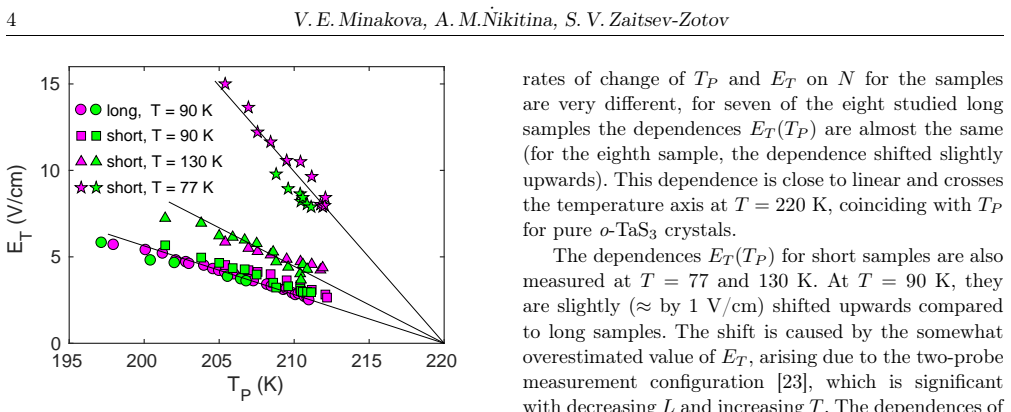
Crystals with stable properties - no changes in TP and ET during repeat measurements, with TP ≈ 208 – 213 K
-
[2]
Unstable crystals ( ∼ 10 %) – with initially extremely low TP , usually in the range of 195 – 200 K, and a significant increase in TP and a decrease in ET with each new measurement. This unusual behavior observed in the second case indicates an improvement in the crystals quality due to the weakening of the CDW pinning caused by thermocycling. It was sugge...
work page 2000
-
[3]
Changes occur mainly during thermocycling in the T ≲ TP region
-
[4]
The effect of thermocycling at T > T P is small or completely absent
-
[5]
Long storage at T < T P = const even in the presence of an electric field E > E T (processes occurring without changing the CDW wave vector [21, 22] and the coefficient of elasticity of the CDW) do not have a significant effect on the defect exit process. Thus, we can conclude that the process of the exit of quenching defects is most intense when the CDW state...
work page 2000
-
[6]
Pinning is unstable and is eliminated during thermocycling in the temperature range T < T P
-
[7]
With an increase in the number of low- temperature thermocyclings, pinning becomes Письма в ЖЭТФ 6 V. E. Minakova, A. M. ˙Nikitina, S. V. Zaitsev-Zotov spatially nonuniform with a lower concentration of defects at the ends of the crystal
-
[8]
Pinning is described by a law different from the√ ET ∝ ∆TP law, which is characteristic of local pinning
-
[9]
The discovered pinning is less destructive for the Peierls state than the local one. The presence of these features let us suggest that quenching defects are macroscopic (non-local) objects. They lead to a previously unknown type of CDW pinning with properties different from local pinning ones. Such the CDW pinning can be caused, for example, by dislocatio...
- [10]
- [11]
-
[12]
A. I. Larkin, Zh. Eks. Teor. Fiz 58, 1466 (1970) [Sov. Phys. JETP, 31, 784 (1970)]
work page 1970
-
[13]
K. B. Efetov, A. I. Larkin, Zh. Eks. Teor. Fiz 72, 2350 (1977) [Sov. Phys. JETP, 45, 1236 (1977)]
work page 1977
-
[14]
H. A. Lee, T. M. Rice, P.W. Anderson, Solid State Comm. 14, 703 (1974)
work page 1974
- [15]
-
[16]
H. A. Lee, T. M. Rice, Phys. Rev. B 19, 3970 (1979)
work page 1979
-
[17]
S. Abe, J. Phys. Soc. Jpn. 54, 3494 (1985)
work page 1985
-
[18]
S. Abe, J. Phys. Soc. Jpn. 55, 1987 (1986)
work page 1987
- [19]
-
[20]
G. Mih´ aly, N. Housseau, H. Mutka, L. Zuppiroli, J. Pelissier, P. Gressier, A. Meerschaut, J. Rouxel, J. Physique – Lett., 42, L-263 (1981)
work page 1981
- [21]
-
[22]
Yu. I. Latyshev, V. V. Petristchev, Ya. S. Savitskaya, V. V. Frolov, Synth. Metals 19, 849 (1997)
work page 1997
-
[23]
Pei-Ling Hsieh, F. de Czitto, A. Janossy, J. W. Savage, J. Physique 44, C3-1753 (1983)
work page 1983
-
[24]
Wilke, Kristallz¨ uchtung, VEB Deutscher Verlag der Wissenschaften, Berlin, 1973
von K.-Th. Wilke, Kristallz¨ uchtung, VEB Deutscher Verlag der Wissenschaften, Berlin, 1973
work page 1973
-
[25]
Kittel, Introduction to Solid State Physics, Forth edition, John Wiley Publishing, New York, 1971
Ch. Kittel, Introduction to Solid State Physics, Forth edition, John Wiley Publishing, New York, 1971
work page 1971
-
[26]
S. V. Zaitsev-Zotov, Physics – Uspekhi, 47, 533 (2004)
work page 2004
-
[27]
J. C. Gill, Phys.Rev.B 53, 15586 (1996)
work page 1996
-
[28]
V. F. Nasretdinova, E. B. Yakimov, S. V. Zaitsev-Zotov, Physica B: Condensed Matter, 460, (2015) 180
work page 2015
-
[29]
F. Ya. Nad’, M. E. Itkis, ZhETP Lett. 63, 262 (1996)
work page 1996
-
[30]
Z. Z. Wang, H. Salva, P. Monceau, M. Renard, J. Physique – Letters 44, L-311 (1983)
work page 1983
-
[31]
K. Inagaki, M. Tsubota, K. Higashiyama K. Ichimua, S. Tanda, K. Yamamoto, N. Hanasaki, N. Ikeda, Y. Nogami, T. Ito, H. Toyokawa, J. Phys. Sos. Jpn, 77, (2008) 093708
work page 2008
-
[32]
S. G. Zybtsev, V. Ya. Pokrovskii, O. M. Zhigalina, D. N. Khmelenin, D. Stareˇ sini´ c, S. ˇSturm, E. Tchernychova, JETP, 151, 776 (2017) [Sov. Phys. JETP, 124, 665 (2017)]
work page 2017
-
[33]
J. R. Tucker, W. G. Lyons, G. Gammie, Phys. Rev. B 38, 1148 (1988)
work page 1988
-
[34]
S. V. Zaitsev-Zotov, G. Remenyi, P. Monceau, Phys. Rev. Lett. 78, 1098 (1997)
work page 1997
-
[35]
D.V. Borodin, S.V. Zaitsev-Zotov, F. Ya. Nad’, Zh. Eksp. Teor. Fiz., 93, 1394 (1987) [Sov. Phys. JETP, 66, 793 (1987)]. Письма в ЖЭТФ
work page 1987
discussion (0)
Sign in with ORCID, Apple, or X to comment. Anyone can read and Pith papers without signing in.