REVIEW 4 major objections 6 minor 31 references
Predicting The Evolution of Interfaces with Fourier Neural Operators
T0 review · 4 major / 6 minor · reviewed 2026-08-16 · deepseek-v4-flash
Pith's one-line read A Fourier Neural Operator trained on volume-of-fluid simulations predicts liquid-vapour interface evolution with $R^2=0.95$ and 1–8 ms inference, making real-time multiphase control plausible.
desk verdict Useful first FNO-for-interface-evolution demo, but the headline R2=0.95 is on a smoothed field, not the interface, so the accuracy claim outruns the evidence. read the letter →
The pith
A machine-rendered reading of the paper's core claim, the machinery that carries it, and where it could break.
The reading
What carries the argument
The load-bearing mechanism is the Fourier Neural Operator's spectral convolution layer, which learns a kernel directly in Fourier space, truncates to a fixed number of modes, and thereby captures global spatial dependencies at a cost of $O(N\log N + k_{\max}N)$ per layer. To make the discontinuous volume-fraction field learnable, the paper maps $\alpha$ to a reconstructed distance function through $\zeta = \varepsilon\tanh^{-1}(1-2\alpha)$, a regularized inverse Heaviside transform that converts the sharp interface into a smooth field. The network takes the initial RDF plus a scalar time channel as input and outputs the predicted future RDF. The smoothing transform is what lets a continuous operator-learning architecture represent a discontinuous two-phase interface, while the spectral kernel is what lets the model propagate interface information across the whole domain in each layer.
What would settle it
Reconstruct the volume fraction from a predicted SDF via the inverse of Eq. (31), threshold it at $\alpha = 0.5$, and compare the resulting interface contours to the ground-truth VOF interface at $t = 0.25$ s and $t = 0.50$ s; if contour-position errors are large while SDF $R^2$ is 0.95, the central claim of accurate interface prediction fails.
Extended reading notes
Core claim
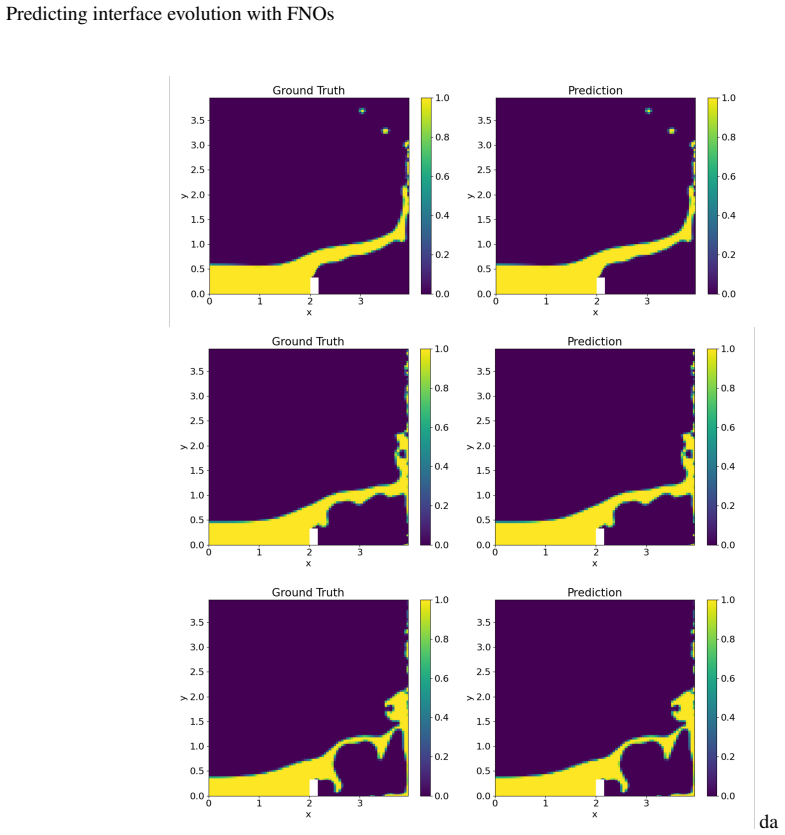
The central claim is that an FNO trained on compressed volume-of-fluid data learns the operator that maps an initial interface configuration to its future evolution, and that the learned operator generalizes both in time and across initial conditions. In the dam-break case, training on the first 60% of the simulated evolution lets the model forecast the remaining 40%, including the collapse and impact dynamics. In the second case, the model trained on two snapshots from 900 random initial conditions predicts the interface at later times for unseen configurations. Accuracy is measured on reconstructed distance fields (RDFs), where the model reaches MSE 9.72, MAE 1.69, and $R^2 = 0.95$, with 1–8 ms inference per prediction. The paper concludes that this makes neural-operator-based prediction fast enough to control multiphase applications.
Load-bearing premise
The accuracy score is computed on the smoothed reconstructed distance field and never on the physical volume fraction or on the interface location, and the smoothing parameter $\varepsilon$ is unspecified.
Editorial extensions
If this is right
- Predictions at 1–8 ms make the surrogate a candidate for real-time monitoring and feedback control in multiphase systems, a regime where full CFD is too slow.
- A model trained only on the early dam-break evolution can forecast subsequent impact and nonlinear deformation, suggesting the learned operator captures physics rather than memorizing the training window.
- Two-snapshot training on random initial conditions generalizes to unseen configurations, which would let users build surrogates from sparse simulation or experimental data.
- Because the method learns from volume-fraction fields produced by a standard VOF solver, the same pipeline can be re-trained for other two-phase geometries and fluids without changing the architecture.
- The reported time scale matches the response time of many multiphase processes, so process controllers could embed the FNO as a predictive model.
Reading between the lines
- The paper validates on smooth RDFs; a natural next check is to threshold the predicted RDF at zero and compare the extracted interface contour against the ground-truth VOF interface, since control actions depend on where the interface is, not just on field correlation.
- The transform $\alpha \leftrightarrow \zeta$ is invertible for $\alpha \in (0,1)$, so every SDF prediction can be mapped back to a volume-fraction field; the paper does not report errors in that physical space, and doing so on the published dataset would settle how much of the $R^2$ score is inherited from smooth regions away from the interface.
- The unspecified smoothing parameter $\varepsilon$ controls the sharpness of the reconstructed distance field; reporting its value and testing sensitivity to it would indicate whether the reported accuracy is robust or tuned to a favourable smoothness.
- If the method extends to 3D and to phase change, as the paper names as next steps, the same operator-learning pipeline would apply to spray atomization and evaporating films, where interface evolution currently limits control bandwidth.
Signed reviews
Editorial analysis
A structured set of objections, weighed in public.
Referee Report
Summary. The manuscript proposes using Fourier Neural Operators (FNOs) as a surrogate for two-phase volume-of-fluid simulations. The authors train an FNO on signed-distance fields derived from the volume fraction α via a regularized inverse Heaviside transformation (Eq. 31), taking as input the initial SDF plus a scalar time channel and outputting the predicted SDF at a future time. Two benchmark cases are presented: a dam-break forecasting scenario and a dataset of random liquid-blob initial conditions. The authors report validation R²=0.95 on the SDF, inference times of 1–8 ms, and compare FNO with U-Net and GCN, concluding that FNO-based surrogates are fast enough for real-time control of multiphase processes.
Significance. If the accuracy claim held at the level of the physical interface, the work would be a useful demonstration of neural-operator surrogates for multiphase-flow control. The manuscript has clear strengths: it uses a high-fidelity VOF solver, provides a detailed architectural description, includes a baseline comparison with U-Net and GCN, and reports inference times. However, the reported accuracy is measured on a smooth transformed field rather than on the volume fraction or the extracted interface geometry, and the transformation contains an unreported free parameter. As it stands, the central claim of highly accurate interface prediction is not established.
major comments (4)
- [§3, Eq. (31) and Table 2] The central accuracy claim rests on metrics computed on the reconstructed distance function ζ, not on the physical volume fraction α or on the extracted interface. Because Eq. (31), ζ = ε·tanh⁻¹(1−2α), is singular at α=0 and α=1, the implementation must involve clipping or regularization, and the smoothing parameter ε is never reported. The reported MSE=9.72, MAE=1.69, and R²=0.95 are therefore not reproducible and are not interpretable as physical errors. Please report ε and the regularization strategy, and re-evaluate the predictions using α-based metrics (for example, errors restricted to interface cells with 0<α<1) or geometric interface measures such as the distance between predicted and true zero level sets (Hausdorff or contour distance).
- [§3, Case 1] The temporal-extrapolation claim for Case 1 is supported only by the qualitative comparison in Figure 1 and the loss curves in Figure 2; no quantitative error metric is reported for the held-out final 40% of the simulation. Since the case is explicitly presented as a test of extrapolation beyond the training horizon, the same numeric metrics used in Table 2 (MSE, MAE, R², and ideally interface-location error) should be reported for Case 1 separately.
- [§2 vs §3, Table 2] The validation metrics defined in Eqs. (27)–(30) are written in terms of α, yet Table 2 reports them on SDF fields. This inconsistency matters because a global R² on a smooth field is dominated by bulk regions, so R²=0.95 can coexist with systematically misplaced interfaces. Please state explicitly which field each metric is evaluated on, and add interface-focused error statistics (e.g., errors in the band |ζ|<ε or in cells with 0<α<1) so that the reader can assess the actual interface accuracy.
- [§3, Figure 3] The bottom row of Figure 3 shows 'binary volume fractions reconstructed from each RDF', but the reconstruction procedure is not described (for example, is it a threshold at ζ=0? Is there a re-initialization step?). Without this information, the visual comparison cannot be reproduced, and no quantitative error on α is given. Please describe the reconstruction and report error statistics for α as well.
minor comments (6)
- [§2, Figures 2 and 4] The 'Lp loss' label in Figures 2 and 4 is not defined; please specify the norm (presumably p=2) and use consistent terminology with Eq. (25).
- [§3, Case 1] The sentence 'The dataset comprises T simulations performed using compressibleInterIsoFoam' leaves T undefined; please provide the actual number of training and validation simulations used in Case 1.
- [§2, Hardware paragraph] The statement 'Training on a N=900 base simulation dataset (yielding 1800 SDF samples)' appears in the Hardware section but actually describes the Case 2 dataset; this placement is confusing and should be moved to the relevant experimental section.
- [Figure 2, caption (b)] The caption says 'Predicted vs. ground-truth volume fraction' while the main text refers to the signed-distance field; please clarify which field is plotted.
- [§4, Conclusions] The claim that the model 'successfully captures the underlying physics and extrapolates the evolution beyond the training window' is not substantiated by quantitative results for Case 1; please either soften this statement or add the missing metrics.
- [§3, Inference time] The 1–8 ms inference time is reported without specifying the hardware, the batch size, or the number of samples averaged, and there is no comparison with the per-step CFD solve time; please provide these details to support the real-time control claim.
Circularity Check
No significant circularity: the FNO is trained on held-out VOF simulation data and the RDF transform is a bijective preprocessing step, not a forced equivalence.
full rationale
The paper's derivation chain is a standard supervised operator-learning pipeline: VOF simulations generate volume-fraction fields, these are transformed into smooth reconstructed distance functions via Eq. (31), and an FNO is trained to map an initial RDF field to future RDF fields. Validation is performed on held-out simulation samples (40% temporal extrapolation in Case 1 and a 90/10 split in Case 2), so the reported R2 = 0.95 is an independent holdout metric, not a quantity fitted during training. The RDF transform is invertible in the interior of the domain (alpha = (1 - tanh(zeta/epsilon))/2), so predicting zeta is mathematically equivalent to predicting alpha up to the smoothing parameter; this is preprocessing, not a circular definition of the target. The only self-citation, reference [29], appears in the description of geometric curvature reconstruction in the OpenFOAM solver and is not load-bearing for the neural operator claim. A genuine validation concern exists: the global R2 is computed on the smooth SDF field, where bulk-cell contributions can dominate and the zero level set is not separately scored, so the paper has not directly quantified interface-position error. However, that is a correctness/reproducibility weakness, not circularity, because the predictions are not constructed from the ground-truth outputs. Overall, no step in the claimed derivation reduces to its own inputs by construction.
Assumptions & free parameters
free parameters (5)
- Interface smoothing parameter epsilon
- Number of Fourier modes kmax =
20 per dimension
- Hidden channels dv =
96
- Number of Fourier layers =
5
- Learning rate, weight decay, batch size, epochs =
5e-4, 1e-4, 32, 100
assumptions (4)
- domain assumption The compressibleInterIsoFoam simulation data provides accurate ground truth for the interface evolution.
- domain assumption The reconstructed distance function transform (Eq. 31) is smooth and carries the same interface information as alpha.
- domain assumption The learned operator G_theta approximates the true operator G in the L2 norm (Eq. 25) with sufficient accuracy.
- domain assumption The training and test initial conditions are independent draws from the same distribution.
Cite this review
Pith. "Pith review of Predicting The Evolution of Interfaces with Fourier Neural Operators." pith.science (2026). https://pith.science/paper/63MKC4TL
@misc{pith2026250513463,
  author       = {Pith},
  title        = {Pith review of: Predicting The Evolution of Interfaces with Fourier Neural Operators},
  year         = {2026},
  howpublished = {\url{https://pith.science/paper/63MKC4TL}},
  note         = {Machine review of arXiv:2505.13463}
}
read the original abstract
Recent progress in AI has established neural operators as powerful tools that can predict the evolution of partial differential equations, such as the Navier-Stokes equations. Some complex problems rely on sophisticated algorithms to deal with strong discontinuities in the computational domain. For example, liquid-vapour multiphase flows are a challenging problem in many configurations, particularly those involving large density gradients or phase change. The complexity mentioned above has not allowed for fine control of fast industrial processes or applications because computational fluid dynamics (CFD) models do not have a quick enough forecasting ability. This work demonstrates that the time scale of neural operators-based predictions is comparable to the time scale of multi-phase applications, thus proving they can be used to control processes that require fast response. Neural Operators can be trained using experimental data, simulations or a combination. In the following, neural operators were trained in volume of fluid simulations, and the resulting predictions showed very high accuracy, particularly in predicting the evolution of the liquid-vapour interface, one of the most critical tasks in a multi-phase process controller.
Figures


Figures from the paper (1 more)

Reference graph
Works this paper leans on
-
[29]
A computational study of thermally induced secondary atomization in multicomponent droplets
Paolo Guida, Alberto Ceschin, Saumitra Saxena, Hong G Im, and William L Roberts. A computational study of thermally induced secondary atomization in multicomponent droplets. Journal of Fluid Mechanics, 935, 2022
work page 2022
-
[1]
Thermo-fluid dynamics of two-phase flow
Mamoru Ishii and Takashi Hibiki. Thermo-fluid dynamics of two-phase flow. Springer, 2010
work page 2010
-
[2]
Direct numerical simulations of gas–liquid multiphase flows
Gretar Tryggvason, Ruben Scardovelli, and Stephane Zaleski. Direct numerical simulations of gas–liquid multiphase flows. Cambridge University Press, 2011
work page 2011
-
[3]
Computational methods for multiphase flow
Andrea Prosperetti and Gretar Tryggvason. Computational methods for multiphase flow. Cambridge University Press, 2009
work page 2009
-
[4]
A continuum method for modeling surface tension
JU Brackbill, DB Kothe, and C Zemach. A continuum method for modeling surface tension. J. Comput. Phys., 100(2):335–354, 1992
work page 1992
-
[5]
V olume of fluid (vof) method for the dynamics of free boundaries.J
CW Hirt and BD Nichols. V olume of fluid (vof) method for the dynamics of free boundaries.J. Comput. Phys., 39(1):201–225, 1981
work page 1981
-
[6]
Direct numerical simulation of gas–liquid multiphase flows using the volume-of-fluid method
Ruben Scardovelli and Stephane Zaleski. Direct numerical simulation of gas–liquid multiphase flows using the volume-of-fluid method. Annu. Rev. Fluid Mech., 31(1):567–603, 1999
work page 1999
-
[7]
A front-tracking method for the computations of interfacial flows with sharp interfaces
Gretar Tryggvason, Bernard Bunner, Asghar Esmaeeli, and Damir Juric. A front-tracking method for the computations of interfacial flows with sharp interfaces. J. Comput. Phys., 169(2):708–759, 2001
work page 2001
Show all 31 references
-
[8]
A volume-tracking method for incompressible multifluid flows with large density variations
Murray Rudman. A volume-tracking method for incompressible multifluid flows with large density variations. Int. J. Numer. Meth. Fluids, 28(2):357–378, 1998
1998
-
[9]
Gerris: a tree-based adaptive solver for the incompressible euler equations
Stéphane Popinet. Gerris: a tree-based adaptive solver for the incompressible euler equations. J. Comput. Phys., 190(2):572–600, 2003
2003
-
[10]
A new volume-of-fluid method in openfoam
Johan Roenby, Bjarke Eltard Larsen, Henrik Bredmose, and Hrvoje Jasak. A new volume-of-fluid method in openfoam. In VII International Conference on Computational Methods in Marine Engineering. Nantes: International Center for Numerical Methods in Engineering, 2017
2017
-
[11]
Physics-informed neural networks: A deep learning framework for solving forward and inverse problems involving nonlinear pdes
Maziar Raissi, Paris Perdikaris, and George E Karniadakis. Physics-informed neural networks: A deep learning framework for solving forward and inverse problems involving nonlinear pdes. J. Comput. Phys., 378:686–707, 2019
2019
-
[12]
Learning nonlinear operators via deeponet based on the universal approximation theorem
Lu Lu, Pengzhan Jin, and George E Karniadakis. Learning nonlinear operators via deeponet based on the universal approximation theorem. Nat. Mach. Intell., 3:218–229, 2021. 10 Predicting interface evolution with FNOs
2021
-
[13]
Neural operators for accelerating scientific simulations and design
Kamyar Azizzadenesheli, Nikola Kovachki, Zongyi Li, Miguel Liu-Schiaffini, Jean Kossaifi, and Anima Anand- kumar. Neural operators for accelerating scientific simulations and design. Nature Reviews Physics, 6(5):320–328, 2024
2024
-
[14]
Fourier neural operator for parametric partial differential equations
Zongyi Li, Nikola Kovachki, Kamyar Azizzadenesheli, Burigede Liu, Kaushik Bhattacharya, Andrew M Stuart, and Anima Anandkumar. Fourier neural operator for parametric partial differential equations. arXiv preprint arXiv:2010.08895, 2020
2010 arXiv
-
[15]
Neural operator: Graph kernel network for pdes
Nikola B Kovachki, Zongyi Li, Burigede Liu, Kamyar Azizzadenesheli, Kaushik Bhattacharya, Andrew M Stuart, and Anima Anandkumar. Neural operator: Graph kernel network for pdes. arXiv preprint arXiv:2103.12806, 2021
2021 arXiv
-
[16]
Physics-based deep learning for fluid flow modeling
Nils Thuerey and et al. Physics-based deep learning for fluid flow modeling. Comput. Graph. Forum, 40(2):479– 496, 2021
2021
-
[17]
Fourcastnet: A global data-driven high-resolution weather model using adaptive fnos
Jaideep Pathak and et al. Fourcastnet: A global data-driven high-resolution weather model using adaptive fnos. arXiv preprint arXiv:2202.11214, 2022
2022 arXiv
-
[18]
Message passing neural pde solvers
Johannes Brandstetter, Daniel Worrall, and Max Welling. Message passing neural pde solvers. arXiv preprint arXiv:2202.03376, 2022
2022 arXiv
-
[19]
Turbulence modeling in the age of data
Karthik Duraisamy, Gianluca Iaccarino, and Heng Xiao. Turbulence modeling in the age of data. Annu. Rev. Fluid Mech., 51:357–377, 2019
2019
-
[20]
Numerical models of surface tension
Stéphane Popinet. Numerical models of surface tension. Annual Review of Fluid Mechanics, 50:49–75, 2018
2018
-
[21]
Enhancing computational fluid dynamics with machine learning
Ricardo Vinuesa and Steven L Brunton. Enhancing computational fluid dynamics with machine learning. Nat. Comput. Sci., 2:358–366, 2022
2022
-
[22]
Ai4s: Artificial intelligence for science
Stefano Markidis. Ai4s: Artificial intelligence for science. Computing in Science & Engineering, 23(5):5–8, 2021
2021
-
[23]
Towards physics-informed foundation models for scientific machine learning
Vishal Gupta and et al. Towards physics-informed foundation models for scientific machine learning. arXiv preprint arXiv:2205.12109, 2022
2022 arXiv
-
[24]
Validation of volume- of-fluid openfoam® isoadvector solvers using single bubble benchmarks
Lionel Gamet, Marco Scala, Johan Roenby, Henning Scheufler, and Jean-Lou Pierson. Validation of volume- of-fluid openfoam® isoadvector solvers using single bubble benchmarks. Computers & Fluids, 213:104722, 2020
2020
-
[25]
Openfoam: A c++ library for complex physics simulations
Hrvoje Jasak, Aleksandar Jemcov, Zeljko Tukovic, et al. Openfoam: A c++ library for complex physics simulations. In International workshop on coupled methods in numerical dynamics, volume 1000, pages 1–20. IUC Dubrovnik Croatia, 2007
2007
-
[26]
Accurate and efficient surface reconstruction from volume fraction data on general meshes
Henning Scheufler and Johan Roenby. Accurate and efficient surface reconstruction from volume fraction data on general meshes. Journal of Computational Physics, 383:1–23, 2019
2019
-
[27]
A continuum method for modeling surface tension
J.U Brackbill, D.B Kothe, and C Zemach. A continuum method for modeling surface tension. Journal of Computational Physics, 100(2):335 – 354, 1992
1992
-
[28]
Cummins, Marianne M
Sharen J. Cummins, Marianne M. Francois, and Douglas B. Kothe. Estimating curvature from volume fractions. Computers & Structures, 83(6):425 – 434, 2005. Frontier of Multi-Phase Flow Analysis and Fluid-Structure
2005
-
[30]
Adam: A method for stochastic optimization
Diederik P Kingma and Jimmy Ba. Adam: A method for stochastic optimization. arXiv preprint arXiv:1412.6980, 2014
2014 arXiv
-
[31]
Improved adam optimizer for deep neural networks
Zijun Zhang. Improved adam optimizer for deep neural networks. In 2018 IEEE/ACM 26th international symposium on quality of service (IWQoS), pages 1–2. Ieee, 2018. 11
2018
Reviewed August 16, 2026 · model on record in the stance chip above.
Discussion (0). Continue with ORCID to comment.