REVIEW 3 major objections 4 minor 21 references
When Correct Solutions Repeat: Rarity-Aware Credit Redistribution for GRPO
T0 review · 3 major / 4 minor · reviewed 2026-08-08 · deepseek-v4-flash
Pith's one-line read GRPO's uniform per-completion credit over-rewards solution forms that repeat; Cue-GRPO's rarity-aware redistribution improves AIME repeated sampling without a judge model.
desk verdict Credible empirical gains for cheap credit redistribution in GRPO, but the cue-mechanism claim is undercut by a confounded ablation. read the letter →
The pith
A machine-rendered reading of the paper's core claim, the machinery that carries it, and where it could break.
The reading
What carries the argument
The load-bearing object is the partition-conditioned Credit Redistribution rule, Eq. (3), paired with the deterministic Strategy-Cue partition. For each verified-correct completion, the rule multiplies the GRPO advantage by a normalized inverse-power function of its cluster size, $|C_i|^{-\alpha}$ with $\alpha=0.8$ in the main configuration, so total positive multiplier mass is conserved while frequent clusters lose mass to rare clusters. The partition is constructed by extracting 27 fixed strategy cues from each reasoning trace, converting the cleaned cue sequences into bag-of-cues count vectors, suppressing cues that appear in more than $\rho|P|$ correct completions ($\rho=0.75$), and taking connected components of the cosine-similarity graph at threshold $\varepsilon=0.50$, with no-retained-cue traces forming one extra cluster. Multipliers are then clipped to $[0.3,3.0]$ and shifted by a floor so no correct completion is down-weighted below $\tau=1.05$. This machinery transfers coefficient mass from overrepresented to underrepresented correct solution structures while keeping the overall positive update scale fixed.
What would settle it
Annotate a random sample of training rollout groups (for example, 100 groups from the Qwen run) with human labels of the mathematical strategy of each verified-correct trace, and check whether Cue-GRPO's connected components agree with the human strategy labels. If most components mix strategies or split a single strategy, the partition does not track solution structure, and the AIME gain cannot be attributed to structure-level credit redistribution.
Extended reading notes
Core claim
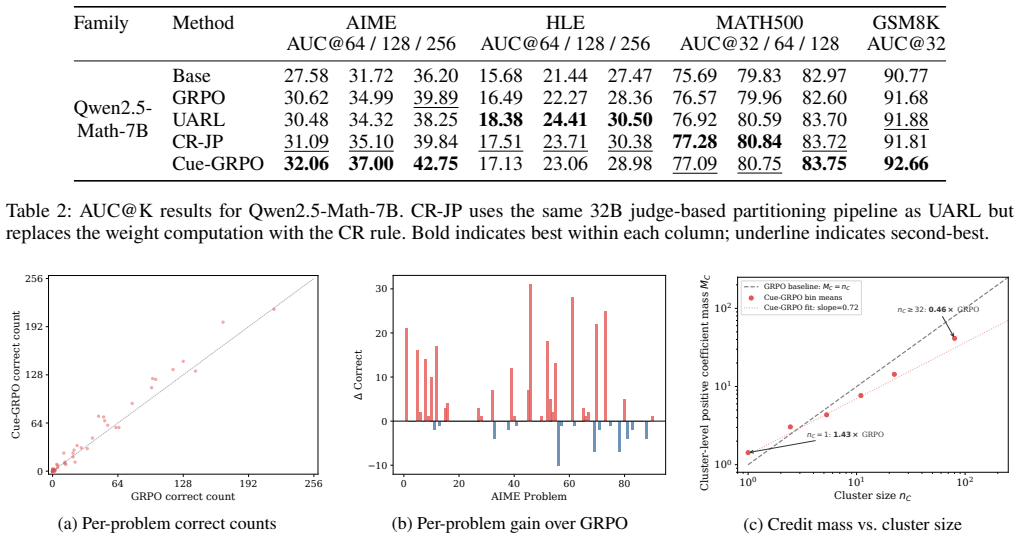
Under binary rewards in GRPO, every correct completion in a non-degenerate group gets the same positive base advantage $A^+=(1-\mu)/\sigma$, so a set of completions sharing one recurring solution form receives aggregate credit $M_{\mathrm{GRPO}}(S)=n_S A^+$, proportional to its multiplicity. The paper's central claim is that this completion-level uniformity creates structure-level credit concentration, and that reallocating positive credit according to cluster rarity improves high-budget repeated-sampling performance. Credit Redistribution replaces the positive advantage of each verified-correct completion $i$ with a reweighted value proportional to $|C_i|^{-\alpha}$, normalized so the mean positive multiplier stays one, while negative advantages are unchanged; Cue-GRPO builds the partition from deterministic Strategy Cues (27 symbolic LaTeX and natural-language triggers), suppressing cues shared by more than $\rho|P|$ correct traces and taking connected components of a cosine-similarity graph at threshold $\varepsilon=0.50$. The paper reports AIME AUC@256 rising from 39.89 to 42.75 on Qwen2.5-Math-7B and from 23.92 to 25.71 on Llama-3.1-8B-Instruct, a fitted slope of cluster size versus positive coefficient mass falling from 1.00 to 0.72, and that the same Credit Redistribution rule applied to judge-derived partitions (CR-JP) can match or exceed the judge-based rarity baseline.
Load-bearing premise
The load-bearing premise is that the fixed 27-cue catalog and the cosine-threshold clustering really group completions by recurring solution structure; if the cue clusters are arbitrary, the rarity signal is noise and the AIME gain should fall toward the paper's Random-Cluster control (AUC@128 of 34.09 versus 36.19 for Cue-GRPO).
Editorial extensions
If this is right
- If the central claim is right, GRPO's completion-level credit assignment is systematically skewed for high-budget repeated sampling, and any RLVR pipeline using group-relative advantages can change the allocation without changing the objective or adding a value model.
- On AIME the gain grows with sampling budget: pass@256 improves by +4.4 points on Qwen2.5-Math-7B and +3.4 on Llama-3.1-8B-Instruct, while pass@1 stays essentially flat, indicating a coverage improvement rather than a single-sample accuracy boost.
- Because the same Credit Redistribution rule works with judge-derived partitions (CR-JP), partition construction and credit allocation are separable design axes, so future work can improve either component independently.
- The mechanism is cheap: about 6% wall-clock training overhead versus about 62% for the 32B-judge pipeline, so rarity-aware credit fits in compute-budgeted RLVR training.
- The effect appears on both a math-specialized checkpoint and a general instruction-tuned model, while near-saturated retention benchmarks show little change, suggesting the benefit is specific to hard, high-budget repeated-sampling settings.
Reading between the lines
- The same partition-conditioned reweighting could be applied to other verifiable-reward domains such as code generation, provided the fixed math cue catalog is replaced by domain-specific structural markers; the paper's separation of partition construction from credit allocation makes this a direct extension.
- A sharper test than the reported ablations would compare Cue-GRPO with Random-Cluster under matched cluster-size distributions across several seeds; if the cue partition's advantage persists, it would isolate the value of structure-aware grouping beyond generic reweighting effects.
- The results suggest that token-level entropy regularization and structure-level credit redistribution target different mechanisms and could be combined: entropy methods keep the policy from collapsing while Cue-GRPO changes which correct modes receive credit.
- A testable extension is to sweep the rarity exponent $\alpha$ jointly with the sampling budget $K$; the paper's mechanism predicts the optimal $\alpha$ should move toward 1 at larger budgets, because more repeated correct structures are exposed and need reweighting.
Editorial analysis
A structured set of objections, weighed in public.
Referee Report
Summary. This paper studies GRPO for RLVR with binary rewards and argues that completion-level uniform positive advantages concentrate credit on frequently sampled solution forms. It formalizes this as multiplicity-induced structure-level credit concentration (Eqs. 1-2), proposes a partition-conditioned Credit Redistribution rule (Eq. 3) that reweights positive advantages by cluster rarity, and instantiates it as Cue-GRPO using a fixed 27-cue deterministic catalog, bag-of-cues vectors, and connected-components clustering. Experiments on Qwen2.5-Math-7B and Llama-3.1-8B-Instruct report AIME AUC@256 gains of +2.86 and +1.79 over GRPO, with larger gains at higher budgets; a judge-partition variant (CR-JP) is included as a control. The paper also reports multi-seed AIME runs on Qwen, a paired sign test, ablations, training dynamics, and roughly 6% wall-clock training overhead.
Significance. If the reported empirical gains hold under proper controls, the paper makes a useful practical contribution: a judge-free, approximately 6%-overhead post-verification reweighting that improves high-budget repeated-sampling coverage on competition mathematics. The paper's strengths include multi-seed AIME experiments on Qwen, a paired per-problem analysis, an explicit judge-partition control (CR-JP), and public code; these go beyond many point-estimate-only RLVR papers. However, the mechanistic claim that Strategy Cues capture recurring solution structure is not yet supported by the evidence, for the reasons in Major Comment 1, and the headline rarity exponent is selected on the target benchmark (Major Comment 2). The paper would be a credible contribution after these issues are addressed.
major comments (3)
- [Credit Redistribution Ablations (Table 4, Appendix G)] The Random-Cluster control does not isolate the semantic content of Strategy Cues. Equations (3), (8), and the clipping/floor/singleton-reset steps consume only the cluster sizes |C_i|; the partition's content enters only through which completions share a cluster. Appendix G states that Random-Cluster assigns each verified-correct completion an i.i.d. uniform label from {1,...,m}, so its expected cluster sizes are nearly equal, whereas the cue partition (Appendix I) contains a large common cluster plus rare singleton/artifact clusters. Because the entire reweighting is monotone in cluster size, Random-Cluster suppresses exactly the rare-cluster signal that Cue-GRPO is designed to amplify; the 2.10-point gap in Table 4 could therefore be produced by the size distribution alone. A content-blind control must preserve the exact cluster-size multiset while randomizing which completions occupy each cluster. Without it, the paper's mechanistic claim that Strategy Cues capture recurring 'solution form' is not established, even though the Cue-GRPO versus GRPO comparison itself is unaffected by this confound.
- [Experimental Setup and Ablations (Table 4)] The headline rarity exponent alpha=0.8 was selected on the same benchmark used for the central claim. The fixed configuration in the Experimental Setup section (alpha=0.8) is justified by the ablation in Table 4, which sweeps alpha on AIME at K=128 and reports that alpha=0.8 performs best. The final AIME AUC@256 numbers in Table 2 are then reported for the same backbone and benchmark. This makes the headline a selected maximum over the alpha grid rather than a configuration chosen independently of the target evaluation. The paper should either report AIME results for alpha=0.5 and alpha=1.0 at K=256, or present a held-out choice of alpha; otherwise the size of the headline gain is partially attributable to selection on the benchmark.
- [Table 3 and Multi-Seed Robustness (Table 5)] The cross-family generalization in the abstract rests on a single training run for Llama-3.1-8B-Instruct: Table 3 reports one AUC@256 pair (23.92 versus 25.71), and Appendix E provides no additional seeds. The multi-seed analysis in Table 5 covers only Qwen2.5-Math-7B and only AIME. Because the Llama AIME gain is the only evidence that the effect transfers to a non-math-specialized checkpoint, I would like either additional Llama seeds or a softened claim that limits the reliable cross-family statement to the observed point estimates.
minor comments (4)
- [Equation (4) and Figure 2(c)] Equation (4) is a definitional consequence of Equation (3), so the slope reduction in Figure 2(c) should be presented as a check on the implemented reweighting rather than as an independent test of the theoretical rule.
- [Appendix J] The sensitivity statistics in Table 11 are computed on the first 30 AIME problems at K=256, not the full 90-problem set; the text should state this limitation in the main discussion rather than only in the appendix.
- [Appendix F] The paired sign test p=0.049 is marginal and is not adjusted for the fact that multiple sampling budgets are examined; the paper should either report a small multiple-comparisons correction or explicitly describe the test as exploratory.
- [Conclusion] The conclusion states that CR-JP 'exceeds the in-recipe UARL-32B baseline' at pass@256 on both benchmarks, but CR-JP differs from UARL in alpha, clipping, and the floor in addition to the weighting rule; the wording should clarify that this is not an ablation of the CR rule alone.
Circularity Check
No significant circularity: headline AIME gains are held-out empirical results; Eq. (4) is an algebraic restatement, not a prediction.
full rationale
The central claim—Cue-GRPO improves AIME repeated-sampling performance—is tested by generating held-out completions on AIME/MATH500/GSM8K/HLE with a fixed verification and evaluation pipeline; nothing in Eqs. (3)-(8) is fitted to those pass@k numbers. Eq. (4) is a direct algebraic consequence of Eq. (3) (substitute Eq. (1) into Eq. (3) and sum over a cluster); presenting it as a characterization of the reweighting is a definitional identity, not an independent prediction, and the paper does not use it to derive the empirical gains. There are no load-bearing self-citations: UARL is an external prior method that the authors reimplement as a baseline, and the 27-cue catalog is defined in this paper. The real weakness is experimental rather than circular: the Random-Cluster control (Appendix G) randomizes cluster membership, which also destroys the cluster-size skew on which Eq. (3) acts, so the 2.10-point Cue-vs-Random-Cluster gap cannot cleanly isolate cue semantics; the Table 4 wording that this is 'consistent with the benefit of organizing redistribution using recurring procedural cues' overstates what the control can establish. Also, α=0.8 was selected through the AIME ablation sweep (Table 4), so AIME is not a purely pre-registered test. These are correctness and experimental-identification concerns, not instances of a result being equivalent to its own inputs by construction, so the circularity score is 0.
Assumptions & free parameters
free parameters (6)
- rarity exponent alpha =
0.8
- cosine similarity threshold epsilon =
0.50
- cue suppression threshold rho =
0.75
- minimum positive multiplier floor tau =
1.05
- clipping bounds gamma_min, gamma_max =
0.3, 3.0
- singleton artifact reset thresholds =
max(2, 0.3*median) and max(6, 3.0*median)
assumptions (4)
- domain assumption Redistributing positive credit toward rare correct solution forms improves high-budget pass@k
- domain assumption The fixed 27-cue catalog plus bag-of-cues cosine clustering is a faithful proxy for recurring solution structure
- domain assumption Conservative string-match verification preserves relative rankings among methods
- domain assumption The compute-budgeted UARL reimplementation is a faithful version of UARL
invented entities (1)
-
Strategy Cue catalog of 27 deterministic markers
Cite this review
Pith. "Pith review of When Correct Solutions Repeat: Rarity-Aware Credit Redistribution for GRPO." pith.science (2026). https://pith.science/paper/656HFSJ7
@misc{pith2026260803467,
  author       = {Pith},
  title        = {Pith review of: When Correct Solutions Repeat: Rarity-Aware Credit Redistribution for GRPO},
  year         = {2026},
  howpublished = {\url{https://pith.science/paper/656HFSJ7}},
  note         = {Machine review of arXiv:2608.03467}
}
read the original abstract
Reinforcement learning with verifiable rewards (RLVR) com- monly optimizes each correct completion as an independent learning signal. In GRPO, this completion-level uniformity creates structure-level skew: recurring correct solution forms accumulate positive coefficient mass in proportion to how often they are sampled, while rare forms receive limited credit. We formalize this behavior as multiplicity-induced structure-level credit concentration and introduce a partition- conditioned rule that redistributes positive advantages accord- ing to cluster rarity. Cue-GRPO instantiates this rule with- out auxiliary-model inference by using deterministic Strategy Cues to construct rollout-local partitions of verified-correct traces. Across Qwen2.5-Math-7B and Llama-3.1-8B-Instruct, Cue-GRPO improves AIME repeated-sampling performance, with the largest gains at high sampling budgets. Credit Re- distribution (CR) under Judge Partitions (JP) further indi- cates that the proposed redistribution mechanism can oper- ate with judge-derived partitions. Cue-GRPO adds only 6% wall-clock training overhead over GRPO. These results sup- port structure-level credit redistribution as a practical design axis for RLVR, with Strategy Cues providing a low-overhead implementation for competition mathematics. Code is avail- able at https://github.com/CzZ12/When-Correct-Solutions- Repeat-Rarity-Aware-Credit-Redistribution-for-GRPO.
Figures

Reference graph
Works this paper leans on
-
[1]
LoRA:Low-RankAdaptation of Large Language Models
Hu,E.J.;Shen,Y.;Wallis,P.;Allen-Zhu,Z.;Li,Y.;Wang,S.; Wang,L.;andChen,W.2022. LoRA:Low-RankAdaptation of Large Language Models. InInternational Conference on Learning Representations (ICLR). Hu, J.; Zhang, Y.; Han, Q.; Jiang, D.; Zhang, X.; and Shum, H
2022
-
[2]
Cui,G.;Zhang,Y.;Chen,J.;etal.2025
Train- ing Verifiers to Solve Math Word Problems.arXiv preprint arXiv:2110.14168. Cui,G.;Zhang,Y.;Chen,J.;etal.2025. TheEntropyMech- anism of Reinforcement Learning for Reasoning Language Models.arXiv preprint arXiv:2505.22617. Grattafiori, A.; Dubey, A.; Jauhri, A.; et al
arXiv 2025
-
[6]
InAdvances in Neural Information Processing Systems, vol- ume 38, 162239–162262
Open-Reasoner-Zero: An Open Source Approach to Scaling Up Reinforcement Learning on the Base Model. InAdvances in Neural Information Processing Systems, vol- ume 38, 162239–162262. Hu,Z.;Wang,Y.;He,Y.;Wu,J.;Zhao,Y.;Ng,S.;Breazeal, C.;Luu,A.T.;Park,H.W.;andHooi,B.2026.Rewardingthe Rare: Uniqueness-Aware RL for Creative Problem Solving in LLMs. InFindings o...
2026
-
[8]
Li, T.; Zhang, Y.; Yu, P.; Saha, S.; Khashabi, D.; Weston, J.; Lanchantin, J.; and Wang, T
SetPO: Set-Level Policy Optimization for Diversity-Preserving LLM Reason- ing.arXiv preprint arXiv:2602.01062. Li, T.; Zhang, Y.; Yu, P.; Saha, S.; Khashabi, D.; Weston, J.; Lanchantin, J.; and Wang, T
-
[9]
Lightman, H.; Kosaraju, V.; Burda, Y.; et al
Jointly Reinforcing DiversityandQualityinLanguageModelGenerations.arXiv preprint arXiv:2509.02534. Lightman, H.; Kosaraju, V.; Burda, Y.; et al
-
[10]
Orney,I.H.;Hamid,J.I.;Ramanujam,S.S.;Wu,S.;Hu,H.; Goodman, N
Understanding R1- Zero-Like Training: A Critical Perspective.arXiv preprint arXiv:2503.20783. Orney,I.H.;Hamid,J.I.;Ramanujam,S.S.;Wu,S.;Hu,H.; Goodman, N. D.; Sadigh, D.; and Finn, C
-
[11]
Peng,R.;Ren,Y.;Yu,Z.;Liu,W.;andWen,Y.2025
Poly-EPO: Training Exploratory Reasoning Models.arXiv preprint arXiv:2604.17654. Peng,R.;Ren,Y.;Yu,Z.;Liu,W.;andWen,Y.2025. Beyond theSampledToken:PreservingCandidateSupportinRLVR. arXiv preprint arXiv:2510.14807. Phan, L.; Gatti, A.; Han, Z.; et al
arXiv 2025
-
[12]
Humanity’s Last Exam.arXiv preprint arXiv:2501.14249. Plyusov, D.; Gorbatovski, A.; Shaposhnikov, B.; Sinii, V.; Malakhov, A.; Korotyshova, D.; and Gavrilov, D
Show all 21 references
-
[13]
Qwen Team
F- GRPO:Don’tLetYourPolicyLearntheObviousandForget the Rare.arXiv preprint arXiv:2602.06717. Qwen Team
-
[14]
Schulman, J.; Wolski, F.; Dhariwal, P.; Radford, A.; and Klimov,O.2017
Qwen2.5 Technical Report.arXiv preprint arXiv:2412.15115. Schulman, J.; Wolski, F.; Dhariwal, P.; Radford, A.; and Klimov,O.2017. ProximalPolicyOptimizationAlgorithms. arXiv preprint arXiv:1707.06347. Shao, Z.; Wang, P.; Zhu, Q.; et al
2017 arXiv
-
[15]
Strozzi, I
DeepSeekMath: PushingtheLimitsofMathematicalReasoninginOpenLan- guage Models.arXiv preprint arXiv:2402.03300. Strozzi, I. L
-
[16]
Walder,C.;andKarkhanis,D.T.2025
Teacher-Free Self-Training Amplifies but Does Not Compound: A Pass@K Crossover on a Free- Verifier Domain.arXiv preprint arXiv:2606.07856. Walder,C.;andKarkhanis,D.T.2025. Pass@KPolicyOpti- mization:SolvingHarderReinforcementLearningProblems. InAdvances in Neural Information P...
2025 arXiv
-
[17]
arXiv preprint arXiv:2409.12122
Qwen2.5-Math Technical Report: Toward Mathematical Expert Model via Self-Improvement. arXiv preprint arXiv:2409.12122. Yu, Q.; Zhang, Z.; Zhu, R.; et al
-
[18]
In Advances in Neural Information Processing Systems, vol- ume 38, 113222–113244
DAPO: An Open- Source LLM Reinforcement Learning System at Scale. In Advances in Neural Information Processing Systems, vol- ume 38, 113222–113244. Yue, Y.; Chen, Z.; Lu, R.; Zhao, A.; Wang, Z.; Yue, Y.; Song,S.;andHuang,G.2025.DoesReinforcementLearning ReallyIncentivizeReason...
2025
-
[19]
Appendix A
EDGE- GRPO:Entropy-DrivenGRPOwithGuidedErrorCorrection for Advantage Diversity.arXiv preprint arXiv:2507.21848. Appendix A. Complete Strategy Cue Catalog Table 6 lists the complete set of 27 Strategy Cues used by Cue-GRPO. The main paper (Table
-
[20]
The judge is loaded via Transformers 4-bit quantization (BitsAndBytesConfig) alongside the 7B policy model and queried with max_new_tokens=512, do_sample=False. The policy model’s vLLM instance uses GPU memory utilization 0.45 to accommodate the additional judge.Credit Redistr...
2024
-
[21]
AUC values for all methods are reported in Table 2 of the main paper
(indices 0–199 of 976 total); Dataset Method pass@1 pass@4 pass@8 pass@16 pass@32 pass@64 pass@128 pass@256 AIME Base 6.3 15.2 20.5 25.3 29.6 33.6 38.0 43.3 GRPO 7.6 17.6 23.1 28.3 32.8 36.9 41.7 47.8 UARL 8.4 18.3 23.5 28.3 32.6 36.3 39.9 44.4 CR-JP 8.8 19.1 24.4 29.1 33.1 36...
2021
-
[2021]
Cheng, D.; Huang, S.; Zhu, X.; Dai, B.; Zhao, X.; Zhang, Z.; and Wei, F
Evaluating Large Language Models Trained on Code.arXiv preprint arXiv:2107.03374. Cheng, D.; Huang, S.; Zhu, X.; Dai, B.; Zhao, X.; Zhang, Z.; and Wei, F
-
[2024]
Guo, D.; Yang, D.; Zhang, H.; et al
The Llama 3 Herd of Models.arXiv preprint arXiv:2407.21783. Guo, D.; Yang, D.; Zhang, H.; et al
-
[2025]
Hendrycks, D.; Burns, C.; Kadavath, S.; Arora, A.; Basart, S.; Tang, E.; Song, D.; and Steinhardt, J
DeepSeek-R1: Incentivizing Reasoning Capability in LLMs via Reinforce- ment Learning.arXiv preprint arXiv:2501.12948. Hendrycks, D.; Burns, C.; Kadavath, S.; Arora, A.; Basart, S.; Tang, E.; Song, D.; and Steinhardt, J
-
[2026]
KimiTeam.2025
MC-GRPO: Median-Centered Group Rel- ative Policy Optimization for Small-Rollout Reinforcement Learning.arXiv preprint arXiv:2601.22582. KimiTeam.2025. Kimik1.5:ScalingReinforcementLearn- ing with LLMs.arXiv preprint arXiv:2501.12599. Kwon, W.; Li, Z.; Zhuang, S.; Sheng, Y.; Zh...
2025
Reviewed August 8, 2026 · model on record in the stance chip above.
Discussion (0). Continue with ORCID to comment.