REVIEW 3 major objections 5 minor 15 references
Exploiting Gaussian Agnostic Representation Learning with Diffusion Priors for Enhanced Infrared Small Target Detection
T0 review · 3 major / 5 minor · reviewed 2026-08-06 · deepseek-v4-flash
Pith's one-line read This paper argues that a Gaussian-quantization plus two-stage diffusion augmentation pipeline can generate synthetic infrared images that keep small-target detectors accurate even when only 10% of the training data is available.
desk verdict A plausible data-augmentation idea whose headline numbers are compromised by test-set tuning, an unstated diffusion fine-tuning split, and a detector/augmentation confound. read the letter →
The pith
A machine-rendered reading of the paper's core claim, the machinery that carries it, and where it could break.
The reading
What carries the argument
The load-bearing mechanism is the pairing of a Gaussian Group Squeezer with a two-stage generative model. The squeezer samples the number of quantization intervals from a Gaussian distribution, sorts random cut points across the pixel range, and replaces pixel values in each interval with a random representative value, while a binary mask preserves the small-target pixels. The coarse-rebuilding stage, built from Residual Swin Transformer Blocks, maps the quantized image to an initial reconstruction under L2 loss. The diffusion stage then encodes that reconstruction into latent space, adds Gaussian noise, denoises it, and decodes it, learning a resample loss against the true latent. The final synthetic image is assembled by pasting the original small-target pixels onto the generated background, so the target is never lost in regeneration.
What would settle it
Retrain the full augmentation pipeline with the diffusion model fine-tuned exclusively on the 50% training split, keeping the test split untouched, and recompute IoU, Pd, and Fa on the same splits; if the reported margins shrink to noise, the original numbers depended on test-set leakage. As a quicker check, run nearest-neighbor matching between the generated synthetic images and the test split: a close match for any generated image would confirm leakage.
Extended reading notes
Core claim
The central discovery is that non-uniform quantization with Gaussian-sampled interval counts, followed by a coarse-rebuilding stage and a latent diffusion resampling stage, can create synthetic infrared images whose feature distribution is richer and more compact than the originals, and that training a detector on these images substantially preserves performance under data scarcity. The paper reports that with 30% of SIRST training data, the augmented detector reaches 78.19 IoU, higher than the 76.00 IoU of the best comparator trained on the full dataset. Ablations attribute the gain to both the Gaussian Group Squeezer, which supplies diverse compression levels, and the diffusion stage, which reduces false alarms by aligning reconstructed images with real-world infrared distributions.
Load-bearing premise
Every reported test metric assumes the latent diffusion model was fine-tuned only on the 50% training split of SIRST and NUDT-SIRST, never on the 50% test split; the paper says it used 'an infrared small-target dataset' without specifying which split.
Editorial extensions
If this is right
- If the reported numbers hold, scarce-data infrared detection can be improved by generating synthetic training images instead of collecting and labeling more data.
- The SIRST result at 30% training data (IoU 78.19) exceeding the full-scale SCTransNet baseline (76.00) implies the augmentation can offset more than two-thirds of the training set.
- The ablations show the two components are complementary: removing the Gaussian Group Squeezer drops IoU from 95.37 to 93.14 on NUDT-SIRST, while removing the diffusion stage raises the false-alarm rate from 0.80 to 4.18.
- The augmentation runs offline, so the detector itself gains inference-time efficiency; the paper reports 10.11 GFLOPs and 11.19M parameters for its detector.
- Generated samples transfer to other backbones: DNANet and UIU-Net both improve when trained with the synthetic data, and the method also improves results on RealScene-ISTD and IRSTD-1K.
Reading between the lines
- The same quantize-and-reconstruct recipe could be tested on other tiny-object detection tasks with scarce labels, such as medical lesion or industrial defect detection; the paper only demonstrates it on infrared imagery.
- The diffusion stage is fine-tuned on target-domain data, so the method's benefit in a truly new domain with no clean infrared images remains an open question the paper does not address.
- The Gaussian parameters mean 17 and variance 4 are tuned on these benchmarks; the optimal settings may shift with sensor type, target size, or clutter level.
- A direct comparison against a much larger detection backbone would clarify whether the gains persist when the detector itself is powerful enough to learn from scarce data.
Editorial analysis
A structured set of objections, weighed in public.
Referee Report
Summary. The paper proposes Gaussian Agnostic Representation Learning for infrared small target detection (ISTD) under data scarcity. A Gaussian Group Squeezer non-uniformly quantizes the background of training images while preserving target pixels; a coarse-rebuilding network then reconstructs the quantized images, and a fine-tuned latent diffusion model resamples them to produce synthetic training samples. The generated data are added to the original training set for training a detection network. Experiments on SIRST, NUDT-SIRST, RealScene-ISTD, and IRSTD-1K report improved IoU, Pd, and Fa, especially in 10% and 30% few-shot regimes, and ablations attribute the gains to the squeezer and diffusion stages.
Significance. If the claims are validated, the work would offer a data-centric augmentation strategy for ISTD that is practically attractive because generation is offline and detection inference has zero extra overhead. The core idea---quantizing only background pixels and using a two-stage diffusion reconstruction to generate realistic synthetic samples---is plausible and the paper includes controlled ablations and cross-domain evaluations. However, the current evidence is weakened by three load-bearing issues: the Gaussian squeezer parameters appear to be selected on the test benchmarks, the diffusion fine-tuning split is not stated, and the main comparisons confound a new detection architecture with the augmentation contribution.
major comments (3)
- [Sec. 4.2 / Table 9] The Gaussian squeezer parameters (μ=17, σ=4) that determine the entire quantization pipeline are selected from a sensitivity sweep whose metrics appear to be computed on the same test benchmarks used for the headline comparisons. Because no validation split is described, the reported IoU/Pd/Fa values are partly fitted to the evaluation data. Please specify a validation-based selection protocol or explicitly report the sweep on a held-out validation set, and re-report the main tables with parameters chosen without test access.
- [Secs. 3.4/4.2] The manuscript never states whether the latent diffusion model was fine-tuned only on the 50% training split. Section 3.4 says only that the model was "fine-tuned using an infrared small-target dataset," and Section 4.2 describes the 50/50 train/test split without specifying which split feeds fine-tuning. Since the generated samples are used to train the detection model, any test images seen by the diffusion model could reappear in modified form in the training set, inflating IoU and Pd and lowering Fa precisely in the few-shot regimes. Please state explicitly that fine-tuning used only the training split, and ideally verify by re-running the pipeline with the fine-tuning data restricted accordingly.
- [Secs. 4.3/3.5, Tables 4/5 vs Tables 8/12-14] The headline comparisons in Tables 4 and 5 pit the proposed detection network ('Ours', Table 7) plus augmentation against existing backbones without augmentation, so architecture differences are confounded with the augmentation contribution. The controlled ablations on fixed backbones show much smaller gains (e.g., Table 13: IoU +0.63 with Pd decreasing; Table 14: IoU +2.49), which cannot by themselves explain the large gaps such as NUDT 10% IoU 86.04 vs 71.64 for SCTransNet. In addition, Section 4.3's phrase "we employed the generated datasets for baseline network training" is ambiguous about whether all compared methods used the same augmentation. Please present the main comparison with the same detection backbone trained with and without the generated data, or separate the architecture contribution from the augmentation contribution.
minor comments (5)
- [Eqs. (2)-(3)] The definition of y_i uses a_{i+1} for i = Num-1, but the sorted list a_0,...,a_{n-1} lacks an upper bound a_n; define a_n = max(x) to make the intervals complete.
- [Tables 2, 4, 5, 9] The units of Fa are inconsistent across tables (×10^6 in Tables 4/5, ×10^-3 in Table 9, and unlabeled in Table 2); please unify the units and make the column headers self-contained.
- [Tables 13/14] The arrow notation is confusing: a reduction in false alarms is marked with ↑ while the caption says ↑ indicates an increase in performance including Fa; re-annotate the tables so that arrows consistently denote improvement or degradation.
- [Throughout] Please fix typos and inconsistent naming: "autoender" (Sec. 3.4), "starge" (Sec. 3.4), "SCTansNet" (Sec. 3.1), "agnoistic" (Fig. 7), and "DNA-Net" vs "DNANet" are used inconsistently.
- [Sec. 3.5] The detection network is described only briefly (ResNet block plus spatial attention and multi-scale fusion); since this network is part of the main result, provide a fuller architectural description or a reference to an existing design.
Circularity Check
The augmentation pipeline is not a derivation circle, but the headline full-scale NUDT-SIRST number is the argmax of a Gaussian-parameter sweep reported on the same test metrics, so part of the central quantitative claim is fitted to the evaluation data.
-
fitted input called prediction
[Section 4.4, Table 9 (Gaussian parameter sensitivity); Section 4.2 and Table 4 (final Ours row)]
"Table 9: "Gaussian parameter sensitivity analysis. Different combinations of mean (μ) and standard deviation (σ) are tested to evaluate their influence on detection performance." Row μ=17, σ=4 gives IoU 95.37, Pd 99.04, Fa 0.80; Table 4 lists the same values for Ours under full-scale NUDT-SIRST."
Section 4.2 describes only a 50% train / 50% test split and never introduces a validation split. Table 9 sweeps (μ,σ) and selects the configuration with the best IoU/Fa on the reported evaluation metrics; that selected row (95.37 IoU, 0.80 Fa) is exactly the Ours full-scale NUDT-SIRST row in Table 4. The headline full-scale result is therefore the argmax of a search over the test metric rather than an independent prediction. The few-shot Table 4 numbers inherit the same test-selected hyperparameters. This is a partial fitting-to-evaluation-data problem, not a construction-level tautology; the w/w.o-Gauss ablations still provide independent evidence of a modest augmentation effect.
full rationale
The core derivation chain is otherwise self-contained: Gaussian Group Squeezer quantizes background pixels (Eq. 1-4), the coarse-rebuilding stage minimizes pixel loss (Eq. 5), the diffusion stage minimizes latent resampling loss (Eq. 7-8), and the detection network is trained on original plus generated images (Eq. 9). None of these equations defines the claimed improvement in terms of the target metric. Diff-Mosaic and DiffBIR citations are used as a baseline and as a pretrained prior, not to import an unverified uniqueness or theoretical premise, so they are not load-bearing self-citations. The unspecified split for diffusion fine-tuning (Sec. 3.4: 'we fine-tuned it using an infrared small-target dataset') is a serious potential test-data leakage risk, but the paper does not state that the test split was used, so I do not count it as a demonstrated circular step. The one demonstrated circularity-adjacent issue is the Table 9 parameter sweep selecting final numbers on the evaluation set, which warrants a mid-range score rather than a 0.
Assumptions & free parameters
free parameters (5)
- Gaussian mean μ for Num sampling =
17
- Gaussian std σ for Num sampling =
4
- Diffusion fine-tuning epochs =
20
- Detection learning rate =
0.05
- Coarse-rebuilding steps =
25000
assumptions (4)
- domain assumption A pre-trained latent diffusion model fine-tuned on infrared images can generate realistic infrared backgrounds that preserve the statistics of real scenes.
- domain assumption Quantizing only background pixels while copying target pixels from the original preserves label consistency between synthetic and real data.
- domain assumption The generative fine-tuning uses only the training split of the evaluation datasets.
- standard math Standard results of DDPM/LDM and Swin Transformer are accepted without proof.
Cite this review
Pith. "Pith review of Exploiting Gaussian Agnostic Representation Learning with Diffusion Priors for Enhanced Infrared Small Target Detection." pith.science (2026). https://pith.science/paper/66QK2PJB
@misc{pith2026250718260,
  author       = {Pith},
  title        = {Pith review of: Exploiting Gaussian Agnostic Representation Learning with Diffusion Priors for Enhanced Infrared Small Target Detection},
  year         = {2026},
  howpublished = {\url{https://pith.science/paper/66QK2PJB}},
  note         = {Machine review of arXiv:2507.18260}
}
read the original abstract
Infrared small target detection (ISTD) plays a vital role in numerous practical applications. In pursuit of determining the performance boundaries, researchers employ large and expensive manual-labeling data for representation learning. Nevertheless, this approach renders the state-of-the-art ISTD methods highly fragile in real-world challenges. In this paper, we first study the variation in detection performance across several mainstream methods under various scarcity -- namely, the absence of high-quality infrared data -- that challenge the prevailing theories about practical ISTD. To address this concern, we introduce the Gaussian Agnostic Representation Learning. Specifically, we propose the Gaussian Group Squeezer, leveraging Gaussian sampling and compression for non-uniform quantization. By exploiting a diverse array of training samples, we enhance the resilience of ISTD models against various challenges. Then, we introduce two-stage diffusion models for real-world reconstruction. By aligning quantized signals closely with real-world distributions, we significantly elevate the quality and fidelity of the synthetic samples. Comparative evaluations against state-of-the-art detection methods in various scarcity scenarios demonstrate the efficacy of the proposed approach.
Figures


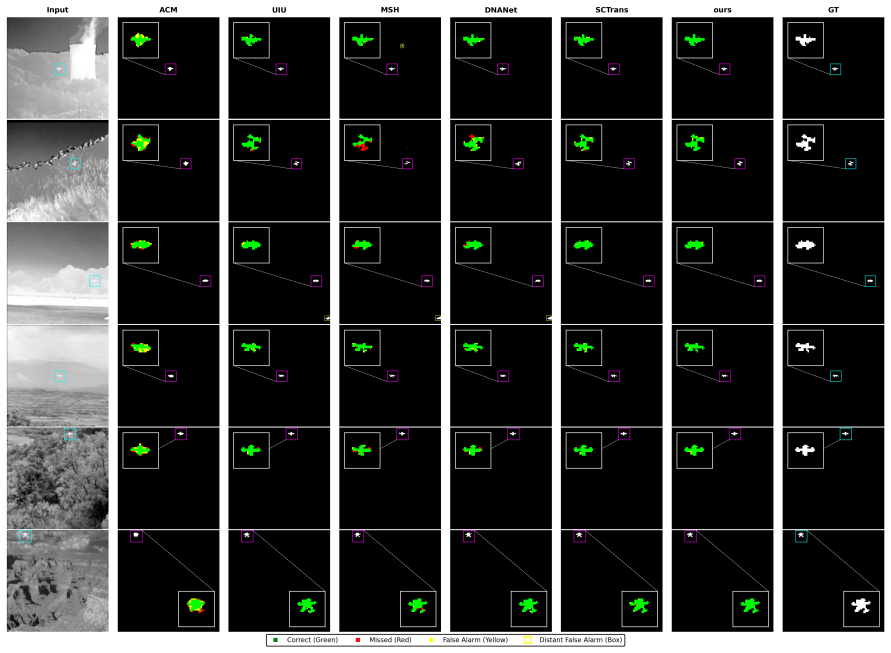
Figures from the paper (6 more)



Reference graph
Works this paper leans on
-
[10]
Mpanet: Multi-patch attentionforinfraredsmalltargetobjectdetection,in:IGARSS2022-2022 IEEE International Geoscience and Remote Sensing Symposium, IEEE. pp. 3095–3098. Wang, H., Zhou, L., Wang, L.,
work page 2022
-
[12]
Local Motion and Contrast Priors Driven Deep Network for Infrared Small Target Super-Resolution
Mocopnet: Exploring local motion and contrast priors for infrared small target super-resolution. arXiv preprint arXiv:2201.01014 . Yuan, S., Qin, H., Yan, X., Akhtar, N., Mian, A.,
-
[14]
arXiv preprint arXiv:1710.09412
mixup: Beyond empirical risk minimization. arXiv preprint arXiv:1710.09412 . Zhang, M., Zhang, R., Yang, Y., Bai, H., Zhang, J., Guo, J.,
-
[15]
Isnet: Shape matters for infrared small target detection. Information Fusion 97, 1–13. doi:10.1016/j.inffus.2023.05.005. Zhang, S., Wang, Z., Xing, Y., Lin, L., Su, X., Zhang, Y.,
-
[21]
Gao, C., Meng, D., Yang, Y., Wang, Y., Zhou, X., Hauptmann, A.G.,
doi:10.1109/LGRS.2024.3401838. Gao, C., Meng, D., Yang, Y., Wang, Y., Zhou, X., Hauptmann, A.G.,
-
[2009]
Imagenet: A large-scale hierarchical image database, in: 2009 IEEE Conference on Computer Vision and Pattern Recognition, IEEE. pp. 248–255. DeVries, T., Taylor, G.W.,
work page 2009
-
[2010]
Classification of small boats in infrared images for maritime surveillance, in: 2010 International WaterSide Security Conference, IEEE. pp. 1–7. Van Den Oord, A., Vinyals, O., et al.,
work page 2010
-
[2013]
IEEE Transactions on Image Processing 22, 4996–5009
Infrared patch-image model for small target detection in a single image. IEEE Transactions on Image Processing 22, 4996–5009. Goodall,T.R.,Bovik,A.C.,Paulter,N.G.,2016. Taskingonnaturalstatistics of infrared images. IEEE Transactions on Image Processing 25, 65–79. doi:10.1109/TIP.2015.2496289. Ho, J., Jain, A., Abbeel, P.,
arXiv 2016
Show all 15 references
-
[2017]
arXiv preprint arXiv:1708.04552
Improved regularization of convolutional neural networks with cutout. arXiv preprint arXiv:1708.04552 . Du, N., Gong, X., Liu, Y.,
-
[2020]
arXiv preprint arXiv:2004.10934
Yolov4: Optimal speed and accuracy of object detection. arXiv preprint arXiv:2004.10934 . Chen,C.P.,Li,H.,Wei,Y.,Xia,T.,Tang,Y.Y.,2013. Alocalcontrastmethod forsmallinfraredtargetdetection. IEEETransactionsonGeoscienceand Remote Sensing 52, 574–581. Chen, J., Pan, Y., Yao, T.,...
2004 arXiv
-
[2021]
IEEE Transactions on Geoscience and Remote Sensing 59, 5966–5978
Graph convolutional networks for hyperspectral image classification. IEEE Transactions on Geoscience and Remote Sensing 59, 5966–5978. doi:10.1109/TGRS.2020.3015157. Hu, M., Jiang, K., Wang, Z., Bai, X., Hu, R.,
2020
-
[2022]
IEEE Transactions on Image Processing 32, 1745–1758
Dense nested attention network for infrared small target detection. IEEE Transactions on Image Processing 32, 1745–1758. Lin, X., He, J., Chen, Z., Lyu, Z., Fei, B., Dai, B., Ouyang, W., Qiao, Y., Dong,C.,2023. Diffbir:Towardsblindimagerestorationwithgenerative diffusion prior...
2023 arXiv
-
[2023]
IEEE Transactions on Geoscience and Remote Sensing
Ediffsr: An efficient diffusion probabilistic model for remote sensing image super- resolution. IEEE Transactions on Geoscience and Remote Sensing . Xiao,Y.,Yuan,Q.,Jiang,K.,Jin,X.,He,J.,Zhang,L.,Lin,C.,. Local-global temporal difference learning for satellite video super-reso...
-
[2024]
IEEE Transactions on Geoscience and Remote Sensing 62, 1–15
Sctransnet: Spatial-channel cross transformer network for infrared small target detection. IEEE Transactions on Geoscience and Remote Sensing 62, 1–15. doi:10.1109/TGRS.2024.3383649. Yun, S., Han, D., Oh, S.J., Chun, S., Choe, J., Yoo, Y.,
2024
-
[2025]
arXivpreprintarXiv:2504.16487 URL: https://arxiv.org/abs/2504.16487
Rethinking generalizable infrared small target detection: A real-scene benchmark andcross-viewrepresentationlearning. arXivpreprintarXiv:2504.16487 URL: https://arxiv.org/abs/2504.16487. Lu, Y., Lin, Y., Wu, H., Xian, X., Shi, Y., Lin, L.,
Reviewed August 6, 2026 · model on record in the stance chip above.
Discussion (0). Sign in to comment.