REVIEW 4 major objections 4 minor 81 references
Al-Cu-Fe alloys: the relationship between the quasicrystal and its melt
T0 review · 4 major / 4 minor · reviewed 2026-08-14 · deepseek-v4-flash
Pith's one-line read The paper argues that Al-Cu-Fe melts retain the chemical short-range order of the quasicrystal solid—Cu–Fe repulsion and Fe–Al attraction—while losing its topological icosahedra, and that this chemical memory shows up as minima in…
desk verdict Careful AIMD and viscosity study of Al-Cu-Fe melts, but the headline 'minima at the i-phase' claim is not statistically supported by the experimental data. read the letter →
The pith
A machine-rendered reading of the paper's core claim, the machinery that carries it, and where it could break.
The reading
What carries the argument
The argument turns on the Warren-Cowley parameters $\alpha_{i-j}=1-\frac{Z_{i-j}}{Z_{i,\text{tot}}\,x_j}$, which measure whether pairs of species attract (negative $\alpha$) or repel (positive $\alpha$) relative to a random mixture. Computed from ab initio partial radial distribution functions and coordination numbers, these parameters supply the concentration-resolved chemical short-range order that is then compared with experimental viscosity, equal-viscosity lines, and undercoolability. Bond-angle distribution functions around Fe—a sharp Al–Fe–Al peak and a weak Cu–Fe–Cu peak—back up the same interaction picture, and Voronoi tessellation identifies the polytetrahedral Kasper-polyhedra motif that replaces perfect icosahedra in the melt.
What would settle it
Measure the viscosity and undercoolability along the 12.5 at.% iron cross-section with per-point error bars and multiple independent runs: if the minimum near 25 at.% copper disappears within the 5% scatter or shifts with cooling rate, the claimed composition-structure link fails. Independently, in situ diffraction on levitated undercooled droplets at 20–80 K undercooling could test whether the Warren-Cowley parameter changes predicted from equilibrium melts are actually present in the liquid that nucleates.
Extended reading notes
Core claim
The central claim is that structural heredity in Al-Cu-Fe is chemical rather than topological. Melt snapshots from ab initio molecular dynamics contain almost no perfect $\langle 0,0,12,0\rangle$ icosahedra even at the icosahedral-phase composition; the local order is polytetrahedral, dominated by distorted Kasper polyhedra such as $\langle 0,3,6,4\rangle$. Yet Warren-Cowley parameters extracted from partial radial distribution functions show the same interaction fingerprints as the solid: Cu and Fe avoid each other, Fe and Al bond strongly, and these features are nearly concentration-independent. In the composition window of the i-phase, the chemical short-range order changes qualitatively—Al–Cu and Al–Fe interactions flip sign, Cu–Fe repulsion is minimal—and the same window shows minima in viscosity isotherms, equal-viscosity temperature lines, and undercoolability. The paper concludes that the chemical short-range order of the melt, rather than pre-formed icosahedra, is what links melt properties to quasicrystal formation.
Load-bearing premise
The whole link rests on the claim that the weak viscosity minimum near 25 at.% copper is a real feature of the alloy rather than scatter within the stated 5% measurement error, and that melt structure measured 100 K above the melting point tells us what the undercooled liquid looks like when solidification begins.
Editorial extensions
If this is right
- Concentration curves of viscosity, equal-viscosity temperatures, and undercoolability can be used as fast experimental screens for the icosahedral-phase stoichiometry in Al-Cu-Fe, without costly structural probes.
- Because topological icosahedra are absent in the equilibrium melt, the initial stage of solidification is better interpreted through chemical short-range order and its concentration changes than through pre-existing icosahedral clusters.
- The near concentration-independence of Cu–Fe repulsion and Fe–Al attraction means these interaction fingerprints are robust signatures of the system, useful for validating interatomic potentials in simulation.
- At i-phase stoichiometry, minimal chemical interaction—near-random Al–Cu and Cu–Cu bonding, sign flips in Al–Fe—coincides with the highest viscosity near the liquidus; this can guide composition selection for casting.
Reading between the lines
- The same recipe—measuring a structural-sensitive liquid property and computing Warren-Cowley parameters across a composition cross-section—could be applied to other quasicrystal-forming or high-entropy alloy families, treating viscosity minima as a fast screening signal before full phase-diagram work.
- AIMD's non-equilibrated undercooled run hints that substantial icosahedral order appears only on undercooling; if that tendency survives equilibration, the melt may develop topological icosahedra just before nucleation even though the equilibrium melt has none—an extension the paper explicitly leaves to future semi-empirical potentials.
- A direct testable extension would be to compare these melt indicators with nucleation-rate measurements, for example from droplet dispersion or fluxing, to see whether the viscosity and undercoolability minima correspond to lower nucleation barriers or simply to liquidus-shape effects.
Signed reviews
Editorial analysis
A structured set of objections, weighed in public.
Referee Report
Summary. The paper studies Al-Cu-Fe melts along two composition cross-sections containing the icosahedral quasicrystal (i-phase) stoichiometry. The authors report experimental kinematic viscosity and undercoolability data across a wide composition range, and combine these with ab initio molecular dynamics (AIMD) simulations of six compositions at about 100 K above the liquidus. From the simulations they extract Warren-Cowley short-range order (SRO) parameters, radial and bond-angle distribution functions, Voronoi polyhedra, and bond-orientational order parameters. The central claim is that the main features of interatomic interaction in Al-Cu-Fe are the same in liquid and solid states, and that a change in chemical SRO near the i-phase stoichiometry produces minima in viscosity and undercoolability isotherms, suggesting that melt SRO and structural-sensitive properties can serve as indicators of quasicrystal-forming compositions.
Significance. If established, the proposed connection between melt chemical SRO, viscosity, undercoolability, and quasicrystal-forming ability would be practically useful for selecting alloy compositions for casting or rapid quenching. The paper contributes a substantial experimental dataset of viscosity and undercoolability for Al-Cu-Fe melts over a broader composition range than previous studies, and the AIMD analysis addresses an important question about whether icosahedral order survives melting. The finding that topological icosahedra are almost absent in the equilibrium melt while pair and angular correlations persist is interesting and appears internally consistent. However, the load-bearing experimental claim of viscosity minima at the i-phase stoichiometry is not robust to the stated measurement uncertainty, and the claim is not uniformly supported across both cross-sections. The equal-viscosity line construction also introduces a nearly tautological comparison with the liquidus. The work would be publishable if the central claims are re-evaluated and appropriately qualified.
major comments (4)
- [§3, Fig. 2a and Table 1] The claimed 'weakly pronounced minimum' in viscosity at xCu ≈ 25 at.% is not statistically established by the data in Table 1. Re-evaluating the Arrhenius parameters for the xFe = 12.5 cross-section at 1473 K gives ν(Al67Cu20.5Fe12.5) = 5.49×10^-7 m²/s and ν(Al62Cu25.5Fe12.5) = 5.50×10^-7 m²/s, a difference of about 0.2%; at 1573 K the difference is about 0.5%, and at 1673 K about 1.7%. All of these differences are far smaller than the stated total error of 5%, and Fig. 2a shows no error bars. The authors themselves call the minimum weak, so the central experimental anchor of the 'minima at i-phase stoichiometry' claim is not supported by the reported measurements.
- [Abstract and §5 Conclusions, compared with Figs. 2b and 3b] The blanket statement that viscosity and undercoolability isotherms develop minima at the i-phase stoichiometry is contradicted by the Fe cross-section. Along xCu = 25.5 at.%, Fig. 2b shows viscosity increasing monotonically with xFe, and Fig. 3d shows undercoolability with only a kink at xFe ≈ 12.5, not a minimum. The Conclusions state that 'All of these characteristics develop minima at concentration corresponding to i-phase stoichiometry', which overstates the reported data. The claims should be restricted to the Cu cross-section, or the text should explicitly characterize the Fe cross-section as showing monotonic increase and a kink.
- [§3, Fig. 3] The lines of equal viscosity T_visc(x) are constructed using a reference viscosity of 7.5×10^-7 m²/s taken from the i-phase near its melting point, and the text states that most melts have approximately this same viscosity at their own melting points. Consequently, the observed coincidence T_visc(x) ≈ Tm(x) is largely a consequence of the construction rather than an independent physical finding. The claim that this coincidence supports structural heredity between liquid and solid is therefore over-interpreted and should be reframed as a restatement of the near-constancy of viscosity at the liquidus, not as new evidence.
- [§4, Fig. 7 caption and text] The only undercooled-liquid AIMD simulation (Al52Cu25.5Fe22.5 at 1000 K) is explicitly described as not equilibrated, having been cooled from 1600 K over 10,000 fs and relaxed for only 5,000 fs. This is the sole direct simulation evidence connecting SRO to the undercooled state from which solidification begins. Since the central argument requires that SRO changes near the i-phase stoichiometry affect the initial stage of solidification, the conclusion rests on a non-equilibrium simulation of a single off-stoichiometry composition. Equilibrated undercooled-structure data, or at least a clear quantitative statement of the relaxation limitations, are needed to support that inference.
minor comments (4)
- [Abstract and Highlights] There are several typographical errors: 'udercoolability' should be 'undercoolability', and in the Abstract 'bong-angle distribution function' should be 'bond-angle distribution function'.
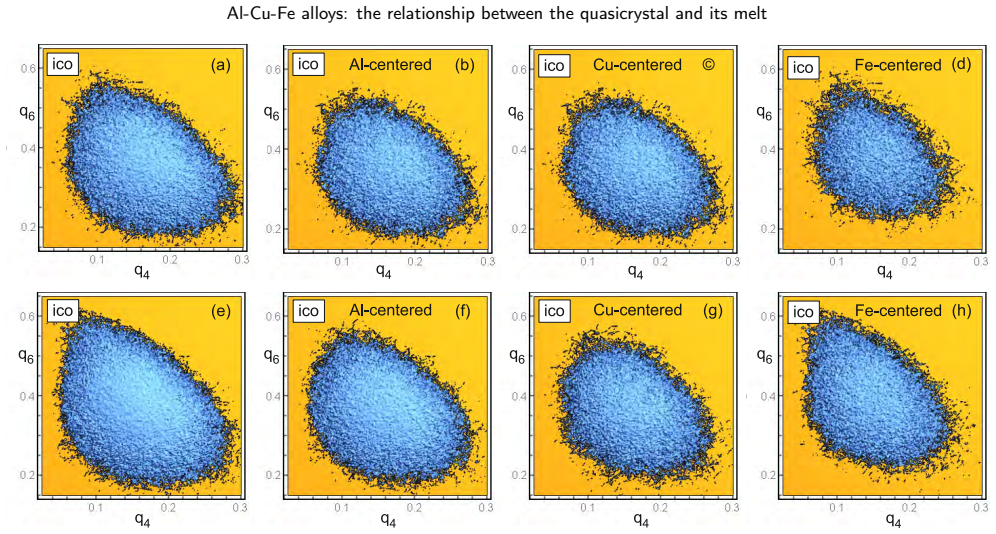
- [§4, Fig. 7] The text refers to 'Fig. 7(a-d)' twice for two different temperatures (1600 K and 1000 K); the figure actually has panels (a)-(h). The first reference should be to panels (a-d) and the second to panels (e-h).
- [§4, undercooling simulation paragraph] The sentence 'A high-temperature configuration of the system at T = 1600 K was cooled down to 10,000fs forandthenrelaxedatthistemperaturefor5,000fs' is grammatically broken and should read 'cooled down to 1000 K for 10,000 fs and then relaxed at this temperature for 5,000 fs'.
- [Table 2] The r(Fe-Fe) values in Table 2 vary erratically (2.98, 2.28, 2.23, 2.90, 2.63, 2.34 Å) without a clear trend. The authors note low accuracy for iron-related quantities, but the table should include an explicit statement of estimated uncertainties or a footnote explaining the scatter.
Circularity Check
No significant circularity; the central SRO-viscosity correlation is independent, with only a minor self-referential choice in the equal-viscosity reference value.
-
self definitional
[Section 3, Fig. 3, equal-viscosity lines]
"In our case, the viscosity of the i-phase near the melting point (7.5⋅10−7 m2/s) is chosen as such characteristic value. ... Tν=ν_ico(x) (the temperature at which the viscosity of the melts studied is equal to the viscosity of the ico-phase near the liquidus temperature) coincides well with the liquidus line for each alloy."
The reference viscosity ν_ico is defined as the viscosity of the i-phase at its own melting point. Therefore, for the i-phase composition x_ico, the defining equation ν(x_ico,T)=ν_ico is solved by T=T_m(x_ico) by construction, up to Arrhenius-fit error. The reported 'coincidence' of the equal-viscosity line with the liquidus at the central composition is thus an identity, not an independent finding. The coincidences at other compositions remain empirical because ν(x,T) is measured there, so the circularity is partial and not load-bearing.
full rationale
The central claim—that viscosity and undercoolability isotherms develop minima near i-phase stoichiometry and that this correlates with a change in chemical short-range order—rests on independent experimental measurements (viscosity by torsional oscillations, undercooling by DTA) and independent AIMD-derived Warren-Cowley parameters. No target result is defined in terms of a fitted constant, and the SRO parameters are not adjusted to reproduce the viscosity data. The only self-referential element is the equal-viscosity line: the reference value is taken from the i-phase at its melting point, so the T_ν = T_m coincidence at the i-phase composition is true by definition, but the raw viscosity and undercooling minima do not depend on this choice. Self-citations in the paper are methodological and contextual, not load-bearing for the central results. The statistical fragility of the 'weakly pronounced minimum' relative to the stated 5% error is a robustness and correctness concern, not a circularity concern.
Assumptions & free parameters
free parameters (2)
- Arrhenius parameters A_v and E_v for each alloy =
A_v = 3.9 to 8.4 x 10^-8 m2/s; E_v = 18.8 to 36.2 kJ/mol (Table 1)
- Reference viscosity for equal-viscosity lines =
7.5 x 10^-7 m2/s
assumptions (8)
- domain assumption AIMD with PAW pseudopotentials and PBE exchange-correlation gives accurate liquid structure for Al-Cu-Fe.
- domain assumption Simulations at zero-pressure densities estimated by energy minimization reproduce the experimental melt density.
- domain assumption The damped torsional vibration method measures the true kinematic viscosity of the melt.
- domain assumption Viscosity follows the Arrhenius law over the measured temperature range.
- domain assumption Coordination numbers defined by integrating partial RDFs to their first minima give reliable Warren-Cowley parameters.
- ad hoc to paper Equilibrium melt structure 100 K above the liquidus is a meaningful proxy for the solidification-relevant liquid.
- domain assumption Voronoi indices and bond orientational order with fixed coordination number 12 correctly classify local order in the melts.
- domain assumption Known i-phase stoichiometry around Al62Cu25.5Fe12.5 is the correct reference composition.
Cite this review
Pith. "Pith review of Al-Cu-Fe alloys: the relationship between the quasicrystal and its melt." pith.science (2026). https://pith.science/paper/66UVMERB
@misc{pith2026190803931,
  author       = {Pith},
  title        = {Pith review of: Al-Cu-Fe alloys: the relationship between the quasicrystal and its melt},
  year         = {2026},
  howpublished = {\url{https://pith.science/paper/66UVMERB}},
  note         = {Machine review of arXiv:1908.03931}
}
read the original abstract
Understanding the mechanisms which relate properties of liquid and solid phases is crucial for fabricating new advanced solid materials, such as glasses, quasicrystals and high-entropy alloys. Here we address this issue for quasicrystal-forming Al-Cu-Fe alloys which can serve as a model for studying microscopic mechanisms of quasicrystal formation. We study experimentally two structural-sensitive properties of the liquid -- viscosity and undercoolability -- and compare results with \textit{ab initio} investigations of short-range order (SRO). We observe that SRO in Al-Cu-Fe melts is polytetrahedral and mainly presented by distorted Kasper polyhedra. However, topologically perfect icosahedra are almost absent an even stoichiometry of icosahedral quasicrystal phase that suggests the topological structure of local polyhedra does not survive upon melting. It is shown that the main features of interatomic interaction in Al-Cu-Fe system, extracted from radial distribution function and bong-angle distribution function, are the same for both liquid and solid states. In particular, the system demonstrates pronounced repulsion between Fe and Cu as well as strong chemical interaction between Fe and Al, which are almost concentration-independent. We argue that SRO and structural-sensitive properties of a melt may serve as useful indicators of solid phase formation. In particular, in the concentration region corresponding to the composition of the icosahedral phase, a change in the chemical short-range order is observed, which leads to minima on the viscosity and udercoolability isotherms and has a noticeable effect on the initial stage of solidification.
Figures


Figures from the paper (3 more)


Reference graph
Works this paper leans on
-
[1]
J. C. Bendert, A. K. Gangopadhyay, N. A. Mauro, K. F. Kelton, Vol- ume expansion measurements in metallic liquids and their relation to fragility and glass forming ability: An energy landscape interpreta- tion, Phys. Rev. Lett. 109 (2012) 185901
2012
-
[2]
R. Ryltsev, B. Klumov, N. Chtchelkatchev, Self-assembly of the decagonal quasicrystalline order in simple three-dimensional sys- tems, Soft Matter 11 (2015) 6991–6998
work page 2015
-
[3]
Z. W. Wu, F. X. Li, C. W. Huo, M. Z. Li, W. H. Wang, K. X. Liu, Critical scaling of icosahedral medium-range order inCuZr metallic glass-forming liquids, Scientific Reports 6 (2016) 35967
work page 2016
-
[4]
R. Ryltsev, N. Chtchelkatchev, Universal self-assembly of one- componentthree-dimensionaldodecagonalquasicrystals, SoftMatter 13 (2017) 5076–5082
work page 2017
-
[5]
M.C.Gao,D.E.Alman,Searchingfornextsingle-phasehigh-entropy alloy compositions, Entropy 15 (2013) 4504–4519
work page 2013
-
[6]
L.J.Santodonato,Y.Zhang,M.Feygenson,C.M.Parish,M.C.Gao, R. J. K. Weber, J. C. Neuefeind, Z. Tang, P. K. Liaw, Deviation from high-entropy configurations in the atomic distributions of a multi- principal-element alloy, Nature Communications 6 (2015) 5964
work page 2015
-
[7]
J. Ding, M. Asta, R. O. Ritchie, Melts of CrCoNi-based high- entropyalloys: Atomicdiffusionandelectronic/atomicstructurefrom abinitio simulation, Appl. Phys. Lett. 113 (2018) 111902
work page 2018
-
[8]
R. Godbole, S. Jha, M. Milanarun, A. Mishra, Thermodynamics of liquid cu–mg alloys, Journal of Alloys and Compounds 363 (2004) 187 – 193
work page 2004
Show all 81 references
-
[9]
Terzieff, The viscosity of liquid alloys, Journal of Alloys and Compounds 453 (2008) 233 – 240
P. Terzieff, The viscosity of liquid alloys, Journal of Alloys and Compounds 453 (2008) 233 – 240
2008
-
[10]
Bendert, K
J. Bendert, K. Kelton, Correlation between kinetic strength, volu- metric properties, and glass forming ability in metallic liquids, J. of Non-Cryst. Solids 376 (2013) 205 – 208
2013
-
[11]
Yakymovych, I
A. Yakymovych, I. Shtablavyi, S. Mudry, Structural studies of liquid Co-Sn alloys, Journal of Alloys and Compounds 610 (2014) 438 – 442
2014
-
[12]
S. Pan, S. Feng, J. Qiao, B. Dong, J. Qin, The atomic structure of liquidFe–C alloys, Journal of Alloys and Compounds 648 (2015) 178 – 183
2015
-
[13]
K. F. Kelton, Kinetic and structural fragility—a correlation between structures and dynamics in metallic liquids and glasses, Journal of Physics: Condensed Matter 29 (2016) 023002
2016
-
[14]
M.Johnson,P.Gibbons,A.Vogt,K.Kelton, Metastablephaseselec- tion from undercooledZr77Rh23 liquid alloys, Journal of Alloys and Compounds 725 (2017) 1217 – 1222
2017
-
[15]
N.Dubinin, Square-wellself-diffusioncoefficientsinliquidbinaryal- loysofalkalimetalswithinthemeansphericalapproximation,Journal of Alloys and Compounds 803 (2019) 1100 – 1104
2019
-
[16]
Filippov, A
V. Filippov, A. Belozerova, K. Y. Shunyaev, B. Gelchinski, Viscos- ity of ga-rich alloys in the ga-in-sn system, Journal of Alloys and Compounds 789 (2019) 66 – 70
2019
-
[17]
Y. Shi, M. Liu, Y. Chen, X. Wang, W. Mo, D. Li, T. Fa, B. Bai, X. Wang, X.-Q. Chen, Evolution of local atomic structure during solidification ofU116Nb12 liquid: Anab initiomolecular dynamics study, Journal of Alloys and Compounds 787 (2019) 267 – 275
2019
-
[18]
Muratov, O
O. Muratov, O. Roik, V. Kazimirov, N. Golovataya, V. Nosenko, G. Zelinskaya, T. Mika, V. Sokol’skii, X-ray diffraction studies of the Ni−Si and Al−Ni−Si melts, Journal of Molecular Liquids 200 (2014) 213 – 222
2014
-
[19]
Y. Xie, S. Sohn, M. Wang, H. Xin, Y. Jung, M. D. Shattuck, C. S. OvDj(tm)Hern, J. Schroers, J. J. Cha, Supercluster-coupled crystal growthinmetallicglassformingliquids, NatureCommunications10 (2019) 915
2019
-
[20]
L.Wang,S.Li,L.Bo,D.Wu,D.Zhao,Liquid-liquidphaseseparation andsolidificationbehaviorof Al−Bi−Sn monotecticalloy, Journal of Molecular Liquids 254 (2018) 333 – 339
2018
-
[21]
O. Roik, O. Samsonnikov, V. Kazimirov, V. Sokolskii, S. Galushko, Medium-range order inAl-based liquid binary alloys, Journal of Molecular Liquids 151 (2010) 42 – 49
2010
-
[22]
J.Wang,X.Li,S.Pan,J.Qin, Mgfragmentsand Albondednetworks in liquidMgAl alloys, Computational Materials Science 129 (2017) 115 – 122
2017
-
[23]
T. T. Debela, H. G. Abbas, Role of nanosize icosahedral quasicrystal ofMg−Al andMg−Ca alloys in avoiding crystallization of liquid mg: Abinitio molecular dynamics study, Journal of Non-Crystalline Solids 499 (2018) 173 – 182
2018
-
[24]
Holland-Moritz, J
D. Holland-Moritz, J. Schroers, B. Grushko, D. Herlach, K. Urban, Dependence of phase selection and micro structure of quasicrystal- formingAl−Cu−Fe alloysontheprocessingandsolidificationcon- ditions, Materials Science and Engineering: A 226-228 (1997) 976 – 980. Ninth Internat...
1997
-
[25]
Huttunen-Saarivirta, Microstructure, fabrication and properties of quasicrystallineAl−Cu−Fe alloys: areview, J.AlloysCompd.363 (2004) 154 – 178
E. Huttunen-Saarivirta, Microstructure, fabrication and properties of quasicrystallineAl−Cu−Fe alloys: areview, J.AlloysCompd.363 (2004) 154 – 178
2004
-
[26]
Inoue, T
A. Inoue, T. Zhang, K. Kita, T. Masumoto, Mechanical strengths, thermal stability and electrical resistivity of aluminum-rare earth metal binary amorphous alloys, Materials Transactions, JIM 30 (1989) 870–877
1989
-
[27]
S. Lee, H. Jeon, B. Kim, W. Kim, D. Kim, Solidification sequence of the icosahedral quasicrystal formingAl−Cu−Fe alloys, Mate- rials Science and Engineering: A 304-306 (2001) 871 – 878. RQ10, TenthInternationalConferenceonRapidlyQuenchedandMetastable Materials
2001
-
[28]
D.Holland-Moritz,I.-R.Lu,G.Wilde,J.Schroers,B.Grushko, Melt- ing entropy ofAl-based quasicrystals, Journal of Non-Crystalline Solids 250-252 (1999) 829 – 832
1999
-
[29]
Faudot, A
F. Faudot, A. Quivy, Y. Calvayrac, D. Gratias, M. Harmelin, About theAl−Cu−Fe icosahedralphaseformation, MaterialsScienceand Engineering: A 133 (1991) 383 – 387. Proceedings of the Seventh International Conference on Rapidly Quenched Materials. L.V. Kamaeva et al.:Preprint sub...
1991
-
[30]
W.Wolf,F.Coury,M.Kaufman,C.Bolfarini,C.Kiminami,W.Botta, Theformationofquasicrystalsin Al−Cu−Fe−(M=Cr ,Ni)melt- spun ribbons, Journal of Alloys and Compounds 731 (2018) 1288 – 1294
2018
-
[31]
Leskovar, S
B. Leskovar, S. Šturm, Z. Samardžija, B. Ambroži/uni010D, B. Markoli, I. Nagli/uni010D, Epitaxial growth of a metastable icosahedral quasicrys- tal on a stable icosahedral quasicrystal substrate, Scripta Materialia 150 (2018) 92–95
2018
-
[32]
Coddet, In-situ synthesis of aluminum/nano-quasicrystalline Al−Fe−Cr composite by using selective laser melting, Compos- ites Part B: Engineering 155 (2018) 382–390
N.Kang, M.ElMansori, X.Lin, F.Guittonneau, H.Liao, W.Huang, C. Coddet, In-situ synthesis of aluminum/nano-quasicrystalline Al−Fe−Cr composite by using selective laser melting, Compos- ites Part B: Engineering 155 (2018) 382–390
2018
-
[33]
Gharehbaghi, E
R. Gharehbaghi, E. T. Akinlabi, O. S. Fatoba, Experimental inves- tigation of laser metal deposited icosahedralAl−Cu−Fe coatings on grade five titanium alloy, in: 2018 IEEE 9th International Con- ference on Mechanical and Intelligent Manufacturing Technologies (ICMIMT), IEEE, 2...
2018
-
[34]
Kawazoe, U
Y. Kawazoe, U. Carow-Watamura, D. V. Louzguine, Structural, thermal and magnetic properties ofAl−Cu−Fe−Pr alloys, in: Phase Diagrams and Physical Properties of Nonequilibrium Alloys, Springer, 2019, pp. 258–263
2019
-
[35]
Y.Wang,H.Hou,Y.Zhao,J.Tian, Synthesisandinvestigationofqua- ternary quasi-crystalline phase inAl−Cu−Fe−Cr alloys, Metal Science and Heat Treatment (2019) 1–7
2019
-
[36]
V. V. Tcherdyntsev, A. A. Stepashkin, D. I. Chukov, L. K. Olifirov, F. S. Senatov, Formation of ethylene-vinyl acetate composites filled withAl−Cu−Fe andAl−Cu−Cr quasicrystalllineparticles, Jour- nal of Materials Research and Technology 8 (2019) 572–589
2019
-
[37]
Salimon, A
A. Salimon, A. Shevchukov, A. Stepashkin, V. Tcherdyntsev, L.Olifirov,S.Kaloshkin,Mechanicalalloyingasasolidstateroutefor fabrication ofAl−Cu−M(=Fe ,Cr) quasicrystalline phases, Jour- nal ofAlloys and Compounds 707(2017) 315 –320. Selected papers presented atISMANAM2016, July 3...
2017
-
[38]
RQ10, Tenth International Conference on Rapidly Quenched and Metastable Materials
P.Barua,B.Murty,V.Srinivas, Mechanicalalloyingof Al−Cu−Fe elemental powders, Materials Science and Engineering: A 304-306 (2001) 863 – 866. RQ10, Tenth International Conference on Rapidly Quenched and Metastable Materials
2001
-
[39]
Nicula, M
R. Nicula, M. Stir, F. Turquier, E. Burkel, Single-phase bulk Al−Cu−Fe quasicrystals by field-assisted sintering, Materials Sci- ence and Engineering: A 475 (2008) 113 – 116. International Sym- posium on Inorganic Interfacial Engineering 2006
2008
-
[40]
Srivastava, E
V. Srivastava, E. Huttunen-Saarivirta, C. Cui, V. Uhlenwinkel, A. Schulz, N. Mukhopadhyay, Bulk synthesis by spray forming of Al−Cu−Fe andAl−Cu−Fe−Sn alloys containing a quasicrys- talline phase, Journal of Alloys and Compounds 597 (2014) 258 – 268
2014
-
[41]
A. P. Tsai, Icosahedral clusters, icosaheral order and stability of qua- sicrystals—a view of metallurgy, Science and Technology of Ad- vanced Materials 9 (2008) 013008
2008
-
[42]
Yokoyama, K
Y. Yokoyama, K. Fukaura, H. Sunada, R. Note, K. Hiraga, A. Inoue, Production of singleAl64Cu23Fe13 icosahedral quasicrystal with the czochralski method, Materials Science and Engineering: A 294-296 (2000) 68 – 73
2000
-
[43]
Biluši/uni0107, Y
J.Dolinšek,S.Vrtnik,M.Klanjšek,Z.Jagli/uni010Di/uni0107,A.Smontara,I.Smil- jani/uni0107, A. Biluši/uni0107, Y. Yokoyama, A. Inoue, C. V. Landauro, Intrin- sic electrical, magnetic, and thermal properties of single-crystalline Al64Cu23Fe13 icosahedral quasicrystal: Experiment a...
2007
-
[44]
H. O. Qin, H. R. Geng, Z. Y. Li, QuasicrystalAl63Cu25Fe12 melting nearby resistivity and viscosity properties research, in: Applied Me- chanics and Materials, volume 55, Trans Tech Publ, 2011, pp. 913– 917
2011
-
[45]
S.J.-F.L.Q.-C.TianXue-Lei,ShenJun, Anewmodelformicrostruc- ture of liquid metals, Chinese Physics Letters 21 (2004) 700–703
2004
-
[46]
I.Sterkhova,L.Kamaeva, Peculiaritiesofviscosityandsolidification ofthe Cr−C meltsinthevicinityoftheeutecticcomposition, Journal of Non-Crystalline Solids 401 (2014) 241 – 244
2014
-
[47]
A.Bel’tyukov,S.Menshikova,V.Lad’yanov, Theviscosityofbinary Al−Fe melts in theAl-rich area, Journal of Non-Crystalline Solids 410 (2015) 1 – 6
2015
-
[48]
Sterkhova, L
I. Sterkhova, L. Kamaeva, The influence of si concentration on un- dercoolingofliquidfe, JournalofNon-CrystallineSolids401(2014) 250 – 253
2014
-
[49]
L.V.Kamaeva,I.V.Sterkhova,V.I.Lad’yanov, Viscosityandsuper- coolingof Fe−Cr (40at% Cr)melts, InorganicMaterials48(2012) 318–324
2012
-
[50]
A. L. Bel’tyukov, V. I. Lad’yanov, An automated setup for determin- ing the kinematic viscosity of metal melts, Instruments and Experi- mental Techniques 51 (2008) 304–310
2008
-
[51]
N.V.Olyanina,A.L.Bel’tyukov,V.I.Lad’yanov, Onparticularmea- surements the viscosity of liquid cobalt by the method of torsional vibrations, AIP Conference Proceedings 1673 (2015) 020015
2015
-
[52]
L. V. Kamaeva, A. Y. Korepanov, V. I. Lady’anov, Temperature be- havior of the viscosity of quasi crystal-formingAl−Cu−Fe melts, High Temperature 56 (2018) 514–518
2018
-
[53]
Z. Zhou, W. Wang, B. Sun, Undercooling and metastable phase for- mation in aBi95Sb5 melt, Appl. Phys. A 261-265 (2000) 261–265
2000
-
[54]
Hutter, M
J. Hutter, M. Iannuzzi, F. Schiffmann, J. VandeVondele, cp2k: atom- istic simulations of condensed matter systems, Wiley Interdisci- plinary Reviews: Computational Molecular Science 4 (2014) 15–25
2014
-
[55]
Kresse, D
G. Kresse, D. Joubert, From ultrasoft pseudopotentials to the projec- tor augmented-wave method, Phys. Rev. B 59 (1999) 1758–1775
1999
-
[56]
Engel, P
M. Engel, P. Damasceno, C. L. Phillips, S. C. Glotzer, Compu- tational self-assembly of a one-component icosahedral quasicrystal, Nat. Mater. 14 (2015) 109–116
2015
-
[57]
Brillo, A
J. Brillo, A. Bytchkov, I. Egry, L. Hennet, G. Mathiak, I. Pozd- nyakova,D.Price,D.Thiaudiere,D.Zanghi, Localstructureinliquid binaryAl−Cu andAl−Ni alloys, JournalofNon-CrystallineSolids 352 (2006) 4008 – 4012
2006
-
[58]
Waseda, The structure of non-crystalline materials: liquids and amorphous solids, Advanced Book Program, McGraw-Hill Interna- tional Book Co., 1980
Y. Waseda, The structure of non-crystalline materials: liquids and amorphous solids, Advanced Book Program, McGraw-Hill Interna- tional Book Co., 1980
1980
-
[59]
B. E. Warren, B. L. Averbach, B. W. Roberts, Atomic size effect in theX ray scattering by alloys, J. Appl. Phys. 22 (1951) 1493–1496
1951
-
[60]
Brand, G
R. Brand, G. Coddens, A. Chumakov, A.-J. Dianoux, Y. Calvayrac, The phonon density of states in the archetypical icosahedral qua- sicrystal Al62Cu25.5Fe12.5, Materials Science and Engineering: A 294-296 (2000) 662 – 665
2000
-
[61]
Brand, J
R. Brand, J. Voss, Y. Calvayrac, Dynamics in the icosahedral qua- sicrystali−Al 62Cu25.5Fe12.5: phononsandphasons, JournalofNon- Crystalline Solids 287 (2001) 210 – 215
2001
-
[62]
R. E. Ryltsev, N. M. Chtchelkatchev, Multistage structural evolution in simple monatomic supercritical fluids: Superstable tetrahedral lo- cal order, Phys. Rev. E 88 (2013) 052101
2013
-
[63]
B. A. Klumov, R. E. Ryltsev, N. M. Chtchelkatchev, Polytetrahedral structure and glass-forming ability of simulatedNi−Zr alloys, J. Chem. Phys. 149 (2018) 134501
2018
-
[64]
Rycroft, Voro++: A three-dimensional Voronoi cell library in C++, Technical Report, Lawrence Berkeley National Lab.(LBNL), Berkeley, CA (United States), 2009
C. Rycroft, Voro++: A three-dimensional Voronoi cell library in C++, Technical Report, Lawrence Berkeley National Lab.(LBNL), Berkeley, CA (United States), 2009
2009
-
[65]
E. A. Lazar, VoroTop: Voronoi cell topology visualization and anal- ysis toolkit, Modelling and Simulation in Materials Science and En- gineering 26 (2017) 015011
2017
-
[66]
Stukowski, Structure identification methods for atomistic simula- tions of crystalline materials, Modelling and Simulation in Materials Science and Engineering 20 (2012) 045021
A. Stukowski, Structure identification methods for atomistic simula- tions of crystalline materials, Modelling and Simulation in Materials Science and Engineering 20 (2012) 045021
2012
-
[67]
Cheng, E
Y. Cheng, E. Ma, Atomic-level structure and structure-property rela- tionship in metallic glasses, Prog. Mater. Sci. 56 (2011) 379 – 473
2011
-
[68]
R. E. Ryltsev, B. A. Klumov, N. M. Chtchelkatchev, K. Y. Shunyaev, Nucleationinstabilityinsupercooled Cu−Zr−Al glass-formingliq- uids, J. Chem. Phys. 149 (2018) 164502
2018
-
[69]
Sheng, W
H. Sheng, W. Luo, F. Alamgir, J. Bai, E. Ma, Atomic packing and short-to-medium-range order in metallic glasses, Nature 439 (2006) 419
2006
-
[70]
Z. Wang, L. Huang, G. Q. Yue, B. Shen, F. Dong, R. J. Zhang, Y. X. Zheng,S.Y.Wang,C.Z.Wang,M.J.Kramer,K.M.Ho,L.Y.Chen, L.V. Kamaeva et al.:Preprint submitted to Elsevier Page 10 of 11 Al-Cu-Fe alloys: the relationship between the quasicrystal and its melt Effectsofoxygenimpurit...
2016
-
[71]
boson peak
M.Guerdane, H.Teichler, Short-range-orderlifetimeandthe “boson peak” in a metallic glass model, Phys. Rev. Lett. 101 (2008) 065506
2008
-
[72]
R. E. Ryltsev, B. A. Klumov, N. M. Chtchelkatchev, K. Y. Shun- yaev, Cooling rate dependence of simulated cu64.5zr35.5 metallic glass structure, J. Chem. Phys. 145 (2016) 034506
2016
-
[73]
Y. D. Fomin, V. N. Ryzhov, B. A. Klumov, E. N. Tsiok, How to quantify structural anomalies in fluids?, J. Chem. Phys. 141 (2014) 034508
2014
-
[74]
Hirata, L
A. Hirata, L. J. Kang, T. Fujita, B. Klumov, K. Matsue, M. Kotani, A. R. Yavari, M. W. Chen, Geometric frustration of icosahedron in metallic glasses, Science 341 (2013) 376–379
2013
-
[75]
B. A. Klumov, R. E. Ryltsev, N. M. Chtchelkatchev, Simulated cu–zr glassy alloys: the impact of composition on icosahedral order, JETP Lett. 104 (2016) 546–551
2016
-
[76]
P.J.Steinhardt,D.Nelson,M.Ronchetti, Bond-orientationalorderin liquids and glasses, Phys. Rev. B 28 (1983) 784–805
1983
-
[77]
Zhang, R
Y. Zhang, R. Ashcraft, M. Mendelev, C. Z. Wang, K. F. Kelton, Ex- perimental and molecular dynamics simulation study of structure of liquid and amorphousNi62Nb38 alloy, J. Chem. Phys. 145 (2016) 204505
2016
-
[78]
J. Kang, J. Zhu, S.-H. Wei, E. Schwegler, Y.-H. Kim, Persistent medium-rangeorderandanomalousliquidpropertiesof Al1−xCux al- loys, Phys. Rev. Lett. 108 (2012) 115901
2012
-
[79]
Jakse, A
N. Jakse, A. Pasturel, Relationship between structural and dynamic propertiesof Al-richAl−Cu melts: Beyondthestokes-einsteinrela- tion, Phys. Rev. B 94 (2016) 224201
2016
-
[80]
Jingyu, B
Q. Jingyu, B. Xiufang, S. I. Sliusarenko, W. Weimin, Pre-peak in the structurefactorofliquid Al−Fe alloy,JournalofPhysics: Condensed Matter 10 (1998) 1211–1218
1998
-
[81]
W. Chen, L. Zhang, Y. Du, B. Huang, Viscosity and diffusivity in melts: from unary to multicomponent systems, Philosophical Maga- zine 94 (2014) 1552–1577. L.V. Kamaeva et al.:Preprint submitted to Elsevier Page 11 of 11
2014
Reviewed August 14, 2026 · model on record in the stance chip above.
Discussion (0). Continue with ORCID to comment.