REVIEW 3 major objections 6 minor 1 cited by
TVID 2: Evaluation of planar-type three-loop self-energy integrals with arbitrary masses
T0 review · 3 major / 6 minor · reviewed 2026-08-14 · deepseek-v4-flash
Pith's one-line read The authors show that every planar three-loop self-energy master integral needed for two closed fermion loops can be evaluated as a one- or two-dimensional numerical integral, with 6–10 digit precision for arbitrary masses, by combining…
desk verdict A useful, honest methods paper whose 6-10 digit claim for the flagship U8a topology is not yet supported due to an order-of-magnitude imaginary-part disagreement with FIESTA that lacks a third cross-check. read the letter →
The pith
A machine-rendered reading of the paper's core claim, the machinery that carries it, and where it could break.
The reading
What carries the argument
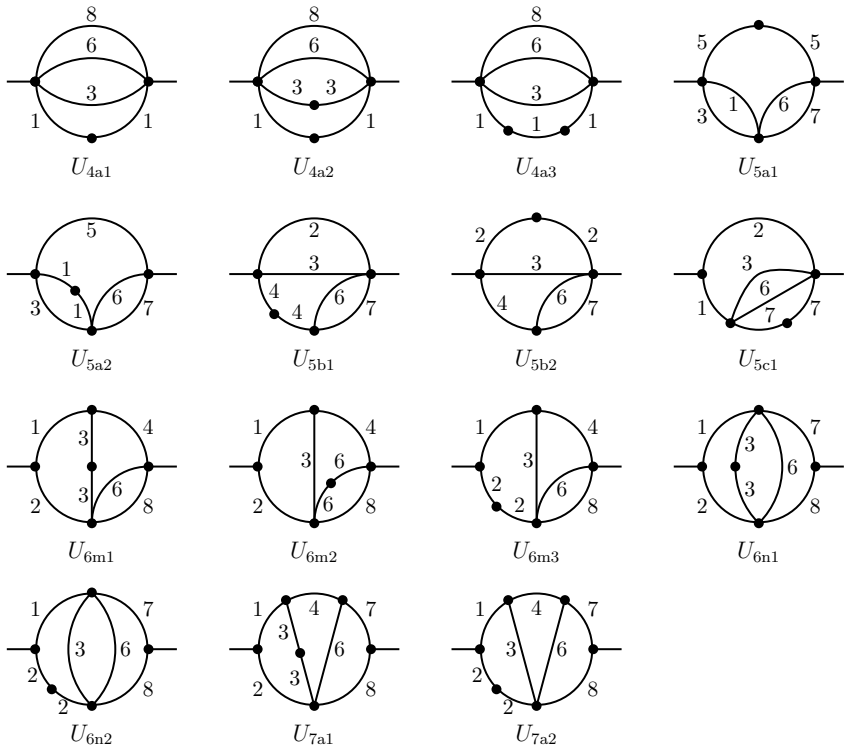
The two load-bearing devices are the sub-loop dispersion relation, which replaces each self-energy bubble by an integral over its discontinuity $\Delta B_0(s)$ weighted by $1/(s-q_2^2-i\varepsilon)$, and a modification of the triangle-based method of Ref. [15] that casts $U_{8a}$ (and $U_{7a}$) as a double integral over the one-loop vertex function $C_0(p^2,y,x,\ldots)$ times a phase-space factor $\sqrt{\lambda(x,y,p^2)}$, with the propagator denominators $x-m_4^2$ and $y-m_5^2$ split into residue plus principal value. These devices reduce every master integral to at most two dimensions and avoid complex contour deformation.
What would settle it
Evaluate $U_{8a}$ for $p^2=40$ and squared masses $m^2_1=1.1,\ldots,m^2_8=1.8$ using a third independent method, such as differential equations in $p^2$ matched to the known $p^2\to 0$ limit, and compare the imaginary part: one method gives $-0.16344185(2)$, the other gives $-0.016361(3)$. The value reproduced by the independent method settles which code, if either, is correct.
Extended reading notes
Core claim
The paper claims that all master integrals descending from the planar three-loop self-energy topology $U_{8a}$ that are needed for three-loop self-energy diagrams with two closed fermion loops can be evaluated numerically as one- or two-dimensional integrals over known functions, with arbitrary masses. Topologies with sub-loop self-energies are handled by dispersion relations that replace each sub-bubble by an integral over its discontinuity; topologies without sub-loop self-energies ($U_{7a}$, $U_{8a}$, and their doubled-propagator variants) are handled by writing the integral in terms of the one-loop triangle function $C_0$ in the variables $x=q^2$ and $y=(q+p)^2$, splitting each propagator pole into a residue plus principal value. UV divergences are removed by subtracting known vacuum and two-loop integrals, and the finite remainders are integrated with adaptive quadrature in C. The paper reports 6–10 digit precision for most master integrals, in run times from under a second to about twenty minutes, and documents agreement with FIESTA for almost all cases except the $U_{8a}$ imaginary part at large $p^2$.
Load-bearing premise
The accuracy claim for the flagship topology $U_{8a}$ stands on the assumption that TVID's imaginary part is right and the independent code's is wrong at $p^2=40$, a choice the paper makes without a third independent cross-check.
Editorial extensions
If this is right
- Planar three-loop self-energy diagrams with two closed fermion loops can be evaluated numerically with 6–10 digit precision for arbitrary masses in run times of seconds to minutes.
- The threshold region, where the integrals develop imaginary parts, is handled without complex contour deformation, so the reported precision does not degrade when $p^2$ lies above physical thresholds.
- The $O(\epsilon)$ parts of the two-loop subtraction functions cancel against counterterms in physical observables and therefore do not need to be evaluated explicitly.
- The method currently excludes IR-divergent parameter choices and the non-planar and Mercedes-star three-loop self-energy topologies, which would need separate treatments.
- For most master integrals the results agree with the independent code within integration errors, but for $U_{7a}$ and $U_{8a}$ the discrepancies exceed the reported errors, so the flagship topology's result needs independent confirmation before being used in predictions.
Reading between the lines
- If a third method confirms TVID's value for $\mathrm{Im}\,U_{8a}$ at $p^2=40$, the discrepancy would point to a systematic failure of contour-deformed sector decomposition above threshold and would motivate re-benchmarking such codes on imaginary parts.
- The residue/principal-value split separates dispersive and absorptive parts cleanly, so it could be combined with differential equations in the masses or in $p^2$ to produce semi-analytic results for the same master integrals.
- The same two-technique template (dispersion for sub-bubbles, $C_0$ double integrals for the rest) may extend to the missing non-planar and Mercedes-star three-loop self-energy topologies.
- Replacing the numerical mass differentiation used for $U_{6m1}$, $U_{6m3}$, $U_{6n2}$, $U_{7a1}$ and $U_{7a2}$ with analytic derivatives of the dispersion integrands would test whether the reduced 6–7 digit precision is a limitation of the implementation or of the representation.
Editorial analysis
A structured set of objections, weighed in public.
Referee Report
Summary. The manuscript presents TVID 2.0, a C/Mathematica package for the numerical evaluation of planar three-loop self-energy master integrals with arbitrary masses, focusing on the topology class needed for three-loop self-energy diagrams with two closed fermion loops. The method separates each master integral into a known UV-divergent subtraction part and a finite remainder, which is written as a one- or two-dimensional integral over known one-loop B0/C0 functions and simpler two-loop or vacuum integrals. Two techniques are used: sub-loop dispersion relations for topologies with sub-bubbles, and a modified Ghinculov-type representation for topologies with sub-loop triangles. Benchmark comparisons against FIESTA 4.1 are presented for p^2 below threshold (Table 2) and for p^2=40 with physical thresholds and imaginary parts (Table 3). The paper claims general 6-10 digit precision with run times from under a second to about 20 minutes, while also listing explicit limitations: no IR-divergent inputs, omitted O(epsilon) terms of some two-loop functions, reduced precision from numerical mass differentiation, and double-precision evaluation of C0 functions.
Significance. If the central claims are correct, TVID 2.0 is a genuinely useful tool for precision calculations in the Standard Model and BSM theories, since it covers a large class of three-loop self-energy master integrals that are difficult to obtain analytically. The paper is commendably concrete: the derivations for representative topologies in Section 3 and the subtraction formulas in Appendix A are explicit, the source code is made available, and the benchmark tables permit independent scrutiny. The use of FIESTA 4.1 as an independent cross-check is appropriate, since no parameters of TVID are fitted to FIESTA. However, the benchmark evidence contains at least one order-of-magnitude disagreement for the flagship topology U8a, and one further sign discrepancy in Table 2, so the paper's central accuracy claim is not fully established. The stated limitations also narrow the practical scope of the 'arbitrary masses' claim. These issues are fixable and do not, in my view, invalidate the approach.
major comments (3)
- [Sec. 4, Table 2 (U4a1 row)] At p^2=40, the imaginary part of U8a is -0.16344185(2) in TVID 2.0 and -0.016361(3) in FIESTA 4.1, an order-of-magnitude discrepancy that is roughly 5e4 times FIESTA's stated error. The real parts also differ by more than the combined quoted errors (0.01238717(2) versus 0.012353(3)). The paragraph after Table 3 attributes the disagreement to insufficient smoothness of FIESTA's contour-deformed sector decomposition, but no third independent method, analytic limit, threshold behavior check, or alternative numerical integration is supplied to show that TVID's value is the correct one. This matters because U8a is the only benchmark that exercises the double propagator poles at x=m4^2 and y=m5^2 and the branch-cut structure of the C0 functions in Eq. (9); the residue/principal-value prescription of Eq. (10) is therefore not independently validated. The adjacent U7a row also shows differences larger than the quoted errors. I request a third cross-check for U8a, or a correspondingly qualified statement of the accuracy claim for this topology.
- [Sec. 4, Table 2 (U4a1 row)] The table lists TVID 2.0 result -1.4651121210(1) for U4a1, while FIESTA 4.1 gives 1.465(3), i.e. opposite sign and no overlap. The text states that agreement is 'excellent' for almost all master integrals and does not comment on this row. If the sign difference is due to a convention in defining the mass derivative, or to a known limitation of FIESTA for this doubled-propagator case, this should be stated explicitly; otherwise this is a second unexplained failure of the benchmark and must be resolved before the general accuracy claim can be accepted.
- [Sec. 4, limitations; Sec. 5] The advertised scope is narrower than the phrase 'arbitrary masses' in the abstract may suggest. TVID 2.0 cannot handle IR-divergent inputs and does not check for them; several IR-finite but special parameter combinations are known to require treatment that is not yet implemented; the O(epsilon) terms T...,delta are omitted and are assumed to cancel in physical observables; and the mass-derivative masters U6m1, U6m3, U6n2, U7a1, U7a2 are evaluated by numerical differentiation, reducing their precision to 6-7 digits. These caveats are honestly stated, but the abstract and conclusions should reflect them, and the benchmark section should identify which master integrals and parameter regions are covered by the claimed 6-10 digit precision. As written, the accuracy claim applies only to a non-excluded, non-special subset.
minor comments (6)
- [Sec. 3.2] The sentence 'An simple method...' should read 'A simple method...'.
- [Sec. 3.3] 'In princple' should be 'In principle'.
- [Sec. 4] 'The numerical of TVID uses quadruple precision...' appears to be missing the word 'part'; should read 'The numerical part of TVID...'.
- [Sec. 5] 'TVID 2 contains also contains all the basic elements...' contains a duplicated verb; should read 'TVID 2 also contains...'.
- [Appendix B.2] The example directory is named 'vaccum.m' in the text; this appears to be a typo for 'vacuum.m'. The notation pm[n] for integration errors in UCallE output should be defined explicitly.
- [Sec. 4] The asymptotic cutoff parameter scut = c * p^2 is said to be 'suitably chosen' with c depending on the function, but no values or convergence tests are reported. Please provide the chosen constants or a reproducibility test for the choice of scut.
Circularity Check
No significant circularity: the finite-integral representations are constructed from standard one-loop B0/C0 functions and known low-loop integrals, and the benchmarks compare against the independent FIESTA package; the remaining U8a discrepancy is an external-validation gap, not a circular step.
full rationale
The derivation chain is self-contained in the relevant sense: the finite remainder formulas are exhibited in the paper itself, e.g. Eqs. (4)-(12) and Appendix A, starting from analytically known one-loop B0/C0 functions and previously established two-loop/vacuum integrals. The self-citations (TVID 1 [10], dispersion-relation papers [13,14], Bauberger's dissertation [20]) supply building blocks and techniques, not the target answer: the three-loop self-energy master integrals are not defined in terms of their own numerical output, nor is any parameter fitted to reproduce the comparison data. The benchmark comparisons use FIESTA 4.1 as an independent method, and the paper reports disagreement for U8a at p^2=40 (TVID gives Im = -0.16344185(2), FIESTA gives Im = -0.016361(3)). That is a genuine external-validation concern about which program is correct, and the paper's explanation that FIESTA's contour deformation may be insufficiently smooth is not independently established. However, this is a correctness risk, not circularity: neither result is constructed from the other, and no equation in the paper reduces the claimed prediction to its benchmark input. The stated limitations (no IR-divergent cases, missing O(eps) two-loop terms expected to cancel in physical observables, reduced precision for mass-derivative and C0-integral topologies) are honest scoping qualifications. Therefore no specific circular step can be exhibited, and the paper earns a low circularity score despite the unresolved validation gap.
Assumptions & free parameters
free parameters (2)
- asymptotic cutoff constant c (scut = c*p2) =
not specified; per-function values in code
- five-point stencil step size for numerical mass derivatives
assumptions (5)
- standard math The one-loop functions B0 and C0 are known analytically, and their discontinuities are given by Eqs. (3), (17)-(19).
- standard math Sub-loop dispersion relations of the form Eq. (2) are valid for one-loop self-energy sub-bubbles with arbitrary masses.
- standard math UV-subtraction terms reduce to known three-loop vacuum and two-loop master integrals via integration-by-parts identities.
- domain assumption The O(eps) parts T...,delta of the two-loop functions cancel in physical observables and can be omitted.
- domain assumption All user-supplied parameter choices are IR-finite.
Cite this review
Pith. "Pith review of TVID 2: Evaluation of planar-type three-loop self-energy integrals with arbitrary masses." pith.science (2026). https://pith.science/paper/67JNEYYI
@misc{pith2026190809887,
  author       = {Pith},
  title        = {Pith review of: TVID 2: Evaluation of planar-type three-loop self-energy integrals with arbitrary masses},
  year         = {2026},
  howpublished = {\url{https://pith.science/paper/67JNEYYI}},
  note         = {Machine review of arXiv:1908.09887}
}
read the original abstract
We present TVID 2, a program to numerically evaluate an important class of planar three-loop self-energy master integrals with arbitrary masses. As with the predecessor version (TVID 1) the integrals are separated into a known piece, containing the UV divergencies, and a finite piece that is integrated numerically, implemented in C. The set of master integrals under consideration was found with self-energy diagrams containing two closed fermion loops in mind. Two techniques are employed in deriving the expressions for the finite pieces that are then numerically integrated: (a) Sub-loop dispersion relations in the case of topologies containing sub-bubbles, and (b) a modification of the procedure suggested by Ghinculov for integrals with only sub-loop triangles.
Figures

Forward citations
Cited by 1 Pith paper
-
Fermionic Electroweak Two-Loop Corrections to Drell-Yan and Related Processes
The full NNLO electroweak corrections with closed fermion loops to e+e- → ffbar (and Drell-Yan) were calculated semi-numerically and found to modify NLO cross-sections by about 1%.
Reference graph
Works this paper leans on
-
[1]
A. Freitas, Prog. Part. Nucl. Phys. 90, 201 (2016) [arXiv:1604.00406 [hep-ph]]
arXiv 2016
-
[2]
E. Remiddi and J. A. M. Vermaseren, Int. J. Mod. Phys. A 15, 725 (2000) [hep-ph/9905237]
arXiv 2000
-
[3]
A. B. Goncharov, Math. Res. Lett. 5, 497 (1998) [arXiv:1105.2076 [math.AG]]; T. Gehrmann and E. Remiddi, Nucl. Phys. B 601, 248 (2001) [hep-ph/0008287]; T. Gehrmann and E. Remiddi, Comput. Phys. Commun. 144, 200 (2002) [hep-ph/0111255]; J. Vollinga and S. Weinzierl, Comput. Phys. Commu n. 167, 177 (2005) [hep-ph/0410259]
arXiv 1998
-
[4]
A. Levin, Compos. Math. 106, 267 (1997); A. Levin and G. Racinet, math/0703237; S. Bloch and P. Vanhove, J. Number Theor. 148, 328 (2015) [arXiv:1309.5865 [hep- th]]; L. Adams, C. Bogner and S. Weinzierl, J. Math. Phys. 55, no. 10, 102301 (2014) [arXiv:1405.5640 [hep-ph]]; L. Adams and S. Weinzierl, Commun. Num. Th eor. Phys. 12, 193 (2018) [arXiv:1704.08...
arXiv 1997
- [5]
-
[6]
SecDec: A general program for sector decomposition
J. Carter and G. Heinrich, Comput. Phys. Commun. 182, 1566 (2011) [arXiv:1011.5493 [hep-ph]]; S. Borowka, J. Carter and G. Heinrich, Comput. Phys. Co mmun. 184, 396 (2013) [arXiv:1204.4152 [hep-ph]]; S. Borowka, G. Heinrich, S. P. Jon es, M. Kerner, J. Schlenk and T. Zirke, Comput. Phys. Commun. 196, 470 (2015) [arXiv:1502.06595 [hep-ph]]; S. Borowka, G. ...
work page Pith review arXiv 2011
-
[7]
A. V. Smirnov and M. N. Tentyukov, Comput. Phys. Commun. 180, 735 (2009) [arXiv:0807.4129 [hep-ph]]; A. V. Smirnov, V. A. Smirnov and M. Tentyu kov, Comput. Phys. Commun. 182, 790 (2011) [arXiv:0912.0158 [hep-ph]]; A. V. Smirnov, Comput. Phys. Commun. 185, 2090 (2014) [arXiv:1312.3186 [hep-ph]]
arXiv 2009
-
[8]
A. V. Smirnov, Comput. Phys. Commun. 204, 189 (2016) [arXiv:1511.03614 [hep-ph]]
arXiv 2016
Show all 26 references
-
[9]
Gluza, K
J. Gluza, K. Kajda and T. Riemann, Comput. Phys. Commun. 177, 879 (2007) [arXiv:0704.2423 [hep-ph]]; J. Gluza, K. Kajda, T. Riemann and V. Yund in, Eur. Phys. J. C 71, 1516 (2011) [arXiv:1010.1667 [hep-ph]]; I. Dubovyk, J. Gluza and T . Rie- mann, J. Phys. Conf. Ser. 608, no. ...
2007 arXiv
-
[10]
Freitas, JHEP 1611, 145 (2016) [arXiv:1609.09159 [hep-ph]]
A. Freitas, JHEP 1611, 145 (2016) [arXiv:1609.09159 [hep-ph]]
2016 arXiv
- [11]
-
[12]
S. P. Martin and D. G. Robertson, Phys. Rev. D 95, no. 1, 016008 (2017) [arXiv:1610.07720 [hep-ph]]
2017 arXiv
-
[13]
Bauberger, F
S. Bauberger, F. A. Berends, M. B¨ ohm and M. Buza, Nucl. Phy s. B 434, 383 (1995) [hep-ph/9409388]
1995 arXiv
-
[14]
Bauberger and M
S. Bauberger and M. B¨ ohm, Nucl. Phys. B 445, 25 (1995) [hep-ph/9501201]
1995 arXiv
- [15]
- [16]
-
[17]
A. V. Smirnov, Comput. Phys. Commun. 189, 182 (2015) [arXiv:1408.2372 [hep-ph]]
2015 arXiv
-
[18]
Weiglein, R
G. Weiglein, R. Scharf and M. B¨ ohm, Nucl. Phys. B 416, 606 (1994) [hep-ph/9310358]. 24
1994 arXiv
-
[19]
’t Hooft and M
G. ’t Hooft and M. J. G. Veltman, Nucl. Phys. B 153, 365 (1979); G. J. van Oldenborgh and J. A. M. Vermaseren, Z. Phys. C 46, 425 (1990); A. Denner, Fortsch. Phys. 41, 307 (1993) [arXiv:0709.1075 [hep-ph]]
1979 arXiv
-
[20]
Two-loop Contributions to Muon Decay,
S. Bauberger, “Two-loop Contributions to Muon Decay,” Disser tation, Universit¨ at W¨ urzburg (1997)
1997
-
[21]
A. I. Davydychev and J. B. Tausk, Nucl. Phys. B 397, 123 (1993)
1993
-
[22]
C. Ford, I. Jack and D. R. T. Jones, Nucl. Phys. B 387, 373 (1992) [Erratum-ibid. 504, 551 (1997)] [hep-ph/0111190]; R. Scharf and J. B. Tausk, Nucl. Phys. B 412, 523 (1994)
1992 arXiv
-
[23]
Mathematica, Version 10.2,
Wolfram Research, Inc., “Mathematica, Version 10.2,” Champaig n, Illinois, USA (2015)
2015
-
[24]
QUADPACK, A Subroutine Package for Automatic Integration, Springer,
R. Piessens, E. de Doncker-Kapenga, C. W. ¨Uberhuber, D. K. Kahanger, “QUADPACK, A Subroutine Package for Automatic Integration, Springer,” Berlin (1983)
1983
-
[25]
Briggs, doubledouble version 2.2, boutell.com/fracster-src/doubledouble/doubledouble.html
K. Briggs, doubledouble version 2.2, boutell.com/fracster-src/doubledouble/doubledouble.html
-
[26]
Hahn and M
T. Hahn and M. Perez-Victoria, Comput. Phys. Commun. 118, 153 (1999) [hep-ph/9807565], www.feynarts.de/looptools. 25
1999 arXiv
Reviewed August 14, 2026 · model on record in the stance chip above.
Discussion (0). Continue with ORCID to comment.