REVIEW 1 major objections 2 minor 54 references
Filament flexibility optimizes transport in disordered obstacle arrays at intermediate values but favors semiflexible filaments in ordered arrays.
Reviewed by Pith at T0; open to challenge. T0 means a machine referee read the full paper against a public rubric. the ladder, T0–T4 →
T0 review · grok-4.3
2026-06-26 06:01 UTC pith:67QX72P5
load-bearing objection Simulations map three flexibility-dependent transport regimes for active filaments in ordered versus disordered obstacles, but the long-time diffusion assumption needs direct checks. the 1 major comments →
Flexibility Controls Active-Filament Transport in Crowded Landscapes
The pith
A machine-rendered reading of the paper's core claim, the machinery that carries it, and where it could break.
Core claim
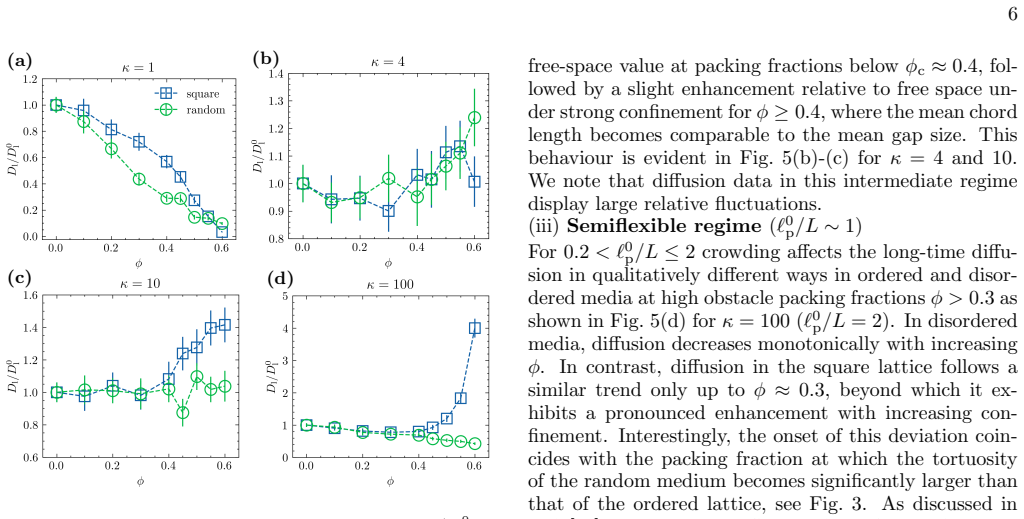
Active filaments moving through obstacle arrays exhibit three distinct transport regimes determined by their flexibility. Highly flexible filaments undergo tortuosity-controlled diffusion via trapping-and-hopping. Moderately flexible ones benefit from confinement-assisted transport that enhances diffusion in dense media. Semiflexible filaments show persistence-controlled transport that aids diffusion in ordered arrays but hinders it in disordered ones. Long-time diffusion is governed by confinement-induced changes in filament conformation and reorientation dynamics.
What carries the argument
Three transport regimes (tortuosity-controlled, confinement-assisted, persistence-controlled) extracted from simulations of tangentially driven active polymers in ordered versus disordered obstacle arrays.
Load-bearing premise
The Brownian dynamics model with tangential driving and the chosen obstacle interactions produces long-time diffusion statistics representative of real active filaments without major finite-time or finite-size artifacts.
What would settle it
Measuring that semiflexible filaments do not exhibit faster long-time diffusion than intermediate-flexibility ones in dense ordered arrays, or that highly flexible filaments lack trapping-and-hopping dynamics, would falsify the regime distinctions.
If this is right
- In disordered environments transport peaks at intermediate filament flexibility.
- In dense ordered arrays semiflexible filaments gain mobility through directed motion along periodic channels.
- Long-time diffusion is set by confinement-induced shifts in filament shape and turning rates.
- The three regimes organize behavior across the full range of flexibility and obstacle density.
Where Pith is reading between the lines
- The regime map could guide design of synthetic filaments or microrobots for targeted navigation through specific porous materials.
- Similar flexibility-medium interactions may govern transport of other deformable active objects such as cells or worms in heterogeneous settings.
- Varying driving forces or obstacle interaction rules in follow-up simulations could expose additional regimes or crossovers.
- Direct comparison of the simulated regimes against experiments on bacterial filaments or microtubules in fabricated obstacle arrays would test the predicted optima.
Editorial analysis
A structured set of objections, weighed in public.
Referee Report
Summary. The manuscript uses large-scale Brownian dynamics simulations of tangentially driven active polymers in ordered and disordered obstacle arrays to map long-time diffusion coefficients versus filament flexibility and obstacle density. It reports that flexibility can enhance or hinder transport depending on medium structure, with non-monotonic behavior in disordered media and enhanced mobility for semiflexible filaments in dense ordered arrays. Three regimes are identified—tortuosity-controlled (highly flexible), confinement-assisted (moderately flexible), and persistence-controlled (semiflexible)—and linked via theory to confinement-induced changes in conformation and reorientation dynamics.
Significance. If the long-time diffusive regime is confirmed across parameters, the work provides a predictive framework for deformable active agents in heterogeneous porous media, with relevance to biological systems such as motor-driven filaments. Strengths include the systematic exploration of flexibility and ordering effects and the combination of simulation with theoretical interpretation of microscopic mechanisms.
major comments (1)
- [Results / Simulation Methods] The identification of three distinct transport regimes and the reported non-monotonic dependence of diffusion on flexibility rest on the assumption that mean-squared displacements have entered the asymptotic linear regime for every combination of bending rigidity, obstacle density, and ordering. The manuscript should provide explicit validation (e.g., time-dependent effective diffusion coefficients or MSD plots spanning multiple decades) in the Results or Methods section to rule out finite-time artifacts from trapping or channeling.
minor comments (2)
- [Abstract] The abstract states that 'long-time diffusion' is mapped but does not specify the observation times, system sizes, or convergence criteria used; adding a brief statement on these would improve clarity.
- [Introduction / Model] Notation for the bending rigidity and driving force should be defined consistently when first introduced in the main text.
Simulated Author's Rebuttal
We thank the referee for their constructive feedback on our manuscript. The single major comment raises a valid methodological point about confirming the long-time diffusive regime, which we address below by agreeing to add explicit validation.
read point-by-point responses
-
Referee: [Results / Simulation Methods] The identification of three distinct transport regimes and the reported non-monotonic dependence of diffusion on flexibility rest on the assumption that mean-squared displacements have entered the asymptotic linear regime for every combination of bending rigidity, obstacle density, and ordering. The manuscript should provide explicit validation (e.g., time-dependent effective diffusion coefficients or MSD plots spanning multiple decades) in the Results or Methods section to rule out finite-time artifacts from trapping or channeling.
Authors: We agree that explicit confirmation of the asymptotic regime strengthens the claims. Although our Brownian dynamics runs were extended until the effective diffusion coefficient D_eff(t) = MSD(t)/(4t) plateaued for all reported parameter sets (with total simulation times exceeding 10^4 persistence times in the densest cases), we did not include these diagnostic plots. In the revised manuscript we will add, in a new subsection of the Methods and representative panels in the Results, time-dependent D_eff(t) curves and log-log MSD plots spanning at least three decades for representative combinations of bending rigidity, obstacle density, and ordering. These will demonstrate that the quoted long-time diffusivities are free of transient trapping or channeling artifacts. revision: yes
Circularity Check
No circularity: results are direct simulation outputs
full rationale
The manuscript reports long-time diffusion coefficients and transport regimes obtained from explicit Brownian dynamics simulations of tangentially driven polymers interacting with obstacle arrays. No load-bearing step reduces a reported quantity (e.g., D or regime boundaries) to an input parameter by construction, nor does any equation or self-citation chain equate a prediction to its own fitted value. The three regimes are classified post hoc from measured MSD, conformation, and reorientation statistics; the mapping itself is not tautological. The derivation chain is therefore self-contained against external benchmarks.
Axiom & Free-Parameter Ledger
axioms (1)
- domain assumption Brownian dynamics simulations with tangential driving accurately reproduce the long-time diffusive behavior of active filaments in obstacle arrays
read the original abstract
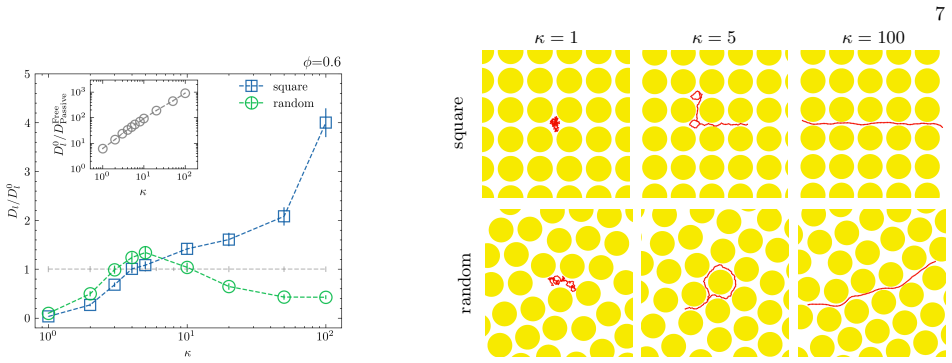
Active filaments, ranging from motor-driven biopolymers to elongated bacteria and worms, are paradigmatic examples of deformable active matter. How filament flexibility interacts with environmental heterogeneity to control their transport in crowded environments, however, remains poorly understood. Here, we perform large-scale Brownian dynamics simulations of tangentially driven active polymers moving through ordered and disordered obstacle arrays to map the long-time diffusion as a function of obstacle density and filament flexibility. We find that flexibility can either enhance or hinder transport depending on the structure of the medium. In disordered environments, transport is optimized at intermediate filament flexibility, whereas both highly flexible and semiflexible filaments diffuse more slowly. In contrast, dense ordered arrays enhance the mobility of semiflexible filaments by promoting directed motion along periodic channels. We identify three distinct transport regimes: (i) tortuosity-controlled diffusion of highly flexible filaments, characterized by trapping-and-hopping dynamics; (ii) confinement-assisted transport of moderately flexible filaments, which enhances diffusion in dense media; and (iii) persistence-controlled transport of semiflexible filaments, which facilitates diffusion in dense ordered media, but suppresses it in disordered media. Combining theory and simulations, we show that long-time diffusion is governed by confinement-induced changes in filament conformation and reorientation dynamics. Our work uncovers general transport principles for deformable active agents in heterogeneous environments and provides a predictive framework for active-filament navigation in complex porous landscapes.
Figures







Reference graph
Works this paper leans on
-
[1]
Square Lattice We place obstacles on the lattice sites of 2D square lattices
Generation of porous media with different configurations a. Square Lattice We place obstacles on the lattice sites of 2D square lattices. The simulation box has approximate side lengthL box ≈120σwith periodic boundary conditions. The lattice constant for a prescribed obstacle packing fraction isa= p π/ϕRo. The corresponding channel width isξ= ( p π/ϕ−2)R ...
-
[2]
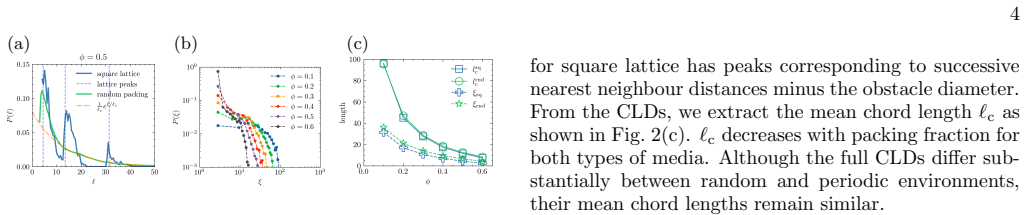
Characteristic length scales of porous media Here, we discuss and characterize the relevant geomet- ric length scales of the porous medium. A key measure is the chord length, defined as the length of a straight line segment that lies entirely within the pore phase and connects two points on the obstacle surface, see Fig. 1(b). It provides a geometric prox...
-
[3]
Tortuosity is a scale-invariant geometric property of the medium and can be defined in several ways
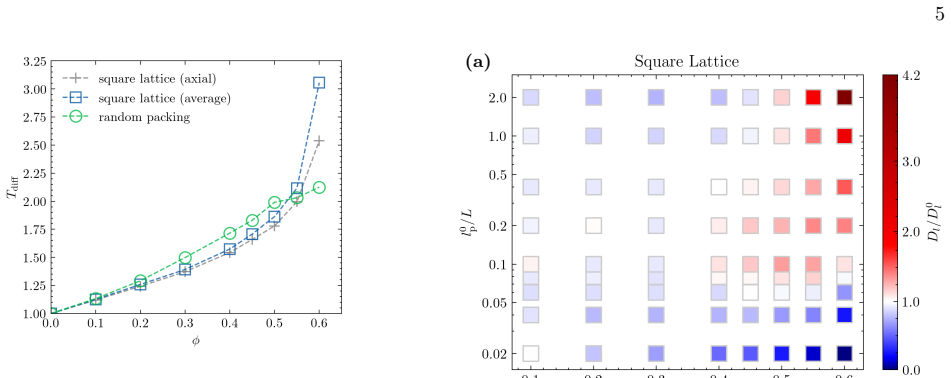
Tortuosity of ordered and random media Another important geometric characteristic of porous media is the tortuosity, which quantifies how strongly transport pathways through the pore space deviate from straight lines. Tortuosity is a scale-invariant geometric property of the medium and can be defined in several ways. Here, we focus on the bulk-diffusion t...
-
[4]
adopt collapsed conformations and remain primarily trapped within pore spaces in both ordered and disor- dered media with occasional hopping events in which polymers transiently extend to pass through the nar- row channels; (ii) moderately flexible polymers (κ= 5) whose persistence length is comparable to the obstacle size bend around multiple obstacles t...
-
[5]
comparable magnitude, except for the caseκ= 1 and ϕ= 0.6 on a square lattice, where⟨τ⟩is significantly smaller thanτ k and exhibits large uncertainty
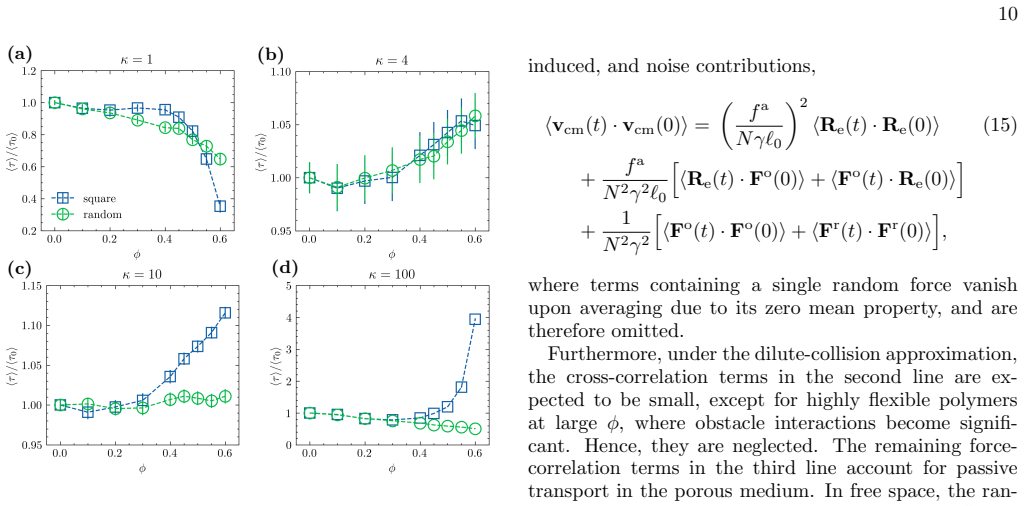
Panels (c) and (d) show the corresponding fitted relax- ation timeτ k and mean relaxation time⟨τ⟩=τ kΓ(1/β)/β, for square-lattice and random packings as a function ofϕ. comparable magnitude, except for the caseκ= 1 and ϕ= 0.6 on a square lattice, where⟨τ⟩is significantly smaller thanτ k and exhibits large uncertainty. Figure 12 shows the mean relaxation t...
-
[6]
Polymer physics of the cy- toskeleton,
Q. Wen and P. A. Janmey, “Polymer physics of the cy- toskeleton,”Current Opinion in Solid State and Materi- als Science, vol. 15, no. 5, pp. 177–182, 2011
2011
-
[7]
The genera beggiatoa and thioploca,
A. Teske and D. C. Nelson, “The genera beggiatoa and thioploca,”Prokaryotes, vol. 6, pp. 784–810, 2006
2006
-
[8]
Gliding motility driven by individual cell-surface movements in a multicellular filamentous bac- terium chloroflexus aggregans,
S.-i. Fukushima, S. Morohoshi, S. Hanada, K. Matsuura, and S. Haruta, “Gliding motility driven by individual cell-surface movements in a multicellular filamentous bac- terium chloroflexus aggregans,”FEMS Microbiology Let- ters, vol. 363, no. 8, p. fnw056, 2016
2016
-
[9]
Motil- ity of small nematodes in wet granular media,
G. Juarez, K. Lu, J. Sznitman, and P. E. Arratia, “Motil- ity of small nematodes in wet granular media,”Euro- physics Letters, vol. 92, no. 4, p. 44002, 2010
2010
-
[10]
Locomotion of active polymerlike worms in porous media,
R. Sinaasappel, M. Fazelzadeh, T. Hooijschuur, Q. Di, S. Jabbari-Farouji, and A. Deblais, “Locomotion of active polymerlike worms in porous media,”Physical Review Letters, vol. 134, no. 12, p. 128303, 2025
2025
-
[11]
From strings to coils: Rotational dynamics of dna-linked colloidal chains,
S. Kuei, B. Garza, and S. L. Biswal, “From strings to coils: Rotational dynamics of dna-linked colloidal chains,”Physical Review Fluids, vol. 2, no. 10, p. 104102, 2017
2017
-
[12]
Autonomous life-like behavior emerging in active and flexible microstructures,
M. Wei and D. J. Kraft, “Autonomous life-like behavior emerging in active and flexible microstructures,”arXiv preprint arXiv:2506.15198, 2025
-
[13]
Chainform: a linear integrated modular hardware system for shape changing interfaces,
K. Nakagaki, A. Dementyev, S. Follmer, J. A. Paradiso, and H. Ishii, “Chainform: a linear integrated modular hardware system for shape changing interfaces,” inPro- ceedings of the 29th Annual Symposium on User Interface Software and Technology, pp. 87–96, 2016
2016
-
[14]
Active transport in complex environments,
A. Mart´ ınez-Calvo, C. Trenado-Yuste, and S. S. Datta, “Active transport in complex environments,” 2023
2023
-
[15]
Burrowing dynamics of aquatic worms in soft sediments,
A. Kudrolli and B. Ramirez, “Burrowing dynamics of aquatic worms in soft sediments,”Proceedings of the Na- tional Academy of Sciences, vol. 116, no. 51, pp. 25569– 25574, 2019
2019
-
[16]
Physical confinement regulates transitions in nema- tode motility,
M. Sreepadmanabh, S. Dey, S. Kundu, A. B. Arun, S. P. Koushika, S. Thutupalli, D. Hewitt, and T. Bhattachar- jee, “Physical confinement regulates transitions in nema- tode motility,”PRX Life, vol. 3, no. 4, p. 043014, 2025
2025
-
[17]
Trypanosome motion represents an adaptation to the crowded environment of the vertebrate bloodstream,
N. Heddergott, T. Kr¨ uger, S. B. Babu, A. Wei, E. Stel- lamanns, S. Uppaluri, T. Pfohl, H. Stark, and M. En- gstler, “Trypanosome motion represents an adaptation to the crowded environment of the vertebrate bloodstream,” PLoS pathogens, vol. 8, no. 11, p. e1003023, 2012
2012
-
[18]
Microstruc- tured blood vessel surrogates reveal structural tropism of motile malaria parasites,
M. J. Muthinja, J. Ripp, J. K. Hellmann, T. Ha- raszti, N. Dahan, L. Lemgruber, A. Battista, L. Sch¨ utz, O. T. Fackler, U. S. Schwarz,et al., “Microstruc- tured blood vessel surrogates reveal structural tropism of motile malaria parasites,”Advanced Healthcare Mate- rials, vol. 6, no. 6, p. 1601178, 2017
2017
-
[19]
Multivalent cross- linking of actin filaments and microtubules through the microtubule-associated protein tau,
Y. Cabrales Fontela, H. Kadavath, J. Biernat, D. Riedel, E. Mandelkow, and M. Zweckstetter, “Multivalent cross- linking of actin filaments and microtubules through the microtubule-associated protein tau,”Nature communica- tions, vol. 8, no. 1, p. 1981, 2017
1981
-
[20]
Active particles in complex and crowded environments,
C. Bechinger, R. Di Leonardo, H. L¨ owen, C. Reichhardt, G. Volpe, and G. Volpe, “Active particles in complex and crowded environments,”Reviews of modern physics, vol. 88, no. 4, p. 045006, 2016
2016
-
[21]
Swimming in a crystal,
A. T. Brown, I. D. Vladescu, A. Dawson, T. Vissers, J. Schwarz-Linek, J. S. Lintuvuori, and W. C. Poon, “Swimming in a crystal,”Soft matter, vol. 12, no. 1, pp. 131–140, 2016
2016
-
[22]
Active brownian par- 15 ticles moving in a random lorentz gas,
M. Zeitz, K. Wolff, and H. Stark, “Active brownian par- 15 ticles moving in a random lorentz gas,”The European Physical Journal E, vol. 40, no. 2, p. 23, 2017
2017
-
[23]
Optimized diffusion of run-and-tumble particles in crowded environments,
T. Bertrand, Y. Zhao, O. B´ enichou, J. Tailleur, and R. Voituriez, “Optimized diffusion of run-and-tumble particles in crowded environments,”Physical Review Let- ters, vol. 120, no. 19, p. 198103, 2018
2018
-
[24]
Transport and dispersion of active particles in periodic porous media,
R. Alonso-Matilla, B. Chakrabarti, and D. Saintillan, “Transport and dispersion of active particles in periodic porous media,”Physical Review Fluids, vol. 4, no. 4, p. 043101, 2019
2019
-
[25]
Mechanisms of transport enhancement for self-propelled nanoswim- mers in a porous matrix,
H. Wu, B. Greydanus, and D. K. Schwartz, “Mechanisms of transport enhancement for self-propelled nanoswim- mers in a porous matrix,”Proceedings of the National Academy of Sciences, vol. 118, no. 27, p. e2101807118, 2021
2021
-
[26]
Invariance properties of bacterial random walks in complex struc- tures,
G. Frangipane, G. Vizsnyiczai, C. Maggi, R. Savo, A. Sciortino, S. Gigan, and R. Di Leonardo, “Invariance properties of bacterial random walks in complex struc- tures,”Nature Communications, vol. 10, no. 1, p. 2442, 2019
2019
-
[27]
Enhanced propagation of motile bacteria on surfaces due to forward scattering,
S. Makarchuk, V. C. Braz, N. A. Ara´ ujo, L. Ciric, and G. Volpe, “Enhanced propagation of motile bacteria on surfaces due to forward scattering,”Nature Communica- tions, vol. 10, no. 1, p. 4110, 2019
2019
-
[28]
Bacterial hopping and trapping in porous media,
T. Bhattacharjee and S. S. Datta, “Bacterial hopping and trapping in porous media,”Nature communications, vol. 10, no. 1, p. 2075, 2019
2075
-
[29]
Self- transport of swimming bacteria is impaired by porous microstructure,
A. Dehkharghani, N. Waisbord, and J. S. Guasto, “Self- transport of swimming bacteria is impaired by porous microstructure,”Communications Physics, vol. 6, no. 1, p. 18, 2023
2023
-
[30]
Coarse-graining bacterial diffusion in disordered media to surface states,
H. H. Mattingly, “Coarse-graining bacterial diffusion in disordered media to surface states,”Proceedings of the National Academy of Sciences, vol. 122, no. 12, p. e2407313122, 2025
2025
-
[31]
Bacterial motility patterns vary smoothly with spatial confinement and disorder,
H. Zhang, M. T. Wetherington, H. Ko, C. E. FitzGer- ald, L. V. Luzzatto, I. A. Kov´ acs, E. M. Munro, and J. A. Nirody, “Bacterial motility patterns vary smoothly with spatial confinement and disorder,”PRX Life, vol. 4, no. 1, p. 013002, 2026
2026
-
[32]
Dynamics of active fila- ments in porous media,
Z. Mokhtari and A. Zippelius, “Dynamics of active fila- ments in porous media,”Physical review letters, vol. 123, no. 2, p. 028001, 2019
2019
-
[33]
Facilitated dynamics of an active polymer in 2d crowded environments with obstacles,
S. Wu, J.-X. Li, and Q.-L. Lei, “Facilitated dynamics of an active polymer in 2d crowded environments with obstacles,”Soft Matter, vol. 18, no. 48, pp. 9263–9272, 2022
2022
-
[34]
Active dynamics of linear chains and rings in porous media,
L. Theeyancheri, S. Chaki, T. Bhattacharjee, and R. Chakrabarti, “Active dynamics of linear chains and rings in porous media,”The Journal of Chemical Physics, vol. 159, no. 1, 2023
2023
-
[35]
Conformation and dynamics of an active filament in crowded media,
R. Yan, F. Tan, J. Wang, and N. Zhao, “Conformation and dynamics of an active filament in crowded media,” The Journal of Chemical Physics, vol. 158, no. 11, 2023
2023
-
[36]
Active motion of tangentially driven polymers in periodic array of obstacles,
M. Fazelzadeh, Q. Di, E. Irani, Z. Mokhtari, and S. Jabbari-Farouji, “Active motion of tangentially driven polymers in periodic array of obstacles,”The Journal of Chemical Physics, vol. 159, no. 22, 2023
2023
-
[37]
Experiments and theory of undulatory locomotion in a simple structured medium,
T. Majmudar, E. E. Keaveny, J. Zhang, and M. J. Shel- ley, “Experiments and theory of undulatory locomotion in a simple structured medium,”Journal of the Royal Society Interface, vol. 9, no. 73, pp. 1809–1823, 2012
2012
-
[38]
Diffusion of bacterial cells in porous media,
N. A. Licata, B. Mohari, C. Fuqua, and S. Setayeshgar, “Diffusion of bacterial cells in porous media,”Biophysical Journal, vol. 110, no. 1, pp. 247–257, 2016
2016
-
[39]
The topography of the environ- ment alters the optimal search strategy for active parti- cles,
G. Volpe and G. Volpe, “The topography of the environ- ment alters the optimal search strategy for active parti- cles,”Proceedings of the National Academy of Sciences, vol. 114, no. 43, pp. 11350–11355, 2017
2017
-
[40]
A geometric criterion for the optimal spreading of active polymers in porous media,
C. Kurzthaler, S. Mandal, T. Bhattacharjee, H. L¨ owen, S. S. Datta, and H. A. Stone, “A geometric criterion for the optimal spreading of active polymers in porous media,”Nature communications, vol. 12, no. 1, p. 7088, 2021
2021
-
[41]
The role of disorder in the motion of chiral active particles in the presence of obstacles,
D. M. Van Roon, G. Volpe, M. M. T. da Gama, and N. A. Ara´ ujo, “The role of disorder in the motion of chiral active particles in the presence of obstacles,”Soft Matter, vol. 18, no. 36, pp. 6899–6906, 2022
2022
-
[42]
Universal law for the dis- persal of motile microorganisms in porous media,
T. Pietrangeli, R. Foffi, R. Stocker, C. Ybert, C. Cottin- Bizonne, and F. Detcheverry, “Universal law for the dis- persal of motile microorganisms in porous media,”Phys- ical Review Letters, vol. 134, no. 18, p. 188303, 2025
2025
-
[43]
Geometry of disordered porous environments regulates cell migration,
L. W¨ urthner and F. Graw, “Geometry of disordered porous environments regulates cell migration,”Phys. Rev. E, vol. 113, p. 014407, Jan 2026
2026
-
[44]
The physics of ac- tive polymers and filaments,
R. G. Winkler and G. Gompper, “The physics of ac- tive polymers and filaments,”The journal of chemical physics, vol. 153, no. 4, 2020
2020
-
[45]
Controlling the direction of kinesin-driven microtubule movements along microlithographic tracks,
Y. Hiratsuka, T. Tada, K. Oiwa, T. Kanayama, and T. Q. Uyeda, “Controlling the direction of kinesin-driven microtubule movements along microlithographic tracks,” Biophysical Journal, vol. 81, no. 3, pp. 1555–1561, 2001
2001
-
[46]
Self- propelled worm-like filaments: spontaneous spiral for- mation, structure, and dynamics,
R. E. Isele-Holder, J. Elgeti, and G. Gompper, “Self- propelled worm-like filaments: spontaneous spiral for- mation, structure, and dynamics,”Soft matter, vol. 11, no. 36, pp. 7181–7190, 2015
2015
-
[47]
Statis- tical properties of a tangentially driven active filament,
M. S. Peterson, M. F. Hagan, and A. Baskaran, “Statis- tical properties of a tangentially driven active filament,” Journal of Statistical Mechanics: Theory and Experi- ment, vol. 2020, no. 1, p. 013216, 2020
2020
-
[48]
Tan- gentially driven active polar linear polymers—an analyt- ical study,
C. A. Philipps, G. Gompper, and R. G. Winkler, “Tan- gentially driven active polar linear polymers—an analyt- ical study,”The Journal of Chemical Physics, vol. 157, no. 19, 2022
2022
-
[49]
Effects of inertia on conformation and dynamics of tangentially driven active filaments,
M. Fazelzadeh, E. Irani, Z. Mokhtari, and S. Jabbari- Farouji, “Effects of inertia on conformation and dynamics of tangentially driven active filaments,”Physical Review E, vol. 108, no. 2, p. 024606, 2023
2023
-
[50]
Inertia and activity: Spiral transitions in semi-flexible, self-avoiding polymers,
C. Karan, A. Chaudhuri, and D. Chaudhuri, “Inertia and activity: Spiral transitions in semi-flexible, self-avoiding polymers,”arXiv preprint arXiv:2404.15748, 2024
-
[51]
Pseudo-random number generation for brownian dy- namics and dissipative particle dynamics simulations on gpu devices,
C. L. Phillips, J. A. Anderson, and S. C. Glotzer, “Pseudo-random number generation for brownian dy- namics and dissipative particle dynamics simulations on gpu devices,”Journal of Computational Physics, vol. 230, no. 19, pp. 7191–7201, 2011
2011
-
[52]
Chord-length and free-path dis- tribution functions for many-body systems,
B. Lu and S. Torquato, “Chord-length and free-path dis- tribution functions for many-body systems,”The Journal of chemical physics, vol. 98, no. 8, pp. 6472–6482, 1993
1993
-
[53]
Porespy: A python toolkit for quantitative analysis of porous media images,
J. T. Gostick, Z. A. Khan, T. G. Tranter, M. D. Kok, M. Agnaou, M. Sadeghi, and R. Jervis, “Porespy: A python toolkit for quantitative analysis of porous media images,”Journal of Open Source Software, vol. 4, no. 37, p. 1296, 2019
2019
-
[54]
Tortuosity in porous media: a critical review,
B. Ghanbarian, A. G. Hunt, R. P. Ewing, and M. Sahimi, “Tortuosity in porous media: a critical review,”Soil sci- ence society of America journal, vol. 77, no. 5, pp. 1461– 1477, 2013
2013
discussion (0)
Sign in with ORCID, Apple, or X to comment. Anyone can read and Pith papers without signing in.