REVIEW 6 minor 28 references
QuoteBench: How Matched Scores Can Hide Command-Path Failures
T0 review · 0 major / 6 minor · reviewed 2026-08-14 · deepseek-v4-flash
Pith's one-line read Matched execution scores can hide command-path failures: replaying the same stored reply through one added parser costs 55.4–73.2 points, and disclosing the boundary recovers 30.4–60.7, so a near-zero matched gap can mask two large…
desk verdict The fixed-reply crossover design actually delivers: matched scores here demonstrably hide a large transport effect, and the paper is unusually honest about where it could still be wrong. read the letter →
The pith
A machine-rendered reading of the paper's core claim, the machinery that carries it, and where it could break.
The reading
What carries the argument
The crossed $2\times2$ design with cells $RR$, $RN$, $NR$, $NN$, where generation contract precedes transport, together with the identity $Y_{NN}-Y_{RR} = (Y_{RN}-Y_{RR}) + (Y_{NN}-Y_{RN})$. The "nested transport" is one deliberately unescaped double-quoted parser added to the command path, standing in for remote, container, or CI wrappers. Fixed-reply replay keeps the stored command constant so any change between $RR$ and $RN$ is attributable to the parser, and exact final-state validators score only the resulting files, argument vectors, JSON, directory state, or Git history. Escaping at the interpolation point reproduces raw-path outcomes, closing the attribution loop by showing the damage is removed when the boundary is handled correctly.
What would settle it
Re-run the 448 public fixed-reply pairs with correct escaping at the interpolation point: the paper's claim predicts that every raw-path success is restored. A single pair in which correct escaping does not restore the raw-path outcome, or a validator false accept or reject found by additional mutation classes, would break the attribution of the loss to the unescaped parser.
Extended reading notes
Core claim
The central discovery is an empirical decomposition: matched score equals transport damage plus contract-conditioned compensation, where damage is fixed-reply transport loss and compensation is the recovery from telling the model about the boundary. Using 56 tasks and exact final-state validation, the paper crosses generation contract (raw versus disclosed-boundary) with execution transport (raw versus a nested double-quoted parser). Fixed-reply replay, comparing $RN$ against $RR$, shows a loss in every configuration; the disclosed-boundary contract, comparing $NN$ against $RN$, recovers most of it in six configurations. Correct escaping at the interpolation point reproduces the raw-path outcome for all 448 public pairs, so the loss is attributable to the unescaped transform rather than to model error. The paper concludes that matched scores should be reported alongside the full command path, and that raw generation is nearly saturated at the frontier while boundary adaptation is what still separates models.
Load-bearing premise
The load-bearing premise is that the final-state validators and the execution harness correctly classify success on both the raw and nested paths for all 56 tasks; the paper acknowledges that other validator blind spots may remain, and a wrong accept or reject would shift the damage and compensation numbers.
Editorial extensions
If this is right
- A matched execution score alone cannot tell whether a model generated a wrong command or a correct command that was mangled by the execution path.
- Model leaderboards are path-dependent: one unambiguous reversal and four single-task-margin reversals appear when comparing raw and nested orderings, so rankings should be reported together with the deployment configuration.
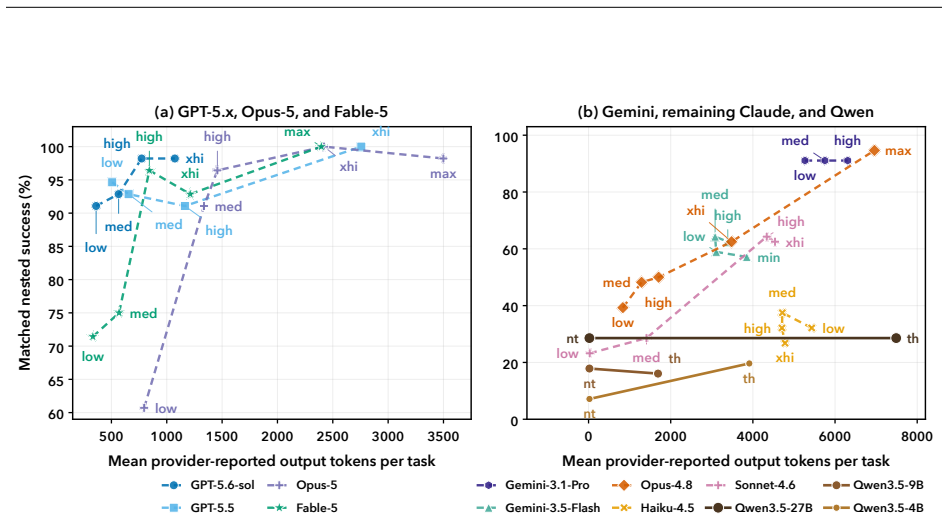
- Effort-ladder gains in matched score can be contract-conditioned compensation rather than improved cross-path portability; Opus-4.8's matched gap moves from $-48.2$ to $-3.6$ points while its nested-replay pass rate stays near its starting level.
- Correct escaping at the interpolation point, or a temporary-script transport, restores every raw-path success in the public replays, so the transport damage is removable at the harness side.
- Evaluators of command-issuing agents should report the generation contract, execution transport, operating point, and final-state validator, because raw generation is near saturation at the frontier and the remaining signal is boundary adaptation.
Reading between the lines
- A practical diagnostic follows from the masking threshold: for any model with a small matched gap, report the two off-diagonal cells, since a near-zero gap is exactly the case where damage and compensation may both be large.
- The same four-cell decomposition should transfer to any pipeline that transforms generated output before execution, so matched scores in tool-use, structured-action, and serialization benchmarks may carry the same ambiguity even where the paper does not test them.
- Because validator completeness is the load-bearing premise, adding new mutation classes or independent final-state checkers on the private payloads is a testable way to check whether the absolute damage and compensation numbers shift while the sign pattern persists.
- A further testable extension is to make the frozen 56-task core a regression audit: models that rank high on matched nested scores should also be required to show positive compensation and small transport damage, not just a high diagonal cell.
Signed reviews
Editorial analysis
A structured set of objections, weighed in public.
Referee Report
Summary. QuoteBench is a 56-task, one-shot Bash-command benchmark built from 14 incident-derived operation families, each with one benign control and three hazardous payload variants, scored by exact final-state validators. The paper's central contribution is a crossed design: for each of eight same-window model configurations it separates the generation contract (raw versus a disclosed-boundary contract that tells the model its reply will be interpolated inside double quotes) from the execution transport (raw versus a nested double-quoted parser), and replays stored replies across the four cells without additional model calls. The key empirical finding is that moving a fixed raw reply through the added parser lowers success by 55.4–73.2 percentage points in every configuration, while the disclosed-boundary contract recovers 30.4–60.7 points for six configurations; the matched gap is thus an identity sum of two large opposing components (Eq. (1)), illustrated by GPT-5.6-sol's -3.6 = -64.3 + 60.7. Robustness evidence includes a 197/197 validator mutation audit, oracle and naive-probe checks, a correct-escaping control that reproduces every raw-path outcome for all 448 public replay pairs, real-ssh grounding (seven of eight configurations match to the decimal), leave-one-family-out ranges with Holm-adjusted family-sign tests, three-draw repetitions, and a private 42-payload crossover.
Significance. Assuming the measurements are correct, this is a significant evaluation-methodology result. It provides a rare controlled decomposition of a matched score into transport damage and contract-conditioned compensation, with a fixed-reply design that avoids confounds from regeneration. The finding that raw-path scores are near-saturated at the frontier while nested-path scores separate models, and that one model pair reverses under the two paths, gives concrete evidence that leaderboard comparisons of command-issuing agents are path-dependent. The paper is unusually careful: the decomposition is an identity and is labeled as such; the primary mechanism analysis is restricted to same-window configurations; the 'compensation' is described as a realized contrast over stored generations, not a fitted parameter; and the limitations (purposive family set, observational native-tool campaign, single stored generations on effort ladders, unenumerated validator blind spots) are stated explicitly in Section 3.1, Appendix F.1, and the Limitations section. The release of the harness, exact prompts, SHA-256 manifest, and sanitized rollout archive supports reproducibility.
minor comments (6)
- [Abstract / Section 4.2] Please fix the typographical spacing errors, including 'QuoteBenchmeasures' in the abstract and 'writtenpoints' in Section 4.2, and clean up the missing spaces around minus signs and percent symbols throughout (for example, '-64.3damage', '+60 .7compensation', and '-3.6points').
- [Section 4.2 / Table 4] The sentence 'The realized generation-by-transport interaction ... ranges from -7.1 to +119.6 points across the eight configurations (Table 4)' cites Table 4, but Table 4 does not report the interaction column; either add that column or cite Appendix Table 14 instead.
- [Section 4.3] The family-level compensation values quoted in prose (json-write +50.0, sed-replace +46.9, find-glob -12.5, grep-count +15.6, hostile-filenames +18.8) are not tabulated anywhere in the manuscript; please add a family-level compensation table or point to a specific artifact table so the claim that compensation concentrates where the hazard is explicit can be checked.
- [Section 3.1 / Appendix F.1] Because the headline damage and compensation numbers depend on exact final-state labels, I suggest adding one sentence stating what a hypothetical validator blind spot would need to look like (systematically transport-correlated and large enough to remove most of the 55.4-73.2 pp damage) to threaten the conclusion; the existing controls already make that scenario implausible, but the reader should not have to assemble the argument from multiple sections.
- [Section 4.1] The sentence 'Raw generation itself is close to saturated at the frontier' should be scoped to 'the six frontier configurations', because Table 4's same-window raw scores range from 78.6% to 100% across all eight configurations, and the lower-scoring configurations still show substantial raw-path spread.
- [Appendix A.2] Appendix A.2 gives verbatim prompts for the raw and disclosed-boundary contracts but not for the native contract; please include the native-tool prompt or explicitly state that it is available in the artifact, for full reproducibility.
Circularity Check
No circularity: the paper's decomposition is an explicit identity and all contrasts are observed pass-rate differences, not fitted or self-citation-derived quantities.
full rationale
QuoteBench is an experimental measurement paper; its central claim is that matched execution scores can hide large transport damage. The only 'derivation' in the methods is Eq. (1), which the paper itself presents as an algebraic identity (YNN−YRR = (YRN−YRR)+(YNN−YRN)); it is used for bookkeeping, not to generate predictions. The damage and compensation values are directly observed pass-rate differences across fixed stored replies in the four crossed cells, with no fitted parameter that is later renamed as a prediction. The escape control (correct escaping reproduces raw-path outcomes for all 448 public pairs) is a logical control isolating the transport, not a redefinition of the input. The 'masked-fragility' cut is explicitly labeled 'illustrative reading aid (not a fitted criterion)' and does not feed back into the mechanism estimates. The paper contains no load-bearing self-citation: prior work references are contextual, and no uniqueness theorem or ansatz is imported from the authors' own prior results. Validator completeness is a correctness risk, not circularity, and the paper discloses remaining blind spots ('Unenumerated false positives remain possible'). Therefore the derivation chain is self-contained and no circular step is identifiable.
Assumptions & free parameters
free parameters (1)
- Masked-fragility thresholds =
|matched gap| <= 5 pp; damage <= -40 pp; compensation >= 30 pp
assumptions (4)
- domain assumption Bash quoting and expansion semantics, and the pinned GNU/Linux coreutils environment, are deterministic and as documented by the Free Software Foundation.
- domain assumption The final-state validators correctly encode the target state for each of the 56 tasks.
- domain assumption The raw and disclosed-boundary system prompts differ only in the stated execution-contract clause.
- domain assumption The family-sign symmetry null is a valid inferential basis for the reported p-values over the 14 constructed families.
Cite this review
Pith. "Pith review of QuoteBench: How Matched Scores Can Hide Command-Path Failures." pith.science (2026). https://pith.science/paper/67TQULDD
@misc{pith2026260813547,
  author       = {Pith},
  title        = {Pith review of: QuoteBench: How Matched Scores Can Hide Command-Path Failures},
  year         = {2026},
  howpublished = {\url{https://pith.science/paper/67TQULDD}},
  note         = {Machine review of arXiv:2608.13547}
}
read the original abstract
LLM coding agents issue Bash commands through interfaces that may serialize, wrap, and reparse model output. Matched execution scores alone cannot distinguish command-generation errors from failures introduced after generation. QuoteBench measures this boundary with exact final-state validation on 56 one-shot tasks from 14 incident-derived families, crossing the generation contract with the execution transport around one deliberately unescaped added parser. Escaping at the interpolation point reproduces each replayed reply's raw-path outcome, so any recovery under a disclosed boundary must come from the model changing its generation. Across eight same-window configurations, replaying the same reply through the added parser lowers success by 55.4 to 73.2 percentage points; disclosure recovers 30.4 to 60.7 points for six configurations, and zero or slightly negative for the other two. Raw generation is nearly saturated at the frontier; boundary adaptation is what still separates models. GPT-5.6-sol's matched gap of -3.6 points hides -64.3 points of damage and +60.7 points of compensation. The deployment configuration reorders models: one reversal among 26 comparable pairs is unambiguous and four more sit on single-task margins. Evaluations of command-issuing agents should report the model configuration, generation contract, execution path, operating point, and final-state validator rather than treat a matched score as an intrinsic model property.
Figures


Figures from the paper (2 more)

Reference graph
Works this paper leans on
-
[7]
URL https://github.com/google-gemini/gemini-cli/issues/1839. Accessed 2026-07-29. Vidar Holen. ShellCheck: A static analysis tool for shell scripts, 2012.https://www.shellcheck.net. 14 Carlos E. Jimenez, John Yang, Alexander Wettig, Shunyu Yao, Kexin Pei, Ofir Press, and Karthik Narasimhan. SWE-bench: Can language models resolve real-world GitHub issues?I...
work page 2026
-
[8]
Association for Computational Linguistics. ISBN 979-8-89176-390-6. doi: 10.18653/v1/ 2026.acl-long.607. URLhttps://aclanthology.org/2026.acl-long.607/. LangChain contributors. Langchain shell tool source at commit b3a6d9a. GitHub source repository,
doi:10.18653/v1/ 2026
-
[9]
URL https://github.com/langchain-ai/langchain/tree/b3a6d9a012681df8a8e33345c8255ca69ec0e437. Accessed 2026-07-29. Xi Victoria Lin, Chenglong Wang, Luke Zettlemoyer, and Michael D. Ernst. NL2Bash: A corpus and semantic parser for natural language interface to the linux operating system. InProceedings of LREC,
work page 2026
-
[11]
URL https://arxiv.org/abs/2308.03688. arXiv:2308.03688. Waldek Mastykarz. Don’t rewrite your CLI for agents. Microsoft for Developers, July
-
[13]
The released benchmark is Terminal-Bench 2.0
URL https://arxiv.org/abs/2601.11868. The released benchmark is Terminal-Bench 2.0. Microsoft AutoGen contributors. Autogen docker code executor at commit 027ecf0. GitHub source repository,
-
[14]
URL https://github.com/microsoft/autogen/tree/ 027ecf0a379bcc1d09956d46d12d44a3ad9cee14. Accessed 2026-07-29. OpenAI. Codex shell execution source at commit fa1d4c4. GitHub source repository,
work page 2026
-
[15]
URLhttps: //github.com/openai/codex/tree/fa1d4c40d0e63eef2e0ba8a9e004ccd0a80b77f5. Accessed 2026-07-
work page 2026
-
[16]
URLhttps://github.com/openai/codex/issues/ 20875. Accessed 2026-07-29. OpenHands community. Use language server protocol to re-implement code editing. GitHub issue Open- Hands/OpenHands#1934,
work page 2026
Show all 28 references
-
[17]
Moti- vated partly by weird issues from heredoc-plus-Bash editing; accessed 2026-07-29
URL https://github.com/OpenHands/OpenHands/issues/1934. Moti- vated partly by weird issues from heredoc-plus-Bash editing; accessed 2026-07-29. 15 OpenHands contributors. Openhands argv command parser at commit 850bd64. GitHub source repository,
1934
-
[18]
Accessed 2026-07-29
URL https://github.com/All-Hands-AI/OpenHands/tree/ 850bd647b64c9a6b5d2bbf25d4d9e16a3c6f685e. Accessed 2026-07-29. Shishir G. Patil, Tianjun Zhang, Xin Wang, and Joseph E. Gonzalez. Gorilla: Large language model connected with massive APIs. InAdvances in Neural Information Pro...
2026
-
[21]
Jiaqi Shao, Hanck Chen, Wei Zhang, Maxm Pan, and Bing Luo
URLhttps://arxiv.org/abs/2310.11324. Jiaqi Shao, Hanck Chen, Wei Zhang, Maxm Pan, and Bing Luo. Do agent benchmarks measure capability? protocol validity in the age of agentic AI.arXiv preprint arXiv:2607.22368,
-
[22]
org/abs/2607.22368
URLhttps://arxiv. org/abs/2607.22368. SWE-agent contributors. Swe-agent action execution source at commit 3ea751c. GitHub source repository,
-
[23]
Accessed 2026-07-29
URL https://github.com/princeton-nlp/SWE-agent/tree/ 3ea751c087f32b16e039a2233dd6eefecef325d5. Accessed 2026-07-29. Terminal-Bench contributors. Terminal-bench tmux execution source at commit d28711d. GitHub source repository,
2026
-
[24]
Accessed 2026-07-29
URL https://github.com/laude-institute/terminal-bench/tree/ d28711d0da2675d0bb1d56de45ae5df6082438a3. Accessed 2026-07-29. Xingyao Wang, Yangyi Chen, Lifan Yuan, Yizhe Zhang, Yunzhu Li, Hao Peng, and Heng Ji. Executable code actions elicit better LLM agents. InProceedings of t...
2026
-
[25]
ISBN 979-8-89176-390-6
Association for Computational Linguistics. ISBN 979-8-89176-390-6. doi: 10.18653/v1/2026.acl-long.1711. URLhttps://aclanthology.org/2026.acl-long.1711/. Warp community. Agent mode fails to create files with heredoc syntax—quote escaping issues. GitHub issue warpdotdev/Warp#7735,
2026 doi
-
[26]
Accessed 2026-07-29
URL https://github.com/warpdotdev/Warp/issues/7735. Accessed 2026-07-29. Finnian Westenfelder, Erik Hemberg, Stephen Moskal, Una-May O’Reilly, and Silviu Chiricescu. LLM- supported natural language to bash translation. InProceedings of NAACL, pp. 11135–11147,
2026
-
[27]
URLhttps://aclanthology.org/2025.naacl-long.555/
doi: 10.18653/v1/2025.naacl-long.555. URLhttps://aclanthology.org/2025.naacl-long.555/. David A. Wheeler. Fixing Unix/Linux/POSIX filenames,
2025 doi
-
[28]
URL https://proceedings.neurips.cc/paper_files/paper/2024/hash/ 5d413e48f84dc61244b6be550f1cd8f5-Abstract-Datasets_and_Benchmarks_Track.html
doi: 10.52202/079017-1650. URL https://proceedings.neurips.cc/paper_files/paper/2024/hash/ 5d413e48f84dc61244b6be550f1cd8f5-Abstract-Datasets_and_Benchmarks_Track.html. 16 John Yang, Akshara Prabhakar, Karthik Narasimhan, and Shunyu Yao. InterCode: Standardizing and bench- mar...
2024 doi
-
[29]
URL https://proceedings.neurips.cc/paper_files/ paper/2023/hash/4b175d846fb008d540d233c188379ff9-Abstract-Datasets_and_Benchmarks.html
doi: 10.52202/075280-1035. URL https://proceedings.neurips.cc/paper_files/ paper/2023/hash/4b175d846fb008d540d233c188379ff9-Abstract-Datasets_and_Benchmarks.html. John Yang, Carlos E. Jimenez, Alexander Wettig, Kilian Lieret, Shunyu Yao, Karthik Narasimhan, and Ofir Press. SWE...
2023 doi
-
[31]
Boxi Yu, Yuxuan Zhu, Pinjia He, and Daniel Kang
URL https: //arxiv.org/abs/2406.12045. Boxi Yu, Yuxuan Zhu, Pinjia He, and Daniel Kang. UTBoost: Rigorous evaluation of coding agents on SWE-bench. In Wanxiang Che, Joyce Nabende, Ekaterina Shutova, and Mohammad Taher Pilehvar (eds.),Proceedings of the 63rd Annual Meeting of t...
-
[33]
Wenxiao Zhang, Yu Liu, Zhiwei Yang, Zhongyi Zhang, Hanqi Feng, Xinyu Wang, Peng Qiu, Yanbing Liu, Barnabas Poczos, and Jin B
URL https://arxiv.org/abs/2606.27733. Wenxiao Zhang, Yu Liu, Zhiwei Yang, Zhongyi Zhang, Hanqi Feng, Xinyu Wang, Peng Qiu, Yanbing Liu, Barnabas Poczos, and Jin B. Hong. CARE: Pre-execution command verification for shell-executing LLM agents.arXiv preprint arXiv:2607.21642, 20...
-
[34]
arXiv:2307.13854
URL https://arxiv.org/abs/2307.13854. arXiv:2307.13854. A Benchmark Construction, Coverage, and Contracts Two mechanism surveys guided the family design. The internal survey contains 86 de-identified incidents from author-owned coding-agent sessions: 50 Codex incidents and 36 ...
2026 arXiv
-
[2018]
arXiv:1802.08979
URL https://arxiv.org/abs/1802.08979. arXiv:1802.08979. Xiao Liu, Hao Yu, Hanchen Zhang, Yifan Xu, Xuanyu Lei, Hanyu Lai, Yu Gu, Hangliang Ding, Kaiwen Men, Kejuan Yang, Shudan Zhang, Xiang Deng, Aohan Zeng, Zhengxiao Du, Chenhui Zhang, Sheng Shen, Tianjun Zhang, Yu Su, Huan S...
-
[2021]
Anthropic Claude Code community
URLhttps://arxiv.org/ abs/2103.02523. Anthropic Claude Code community. Avoid shell quoting issues when passing markdown to cli tools like gh. GitHub issue anthropics/claude-code#29619, 2026a. URLhttps://github.com/anthropics/ claude-code/issues/29619. Accessed 2026-07-29. Anth...
2026 arXiv
-
[2023]
MelanieSclar, YejinChoi, YuliaTsvetkov, andAlaneSuhr
URLhttps://arxiv.org/abs/2307.16789. MelanieSclar, YejinChoi, YuliaTsvetkov, andAlaneSuhr. Quantifyinglanguagemodels’sensitivitytospurious features in prompt design or: How I learned to start worrying about prompt formatting. InInternational Conference on Learning Representati...
-
[2024]
Zhaoyang Chu, Jiarui Hu, Xingyu Jiang, Pengyu Zou, Han Li, Chao Peng, Peter O’Hearn, Earl T
URLhttps://arxiv.org/abs/2407.21787. Zhaoyang Chu, Jiarui Hu, Xingyu Jiang, Pengyu Zou, Han Li, Chao Peng, Peter O’Hearn, Earl T. Barr, Mark Harman, Federica Sarro, and He Ye. TerminalWorld: Benchmarking agents on real-world terminal tasks.arXiv preprint arXiv:2605.22535,
-
[2025]
Free Software Foundation.Bash Reference Manual, Version 5.3,
URL https: //arxiv.org/abs/2503.14443. Free Software Foundation.Bash Reference Manual, Version 5.3,
-
[2026]
URLhttps://arxiv.org/abs/2605.22535. Deming Ding, Shichun Liu, Enhui Yang, Jiahang Lin, Ziying Chen, Shihan Dou, Honglin Guo, Weiyu Cheng, Pengyu Zhao, Chengjun Xiao, Qunhong Zeng, Qi Zhang, Xuanjing Huang, Qidi Xu, and Tao Gui. OctoBench: Benchmarking scaffold-aware instructi...
Reviewed August 14, 2026 · model on record in the stance chip above.
Discussion (0). Continue with ORCID to comment.