REVIEW 3 major objections 5 minor 92 references
Video editing can be learned from synthetic video pairs generated by warping image-edit pairs, with no curated video data required.
Reviewed by Pith at T0; open to challenge. T0 means a machine referee read the full paper against a public rubric. the ladder, T0–T4 →
T0 review · deepseek-v4-flash
2026-08-01 15:37 UTC pith:6A7H6Z5X
load-bearing objection A novel synthetic-data pipeline for video editing with an all-qualitative evaluation and a self-admitted caveat that undercuts the strongest reading of its central claim. the 3 major comments →
FlowMimic: Mask-free Visual Editing and Generation with Pixel-pair Warped Flow Field for Online Video Editing Data Generation and Modality Mimicry
The pith
A machine-rendered reading of the paper's core claim, the machinery that carries it, and where it could break.
Core claim
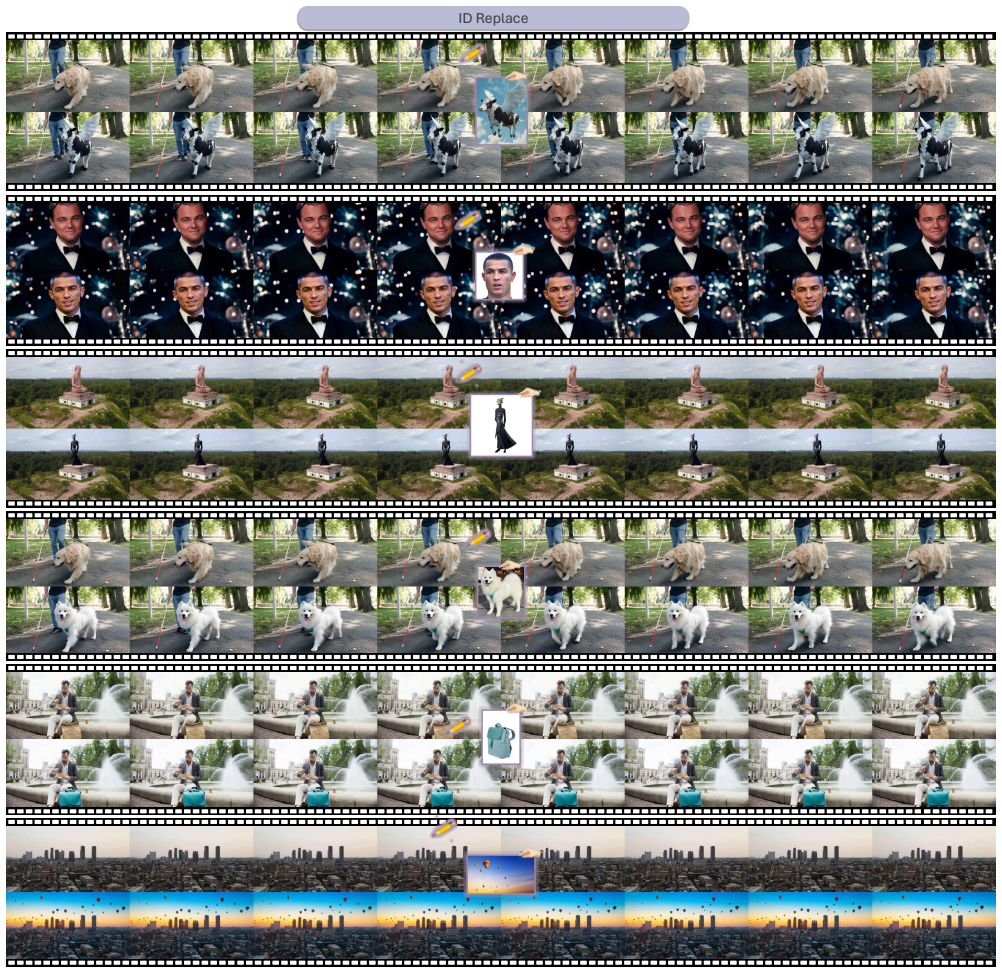
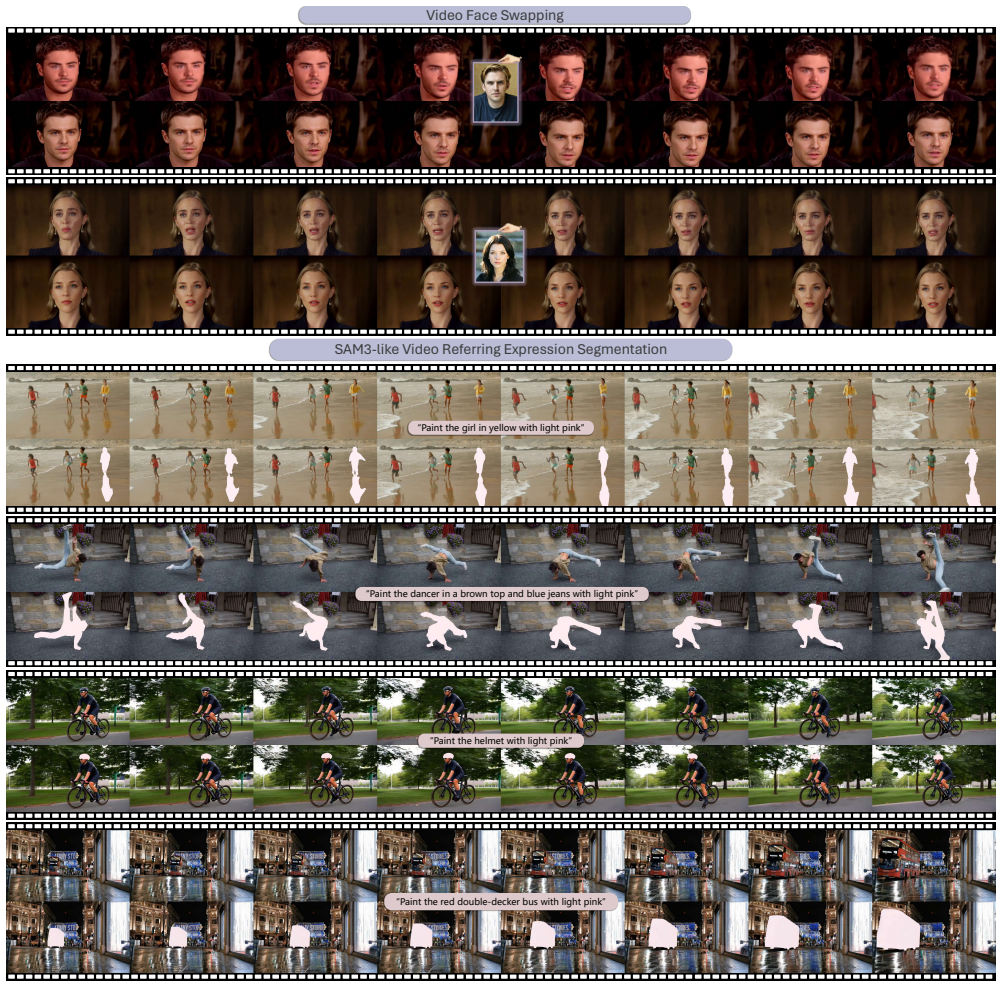
The paper's central claim: temporal consistency of pixel-level editing correspondences, not naturalness of motion, is the ingredient needed to learn video editing. Applying one shared time-varying warp to source and target images of an image-edit pair yields a synthetic video pair in which every frame preserves the same pixel-pair edit relation; training on such pairs alone is reported to produce editing on real videos across relighting, stylization, swapping, insertion, removal, and try-on. Second, image is a single-frame video: a modality-mimic loss aligns text-to-image with text-to-video and image-editing with video-editing via KL divergence on one-step-denoised latents. Third, referring-
What carries the argument
The load-bearing object is the pixel-pair 4D temporal warped flow field: a canonical 3D grid of pixel coordinates for the source and target images is deformed by the same time-dependent warping, using a shared random seed, and each frame is produced by bilinear grid inverse sampling. Because the same deformation is applied to both images, every frame preserves the exact pixel-wise editing correspondence established in the first frame; the model sees a synchronized walk of edit pairs. Two supporting mechanisms carry the rest of the argument: modality-mimic losses, which compute KL divergence on softmaxed one-step reversed latents to align text-to-image with text-to-video and image-editing wit
Load-bearing premise
The load-bearing premise is that a model trained on synthetic videos made by applying the same parametric warp to image-edit pairs will transfer to real videos with natural object and camera motion, occlusions, lighting changes, and parallax; the paper asserts that temporal consistency of pixel-level editing correspondences suffices, but does not compare against real video editing data or natural-motion training baselines.
What would settle it
Train two models on the same image-edit pairs: one with only warped synthetic video pairs, and one with real video editing pairs spanning natural object motion, occlusions, and parallax. If the synthetic-only model performs comparably or better on held-out real videos, the sufficiency claim stands; if the real-data model is substantially better, the claim that temporal consistency of pixel-level editing correspondences suffices fails. A cheaper probe is to evaluate the synthetic-only model on videos whose motion types are absent from the warp family, for instance fast articulated motion with o
If this is right
- Any image editing task with loose layout correspondence between source and target can be upgraded to video editing by applying the warp online during training, making video editing data a by-product of image editing data.
- Training can start from a pretrained text-to-video model with a low learning rate and only a few thousand steps, so the data-generation overhead is minimal.
- The model generalizes to longer videos than it saw in training, indicating the learned pixel-correspondence regularity is not tied to a fixed frame count.
- Editing-region localization is learned from language and attention, so inference needs no mask sequence and no attached multimodal LLM.
- Aligning image and video output distributions improves single-image generation realism and stylized video generation relative to the pretrained model.
Where Pith is reading between the lines
- If the sufficiency claim holds, the scalability bottleneck for video editing shifts entirely to image editing data quality; improving datasets such as referring-expression masks or object-removal inpaints should directly improve video editing, a prediction that can be tested by dataset ablations.
- The warp family acts as an implicit prior over motion; one could probe how far the model generalizes by evaluating on videos with articulated motion, occlusion, or parallax far outside the pan/zoom/rotation/stretch/elastic family, and by ablating motion types.
- The modality-mimic losses exemplify a form of on-the-fly self-distillation in which the model's faster-converging image-editing pathway supervises its harder video-editing pathway and vice versa; this recipe may transfer to other paired modalities or favorable conditioning signals.
Editorial analysis
A structured set of objections, weighed in public.
Referee Report
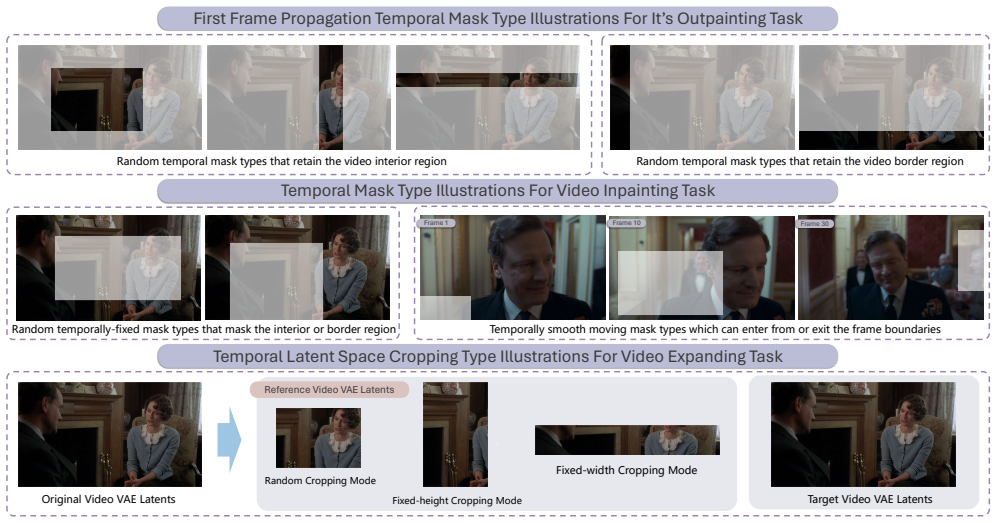
Summary. The paper proposes FlowMimic, a post-training recipe built on the pretrained Wan2.1-T2V-1.3B model. It has three main components: (i) an online data-generation paradigm that converts image-editing pairs into video-editing pairs by applying a shared, time-varying parametric warp (pan, zoom, rotation, stretch, elastic, or compositions) to both source and target images; (ii) first-frame modality-mimic losses that align T2I with T2V and I2I with V2V via KL divergence between softmax-transformed, one-step-reversed latent estimates; and (iii) 'sense' tasks, chiefly referring-expression segmentation, with region-aware flow-matching and cross-attention losses. The central claim is that a model can learn video editing using only such online-generated warped video pairs, without specially curated real video-editing training data. The paper reports qualitative editing results on FiVE-Bench, UNIC-Bench, and additional web videos, along with cross-attention visualizations and stylized T2V examples.
Significance. If the central claim holds, the paper identifies a simple, scalable route to video-editing training data: temporal consistency of pixel-level edit correspondences, rather than natural motion or real-world coherence, may be sufficient. This would be a genuinely useful contribution, and the paper is unusually explicit about the limitations of its training data. The writing is also clear about the construction of the warp field. However, the evidence provided is almost entirely qualitative: no numeric metrics, no controlled ablation that isolates the flow field from the strong priors of the pretrained T2IV model, and no comparison against a real-video-pair baseline. The paper's own Fig. 13 caption attributes natural motion to the pretrained T2V/I2V capabilities, not to the proposed flow field. Consequently, the significance is currently prospective rather than established, and the strong 'only such data' claim is not yet supported.
major comments (3)
- [Sec. 3.3, Eqs. (38), (39), (42), (43)] The central claim—that a model can learn video editing using only online-generated warped image-pair data—is supported only by qualitative stills. There are no metrics on FiVE-Bench or UNIC-Bench, no comparison against a no-warp baseline, and no ablation that removes or varies the proposed flow field while keeping all other components fixed. Because Wan2.1-T2V already contains strong T2V and I2V motion priors, the qualitative results cannot establish that the pixel-pair warped flow field is the operative source of temporal editing competence. The Fig. 13 caption itself states that natural motion 'may arise from FlowMimic implicitly transferring the motion-generation ability—acquired from training on T2V and I2V tasks—to editing tasks', while the flow field is credited only with 'placement and consistency'. This directly weakens the abstract and Sec. 1 claim that video editing is learned
- [Sec. 3.4, Sec. 4.4, Fig. 28] The text claims that the modality-mimic editing loss enables 'mutual imitation' or 'bidirectional distribution alignment' because both distributions are produced by the same model. However, as implemented via torch.nn.functional.kl_div in Sec. 4.1, each KL term has a fixed target and gradients flow only through the 'input' distribution—for Eq. (39), the T2I path; for Eq. (43), the I2I path if log(p_i2i) is the input. The target distribution is not directly updated by the loss. Shared weights provide only an indirect coupling. Thus the loss as written is a one-directional regularizer, and the 'mutual mimic' claim is not a direct consequence of the loss geometry. Please specify the exact gradient flow, or use a symmetric divergence (e.g., JS divergence or Hellinger distance, both of which are mentioned as exploratory) if bidirectional alignment is intended.
- [Sec. 4.1, Sec. 5] The sense-related losses are a stated contribution, but their evaluation is limited to a few attention-map visualizations. No quantitative metrics are provided for referring-expression localization (e.g., mIoU or acc@0.5 on RefCOCO/RefCOCOg/gRefCOCO), no segmentation evaluation for the video referring-expression results, and no comparison of editing-region localization against the pretrained base model or against a model trained without the sense losses. Since 'the model has internalized this capability' is a load-bearing claim for the editing-region-aware component, the lack of quantitative validation is a major gap.
minor comments (5)
- [Sec. 3.2, Eqs. (5)–(29)] The implementation details give loss weights and warm-up schedules, but task sample ratios and per-task data weights are not specified beyond the 4:1 generation:editing ratio. Several tasks are described as receiving 'a prescribed ratio' or 'a modest weight'; these should be reported for reproducibility.
- [Sec. 3.4, Eq. (53)] The softmax is applied to the flattened latent of dimension D = (H/8)·(W/8)·16. This is an unusual choice; no justification or sensitivity analysis is given. If kept, please explain why the resulting distribution is semantically meaningful for KL alignment.
- [Throughout] The sense cross-attention loss uses the difference between mean attention inside and outside the ground-truth mask. This is reasonable, but the normalization by h_l·w_l in both terms cancels; consider reporting the actual normalization used.
- [Sec. 5] There are typographical and stylistic issues: 'embbedings', 'likewisely', 'JRK' rendering of template delimiters, and the very long timeline/attribution paragraph in Sec. 5. These do not affect the technical content but should be cleaned up.
- [Sec. 5] The paper explicitly acknowledges low-quality internal data, color discrepancies, and lack of per-task hyperparameter tuning. These are useful caveats, but they also underscore that the qualitative results may reflect favorable data selection; adding failure cases or quantitative error analysis would strengthen the report.
Circularity Check
No significant circularity: the flow-field data augmentation and mimic losses are training constructs, and the evidence for transfer is on out-of-distribution benchmarks rather than the fitted quantities.
full rationale
The central derivation—applying identical time-varying warps to source and target images (Sec. 3.2, Eqs. 5-28)—is a definitional data-generation scheme; it does not set a parameter from the evaluation set and then predict it. The modality mimic losses (Eqs. 38-43) are training objectives that directly minimize KL divergence; the paper's Sec. 4.4 observations of distributional similarity are on unseen FiVE-Bench/UNIC-Bench videos, so they are a generalization check, not the same fitted quantity. The sense losses are supervised by RefCOCO masks, and the attention-map visualizations (Fig. 28) are on UNIC-Bench, again outside the training distribution. The only self-citation (Rig-Your-Portrait, ref. [46]) is an anecdotal related-work note and is not load-bearing. The main weaknesses are evidential, not circular: evaluation is purely qualitative, and Fig. 13's caption explicitly credits natural motion to pretrained T2V/I2V priors rather than the flow field; these are correctness/evidence concerns, not reduction of outputs to inputs.
Axiom & Free-Parameter Ledger
free parameters (5)
- motion strength hyperparameter mapping f_alpha(M) (pan distance, rotation angle, stretch intervals, elastic sigma/alpha0 =
not specified; set to a moderate level
- loss weights (alpha_mimic_gen, alpha_mimic_editing, alpha_FM_SC, alpha_sense_attn) =
0.1, 0.1, 0.5, 1.0
- learning rate warmup schedule =
5e-6 to 1e-5 over 5000 steps
- frame count distribution for online-generated video samples =
uniform over {13, 25, 37, 49, 61}
- task sample weights and ratios (generation:editing = 4:1, per-task weights) =
not fully specified; 'prescribed ratio'
axioms (5)
- standard math Flow matching linear interpolation and one-step reverse formula (Eqs. 1–2, 33–34) are valid for Wan2.1.
- domain assumption Pixel-correspondence maintenance is sufficient for video-editing learning.
- domain assumption Identical warps preserve the semantics of the edit.
- domain assumption Reference elements as noise-free in-context conditioning (timestep 0, reference-inject self-attention mask) is a valid editing formulation.
- ad hoc to paper Softmax over flattened one-step-reversed latents is a meaningful perceptual distribution for KL alignment.
read the original abstract
In line with the prevailing direction of vision research, we explore the integration of both generation and editing capabilities for video and image modalities within a single model. Current approaches to collecting video editing data typically depend on labour-intensive, time-consuming curated procedures--involving object mask annotation, the use of error-introducing pair synthesis via I2V model and ControlNet-like guidance, and VLM-based quality filtering or refinement--and demonstrate limited task scalability. As a result, the diversity of editing tasks remains substantially narrower than that available for image editing models. We develop a pixel-pair temporal warped flow field that can directly generate corresponding video editing samples in real time from image editing samples, and we demonstrate across multiple levels of video editing tasks that a model can learn video editing using only such data. We regard the image modality as a particular form of the video modality. Accordingly, we design a modality mimic generation loss and a modality mimic editing loss to relatively align the capabilities--and thereby the output distributions--of the two modalities through mutual imitation. Moreover, language-based visual editing entails the comprehension of the editing instruction and the reference visual content, the localization of the region corresponding to that instruction within the reference visual contents, and the modification of that region alone. Existing approaches predominantly rely on external aids, such as fine-tuning an additional MLLM or explicitly supplying a mask sequence as auxiliary input during inference. In contrast, we aspire for the model to internalize this capability. To that end, we introduce sense-related tasks--for instance, referring expression segmentation--along with corresponding editing-region-aware latent-level loss and attention-level loss.
Figures








Reference graph
Works this paper leans on
-
[1]
Consistent video- to-video transfer using synthetic dataset
Jiaxin Cheng, Tianjun Xiao, and Tong He. Consistent video- to-video transfer using synthetic dataset. InICLR, 2026. 2, 4
2026
-
[2]
Prompt-to-prompt image editing with cross attention control
Amir Hertz, Ron Mokady, Jay Tenenbaum, Kfir Aberman, Yael Pritch, and Daniel Cohen-Or. Prompt-to-prompt image editing with cross attention control. InICLR, 2023. 4
2023
-
[3]
Se ˜norita-2m: A high-quality instruction- based dataset for general video editing by video specialists
Bojia Zi, Penghui Ruan, Marco Chen, Xianbiao Qi, Shaozhe Hao, Shihao Zhao, Youze Huang, Bin Liang, Rong Xiao, and Kam-Fai Wong. Se ˜norita-2m: A high-quality instruction- based dataset for general video editing by video specialists. InNeurIPS, 2025. 4
2025
-
[4]
Scaling instruction-based video editing with a high-quality synthetic dataset
Qingyan Bai, Qiuyu Wang, Hao Ouyang, Yue Yu, Hanlin Wang, Wen Wang, Ka Leong Cheng, Shuailei Ma, Yan- hong Zeng, Zichen Liu, et al. Scaling instruction-based video editing with a high-quality synthetic dataset. InarXiv preprint:2510.15742, 2025. 4
arXiv 2025
-
[5]
Insvie-1m: Effective instruction-based video editing with elaborate dataset construction
Yuhui Wu, Liyi Chen, Ruibin Li, Shihao Wang, Chenxi Xie, and Lei Zhang. Insvie-1m: Effective instruction-based video editing with elaborate dataset construction. InCVPR, 2025. 4
2025
-
[6]
Openve-3m: A large-scale high-quality dataset for instruction- guided video editing
Haoyang He, Jie Wang, Jiangning Zhang, Zhucun Xue, Xingyuan Bu, Qiangpeng Yang, Shilei Wen, and Lei Xie. Openve-3m: A large-scale high-quality dataset for instruction- guided video editing. InarXiv preprint:2512.07826, 2025. 2, 4
arXiv 2025
-
[7]
A survey on multimodal large language models
Shukang Yin, Chaoyou Fu, Sirui Zhao, Ke Li, Xing Sun, Tong Xu, and Enhong Chen. A survey on multimodal large language models. InNational Science Review, 2024. 2 5https://ipr.tsa.cn/
2024
-
[8]
Vision-language models for vision tasks: A survey
Jingyi Zhang, Jiaxing Huang, Sheng Jin, and Shijian Lu. Vision-language models for vision tasks: A survey. InTPAMI,
-
[9]
A survey of state of the art large vision language models: Benchmark evaluations and challenges
Zongxia Li, Xiyang Wu, Hongyang Du, Fuxiao Liu, Huy Nghiem, and Guangyao Shi. A survey of state of the art large vision language models: Benchmark evaluations and challenges. InCVPR, 2025. 2
2025
-
[10]
Sam 2: Segment anything in images and videos
Nikhila Ravi, Valentin Gabeur, Yuan-Ting Hu, Ronghang Hu, Chaitanya Ryali, Tengyu Ma, Haitham Khedr, Roman R¨adle, Chloe Rolland, Laura Gustafson, et al. Sam 2: Segment anything in images and videos. InICLR, 2025. 2, 15
2025
-
[11]
Sam 3: Segment anything with concepts
Nicolas Carion, Laura Gustafson, Yuan-Ting Hu, Shoub- hik Debnath, Ronghang Hu, Didac Suris, Chaitanya Ryali, Kalyan Vasudev Alwala, Haitham Khedr, Andrew Huang, et al. Sam 3: Segment anything with concepts. InarXiv preprint:2511.16719, 2025. 2, 15
Pith/arXiv arXiv 2025
-
[12]
Grounding dino: Marrying dino with grounded pre-training for open-set object detection
Shilong Liu, Zhaoyang Zeng, Tianhe Ren, Feng Li, Hao Zhang, Jie Yang, Qing Jiang, Chunyuan Li, Jianwei Yang, Hang Su, et al. Grounding dino: Marrying dino with grounded pre-training for open-set object detection. InECCV, 2024. 2
2024
-
[13]
Qwen2-vl: Enhancing vision-language model’s perception of the world at any resolution
Peng Wang, Shuai Bai, Sinan Tan, Shijie Wang, Zhihao Fan, Jinze Bai, Keqin Chen, Xuejing Liu, Jialin Wang, Wenbin Ge, et al. Qwen2-vl: Enhancing vision-language model’s perception of the world at any resolution. InarXiv preprint:2409.12191, 2024. 2, 15
Pith/arXiv arXiv 2024
-
[14]
Shuai Bai, Keqin Chen, Xuejing Liu, Jialin Wang, Wen- bin Ge, Sibo Song, Kai Dang, Peng Wang, Shijie Wang, Jun Tang, et al. Qwen2. 5-vl technical report. InarXiv preprint:2502.13923, 2025
Pith/arXiv arXiv 2025
-
[15]
Shuai Bai, Yuxuan Cai, Ruizhe Chen, Keqin Chen, Xionghui Chen, Zesen Cheng, Lianghao Deng, Wei Ding, Chang Gao, Chunjiang Ge, et al. Qwen3-vl technical report. InarXiv preprint:2511.21631, 2025. 2, 15
Pith/arXiv arXiv 2025
-
[16]
Adding conditional control to text-to-image diffusion models
Lvmin Zhang, Anyi Rao, and Maneesh Agrawala. Adding conditional control to text-to-image diffusion models. In ICCV, 2023. 2, 5
2023
-
[17]
Reward models in deep reinforcement learning: A survey
Rui Yu, Shenghua Wan, Yucen Wang, Chen-Xiao Gao, Le Gan, Zongzhang Zhang, and De-Chuan Zhan. Reward models in deep reinforcement learning: A survey. InIJCAI,
-
[18]
Wan: Open and advanced large-scale video gener- ative models
Team Wan, Ang Wang, Baole Ai, Bin Wen, Chaojie Mao, Chen-Wei Xie, Di Chen, Feiwu Yu, Haiming Zhao, Jianxiao Yang, et al. Wan: Open and advanced large-scale video gener- ative models. InarXiv preprint:2503.20314, 2025. 2, 3, 4, 5, 6, 18, 38
Pith/arXiv arXiv 2025
-
[19]
Instructx: To- wards unified visual editing with mllm guidance
Chong Mou, Qichao Sun, Yanze Wu, Pengze Zhang, Xinghui Li, Fulong Ye, Songtao Zhao, and Qian He. Instructx: To- wards unified visual editing with mllm guidance. InarXiv preprint:2510.08485, 2025. 2, 3, 6, 13
arXiv 2025
-
[20]
Vino: A unified visual generator with interleaved omnimodal context
Junyi Chen, Tong He, Zhoujie Fu, Pengfei Wan, Kun Gai, and Weicai Ye. Vino: A unified visual generator with interleaved omnimodal context. InarXiv preprint:2601.02358, 2026. 2, 3, 6, 13
arXiv 2026
-
[21]
Videopainter: Any- length video inpainting and editing with plug-and-play con- text control
Yuxuan Bian, Zhaoyang Zhang, Xuan Ju, Mingdeng Cao, Liangbin Xie, Ying Shan, and Qiang Xu. Videopainter: Any- length video inpainting and editing with plug-and-play con- text control. InSIGGRAPH, 2025. 3, 4, 24
2025
-
[22]
Unic: Unified in-context video editing
Zixuan Ye, Xuanhua He, Quande Liu, Qiulin Wang, Xintao Wang, Pengfei Wan, Di Zhang, Kun Gai, Qifeng Chen, and Wenhan Luo. Unic: Unified in-context video editing. InarXiv preprint:2506.04216, 2025. 4, 13, 24, 25, 26, 27, 30, 41, 49
Pith/arXiv arXiv 2025
-
[23]
Anyportal: Zero-shot consistent video background replacement
Wenshuo Gao, Xicheng Lan, and Shuai Yang. Anyportal: Zero-shot consistent video background replacement. InICCV,
-
[24]
Generative video propagation
Shaoteng Liu, Tianyu Wang, Jui-Hsien Wang, Qing Liu, Zhifei Zhang, Joon-Young Lee, Yijun Li, Bei Yu, Zhe Lin, Soo Ye Kim, et al. Generative video propagation. InCVPR,
-
[25]
Univideo: Unified understanding, generation, and editing for videos
Cong Wei, Quande Liu, Zixuan Ye, Qiulin Wang, Xintao Wang, Pengfei Wan, Kun Gai, and Wenhu Chen. Univideo: Unified understanding, generation, and editing for videos. In ICLR, 2026. 3, 6, 13
2026
-
[26]
Magicbrush: A manually annotated dataset for instruction- guided image editing
Kai Zhang, Lingbo Mo, Wenhu Chen, Huan Sun, and Yu Su. Magicbrush: A manually annotated dataset for instruction- guided image editing. InNeurIPS, 2023. 4
2023
-
[27]
Pico-banana- 400k: A large-scale dataset for text-guided image editing
Yusu Qian, Eli Bocek-Rivele, Liangchen Song, Jialing Tong, Yinfei Yang, Jiasen Lu, Wenze Hu, and Zhe Gan. Pico-banana- 400k: A large-scale dataset for text-guided image editing. arXiv preprint:2510.19808, 2025. 4
arXiv 2025
-
[28]
Gpt-image-edit-1.5 m: A million-scale, gpt-generated image dataset
Yuhan Wang, Siwei Yang, Bingchen Zhao, Letian Zhang, Qing Liu, Yuyin Zhou, and Cihang Xie. Gpt-image-edit-1.5 m: A million-scale, gpt-generated image dataset. InarXiv preprint:2507.21033, 2025. 4
Pith/arXiv arXiv 2025
-
[29]
Imgedit: A unified image editing dataset and benchmark
Yang Ye, Xianyi He, Zongjian Li, Bin Lin, Shenghai Yuan, Zhiyuan Yan, Bohan Hou, and Li Yuan. Imgedit: A unified image editing dataset and benchmark. InarXiv preprint:2505.20275, 2025. 4
Pith/arXiv arXiv 2025
-
[30]
Learning transferable visual models from natural language supervision
Alec Radford, Jong Wook Kim, Chris Hallacy, Aditya Ramesh, Gabriel Goh, Sandhini Agarwal, Girish Sastry, Amanda Askell, Pamela Mishkin, Jack Clark, et al. Learning transferable visual models from natural language supervision. InICML, 2021. 4, 54
2021
-
[31]
Relightmaster: Precise video relighting with multi-plane light images
Weikang Bian, Xiaoyu Shi, Zhaoyang Huang, Jianhong Bai, Qinghe Wang, Xintao Wang, Pengfei Wan, Kun Gai, and Hongsheng Li. Relightmaster: Precise video relighting with multi-plane light images. InarXiv preprint:2511.06271, 2025. 4
arXiv 2025
-
[32]
Recammaster: Camera-controlled generative ren- dering from a single video
Jianhong Bai, Menghan Xia, Xiao Fu, Xintao Wang, Lianrui Mu, Jinwen Cao, Zuozhu Liu, Haoji Hu, Xiang Bai, Pengfei Wan, et al. Recammaster: Camera-controlled generative ren- dering from a single video. InICLR, 2026. 4
2026
-
[33]
Anyv2v: A tuning-free framework for any video-to- video editing tasks
Max Ku, Cong Wei, Weiming Ren, Harry Yang, and Wenhu Chen. Anyv2v: A tuning-free framework for any video-to- video editing tasks. InTMLR, 2024. 4, 28
2024
-
[34]
Denoising diffusion implicit models
Jiaming Song, Chenlin Meng, and Stefano Ermon. Denoising diffusion implicit models. InICLR, 2021. 4
2021
-
[35]
Videoshop: Localized semantic video editing with noise-extrapolated dif- fusion inversion
Xiang Fan, Anand Bhattad, and Ranjay Krishna. Videoshop: Localized semantic video editing with noise-extrapolated dif- fusion inversion. InECCV, 2024. 4
2024
-
[36]
Con- textflow: Training-free video object editing via adaptive con- text enrichment
Yiyang Chen, Xuanhua He, Xiujun Ma, and Jack Ma. Con- textflow: Training-free video object editing via adaptive con- text enrichment. InAAAI, 2026. 4, 19
2026
-
[37]
Flow matching for generative modeling
Yaron Lipman, Ricky TQ Chen, Heli Ben-Hamu, Maximilian Nickel, and Matt Le. Flow matching for generative modeling. InICLR, 2023. 4, 6
2023
-
[38]
Lora: Low-rank adaptation of large language models
Edward J Hu, Yelong Shen, Phillip Wallis, Zeyuan Allen- Zhu, Yuanzhi Li, Shean Wang, Liang Wang, Weizhu Chen, et al. Lora: Low-rank adaptation of large language models. InICLR, 2022. 4
2022
-
[39]
I2vedit: First-frame-guided video editing via image-to- video diffusion models
Wenqi Ouyang, Yi Dong, Lei Yang, Jianlou Si, and Xingang Pan. I2vedit: First-frame-guided video editing via image-to- video diffusion models. InSIGGRAPH Asia, 2024. 4
2024
-
[40]
Vace: All-in-one video creation and editing
Zeyinzi Jiang, Zhen Han, Chaojie Mao, Jingfeng Zhang, Yulin Pan, and Yu Liu. Vace: All-in-one video creation and editing. InICCV, 2025. 4
2025
-
[41]
Scalable diffusion models with transformers
William Peebles and Saining Xie. Scalable diffusion models with transformers. InICCV, 2023. 4, 6
2023
-
[42]
Roformer: Enhanced transformer with rotary position embedding
Jianlin Su, Murtadha Ahmed, Yu Lu, Shengfeng Pan, Wen Bo, and Yunfeng Liu. Roformer: Enhanced transformer with rotary position embedding. InNeurocomputing, 2024. 4, 22
2024
-
[43]
Light-a-video: Training-free video relight- ing via progressive light fusion
Yujie Zhou, Jiazi Bu, Pengyang Ling, Pan Zhang, Tong Wu, Qidong Huang, Jinsong Li, Xiaoyi Dong, Yuhang Zang, Yuhang Cao, et al. Light-a-video: Training-free video relight- ing via progressive light fusion. InICCV, 2025. 5
2025
-
[44]
Vface: A training-free approach for diffusion-based video face swapping
Sanoojan Baliah, Yohan Abeysinghe, Rusiru Thushara, Khan Muhammad, Abhinav Dhall, Karthik Nandakumar, and Muhammad Haris Khan. Vface: A training-free approach for diffusion-based video face swapping. InWACV, 2026. 5
2026
-
[45]
The devil is in the details: Enhancing video virtual try-on via keyframe-driven details injection
Qingdong He, Xueqin Chen, Yanjie Pan, Peng Tang, Pengcheng Xu, Zhenye Gan, Chengjie Wang, Xiaobin Hu, Jiangning Zhang, and Yabiao Wang. The devil is in the details: Enhancing video virtual try-on via keyframe-driven details injection. InarXiv preprint:2512.20340, 2025. 5
Pith/arXiv arXiv 2025
-
[46]
Rig-your-portrait: Controllable and re- lightable portrait video generation with explicit 3d guidance
Dingyun Zhang. Rig-your-portrait: Controllable and re- lightable portrait video generation with explicit 3d guidance. https://rigyourportrait.github.io , 2025. 5, 42
2025
-
[47]
Editverse: Unifying image and video editing and generation with in-context learning
Xuan Ju, Tianyu Wang, Yuqian Zhou, He Zhang, Qing Liu, Nanxuan Zhao, Zhifei Zhang, Yijun Li, Yuanhao Cai, Shaoteng Liu, et al. Editverse: Unifying image and video editing and generation with in-context learning. InarXiv preprint:2509.20360, 2025. 6
Pith/arXiv arXiv 2025
-
[48]
Omni-video 2: Scaling mllm-conditioned dif- fusion for unified video generation and editing
Hao Yang, Zhiyu Tan, Jia Gong, Luozheng Qin, Hesen Chen, Xiaomeng Yang, Yuqing Sun, Yuetan Lin, Mengping Yang, and Hao Li. Omni-video 2: Scaling mllm-conditioned dif- fusion for unified video generation and editing. InarXiv preprint:2602.08820, 2026. 6
arXiv 2026
-
[49]
Multimodal referring segmentation: A survey
Henghui Ding, Song Tang, Shuting He, Chang Liu, Zuxuan Wu, and Yu-Gang Jiang. Multimodal referring segmentation: A survey. InarXiv preprint:2508.00265, 2025. 6
Pith/arXiv arXiv 2025
-
[50]
Attention is all you need
Ashish Vaswani, Noam Shazeer, Niki Parmar, Jakob Uszko- reit, Llion Jones, Aidan N Gomez, Łukasz Kaiser, and Illia Polosukhin. Attention is all you need. InNIPS, 2017. 6
2017
-
[51]
Exploring the limits of transfer learning with a unified text-to-text transformer
Colin Raffel, Noam Shazeer, Adam Roberts, Katherine Lee, Sharan Narang, Michael Matena, Yanqi Zhou, Wei Li, and Peter J Liu. Exploring the limits of transfer learning with a unified text-to-text transformer. InJMLR, 2020. 6, 17
2020
-
[52]
Five-bench: A fine-grained video editing benchmark for evaluating emerging diffusion and rectified flow models
Minghan Li, Chenxi Xie, Yichen Wu, Lei Zhang, and Mengyu Wang. Five-bench: A fine-grained video editing benchmark for evaluating emerging diffusion and rectified flow models. InICCV, 2025. 13, 19, 20, 22, 23, 41
2025
-
[53]
Sparse videogen: Accelerating video dif- fusion transformers with spatial-temporal sparsity
Haocheng Xi, Shuo Yang, Yilong Zhao, Chenfeng Xu, Muyang Li, Xiuyu Li, Yujun Lin, Han Cai, Jintao Zhang, Dacheng Li, et al. Sparse videogen: Accelerating video dif- fusion transformers with spatial-temporal sparsity. InICML,
-
[54]
Kullback-leibler divergence
James M Joyce. Kullback-leibler divergence. InInternational encyclopedia of statistical science, 2025. 13
2025
-
[55]
Unireal: Universal image generation and editing via learning real-world dynamics
Xi Chen, Zhifei Zhang, He Zhang, Yuqian Zhou, Soo Ye Kim, Qing Liu, Yijun Li, Jianming Zhang, Nanxuan Zhao, Yilin Wang, et al. Unireal: Universal image generation and editing via learning real-world dynamics. InCVPR, 2025. 13
2025
-
[56]
Omnigen: Unified image generation
Shitao Xiao, Yueze Wang, Junjie Zhou, Huaying Yuan, Xin- grun Xing, Ruiran Yan, Chaofan Li, Shuting Wang, Tiejun Huang, and Zheng Liu. Omnigen: Unified image generation. InCVPR, 2025. 13, 50
2025
-
[57]
Language as queries for referring video object segmentation
Jiannan Wu, Yi Jiang, Peize Sun, Zehuan Yuan, and Ping Luo. Language as queries for referring video object segmentation. InCVPR, 2022. 16
2022
-
[58]
Semantic and sequential alignment for referring video object segmentation
Feiyu Pan, Hao Fang, Fangkai Li, Yanyu Xu, Yawei Li, Luca Benini, and Xiankai Lu. Semantic and sequential alignment for referring video object segmentation. InCVPR, 2025. 16
2025
-
[59]
Modeling context in referring expressions
Licheng Yu, Patrick Poirson, Shan Yang, Alexander C Berg, and Tamara L Berg. Modeling context in referring expressions. InECCV, 2016. 16, 40
2016
-
[60]
Referitgame: Referring to objects in pho- tographs of natural scenes
Sahar Kazemzadeh, Vicente Ordonez, Mark Matten, and Tamara Berg. Referitgame: Referring to objects in pho- tographs of natural scenes. InEMNLP, 2014. 16
2014
-
[61]
Gres: General- ized referring expression segmentation
Chang Liu, Henghui Ding, and Xudong Jiang. Gres: General- ized referring expression segmentation. InCVPR, 2023. 16, 40
2023
-
[62]
Fastcomposer: Tuning-free multi- subject image generation with localized attention
Guangxuan Xiao, Tianwei Yin, William T Freeman, Fr ´edo Durand, and Song Han. Fastcomposer: Tuning-free multi- subject image generation with localized attention. InIJCV,
-
[63]
Do vision trans- formers see like convolutional neural networks? InNeurIPS,
Maithra Raghu, Thomas Unterthiner, Simon Kornblith, Chiyuan Zhang, and Alexey Dosovitskiy. Do vision trans- formers see like convolutional neural networks? InNeurIPS,
-
[64]
From ideal to real: Stable video object removal under imperfect conditions
Jiagao Hu, Yuxuan Chen, Fuhao Li, Zepeng Wang, Fei Wang, Daiguo Zhou, and Jian Luan. From ideal to real: Stable video object removal under imperfect conditions. InarXiv preprint:2603.09283, 2026. 24
Pith/arXiv arXiv 2026
-
[65]
Deep multi-scale convolutional neural network for dynamic scene deblurring
Seungjun Nah, Tae Hyun Kim, and Kyoung Mu Lee. Deep multi-scale convolutional neural network for dynamic scene deblurring. InCVPR, 2017. 28, 42
2017
-
[66]
First frame is the place to go for video content customization
Jingxi Chen, Zongxia Li, Zhichao Liu, Guangyao Shi, Xiyang Wu, Fuxiao Liu, Cornelia Fermuller, Brandon Y Feng, and Yiannis Aloimonos. First frame is the place to go for video content customization. InarXiv preprint:2511.15700, 2025. 24
arXiv 2025
-
[67]
Deep learning-based image and video inpainting: A survey
Weize Quan, Jiaxi Chen, Yanli Liu, Dong-Ming Yan, and Pe- ter Wonka. Deep learning-based image and video inpainting: A survey. InIJCV, 2024. 34
2024
-
[68]
Unboxed: Geometrically and tem- porally consistent video outpainting
Zhongrui Yu, Martina Megaro-Boldini, Robert W Sumner, and Abdelaziz Djelouah. Unboxed: Geometrically and tem- porally consistent video outpainting. InCVPR, 2025. 35
2025
-
[69]
Colorflux: A structure- color decoupling framework for old photo colorization
Bingchen Li, Zhixin Wang, Fan Li, Jiaqi Xu, Jiaming Guo, Renjing Pei, Xin Li, and Zhibo Chen. Colorflux: A structure- color decoupling framework for old photo colorization. In arXiv preprint:2603.28162, 2026. 37
arXiv 2026
-
[70]
Colorsurge: Bringing vibrancy and efficiency to automatic video colorization via dual-branch fusion
Hongbo Zhao, Jiaxing Li, Peiyi Zhang, Peng Xiao, Jianxin Lin, and Yijun Wang. Colorsurge: Bringing vibrancy and efficiency to automatic video colorization via dual-branch fusion. InSIGGRAPH, 2025. 37
2025
-
[71]
Objectclear: Complete object removal via object-effect attention
Jixin Zhao, Shangchen Zhou, Zhouxia Wang, Peiqing Yang, and Chen Change Loy. Objectclear: Complete object removal via object-effect attention. InCVPR, 2026. 40
2026
-
[72]
Insert anything: Image insertion via in-context editing in dit
Wensong Song, Hong Jiang, Zongxin Yang, Zheqiao Cheng, Ruijie Quan, and Yi Yang. Insert anything: Image insertion via in-context editing in dit. InAAAI, 2026. 40
2026
-
[73]
Champ: Controllable and consistent human image animation with 3d parametric guidance
Shenhao Zhu, Junming Leo Chen, Zuozhuo Dai, Zilong Dong, Yinghui Xu, Xun Cao, Yao Yao, Hao Zhu, and Siyu Zhu. Champ: Controllable and consistent human image animation with 3d parametric guidance. InECCV, 2024. 42
2024
-
[74]
Phantom-data: Towards a general subject-consistent video generation dataset
Zhuowei Chen, Bingchuan Li, Tianxiang Ma, Lijie Liu, Ming- cong Liu, Yi Zhang, Gen Li, Xinghui Li, Siyu Zhou, Qian He, et al. Phantom-data: Towards a general subject-consistent video generation dataset. InarXiv preprint:2506.18851, 2025. 50
Pith/arXiv arXiv 2025
-
[75]
Phan- tom: Subject-consistent video generation via cross-modal alignment
Lijie Liu, Tianxiang Ma, Bingchuan Li, Zhuowei Chen, Jiawei Liu, Gen Li, Siyu Zhou, Qian He, and Xinglong Wu. Phan- tom: Subject-consistent video generation via cross-modal alignment. InICCV, 2025. 50, 54
2025
-
[76]
Self-distilled reasoner: On-policy self-distillation for large language models
Siyan Zhao, Zhihui Xie, Mengchen Liu, Jing Huang, Guan Pang, Feiyu Chen, and Aditya Grover. Self-distilled reasoner: On-policy self-distillation for large language models. InarXiv preprint:2601.18734, 2026. 50
Pith/arXiv arXiv 2026
-
[77]
A survey of on- policy distillation for large language models
Mingyang Song and Mao Zheng. A survey of on- policy distillation for large language models. InarXiv preprint:2604.00626, 2026
Pith/arXiv arXiv 2026
-
[78]
Reinforcement learning: A survey
Leslie Pack Kaelbling, Michael L Littman, and Andrew W Moore. Reinforcement learning: A survey. InJAIR, 1996. 50
1996
-
[79]
Z-image: An efficient image generation foundation model with single-stream diffusion transformer
Huanqia Cai, Sihan Cao, Ruoyi Du, Peng Gao, Steven Hoi, Zhaohui Hou, Shijie Huang, Dengyang Jiang, Xin Jin, Liangchen Li, et al. Z-image: An efficient image generation foundation model with single-stream diffusion transformer. arXiv preprint:2511.22699, 2025. 50
Pith/arXiv arXiv 2025
-
[80]
Scaling rectified flow trans- formers for high-resolution image synthesis
Patrick Esser, Sumith Kulal, Andreas Blattmann, Rahim En- tezari, Jonas M¨uller, Harry Saini, Yam Levi, Dominik Lorenz, Axel Sauer, Frederic Boesel, et al. Scaling rectified flow trans- formers for high-resolution image synthesis. InICML, 2024. 50
2024
discussion (0)
Sign in with ORCID, Apple, or X to comment. Anyone can read and Pith papers without signing in.