REVIEW 3 major objections 5 minor 1 cited by
Ice-rule made manifold: phase transitions, topological defects and manifold restoration in two-dimensional artificial spin systems
T0 review · 3 major / 5 minor · reviewed 2026-08-14 · deepseek-v4-flash
Pith's one-line read Rotating each island from square to pinwheel flips artificial spin ice order from antiferromagnetic to ferromagnetic, passing through a frustrated ice-rule phase.
desk verdict Solid experimental mapping of a geometry-tuned AFM-FM transition in artificial spin ice, but the Kibble-Zurek scaling claim rests on an unjustified defect-density observable and needs rethinking. read the letter →
The pith
A machine-rendered reading of the paper's core claim, the machinery that carries it, and where it could break.
The reading
What carries the argument
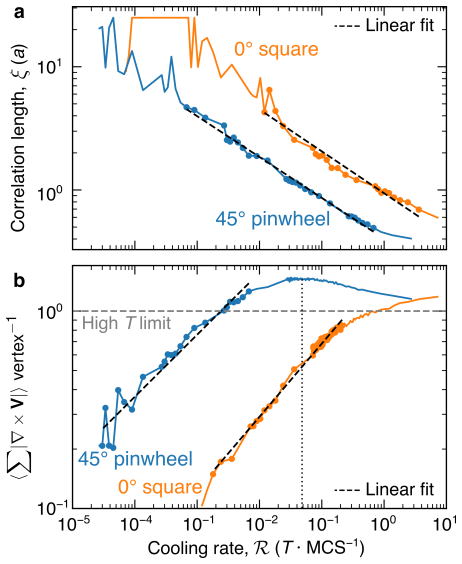
The load-bearing object is the vertex-moment field $\mathbf{V}$—the vector sum of the four island moments meeting at each vertex—together with its discrete curl $\nabla\times\mathbf{V}$; the absolute curl summed over the array is the paper's defect counter. The rotation angle $\vartheta$ is the control parameter: it modulates the relative strengths of nearest- and next-nearest-neighbour dipolar couplings, and thereby decides which vertex type has the lowest energy. The Kibble-Zurek mechanism, which predicts how many topological defects remain when a system is driven through a continuous transition at a finite rate, supplies the scaling relation used to interpret the cooling-rate data. With the two-dimensional Ising exponents $\nu=1$ and $z\approx 2.1665$, it predicts that correlation length and defect density scale with cooling rate as $R^{\mp 0.315}$; the paper compares its measured slopes to this number.
What would settle it
Run the same Monte Carlo cooling protocol over several decades of rate $R$ and record both the two-point correlation length $\xi$ and the summed absolute curl $\langle\sum|\nabla\times\mathbf{V}|\rangle$; if their product is not approximately constant across the power-law window, the identification of the curl exponent with the inverse-correlation-length exponent is falsified.
Extended reading notes
Core claim
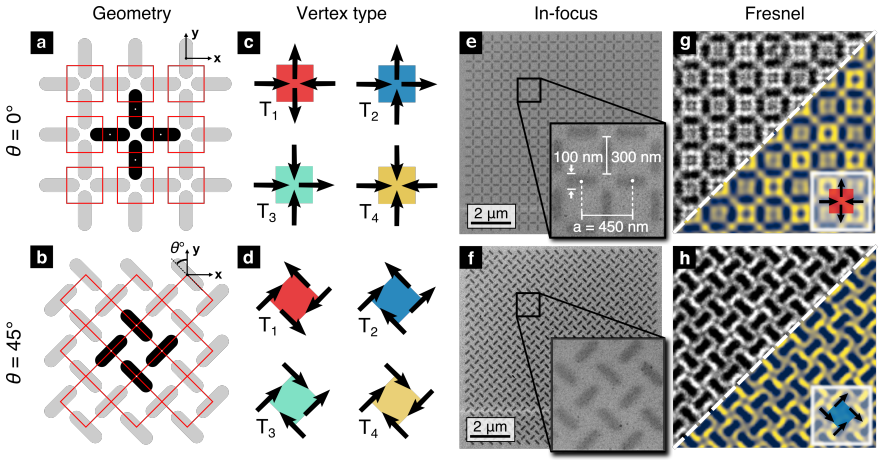
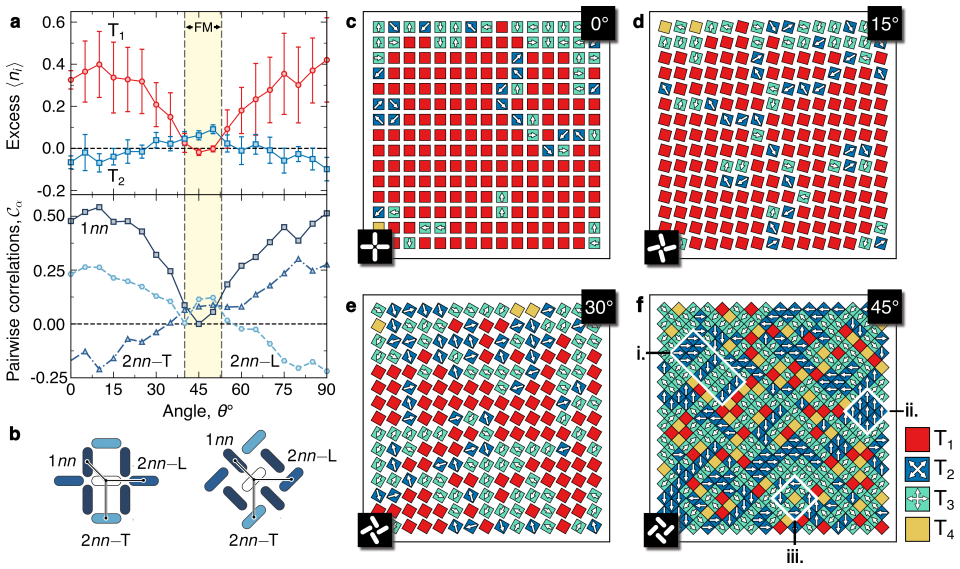
The paper's central claim is that a single angular parameter, the rotation $\vartheta$ of every island about its midpoint, changes the effective dipolar interactions in an artificial spin ice strongly enough to switch the ground state. In the square tiling ($\vartheta = 0^\circ$) the ground state is a chequerboard of T1 vertices—two moments in, two out, no net moment—which is antiferromagnetic; in the pinwheel tiling ($\vartheta = 45^\circ$) it is ferromagnetic, dominated by T2 vertices, which carry a net moment. The experiment locates the crossover at roughly $39^\circ$ to $53^\circ$, where the T2 excess is about ten percent because the ferromagnetic arrays are more severely quenched by the same anneal; at the angle where T1 and T2 populations are equal, all two-in/two-out vertices are equally populated, restoring the ice-rule manifold in a fully planar geometry. The defects that accompany ordering are characterized by the discrete curl of the vertex-moment field: one-dimensional strings in the antiferromagnetic phase and two-dimensional vortices wrapped around moment-free T1/T4 cores in the ferromagnetic phase. Monte Carlo simulations give cooling-rate exponents for the correlation length ($-0.340 \pm 0.005$ for square, $-0.332 \pm 0.018$ for pinwheel) and for the summed absolute curl ($0.370 \pm 0.004$ and $0.314 \pm 0.017$) that agree with the Kibble-Zurek prediction of $\pm 0.315$ for the two-dimensional Ising class.
Load-bearing premise
The load-bearing premise is that the summed absolute curl of the vertex-moment field is proportional to the inverse correlation length $\xi^{-1}$; if these two quantities are not proportional, the measured cooling-rate exponents are not Kibble-Zurek exponents.
Editorial extensions
If this is right
- At the crossover angles, the planar arrays approximately satisfy the ice rule with all two-in/two-out vertices equally probable, so the same sample family offers a two-dimensional platform for frustrated ice-rule physics without sublattice offsets or external modifiers.
- Defect density in both square and pinwheel tilings scales with cooling rate as expected for the two-dimensional Ising universality class, making the rotation family a tuneable Kibble-Zurek testbed for quenched phase transitions.
- Because ferromagnetic pinwheel arrays equilibrate roughly ten times slower than square arrays under the same anneal, choosing the island angle selects how far the final state sits from equilibrium.
- The defect textures observed are one-dimensional strings in the antiferromagnetic phase and two-dimensional vortices in the ferromagnetic phase, so defect dimensionality is set by the lattice geometry rather than by the magnetic material.
Reading between the lines
- A direct cross-check of the paper's diagnostic would be to measure correlation length and summed curl in the same Monte Carlo ensembles over several decades of cooling rate; a constant product of the two would confirm that the curl exponent is a genuine Kibble-Zurek exponent.
- If the restored ice-rule manifold at the crossover angle hosts a Coulomb phase, larger simulations or structure-factor measurements should reveal algebraic spin correlations; measuring that would test the equilibrium side of the transition directly.
- Applying the same continuous rotation to other lattices, such as kagome or honeycomb geometries, would test whether the string-to-vortex defect transition is a general consequence of morphing artificial spin ice arrays.
Signed reviews
Editorial analysis
A structured set of objections, weighed in public.
Referee Report
Summary. The manuscript studies artificial spin ice arrays in which every island is rotated by an angle ϑ between the square (ϑ=0°) and pinwheel (ϑ=45°) geometries. Using Lorentz TEM on annealed cobalt arrays, the authors report a gradual crossover from antiferromagnetic T1-dominated order to ferromagnetic T2-dominated order, with a region around 39°–53° where T2 vertices are in excess. Monte Carlo simulations of the full dipolar model reproduce the experimental vertex populations and correlation functions. The paper further claims that the defects accompanying ordering change from one-dimensional strings in the AFM phase to two-dimensional vortex structures in the FM phase, and that the cooling-rate scaling of the quantity ⟨Σ|∇×V|⟩ is consistent with Kibble-Zurek scaling for the 2D Ising universality class, with fitted exponents near 0.315. The Discussion carefully notes that a systematic experimental scaling study would be needed for conclusive proof.
Significance. If the central ordering result is correct, the paper provides a clean experimental demonstration that a single geometric parameter can continuously tune an artificial spin ice between AFM and FM ground states and can restore an ice-rule manifold at the crossover. The experimental vertex-population statistics after annealing, the use of the full dipolar Monte Carlo model, and the analytic paramagnetic limits for the curl observable are valuable. However, the Kibble-Zurek scaling claim is a headline result and rests on an observable whose identification as a defect density is not established; as written, that part of the paper is not conclusive.
major comments (3)
- [Methods, 'Defect density in the Kibble Zurek Mechanism'] The justification that ⟨Σ|∇×V|⟩ scales as ξ⁻¹ is not valid. The curl at a vertex is a finite difference of neighbouring vertex moments and hence a linear combination of island spin components; |∇×V| is a local nonlinear function of roughly a dozen spins, not a two-point correlation function. Even though expressing |X| as sqrt(X²) introduces products of pairs of spin components, the expectation value of such a nonlinear function is not governed by the scaling dimension of the two-point correlator. Consequently the fitted exponents in Table 1 (0.370±0.004 and 0.314±0.017) are not established as KZM exponents, and the central KZM claim is unsupported unless an independent derivation or a direct test links this observable to the actual topological defect density.
- [Figure 5 and Table 1] The KZM defect-density exponent is compared with the inverse correlation-length exponent 0.315, but for point-like vortex cores in two dimensions the defect density should scale as ξ⁻², giving an exponent 2ν/(1+zν) ≈ 0.63 for the 2D Ising class. The paper's observable is per-vertex and would naturally measure a density per unit area, so the quoted pinwheel exponent 0.314 is quantitatively inconsistent with the 2D vortex interpretation. The authors should either identify the proper topological defect density (for example, by counting T1/T4 vortex cores) and compute its scaling, or explicitly justify why their curl measure behaves as an inverse length rather than an inverse area.
- [Figure 3 and Monte Carlo section] The Monte Carlo cooling rate is calibrated to reproduce the experimentally observed vertex populations (the dashed vertical line in Fig. 3a), and the KZM exponents are extracted from the same simulations. This makes the KZM consistency claim dependent on a rate scale that is not independently determined. In addition, the Discussion acknowledges that no experimental cooling-rate scaling data are presented. The paper should clarify that the KZM claim is a simulation-based prediction, not an experimental verification, and should show that the extracted exponents are stable across the fitting range and simulation parameters rather than being artefacts of the chosen quench schedule.
minor comments (5)
- [Methods, 'Monte Carlo'] The algorithm is called 'Metropolis-Hasting' but the standard name is 'Metropolis-Hastings'.
- [Methods, 'Defect density in the Kibble Zurek Mechanism'] The symbol for the correlation-length exponent is written as 'v' instead of the usual Greek ν, which may confuse readers.
- [Figure 3 caption and Methods] The text states that 50×50 vertex arrays comprise 5100 islands; for square-like vertex lattices with periodic boundary conditions one expects 2L²=5000 islands for L=50, so the number 5100 should be checked.
- [Methods, 'Sample Fabrication'] The data availability statement reads 'DOI xx.xxxx' and should be completed before publication.
- [Figure 3 caption] The statement that 'the angular FM region depends on system size' is given without quantitative support; a brief explanation or reference would help.
Circularity Check
The AFM–FM transition claim is independently supported by LTEM and full-dipolar MC; partial circularity enters through calibrating the MC quench rate to experimental vertex populations, while the KZM exponent match rests on an unproved curl-as-defect-density identification rather than on a circular derivation.
-
fitted input called prediction
[Figure 3 and 'Quench behaviour' section (Fig. 3a caption; text following Fig. 3b)]
"The dashed vertical line reflects a fast cooling rate which recovers well the experimentally obtained populations for the two tilings. ... the quenched simulations—which are purposely not allowed to equilibrate at each temperature step—show excess populations in good agreement with those obtained in the experiment."
The Monte Carlo cooling rate R is a free parameter chosen so that the quenched MC populations reproduce the experimental vertex populations for the two endpoint tilings. The same calibrated R is then used to generate the full-angle quenched population curves, and the agreement is presented as validation. This is a calibration check, not an independent prediction of the angular populations. However, the AFM-to-FM transition itself is observed directly in annealed LTEM arrays and also appears in the equilibrium (rate-independent) MC limit, so the circularity is partial rather than determinative of the central claim.
full rationale
No step in the paper makes the central phase-transition claim equivalent to its own inputs by construction. The 39–53 degree T2-excess region is measured in thermally annealed cobalt arrays and reproduced by full-dipolar Monte Carlo simulations that are compared with, but not derived from, the experiment. The citation of Ref. [28] (Macêdo, Macauley, Nascimento & Stamps) for the predicted transition and near-degenerate pinwheel vertex energies is a same-group self-citation, yet it is not load-bearing: the present experiment and MC provide independent support for the ordering change, so the self-citation mostly frames the prediction rather than supplying the argument. The larger concern is the Kibble-Zurek comparison: the Methods identify the summed absolute curl of the vertex-moment field as a defect density and assert ⟨Σ|∇×V|⟩ ∼ ξ^{-1} because the absolute value 'introduces products of at most two spin components—exactly the same as in the two-point correlator.' That is a dimensional-scaling assumption, not a derivation, and for point-like 2D vortex cores KZM would instead suggest a defect density scaling closer to ξ^{-2}; the paper itself concedes that 'a systematic investigation of their experimental scaling with cooling rate would provide conclusive proof.' This is a correctness risk in the fitted exponents rather than a circular reduction from an equation or fitted parameter to the claimed result, so it is not counted as a circularity step. Overall the derivation chain is largely self-contained; the one genuine circularity is the calibrated MC validation loop in Fig. 3, which lowers the score but does not undermine the independently observed ordering transition.
Assumptions & free parameters
free parameters (4)
- Monte Carlo cooling rate R =
not stated; set by the dashed vertical line in Fig. 3a
- Spin-flip energy barrier Eb =
10 D (with 10% standard deviation)
- Saturation magnetization MS =
70% of bulk Co
- Linear fitting range for KZM exponents =
not specified; 'linear portion of each series'
assumptions (6)
- domain assumption Each island behaves as a single-domain Ising macrospin with two stable orientations.
- domain assumption Point-dipole approximation for the inter-island interactions.
- domain assumption Square and pinwheel artificial spin ices belong to the 2D Ising universality class, and this holds for all rotation angles.
- domain assumption The attempt frequency in the Néel-Arrhenius switching rate has no angular dependence.
- ad hoc to paper The sum of absolute curl, ⟨Σ|∇×V|⟩, scales as xi^(-1).
- domain assumption Blocking temperatures are site-dependent and annealing at 250 C resets the arrays into a superparamagnetic state.
Cite this review
Pith. "Pith review of Ice-rule made manifold: phase transitions, topological defects and manifold restoration in two-dimensional artificial spin systems." pith.science (2026). https://pith.science/paper/6AVWER7P
@misc{pith2026190808903,
  author       = {Pith},
  title        = {Pith review of: Ice-rule made manifold: phase transitions, topological defects and manifold restoration in two-dimensional artificial spin systems},
  year         = {2026},
  howpublished = {\url{https://pith.science/paper/6AVWER7P}},
  note         = {Machine review of arXiv:1908.08903}
}
read the original abstract
Artificial spin ices are arrays of correlated nano-scale magnetic islands that prove an excellent playground in which to study the role of topology in critical phenomena. Here, we investigate a continuum of spin ice geometries, parameterised by rotation of the islands. In doing so, we morph from the classic square ice to the recently studied pinwheel geometry, with the rotation angle acting as a proxy for controlling inter-island interactions. We experimentally observe a change in ground state magnetic order from antiferromagnetic to ferromagnetic across this class of geometries using Lorentz transmission electron microscopy on thermally annealed cobalt arrays. The change in ordering leads to an apparent change in the nature of the defects supported: from one-dimensional strings in the antiferromagnetic phase to two-dimensional vortex-like structures in the ferromagnetic one, consistent with the scaling predicted by the Kibble-Zurek mechanism. Our results show how magnetic order in artificial spin ices can be tuned by changes in geometry so that a truly frustrated ice-rule phase is possible in two-dimensional systems. Furthermore, we demonstrate this system as a testbed to investigate out-of-equilibrium dynamics across phases.
Figures

Figures from the paper (2 more)

Forward citations
Cited by 1 Pith paper
-
Heisenberg pseudo-exchange and emergent anisotropies in field-driven pinwheel artificial spin ice
In field-driven pinwheel artificial spin ice, island end-states produce a field-induced Heisenberg-like pseudo-exchange coupling that sets the reversal path and explains emergent anisotropies, with strength tunable by...
Reference graph
Works this paper leans on
-
[1]
Wang, R. F.et al. Artificial ‘spin ice’ in a geometrically frustrated lattice of nanoscale ferromagnetic islands. Nat. 439, 303 (2006)
work page 2006
-
[2]
Malozovsky, Y . & Rozenbaum, V . Orientational ordering in two-dimensional systems with long-range interaction. Phys. A: Stat. Mech. its Appl. 175, 127 – 145 (1991)
work page 1991
-
[3]
Politi, P., Pini, M. G. & Stamps, R. L. Dipolar ground state of planar spins on triangular lattices. Phys. Rev. B 73, 020405 (2006)
work page 2006
-
[4]
Cowburn, R. P. & Welland, M. E. Room temperature magnetic quantum cellular automata. Sci. 287, 1466–1468 (2000)
work page 2000
-
[5]
Arnalds, U. B. et al. A new look on the two-dimensional Ising model: thermal artificial spins. New J. Phys. 18, 023008 (2016). 14/18
work page 2016
-
[6]
Nguyen, V .-D., Perrin, Y ., Le Denmat, S., Canals, B. & Rougemaille, N. Competing interactions in artificial spin chains. Phys. Rev. B 96, 014402 (2017)
work page 2017
- [7]
-
[8]
Sklenar, J. et al. Field-induced phase coexistence in an artificial spin ice. Nat. Phys. 15, 191–195 (2019)
work page 2019
Show all 62 references
-
[9]
Louis, D. et al. A tunable magnetic metamaterial based on the dipolar four-state Potts model. Nat. Mater. 17, 1076–1080 (2018)
2018
-
[10]
Streubel, R. et al. Spatial and temporal correlations of XY macro spins. Nano Lett. 18, 7428–7434 (2018)
2018
-
[11]
Schildknecht, D., Heyderman, L. J. & Derlet, P. M. Phase diagram of dipolar-coupled XY moments on disordered square lattices. Phys. Rev. B 98, 064420 (2018)
2018
-
[12]
Leo, N. et al. Collective magnetism in an artificial 2-D XY spin system. Nat. Commun. 9, 2850 (2018)
2018
-
[13]
& Iye, Y
Tanaka, M., Saitoh, E., Miyajima, H., Yamaoka, T. & Iye, Y . Magnetic interactions in a ferromagnetic honeycomb nanoscale network. Phys. Rev. B 73, 052411 (2006)
2006
-
[14]
Farhan, A. et al. Direct observation of thermal relaxation in artificial spin ice. Phys. Rev. Lett. 111, 057204 (2013)
2013
-
[15]
A., Petrova, O., Tchernyshyov, O
Daunheimer, S. A., Petrova, O., Tchernyshyov, O. & Cumings, J. Reducing disorder in artificial kagome ice. Phys. Rev. Lett. 107, 167201 (2011)
2011
-
[16]
& Cumings, J
Qi, Y ., Brintlinger, T. & Cumings, J. Direct observation of the ice rule in an artificial kagome spin ice. Phys. Rev. B 77, 094418 (2008)
2008
-
[17]
pinwheel
Li, Y .et al. Superferromagnetism and domain-wall topologies in artificial “pinwheel” spin ice. ACS Nano 13, 2213–2222 (2019)
2019
-
[18]
M., Chadha, M
Burn, D. M., Chadha, M. & Branford, W. R. Angular-dependent magnetization reversal processes in artificial spin ice. Phys. Rev. B 92, 214425 (2015)
2015
-
[19]
Le, B. L. et al. Effects of exchange bias on magnetotransport in permalloy kagome artificial spin ice. New J. Phys. 17, 023047 (2015)
2015
-
[20]
Jungfleisch, M. B. et al. High-frequency dynamics modulated by collective magnetization reversal in artificial spin ice. Phys. Rev. Appl. 8, 064026 (2017)
2017
-
[21]
Gliga, S. et al. Emergent dynamic chirality in a thermally driven artificial spin ratchet. Nat. Mater. 16, 1106–1111 (2017)
2017
-
[22]
Morley, S. A. et al. V ogel-Fulcher-Tammann freezing of a thermally fluctuating artificial spin ice probed by X-ray photon correlation spectroscopy. Phys. Rev. B 95, 104422 (2017)
2017
-
[23]
Canals, B. et al. Fragmentation of magnetism in artificial kagome dipolar spin ice. Nat. Commun. 7, 11446 (2016)
2016
-
[24]
E., Perkins, G
Ladak, S., Read, D. E., Perkins, G. K., Cohen, L. F. & Branford, W. R. Direct observation of magnetic monopole defects in an artificial spin-ice system. Nat. Phys. 6 (2010)
2010
-
[25]
Mengotti, E. et al. Real-space observation of emergent magnetic monopoles and associated Dirac strings in artificial kagome spin ice. Nat. Phys. 7, 68 (2010). 15/18
2010
-
[26]
Farhan, A. et al. Emergent magnetic monopole dynamics in macroscopically degenerate artificial spin ice. Sci. Adv. 5 (2019)
2019
-
[27]
Vedmedenko, E. Y . Dynamics of bound monopoles in artificial spin ice: How to store energy in Dirac strings. Phys. Rev. Lett. 116, 077202 (2016)
2016
-
[28]
M., Nascimento, F
Macˆedo, R., Macauley, G. M., Nascimento, F. S. & Stamps, R. L. Apparent ferromagnetism in the pinwheel artificial spin ice. Phys. Rev. B 98, 014437 (2018)
2018
-
[29]
Switchable geometric frustration in an artificial-spin-ice-superconductor heterosys- tem
Wang, Y .-L.et al. Switchable geometric frustration in an artificial-spin-ice-superconductor heterosys- tem. Nat. Nanotechnol. 13, 560–565 (2018)
2018
-
[30]
& Cugliandolo, L
Levis, D. & Cugliandolo, L. F. Out-of-equilibrium dynamics in the bidimensional spin-ice model. EPL 97, 30002 (2012)
2012
-
[31]
Zurek, W. H. Cosmological experiments in superfluid helium. Nat. 317, 505–508 (1985)
1985
-
[32]
Kibble, T. W. B. Topology of cosmic domains and strings. J. Phys. A: Math. Gen. 9, 1387–1398 (1976)
1976
-
[33]
del Campo, A., Kibble, T. W. B. & Zurek, W. H. Causality and non-equilibrium second-order phase transitions in inhomogeneous systems. J. Physics: Condens. Matter 25, 404210 (2013)
2013
-
[34]
& Heinonen, O
Gliga, S., K ´akay, A., Hertel, R. & Heinonen, O. G. Spectral analysis of topological defects in an artificial spin-ice lattice. Phys. Rev. Lett. 110, 117205 (2013)
2013
-
[35]
Ulm, S. et al. Observation of the Kibble-Zurek scaling law for defect formation in ion crystals. Nat. Commun. 4, 2290 (2013)
2013
-
[36]
Nisoli, C. et al. Effective temperature in an interacting vertex system: Theory and experiment on artificial spin ice. Phys. Rev. Lett. 105, 047205 (2010)
2010
-
[37]
As we compare types from square to pinwheel, we simply refer to them all as vertices
The geometric structure of a pinwheel type does not involve four islands meeting head on (and so ‘unit’ rather than ‘vertex’ would be a more appropriate description17, 28). As we compare types from square to pinwheel, we simply refer to them all as vertices
-
[38]
P., Stein, A., Langridge, S
Morgan, J. P., Stein, A., Langridge, S. & Marrows, C. H. Thermal ground-state ordering and elementary excitations in artificial magnetic square ice. Nat. Phys. 7 (2010)
2010
-
[39]
For the case of a T3 vertex, while moments in one sub-lattice align parallel, the remaining two moments are aligned antiparallel
For the case of a T2 vertex, this definition is unambiguous: the island moments within each sub-lattice of the vertex are parallel. For the case of a T3 vertex, while moments in one sub-lattice align parallel, the remaining two moments are aligned antiparallel. Nonetheless, the...
-
[40]
Ding, W. et al. J. Appl. Phys. 98, 014905 (2005)
2005
-
[41]
& Cushley, M
McVitie, S. & Cushley, M. Quantitative fresnel lorentz microscopy and the transport of intensity equation. Ultramicroscopy 106, 423 – 431 (2006)
2006
-
[42]
C´ordoba, R., Ses´e, J., Teresa, J. D. & Ibarra, M. High-purity cobalt nanostructures grown by focused- electron-beam-induced deposition at low current. Microelectron. Eng. 87, 1550 – 1553 (2010). The 35th International Conference on Micro- and Nano-Engineering (MNE)
2010
-
[43]
Belova, L. M. et al. Rapid electron beam assisted patterning of pure cobalt at elevated temperatures via seeded growth. Nanotechnol. 22, 145305 (2011)
2011
-
[44]
& Moessner, R
M¨oller, G. & Moessner, R. Artificial square ice and related dipolar nanoarrays. Phys. Rev. Lett. 96, 237202 (2006). 16/18
2006
-
[45]
& Rougemaille, N
Perrin, Y ., Canals, B. & Rougemaille, N. Extensive degeneracy, Coulomb phase and magnetic monopoles in artificial square ice. Nat. 540, 410 (2016)
2016
-
[46]
¨Ostman, E. et al. Interaction modifiers in artificial spin ices. Nat. Phys. 14, 375–379 (2018)
2018
-
[47]
On thermalization of magnetic nano-arrays at fabrication
Nisoli, C. On thermalization of magnetic nano-arrays at fabrication. New J. Phys. 14, 035017 (2012)
2012
-
[48]
Y ., J´onsson, H
Liashko, S. Y ., J´onsson, H. & Uzdin, V . M. The effect of temperature and external field on transitions in elements of kagome spin ice. New J. Phys. 19, 113008 (2017)
2017
-
[49]
This implicitly assumes that the systems are not glassy enough to jam in a local energy minima
-
[50]
& Sandvik, A
Liu, C.-W., Polkovnikov, A. & Sandvik, A. W. Dynamic scaling at classical phase transitions approached through nonequilibrium quenching. Phys. Rev. B 89, 054307 (2014)
2014
-
[51]
C., Lawson, N
Hendry, P. C., Lawson, N. S., Lee, R. A. M., McClintock, P. V . E. & Williams, C. D. H. Generation of defects in superfluid 4He as an analogue of the formation of cosmic strings. Nat. 368, 315–317 (1994)
1994
-
[52]
Zurek, W. H. Cosmic strings in laboratory superfluids and the topological remnants of other phase transitions. Acta Phys. Polon. B24, 1301–1311 (1993)
1993
-
[53]
Mol, L. A. S. et al. Magnetic monopole and string excitations in a two-dimensional spin ice. J. Appl. Phys. 106, 063913 (2009)
2009
-
[54]
Melting artificial spin ice
Kapaklis, V .et al. Melting artificial spin ice. New J. Phys. 14, 035009 (2012)
2012
-
[55]
Choosing a coordinate system in which the vertex moments lie in the (x, y)-plane, only the z-component of ∇× V is non-zero. Writing the vertex moment at a lattice point (i, j) as V(i, j) = (V (i, j) x ,V (i, j) y ), the curl becomes ∂xVy− ∂yVx ⏐⏐⏐⏐ (i, j) ≈ 1 2a ( V (i+1, j) y...
-
[56]
In fact, it can be shown analytically that the two tilings tend to slightly different limits in the paramagnetic regime: lim T→∞∑|∇× V| = 674+223 √ 2 1024 ≈ 0.966 vertex−1 for ϑ = 0◦ 15(181+248 √ 2) 8192 ≈ 0.974 vertex−1 for ϑ = 45◦
-
[57]
Sendetskyi, O. et al. Continuous magnetic phase transition in artificial square ice. Phys. Rev. B 99, 214430 (2019)
2019
-
[58]
& Zheng, B
Luo, H., Schulz, M., Sch¨uke, L., Trimper, S. & Zheng, B. Short-time dynamic behaviour of critical XY systems. Phys. Lett. A 250, 383 – 388 (1998)
1998
-
[59]
& Zurek, W
Dziarmaga, J. & Zurek, W. H. Quench in the 1-D Bose-Hubbard model: Topological defects and excitations from the Kosterlitz-Thouless phase transition dynamics. Sci. Reports 4 (2014)
2014
-
[60]
W., Rosenbluth, M
Metropolis, N., Rosenbluth, A. W., Rosenbluth, M. N., Teller, A. H. & Teller. Equation of state calculations by fast computing machines. The J. Chem. Phys. 21, 1087–1092 (1953)
1953
-
[61]
& Stamps, R
Budrikis, Z., Politi, P. & Stamps, R. L. A network model for field and quenched disorder effects in artificial spin ice. New J. Phys. 14, 045008 (2012). 17/18
2012
-
[62]
Nightingale, M. P. & Bl¨ote, H. W. J. Dynamic exponent of the two-dimensional Ising Model and Monte Carlo computation of the subdominant eigenvalue of the stochastic matrix. Phys. Rev. Lett. 76, 4548–4551 (1996). Acknowledgements This work was supported by the Engineering and ...
1996
Reviewed August 14, 2026 · model on record in the stance chip above.
Discussion (0). Continue with ORCID to comment.