REVIEW 3 major objections 5 minor 83 references
This paper argues that magnetic reconnection extracts rotational energy from rapidly rotating pure Lovelock black holes far more efficiently as spacetime dimension rises, with efficiency exceeding 180% in eight dimensions and peaking in nin
Reviewed by Pith at T0; open to challenge. T0 means a machine referee read the full paper against a public rubric. the ladder, T0–T4 →
T0 review · deepseek-v4-flash
2026-08-03 00:22 UTC pith:6BONMNFX
load-bearing objection A clean, transparent parameter scan of the Comisso–Asenjo mechanism on an approximate rotating pure-Lovelock metric; the D-trend is plausible but the quantitative claims rest on an unvalidated metric. the 3 major comments →
Extending the Comisso-Asenjo Energy Extraction Mechanism to Pure Lovelock Gravity
The pith
A machine-rendered reading of the paper's core claim, the machinery that carries it, and where it could break.
Core claim
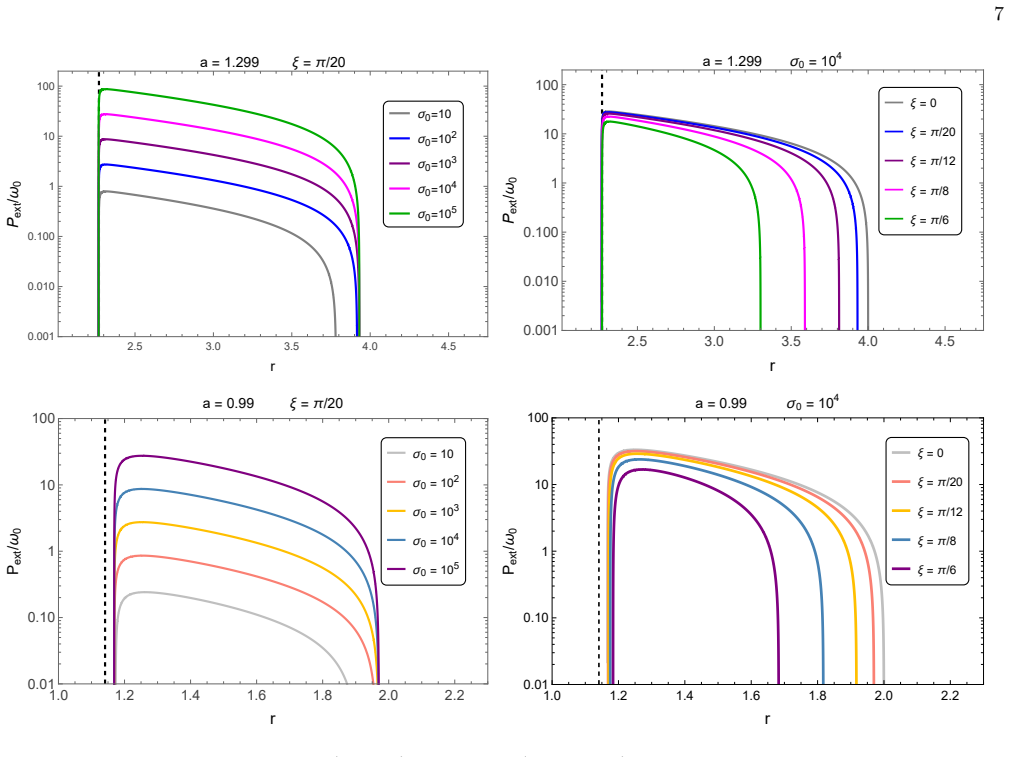
The central claim is that the efficiency and power of the Comisso-Asenjo magnetic reconnection mechanism increase with spacetime dimension for rapidly rotating pure Lovelock black holes with a single rotation parameter. Using an effective rotating metric built by inserting the pure Lovelock mass parameter into the standard higher-dimensional rotating black hole line element (valid to leading order), the authors compute the energy-at-infinity per enthalpy of accelerated and decelerated plasma outflows and the resulting efficiency. They find η exceeding 100% in all dimensions 6–9, reaching about 135% in D=6, 150% in D=7 (the same as the four-dimensional rotating black hole), 180% in D=8, and t
What carries the argument
The argument runs through two pieces of machinery. First, the effective rotating pure Lovelock spacetime: a line element of the same form as the standard higher-dimensional rotating black hole, with the mass parameter replaced by the pure Lovelock exponent α = (D−2N−1)/N, giving the horizon and ergosphere structure used in all subsequent calculations. Second, the Comisso-Asenjo magnetic reconnection equations, which give the energy-at-infinity per enthalpy ε±∞ of the accelerated/decelerated plasma outflows in the zero angular momentum observer (ZAMO) frame, together with the extraction efficiency η = ε+/(ε++ε−) and the extracted power P_ext = −ε−∞ w0 A_in U_in. The conditions ε+>0 and ε−<0 d
Load-bearing premise
The rotating pure Lovelock spacetime used in the paper is not an exact vacuum solution; every quantitative result depends on the assumption that this leading-order metric faithfully captures the horizon, ergosphere, and frame-dragging geometry, with no estimate of how large the neglected terms are.
What would settle it
Compute the first-order corrections to the effective rotating pure Lovelock metric by solving the vacuum field equations perturbatively in the rotation parameter and re-evaluate η and P_ext; if the corrected horizon or ergosphere radius changes by a significant fraction, the reported dimension-dependence and efficiency values would not survive. Alternatively, an exact rotating vacuum solution—or a proof that none exists—would settle the spacetime question directly.
If this is right
- Rapidly rotating pure Lovelock black holes in dimensions 6–9 can convert a substantial fraction of their rotational energy into escaping plasma, with efficiency exceeding 100% in all cases and reaching 180% or more in higher dimensions.
- The Comisso-Asenjo mechanism can outproduce the Blandford-Znajek process by factors ≫1 over broad magnetization ranges, making magnetic reconnection a potentially dominant energy extraction channel for these black holes.
- The D=7 case matches the four-dimensional rotating black hole result exactly, giving a consistency check and a concrete prediction for what a pure Lovelock black hole looks like energetically in that dimension.
- Higher-dimensional pure Lovelock black holes are energetically distinct from general-relativity counterparts, except at D=3N+1, so energy-extraction measurements could in principle distinguish the theories.
Where Pith is reading between the lines
- If the leading-order rotating metric is a reliable approximation, the same analysis could be extended to multiple rotation parameters and to higher Lovelock order N > 2, likely pushing efficiencies even higher; the paper does not explore these cases.
- The sharp divergence between MR and BZ power as σ0→∞ suggests an observational discriminant: high-magnetization systems should show BZ-dominated jets, while moderate-magnetization rapidly spinning candidates should show reconnection-enhanced outflows.
- Because the paper's metric is not an exact solution, a numerical or perturbative check of the first corrections could either confirm or overturn the reported dimension-dependence; the authors provide no estimate of the corrections' size.
- The growth of η with dimension, if taken at face value, offers a potential signature of extra dimensions in future high-energy astrophysical observations, though the paper does not specify an observational route.
Editorial analysis
A structured set of objections, weighed in public.
Referee Report
Summary. The paper applies the Comisso–Asenjo (CA) magnetic reconnection energy-extraction mechanism to rotating pure Lovelock/Gauss–Bonnet black holes with a single rotation parameter in D=6,7,8,9 dimensions. The spacetime is the effective rotating metric of Dadhich and Ghosh (Eqs. (1)–(7)), which the authors explicitly state is not an exact solution of the pure Lovelock vacuum equations but is valid to leading order. Using the CA energy-at-infinity formula (Eq. (28)), the paper computes allowed parameter-space regions, extracted power P_ext (Eq. (31)), efficiency η=ε+/(ε++ε−) (Eq. (32)), and compares P_ext with the Blandford–Znajek power P_BZ (Eqs. (33)–(34)). The central claims are that the efficiency grows with dimension, reaching approximately 135% in D=6, approximately 150% in D=7 (matching 4D Kerr), approximately 180% in D=8, and its highest values in D=9, and that P_MR/P_BZ≫1 over broad magnetization ranges. The paper also emphasizes the D=3N+1 correspondence, whereby D=7 reproduces the 4D Kerr behavior.
Significance. If the quantitative results are reliable, the paper would extend a well-studied astrophysical energy-extraction mechanism to higher-dimensional pure Lovelock gravity and identify a striking dimension dependence, including a regime in which magnetic reconnection outperforms the Blandford–Znajek process. The paper is transparent about the fact that the rotating metric is approximate, and the D=7 agreement with Kerr provides a valuable internal consistency check. The parameter-space scans are clearly described and the algebra leading from Eq. (28) through Eq. (34) is internally coherent. However, the central quantitative claims rest on two unvalidated premises: the effective rotating metric is not an exact solution, and Eq. (28) is imported from the 4D Kerr derivation. Because the D-dependence of η and P_MR/P_BZ is the paper's main finding, these premises are load-bearing. The paper does not supply numerical code or data, limiting independent reproducibility of the scans.
major comments (3)
- The rotating pure Lovelock/GB metric used for all subsequent calculations is explicitly not an exact vacuum solution: the text states 'Although it does not exactly satisfy the pure GB vacuum field equations, it remains valid to leading order.' Every quantitative result in the paper—the horizon and ergosphere boundaries, the lapse and shift functions, the Keplerian velocity, the energy-at-infinity conditions, η, and P_MR/P_BZ—is computed from this approximate metric. No estimate is provided for the size of the neglected terms or for how they shift r_H, r_erg, or β^φ. Since the central claim is that η grows with dimension (≈135% in D=6, ≈150% in D=7, ≈180% in D=8, highest in D=9), a dimension-dependent shift in the horizon or ergosphere by even a few percent could change η by tens of percent and alter the claimed trend. The authors should provide an explicit error estimate, for example by
- The core energy-at-infinity formula ϵ±∞ is taken directly from the Comisso–Asenjo derivation [28], which is formulated for a four-dimensional Kerr background. The paper does not rederive Eq. (28) for a D-dimensional effective metric, nor does it justify that the ZAMO 3+1 decomposition, the equatorial-plane reduction, the neglect of the electromagnetic energy density leading to Eq. (20), and the velocity addition rule in Eq. (27) remain valid when the spacetime is not an exact solution and has D>4. The quantities α, β^φ, and v_K are D-dependent, so a formal extension may be possible, but it must be demonstrated. In particular, the Lorentz factor and the coordinate transformations in Eqs. (21)–(22) implicitly assume a 3+1 split; for a single-rotation D-dimensional metric one may need to project onto the equatorial plane and explicitly state the relevant (2+1)-dimensional subspace. Because
- The comparison with the Blandford–Znajek mechanism uses the split-monopole formula with κ=0.05, χ1=1.38, χ2=−9.2 from [84], and the flux estimate Φ_BH∼B_0 sinξ r_H^2. These constants and the flux scaling are calibrated for 4D Kerr force-free electrodynamics, where the horizon is a 2-sphere. For D=6–9 pure Lovelock black holes the horizon topology is S^{D−2} and the field geometry differs; no D-dependent calibration is provided. Consequently, the ratio P_MR/P_BZ≫1, which is one of the paper's central conclusions, carries an unjustified normalization from 4D. Similarly, A_in=(r_st^2−r_H^2) in Eq. (31) is a 4D cross-section ansatz; in D dimensions the current-sheet area should be derived from the induced metric on the reconnection layer. The authors should either derive D-dependent coefficients and area factors, or restrict the discussion to qualitative statements that do not depend on the
minor comments (5)
- Notation is inconsistent: the enthalpy density is denoted w in Eq. (11), but ω_0 in Eq. (31) and in the figures, while ω is also used for the frame-dragging angular velocity in Sec. II. Please unify the notation throughout.
- The definition of Δϵ+∞ is hard to parse. Please define p/w and explain why Δϵ+∞ reduces to ϵ+∞ in the present approximation.
- The captions refer to 'left panels' and 'right panels' but the panel arrangement is not fully self-explanatory. Please label each panel (a), (b), ... and refer to them explicitly in the text.
- The phrase 'vertical dashed lines in all figures represent limiting circular orbits' is not accompanied by a definition. Specify which orbit (e.g., the innermost stable circular orbit or the static limit) and how it is computed for the effective metric.
- The D=7 agreement with 4D Kerr is a strong consistency check and should be highlighted as following from the D=3N+1 correspondence. It would be useful to state explicitly that this check does not, by itself, validate the D=6, 8, and 9 results.
Circularity Check
No circularity: the efficiency/power claims are evaluations of external Comisso–Asenjo formulas on a cited approximate metric, with no fitted parameters and no load-bearing self-citation.
full rationale
The paper's quantitative results are obtained by inserting a known metric (Sec. II, taken from Dadhich & Ghosh, Ref. [79]) into the externally derived Comisso–Asenjo energy-at-infinity expression (Eq. (28)), the extraction-power formula (Eq. (31)), the efficiency definition (Eq. (32)), and the Blandford–Znajek comparison (Eqs. (33)–(34)). No parameter is fitted to the target claims: the magnetization σ0, orientation angle ξ, spin a, and reconnection radius r are scanned input parameters, and the constants κ=0.05, χ1=1.38, χ2=−9.2 are taken from the independent Tchekhovskoy et al. result [84]. The D=7 ↔ 4D Kerr agreement is presented as an external consistency check, not as an input. The self-citations present in the manuscript are background or related-work citations (e.g., Refs. [26], [27], [57], [68], [70]) and are not load-bearing for the central extraction-efficiency trend. The admitted approximation that the rotating pure-Lovelock metric is not an exact vacuum solution is a correctness/robustness caveat, not a circularity: the paper discloses that the metric is valid only to leading order, and the subsequent computation is a straightforward application of independent formulas to that stated approximate spacetime. There is no step where a 'prediction' reduces by construction to an input, and no uniqueness claim or ansatz is smuggled in via self-citation.
Axiom & Free-Parameter Ledger
free parameters (7)
- Lovelock order N =
2 (Gauss-Bonnet)
- Spacetime dimension D =
6, 7, 8, 9
- Dimensionless spin parameter a =
D=6: 1.299; D=7: 0.99; D=8: 1.0911; D=9: 1.4142
- Upstream magnetization σ0 =
Scanned 3–100 (phase-space) and 10–10^5 (power)
- Magnetic field orientation angle ξ =
Scanned 0 to π/6, often fixed at π/20
- Reconnection radius r =
Scanned from horizon to ergosphere
- Inflow coefficient U_in =
O(10^-1)
axioms (6)
- domain assumption Comisso-Asenjo energy-at-infinity formula (Eq. 28) is valid in D=6–9 Lovelock spacetimes.
- domain assumption The rotating pure Lovelock/GB metric of [79] is a valid effective spacetime for ergosphere energy-extraction calculations.
- domain assumption Plasma is non-compressible and adiabatic; electromagnetic energy density is negligible compared with the hydrodynamic term.
- domain assumption Reconnection occurs in the fast collisionless regime with U_in = O(10^-1).
- standard math Blandford-Znajek split-monopole power formula with κ=0.05, χ1=1.38, χ2=−9.2 from [84] is applicable.
- domain assumption Single-rotation configuration (n=1) and equatorial-plane analysis capture the mechanism.
read the original abstract
In this paper, we extend the Comisso-Asenjo magnetic reconnection (MR) mechanism to rotating black holes (BHs) in pure Lovelock/Gauss-Bonnet (GB) gravity in dimension $2N+2\leq D\leq 4N+1$ (where $N$ is the Lovelock polynomial degree of $N$th order term in the action). We perform a comprehensive analysis of the efficiency and power of extracted energy by exploring the effects of the spin parameter, plasma magnetization, magnetic field orientation, and reconnection location. Our results reveal distinctive energetic features of pure Lovelock BHs relative to their Einstein counterparts, except in the special case of $D=3N+1$, where the two theories coincide. Our results demonstrate that magnetic reconnection becomes increasingly efficient in extracting rotational energy from rapidly rotating pure Lovelock BHs with single rotation configuration as the spacetime dimension increases from $D=6$ to $9$. Furthermore, the Comisso-Asenjo MR mechanism can produce higher extraction power than the Blandford-Znajek (BZ) process in certain regions of parameter space because of its enhanced energy extraction rate. These results show that magnetic reconnection is an efficient mechanism for extracting rotational energy from rapidly rotating pure Lovelock/GB BHs, highlighting their relevance to high-energy astrophysical phenomena.
Figures




Reference graph
Works this paper leans on
-
[1]
Lovelock, J
D. Lovelock, J. Math. Phys.12, 498 (1971)
1971
-
[2]
Zwiebach, Phys
B. Zwiebach, Phys. Lett. B156, 315 (1985)
1985
-
[3]
Sen, JHEP2005, 059 (2005), arXiv:hep-th/0411255 [hep-th]
A. Sen, JHEP2005, 059 (2005), arXiv:hep-th/0411255 [hep-th]
Pith/arXiv arXiv 2005
-
[4]
D. G. Boulware and S. Deser, Phys. Rev. Lett.55, 2656 (1985)
1985
-
[5]
J. T. Wheeler, Nucl. Phys. B268, 737 (1986)
1986
-
[6]
J. T. Wheeler, Nucl. Phys. B273, 732 (1986)
1986
-
[7]
Whitt, Phys
B. Whitt, Phys. Rev. D38, 3000 (1988)
1988
-
[8]
D. Kastor and R. Mann, JHEP2006, 048 (2006), arXiv:hep-th/0603168 [hep-th]
Pith/arXiv arXiv 2006
-
[9]
G. Giribet, J. Oliva, and R. Troncoso, JHEP2006, 007 (2006), arXiv:hep-th/0603177 [hep-th]
Pith/arXiv arXiv 2006
-
[10]
M. Ba˜ nados, C. Teitelboim, and J. Zanelli, Phys. Rev. D49, 975 (1994), arXiv:gr-qc/9307033 [gr-qc]
Pith/arXiv arXiv 1994
-
[11]
J. Cris´ ostomo, R. Troncoso, and J. Zanelli, Phys. Rev. D62, 084013 (2000), arXiv:hep-th/0003271 [hep-th]
Pith/arXiv arXiv 2000
-
[12]
R.-G. Cai and N. Ohta, Phys. Rev. D74, 064001 (2006), arXiv:hep-th/0604088 [hep-th]
Pith/arXiv arXiv 2006
-
[13]
N. Dadhich and S. Shaymatov, Phys. Dark Universe35, 100986 (2022), arXiv:2104.00427 [gr-qc]
Pith/arXiv arXiv 2022
-
[14]
N. Dadhich, S. G. Ghosh, and S. Jhingan, Physics Let- ters B711, 196 (2012), arXiv:1202.4575 [gr-qc]
Pith/arXiv arXiv 2012
-
[16]
N. Dadhich, S. G. Ghosh, and S. Jhingan, Phys. Rev. D 88, 124040 (2013), arXiv:1308.4770 [gr-qc]
Pith/arXiv arXiv 2013
-
[17]
Chakraborty and N
S. Chakraborty and N. Dadhich, Eur. Phys. J. C78, 81 (2018)
2018
-
[18]
R. Gannouji, Y. Rodr ´ ıguez Baez, and N. Dadhich, Phys. Rev. D100, 084011 (2019), arXiv:1907.09503 [gr-qc]
Pith/arXiv arXiv 2019
-
[19]
Dadhich, inSpringer Proc
N. Dadhich, inSpringer Proc. Phys., Springer Proceed- ings in Physics, Vol. 157 (2014) p. 43
2014
-
[20]
N. Dadhich, Eur. Phys. J. C76, 104 (2016), arXiv:1506.08764 [gr-qc]
Pith/arXiv arXiv 2016
-
[21]
S. Chakraborty and N. Dadhich, Phys. Dark Universe 30, 100658 (2020), arXiv:2005.07504 [gr-qc]
Pith/arXiv arXiv 2020
-
[22]
N. Dadhich and S. Chakraborty, Phys. Rev. D95, 064059 (2017), arXiv:1606.01330 [gr-qc]
Pith/arXiv arXiv 2017
-
[23]
N. Dadhich, S. Hansraj, and B. Chilambwe, Int. J. Mod. Phys. D26, 1750056 (2017), arXiv:1607.07095 [gr-qc]
Pith/arXiv arXiv 2017
-
[24]
S. Chakraborty and N. Dadhich, JHEP2015, 3 (2015), arXiv:1509.02156 [gr-qc]
Pith/arXiv arXiv 2015
-
[25]
Dadhich, JCAP2020, 035 (2020), arXiv:1903.03436 [gr-qc]
N. Dadhich, JCAP2020, 035 (2020), arXiv:1903.03436 [gr-qc]
Pith/arXiv arXiv 2020
-
[26]
S. Shaymatov and N. Dadhich, Phys. Lett. B846, 138243 (2023), arXiv:2209.02560 [gr-qc]
Pith/arXiv arXiv 2023
-
[27]
S. Shaymatov and N. Dadhich, J. Cosmol. Astropart. Phys.2022, 060 (2022), arXiv:2008.04092 [gr-qc]
Pith/arXiv arXiv 2022
-
[28]
L. Comisso and F. A. Asenjo, Phys. Rev. D103, 023014 (2021), arXiv:2012.00879 [astro-ph.HE]
Pith/arXiv arXiv 2021
-
[29]
A. R. King, M. B. Davies, M. J. Ward, G. Fabbiano, and M. Elvis, Astrophys. J.552, L109 (2001), arXiv:astro- ph/0104333 [astro-ph]
arXiv 2001
-
[30]
B. M. Peterson,An Introduction to Active Galactic Nu- clei(1997)
1997
-
[31]
P. Meszaros, Rept. Prog. Phys.69, 2259 (2006), arXiv:astro-ph/0605208
Pith/arXiv arXiv 2006
-
[32]
R. D. Blandford and R. L. Znajek, Mon. Not. Roy. As- tron. Soc.179, 433 (1977)
1977
-
[33]
Penrose, Riv
R. Penrose, Riv. Nuovo Cim.1, 252 (1969)
1969
-
[34]
M. Bhat, S. Dhurandhar, and N. Dadhich, Journal of Astrophysics and Astronomy6, 85 (1985)
1985
-
[35]
Parthasarathy, S
S. Parthasarathy, S. M. Wagh, S. V. Dhurandhar, and N. Dadhich, Atrophys. J.307, 38 (1986)
1986
-
[36]
S. Koide and K. Arai, Astrophys. J.682, 1124 (2008), arXiv:0805.0044 [astro-ph]
Pith/arXiv arXiv 2008
-
[37]
K. Parfrey, A. Philippov, and B. Cerutti, Phys. Rev. Lett.122, 035101 (2019), arXiv:1810.03613 [astro- ph.HE]
Pith/arXiv arXiv 2019
-
[38]
M. J. Rees, Ann. Rev. Astron. Astrophys.22, 471 (1984)
1984
-
[39]
J. C. McKinney and R. Narayan, Mon. Not. Roy. Astron. Soc.375, 531 (2007), arXiv:astro-ph/0607576 [astro-ph]
Pith/arXiv arXiv 2007
-
[40]
S. M. Wagh and N. Dadhich, Phys. Rep.183, 137 (1989)
1989
-
[41]
S. V. Dhurandhar and N. Dadhich, Phys. Rev. D30, 1625 (1984)
1984
-
[42]
S. M. Wagh, S. V. Dhurandhar, and N. Dadhich, Astro- phys. J.290, 12 (1985)
1985
-
[43]
A. A. Abdujabbarov, B. J. Ahmedov, S. R. Shayma- tov, and A. S. Rakhmatov, Astrophys Space Sci334, 13 237 (2011), arXiv:1105.1910 [astro-ph.SR]
Pith/arXiv arXiv 2011
-
[44]
A. Tursunov and N. Dadhich, Universe5, 125 (2019), arXiv:1905.05321 [astro-ph.HE]
Pith/arXiv arXiv 2019
-
[45]
S. Shaymatov, Phys. Rev. D110, 044042 (2024), arXiv:2402.02471 [gr-qc]
Pith/arXiv arXiv 2024
-
[46]
T. Xamidov, S. Shaymatov, P. Sheoran, and B. Ahme- dov, Eur. Phys. J. C84, 1300 (2024), arXiv:2407.19800 [gr-qc]
Pith/arXiv arXiv 2024
-
[47]
N. Dadhich, A. Tursunov, B. Ahmedov, and Z. Stuchl ´ ık, Mon. Not. Roy. Astron. Soc.478, L89 (2018), arXiv:1804.09679 [astro-ph.HE]
Pith/arXiv arXiv 2018
-
[48]
S. Shaymatov, N. Dadhich, and A. Tursunov, Eur. Phys. J. C84, 1015 (2024), arXiv:2404.06870 [gr-qc]
Pith/arXiv arXiv 2024
-
[49]
Shaymatov, P
S. Shaymatov, P. Sheoran, R. Becerril, U. Nucamendi, and B. Ahmedov, Phys. Rev. D106, 024039 (2022)
2022
-
[50]
T. Xamidov, P. Sheoran, S. Shaymatov, and T. Zhu, J. Cosmol. Astropart. Phys.2025, 053 (2025), arXiv:2412.03885 [gr-qc]
Pith/arXiv arXiv 2025
-
[51]
W. Liu, Astrophys. J.925, 149 (2022), arXiv:2204.07338 [astro-ph.HE]
Pith/arXiv arXiv 2022
-
[52]
S.-W. Wei, H.-M. Wang, Y.-P. Zhang, and Y.-X. Liu, JCAP2022, 050 (2022), arXiv:2201.12729 [gr-qc]
Pith/arXiv arXiv 2022
-
[53]
A. Carleo, G. Lambiase, and L. Mastrototaro, Eur. Phys. J. C82, 776 (2022), arXiv:2206.12988 [gr-qc]
Pith/arXiv arXiv 2022
-
[54]
M. Khodadi, Phys. Rev. D105, 023025 (2022), arXiv:2201.02765 [gr-qc]
Pith/arXiv arXiv 2022
-
[55]
C.-H. Wang, C.-Q. Pang, and S.-W. Wei, Phys. Rev. D 106, 124050 (2022), arXiv:2209.08837 [gr-qc]
Pith/arXiv arXiv 2022
-
[56]
Khodadi, D
M. Khodadi, D. F. Mota, and A. Sheykhi, J. Cosmol. Astropart. Phys.2023, 034 (2023)
2023
-
[57]
S. Shaymatov, M. Alloqulov, B. Ahmedov, and A. Wang, Phys. Rev. D110, 044005 (2024), arXiv:2307.03012 [gr- qc]
Pith/arXiv arXiv 2024
-
[58]
S.-J. Zhang, J. Cosmol. Astropart. Phys.2024, 042 (2024), arXiv:2405.16941 [gr-qc]
Pith/arXiv arXiv 2024
-
[59]
B. Chen, Y. Hou, J. Li, and Y. Shen, Phys. Rev. D110, 063003 (2024), arXiv:2405.11488 [gr-qc]
Pith/arXiv arXiv 2024
-
[60]
Y. Shen and H.-Y. YuChih, Phys. Rev. D111, 023003 (2025), arXiv:2412.03010 [astro-ph.HE]
Pith/arXiv arXiv 2025
-
[61]
F. Long, S. Wang, S. Chen, and J. Jing, Eur. Phys. J. C85, 26 (2025), arXiv:2409.11942 [gr-qc]
Pith/arXiv arXiv 2025
-
[62]
S. Rodriguez, A. Sidler, L. Rodriguez, and L. R. Ram-Mohan, Phys. Dark Universe48, 101961 (2025), arXiv:2407.15347 [gr-qc]
Pith/arXiv arXiv 2025
-
[63]
H.-Y. YuChih and Y. Shen, Phys. Rev. D112, 104016 (2025), arXiv:2510.23292 [gr-qc]
Pith/arXiv arXiv 2025
-
[64]
K. Wang and X.-X. Zeng, J. Cosmol. Astropart. Phys. 2025, 026 (2025), arXiv:2508.11934 [gr-qc]
arXiv 2025
-
[65]
A. Jaguri, H. Nandan, P. Sheoran, and S. Shaymatov, “Comisso-asenjo mechanism in rotatingN= 2, u(1) 2 gauged supergravity black holes: Extended comparison with kerr black hole,” (2026), arXiv:2606.11732 [gr-qc]
Pith/arXiv arXiv 2026
-
[66]
X.-X. Zeng and K. Wang, Phys. Rev. D112, 064032 (2025), arXiv:2507.21777 [gr-qc]
Pith/arXiv arXiv 2025
-
[67]
Zeng and K
X.-X. Zeng and K. Wang, Phys. Rev. D112, 064080 (2025)
2025
-
[68]
Magnetic recon- nection in five-dimensional kerr black hole,
I. Eshtursunov and S. Shaymatov, “Magnetic recon- nection in five-dimensional kerr black hole,” (2026), arXiv:2604.27797 [gr-qc]
Pith/arXiv arXiv 2026
- [69]
- [70]
-
[71]
R. C. Myers and M. J. Perry, Ann. Phys. (N.Y.)172, 304 (1986)
1986
-
[72]
J. An, J. Shan, H. Zhang, and S. Zhao, Phys. Rev. D 97, 104007 (2018), arXiv:1711.04310 [hep-th]
Pith/arXiv arXiv 2018
-
[73]
S. Shaymatov, N. Dadhich, and B. Ahmedov, Eur. Phys. J. C79, 585 (2019), arXiv:1809.10457 [gr-qc]
Pith/arXiv arXiv 2019
-
[74]
K. Prabhu and N. Dadhich, Phys. Rev. D81, 024011 (2010), arXiv:0902.3079 [hep-th]
Pith/arXiv arXiv 2010
-
[75]
S. Shaymatov, N. Dadhich, and B. Ahmedov, Phys. Rev. D101, 044028 (2020), arXiv:1908.07799 [gr-qc]
Pith/arXiv arXiv 2020
-
[76]
S. Shaymatov, N. Dadhich, B. Ahmedov, and M. Jamil, Eur. Phys. J. C80, 481 (2020), arXiv:1908.01195 [gr-qc]
Pith/arXiv arXiv 2020
-
[77]
Dadhich and S
N. Dadhich and S. Shaymatov, Int. J. Mod. Phys. D.31, 2150120 (2022)
2022
-
[78]
S. Shaymatov and N. Dadhich, Phys. Dark Universe31, 100758 (2021), arXiv:2004.09242 [gr-qc]
Pith/arXiv arXiv 2021
-
[79]
N. Dadhich and S. G. Ghosh, arXiv e-prints (2013), arXiv:1307.6166 [gr-qc]
Pith/arXiv arXiv 2013
-
[80]
N. Dadhich, Gen. Relativ. Gravit.45, 2383 (2013), arXiv:1301.5314 [gr-qc]
Pith/arXiv arXiv 2013
-
[81]
N. Dadhich, J. M. Pons, and K. Prabhu, Gen. Relativ. Gravit.45, 1131 (2013), arXiv:1201.4994 [gr-qc]
Pith/arXiv arXiv 2013
discussion (0)
Sign in with ORCID, Apple, or X to comment. Anyone can read and Pith papers without signing in.