REVIEW 3 major objections 5 minor 78 references
Melonic Dominance in Subchromatic Sextic Tensor Models
T0 review · 3 major / 5 minor · reviewed 2026-08-14 · deepseek-v4-flash
Pith's one-line read Only three subchromatic sextic maximally-single-trace tensor interactions exist (prism, wheel, octahedron), and each defines a large-N limit dominated by melonic diagrams, so all three theories are explicitly summable.
desk verdict A solid classification of the three subchromatic sextic vertices and a genuinely new octahedron result, but the prism proof leans on an unshown maximality equivalence in Figure 36 that must be filled before the generalized-melonic claim is airtight. read the letter →
The pith
A machine-rendered reading of the paper's core claim, the machinery that carries it, and where it could break.
The reading
What carries the argument
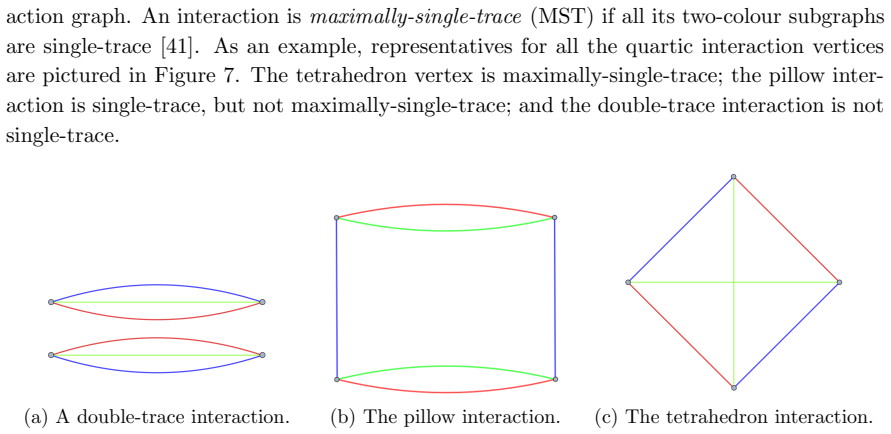
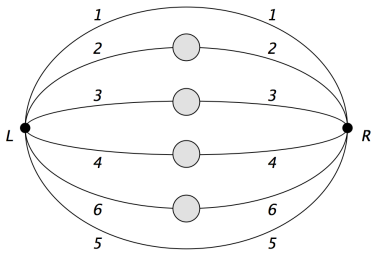
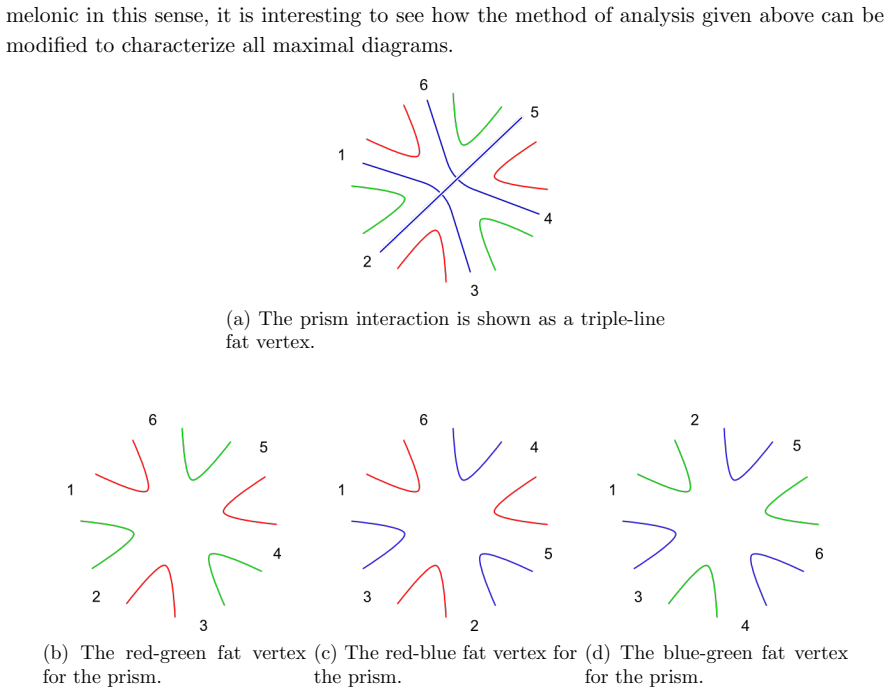
The central object is the maximally-single-trace (MST) interaction graph: a rank-r, order-q tensor interaction drawn as a graph whose two-colour subgraphs are each single cyclic graphs. Subchromatic means r<q-1, so fewer colours than the maximally melonic rank. The argument works by proving that any maximal free-energy diagram must contain a loop passing through one or two vertices, then classifying all inequivalent 1-cycles and 2-cycles modulo colour permutation and automorphism symmetries. For each cycle, planarity of every two-colour fat graph splits the diagram into smaller pieces that can be cut and sewn, yielding recursive melonic moves: replacing a propagator by an elementary snail, replacing a propagator by an elementary melon, and, for the prism only, vertex expansion.
What would settle it
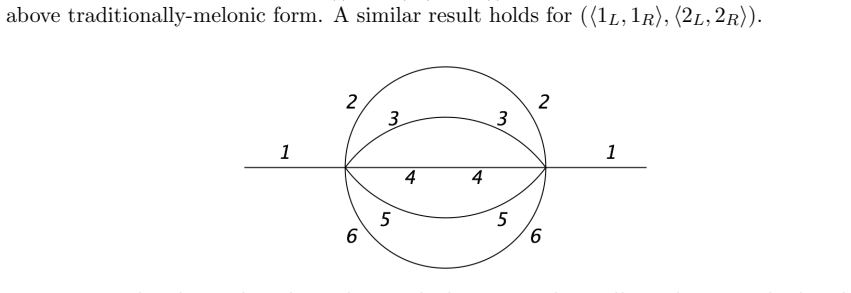
Enumerate all maximal prismatic free-energy diagrams with, say, six interaction vertices; if any diagram containing the non-splitting 2-cycle (⟨1L,1R⟩,⟨2L,2R⟩) cannot be reduced by the inverse of the vertex-expansion move to a smaller maximal diagram, the claim of generalized melonic dominance for the prism fails. A computer search over Wick contractions could in principle find such a counterexample.
Extended reading notes
Core claim
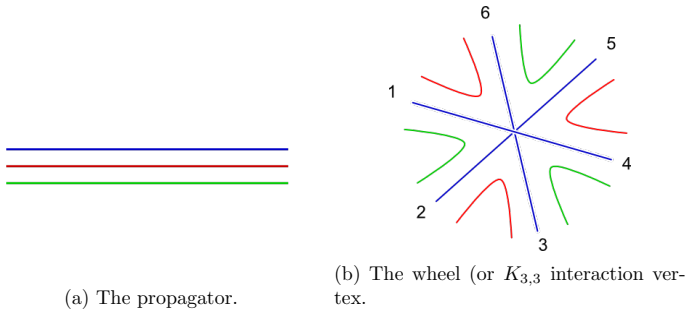
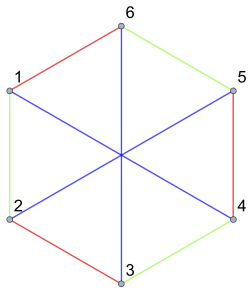
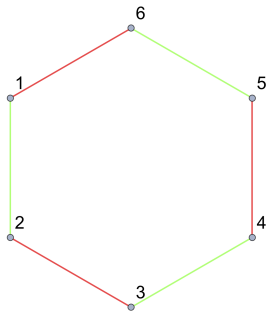
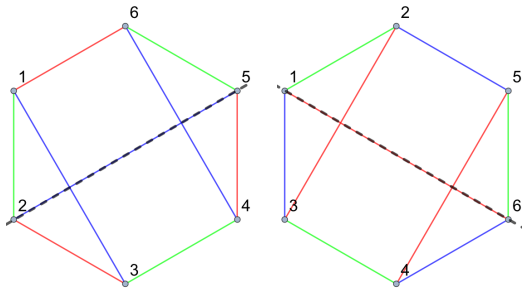
The paper establishes that for sextic (q=6) theories with maximally-single-trace interaction vertices, the subchromatic condition r<5 leaves exactly three interaction graphs: the triangular prism, the wheel (also K3,3), and the octahedron. Using a four-stage argument that classifies inequivalent 1-cycles and 2-cycles, imposes planarity of all two-colour fat graphs, and applies cutting-and-sewing reductions, it proves that every maximal free-energy diagram in the octahedron and wheel theories is generated by conventional melonic moves, while the prism theory requires one additional move, vertex expansion, which replaces one interaction vertex by two contracted vertices. The conclusion is that all three theories are solvable in the large-N limit: the octahedron and wheel reduce to standard melonic Schwinger-Dyson equations, and the prism reproduces the auxiliary-field solution of earlier work.
Load-bearing premise
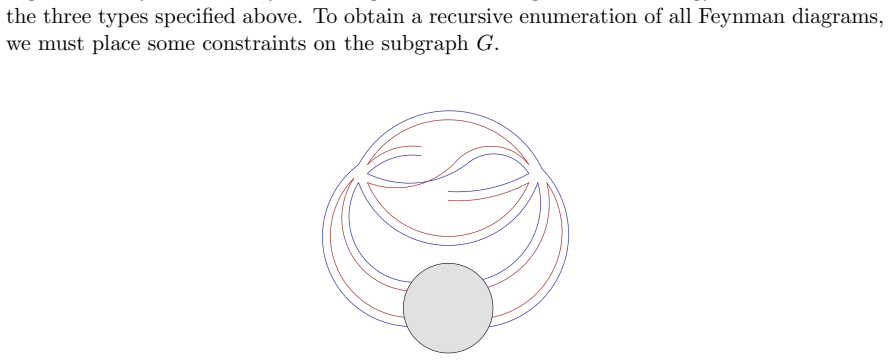
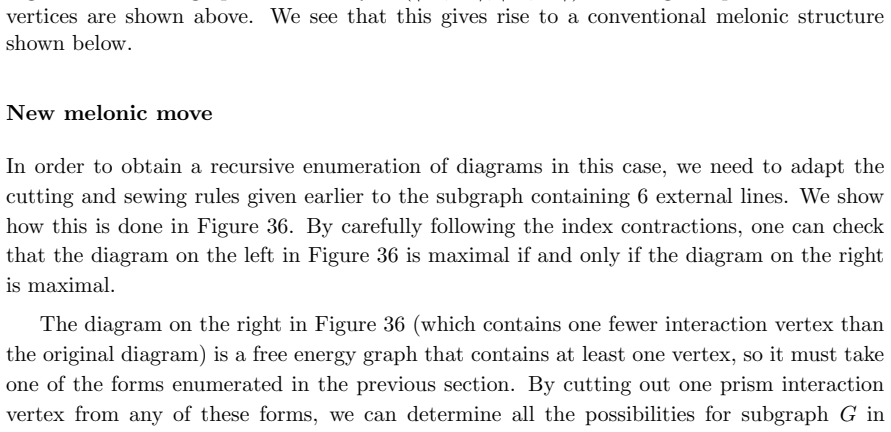
The recursive enumeration for the prism rests on the claim that the diagram in Figure 36 with one added prism vertex is maximal if and only if the diagram with that vertex removed is maximal, a step justified only by 'carefully following the index contractions'.
Editorial extensions
If this is right
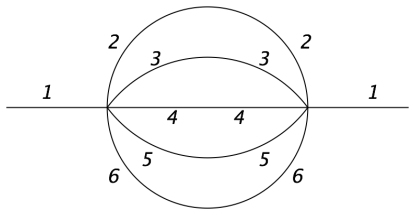
- The octahedron (r=4) theory is conventionally melonic: every surviving free-energy diagram is generated by replacing propagators with a single elementary melon, with no elementary snail.
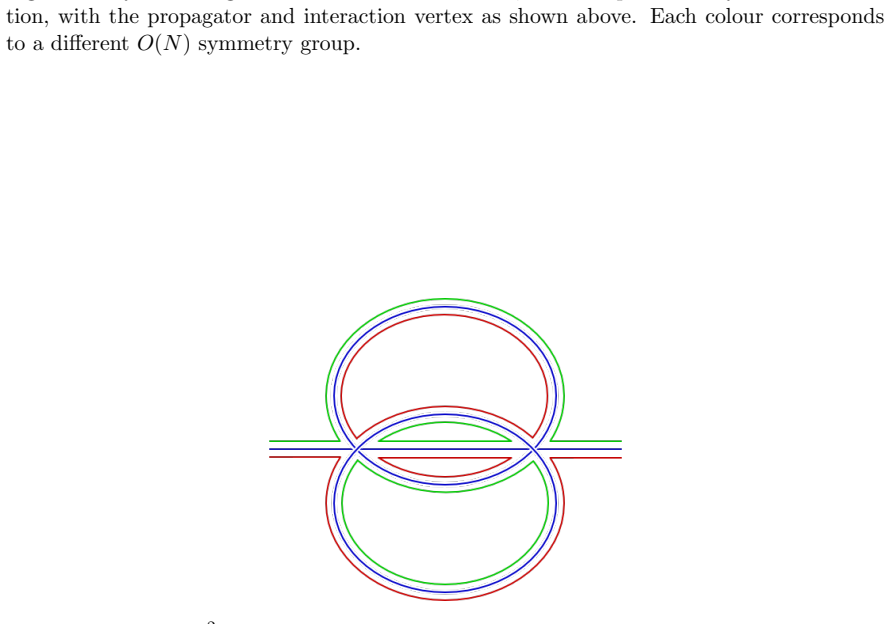
- The wheel (r=3) theory is conventionally melonic with an additional elementary snail, a tadpole that does not affect the propagator Schwinger-Dyson equation under dimensional regularization.
- The prism (r=3) theory is not conventionally melonic but is solvable via a third move, vertex expansion, replacing one vertex by two contracted vertices; the resulting diagrams reproduce the auxiliary-field solution.
- A theory with both prism and wheel interactions has no new mixed elementary melon; its maximal diagrams are generated by the union of the two models' melonic moves.
- Consequently all rank-3 sextic tensor models and the rank-4 octahedron model are solvable in the large-N limit, and their free energies can be explicitly summed.
Reading between the lines
- The recursive colour-adding construction used to enumerate r=3 and r=4 vertices could be rerun for q=8 and higher; the paper sketches the recursion but does not carry it out, leaving higher-order subchromatic solvable vertices as a concrete open search.
- Because the octahedron theory has no elementary snail, its gap equation is identical to the standard q=6 bosonic melonic model; a finite-N exact-diagonalization study of the rank-4 fermionic version could test the paper's large-N prediction against the rank-5 melonic model.
- The prism's vertex-expansion move, if it is the only non-conventional move, suggests that the prismatic and wheel-plus-prism theories have the same leading large-N free energy as the auxiliary-field quartic formulation, an equivalence the paper checks but does not prove directly from the move alone.
Editorial analysis
A structured set of objections, weighed in public.
Referee Report
Summary. The paper studies O(N)^r tensor models with order-six interactions and maximally-single-trace (MST) vertices, focusing on the subchromatic case r < q-1 = 5. It claims a complete classification of subchromatic sextic MST vertices: exactly two rank-3 vertices (the prism and the wheel/K_{3,3}) and one rank-4 vertex (the octahedron). For each of these interactions, the paper analyzes the large-N limit of the free energy, showing that the surviving diagrams are generated by a small set of 'melonic moves.' In the wheel and octahedron cases the diagrams are conventionally melonic (with an elementary snail for the wheel), while the prism requires a new move, 'vertex expansion,' which is introduced in §5.5. The paper also treats the mixed prism+wheel theory and discusses implications for bosonic and fermionic tensor models. The central claims are the classification theorem, the diagrammatic characterization of maximal free-energy diagrams for the three vertices, and the solvability (explicit summability) of the corresponding large-N limits.
Significance. If the claims hold, this is a substantive contribution to the tensor-model literature. The classification of subchromatic sextic MST vertices is new and appears to be correct, and the identification of the octahedron as a conventionally melonic r=4 theory and of the prism as a generalized-melonic theory with a vertex-expansion move are interesting and potentially useful for constructing solvable large-N models. The paper also demonstrates a clear general strategy (Euler counting, 1-cycle/2-cycle reduction, fat-graph planarity, cutting and sewing) that extends and systematizes earlier work of Ferrari–Rivasseau–Valette and Klebanov–Pallegar–Popov. The symmetry analysis in Section 3.2 and the group-theoretic enumeration of inequivalent 2-cycles in the appendix are clean and well-executed. The main limitation is that several load-bearing diagrammatic enumerations are asserted with 'one can check' rather than shown in detail; these gaps are fixable and do not appear to indicate that the conclusions are wrong, but they need to be filled before the arguments are fully convincing.
major comments (3)
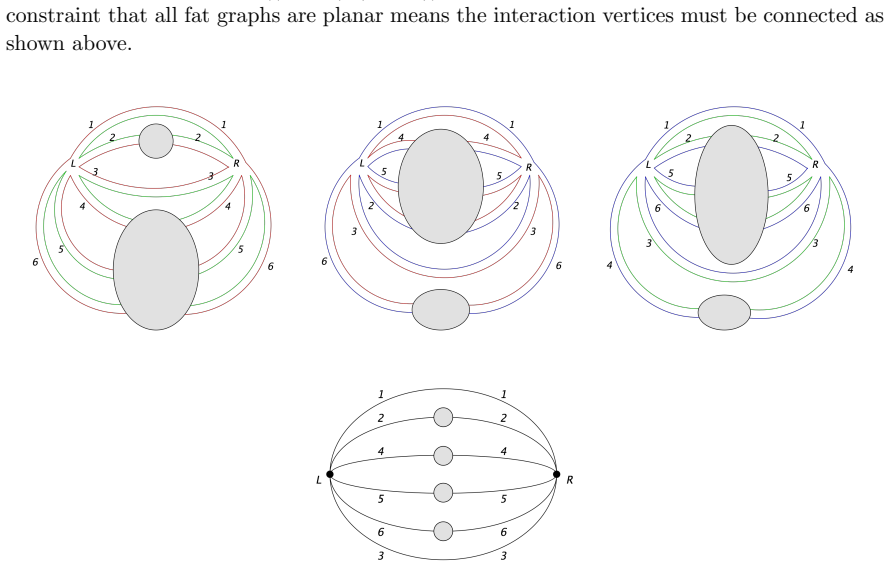
- [§5.5, Figure 36] The claim that the graph on the left of Figure 36 is maximal if and only if the graph on the right is maximal is the load-bearing step for the recursive enumeration of maximal prismatic diagrams. The text justifies this by saying 'By carefully following the index contractions, one can check' but no such check is shown, and the figure does not display the labelled colour-specific index routes. Without this equivalence, the vertex-expansion move of Figure 37 is not established, and the paper's proof that the prism theory is generalized-melonic does not go through. Please provide the full index-tracing argument: for each of the three O(N) symmetries, list which external legs of the six-legged subgraph connect to which legs of the right-hand graph, and show explicitly that the 'if and only if' holds. Alternatively, provide a verification that can be checked by the reader (e.g., a table of all possible connections and the resulting f_total).
- [§3.1] The classification of subchromatic sextic MST vertices is one of the paper's central claims, but the proof is condensed into statements such as 'There are not very many possibilities to consider' and 'One can explicitly check all possibilities'. Since the paper claims that exactly three vertices exist (prism, wheel, octahedron), the reader needs to see the finite enumeration: for r=3, list all possible placements of the third-colour edges on the r=2 cycle and show why every placement except the prism and the wheel violates the MST condition; for r=4, do the same for adding the fourth colour to the prism and to the wheel. This can be done as a table or a short appendix. Without this, the classification claim is an assertion rather than a demonstrated result.
- [§5.3–§5.5] Several additional load-bearing exclusions are asserted with 'one can check' without showing the fat-graph traces: in §5.4 the statement that the 2-cycles (⟨1L,2R⟩,⟨2L,1R⟩) and (⟨1L,5R⟩,⟨5L,1R⟩) 'give rise to at least one non-planar fat graph'; in §5.5 the statements that the 2-cycles (⟨1L,2R⟩,⟨5L,6R⟩) and (⟨1L,2R⟩,⟨2L,1R⟩) 'always give rise to a non-planar fat graph'; and in §5.5 the assertion that the ⟨1L,1R⟩,⟨6L,6R⟩ 2-cycle produces only a conventional melon or a double-snail. These exclusions determine the complete set of melonic moves, so they are not peripheral. Please present the planar/Non-planar fat-graph analysis for these cases (or provide an appendix containing the traces). This would make the proof of melonic dominance auditable.
minor comments (5)
- [Abstract] The abstract first says the free-energy diagrams 'are melonic' and then adds that the prism requires a generalization. This is slightly confusing; consider rephrasing the first sentence to say 'melonic in a generalized sense' for the prism from the outset.
- [§5.5] The text says the ⟨1L,1R⟩,⟨6L,6R⟩ case is 'not pictured' but then uses the resulting diagrams to define a melonic move. Since an explicit figure would substantially help the reader verify the claim, please include the corresponding figure.
- [§5.4] When the octahedron 2-cycles are enumerated, the text states that 'Drawing all fat-graphs for each 2-cycle as we did for the wheel, we obtain the following results' but the figures for the ruled-out cases are not shown. Adding at least one representative excluded case with its non-planar fat graph would make the method clearer.
- [§6.1] The value n_melon = 6 for the octahedron is stated without a counting argument or a figure. Since the gap equation depends on this number, please indicate how this count is obtained (e.g., by listing the six Wick contractions).
- [Throughout] There are several grammatical slips, for example 'an theory with complex fields', 'a the natural large-N 't Hooft limit', and 'we consider the large N limit of tensor models constructed out of rank-r tensors' (missing 'with'). A careful proofreading pass is recommended.
Circularity Check
No significant circularity: the paper's large-N and melonic-dominance arguments are self-contained combinatorial derivations, with prior work cited only for context.
full rationale
The derivation chain is self-contained. The enumeration of the prism, wheel, and octahedron interactions in Section 3 is a direct classification by colour-subgraph constraints, not an assumption of the result. The large-N scaling in Section 4 follows from Euler-characteristic counting and defines maximal diagrams independently of any fitted parameter. Sections 5.3-5.5 then prove melonic or generalized-melonic dominance by enumerating inequivalent 1-cycles and 2-cycles, imposing fat-graph planarity, and applying local cutting-and-sewing reductions; no quantity used as an input is later relabelled as a prediction. The prism case does rely on the Figure 36 assertion that two diagrams are maximal iff, justified by an index-contraction check. That assertion is the paper's weakest proof step and could be a correctness gap, but it is not circular: maximality is defined by the independent N-counting bound (4.6), and the asserted equivalence is a local combinatorial fact rather than an identification of the conclusion with an input. Cited prior work, including [43] which has an overlapping author, is used for context and for the auxiliary-field solution of the prism, but the paper's own vertex-expansion argument is checked directly and does not borrow its central conclusion from that citation. No fitted input is renamed as a prediction, and no self-citation carries the load of the new claims.
Assumptions & free parameters
assumptions (4)
- domain assumption Restriction to maximally-single-trace (MST) interactions captures the most interesting large N dynamics; non-MST sextic interactions reduce to quartic pillow and double-trace interactions via auxiliary fields.
- domain assumption The large N limit is the natural 't Hooft limit with λ = g N^{r(q−2)/4} fixed; only diagrams saturating ftot = r(q−2)v/4 + r (all fat graphs planar) survive.
- ad hoc to paper The finite case checks in Section 3.1 exhaustively enumerate all sextic MST vertices: exactly two r=3 vertices (prism, wheel) and one r=4 vertex (octahedron).
- ad hoc to paper For each inequivalent 1-cycle or 2-cycle, fat-graph planarity splits the subgraph as in Figure 18, or, for the prism (1,1)(2,2) cycle, the Figure 36 equivalence holds.
Cite this review
Pith. "Pith review of Melonic Dominance in Subchromatic Sextic Tensor Models." pith.science (2026). https://pith.science/paper/6C75LKJQ
@misc{pith2026190807178,
  author       = {Pith},
  title        = {Pith review of: Melonic Dominance in Subchromatic Sextic Tensor Models},
  year         = {2026},
  howpublished = {\url{https://pith.science/paper/6C75LKJQ}},
  note         = {Machine review of arXiv:1908.07178}
}
abstract
We study tensor models based on $O(N)^r$ symmetry groups constructed out of rank-$r$ tensors with order-$q$ interaction vertices. We refer to those tensor models for which $r<q-1$ as \textit{subchromatic}. We focus most of our attention on sextic ($q=6$) models with maximally-single-trace interactions. We show that only three subchromatic sextic maximally-single-trace interaction vertices exist: these are the $r=3$ prism, the $r=3$ wheel (or $K_{3,3}$) and the $r=4$ octahedron. For theories based on these interactions we demonstrate that the set of Feynman diagrams that contribute to the free energy in the large $N$ limit are melonic (or closely related to melonic diagrams, in the case of the prism) and thus can be explicitly summed.
Figures

Figures from the paper (38 more)















Reference graph
Works this paper leans on
-
[1]
A Planar Diagram Theory for Strong Interactions,
G. ’t Hooft, “A Planar Diagram Theory for Strong Interactions,” Nucl.Phys. B72 (1974) 461
work page 1974
-
[2]
Quantum field theory in the large N limit: A Review,
M. Moshe and J. Zinn-Justin, “Quantum field theory in the large N limit: A Review,” Phys. Rept. 385 (2003) 69–228, hep-th/0306133
arXiv 2003
-
[3]
R. Gurau, “Colored Group Field Theory,” Commun. Math. Phys. 304 (2011) 69–93, 0907.2582
arXiv 2011
-
[4]
The 1/N expansion of colored tensor models in arbitrary dimension,
R. Gurau and V. Rivasseau, “The 1/N expansion of colored tensor models in arbitrary dimension,” Europhys. Lett. 95 (2011) 50004, 1101.4182
arXiv 2011
-
[5]
The complete 1/N expansion of colored tensor models in arbitrary dimension,
R. Gurau, “The complete 1/N expansion of colored tensor models in arbitrary dimension,” Annales Henri Poincare 13 (2012) 399–423, 1102.5759. 42
arXiv 2012
-
[6]
Critical behavior of colored tensor models in the large N limit,
V. Bonzom, R. Gurau, A. Riello, and V. Rivasseau, “Critical behavior of colored tensor models in the large N limit,” Nucl. Phys. B853 (2011) 174–195, 1105.3122
arXiv 2011
-
[7]
Multi-orientable Group Field Theory
A. Tanasa, “Multi-orientable Group Field Theory,” J. Phys. A45 (2012) 165401, 1109.0694
work page Pith review arXiv 2012
-
[8]
Random tensor models in the large N limit: Uncoloring the colored tensor models,
V. Bonzom, R. Gurau, and V. Rivasseau, “Random tensor models in the large N limit: Uncoloring the colored tensor models,” Phys. Rev. D85 (2012) 084037, 1202.3637
arXiv 2012
Show all 78 references
-
[9]
O(N) Random Tensor Models,
S. Carrozza and A. Tanasa, “ O(N) Random Tensor Models,” Lett. Math. Phys. 106 (2016), no. 11 1531–1559, 1512.06718
2016 arXiv
-
[10]
An SYK-Like Model Without Disorder,
E. Witten, “An SYK-Like Model Without Disorder,” 1610.09758
-
[11]
Uncolored random tensors, melon diagrams, and the Sachdev-Ye-Kitaev models,
I. R. Klebanov and G. Tarnopolsky, “Uncolored random tensors, melon diagrams, and the Sachdev-Ye-Kitaev models,” Phys. Rev. D95 (2017), no. 4 046004, 1611.08915
2017 arXiv
-
[12]
Invitation to Random Tensors,
R. Gurau, “Invitation to Random Tensors,” SIGMA 12 (2016) 094, 1609.06439
2016 arXiv
-
[13]
The Tensor Track V: Holographic Tensors,
N. Delporte and V. Rivasseau, “The Tensor Track V: Holographic Tensors,” 2018. 1804.11101
2018 arXiv
-
[14]
TASI Lectures on Large N Tensor Models,
I. R. Klebanov, F. Popov, and G. Tarnopolsky, “TASI Lectures on Large N Tensor Models,” PoS TASI2017 (2018) 004, 1808.09434
2018 arXiv
-
[15]
Notes on Tensor Models and Tensor Field Theories,
R. Gurau, “Notes on Tensor Models and Tensor Field Theories,” 1907.03531
1907 arXiv
-
[16]
Gapless spin fluid ground state in a random, quantum Heisenberg magnet,
S. Sachdev and J. Ye, “Gapless spin fluid ground state in a random, quantum Heisenberg magnet,” Phys. Rev. Lett. 70 (1993) 3339, cond-mat/9212030
1993 arXiv
-
[17]
A simple model of quantum holography,
A. Kitaev, “A simple model of quantum holography,” http://online.kitp.ucsb.edu/online/entangled15/kitaev/, http://online.kitp.ucsb.edu/online/entangled15/kitaev2/ Talks at KITP, April 7 and May 27, 2015
2015
-
[18]
Remarks on the Sachdev-Ye-Kitaev model,
J. Maldacena and D. Stanford, “Remarks on the Sachdev-Ye-Kitaev model,” Phys. Rev. D94 (2016), no. 10 106002, 1604.07818
2016 arXiv
-
[19]
The Spectrum in the Sachdev-Ye-Kitaev Model,
J. Polchinski and V. Rosenhaus, “The Spectrum in the Sachdev-Ye-Kitaev Model,” JHEP 04 (2016) 001, 1601.06768
2016 arXiv
-
[20]
Conformal symmetry and its breaking in two dimensional Nearly Anti-de-Sitter space,
J. Maldacena, D. Stanford, and Z. Yang, “Conformal symmetry and its breaking in two dimensional Nearly Anti-de-Sitter space,” PTEP 2016 (2016), no. 12 12C104, 1606.01857
2016 arXiv
-
[21]
An investigation of AdS2 backreaction and holography,
J. Engels¨ oy, T. G. Mertens, and H. Verlinde, “An investigation of AdS2 backreaction and holography,” JHEP 07 (2016) 139, 1606.03438
2016 arXiv
-
[22]
Chaos in AdS 2 Holography,
K. Jensen, “Chaos in AdS 2 Holography,” Phys. Rev. Lett. 117 (2016), no. 11 111601, 1605.06098
2016 arXiv
-
[23]
Bi-Local Holography in the SYK Model,
A. Jevicki, K. Suzuki, and J. Yoon, “Bi-Local Holography in the SYK Model,” JHEP 07 (2016) 007, 1603.06246. 43
2016 arXiv
-
[24]
Spectral and thermodynamic properties of the Sachdev-Ye-Kitaev model,
A. M. Garcia-Garcia and J. J. M. Verbaarschot, “Spectral and thermodynamic properties of the Sachdev-Ye-Kitaev model,” Phys. Rev. D94 (2016), no. 12 126010, 1610.03816
2016 arXiv
-
[25]
Black Holes and Random Matrices,
J. S. Cotler, G. Gur-Ari, M. Hanada, J. Polchinski, P. Saad, S. H. Shenker, D. Stanford, A. Streicher, and M. Tezuka, “Black Holes and Random Matrices,” JHEP 05 (2017) 118, 1611.04650
2017 arXiv
-
[26]
A Note on Sachdev-Ye-Kitaev Like Model without Random Coupling,
T. Nishinaka and S. Terashima, “A Note on Sachdev-Ye-Kitaev Like Model without Random Coupling,” 1611.10290
-
[27]
SYK-like Tensor Models on the Lattice,
P. Narayan and J. Yoon, “SYK-like Tensor Models on the Lattice,” 1705.01554
-
[28]
Analytical Spectral Density of the Sachdev-Ye-Kitaev Model at finite N,
A. M. Garcia-Garcia and J. J. M. Verbaarschot, “Analytical Spectral Density of the Sachdev-Ye-Kitaev Model at finite N,” Phys. Rev. D96 (2017), no. 6 066012, 1701.06593
2017 arXiv
-
[29]
The Bulk Dual of SYK: Cubic Couplings,
D. J. Gross and V. Rosenhaus, “The Bulk Dual of SYK: Cubic Couplings,” JHEP 05 (2017) 092, 1702.08016
2017 arXiv
-
[30]
Three Dimensional View of the SYK/AdS Duality,
S. R. Das, A. Jevicki, and K. Suzuki, “Three Dimensional View of the SYK/AdS Duality,” JHEP 09 (2017) 017, 1704.07208
2017 arXiv
-
[31]
Space-Time in the SYK Model,
S. R. Das, A. Ghosh, A. Jevicki, and K. Suzuki, “Space-Time in the SYK Model,” JHEP 07 (2018) 184, 1712.02725
2018 arXiv
-
[32]
Three Dimensional View of Arbitrary q SYK models,
S. R. Das, A. Ghosh, A. Jevicki, and K. Suzuki, “Three Dimensional View of Arbitrary q SYK models,” JHEP 02 (2018) 162, 1711.09839
2018 arXiv
-
[33]
Coadjoint orbit action of Virasoro group and two-dimensional quantum gravity dual to SYK/tensor models,
G. Mandal, P. Nayak, and S. R. Wadia, “Coadjoint orbit action of Virasoro group and two-dimensional quantum gravity dual to SYK/tensor models,” 1702.04266
-
[34]
Traversable Wormholes via a Double Trace Deformation,
P. Gao, D. L. Jafferis, and A. Wall, “Traversable Wormholes via a Double Trace Deformation,” JHEP 12 (2017) 151, 1608.05687
2017 arXiv
-
[35]
Diving into traversable wormholes,
J. Maldacena, D. Stanford, and Z. Yang, “Diving into traversable wormholes,” Fortsch. Phys. 65 (2017), no. 5 1700034, 1704.05333
2017 arXiv
-
[36]
Eternal traversable wormhole,
J. Maldacena and X.-L. Qi, “Eternal traversable wormhole,” 1804.00491
-
[37]
Symmetry Breaking in Coupled SYK or Tensor Models,
J. Kim, I. R. Klebanov, G. Tarnopolsky, and W. Zhao, “Symmetry Breaking in Coupled SYK or Tensor Models,” Phys. Rev. X9 (2019), no. 2 021043, 1902.02287
2019 arXiv
-
[38]
An introduction to the SYK model,
V. Rosenhaus, “An introduction to the SYK model,” J. Phys. A52 (2019), no. 32 323001
2019
-
[39]
Notes on Melonic O(N)q−1 Tensor Models,
S. Choudhury, A. Dey, I. Halder, L. Janagal, S. Minwalla, and R. Poojary, “Notes on Melonic O(N)q−1 Tensor Models,” 1707.09352
-
[40]
Spectra of Operators in Large N Tensor Models,
K. Bulycheva, I. R. Klebanov, A. Milekhin, and G. Tarnopolsky, “Spectra of Operators in Large N Tensor Models,” 1707.09347
-
[41]
A New Large N Expansion for General Matrix-Tensor Models,
F. Ferrari, V. Rivasseau, and G. Valette, “A New Large N Expansion for General Matrix-Tensor Models,” 1709.07366. 44
-
[42]
Higher melonic theories,
S. S. Gubser, C. Jepsen, Z. Ji, and B. Trundy, “Higher melonic theories,” JHEP 09 (2018) 049, 1806.04800
2018 arXiv
-
[43]
Prismatic Large N Models for Bosonic Tensors,
S. Giombi, I. R. Klebanov, F. Popov, S. Prakash, and G. Tarnopolsky, “Prismatic Large N Models for Bosonic Tensors,” Phys. Rev. D98 (2018), no. 10 105005, 1808.04344
2018 arXiv
-
[44]
Majorana Fermion Quantum Mechanics for Higher Rank Tensors,
I. R. Klebanov, P. N. Pallegar, and F. K. Popov, “Majorana Fermion Quantum Mechanics for Higher Rank Tensors,” 1905.06264
1905 arXiv
-
[45]
N=6 superconformal Chern-Simons-matter theories, M2-branes and their gravity duals,
O. Aharony, O. Bergman, D. L. Jafferis, and J. Maldacena, “N=6 superconformal Chern-Simons-matter theories, M2-branes and their gravity duals,” JHEP 0810 (2008) 091, 0806.1218
2008 arXiv
-
[46]
Anomalous dimensions in non-supersymmetric bifundamental Chern-Simons theories,
V. Gurucharan and S. Prakash, “Anomalous dimensions in non-supersymmetric bifundamental Chern-Simons theories,” JHEP 09 (2014) 009, 1404.7849. [Erratum: JHEP11,045(2017)]
2014 arXiv
-
[47]
Large N limit of irreducible tensor models: O(N) rank-3 tensors with mixed permutation symmetry,
S. Carrozza, “Large N limit of irreducible tensor models: O(N) rank-3 tensors with mixed permutation symmetry,” JHEP 06 (2018) 039, 1803.02496
2018 arXiv
-
[48]
More on Supersymmetric and 2d Analogs of the SYK Model,
J. Murugan, D. Stanford, and E. Witten, “More on Supersymmetric and 2d Analogs of the SYK Model,” 1706.05362
-
[49]
More on the New Large D Limit of Matrix Models,
T. Azeyanagi, F. Ferrari, P. Gregori, L. Leduc, and G. Valette, “More on the New Large D Limit of Matrix Models,” Annals Phys. 393 (2018) 308–326, 1710.07263
2018 arXiv
-
[50]
Multi-critical behaviour of 4-dimensional tensor models up to order 6,
L. Lionni and J. Th¨ urigen, “Multi-critical behaviour of 4-dimensional tensor models up to order 6,” Nucl. Phys. B941 (2019) 600–635, 1707.08931
2019 arXiv
-
[51]
Colored triangulations of arbitrary dimensions are stuffed Walsh maps,
V. Bonzom, L. Lionni, and V. Rivasseau, “Colored triangulations of arbitrary dimensions are stuffed Walsh maps,” arXiv preprint arXiv:1508.03805 (2015)
2015 arXiv
-
[52]
On Large N Limit of Symmetric Traceless Tensor Models,
I. R. Klebanov and G. Tarnopolsky, “On Large N Limit of Symmetric Traceless Tensor Models,” JHEP 10 (2017) 037, 1706.00839
2017 arXiv
-
[53]
The 1 /N expansion of the symmetric traceless and the antisymmetric tensor models in rank three,
D. Benedetti, S. Carrozza, R. Gurau, and M. Kolanowski, “The 1 /N expansion of the symmetric traceless and the antisymmetric tensor models in rank three,” 1712.00249
-
[54]
Bosonic Tensor Models at Large N and Small ϵ,
S. Giombi, I. R. Klebanov, and G. Tarnopolsky, “Bosonic Tensor Models at Large N and Small ϵ,” 1707.03866
-
[55]
A Complex Fermionic Tensor Model in d Dimensions,
S. Prakash and R. Sinha, “A Complex Fermionic Tensor Model in d Dimensions,” JHEP 02 (2018) 086, 1710.09357
2018 arXiv
-
[56]
A Renormalizable SYK-type Tensor Field Theory,
J. Ben Geloun and V. Rivasseau, “A Renormalizable SYK-type Tensor Field Theory,” Annales Henri Poincare 19 (2018), no. 11 3357–3395, 1711.05967
2018 arXiv
-
[57]
Tensorial Gross-Neveu models,
D. Benedetti, S. Carrozza, R. Gurau, and A. Sfondrini, “Tensorial Gross-Neveu models,” JHEP 01 (2018) 003, 1710.10253
2018 arXiv
-
[58]
A Supersymmetric SYK-like Tensor Model,
C. Peng, M. Spradlin, and A. Volovich, “A Supersymmetric SYK-like Tensor Model,” JHEP 05 (2017) 062, 1612.03851
2017 arXiv
-
[59]
Correlators in the N = 2 Supersymmetric SYK Model,
C. Peng, M. Spradlin, and A. Volovich, “Correlators in the N = 2 Supersymmetric SYK Model,” JHEP 10 (2017) 202, 1706.06078. 45
2017 arXiv
-
[60]
Correlators in tensor models from character calculus,
A. Mironov and A. Morozov, “Correlators in tensor models from character calculus,” Phys. Lett. B774 (2017) 210–216, 1706.03667
2017 arXiv
-
[61]
Ward identities and combinatorics of rainbow tensor models,
H. Itoyama, A. Mironov, and A. Morozov, “Ward identities and combinatorics of rainbow tensor models,” JHEP 06 (2017) 115, 1704.08648
2017 arXiv
-
[62]
Cut and join operator ring in tensor models,
H. Itoyama, A. Mironov, and A. Morozov, “Cut and join operator ring in tensor models,” Nucl. Phys. B932 (2018) 52–118, 1710.10027
2018 arXiv
-
[63]
Phase diagram and fixed points of tensorial Gross-Neveu models in three dimensions,
D. Benedetti and N. Delporte, “Phase diagram and fixed points of tensorial Gross-Neveu models in three dimensions,” JHEP 01 (2019) 218, 1810.04583
2019 arXiv
-
[64]
2PI effective action for the SYK model and tensor field theories,
D. Benedetti and R. Gurau, “2PI effective action for the SYK model and tensor field theories,” JHEP 05 (2018) 156, 1802.05500
2018 arXiv
-
[65]
On Melonic Supertensor Models,
C.-M. Chang, S. Colin-Ellerin, and M. Rangamani, “On Melonic Supertensor Models,” JHEP 10 (2018) 157, 1806.09903
2018 arXiv
-
[66]
Line of fixed points in a bosonic tensor model,
D. Benedetti, R. Gurau, and S. Harribey, “Line of fixed points in a bosonic tensor model,” JHEP 06 (2019) 053, 1903.03578
2019 arXiv
-
[67]
Supersymmetric Landau-Ginzburg Tensor Models,
C.-M. Chang, S. Colin-Ellerin, and M. Rangamani, “Supersymmetric Landau-Ginzburg Tensor Models,” 1906.02163
1906 arXiv
-
[68]
Supersymmetric Tensor Model at Large N and Small ϵ,
F. K. Popov, “Supersymmetric Tensor Model at Large N and Small ϵ,” 1907.02440
1907 arXiv
-
[69]
Phases Of Melonic Quantum Mechanics,
F. Ferrari and F. I. Schaposnik Massolo, “Phases Of Melonic Quantum Mechanics,” Phys. Rev. D100 (2019), no. 2 026007, 1903.06633
2019 arXiv
-
[70]
Seeking fixed points in multiple coupling scalar theories in the ϵ expansion,
H. Osborn and A. Stergiou, “Seeking fixed points in multiple coupling scalar theories in the ϵ expansion,” JHEP 05 (2018) 051, 1707.06165
2018 arXiv
-
[71]
Diagrammatic proof of the large N melonic dominance in the SYK model,
V. Bonzom, V. Nador, and A. Tanasa, “Diagrammatic proof of the large N melonic dominance in the SYK model,” 1808.10314
-
[72]
Chern-Simons Theory with Vector Fermion Matter,
S. Giombi, S. Minwalla, S. Prakash, S. P. Trivedi, S. R. Wadia, et. al., “Chern-Simons Theory with Vector Fermion Matter,” Eur.Phys.J. C72 (2012) 2112, 1110.4386
2012 arXiv
-
[73]
Random Matrices and Holographic Tensor Models,
C. Krishnan, K. V. P. Kumar, and S. Sanyal, “Random Matrices and Holographic Tensor Models,” JHEP 06 (2017) 036, 1703.08155
2017 arXiv
-
[74]
Towards a Finite- N Hologram,
C. Krishnan and K. V. P. Kumar, “Towards a Finite- N Hologram,” JHEP 10 (2017) 099, 1706.05364
2017 arXiv
-
[75]
Exact Solution of a Strongly Coupled Gauge Theory in 0+1 Dimensions,
C. Krishnan and K. V. Pavan Kumar, “Exact Solution of a Strongly Coupled Gauge Theory in 0+1 Dimensions,” Phys. Rev. Lett. 120 (2018), no. 20 201603, 1802.02502
2018 arXiv
-
[76]
Spectra of eigenstates in fermionic tensor quantum mechanics,
I. R. Klebanov, A. Milekhin, F. Popov, and G. Tarnopolsky, “Spectra of eigenstates in fermionic tensor quantum mechanics,” Phys. Rev. D97 (2018), no. 10 106023, 1802.10263
2018 arXiv
-
[77]
Complete Solution of a Gauged Tensor Model,
C. Krishnan and K. V. Pavan Kumar, “Complete Solution of a Gauged Tensor Model,” 1804.10103
-
[78]
Spectrum of Majorana Quantum Mechanics with O(4)3 Symmetry,
K. Pakrouski, I. R. Klebanov, F. Popov, and G. Tarnopolsky, “Spectrum of Majorana Quantum Mechanics with O(4)3 Symmetry,” Phys. Rev. Lett. 122 (2019), no. 1 011601, 1808.07455. 46
2019 arXiv
Reviewed August 14, 2026 · model on record in the stance chip above.
Discussion (0). Continue with ORCID to comment.