REVIEW 5 major objections 6 minor 2 references
Pressure-Induced Low-Spin State Destabilization and Piezo-Chromic Effect in an Iron(II) Spin Crossover Complex with Pyrazol-Pyridine-Triazolate Coordination Core
T0 review · 5 major / 6 minor · reviewed 2026-08-06 · deepseek-v4-flash
Pith's one-line read Pressure drives spin-transition temperature down, not up, in a new iron(II) spin crossover complex.
desk verdict A striking pressure-induced whole-loop T1/2 decrease and full HS stabilization in an Fe(II) SCO complex, with raw magnetic data largely convincing but a thermodynamic rationale that is fitted, not tested, plus missing background/error-bar details. read the letter →
The pith
A machine-rendered reading of the paper's core claim, the machinery that carries it, and where it could break.
The reading
What carries the argument
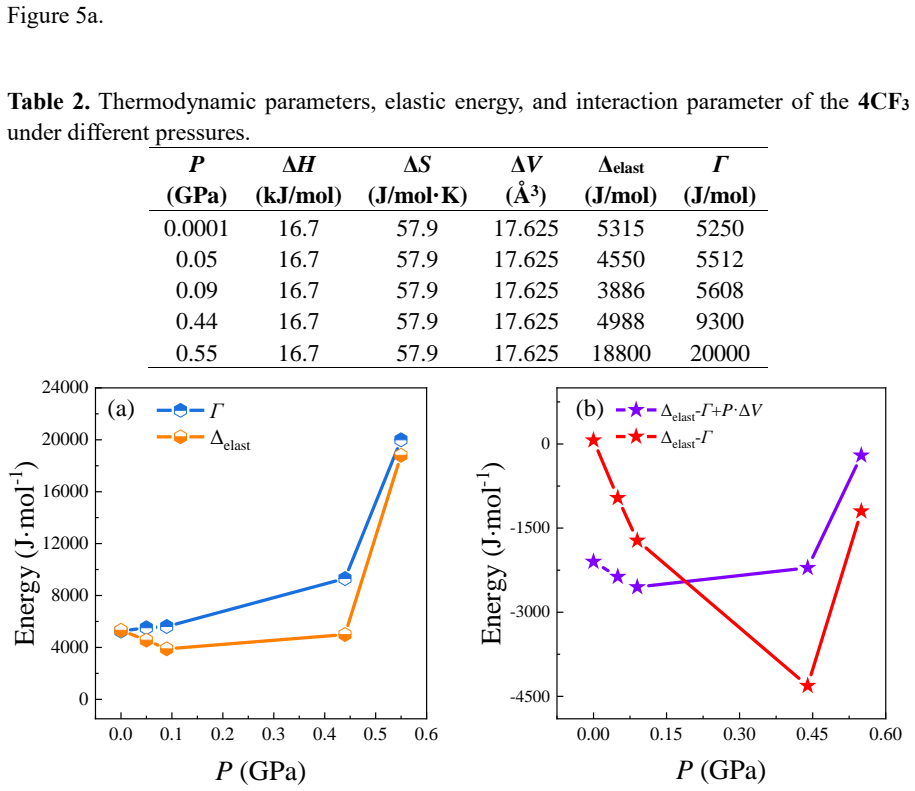
The load-bearing object is the thermodynamic model of elastic interactions for a two-phase HS/LS system, with the Gibbs free energy $G_n = H_n - T S_n + P V_n$ and the equation of state derived from minimizing the free energy with respect to the HS molar fraction $\gamma_{HS}$. The central identity is $T_{1/2} = (\Delta H_{HL} + \Delta_{\mathrm{elast}} - \Gamma + P\Delta V_{HL}) / \Delta S_{HL}$, where $\Delta_{\mathrm{elast}}$ is the change in elastic (ligand-field) energy and $\Gamma$ the interaction energy; a decreasing $T_{1/2}$ requires $(\Delta_{\mathrm{elast}} - \Gamma) + P\Delta V_{HL}$ to decrease with pressure and eventually become negative. The physical mechanism invoked is the trigonal distortion parameter $\Theta$ of the [FeN6] coordination core, defined as the sum of deviations from $60^\circ$ over the 24 trigonal angles of the octahedron: the authors argue from ligand-field theory that in a trigonally distorted environment the $e_g - t_{2g}$ splitting shrinks under pressure and can even change sign, which destabilizes the low-spin state. The model is fitted to the magnetic $\gamma_{HS}(T)$ curves at each pressure to extract $\Delta_{\mathrm{elast}}$ and $\Gamma$, and those fitted values put $(\Delta_{\mathrm{elast}} - \Gamma) + P\Delta V_{HL}$ in the negative region throughout the pressure range.
What would settle it
Record the magnetization of the empty beryllium-copper piston-cylinder cell at the same pressures (0, 0.05, 0.09, 0.44, 0.55, 0.64 GPa) over 120–320 K and subtract it from the reported chi_MT curves; the downward T1/2 shift and the widening hysteresis survive only if the corrected cooling and heating branches still move down together as pressure increases.
Extended reading notes
Core claim
The central claim is that in the desolvated complex 4CF3, increasing hydrostatic pressure destabilizes the low-spin state rather than stabilizing it. Magnetic data show T1/2 decreasing from 286.5 K at ambient pressure to 179.5 K at 0.44 GPa, with the cooling and heating branches both moving down together so that the thermal hysteresis expands from about 3 K to about 20 K, and with the HS fraction increasing in the temperature region where the LS state was stable at ambient pressure. At 0.64 GPa the transferred LS fraction is only about 4%, which the paper treats as virtual disappearance of the low-spin phase and full stabilization of the high-spin state at all temperatures. Optical absorption spectra at room temperature show a continuous pressure-dependent change of color, termed a piezo-chromic effect, and Raman and IR spectra are consistent with the downward shift of T1/2. All of these observations are attributed, within a thermodynamic elastic-interaction model, to pressure-enhanced trigonal distortion of the [FeN6] octahedron that reduces the 3d splitting energy and makes the difference $(\Delta_{\mathrm{elast}} - \Gamma) + P\Delta V$ negative, thereby lowering T1/2.
Load-bearing premise
The load-bearing premise is that the magnetic signal measured inside the beryllium-copper pressure cell comes only from the sample: the paper converts chi_MT directly into high-spin fractions at each pressure without reporting any subtraction of the cell's own temperature- and pressure-dependent magnetic background.
Editorial extensions
If this is right
- If the claim holds, pressure becomes a reversible tool for switching this material between bistable (hysteretic) and fully high-spin behavior, and for erasing the spin transition entirely above about 0.64 GPa.
- The material is a room-temperature visual pressure indicator: its optical absorption changes continuously with pressure (piezo-chromic effect) before pressure-induced HS stabilization takes over.
- The design principle—a tridentate ligand that leaves the [FeN6] core prone to trigonal distortion—suggests a route to other spin crossover compounds with a negative pressure response of T1/2.
- The recovery of the original transition after pressure release confirms that the anomaly is an intrinsic compressed-state effect, not permanent sample damage.
Reading between the lines
- The paper does not report subtracting the magnetic background of the beryllium-copper pressure cell, yet it converts the measured chi_MT curves directly into high-spin fractions; the very large T1/2 drop at 0.05–0.09 GPa is where such a background artifact would be most visible, so an empty-cell subtraction is a natural control experiment.
- The nonmonotonic optical intensity near 0.8 GPa, with a jump in the 1A1–1T2 absorption band, suggests a second structural or electronic event that the thermodynamic model does not explicitly treat; the paper itself flags this feature as requiring additional research.
- If the trigonal-distortion mechanism is general, then other complexes in this [Fe(LR)2] family, or any material with a large octahedral distortion and strong pressure–lattice coupling, should also show downward T1/2 shifts; that prediction could be screened by high-pressure single-crystal diffraction.
Editorial analysis
A structured set of objections, weighed in public.
Referee Report
Summary. This paper reports the synthesis and structural characterization of the neutral iron(II) complex [Fe(L)2] (4CF3) and its methanol solvate, together with magnetic, optical, Raman, and IR measurements under pressure. At ambient pressure, 4CF3 undergoes a nearly complete spin crossover at T1/2 ≈ 286.5 K with approximately 3 K hysteresis. The central claim is that hydrostatic pressure shifts the entire hysteresis loop to lower temperature, widens it from about 3 K to about 20 K, makes the transition incomplete, and above about 0.64 GPa stabilizes the high-spin state at all temperatures; the authors interpret this as the first observation of pressure-induced destabilization and loss of the low-spin state in a spin crossover compound. The observations are described in the framework of a thermodynamic model with elastic interactions, from which the elastic energy and interaction parameter are extracted as functions of pressure.
Significance. If the experimental observations survive scrutiny, this is a significant and unusual result: it would challenge the near-universal expectation that pressure stabilizes the low-spin state and raises T1/2. The crystal structures of the solvated and desolvated forms, the reversibility on pressure release, and the combination of magnetic, optical, Raman, and IR measurements are clear strengths, and the paper makes a falsifiable qualitative prediction that trigonal distortion can invert the usual pressure response. However, the quantitative thermodynamic explanation is currently supported only by post-hoc fits with constants read from the same data, the magnetometry lacks a documented background correction, and there are inconsistencies in the treatment of the interaction parameter; as presented, the paper does not provide a predictive model or independent evidence for the proposed mechanism.
major comments (5)
- [SI2 and 'SCO behavior of 4CF3 under pressure'] The magnetic data inside the BeCu piston-cylinder cell are used without any documented subtraction of the cell's own magnetic background. The conversion of chi_MT to gamma_HS in Figure 4 and in the fits of Figure S6 assumes that the SQUID signal originates only from the sample. Beryllium copper has a temperature- and pressure-dependent magnetic response, and no blank-cell measurement, correction, or estimate of its magnitude is provided. This is load-bearing because the 0.05 and 0.09 GPa shifts in T1/2, the reported 8-11 K hysteresis, and the apparent absence of a transition at 0.64 GPa could in part be instrumental. The authors need to supply the raw data and a quantitative background correction or an explicit demonstration that the background is negligible.
- [SI2, Eqs. (S1.1)-(S1.2)] The equations used for the incomplete transitions at 0.44 and 0.55 GPa are not derived from the model; constants such as 0.4, 1.34, 0.47, 0.87, 0.15, 1.56, and 0.72 are inserted by reading values off the experimental curves. Fits performed with these patched equations therefore cannot validate Eq. (1.2), and the extracted Delta_elast and Gamma values in Table 2 and Figure 5 are not independent evidence for the trigonal-distortion mechanism. The authors should either derive a genuine free energy for incomplete transitions or reframe the exercise as a consistency check, and test whether a single set of physically motivated parameters can reproduce both the complete low-pressure curves and the incomplete high-pressure curves without per-pressure patching.
- [Thermodynamical analysis, Eqs. (1.1)-(1.3) and Figure 5] There appears to be an internal inconsistency in the role of Gamma. From the stated equation of state, the interaction term contains (1-2*gamma_HS), which vanishes at gamma_HS = 1/2, and the text explicitly says Gamma does not affect T1/2; however, Eq. (1.3) and Figure 5b include -Gamma in the expression for T1/2 and in (Delta_elast - Gamma) + P*Delta_V. If Eq. (1.3) is misprinted, then the fitted Delta_elast and Gamma in Table 2 are not connected to the observed T1/2(P) in the way claimed; if the model indeed contains a Gamma term at gamma_HS = 1/2, its derivation should be shown. This point must be resolved because the central explanation of the downward T1/2 shift relies on the sign of (Delta_elast - Gamma) + P*Delta_V.
- [Figure 4b and Table 2] No error bars or uncertainty estimates are given for T1/2, hysteresis width, Delta_elast, or Gamma. The claim of two distinct linear regimes in T1/2(P) and the sharp changes in Delta_elast and Gamma at 0.44 GPa are therefore not testable against measurement scatter. The authors should report temperature and pressure uncertainties, repeat-measurement statistics, and confidence intervals from the fits; the 0.64 GPa point, based on roughly 4% residual conversion, needs to be compared with the sensitivity of the SQUID measurement.
- [Optical properties, Figures 6-9] The conversion of the 425 nm absorption intensity into a quantitative low-spin fraction gamma_LS is not justified. The spectra contain overlapping MLCT bands, the absorption intensity can change with pressure through oscillator-strength and refractive-index effects, and the nonmonotonic jump at 1.07 GPa is attributed to an unidentified structural or MLCT change. The assumption gamma_LS = 1 at 0.11 GPa and the monotonic mapping of intensity to gamma_LS in Figure 9 are therefore not established; the optical data should be treated as qualitative support unless cross-calibrated against magnetic data at the same pressure.
minor comments (6)
- [Abstract and Introduction] The abstract contains the phrase "thermodynamic that model" and should read "thermodynamic model"; in the Introduction, "phenomenologists" should be "phenomena" or "phenomenology".
- [Eq. (1.4)] The typesetting of the derivative d(D_elast - Gamma)/dP is garbled; please rewrite Eq. (1.4) with clear notation for the pressure derivative and for the term involving Delta_V.
- [Table 2] The units of Delta_V (Angstrom^3) need to be accompanied by the conversion to m^3/mol used in the P*Delta_V term, and the sign convention for Gamma relative to Eq. (1.1) should be stated explicitly.
- [Figure S6 caption] The caption labels the 0.44 GPa panel as (c), repeating the previous panel label, while the text refers to (d) and (e); the panel letters should be corrected.
- [SCO behavior of 4CF3 under pressure] The sentence describing the 0.55 and 0.64 GPa runs ("The same hysteresis width ... was observed at pressure 0.64 GPa") is ambiguous; clarify which pressure corresponds to the approximately 4% conversion to the LS state.
- [Spin crossover at ambient pressure] The statement that visible spectra indicate up to 12% of Fe(II) centers are in the LS state at room temperature is not supported by a quantitative analysis in the main text or the SI; either add the derivation or label this as an estimate.
Circularity Check
Thermodynamic explanation of the abnormal pressure shift is largely a re-fit of the measured curves: Eq. S1.1/S1.2 insert data-read constants, and Eq. 1.3 restates the measured T1/2 in energy units.
-
fitted input called prediction
[Supporting Information SI2, Eqs. (S1.1)–(S1.2); main text 'Thermodynamical analysis' after Eq. (1.3).]
"Here the coefficient 0.4 comes from the part of the molecules transformed to LS state. In the numerator, the term (1–2γHS) is replaced by (1.34–2γHS), since 1.34 equals to the 2γHS at transition temperature T1/2 = 179.5 K at 0.44 GPa. In the denominator, the value 0.47 equals molar HS fraction γHS at finishing temperature of the transition under pressure of 0.44 GPa and 0.87 is the value of γHS at room temperature."
These coefficients are read from the same measured γHS(T) curves that Eq. (S1.1) is then fitted to. The fit therefore cannot validate the model; it merely re-encodes the data. The extracted Δelast and Γ are not independent predictions of the trigonal-distortion mechanism but functions of the measured fractions, so the subsequent use of Eq. (1.3) to 'explain' the T1/2 drop and incomplete hysteresis is a restatement of the input curves.
-
fitted input called prediction
[Main text, 'Thermodynamical analysis', Eqs. (1.2)–(1.3) and Figure 5b.]
"By fitting the equation (1.2) to experimental ST curves ... the change of elastic energy and interaction parameters at these pressures have been obtained. ... Furthermore, the expression ((Δelast‒Г) + PΔV) presented in Figure 5b which directly govern the behavior of the SΤ temperature under pressure, is also negative, indicating a decrease in the SΤ temperature when the sample is compressed."
With ΔH, ΔS, and ΔV fixed, Eq. (1.3) gives (Δelast−Γ)+PΔV = ΔS·T1/2 − ΔH. Its negativity is therefore algebraically identical to the measured statement T1/2 < ΔH/ΔS. Because Δelast and Γ were obtained by fitting the same experimental transition curves, the conclusion that the fitted energies 'indicate' a pressure decrease in T1/2 is not an independent deduction but a renaming of the measured T1/2 values in energy units.
full rationale
The central experimental observation—that T1/2 shifts downward and hysteresis widens with pressure—is a direct magnetic measurement (Figure 4a) and is not itself circular. The raw-data claim is supported by the plotted χMT curves and by the room-temperature spectroscopic evidence, though the paper does not describe subtraction of the BeCu pressure-cell background. The circularity lies in the thermodynamic rationalization. For the complete transitions, Eq. (1.2) is fitted to each γHS(T) curve and Δelast and Γ are extracted; Eq. (1.3) then makes (Δelast−Γ)+PΔV negative simply because the fitted T1/2 values are below ΔH/ΔS. For the incomplete 0.44 and 0.55 GPa transitions, Eqs. (S1.1) and (S1.2) are not derived from the model but are assembled from constants read off the same curves (0.4/1.34/0.47/0.87 and 0.15/1.56/0.72/0.87), so the subsequent fits cannot validate the elastic-interaction mechanism or independently support the trigonal-distortion explanation. No error bars on T1/2, hysteresis width, Δelast, or Γ are given, so the two-regime parameter behavior in Figure 5 is not testable. The result is partial circularity in the explanatory model, not in the measurement itself; no load-bearing self-citation chain was found.
Assumptions & free parameters
free parameters (5)
- Delta_elast(P) =
5315 (0 GPa), 4550 (0.05), 3886 (0.09), 4988 (0.44), 18800 (0.55) J/mol
- Gamma(P) =
5250 (0 GPa), 5512 (0.05), 5608 (0.09), 9300 (0.44), 20000 (0.55) J/mol
- Incomplete-transition coefficients =
0.4, 0.15, 1.34, 1.56, 0.47, 0.72, 0.87
- Delta_H and Delta_S =
16.7 kJ/mol, 57.9 J/(mol K)
- Delta_V =
17.625 A^3 per formula unit
assumptions (6)
- domain assumption Standard thermodynamic elastic-interaction model for spin crossover with Gibbs energies of HS and LS phases
- domain assumption Enthalpy and entropy changes are pressure-independent
- domain assumption Trigonal distortion increases with pressure and reduces the ligand-field splitting, eventually changing its sign
- domain assumption The BeCu pressure cell provides a hydrostatic, accurately known pressure and a negligible or correctable magnetic background
- domain assumption The 425 nm absorption band intensity is proportional to the low-spin molar fraction
- ad hoc to paper The incomplete-transition equations (S1.1) and (S1.2) are valid modifications of Eq (1.2)
Cite this review
Pith. "Pith review of Pressure-Induced Low-Spin State Destabilization and Piezo-Chromic Effect in an Iron(II) Spin Crossover Complex with Pyrazol-Pyridine-Triazolate Coordination Core." pith.science (2026). https://pith.science/paper/6DAIORFV
@misc{pith2026250715369,
  author       = {Pith},
  title        = {Pith review of: Pressure-Induced Low-Spin State Destabilization and Piezo-Chromic Effect in an Iron(II) Spin Crossover Complex with Pyrazol-Pyridine-Triazolate Coordination Core},
  year         = {2026},
  howpublished = {\url{https://pith.science/paper/6DAIORFV}},
  note         = {Machine review of arXiv:2507.15369}
}
read the original abstract
Rapidly developing science and technology demand new materials with versatile and promising properties for practical applications. In this context, pseudo-octahedral iron(II) spin crossover (SCO) complexes are particularly appealing - not only for their fundamental scientific interest but also for their potential as key components in the development of multifunctional switchable molecular materials and novel technological applications. This work presents the synthesis and structure of a new mononuclear SCO complex [FeII(L)2]0*nMeOH (n = 2, 0) where L is the asymmetrically substituted tridentate ligand [4-trifluoromethylphenyl-(1H-1,2,4-triazol-5-yl)-6-(1H-pyrazol-1-yl)pyridine]. Due to high trigonal distortion, the solvated form (n = 2) remains high spin (HS) at all temperatures. In contrast, the more regular Oh geometry of the unsolvated form, 4CF3, favors a complete spin transition (ST) at room temperature, which has been investigated, in the pressure interval 0-0.64 GPa, by means of its magnetic and optical properties. Contrary to intuition and experience, the increase of pressure on 4CF3 denotes a radically abnormal behavior of this ST, involving: i) decrease of the characteristic temperatures, ii) increase of the high-spin molar fraction in the temperature range where the low-spin state is stable at ambient pressure; iii) increase of the thermal hysteresis width; and iv) above certain threshold pressure, full stabilization of the high-spin state. All these observations have been explained in the framework of a thermodynamic that model based on the elastic interactions.
Figures


Figures from the paper (1 more)

Reference graph
Works this paper leans on
-
[1]
(1) Seredyuk, M.; Znovjyak, K.; Valverde-Muñoz, F. J.; da Silva, I.; Muñoz, M. C.; Moroz, Y . S.; Real, J. A. 105 K Wide Room Temperature Spin Transition Memory Due to a Supramolecular Latch Mechanism. J. Am. Chem. Soc. 2022, 144 (31), 14297-14309. (2) Seredyuk, M.; Znovjyak, K.; Valverde-Muñoz, F. J.; Muñoz, M. C.; Fritsky, I. O.; Real, J. A. Rotational ...
work page 2022
-
[1122]
(11) Legrand, V .; Pechev, S.; Létard, J.-F.; Guionneau, P. Synergy between polymorphism, pressure, spin -crossover and temperature in [Fe(PM -BiA)2(NCS)2]: a neutron powder diffraction investigation. Physical Chemistry Chemical Physics 2013, 15 (33), 13872-13880. (12) Molnár, G.; Niel, V .; Gaspar, A. B.; Real, J.-A.; Zwick, A.; Bousseksou, A.; McGarvey,...
work page 2013
Reviewed August 6, 2026 · model on record in the stance chip above.
Discussion (0). Sign in to comment.