REVIEW 2 major objections 5 minor 70 references
A blind FAST search for OH 18-cm absorption in 19 HI-selected systems re-detects the known absorber toward PKS 1413+135, finds no new ones, and places the tightest limits to date on [OH]/[HI].
Reviewed by Pith at T0; open to challenge. T0 means a machine referee read the full paper against a public rubric. the ladder, T0–T4 →
T0 review · deepseek-v4-flash
2026-08-01 22:49 UTC pith:6F7Z5NKP
load-bearing objection Solid survey paper with genuinely new HI absorbers and the tightest [OH]/[HI] limits to date, but the combined-sample limit is a ratio of weighted stacks that may be biased low, so the headline claim is slightly oversold. the 2 major comments →
The FAST HI 21-cm Absorption Blind Survey. III. OH Absorption Search in the 21-cm Absorber Sample and Continued HI Absorption Search
The pith
A machine-rendered reading of the paper's core claim, the machinery that carries it, and where it could break.
Core claim
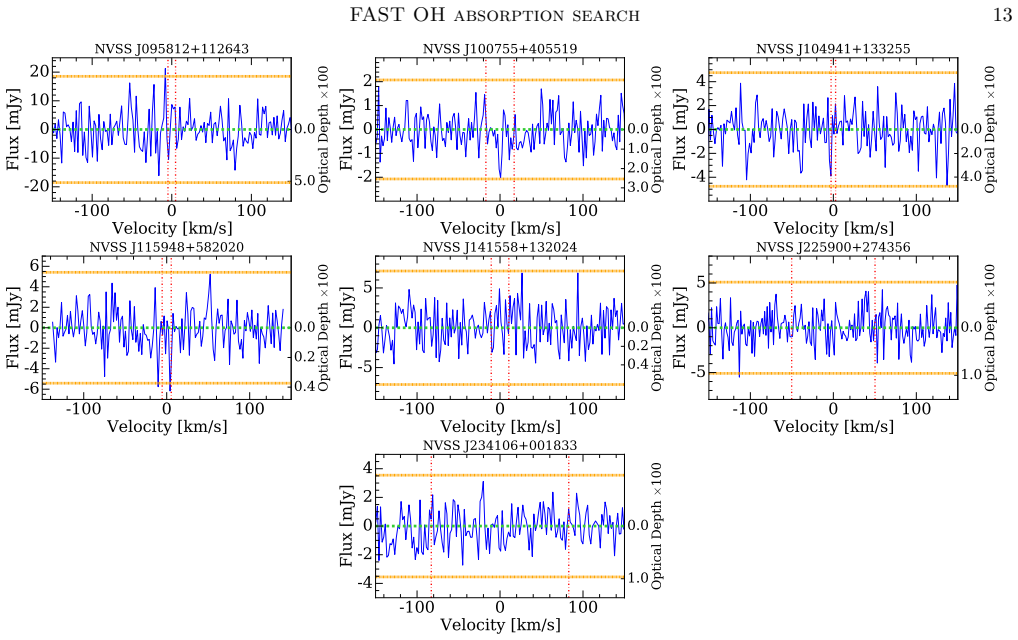
In the survey's own terms, the result is that OH 18-cm absorption is rare in unbiased, HI-selected systems. The only detection is the previously known absorber toward PKS 1413+135, whose 1612 MHz absorption and 1720 MHz emission are re-detected. All other searched spectra are non-detections; spectral stacking turns these into 3-sigma upper limits of [OH]/[HI] < 1.66e-8, < 1.42e-8, and < 0.90e-8 (associated, intervening, combined) under adopted Tex=10 K, Ts=100 K, covering-factor-unity, 30 km/s assumptions. The survival analysis finds no statistically significant N_OH-N_HI correlation or redshift evolution, suggesting earlier reported trends came from targeted, molecule-biased samples.
What carries the argument
The central machinery is the OH 18-cm ground-state transitions (1612, 1665, 1667, 1720 MHz) observed toward a parent sample of HI 21-cm absorbers found in a blind drift-scan survey. Because OH absorption is typically optically thin, non-detections are converted into 3-sigma upper limits on integrated optical depth; these are combined across sources by spectral stacking, which weights each OH spectrum by completeness and noise, and by Bayesian censored regression that treats detections and upper limits together. The load-bearing comparison is the OH-to-HI column-density ratio [OH]/[HI] derived by converting optical-depth limits into column densities under fixed excitation and spin temperature
Load-bearing premise
The headline upper limits assume optically thin OH lines, an OH excitation temperature of 10 K, an HI spin temperature of 100 K, unit covering factors, and a 30 km/s line width; if the real excitation temperature is lower or the covering factor is below unity, the limits weaken proportionally.
What would settle it
Take any one of the 19 HI absorbers, integrate with FAST in ON-OFF mode until the 3-sigma sensitivity on the OH 1667 MHz integrated optical depth is three times deeper than the current stacked limit. A detection at the expected redshifted frequency would falsify the claim that these systems contain little OH. Alternatively, a direct measurement of OH excitation temperature (e.g., from the 1612/1667 ratio in PKS 1413+135) below 10 K would rescale the quoted column-density limits upward.
If this is right
- Every known extragalactic OH absorber also shows HI 21-cm absorption, so HI-selected samples provide an efficient route to finding OH absorbers; this survey demonstrates that route blind.
- Because the stacked limits sit at or below the diffuse-Galactic value of [OH]/[HI] ~ few x 1e-8, the typical HI absorber in this sample contains very little OH, meaning molecular gas is either confined to small clumps or absent.
- The absence of a significant N_OH-N_HI correlation or redshift evolution in the unbiased sample indicates previously reported correlations were likely driven by targeted, dust- and molecule-biased samples.
- Wide instantaneous bandwidth instruments can search HI and OH absorption simultaneously, so future large drift-scan surveys can expand the census of molecular absorbers across redshift.
Where Pith is reading between the lines
- Editorial inference: if deeper integrations still show no OH in these systems, the simplest reading is that the bulk of HI-selected absorbers are not molecule-rich; this would lower estimates of the 'dark molecular gas' fraction in such sightlines.
- Editorial inference: the PKS 1413+135 re-detection, now reclassified as intervening, suggests that red, dusty sightlines (V-K > 6) are the high-yield subset of HI absorbers; a testable extension is to compare stacked [OH]/[HI] limits for red versus blue HI absorbers within the same survey.
- Editorial inference: the quoted limits scale linearly with the assumed OH excitation temperature and inversely with covering factor. If OH excitation in these diffuse gas clouds is actually colder than 10 K, the true OH content could be higher; measuring Tex or cf along one absorber would calibrate the whole stacking result.
Editorial analysis
A structured set of objections, weighed in public.
Referee Report
Summary. The paper reports the third installment of the FAST HI 21-cm absorption blind survey. It adds 394.4 hr and 1622.1 deg^2 of 2024 CRAFTS/FASHI data plus FATHOMER, detecting three known and four new HI absorbers, bringing the catalog to 41 systems. For 18 of these systems (19 sightlines including the HVC toward NVSS J090150+030422) with OH transitions in the FAST band, it conducts an OH 18-cm search, re-detecting OH 1612 MHz absorption and 1720 MHz emission toward PKS 1413+135 and finding no new OH absorbers. Survival analysis with Bayesian censored regression finds no statistically significant N_OH-N_HI correlation or redshift evolution. Stacking yields 3-sigma upper limits N_OH < 4.93, 1.64, 1.72 x 10^12 T_ex/c_f cm^-2 K^-1 and [OH]/[HI] < 1.66e-8, 1.42e-8, 0.90e-8 for associated, intervening, and combined samples, claimed as the strongest constraints to date.
Significance. The paper's strengths are the first OH search in a blind HI-selected sample, the re-detection of PKS 1413+135, the use of survival statistics appropriate for ~85% censoring, and stacking that improves on prior limits. If the estimator issues are resolved, the sample and upper limits provide a valuable benchmark for future OH surveys. The paper is honest about the assumptions (T_ex = 10 K, T_s = 100 K, c_f = 1, Delta-v = 30 km/s) and about the large uncertainties in the correlation analysis.
major comments (2)
- [Section 6.2, 'OH abundance relative to H i'] The combined [OH]/[H i] limit is calculated as the ratio of two separately stacked weighted means, with OH weights 1/(C rms_OH^2) and H i weights 1/(C rms_HI^2). Because the weighting is not identical, this quantity is not the mean of per-source [OH]/[H i] ratios; the resulting combined limit (0.90e-8) is lower than both the associated (1.66e-8) and intervening (1.42e-8) limits, which the text does not explain. This suggests that the OH stack is dominated by low-noise intervening sightlines while the H i stack includes high-N_HI associated systems. Please define the estimator explicitly and either justify it as an upper limit on a physically meaningful average abundance, or stack per-source ratio upper limits and report those; if the combined number is not a valid mean ratio, the abstract's headline constraint should be qualified.
- [Section 6.1 and Figure 13] The censored-regression fits are performed only for associated and intervening absorbers; the 11 systems with undetermined classifications are plotted but omitted from the fits. This exclusion is not stated in the text, and no robustness test is given. Because these systems could differ systematically (e.g., in redshift or host properties), the conclusion of no statistically significant correlation/evolution formally applies only to the classified subset. Please state the exclusion explicitly and assess its impact on the conclusions.
minor comments (5)
- [Abstract and Sections 1, 5] The abstract says 19 HI absorption systems were searched for OH, but Section 5 says 'the remaining 18 absorbers' and Table 5 lists 19 rows including the HVC toward NVSS J090150+030422. Please clarify systems vs. sightlines and use consistent counts.
- [Section 5.1] In the PKS 1413+135 paragraph, 'N_OH ~ 0.15 T_s 10^15 cm^-2 K^-1' should use T_ex rather than T_s, since this is an OH column density; this appears to be a typo.
- [Abstract and Section 1] The term 'blind' for the OH search should be qualified. The OH search is not a blind sky survey but a targeted search within a blind HI-selected sample; as written, 'first blind survey to detect OH absorption' could be overstated.
- [Section 6.2] Please state explicitly whether the 'combined' sample includes the 11 systems with undetermined classifications and how they are weighted; currently 'combined' is ambiguous.
- [Section 3.2, Eq. (1)] Equation (1) assumes Gaussian uncorrelated noise. Please specify whether the 1 km/s rebinned channels used for the stacked RMS remain uncorrelated and whether baseline systematics are included in the jackknife error estimates.
Circularity Check
No significant circularity: OH upper limits are direct noise-based 3-sigma conversions with explicit physical assumptions; self-citations supply input catalogs/methods, not the derived result.
full rationale
The derivation chain is not circular. The OH search is an observational search over fixed redshifted 1612/1665/1667/1720 MHz windows in a sample defined by previously detected HI absorption; the only input from the authors' earlier papers is the parent HI catalog (Hu et al. 2023, 2025), which is an externally checkable observational input, not an assumed conclusion. Non-detections are converted to limits by the stated error propagation `tau_3sigma ~ 3sigma/S` and `integral tau_3sigma dv = tau_3sigma * delta_v * sqrt(Delta_v/delta_v)` with Delta_v = 30 km/s; column densities then use standard spectroscopic constants (X = 2.38e14 for OH 1667, 1.82e18 for HI) and explicitly stated Tex = 10 K, Ts = 100 K, cf = 1. These formulas are inputs, not outputs of the analysis. The survival analysis treats the resulting limits as censored data; no fitted parameter is later reported as an independent prediction. The only self-citation beyond the parent catalog is the stacking method (Hu et al. 2019), which is a procedural reference rather than a load-bearing result; the known OH absorber is re-detected and compared with independent spectra (Darling 2004; Combes et al. 2023). The combined-sample [OH]/[HI] limit being lower than both subgroup limits is an arithmetic consequence of taking a ratio of two separately sensitivity-weighted stacks; this is a presentation/interpretation choice that could be debated, but it is not a circular reduction because the value is still directly computed from the stacked optical-depth spectra and the stated assumptions. The paper itself flags the main caveat in Section 6.2: 'the assumed excitation temperature or OH covering-factor parameters may systematically bias the inferred abundances,' and Section 8 notes 'The uncertainties of our analysis remain large.' The claim is therefore self-contained conditional on those physical assumptions.
Axiom & Free-Parameter Ledger
free parameters (4)
- OH excitation temperature Tex =
10 K (assumed)
- HI spin temperature Ts =
100 K (assumed)
- Covering factor cf (OH and HI) =
1
- Assumed OH line width Δv =
30 km/s
axioms (6)
- domain assumption The optical-depth formula τ(V) = −ln(1 + ΔT/(cf Tc)) applies under Ts ≪ cf Tc, and for non-detections τ3σ ≈ 3σ/S.
- domain assumption All six known OH absorbers also show HI 21-cm absorption, so HI-selected samples are a valid parent for OH searches.
- standard math The 1667-MHz conversion constant X=2.38e14 and 1612-MHz X=2.14e15 from Curran et al. (2008) and Grasha et al. (2019) are correct.
- domain assumption Noise in the upper-limit integration is Gaussian and uncorrelated between channels with uniform RMS over the velocity range (Eq. 1).
- domain assumption PKS 1413+135 is classified as an intervening absorber based on VLBI astrometry (Readhead et al. 2021).
- standard math The FAST L-band frequency coverage (1.0–1.5 GHz) corresponds to OH 1667 MHz redshifts z=0.15–0.59 and HI z=0–0.35.
read the original abstract
We present the first blind search for OH 18-cm absorption with the Five-hundred-meter Aperture Spherical Telescope (FAST), conducted alongside the HI 21-cm absorption search. Our previous FAST blind HI absorption search identified 34 systems. In this work, we extend the search using 2024 and part of the 2025 CRAFTS and FASHI data (394.4 hr and 1622.1 deg$^{2}$) together with FATHOMER observations, yielding three known and four new HI absorbers, for a total of 41 HI absorption systems. We search for OH absorption in 19 HI absorption systems whose OH redshifted frequencies fall within the FAST band. The known OH absorber towards PKS 1413+135 was re-detected, making our survey the first blind survey to detect OH absorption. No new OH absorbers were identified. We examine the relationship between $N_{\rm{OH}}$ and $N_{\rm{HI}}$, applying survival analysis to account for upper limits. The analysis does not provide statistically significant evidence for either an $N_{\rm{OH}}$-$N_{\rm{HI}}$ correlation or redshift evolution of $N_{\rm{OH}}$/$N_{\rm{HI}}$. Finally, spectral stacking sets 3$\sigma$ OH column density upper limits of 4.93, 1.64, and 1.72 $T_{\rm{ex}}$/$c_{\rm{f,OH}}\times$10$^{12}$cm$^{-2}$K$^{-1}$ for associated, intervening, and combined samples, corresponding to [\rm{OH}]/[\rm{HI}] ratios of $<$1.66$\times$10$^{-8}$, $<$1.42$\times$10$^{-8}$, and $<$0.90$\times$10$^{-8}$, assuming $T_{\rm{ex}}$=10K for OH and $T_{\rm{s}}$=100K for HI. These results place the strongest constraints to date on the OH content in radio-selected HI absorbers and establish a blind-survey benchmark for future studies of molecular gas in HI-selected systems. They also demonstrate that known HI 21-cm absorbers provide an effective parent sample for systematic OH absorption searches, paving the way for future larger surveys.
Figures




Reference graph
Works this paper leans on
-
[1]
Kass and Adrian E
Robert E. Kass and Adrian E. Raftery , journal =. Bayes Factors , urldate =
-
[2]
CRAFTS for H I Cosmology. I. Data Processing Pipeline and Validation Tests. , keywords =. doi:10.3847/1538-4365/adde4a , archivePrefix =. 2412.08173 , primaryClass =
-
[3]
The FAST H I 21 cm Absorption Blind Survey. II. Statistical Exploration for Associated and Intervening Systems. , keywords =. doi:10.3847/1538-4365/adb0c0 , archivePrefix =. 2407.14411 , primaryClass =
-
[4]
FAST Survey of H I and OH Absorption toward Extragalactic Radio Sources. , keywords =. doi:10.3847/1538-4357/ad5d5c , archivePrefix =. 2406.20026 , primaryClass =
-
[5]
Science China Physics, Mechanics, and Astronomy , keywords =
The FAST all sky H I survey (FASHI): The first release of catalog. Science China Physics, Mechanics, and Astronomy , keywords =. doi:10.1007/s11433-023-2219-7 , archivePrefix =. 2312.06097 , primaryClass =
-
[6]
Astronomical Techniques and Instruments , keywords =
The FAST Core Array. Astronomical Techniques and Instruments , keywords =. doi:10.61977/ati2024012 , archivePrefix =. 2408.12826 , primaryClass =
-
[7]
PKS 1413+135: OH and H I at z = 0.247 with MeerKAT. , keywords =. doi:10.1051/0004-6361/202245482 , archivePrefix =. 2211.09355 , primaryClass =
-
[8]
FAST Drift Scan Survey for HI Intensity Mapping: I. Preliminary Data Analysis. , keywords =. doi:10.3847/1538-4357/ace896 , archivePrefix =. 2305.06405 , primaryClass =
-
[9]
Detections of 21 cm absorption with a blind FAST survey at z 0.09. , keywords =. doi:10.1051/0004-6361/202245549 , archivePrefix =. 2305.02007 , primaryClass =
-
[10]
The Relativistic Jet Orientation and Host Galaxy of the Peculiar Blazar PKS 1413+135. , keywords =. doi:10.3847/1538-4357/abd08c , archivePrefix =. 2012.04045 , primaryClass =
Pith/arXiv arXiv 2012
-
[11]
On the scarcity of redshifted OH and millimetre-band molecular absorption. , keywords =. doi:10.1093/mnras/stab2639 , archivePrefix =. 2109.11100 , primaryClass =
-
[12]
The H I absorption zoo: JVLA extension to z 0.4. , keywords =. doi:10.1051/0004-6361/202141566 , archivePrefix =. 2108.08122 , primaryClass =
-
[13]
A pilot search for extragalactic OH absorption with FAST. , keywords =. doi:10.1093/mnras/staa3033 , archivePrefix =. 2010.01769 , primaryClass =
Pith/arXiv arXiv 2010
-
[14]
The Evolution of the Star-Forming Interstellar Medium Across Cosmic Time. , keywords =. doi:10.1146/annurev-astro-082812-141034 , archivePrefix =. 2003.06245 , primaryClass =
Pith/arXiv arXiv 2003
-
[15]
Jansky Very Large Array Sky Survey (VLASS)
The Karl G. Jansky Very Large Array Sky Survey (VLASS). Science Case and Survey Design. , keywords =. doi:10.1088/1538-3873/ab63eb , archivePrefix =. 1907.01981 , primaryClass =
arXiv 1907
-
[16]
An accurate low-redshift measurement of the cosmic neutral hydrogen density. , keywords =. doi:10.1093/mnras/stz2038 , archivePrefix =. 1907.10375 , primaryClass =
Pith/arXiv arXiv 1907
-
[17]
A Search for Intrinsic H I 21 cm and OH 18 cm Absorption toward Compact Radio Sources. , keywords =. doi:10.3847/1538-4365/ab4906 , archivePrefix =. 1909.12422 , primaryClass =
Pith/arXiv arXiv 1909
-
[18]
and Doherty, Paul and George, Daniel and Hayman, Douglas B
Dunning, Alex and Bowen, Mark and Castillo, Santiago and Chung, Yoon S. and Doherty, Paul and George, Daniel and Hayman, Douglas B. and Jeganathan, Kanapathippillai and Kanoniuk, Henry and Mackay, Simon and Reilly, Les and Roush, Peter and Smart, Sean Ken W. and Shaw, Robert D. and Smith, Stephanie L. and Tzioumis, Tasso and Venables, Veronica-Claire J. ,...
-
[19]
IEEE Microwave Magazine , keywords =
FAST in Space: Considerations for a Multibeam, Multipurpose Survey Using China's 500-m Aperture Spherical Radio Telescope (FAST). IEEE Microwave Magazine , keywords =. doi:10.1109/MMM.2018.2802178 , archivePrefix =. 1802.03709 , primaryClass =
arXiv 2018
-
[20]
Stringent Constraints on Fundamental Constant Evolution Using Conjugate 18 cm Satellite OH Lines. , keywords =. doi:10.1103/PhysRevLett.120.061302 , archivePrefix =. 1801.07688 , primaryClass =
-
[21]
Dust-Gas Scaling Relations and OH Abundance in the Galactic ISM. , keywords =. doi:10.3847/1538-4357/aac82b , archivePrefix =. 1805.11787 , primaryClass =
-
[22]
Discovery of OH Absorption from a Galaxy at z 0.05: Implications for Large Surveys with SKA Pathfinders. , keywords =. doi:10.3847/2041-8213/aac9cd , archivePrefix =. 1806.00172 , primaryClass =
Pith/arXiv arXiv 2041
-
[23]
The interstellar and circumnuclear medium of active nuclei traced by H i 21 cm absorption. , keywords =. doi:10.1007/s00159-018-0109-x , archivePrefix =. 1807.01475 , primaryClass =
-
[24]
The last survey of the old Westerbork Synthesis Radio Telescope
Kinematics and physical conditions of H I in nearby radio sources. The last survey of the old Westerbork Synthesis Radio Telescope. , keywords =. doi:10.1051/0004-6361/201730563 , archivePrefix =. 1705.00492 , primaryClass =
-
[25]
MeerKAT Science: On the Pathway to the SKA , year = 2016, month = jan, eid =
The MeerKAT Radio Telescope. MeerKAT Science: On the Pathway to the SKA , year = 2016, month = jan, eid =. doi:10.22323/1.277.0001 , adsurl =
-
[26]
Invisible Active Galactic Nuclei. II. Radio Morphologies and Five New H I 21cm Absorption Line Detectors. , keywords =. doi:10.3847/0004-6256/151/3/74 , archivePrefix =. 1512.07707 , primaryClass =
-
[27]
The Pan-STARRS1 Surveys. arXiv e-prints , keywords =. doi:10.48550/arXiv.1612.05560 , archivePrefix =. 1612.05560 , primaryClass =
-
[28]
The HI absorption ``Zoo''. , keywords =. doi:10.1051/0004-6361/201424655 , archivePrefix =. 1411.0361 , primaryClass =
-
[29]
Probing the gas content of radio galaxies through H I absorption stacking. , keywords =. doi:10.1051/0004-6361/201423999 , archivePrefix =. 1407.1799 , primaryClass =
-
[30]
Cosmic Star-Formation History. , keywords =. doi:10.1146/annurev-astro-081811-125615 , archivePrefix =. 1403.0007 , primaryClass =
-
[31]
Constraining the variation of fundamental constants at z 1.3 using 21-cm absorbers. , keywords =. doi:10.1111/j.1365-2966.2012.21503.x , archivePrefix =. 1206.2653 , primaryClass =
arXiv 2012
-
[32]
Mid-infrared Selection of Active Galactic Nuclei with the Wide-Field Infrared Survey Explorer. I. Characterizing WISE-selected Active Galactic Nuclei in COSMOS. , keywords =. doi:10.1088/0004-637X/753/1/30 , archivePrefix =. 1205.0811 , primaryClass =
-
[33]
A Catalog of 132,684 Clusters of Galaxies Identified from Sloan Digital Sky Survey III. , keywords =. doi:10.1088/0067-0049/199/2/34 , archivePrefix =. 1202.6424 , primaryClass =
-
[34]
Redshifted H I and OH absorption in radio galaxies and quasars. , keywords =. doi:10.1111/j.1365-2966.2011.18209.x , archivePrefix =. 1012.1972 , primaryClass =
arXiv 2011
-
[35]
High molecular gas fractions in normal massive star-forming galaxies in the young Universe. , keywords =. doi:10.1038/nature08773 , archivePrefix =. 1002.2149 , primaryClass =
-
[36]
Probing Fundamental Constant Evolution with Neutral Atomic Gas Lines. , keywords =. doi:10.1088/2041-8205/712/2/L148 , archivePrefix =. 1003.0444 , primaryClass =
Pith/arXiv arXiv 2041
-
[37]
The Wide-field Infrared Survey Explorer (WISE): Mission Description and Initial On-orbit Performance. , keywords =. doi:10.1088/0004-6256/140/6/1868 , archivePrefix =. 1008.0031 , primaryClass =
-
[38]
IEEE Proceedings , year = 2009, month = aug, volume =
The Square Kilometre Array. IEEE Proceedings , year = 2009, month = aug, volume =. doi:10.1109/JPROC.2009.2021005 , adsurl =
arXiv 2009
-
[39]
The Galaxy Disk in Cosmological Context , year = 2009, editor =
Star Formation in Disks: Spiral Arms, Turbulence, and Triggering Mechanisms. The Galaxy Disk in Cosmological Context , year = 2009, editor =. doi:10.1017/S1743921308027713 , archivePrefix =. 0810.5406 , primaryClass =
Pith/arXiv arXiv 2009
-
[40]
The SINS Survey: SINFONI Integral Field Spectroscopy of z -0.5ex 2 Star-forming Galaxies. , keywords =. doi:10.1088/0004-637X/706/2/1364 , archivePrefix =. 0903.1872 , primaryClass =
-
[41]
The Australian square-kilometre-array pathfinder
Science with ASKAP. The Australian square-kilometre-array pathfinder. Experimental Astronomy , keywords =. doi:10.1007/s10686-008-9124-7 , archivePrefix =. 0810.5187 , primaryClass =
-
[42]
A survey for redshifted molecular and atomic absorption lines - II. Associated HI, OH and millimetre lines in the z > -0.5ex 3 Parkes quarter-Jansky flat-spectrum sample. , keywords =. doi:10.1111/j.1365-2966.2008.13925.x , archivePrefix =. 0805.1581 , primaryClass =
arXiv 2008
-
[44]
Revisiting the infrared spectra of active galactic nuclei with a new torus emission model. , keywords =. doi:10.1111/j.1365-2966.2006.09866.x , archivePrefix =. astro-ph/0511428 , primaryClass =
arXiv 2006
-
[45]
Some Aspects of Measurement Error in Linear Regression of Astronomical Data. , keywords =. doi:10.1086/519947 , archivePrefix =. 0705.2774 , primaryClass =
-
[46]
The Arecibo Legacy Fast ALFA Survey. IV. Strategies for Signal Identification and Survey Catalog Reliability. , keywords =. doi:10.1086/513515 , archivePrefix =. astro-ph/0702178 , primaryClass =
-
[47]
Limits on Variations in Fundamental Constants from 21-cm and Ultraviolet Quasar Absorption Lines , author =. Phys. Rev. Lett. , volume =. 2005 , month =. doi:10.1103/PhysRevLett.95.041301 , url =
-
[48]
Constraints on Changes in Fundamental Constants from a Cosmologically Distant OH Absorber or Emitter. , keywords =. doi:10.1103/PhysRevLett.95.261301 , archivePrefix =. astro-ph/0510760 , primaryClass =
-
[49]
A Laboratory for Constraining Cosmic Evolution of the Fine-Structure Constant: Conjugate 18 Centimeter OH Lines toward PKS 1413+135 at z = 0.24671. , keywords =. doi:10.1086/422450 , archivePrefix =. astro-ph/0405240 , primaryClass =
-
[50]
Conjugate 18cm OH Satellite Lines at a Cosmological Distance. , keywords =. doi:10.1103/PhysRevLett.93.051302 , archivePrefix =. astro-ph/0406121 , primaryClass =
-
[51]
Detection of OH and wide HI absorption toward B0218+357. , keywords =. doi:10.1046/j.1365-8711.2003.07077.x , archivePrefix =. astro-ph/0310759 , primaryClass =
arXiv 2003
-
[52]
Methods for Constraining Fine Structure Constant Evolution with OH Microwave Transitions. , keywords =. doi:10.1103/PhysRevLett.91.011301 , archivePrefix =. astro-ph/0305550 , primaryClass =
-
[53]
Constraining the Variation of Fundamental Constants using 18cm OH Lines. , keywords =. doi:10.1103/PhysRevLett.91.241302 , archivePrefix =. astro-ph/0310764 , primaryClass =
-
[54]
A Search for OH Megamasers at z>0.1. III. The Complete Survey. , keywords =. doi:10.1086/341166 , archivePrefix =. astro-ph/0205185 , primaryClass =
-
[55]
Molecular gas at intermediate redshifts. , keywords =. doi:10.1051/0004-6361:20011697 , archivePrefix =. astro-ph/0111563 , primaryClass =
-
[56]
The Sloan Digital Sky Survey: Technical Summary. , keywords =. doi:10.1086/301513 , archivePrefix =. astro-ph/0006396 , primaryClass =
-
[57]
HI and OH absorption at z=0.89
HI and OH absorption at z=0.89. , keywords =. doi:10.48550/arXiv.astro-ph/9904055 , archivePrefix =. astro-ph/9904055 , primaryClass =
work page internal anchor Pith review Pith/arXiv arXiv doi:10.48550/arxiv.astro-ph/9904055
-
[58]
The NRAO VLA Sky Survey. , keywords =. doi:10.1086/300337 , adsurl =
-
[59]
, keywords =
Galactic OH absorption and emission toward a sample of compact extragalactic mm-wave continuum sources. , keywords =
-
[60]
Neutral Hydrogen 21 Centimeter Absorption at Z = 0.6847 toward the ``Smallest Einstein Ring''. , keywords =. doi:10.1086/186940 , adsurl =
-
[61]
Databases and On-line Data in Astronomy , year = 1991, editor =
The NASA/IPAC extragalactic database. Databases and On-line Data in Astronomy , year = 1991, editor =. doi:10.1007/978-94-011-3250-3\_10 , adsurl =
-
[62]
Statistical methods for astronomical data with upper limits. I. Univariate distributions. , keywords =. doi:10.1086/163225 , adsurl =
-
[63]
Statistical analysis of astronomical data containing upper bounds: general methods and examples drawn from X-ray astronomy. , keywords =. doi:10.1086/163224 , adsurl =
-
[64]
Classification parameters for the emission-line spectra of extragalactic objects. , keywords =. doi:10.1086/130766 , adsurl =
-
[65]
Annals of Statistics , year = 1978, month = jul, volume =
Estimating the Dimension of a Model. Annals of Statistics , year = 1978, month = jul, volume =
1978
-
[66]
, year = 1976, month = jul, volume =
Limits on the variation of fundamental atomic quantities over cosmic time scales. , year = 1976, month = jul, volume =. doi:10.1103/PhysRevLett.37.179 , adsurl =
-
[67]
HI absorption in a gravitational lens at z -0.5ex 0.7645. , keywords =. doi:10.1051/0004-6361:20031676 , archivePrefix =. astro-ph/0311021 , primaryClass =
-
[68]
The Redshift of the Lensed Object in the Einstein Ring B0218+357. , keywords =. doi:10.1086/344837 , archivePrefix =. astro-ph/0209457 , primaryClass =
-
[69]
Neutral Hydrogen 21 Centimeter Absorption at Redshift 0.673 toward 1504+377. , keywords =. doi:10.1086/310445 , archivePrefix =. astro-ph/9610073 , primaryClass =
-
[70]
Discovery of Neutral Hydrogen 21 Centimeter Absorption at Redshift 0.25 toward PKS 1413+135. , keywords =. doi:10.1086/186637 , adsurl =
-
[71]
Constraining Fundamental Constant Evolution with H I and OH Lines. , keywords =. doi:10.1088/2041-8205/746/2/L16 , archivePrefix =. 1201.3372 , primaryClass =
Pith/arXiv arXiv 2041
discussion (0)
Sign in with ORCID, Apple, or X to comment. Anyone can read and Pith papers without signing in.