REVIEW 4 major objections 5 minor 29 references
Enhancing Blood Cells Classification using Hybrid Quantum Neural Networks
T0 review · 4 major / 5 minor · reviewed 2026-08-02 · deepseek-v4-flash
Pith's one-line read Quantum feature transformations give hybrid networks a consistent edge in blood cell classification.
desk verdict A cleanly written HQNN application study whose central quantum-advantage claim is confounded by an under-powered classical control. read the letter →
The pith
A machine-rendered reading of the paper's core claim, the machinery that carries it, and where it could break.
The reading
What carries the argument
The central object is a variational quantum circuit (VQC) used as an intermediate feature transformer. It encodes a 10-dimensional latent vector from the bottleneck into 10 qubits via angle embedding (RY rotations), then applies four trainable layers, each with an RY rotation per qubit and a ring of CNOT entanglements, and finally reads out Pauli-Z expectation values to produce a 10-dimensional quantum feature vector for the classifier. This circuit occupies the same pipeline position as the classical matched layer, so the only difference between models is the nature of the intermediate transformation.
What would settle it
Train a classical model with the same pipeline but replace the VQC with a small multi-layer perceptron containing four tanh layers of width 10 (roughly 110 parameters). If that model attains macro F1 at or above the HQNN's 0.9153 on the Blood Cell Images test set under the same training procedure, the claim that the gains come from the quantum feature transformation is falsified.
Extended reading notes
Core claim
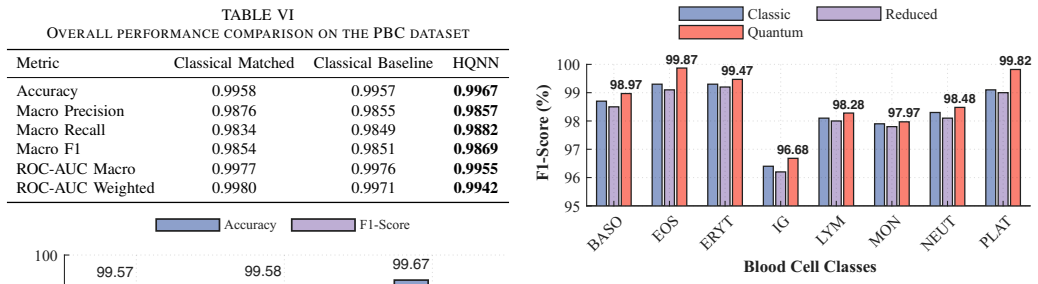
The central claim is that the variational quantum circuit's feature transformation – rather than the added trainable parameters – drives the improvements. The authors isolate this by holding every other component identical and adding a classical layer with 110 parameters as the matched control versus 40 quantum parameters. On the Blood Cell Images dataset the hybrid model reaches 0.9572 accuracy and 0.9153 macro F1, versus 0.9429/0.8862 for the matched classical model and 0.9375/0.8784 for the baseline; on the eight-class PBC dataset it reaches 0.9967 accuracy and 0.9869 macro F1. Class-wise, the largest gains occur for classes that are typically confused, such as monocytes and neutrophils.
Load-bearing premise
The load-bearing assumption is that a single classical linear+tanh layer with 110 parameters is a fair match for a 10-qubit, 4-layer entangling quantum circuit with 40 parameters; if a classical model with several nonlinear layers is needed for a fair match, the claimed quantum advantage could vanish.
Editorial extensions
If this is right
- On the 4-class Blood Cell Images dataset, the hybrid model improves macro F1 from 87.84% (baseline) and 88.62% (matched classical) to 91.53%, with the biggest gains on monocytes and neutrophils.
- On the 8-class PBC dataset, the hybrid model reaches 99.67% accuracy and 98.69% macro F1, edging out classical models even at near-saturation.
- When training data is cut to 25%, the hybrid model still beats the classical matched model by 1.14 accuracy points and 2.19 F1 points, suggesting the quantum transformation helps in data-scarce settings.
- Running inference on real quantum hardware costs only about 2.5–3% F1 relative to the simulator, indicating current noisy devices can support this small-scale model.
- Because the matched classical layer also improved over the baseline, the paper concludes the quantum gain is not attributable to parameter count alone.
Reading between the lines
- The matched classical control (110 parameters in a single linear+tanh block) may under-represent classical expressivity: a deeper classical block with a similar number of nonlinear layers could plausibly close the gap, so the 'quantum advantage' may actually be a feature-map advantage reproducible by classical nonlinear embeddings.
- A direct way to test this is to replace the VQC with a random Fourier-feature or a 4-layer classical feature map; if performance matches the HQNN, the benefit comes from the nonlinear embedding, not quantum entanglement.
- The hardware result hints at near-term deployment, but the 40-sample test is too small to establish scalability; future work should check whether noise degrades performance as qubit count or circuit depth grows.
- The controlled comparison framework could transfer to other fine-grained medical imaging tasks; if the pattern holds, quantum feature maps become a general tool for class-confusable categories.
Editorial analysis
A structured set of objections, weighed in public.
Referee Report
Summary. The paper proposes a hybrid quantum-classical neural network (HQNN) for blood cell image classification, combining a pre-trained ResNet-50 backbone, a 10-dimensional latent bottleneck, and a 10-qubit/4-layer variational quantum circuit as an intermediate feature transformation. To isolate the quantum contribution, the authors compare three architectures: the HQNN, a classical baseline with no intermediate transformation, and a 'Classical Matched Model' that inserts a single linear+tanh layer (110 trainable parameters) in the same position as the VQC. Experiments on the 4-class Blood Cell Images dataset and the 8-class PBC dataset report that the HQNN achieves the highest accuracy, macro recall, and macro F1-score, with gains up to ~3.7% macro F1 on the 4-class task and smaller but consistent gains on the near-saturated 8-class task, alongside a hardware evaluation on IBM quantum hardware using 40 samples.
Significance. If the central claim is correct — that the observed improvements stem from the quantum feature transformation rather than simply added parameters or model capacity — this would be a useful empirical contribution to hybrid quantum-classical medical image classification. The paper's controlled pipeline (shared backbone, bottleneck, and classifier head) and its inclusion of a hardware validation are commendable and go beyond many HQNN studies. The work also makes falsifiable performance predictions on two public datasets. However, the principal evidence for the quantum-specific advantage is undermined by a control model that is not matched in expressiveness: the classical control is a single affine+tanh layer while the VQC applies four layers of entangling nonlinear transformations. The absence of repeated runs or statistical tests further weakens the causal interpretation, and the ROC-AUC results are consistently lower for the HQNN, which is not reconciled with the claim of improved class separability.
major comments (4)
- [Section III.F, Table I, Eq. (3), Eq. (5)] The 'Classical Matched Model' is implemented as a single linear transformation followed by a tanh activation (Eq. 5), with 110 trainable parameters. The variational quantum circuit, in contrast, applies four layers of RY rotations and ring CNOT entangling operations (Eq. 3), with 40 trainable parameters but a much richer nonlinear transformation structure. Parameter count is not a sufficient proxy for expressivity here: the VQC is a deeper and more complex nonlinear map. The comparison therefore does not isolate the quantum mechanism; it confounds the transformation type with the number and structure of nonlinear layers. This is load-bearing for the claim in Section IV.B.2 ('the observed improvements are not solely due to additional parameters, but also to the expressive power of the quantum feature transformation') and the Conclusion. A classical control with comparable depth — for exam
- [Section IV.B.2 (Table V) and Section IV.C.2 (Table VI)] The HQNN achieves higher accuracy and macro F1 on both datasets, but its ROC-AUC is lower than the Classical Matched Model in both cases: 0.9597 vs 0.9745 on Blood Cell Images and 0.9955 vs 0.9977 on PBC. Since the paper claims the quantum transformation improves class separability and 'reduces misclassifications', the substantially lower AUC is a direct contradiction that is not addressed. The authors should either explain this discrepancy or temper the claim that the quantum representation yields better feature discrimination. As reported, the evidence suggests that the HQNN may improve the chosen threshold-based metrics while worsening ranking-based separability, which complicates the central narrative.
- [Section IV.A, Tables V and VI, and Section IV.B.2] All reported results are from single runs; no standard deviations, confidence intervals, or statistical significance tests are provided. The advantage on the PBC dataset is extremely small (macro F1 0.9869 vs 0.9854 and 0.9851). Because the differences are within the range that could be produced by random seed variations, early stopping, or optimizer stochasticity, the claim of a consistent quantum advantage is not statistically substantiated. The paper says random seeds are fixed, but that only fixes a single realization. Repeated runs with different seeds, or at least a paired bootstrap across seeds, are required to establish whether the observed gaps are robust.
- [Section IV.F, Table IX] The hardware evaluation uses only 40 samples (10 per class). The reported simulator baseline on this subset is 0.9250 accuracy / 0.9246 macro F1, and the hardware result is 0.9000 / 0.8963. With such a small sample, the per-class F1 values (e.g., 8.235 for monocytes) have very large uncertainty, and no comparison to the classical models on the same subset is provided. The claim of 'robustness under noise' is therefore only weakly supported. The paper acknowledges the reduced subset, but it should be clear that this is anecdotal evidence rather than a systematic robustness assessment.
minor comments (5)
- [Abstract and Section IV.B.2] The abstract states 'improves macro F1-score by up to 3.7% compared to classical baselines', but Table V shows the improvement over the Classical Baseline is 3.7% (0.9153 vs 0.8784) while over the Classical Matched Model it is about 3.0% (0.9153 vs 0.8862). Clarify what 'classical baselines' refers to.
- [Section II.B and Refs. [15],[26]] Ref. [26] includes three of the authors (Kashif, Marchisio, Shafique) and is cited when discussing quantum image classification frameworks. This is not inappropriate, but the self-citation is not flagged in the text. Also, Ref. [15] is cited when stating that HQNN studies in blood-image analysis are scarce; ensure the citation accurately supports that sentence.
- [Section III.E, Eq. (4)] The notation for the measurement expectation value is nonstandard: the expression inside the kets is written as a product of operators applied to the initial state, but bra-ket notation should be normalized as ⟨0^⊗n_q| U† Z_i U |0^⊗n_q⟩. The current form may confuse readers.
- [Tables V and VI] The tables report ROC-AUC to four decimal places but accuracy to four decimals as well; given the single-run nature, the implied precision is over-stated. Consider reducing significant digits or reporting standard deviations.
- [Figure 3 caption] The description of the ring CNOT pattern is helpful, but the caption says 'the final qubit closing the ring back to the first (q2 → q0, and equivalently q9 → q0 in the full 10-qubit circuit)'. The mention of q9 → q0 is inconsistent with the 3-qubit schematic; it would be clearer to say 'in the full 10-qubit circuit, the final qubit q9 also controls q0'.
Circularity Check
No significant circularity: the comparison is an empirical three-way evaluation; the quantum-advantage claim is confounded by control depth but not derived from its own inputs.
full rationale
The paper's central inference—that HQNN gains come from the quantum transformation rather than only from added parameters—is supported by a held-out comparison (Tables V and VI) among three architectures that share the ResNet-50 backbone, 10-d bottleneck (Eq. 1), and classifier head (Eq. 6). No test metric is used to set a hyperparameter or constant; early stopping is on validation. The Classical Matched Model (Eq. 5, Table I) is an author-designed control with 110 parameters versus 40 VQC parameters. Its fairness is genuinely contestable—a single linear+tanh layer is not matched in nonlinear depth to a 10-qubit, 4-layer entangling circuit—so the phrase 'comparable capacity' is a substantive assumption, not a tautology. That is a correctness/confound concern, not circularity: the classical output is not equal to the quantum output by construction, and the paper's own experiments are the evidence. Self-citations [15] and [26] appear only as contextual related-work examples; no load-bearing theorem, ansatz, or prediction is imported from them. Section IV.G lists limitations but omits the depth-match confound; that omission should be flagged as missing support for the causal claim, but it does not make the derivation circular.
Assumptions & free parameters
free parameters (4)
- latent bottleneck dimension (10) / qubit count (10) =
10
- variational layers L =
4
- Classical Matched block design (linear + tanh, 110 params) =
W_c: 10x10 + b_c: 10
- quantum learning rate (LR_Q) =
1e-4
assumptions (5)
- domain assumption Angle embedding maps each latent scalar z_i to a Y-rotation: U_enc = ⊗ RY(z_i)
- domain assumption Pauli-Z expectation values on the 10 qubits yield a discriminative 10-d feature vector
- domain assumption ImageNet-pretrained ResNet-50 features transfer to blood-cell microscopy
- domain assumption The Blood Cell Images train/test split is clean (no augmented-duplicate leakage)
- standard math Lightning.gpu simulator and ibm_fez hardware compute the VQC within acceptable fidelity
Cite this review
Pith. "Pith review of Enhancing Blood Cells Classification using Hybrid Quantum Neural Networks." pith.science (2026). https://pith.science/paper/6FG6IBND
@misc{pith2026260523324,
  author       = {Pith},
  title        = {Pith review of: Enhancing Blood Cells Classification using Hybrid Quantum Neural Networks},
  year         = {2026},
  howpublished = {\url{https://pith.science/paper/6FG6IBND}},
  note         = {Machine review of arXiv:2605.23324}
}
read the original abstract
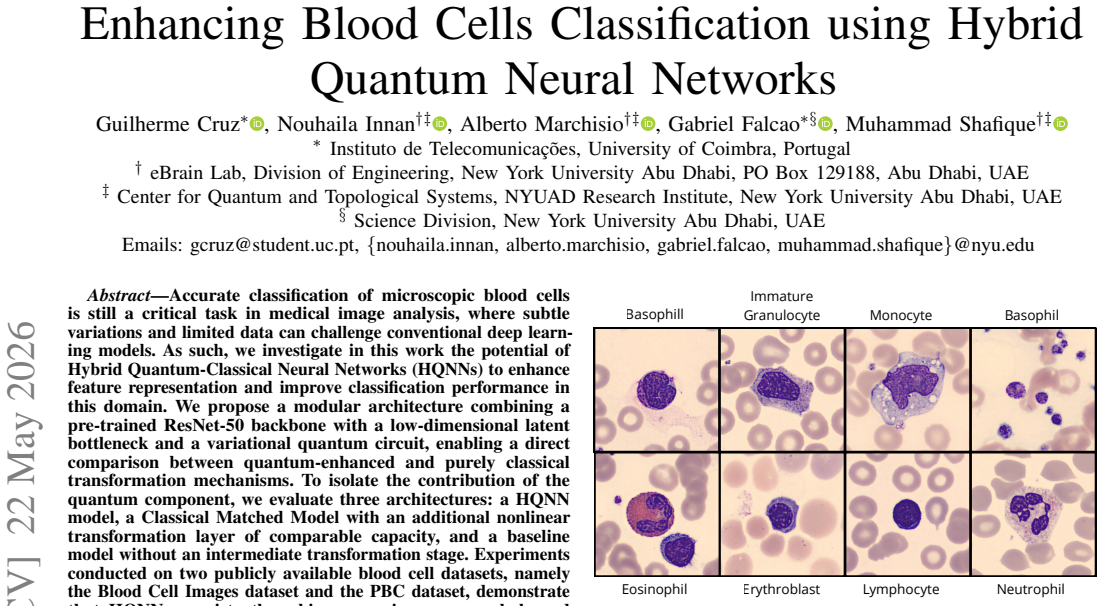
Accurate classification of microscopic blood cells is still a critical task in medical image analysis, where subtle variations and limited data can challenge conventional deep learning models. As such, we investigate in this work the potential of Hybrid Quantum-Classical Neural Networks (HQNNs) to enhance feature representation and improve classification performance in this domain. We propose a modular architecture combining a pre-trained ResNet-50 backbone with a low-dimensional latent bottleneck and a variational quantum circuit, enabling a direct comparison between quantum-enhanced and purely classical transformation mechanisms. To isolate the contribution of the quantum component, we evaluate three architectures: a HQNN model, a Classical Matched Model with an additional nonlinear transformation layer of comparable capacity, and a baseline model without an intermediate transformation stage. Experiments conducted on two publicly available blood cell datasets, namely the Blood Cell Images dataset and the PBC dataset, demonstrate that HQNNs consistently achieve superior or more balanced performance across evaluation metrics. In the Blood Cell Images Dataset, the proposed approach improves macro F1-score by up to 3.7% compared to classical baselines, while improving the F1-score from 98.54% to 98.69% in the more challenging 8-class scenario with near-saturated performance. Additional evaluation on IBM quantum hardware shows that the model remains robust under noise, with only a modest performance degradation relative to simulated results. These results indicate that quantum feature transformations can enhance discriminative representations, particularly in challenging classification scenarios, and highlight the practical potential of HQNN models for medical imaging tasks.
Figures


Figures from the paper (7 more)




Reference graph
Works this paper leans on
-
[1]
Artificial intelligence of digital morphology analyzers improves the efficiency of manual leukocyte differentiation of peripheral blood,
Y . Xing, X. Liu, J. Dai, X. Ge, Q. Wang, Z. Hu, Z. Wu, X. Zeng, D. Xu, and C. Qu, “Artificial intelligence of digital morphology analyzers improves the efficiency of manual leukocyte differentiation of peripheral blood,”BMC Medical Informatics and Decision Making, 2023
2023
-
[2]
From microscope to micropixels: A rapid review of artificial intelligence for the peripheral blood film,
B. E. Fan, B. S. J. Yong, R. Li, S. S. Y . Wang, M. Y . N. Aw, M. F. Chia, D. T. Y . Chen, Y . S. Neo, B. Occhipinti, R. R. Linget al., “From microscope to micropixels: A rapid review of artificial intelligence for the peripheral blood film,”Blood Reviews, 2024
2024
-
[3]
Classification of white blood cells using machine and deep learning models: A systematic review,
R. Asghar, S. Kumar, P. Hynds, and A. Shaukat, “Classification of white blood cells using machine and deep learning models: A systematic review,” 2023
2023
-
[4]
Classification of white blood cell using convolution neural network,
A. Girdhar, H. Kapur, and V . Kumar, “Classification of white blood cell using convolution neural network,”Biomedical Signal Processing and Control, 2022
2022
-
[5]
White blood cell classification using multi-attention data augmentation and regularization,
N. Bayat, D. D. Davey, M. Coathup, and J.-H. Park, “White blood cell classification using multi-attention data augmentation and regularization,” Big Data and Cognitive Computing, 2022
2022
-
[6]
An explainable ai-based blood cell classification using optimized convolutional neural network,
O. Islam, M. Assaduzzaman, and M. Z. Hasan, “An explainable ai-based blood cell classification using optimized convolutional neural network,” Journal of Pathology Informatics, 2024
2024
-
[7]
White blood cell classification using custom deep neural network and visualizing features of the images using heatmaps,
S. Karaddi, H. Bitra, S. S. R. Bairaboina, and B. Gudibandi, “White blood cell classification using custom deep neural network and visualizing features of the images using heatmaps,”Scientific Reports, 2026
2026
-
[8]
Recogni- tion of peripheral blood cell images using convolutional neural networks,
A. Acevedo, S. Alf ´erez, A. Merino, L. Puigv ´ı, and J. Rodellar, “Recogni- tion of peripheral blood cell images using convolutional neural networks,” Computer Methods and Programs in Biomedicine, 2019
2019
Show all 29 references
-
[9]
Quantum machine learning in medical image analysis: A survey,
L. Wei, H. Liu, J. Xu, L. Shi, Z. Shan, B. Zhao, and Y . Gao, “Quantum machine learning in medical image analysis: A survey,”Neurocomputing, 2023
2023
-
[10]
Quantum circuit learning,
K. Mitarai, M. Negoro, M. Kitagawa, and K. Fujii, “Quantum circuit learning,”Phys. Rev. A, 2018
2018
-
[11]
Circuit-centric quantum classifiers,
M. Schuld, A. Bocharov, K. M. Svore, and N. Wiebe, “Circuit-centric quantum classifiers,”Phys. Rev. A, 2020
2020
-
[12]
Variational quantum algorithms,
M. V . S. Cerezo de la Roca, A. T. Arrasmith, R. Babbush, S. C. Benjamin, S. Endo, K. Fujii, J. R. McClean, K. Mitarai, X. Yuan, L. Cincioet al., “Variational quantum algorithms,”Nature Reviews Physics, 2021
2021
-
[13]
Hybrid quantum-classical convolutional neural networks,
J. Liu, K. H. Lim, K. L. Wood, W. Huang, C. Guo, and H.-L. Huang, “Hybrid quantum-classical convolutional neural networks,”Science China Physics, Mechanics & Astronomy, 2021
2021
-
[14]
Hybrid quantum-classical-quantum convolutional neural networks,
C. Long, M. Huang, X. Ye, Y . Futamura, and T. Sakurai, “Hybrid quantum-classical-quantum convolutional neural networks,”Scientific Reports, 2025
2025
-
[15]
Fedqnn: Federated learning using quantum neural networks,
N. Innan, M. A.-Z. Khan, A. Marchisio, M. Shafique, and M. Bennai, “Fedqnn: Federated learning using quantum neural networks,”arXiv preprint arXiv:2403.10861, 2024
2024 arXiv
-
[16]
Analyzing images of blood cells with quantum machine learning methods: Equilibrium propagation and variational quantum circuits to detect acute myeloid leukemia,
A. Bano and L. Liebovitch, “Analyzing images of blood cells with quantum machine learning methods: Equilibrium propagation and variational quantum circuits to detect acute myeloid leukemia,” 2026
2026
-
[17]
Automated microscopic image analysis for leukocytes identification: A survey,
M. Saraswat and K. Arya, “Automated microscopic image analysis for leukocytes identification: A survey,”Micron, vol. 65, pp. 20–33, 2014
2014
-
[18]
Automatic recognition of five types of white blood cells in peripheral blood,
S. H. Rezatofighi and H. Soltanian-Zadeh, “Automatic recognition of five types of white blood cells in peripheral blood,”Computerized Medical Imaging and Graphics, vol. 35, no. 4, pp. 333–343, 2011
2011
-
[19]
The best texture features for leukocytes recognition,
O. Sarrafzadeh, A. M. Dehnavi, H. Y . Banaem, A. Talebi, and A. Gharibi, “The best texture features for leukocytes recognition,”Journal of Medical Signals & Sensors, vol. 7, no. 4, pp. 220–227, 2017
2017
-
[20]
Automatic white blood cell classification using pre-trained deep learning models: Resnet and inception,
M. Habibzadeh, M. Jannesari, Z. Rezaei, H. Baharvand, and M. Totonchi, “Automatic white blood cell classification using pre-trained deep learning models: Resnet and inception,” inTenth international conference on machine vision (ICMV 2017), vol. 10696. SPIE, 2018, pp. 274–281
2017
-
[21]
Accurate classification of white blood cells by coupling pre-trained resnet and densenet with scam mechanism,
H. Chen, J. Liu, C. Hua, J. Feng, B. Pang, D. Cao, and C. Li, “Accurate classification of white blood cells by coupling pre-trained resnet and densenet with scam mechanism,”BMC bioinformatics, vol. 23, no. 1, p. 282, 2022
2022
-
[22]
A large dataset of white blood cells containing cell locations and types, along with segmented nuclei and cytoplasm,
Z. M. Kouzehkanan, S. Saghari, S. Tavakoli, P. Rostami, M. Abaszadeh, F. Mirzadeh, E. S. Satlsar, M. Gheidishahran, F. Gorgi, S. Mohammadi et al., “A large dataset of white blood cells containing cell locations and types, along with segmented nuclei and cytoplasm,”Scientific r...
2022
-
[23]
Hybrid quantum-classical neural networks,
D. Arthur and P. Date, “Hybrid quantum-classical neural networks,” in2022 IEEE international conference on quantum computing and engineering (QCE). IEEE, 2022, pp. 49–55
2022
-
[24]
Quantum machine learning for image classification,
A. Senokosov, A. Sedykh, A. Sagingalieva, B. Kyriacou, and A. Melnikov, “Quantum machine learning for image classification,”Machine Learning: Science and Technology, vol. 5, no. 1, p. 015040, 2024
2024
-
[25]
A novel image classification framework based on variational quantum algorithms,
Y . Chen, “A novel image classification framework based on variational quantum algorithms,”Quantum Information Processing, 2024
2024
-
[26]
Computational advantage in hybrid quantum neural networks: Myth or reality?
M. Kashif, A. Marchisio, and M. Shafique, “Computational advantage in hybrid quantum neural networks: Myth or reality?” in2025 62nd ACM/IEEE Design Automation Conference (DAC). IEEE, 2025, pp. 1–7
2025
-
[27]
Bccd dataset: Blood cell count and detection,
Shenggan, “Bccd dataset: Blood cell count and detection,” https://github. com/Shenggan/BCCD Dataset, 2018
2018
-
[28]
Blood cell images dataset,
P. Mooney, “Blood cell images dataset,” https://www.kaggle.com/datasets/ paultimothymooney/blood-cells, 2018
2018
-
[29]
Noisy intermediate- scale quantum algorithms,
K. Bharti, A. Cervera-Lierta, T. H. Kyaw, T. Haug, S. Alperin-Lea, A. Anand, M. Degroote, H. Heimonen, J. S. Kottmann, T. Menke, W.-K. Mok, S. Sim, L.-C. Kwek, and A. Aspuru-Guzik, “Noisy intermediate- scale quantum algorithms,”Rev. Mod. Phys., 2022
2022
Reviewed August 2, 2026 · model on record in the stance chip above.
Discussion (0). Continue with ORCID to comment.