REVIEW 2 major objections 6 minor 40 references
This paper argues that four deterministic extensions—a diagonal convergence criterion, diagonal pivots, a tightened admissibility condition, and a sustained convergence check—make ACAPP compression of acoustic volume and boundary operators
Reviewed by Pith at T0; open to challenge. T0 means a machine referee read the full paper against a public rubric. the ladder, T0–T4 →
A deterministic combination of diagonal sampling, diagonal pivoting, an extended admissibility condition, and sustained convergence checks lets ACAPP+ DCC meet prescribed tolerances on all tested acoustic volume and boundary integral operators.
T0 review reviewed 2026-08-01 challenge →
load-bearing objection Solid engineering paper with reproducible code and a genuinely more robust ACA variant, but the 'always' claim rests on an admissibility heuristic with no sensitivity analysis. the 2 major comments →
Robust Hierarchical Matrix Compression of Acoustic Volume and Boundary Integral Operators
The pith
A machine-rendered reading of the paper's core claim, the machinery that carries it, and where it could break.
The reading
Core claim
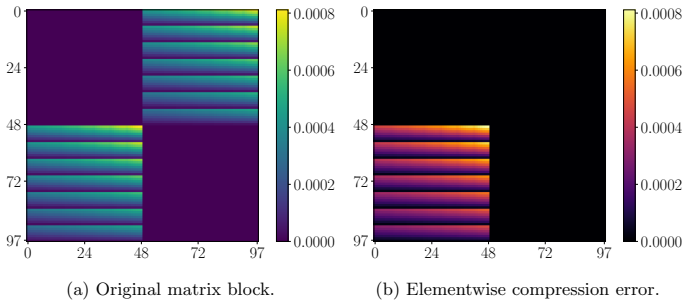
On its own terms, the paper's discovery is that early convergence in ACAPP is not an irreducible flaw but a failure of the error estimator and pivot selection to sample the right parts of a block, and that a deterministic diagonal-based sampling scheme fixes it. Specifically, the paper shows that matrix blocks with two separated nonzero sub-blocks (cube double-layer operator) or with repeating internal sub-structures (ellipsoid volume operator) defeat the standard estimator, yet the ACAPP+ DCC algorithm—with the combined criterion (16), diagonal pivots, condition (17), and sustained convergence check—achieves the target tolerance in every test, including a CT-derived skull model.
What carries the argument
The load-bearing mechanism is the Diagonal Convergence Criterion (DCC): for each m×n admissible block the algorithm evaluates d=max(m,n) extra entries along the extended main diagonal, updates their residuals e_ℓ[s]=e_{ℓ-1}[s]-u_ℓ[i_s]v_ℓ[j_s] each iteration, and adds the block-normalized mean of their squared residuals to the stopping criterion (eq. 16). This gives deterministic coverage of all rows and columns, feeds the extra entries back into pivot selection when the standard criteria pass but DCC does not, and is paired with an admissibility guard (distance > 2×maximum element diameter) and a requirement that convergence hold for α consecutive iterations.
Load-bearing premise
Everything rests on condition (17): the heuristic distance > 2 × maximum element diameter, with no proof or sensitivity study, must be enough to keep every nearly singular interaction out of admissible low-rank blocks; if a thin or high-aspect-ratio element slips a near singularity into a compressed block, the error estimator may not catch it.
What would settle it
Construct a mesh with thin, elongated elements where two octree boxes satisfy condition (17) yet contain nearly singular interacting points closer than the effective element size, compress the single-layer operator with ACAPP+ DCC at a strict tolerance such as ε=10⁻⁶, and compare the measured relative error (18) with ε. If the measured error exceeds ε, the claimed all-benchmark robustness fails.
If this is right
- On all reported benchmarks, ACAPP+ DCC meets the prescribed tolerance; standard ACAPP and ACAPP+ stall far above tolerance in cube, ellipsoid, and skull cases, so users of these operators can switch to the new variant and get bounded errors.
- Compression rates stay essentially unchanged—e.g., 22.5% storage versus 22.4–23.0% for other variants on the cube at ε=10⁻¹⁰—so the reliability gain costs no memory.
- At constant frequency, memory scales O(n log n) with mesh refinement (tested up to about 16.8 million voxels), enabling larger high-resolution acoustic simulations than dense storage allows.
- For the 972 GB VSIE skull system, ACAPP+ DCC compresses to about 335 GB at ε=10⁻¹⁰ and to roughly 18.4% of dense storage at ε=10⁻⁵, and the resulting acoustic field displays expected reflection, absorption, and focal-spot behavior.
- The DCC replaces random restart and random reference-column choices with deterministic choices, improving reproducibility of the compression.
Where Pith is reading between the lines
- Not tested in the paper: applying DCC to the hypersingular operator or to H2/directional compression could reveal different failure modes; the diagonal sweep's coverage of all rows and columns may transfer, but this is an extrapolation.
- The factor 2 in condition (17) is heuristic; a sensitivity sweep on meshes with thin or stretched elements would show whether the robustness holds beyond the tested geometries or whether a per-element distance check is needed.
- One could turn DCC into an adaptive sampler: if the mean diagonal residual concentrates on a few entries, add rows and columns through those entries as pivots, generalizing the diagonal fix to blocks whose hidden structure is not diagonal-aligned.
- Because criterion (16) is the maximum of three normalized residuals, monitoring which term dominates at termination could serve as a diagnostic for early-convergence risk in user codes.
Editorial analysis
A structured set of objections, weighed in public.
Referee Report
Summary. The manuscript addresses early-convergence failures of Adaptive Cross Approximation with Partial Pivoting (ACAPP) when compressing hierarchical (H-)matrix blocks of acoustic volume and boundary integral operators. It proposes four deterministic modifications: a diagonal convergence criterion (DCC) based on an extended diagonal sample of each block, the use of these diagonal entries as additional pivot candidates, an extended admissibility condition intended to keep near-singular interactions in dense blocks, and a sustained convergence check requiring the error estimator to remain below tolerance for α consecutive iterations. Numerical experiments on sphere, cube, ellipsoid, and CT-derived skull models show that ACAPP+ DCC is the only tested variant that meets prescribed relative-vector error tolerances in all benchmarks, while the other variants stagnate or fail in several cases. The paper also reports memory consumption and scaling experiments.
Significance. If the empirical claims hold, the paper makes a practical contribution: it documents early-convergence failures in volume integral operators as well as boundary operators, and proposes a deterministic, reproducible algorithmic fix that does not increase the final memory footprint. The availability of the GitHub code is a strength, as are the large-scale skull benchmark and the algebraic complexity study. However, the robustness conclusions are heuristic rather than proven: the DCC error estimator and the extended admissibility condition rest on unanalyzed modeling choices, and the error measure uses a single random vector. The paper is therefore a useful engineering contribution to computational acoustics, but it does not provide a guaranteed-robust compression algorithm.
major comments (2)
- [§3.4, Eq. (17)] The admissibility safeguard rests on a distance notion that can overestimate geometric separation. Section 2.4 defines dist(Box_i, Box_j) as the shortest distance between all pairs of box corners. For axis-aligned boxes whose intervals overlap in one or two coordinates, the true Euclidean distance between the boxes can be attained on an edge or face and can be strictly smaller than every corner-to-corner distance. A pair of boxes can then satisfy dist_corners > 2·max_element_diameter while containing elements that are actually closer than 2·max_element_diameter. Such a block would be certified admissible and may contain nearly singular interactions; the DCC checks only the extended diagonal and can miss a localized off-diagonal error. The factor 2 is justified in Section 3.4 by a single example and no sensitivity study. Please either (i) replace the corner-based distance by the true Eucl
- [§4.3, Eq. (18)] The relative compression error is evaluated for a single random vector v, with a statement that the seed does not matter but without supporting data. This is important because the conclusion is phrased as 'always achieves the prescribed error margins' (Section 4.7) and because several ACAPP+ DCC curves lie close to the tolerance line at strict ε (e.g., Figure 9b at ε=1e-9 and Figure 15 at ε=1e-9). A single random vector cannot establish a universal statement. Please report at least the range over several random vectors or a deterministic worst-case set (e.g., coordinate basis vectors) for the ACAPP+ DCC runs, and clarify whether the error measure is intended as an estimate of the matrix norm or only as a particular vector norm. This does not undermine the contrast with the clearly failing variants, but it is needed to justify the word 'always'.
minor comments (6)
- [§3.2, Eq. (15)] The expression 'mean(|e_ℓ|²)' should be defined explicitly as the average of the squared moduli over the d extended-diagonal entries; the notation is introduced informally and can be misread as a matrix norm.
- [§3.5] The sustained-convergence parameter α is not subjected to a sensitivity study. The statement that α=2 or 3 is sufficient is supported only by the benchmarks; a small table varying α would help readers apply the method to new problems.
- [§4.3] The random vector v is not specified (e.g., distribution, normalization, real or complex). Please state the exact construction used in Equation (18) and whether the reported errors correspond to a fixed realization.
- [§2.4/§3.4] For boundary triangles, 'element diameter' is defined via the circumscribed circle. For high-aspect-ratio triangles this diameter can be much larger than the actual mesh width, so the interpretation of condition (17) should be discussed, especially in relation to the compression rates reported for P1 discretizations.
- [Algorithm 2] The 'analogous process' note in lines 23–28 is vague. The else branch should be written out explicitly to make the algorithm fully reproducible without referring to an earlier symmetric case.
- [Figs. 12 and 16] The percentage labels above the storage bars are dense and overlap visually. Consider reporting the compression rates in a table or with fewer decimal places.
Circularity Check
No significant circularity: the proposed algorithmic extensions are heuristics validated against dense-matrix reference errors, not predictions derived from fitted parameters or self-citations.
full rationale
The paper's core contribution consists of four algorithmic modifications to ACAPP: a diagonal convergence criterion, diagonal pivots, an extended admissibility condition, and a sustained convergence check. None of these are derived from the results they are used to explain. The DCC uses the extended diagonal both as an error estimator and as a source of pivots, but this is an intentional algorithmic design, not a self-definitional reduction: the final validation measures the actual relative error of the compressed matrix against the original dense matrix via Eq. (18), so the claim that ACAPP+ DCC 'always achieves the prescribed error margins' is checked externally rather than being true by construction. The extended admissibility condition (17) is a heuristic safeguard that routes near-singular interactions to dense blocks; the manuscript explicitly notes that the factor 2 is justified by an example and provides no proof or sensitivity study. That is a correctness or robustness limitation, not circularity. Self-citations, such as [10] for verification of the VSIE implementation and [39] for the transcranial ultrasound model, are used as background and application context, not as load-bearing support for the compression claim. No uniqueness theorem, ansatz, or fitted parameter is imported from the authors' prior work. The conclusion that ACAPP+ DCC 'is the only ACA version that successfully compresses all benchmarks' is an empirical finding on the tested benchmarks, not a consequence of the algorithm's definition. Thus no specific circular step can be exhibited, and the appropriate score is 0.
Axiom & Free-Parameter Ledger
free parameters (3)
- η (admissibility separation parameter, Eq. (6)) =
1
- α (sustained convergence window) =
2 or 3
- Factor 2 in extended admissibility condition (17) =
2
axioms (3)
- ad hoc to paper The error estimators (11) and (13), together with the new DCC criterion (15), are reliable indicators of the true compression error.
- domain assumption Nearly singular integrals are fully addressed by dense treatment when condition (17) is enforced.
- standard math The hierarchical matrix framework achieves O(n log n) storage for the considered operators at constant frequency (as established in prior literature).
Cite this review
Pith. "Pith review of Robust Hierarchical Matrix Compression of Acoustic Volume and Boundary Integral Operators." pith.science (2026). https://pith.science/paper/6GBIBLHO
@misc{pith2026260719500,
  author       = {Pith},
  title        = {Pith review of: Robust Hierarchical Matrix Compression of Acoustic Volume and Boundary Integral Operators},
  year         = {2026},
  howpublished = {\url{https://pith.science/paper/6GBIBLHO}},
  note         = {Machine review of arXiv:2607.19500}
}
read the original abstract
Discretizing integral formulations of the Helmholtz equation yields dense linear systems. Hence, simulating acoustic models at larger scales or higher frequencies is typically constrained by memory capacity. Fast algorithms, such as hierarchical matrix compression, reduce the memory footprint substantially while controlling the approximation error in matrix-vector multiplications. However, the commonly used Adaptive Cross Approximation suffers from early-convergence problems, where the iterative construction of low-rank decompositions stops before reaching the targeted error tolerance. This failure arises when the error estimator does not capture significant components of the matrix structure under partial pivoting. This manuscript proposes a new diagonal convergence criterion, additional matrix elements for the pivoting strategy, an extended admissibility condition, and a sustained convergence check to improve the robustness of hierarchical matrix compression. These modifications improve compression reliability without increasing memory. We tested our compression strategy on various discretized volume and boundary integral operators. The computational results show that our approach successfully compresses all benchmark matrices within predefined tolerances, thereby resolving the early-convergence issues encountered in standard algorithms. This robust matrix compression was achieved at the same memory footprint as alternative compression strategies. Furthermore, a complexity analysis shows log-linear memory scaling with mesh refinement at constant frequency. Finally, we successfully applied our robust matrix compression algorithm to a coupled system of volume and boundary integral operators that models transcranial ultrasound propagation. This confirms the feasibility of our robust algorithm to accelerate large-scale simulations with high-resolution meshes in a biomedical application.
Figures




Reference graph
Works this paper leans on
-
[1]
New York, NY: Springer, 1998.doi:https://doi.org/10.1007/b98828
Frank Ihlenburg.Finite element analysis of acoustic scattering. New York, NY: Springer, 1998.doi:https://doi.org/10.1007/b98828
doi:10.1007/b98828 1998
-
[2]
D. Lahaye, J. Tang, and K. Vuik.Modern Solvers for Helmholtz Problems. Geosystems Mathematics. Cham: Birkh¨ auser, 2017.isbn: 9783319288321. doi:10.1007/978-3-319-28832-1
-
[3]
Jean-Claude N´ ed´ elec.Acoustic and electromagnetic equations: integral rep- resentations for harmonic problems. Vol. 144. Applied Mathematical Sci- ences. New York: Springer, 2001.isbn: 978-1-4757-4393-7.doi:10.1007/ 978-1-4757-4393-7
2001
-
[4]
New York, NY: Springer, 2008.doi:10.1007/978-0-387-68805-3
Olaf Steinbach.Numerical approximation methods for elliptic boundary value problems: finite and boundary elements. New York, NY: Springer, 2008.doi:10.1007/978-0-387-68805-3
-
[5]
Stefan A Sauter and Christoph Schwab.Boundary Element Methods. Vol. 39. Springer Series in Computational Mathematics. Berlin: Springer, 2010. doi:10.1007/978-3-540-68093-2
-
[6]
Benchmarking preconditioned boundary integral formula- tions for acoustics
Elwin van ’t Wout, Seyyed R. Haqshenas, Pierre G´ elat, Timo Betcke, and Nader Saffari. “Benchmarking preconditioned boundary integral formula- tions for acoustics”. In:International Journal for Numerical Methods in Engineering122.20 (2021), pp. 5873–5897.doi:10.1002/nme.6777
doi:10.1002/nme.6777 2021
-
[7]
On the spectrum of volume integral operators in acous- tic scattering
Martin Costabel. “On the spectrum of volume integral operators in acous- tic scattering”. In:Integral Methods in Science and Engineering. Ed. by Christian Constanda and Andreas Kirsch. Cham: Birkh¨ auser, 2015, pp. 119– 127.doi:10.1007/978-3-319-16727-5_11
-
[8]
Ignacio Labarca and Ralf Hiptmair. “Volume integral equations and single- trace formulations for acoustic wave scattering in an inhomogeneous medium”. In:Computational Methods in Applied Mathematics24.1 (2024), pp. 119– 139.doi:10.1515/cmam-2022-0119
-
[9]
Coupled boundary and volume integral equations for electromagnetic scattering
Ignacio Labarca-Figueroa and Ralf Hiptmair. “Coupled boundary and volume integral equations for electromagnetic scattering”. In:Journal of Computational and Applied Mathematics461 (2025), p. 116443.doi: 10.1016/j.cam.2024.116443
arXiv 2025
-
[10]
Nested Volume-Surface Integral Equations for Acoustics
Danilo Aballay and Elwin van ’t Wout. “Nested Volume-Surface Integral Equations for Acoustics”. In:arXiv preprint arXiv:2607.06429(2026). doi:10.48550/arXiv.2607.06429
work page internal anchor Pith review Pith/arXiv arXiv doi:10.48550/arxiv.2607.06429 2026
-
[11]
Frequency-robust preconditioning of boundary inte- gral equations for acoustic transmission
Elwin van ’t Wout, Seyyed R. Haqshenas, Pierre G´ elat, Timo Betcke, and Nader Saffari. “Frequency-robust preconditioning of boundary inte- gral equations for acoustic transmission”. In:Journal of Computational Physics462 (2022), p. 111229.doi:10.1016/j.jcp.2022.111229. 31
arXiv 2022
-
[12]
Benchmark problems for transcranial ultrasound simulation: Intercom- parison of compressional wave models
Jean-Francois Aubry, Oscar Bates, Christian Boehm, Kim Butts Pauly, Douglas Christensen, Carlos Cueto, Pierre G´ elat, Lluis Guasch, Jiri Jaros, Yun Jing, Rebecca Jones, Ningrui Li, Patrick Marty, Hazael Montanaro, Esra Neufeld, Samuel Pichardo, Gianmarco Pinton, Aki Pulkkinen, An- tonio Stanziola, Axel Thielscher, Bradley Treeby, and Elwin van ’t Wout. “...
2022
-
[13]
GMRES: A generalized minimal residual algorithm for solving nonsymmetric linear systems
Youcef Saad and Martin H Schultz. “GMRES: A generalized minimal residual algorithm for solving nonsymmetric linear systems”. In:SIAM Journal on Scientific and Statistical Computing7.3 (1986), pp. 856–869. doi:https://doi.org/10.1137/0907058
doi:10.1137/0907058 1986
-
[14]
Oxford: Oxford University Press, Oct
J¨ org Liesen and Zdenek Strakos.Krylov Subspace Methods: Principles and Analysis. Oxford: Oxford University Press, Oct. 2012.isbn: 9780199655410. doi:10.1093/acprof:oso/9780199655410.001.0001
arXiv 2012
-
[15]
A fast algorithm for particle simulations
Leslie Greengard and Vladimir Rokhlin. “A fast algorithm for particle simulations”. In:Journal of Computational Physics73.2 (1987), pp. 325– 348.doi:10.1016/0021-9991(87)90140-9
-
[16]
The fast multipole method: numerical implementation
Eric Darve. “The fast multipole method: numerical implementation”. In: Journal of Computational Physics160.1 (2000), pp. 195–240.doi:10 . 1006/jcph.2000.6451
arXiv 2000
-
[17]
ExaFMM: a high- performance fast multipole method library with C++ and Python in- terfaces
Tingyu Wang, Rio Yokota, and Lorena A Barba. “ExaFMM: a high- performance fast multipole method library with C++ and Python in- terfaces”. In:Journal of Open Source Software6.61 (2021), p. 3145.doi: 10.21105/joss.03145
-
[18]
Steffen B¨ orm.Efficient numerical methods for non-local operators: H2- matrix compression, algorithms and analysis. Vol. 14. Z¨ urich: European Mathematical Society, 2010.doi:10.4171/091
doi:10.4171/091 2010
-
[19]
Mario Bebendorf.Hierarchical Matrices: A Means to Efficiently Solve El- liptic Boundary Value Problems. Vol. 63. Lecture Notes in Computational Science and Engineering. Berlin: Springer, 2008.doi:10.1007/978- 3- 540-77147-0
doi:10.1007/978- 2008
-
[20]
A fast boundary element method for the scattering analysis of high-intensity focused ultrasound
Elwin van ’t Wout, Pierre G´ elat, Timo Betcke, and Simon Arridge. “A fast boundary element method for the scattering analysis of high-intensity focused ultrasound”. In:The Journal of the Acoustical Society of America 138.5 (2015), pp. 2726–2737.doi:10.1121/1.4932166
-
[21]
Evaluation of fetal exposure to environmental noise using a computer-generated model
Pierre G´ elat, Elwin van ’t Wout, Reza Haqshenas, Andrew Melbourne, Anna L David, Nada Mufti, Julian Henriques, Aude Thibaut de Maisi` eres, and Eric Jauniaux. “Evaluation of fetal exposure to environmental noise using a computer-generated model”. In:Nature Communications16.1 (2025), p. 3916.doi:10.1038/s41467-025-58983-0. 32
-
[22]
Steffen B¨ orm and Jens M Melenk. “Approximation of the high-frequency Helmholtz kernel by nested directional interpolation: error analysis”. In: Numerische Mathematik137.1 (2017), pp. 1–34.doi:10.1007/s00211- 017-0873-y
doi:10.1007/s00211- 2017
-
[23]
Memory-efficient compression of DH2-matrices for high-frequency Helmholtz problems
Steffen B¨ orm and Janne Henningsen. “Memory-efficient compression of DH2-matrices for high-frequency Helmholtz problems”. In:Numerical Lin- ear Algebra with Applications31.6 (2024), e2575.doi:10.1002/nla.2575
-
[24]
Timo Betcke, Elwin van ’t Wout, and Pierre G´ elat. “Computationally Effi- cient Boundary Element Methods for High-Frequency Helmholtz Problems in Unbounded Domains”. In:Modern Solvers for Helmholtz Problems. Ed. by Domenico Lahaye, Jok Tang, and Kees Vuik. Cham: Springer, 2017, pp. 215–243.isbn: 978-3-319-28832-1.doi:10.1007/978-3-319-28832- 1_9
-
[25]
Bj¨ orn Engquist and Hongkai Zhao. “Approximate separability of the Green’s function of the Helmholtz equation in the high frequency limit”. In:Com- munications on Pure and Applied Mathematics71.11 (2018), pp. 2220– 2274.doi:10.1002/cpa.21755
-
[26]
Adaptive Recompression ofH-Matrices for BEM
L. Grasedyck. “Adaptive Recompression ofH-Matrices for BEM”. In: Computing74.3 (2005), pp. 205–223.doi:10.1007/s00607-004-0103-1
-
[27]
Improving the Accuracy of the Adaptive Cross Approximation With a Convergence Cri- terion Based on Random Sampling
Alexander Heldring, Eduard Ubeda, and Juan M. Rius. “Improving the Accuracy of the Adaptive Cross Approximation With a Convergence Cri- terion Based on Random Sampling”. In:IEEE Transactions on Antennas and Propagation69.1 (2021), pp. 347–355.doi:10 . 1109 / TAP . 2020 . 3010857
2021
-
[28]
On the Adaptive Cross Ap- proximation for the Magnetic Field Integral Equation
Joshua M. Tetzner and Simon B. Adrian. “On the Adaptive Cross Ap- proximation for the Magnetic Field Integral Equation”. In:IEEE Trans- actions on Antennas and Propagation72.12 (2024), pp. 9366–9377.doi: 10.1109/TAP.2024.3483296
arXiv 2024
-
[29]
Jaime Laviada, R. Mittra, Marcos R. Pino, and Fernando Las-Heras. “On the convergence of the ACA”. In:Microwave and Optical Technology Let- ters51.10 (2009), pp. 2458–2460.doi:10.1002/mop.24637
-
[30]
On the Convergence of the ACA Algorithm for Radiation and Scattering Problems
Alex Heldring, E. Ubeda, and J. M. Rius. “On the Convergence of the ACA Algorithm for Radiation and Scattering Problems”. In:IEEE Transactions on Antennas and Propagation62.7 (2014), pp. 3806–3809.doi:10.1109/ TAP.2014.2316293
arXiv 2014
-
[31]
Stochastic Estimation of the Frobenius Norm in the ACA Convergence Criterion
A. Heldring, E. Ubeda, and J. M. Rius. “Stochastic Estimation of the Frobenius Norm in the ACA Convergence Criterion”. In:IEEE Trans- actions on Antennas and Propagation63.3 (2015), pp. 1155–1158.doi: 10.1109/TAP.2014.2386306
arXiv 2015
-
[32]
Hier- archical matrices based on a weak admissibility criterion
Wolfgang Hackbusch, Boris N Khoromskij, and Ronald Kriemann. “Hier- archical matrices based on a weak admissibility criterion”. In:Computing 73.3 (2004), pp. 207–243.doi:10.1007/s00607-004-0080-4. 33
-
[33]
Introduction to hierarchical matrices with applications
Steffen B¨ orm, Lars Grasedyck, and Wolfgang Hackbusch. “Introduction to hierarchical matrices with applications”. In:Engineering Analysis with Boundary Elements27.5 (2003), pp. 405–422.doi:10 . 1016 / S0955 - 7997(02)00152-2
2003
-
[34]
New York, NY: Chap- man and Hall/CRC, 2015.doi:10.1201/9781315371412
Dean G Duffy.Green ’s functions with applications. New York, NY: Chap- man and Hall/CRC, 2015.doi:10.1201/9781315371412
-
[35]
Adaptive low-rank approximation of collocation matrices
Mario Bebendorf and Sergej Rjasanow. “Adaptive low-rank approximation of collocation matrices”. In:Computing70.1 (2003), pp. 1–24.doi:10. 1007/s00607-002-1469-6
2003
-
[36]
Array programming with NumPy
Charles R. Harris, K. Jarrod Millman, St´ efan J. van der Walt, Ralf Gom- mers, Pauli Virtanen, David Cournapeau, Eric Wieser, Julian Taylor, Se- bastian Berg, Nathaniel J. Smith, Robert Kern, Matti Picus, Stephan Hoyer, Marten H. van Kerkwijk, Matthew Brett, Allan Haldane, Jaime Fern´ andez del R ´ ıo, Mark Wiebe, Pearu Peterson, Pierre G´ erard-Marchant...
2020
-
[37]
Numba: A LL VM- based Python JIT compiler
Siu Kwan Lam, Antoine Pitrou, and Stanley Seibert. “Numba: A LL VM- based Python JIT compiler”. In:Proceedings of the Second Workshop on the LL VM Compiler Infrastructure in HPC. Austin, TX, USA, Nov. 2015. doi:10.1145/2833157.2833162
arXiv 2015
-
[38]
Bempp-cl: A fast Python based just-in-time compiling boundary element library
Timo Betcke and Matthew W. Scroggs. “Bempp-cl: A fast Python based just-in-time compiling boundary element library.” In:Journal of Open Source Software6.59 (2021), p. 2879.doi:10.21105/joss.02879
-
[39]
Alberto Almuna-Morales, Danilo Aballay, Pierre G´ elat, Reza Haqshenas, and Elwin van ’t Wout. “Full-wave modeling of transcranial ultrasound us- ing volume-surface integral equations and CT-derived heterogeneous skull data”. In:Ultrasonics161 (2026), p. 107954.doi:10.1016/j.ultras. 2026.107954
arXiv 2026
-
[40]
Hybrid matrix compression for high- frequency problems
Steffen B¨ orm and Christina B¨ orst. “Hybrid matrix compression for high- frequency problems”. In:SIAM Journal on Matrix Analysis and Applica- tions41.4 (2020), pp. 1704–1725.doi:10.1137/19M124280X. 34
This paper was first reviewed by deepseek-v4-flash on August 1, 2026.
discussion (0)
Sign in with ORCID, Apple, or X to comment. Anyone can read and Pith papers without signing in.