REVIEW 5 major objections 4 minor 67 references
Deep Convolutional Large-Margin $\ell_p$-SVDD for Visual Anomaly Detection
T0 review · 5 major / 4 minor · reviewed 2026-08-01 · deepseek-v4-flash
Pith's one-line read The paper argues that jointly learning a convolutional representation and an explicit large-margin ℓ_p-SVDD boundary, through alternating Frank-Wolfe boundary updates and a smooth margin-violation CNN loss, consistently outperforms fixed-fe
desk verdict Joint deep feature learning with explicit ℓp-SVDD boundary is plausible, but the claimed consistent gains over the [9] baseline are not controlled; the frozen-CNN ablation is the real evidence. read the letter →
The pith
A machine-rendered reading of the paper's core claim, the machinery that carries it, and where it could break.
The reading
What carries the argument
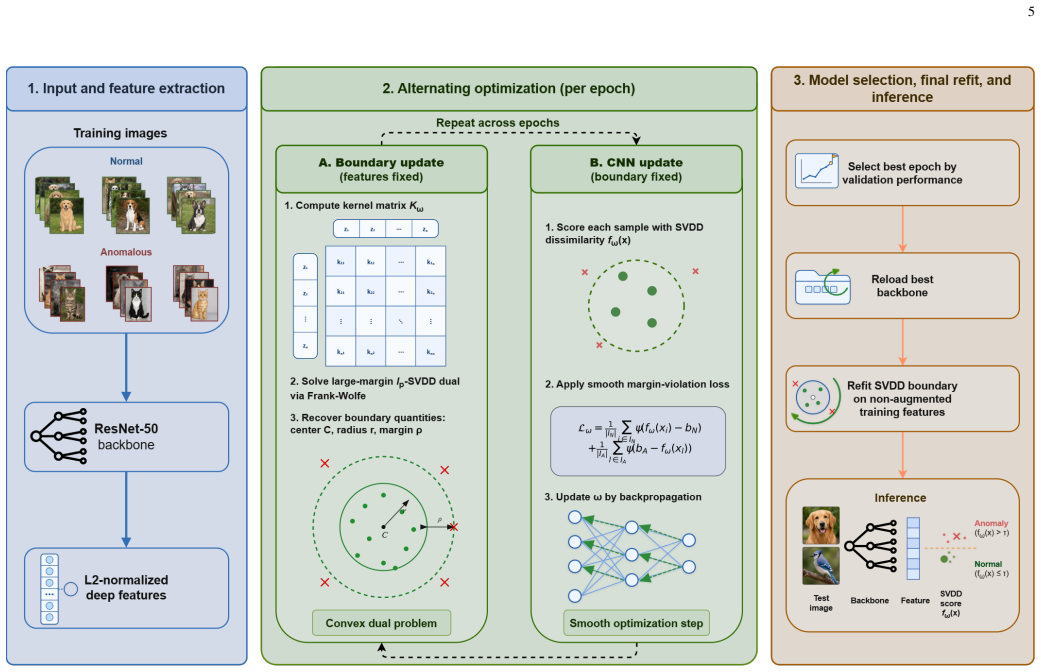
The alternating two-block optimization is the core mechanism: an α-step that solves the convex ℓ_p-SVDD dual via Frank-Wolfe with a closed-form linear subproblem, and a ω-step that backpropagates a smooth margin-violation loss through the CNN. The margin-violation gradient focuses updates on samples that cross the inner or outer boundary, and low-rank kernel backends (Nyström, random Fourier features, RPCholesky) make the kernel operations scalable.
What would settle it
Run the alternating scheme with the paper's fixed Adam learning rate and record squared parameter differences across epochs; if ||ω^(t+1) − ω^(t)|| does not tend to zero even as the loss decreases, then a premise of the stationarity proof is violated. A simpler check: if the CNN gradient norm plateaus above zero while the Frank-Wolfe gap goes to zero, the network block is not reaching the claimed stationarity.
Extended reading notes
Core claim
DLM-SVDD retains the exact large-margin ℓ_p-SVDD dual objective for the boundary while making the features trainable. At each epoch, features from the CNN define a kernel matrix, and a Frank-Wolfe solver recovers the optimal dual variables; then, with that boundary frozen, the CNN is updated to push normal samples inside the inner boundary and anomalous samples outside the outer boundary, using a softplus-regularized version of the slack penalties. The paper reports that this joint training lifts AUROC by up to about 0.117 over a frozen backbone and beats the fixed-feature baseline at all tested ratios, with the biggest gains under severe class imbalance.
Load-bearing premise
The convergence guarantee rests on the assumption that consecutive CNN parameter updates shrink to zero during training; the paper assumes this 'asymptotic regularity' rather than proving it, and Adam with a fixed learning rate makes it nontrivial.
Editorial extensions
If this is right
- If the claims hold, anomaly detectors can get both adaptive representations and explicit margin geometry without sacrificing either.
- Joint training gives the largest gains under severe class imbalance, suggesting representation adaptation matters most when the normal class is poorly represented.
- Kernel approximations such as Nyström and RPCholesky recover near-exact accuracy at a fraction of memory and time, making the approach practical on large datasets.
- The alternating recipe of boundary re-fitting followed by margin-aware feature updates is a template that could extend to other kernel-based one-class objectives.
Reading between the lines
- The paper's own ImageNet-LT results hint that joint training can hurt when positive samples are extremely scarce; a hybrid that freezes the backbone for very small classes might combine the best of both.
- Fixing the RBF bandwidth once from pretrained features avoids a feedback loop; a testable extension would be to adapt the bandwidth slowly or with a separate objective to get further gains.
- Because the CNN loss only has gradient support near the boundary (via the softplus sigmoid), the method may be naturally insensitive to noisy labels far from the boundary—an untested but plausible side effect.
- The convergence proof assumes successive CNN updates shrink to zero; in practice, using a decaying learning rate schedule would bring the algorithm in line with the theory.
Editorial analysis
A structured set of objections, weighed in public.
Referee Report
Summary. The paper proposes DLM-SVDD, a deep anomaly-detection framework that alternates between solving a large-margin ℓ_p-SVDD dual boundary (via Frank–Wolfe on current CNN features) and updating the CNN backbone with a smooth margin-violation loss. It reports experiments on standard one-vs-rest benchmarks, long-tailed CIFAR/ImageNet variants, and a systematic study of seven kernel approximation backends. The central claim is that joint representation–boundary learning consistently improves over the fixed-feature ℓ_p-SVDD baseline [9] and achieves the best average rank among compared methods.
Significance. If the central claim holds, the paper makes a useful contribution: it connects an explicit large-margin kernel boundary to deep representation learning in a single alternating scheme, and it provides a practical scalability analysis of kernel approximations within that scheme. Strengths include the public code link, the controlled kernel-approximation study (Fig. 3, Table IV), the use of the Skillings–Mack rank test, and the internal fixed-CNN ablation (Table V). However, the main empirical claim is currently undercut by an uncontrolled comparison against the [9] baseline and by missing variance reporting; the optimization claim is also weakened by an unproven regularity assumption.
major comments (5)
- [Tables I, II, and V] The headline claim 'consistently improves over the fixed-feature ℓ_p-SVDD baseline of [9]' is not a controlled comparison. Table I reports [9] at 0.958 AUROC on CIFAR-10 (ratio 10%), while the paper's own fixed-CNN DLM-SVDD variant, using the same ImageNet-pretrained ResNet-50 and training only the boundary, reaches 0.867 (Table V). Table II shows an even larger gap: 89.20 vs 59.50 balanced accuracy on CIFAR-10-LT (ϱ=100). Both rows are described as fixed-feature large-margin ℓ_p-SVDD. Unless [9] used a different feature extractor or protocol, these numbers are inconsistent. Rerun [9] with the same pretrained features, or restrict the claim to the within-method fixed-vs-joint improvement.
- [Section III-C2 and Section IV-B] Eq. (7) writes L_ω as a sum of ψ^p terms, but Section IV-B states that p=1 is used in the softplus for all experiments, and Eq. (8) gives the gradient as σ(v), not pψ^{p-1}σ(v). Thus the CNN step actually minimizes a p=1 softplus margin loss while the boundary solver uses p=2. This is a mismatch between the stated ℓ_p objective and the implemented loss. Please correct Eqs. (7)–(8), state the p=1 choice explicitly, and justify it; the current text describes the method as optimizing the ℓ_p primal for general p>1 in the CNN update.
- [Section III-F] The convergence statement (17) depends on 'assume asymptotic regularity, ||ω^{(t+1)}−ω^{(t)}||→0', which is neither proved nor implied by A1–A2 and the descent inequality (16). Adam with constant learning rate does not guarantee this, and the boundary re-estimation changes the objective each epoch. Please either prove this condition under explicit step-size/decay assumptions or present (17) clearly as a conditional statement. Figure 2 shows loss curves for two classes and does not verify the regularity condition.
- [Tables I and II] Results are reported as ten-seed means without standard deviations or confidence intervals. For example, the CIFAR-10 ratio-75 gap between DLM-SVDD (0.984) and Single kernel [9] (0.972) is 0.012 AUROC; without variance, the 'consistent improvement' and rank claims are hard to evaluate. Report per-cell standard deviations/confidence intervals and, where possible, pairwise significance tests. The Skillings–Mack omnibus p-value only establishes that some rank difference exists.
- [Section IV-B] The common configuration p=2, ν=1.2 is selected on the validation split and then used for all reported test results. This can bias the comparison if baselines were not tuned to the same extent. Please specify the validation-based selection rule, report sensitivity of final AUROC to p and ν at least at one ratio, and state the tuning budget for each compared method.
minor comments (4)
- [Figure 2] Please specify which CIFAR classes and seeds are shown and add variability across runs; otherwise 'representative behavior' is unverifiable.
- [Table IV caption] The caption says 'single seed per class', so the ±std is across the 10 classes, not across seeds. State this explicitly to avoid misinterpretation.
- [Section IV-D / Table II] ImageNet-LT results appear not to be averaged over ten seeds. Clarify the seed protocol and report variance for those rows.
- [Eq. (14)] For RFF, the standard construction includes a normalization factor and often a paired sine term to obtain unbiased kernel estimates. Clarify whether the displayed map is the one used in all spectral backends and whether any normalization/scaling is applied.
Circularity Check
No significant circularity: the boundary dual is a cited building block from the authors' prior work, but the central joint-learning claim is an empirical comparison, not a definitional reduction.
full rationale
The paper's derivation chain is not circular in the sense prohibited by the rubric. The boundary update (Eq. 2) is the dual of the large-margin ℓp-SVDD objective taken from the authors' prior work [9], and the Frank–Wolfe solver is applied to that published, peer-reviewed formulation. This is a normal reliance on a cited theorem, not a self-referential reduction. The CNN update (Eq. 7) is a softplus surrogate of the slack terms explicitly inherited from the primal objective (Eq. 1/6), so the representation loss is constructed from the boundary constraints rather than from the claimed result. The central claim that joint representation–boundary learning improves over a fixed backbone is tested in Table V, where both 'fixed CNN' and 'joint' variants share the same pretrained ResNet-50 and pipeline; the positive ΔAUROC is an empirical outcome, not an identity forced by a fitted constant or by definition. No parameter is fitted to a subset and then reported as a prediction of a closely related quantity. The convergence analysis (Section III-F) does contain an explicit unproven assumption—'assume asymptotic regularity, ||ω^{(t+1)}−ω^{(t)}||→0'—and omits a proof of that condition; however, this is a proof gap/weakness, not circularity. Likewise, the baseline comparison to [9] in Tables I–II may be confounded (e.g., 'DLM-SVDD (fixed CNN)' differs markedly from 'Single-kernel ℓp-SVDD [9]' in Table II), and [9]/[16] are self-citations, but these are experimental-validity concerns rather than circular reductions. Because no equation in the paper reduces to its own input by construction, the circularity score is low.
Assumptions & free parameters
free parameters (5)
- RBF bandwidth γ =
median of pairwise squared distances of pretrained features
- margin parameter ν =
1.2
- slack-norm exponent p =
p=2 for boundary; p=1 for softplus CNN loss
- learning rate η =
1e-4
- kernel approximation budget m =
varies 64–4096
assumptions (7)
- domain assumption The dual in Eq. (2) is the exact dual of the primal large-margin ℓp-SVDD problem in Eq. (1).
- domain assumption Assumptions A1 (bounded iterates) and A2 (Lipschitz smoothness of f_ω) hold during training.
- ad hoc to paper The alternating iterates satisfy asymptotic regularity ||ω^{(t+1)}−ω^{(t)}||→0.
- standard math Frank–Wolfe convergence for convex objectives with a linear subproblem solver.
- standard math RBF kernel is shift-invariant, positive definite, and satisfies k(z,z)=1.
- standard math Kernel approximation methods (Nyström, RFF, QMC-RFF, ORF/SORF, Fastfood, RPCholesky) provide valid low-rank or spectral approximations to the RBF kernel.
- domain assumption Softplus is an adequate smooth surrogate for the hinge loss in the CNN update.
Cite this review
Pith. "Pith review of Deep Convolutional Large-Margin $\ell_p$-SVDD for Visual Anomaly Detection." pith.science (2026). https://pith.science/paper/6GPYWKJH
@misc{pith2026260722212,
  author       = {Pith},
  title        = {Pith review of: Deep Convolutional Large-Margin $\ell_p$-SVDD for Visual Anomaly Detection},
  year         = {2026},
  howpublished = {\url{https://pith.science/paper/6GPYWKJH}},
  note         = {Machine review of arXiv:2607.22212}
}
abstract
Visual anomaly detection requires adaptive representations and reliable decision boundaries, particularly when anomalous training samples are scarce and class distributions are highly imbalanced. Classical kernel-based methods yield principled geometric decision regions but typically operate on fixed features, while deep detectors learn task-specific representations but often fail to provide an explicit margin-aware kernel boundary. In this study, we propose DLM-SVDD, a deep large-margin novelty-detection framework that jointly learns convolutional features and an explicit kernel-based decision boundary. By drawing on the large-margin $\ell_p$-Support Vector Data Description ($\ell_p$-SVDD) approach, the proposed method performs explicit margin maximization and nonlinear slack penalization while adapting the representation to the target task. To train the proposed model, we present an optimization scheme that alternates between a Frank--Wolfe--based update of the convex dual boundary and a CNN update step operating on a smooth margin-violation loss induced by the recovered boundary. To improve scalability, we analyze the efficiency--accuracy trade-offs for different kernel approximation strategies, deriving practical propositions for large-scale anomaly detection. Extensive experiments on multiple standard benchmarks show consistent performance improvements over the baseline and strong overall performance compared with state-of-the-art methods while illustrating that the proposed joint representation--boundary learning scheme remains effective under severe imbalanced class distributions.
Figures


Reference graph
Works this paper leans on
-
[9]
Large-margin multiple kernelℓ p-svdd using frank–wolfe algorithm for novelty detection,
S. Rahimzadeh Arashloo, “Large-margin multiple kernelℓ p-svdd using frank–wolfe algorithm for novelty detection,”Pattern Recognition, vol. 148, p. 110189, 2024
2024
-
[1]
Panda: Adapting pretrained features for anomaly detection and segmentation,
T. Reiss, N. Cohen, L. Bergman, and Y . Hoshen, “Panda: Adapting pretrained features for anomaly detection and segmentation,” inPro- ceedings of the IEEE/CVF Conference on Computer Vision and Pattern Recognition (CVPR), 2021, pp. 2806–2814
2021
-
[2]
Mean-shifted contrastive loss for anomaly de- tection,
T. Reiss and Y . Hoshen, “Mean-shifted contrastive loss for anomaly de- tection,” inProceedings of the AAAI Conference on Artificial Intelligence (AAAI), vol. 37, no. 2, 2023, pp. 2155–2162
2023
-
[3]
Robust one-class clas- sification using deep kernel spectral regression,
S. Mohammad and S. Rahimzadeh Arashloo, “Robust one-class clas- sification using deep kernel spectral regression,”Neurocomputing, vol. 573, p. 127246, 2024
2024
-
[4]
Support vector data description,
D. M. J. Tax and R. P. W. Duin, “Support vector data description,” Machine Learning, vol. 54, no. 1, pp. 45–66, 2004
2004
-
[5]
Deep one-class classification,
L. Ruff, R. A. Vandermeulen, N. G ¨ornitz, L. Deecke, S. A. Siddiqui, A. Binder, E. M ¨uller, and M. Kloft, “Deep one-class classification,” in Proceedings of the 35th International Conference on Machine Learning (ICML), ser. Proceedings of Machine Learning Research, vol. 80, 2018, pp. 4393–4402
2018
-
[6]
Deep semi-supervised anomaly detection,
L. Ruff, R. A. Vandermeulen, N. G ¨ornitz, A. Binder, E. M ¨uller, K.-R. M¨uller, and M. Kloft, “Deep semi-supervised anomaly detection,” in International Conference on Learning Representations (ICLR), 2020
2020
-
[7]
Dasvdd: Deep autoencoding support vector data descriptor for anomaly detection,
H. Hojjati and N. Armanfard, “Dasvdd: Deep autoencoding support vector data descriptor for anomaly detection,”IEEE Transactions on Knowledge and Data Engineering, 2023
2023
Show all 67 references
-
[8]
Deep multi-sphere support vector data description based on disentangled representation learning,
H.-J. Xing, H.-N. Wu, and P.-P. Zhang, “Deep multi-sphere support vector data description based on disentangled representation learning,” Pattern Recognition, vol. 156, p. 110842, 2024
2024
-
[10]
Using the nystr ¨om method to speed up kernel machines,
C. K. I. Williams and M. Seeger, “Using the nystr ¨om method to speed up kernel machines,” inAdvances in Neural Information Processing Systems 13, T. K. Leen, T. G. Dietterich, and V . Tresp, Eds. MIT Press, 2001, pp. 682–688
2001
-
[11]
Random features for large-scale kernel machines,
A. Rahimi and B. Recht, “Random features for large-scale kernel machines,” inAdvances in Neural Information Processing Systems, J. Platt, D. Koller, Y . Singer, and S. Roweis, Eds., vol. 20. Curran Associates, Inc., 2007
2007
-
[12]
Quasi-monte carlo feature maps for shift-invariant kernels,
J. Yang, V . Sindhwani, H. Avron, and M. Mahoney, “Quasi-monte carlo feature maps for shift-invariant kernels,” inProceedings of the 31st International Conference on Machine Learning, ser. Proceedings of Machine Learning Research, E. P. Xing and T. Jebara, Eds., vol. 32, no. 1...
2014
-
[13]
Orthogonal random features,
F. X. X. Yu, A. T. Suresh, K. M. Choromanski, D. N. Holtmann-Rice, and S. Kumar, “Orthogonal random features,” inAdvances in Neural Information Processing Systems, vol. 29, 2016
2016
-
[14]
Fastfood - computing hilbert space expansions in loglinear time,
Q. Le, T. Sarlos, and A. Smola, “Fastfood - computing hilbert space expansions in loglinear time,” inProceedings of the 30th International Conference on Machine Learning, ser. Proceedings of Machine Learning Research, S. Dasgupta and D. McAllester, Eds., vol. 28, no. 3. Atlant...
2013
-
[15]
Randomly pivoted cholesky: Practical approximation of a kernel matrix with few entry evaluations,
Y . Chen, E. N. Epperly, J. A. Tropp, and R. J. Webber, “Randomly pivoted cholesky: Practical approximation of a kernel matrix with few entry evaluations,”Communications on Pure and Applied Mathematics, vol. 78, no. 5, pp. 995–1041, 2025
2025
-
[16]
Deep large-margin lp-svdd with cnn feature learning for novelty detection,
A. D. Saei and S. Rahimzadeh Arashloo, “Deep large-margin lp-svdd with cnn feature learning for novelty detection,” inICASSP 2026 - 2026 IEEE International Conference on Acoustics, Speech and Signal Processing (ICASSP), 2026, pp. 2376–2380
2026
-
[17]
Learning multiple layers of features from tiny images,
A. Krizhevsky and G. Hinton, “Learning multiple layers of features from tiny images,” University of Toronto, Toronto, Ontario, Tech. Rep., 2009
2009
-
[18]
M2m: Imbalanced classification via major-to-minor translation,
J. Kim, J. Jeong, and J. Shin, “M2m: Imbalanced classification via major-to-minor translation,” inProceedings of the IEEE/CVF Confer- ence on Computer Vision and Pattern Recognition (CVPR), 2020, pp. 13 896–13 905
2020
-
[19]
Large- scale long-tailed recognition in an open world,
Z. Liu, Z. Miao, X. Zhan, J. Wang, B. Gong, and S. X. Yu, “Large- scale long-tailed recognition in an open world,” inProceedings of the IEEE/CVF Conference on Computer Vision and Pattern Recognition (CVPR), 2019, pp. 2537–2546
2019
-
[20]
ℓ p-norm support vector data description,
S. Rahimzadeh Arashloo, “ℓ p-norm support vector data description,” Pattern Recognition, vol. 132, p. 108930, 2022
2022
-
[21]
One-class classification usingℓ p-norm mul- tiple kernel fisher null approach,
S. Rahimzadeh Arashloo, “One-class classification usingℓ p-norm mul- tiple kernel fisher null approach,”IEEE Transactions on Image Process- ing, vol. 32, pp. 1843–1856, 2023
2023
-
[22]
Sta- bilizing adversarially learned one-class novelty detection using pseudo anomalies,
M. Z. Zaheer, J.-H. Lee, A. Mahmood, M. Astrid, and S.-I. Lee, “Sta- bilizing adversarially learned one-class novelty detection using pseudo anomalies,”IEEE Transactions on Image Processing, vol. 31, pp. 5963– 5975, 2022
2022
-
[23]
Target be- fore shooting: Accurate anomaly detection and localization under one millisecond via cascade patch retrieval,
H. Li, J. Hu, B. Li, H. Chen, Y . Zheng, and C. Shen, “Target be- fore shooting: Accurate anomaly detection and localization under one millisecond via cascade patch retrieval,”IEEE Transactions on Image Processing, vol. 33, pp. 5606–5621, 2024
2024
-
[24]
Drocc: Deep robust one-class classification,
S. Goyal, A. Raghunathan, P. Jain, H. V . Simhadri, and P. N. Jain, “Drocc: Deep robust one-class classification,” inProceedings of the 37th International Conference on Machine Learning (ICML), ser. Proceedings of Machine Learning Research, vol. 119, 2020, pp. 3711–3721
2020
-
[25]
Ocmst: One-class novelty detection using convolutional neural network and minimum spanning trees,
R. La Grassa, I. Gallo, and N. Landro, “Ocmst: One-class novelty detection using convolutional neural network and minimum spanning trees,”Pattern Recognition Letters, vol. 155, pp. 114–120, 2022
2022
-
[26]
Inter- pretable maximum margin deep anomaly detection,
Z. Yang, M. Huang, X. Li, X. Pan, Q. Wang, and J. Zhao, “Inter- pretable maximum margin deep anomaly detection,”arXiv preprint arXiv:2603.07073, 2026
2026
-
[27]
Csi: Novelty detection via contrastive learning on distributionally shifted instances,
J. Tack, S. Mo, J. Jeong, and J. Shin, “Csi: Novelty detection via contrastive learning on distributionally shifted instances,” inAdvances in Neural Information Processing Systems, vol. 33, 2020
2020
-
[28]
Deep anomaly de- tection with outlier exposure,
D. Hendrycks, M. Mazeika, and T. G. Dietterich, “Deep anomaly de- tection with outlier exposure,” inInternational Conference on Learning Representations (ICLR), 2019
2019
-
[29]
Universal novelty detection through adaptive contrastive learning,
H. Mirzaei, M. Nafez, M. Jafari, M. B. Soltani, M. Azizmalayeri, J. Habibi, M. Sabokrou, and M. H. Rohban, “Universal novelty detection through adaptive contrastive learning,” inProceedings of the IEEE/CVF 13 Conference on Computer Vision and Pattern Recognition (CVPR), 2024, ...
2024
-
[30]
Learning in-distribution representations for anomaly detection,
W. T. Lunardi, A. Banabila, D. Herzalla, and M. L. Andreoni, “Learning in-distribution representations for anomaly detection,” 2025
2025
-
[31]
Anomalyclip: Object- agnostic prompt learning for zero-shot anomaly detection,
Q. Zhou, G. Pang, Y . Tian, S. He, and J. Chen, “Anomalyclip: Object- agnostic prompt learning for zero-shot anomaly detection,” inInterna- tional Conference on Learning Representations (ICLR), 2024
2024
-
[32]
Aa-clip: Enhancing zero-shot anomaly detection via anomaly-aware clip,
W. Ma, X. Zhang, Q. Yao, F. Tang, C. Wu, Y . Li, R. Yan, Z. Jiang, and S. K. Zhou, “Aa-clip: Enhancing zero-shot anomaly detection via anomaly-aware clip,” inProceedings of the IEEE/CVF Conference on Computer Vision and Pattern Recognition (CVPR), 2025, pp. 4744– 4754
2025
-
[33]
Fever-ood: Free energy vulnerability elimination for robust out-of-distribution detection,
B. K. S. Isaac-Medina, M. Che, Y . F. A. Gaus, S. Akcay, and T. P. Breckon, “Fever-ood: Free energy vulnerability elimination for robust out-of-distribution detection,” inProceedings of the IEEE/CVF Interna- tional Conference on Computer Vision (ICCV), 2025, pp. 4529–4538
2025
-
[34]
Dual energy-based model with open-world un- certainty estimation for out-of-distribution detection,
Q. Chen and H. Ding, “Dual energy-based model with open-world un- certainty estimation for out-of-distribution detection,” inProceedings of the IEEE/CVF Conference on Computer Vision and Pattern Recognition (CVPR), 2025, pp. 25 728–25 737
2025
-
[35]
Oodd: Test-time out-of-distribution detection with dynamic dictionary,
Y . Yang, L. Zhu, Z. Sun, H. Liu, Q. Gu, and N. Ye, “Oodd: Test-time out-of-distribution detection with dynamic dictionary,” inProceedings of the IEEE/CVF Conference on Computer Vision and Pattern Recognition (CVPR), 2025, pp. 30 630–30 639
2025
-
[36]
Model-free test time adaptation for out-of-distribution detection,
Y .-F. Zhang, X. Wang, T. Zhou, K. Yuan, Z. Zhang, L. Wang, and R. Jin, “Model-free test time adaptation for out-of-distribution detection,”IEEE Transactions on Pattern Analysis and Machine Intelligence, vol. 48, no. 2, pp. 1542–1553, 2026
2026
-
[37]
Decoupling representation and classifier for long-tailed recognition,
B. Kang, S. Xie, M. Rohrbach, Z. Yan, A. Gordo, J. Feng, and Y . Kalantidis, “Decoupling representation and classifier for long-tailed recognition,” inInternational Conference on Learning Representations (ICLR), 2020
2020
-
[38]
Improving calibration for long-tailed recognition,
Z. Zhong, J. Cui, S. Liu, and J. Jia, “Improving calibration for long-tailed recognition,” inProceedings of the IEEE/CVF Conference on Computer Vision and Pattern Recognition (CVPR), 2021, pp. 16 489–16 498
2021
-
[39]
Reslt: Residual learning for long-tailed recognition,
J. Cui, S. Liu, Z. Tian, Z. Zhong, and J. Jia, “Reslt: Residual learning for long-tailed recognition,”IEEE Transactions on Pattern Analysis and Machine Intelligence, vol. 45, no. 3, pp. 3695–3706, 2023
2023
-
[40]
Supervised exploratory learning for long-tailed visual recognition,
Z. Jian, Y . Chen, Y . Wang, J. Yao, M. Wang, and Q. Wu, “Supervised exploratory learning for long-tailed visual recognition,” inProceedings of the IEEE/CVF International Conference on Computer Vision (ICCV), 2025, pp. 1870–1880
2025
-
[41]
Bce3s: Binary cross-entropy based tripartite synergistic learning for long-tailed recognition,
W. Fan, Q. Li, J. Wen, and X. Peng, “Bce3s: Binary cross-entropy based tripartite synergistic learning for long-tailed recognition,” inProceedings of the AAAI Conference on Artificial Intelligence, 2026
2026
-
[42]
Out-of-distribution de- tection in long-tailed recognition with calibrated outlier class learning,
W. Miao, G. Pang, X. Bai, T. Li, and J. Zheng, “Out-of-distribution de- tection in long-tailed recognition with calibrated outlier class learning,” inProceedings of the AAAI Conference on Artificial Intelligence (AAAI), vol. 38, no. 5, 2024, pp. 4216–4224
2024
-
[43]
Eat: Towards long-tailed out- of-distribution detection,
T. Wei, B.-L. Wang, and M.-L. Zhang, “Eat: Towards long-tailed out- of-distribution detection,” inProceedings of the AAAI Conference on Artificial Intelligence (AAAI), vol. 38, no. 14, 2024, pp. 15 787–15 795
2024
-
[44]
Rethinking out-of-distribution detection on imbalanced data distribution,
K. Liu, Z. Fu, S. Jin, C. Chen, Z. Chen, R. Jiang, F. Zhou, Y . Chen, and J. Ye, “Rethinking out-of-distribution detection on imbalanced data distribution,” inAdvances in Neural Information Processing Systems, vol. 37, 2024
2024
-
[45]
Long-tailed out-of-distribution detection via normalized outlier distribution adaptation,
W. Miao, G. Pang, J. Zheng, and X. Bai, “Long-tailed out-of-distribution detection via normalized outlier distribution adaptation,” inAdvances in Neural Information Processing Systems, vol. 37, 2024
2024
-
[46]
Revisiting Frank-Wolfe: Projection-free sparse convex op- timization,
M. Jaggi, “Revisiting Frank-Wolfe: Projection-free sparse convex op- timization,” inProceedings of the 30th International Conference on Machine Learning, 2013, pp. 427–435
2013
-
[47]
Nesterov,Lectures on Convex Optimization, 2nd ed
Y . Nesterov,Lectures on Convex Optimization, 2nd ed. Springer, 2018
2018
-
[48]
Fashion-mnist: a novel image dataset for benchmarking machine learning algorithms,
H. Xiao, K. Rasul, and R. V ollgraf, “Fashion-mnist: a novel image dataset for benchmarking machine learning algorithms,”arXiv preprint arXiv:1708.07747, 2017
2017 arXiv
-
[49]
On the use of a friedman-type statistic in balanced and unbalanced block designs,
J. H. Skillings and G. A. Mack, “On the use of a friedman-type statistic in balanced and unbalanced block designs,”Technometrics, vol. 23, no. 2, pp. 171–177, 1981
1981
-
[50]
Deep residual learning for image recognition,
K. He, X. Zhang, S. Ren, and J. Sun, “Deep residual learning for image recognition,” in2016 IEEE Conference on Computer Vision and Pattern Recognition (CVPR), 2016, pp. 770–778
2016
-
[51]
Emerging properties in self-supervised vision transformers,
M. Caron, H. Touvron, I. Misra, H. J ´egou, J. Mairal, P. Bojanowski, and A. Joulin, “Emerging properties in self-supervised vision transformers,” 2021
2021
-
[52]
Efficient anomaly detection using self-supervised multi-cue tasks,
L. J ´ez´equel, N.-S. Vu, J. Beaudet, and A. Histace, “Efficient anomaly detection using self-supervised multi-cue tasks,”IEEE Transactions on Image Processing, vol. 32, pp. 807–821, 2023
2023
-
[53]
Learning and evalu- ating representations for deep one-class classification,
K. Sohn, C.-L. Li, J. Yoon, M. Jin, and T. Pfister, “Learning and evalu- ating representations for deep one-class classification,” inInternational Conference on Learning Representations (ICLR), 2021
2021
-
[54]
Admm-srnet: Alternating direction method of multipliers based sparse representation network for one-class classification,
C.-Y . Chiou, K.-T. Lee, C.-R. Huang, and P.-C. Chung, “Admm-srnet: Alternating direction method of multipliers based sparse representation network for one-class classification,”IEEE Transactions on Image Processing, vol. 32, pp. 3447–3460, 2023
2023
-
[55]
Latent outlier exposure for anomaly detection with contaminated data,
C. Qiu, A. Li, M. Kloft, M. Rudolph, and S. Mandt, “Latent outlier exposure for anomaly detection with contaminated data,” inProceedings of the 39th International Conference on Machine Learning (ICML), ser. Proceedings of Machine Learning Research, vol. 162, 2022, pp. 18 153– 18 167
2022
-
[56]
Uni- laterally aggregated contrastive learning with hierarchical augmentation for anomaly detection,
G. Wang, Y . Wang, J. Qin, D. Zhang, X. Bao, and D. Huang, “Uni- laterally aggregated contrastive learning with hierarchical augmentation for anomaly detection,” inProceedings of the IEEE/CVF International Conference on Computer Vision (ICCV), 2023
2023
-
[57]
Rodeo: Robust outlier detection via exposing adaptive out-of- distribution samples,
H. Mirzaei, M. Jafari, H. R. Dehbashi, A. Ansari, S. Ghobadi, M. Hadi, A. S. Moakhar, M. Azizmalayeri, M. S. Baghshah, and M. H. Ro- hban, “Rodeo: Robust outlier detection via exposing adaptive out-of- distribution samples,”arXiv preprint arXiv:2501.16971, 2025
2025 arXiv
-
[58]
An evidence-based post-hoc adjustment framework for anomaly detection under data contamination,
S. Patra and S. Ben Taieb, “An evidence-based post-hoc adjustment framework for anomaly detection under data contamination,”arXiv preprint arXiv:2510.21296, 2025
2025
-
[59]
Self supervision to distillation for long- tailed visual recognition,
T. Li, L. Wang, and G. Wu, “Self supervision to distillation for long- tailed visual recognition,” inProceedings of the IEEE/CVF International Conference on Computer Vision (ICCV), 2021, pp. 630–639
2021
-
[60]
Weight balancing for long- tailed image classification,
B. Zhao, C. Li, Y . Li, J. Wang, and Y . Fu, “Weight balancing for long- tailed image classification,” inProceedings of the IEEE/CVF Conference on Computer Vision and Pattern Recognition (CVPR), 2023, pp. 6897– 6907
2023
-
[61]
Learning from multiple experts: Self- paced knowledge distillation for long-tailed classification,
L. Xiang, G. Ding, and J. Han, “Learning from multiple experts: Self- paced knowledge distillation for long-tailed classification,” inProceed- ings of the European Conference on Computer Vision (ECCV), 2020, pp. 247–263
2020
-
[62]
Parametric contrastive learning,
J. Cui, Z. Zhong, S. Liu, B. Yu, and J. Jia, “Parametric contrastive learning,” inProceedings of the IEEE/CVF International Conference on Computer Vision (ICCV), 2021, pp. 715–724
2021
-
[63]
Balanced contrastive learning for long-tailed visual recognition,
J.-X. Zhu, T. Wang, Z. Chen, J.-J. Liu, M.-M. Ye, and X.-S. Cheng, “Balanced contrastive learning for long-tailed visual recognition,” in Proceedings of the IEEE/CVF Conference on Computer Vision and Pattern Recognition (CVPR), 2022, pp. 6908–6917
2022
-
[64]
Diffult: Diffusion for long- tail recognition without external knowledge,
J. Shao, K. Zhu, H. Zhang, and J. Wu, “Diffult: Diffusion for long- tail recognition without external knowledge,” inAdvances in Neural Information Processing Systems, 2024
2024
-
[65]
Ltrl: Boosting long-tail recognition via reflective learning,
Q. Zhao, Y . Dai, S. Lin, W. Hu, F. Zhang, and J. Liu, “Ltrl: Boosting long-tail recognition via reflective learning,” inProceedings of the European Conference on Computer Vision, 2024
2024
-
[66]
Focal-sam: Focal sharpness-aware minimization for long-tailed classi- fication,
S. Li, Q. Xu, Z. Yang, Z. Wang, L. Zhang, X. Cao, and Q. Huang, “Focal-sam: Focal sharpness-aware minimization for long-tailed classi- fication,” inProceedings of the International Conference on Machine Learning, 2025
2025
-
[67]
Long-tailed classification with multi-granularity seman- tics,
Y . Liuet al., “Long-tailed classification with multi-granularity seman- tics,” inProceedings of the IEEE/CVF International Conference on Computer Vision, 2025
2025
Reviewed August 1, 2026 · model on record in the stance chip above.
Discussion (0). Continue with ORCID to comment.