REVIEW 4 major objections 4 minor 76 references
Visual Prompting for One-shot Controllable Video Editing without Inversion
T0 review · 4 major / 4 minor · reviewed 2026-08-16 · deepseek-v4-flash
Pith's one-line read One-shot controllable video editing can be done without DDIM inversion by treating the task as visual prompting with an image inpainting diffusion model, using two new consistency sampling schemes (CCS and TCS) to preserve content and…
desk verdict Visual prompting for inversion-free video editing: genuinely novel framing and strong reported numbers, but the key edit-direction injection is asserted, not derived, and no code, data, or error bars are out. read the letter →
The pith
A machine-rendered reading of the paper's core claim, the machinery that carries it, and where it could break.
The reading
What carries the argument
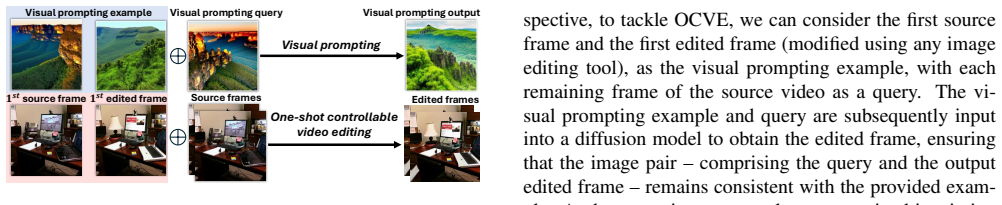
The argument rides on three mechanisms built on top of a pre-trained image inpainting diffusion model. First, the visual-prompting input layout: at frame $i$, the model receives a $2\times2$ grid whose top half holds the first source frame $I_s^{(1)}$ and first edited frame $I_e^{(1)}$, bottom left holds the query frame $I_s^{(i)}$, and bottom right is a blank region to be inpainted, with a mask $M$ that blanks only that region; the edit is also encoded as a pseudo-text prompt $p = \lambda_1 (E_{\mathrm{CLIP}}(I_e^{(1)}) - E_{\mathrm{CLIP}}(I_s^{(1)}))$ in CLIP space. Second, Content Consistency Sampling (CCS): the sampling update removes the adjustment term (sets $\sigma_t = \sqrt{1-\alpha_{t-1}}$), treats the predicted clean latent $\hat{z}_0^{(t)}$ as the output at each step, and replaces the network's noise prediction in that predicted term with a consistency noise $\epsilon_c(t; z_0^s)$ tied to the source-frame latent, so the first step regenerates the source frame; steering then comes from adding $\lambda_2 \Delta\epsilon_t$ with $\Delta\epsilon_t = \epsilon_\theta(z_t(I_e),t) - \epsilon_\theta(z_t(I_s),t)$, the per-step denoising difference between the edited and source regions, which the paper treats as the user's editing direction. Third, Temporal-content Consistency Sampling (TCS): treating the $N$ source-frame latents as samples from a distribution, an SVGD update with an RBF kernel moves the CCS-generated edited latents toward that distribution, applying a repulsive force to avoid mode collapse and enforcing temporal consistency.
What would settle it
Hold the initial latent and all hyperparameters fixed, then sweep $\lambda_2$ in Eq. (7) over a range including 0: if the CLIP edit-fidelity of the output does not rise monotonically with $\lambda_2$, the noise-difference term is not what is steering the edit. A complementary test is to replace $\Delta\epsilon_t$ with zero-mean Gaussian noise of matched variance: if the edited region still tracks the user's edit, the steering mechanism is not load-bearing; if it collapses to the unedited source, the heuristic is doing the claimed work.
Extended reading notes
Core claim
The central claim is that one-shot controllable video editing does not need DDIM inversion at all. The paper recasts editing as a visual prompting problem: the pair (first source frame, first edited frame) is an example of the desired change, each later source frame is a query, and a pre-trained image inpainting diffusion model completes a masked blank in a $2\times2$ grid to produce the edited frame for that query. To keep the generated frames anchored to the source, the paper modifies the inpainter's sampling into a multi-step consistency sampling (CCS) that starts from the source-frame latent and is steered along the edit direction by the difference $\Delta\epsilon_t$ between the model's noise predictions on the edited and source subregions. To keep edited frames smooth across time, a second stage (TCS) applies Stein Variational Gradient Descent to pull the CCS outputs toward the distribution of source-frame latents. The paper reports that this pipeline beats state-of-the-art OCVE methods on edit fidelity, source faithfulness, and temporal-consistency metrics on the MagicBrush-derived benchmark, while cutting per-video processing time to about 19 seconds versus 32–149 seconds for the main baselines.
Load-bearing premise
The load-bearing premise is that adding the per-step difference between the inpainting model's noise predictions on the edited region and the source region, scaled by $\lambda_2$, actually steers the multi-step consistency sampling along the user's intended edit; the paper asserts this heuristic in Sec. 4.2 without derivation.
Editorial extensions
If this is right
- DDIM inversion error no longer limits reconstruction, so the source frame is fed in directly as encoded features rather than as inverted noise.
- A single image diffusion model replaces video diffusion models, cutting per-video cost to about 19 seconds on an A100 compared with 32 and 149 seconds for the two prior OCVE baselines.
- Any off-the-shelf image editor can produce the first-frame edit; the only extra signal needed is the CLIP-space difference between the edited and original first frames.
- CCS and TCS are training-free modifications of the sampling process, so the method inherits the base inpainting model's capabilities without additional optimization.
- The ablations show the two consistency mechanisms are complementary: dropping CCS hurts source faithfulness, while dropping TCS hurts temporal-consistency metrics.
Reading between the lines
- Because the edit direction is read from the per-step denoising difference, the approach is likely best suited to local appearance edits (object swap, color, texture, removal) and may need a stronger prior for edits that change global geometry, a scope the paper does not explore.
- The CLIP-space pseudo-prompt suggests a testable extension: replacing it with a text prompt describing the edit, or with a learned edit-direction vector, would show how much of the method's fidelity comes from CLIP semantics versus the sampling machinery.
- The same visual-prompting arrangement could in principle be applied to any consistency-model-based image diffusion backbone, not just the inpainting model used here, since CCS only modifies the sampling equations.
Signed reviews
Editorial analysis
A structured set of objections, weighed in public.
Referee Report
Summary. The paper addresses one-shot controllable video editing (OCVE): given a video and a user-edited first frame, propagate the edit to all later frames. The authors propose to avoid DDIM inversion by recasting OCVE as a visual-prompting problem. They arrange the first source frame, the first edited frame, and the current source frame as a 2x2 grid, input this grid to a Stable Diffusion inpainting model, and let the model inpaint the lower-right region. To preserve content consistency they introduce Content Consistency Sampling (CCS), a modified multi-step sampling procedure that starts from the source frame and is guided by the difference between noise predictions on the edited and source regions. To preserve temporal consistency they add Temporal-content Consistency Sampling (TCS), an SVGD-based update of the edited latents. The paper reports quantitative comparisons against seven baselines, showing gains on edit fidelity, source faithfulness, temporal consistency, and speed, plus qualitative examples.
Significance. If the central mechanism is correct, this is a practically attractive contribution: it removes DDIM inversion, uses only a single image inpainting diffusion model, and is substantially faster than video-diffusion-based OCVE methods. The visual-prompting formulation is novel and the paper includes extensive quantitative comparisons and ablations (Ours w/o CCS, Ours w/o TCS). The reported efficiency gain (19 s versus 32 s for Videoshop and 149 s for AnyV2V) is a clear strength. The main downside is that the load-bearing edit-direction injection in CCS is heuristic and lacks a derivation or a control experiment, and the TCS step is under-specified. The paper also does not provide code, variance estimates, or the promised supplementary algorithm and human evaluation. For these reasons I cannot recommend acceptance until the mechanism is supported more rigorously.
major comments (4)
- [Sec. 4.2, Eq. (7)] The claim that Δε_t = ε_θ(z_t(I_e), t) − ε_θ(z_t(I_s), t) 'actually reflects the user's intended editing direction' is asserted without derivation. This is load-bearing: the final edited frame is produced by CCS with this term added to the consistency noise, so if Δε_t does not carry edit semantics, the method reduces to source-frame reconstruction plus a perturbation. Please provide a derivation or, at minimum, control experiments: replace Δε_t with a random Gaussian vector of matched norm, or with the noise-prediction difference from an unrelated edit pair, and show that edit fidelity (CLIP_tgt, TIFA) degrades. Also report a sweep over λ2 to demonstrate that edit fidelity increases monotonically only for the correct Δε_t.
- [Sec. 4.2, Eqs. (5)-(7)] The consistency-model analogy is not formally established. The function f̂(·, t, ε_c) in Eq. (5) is the standard predicted-z0 term; no consistency model is trained, and the self-consistency property f(z_t, t) = f(z_{t'}, t') for a trajectory is never shown. Moreover, Eq. (7) deliberately modifies ε_c by adding λ2·Δε_t, so the calibrated consistency noise is no longer the noise that maps the source latent to the source frame. This does not invalidate the method, but the paper should state precisely what property of multi-step consistency sampling is being used and what is preserved when Δε_t is nonzero. A small experiment showing that the multi-step trajectory actually maintains content consistency better than standard DDIM sampling would help substantiate the analogy.
- [Sec. 4.3, Eq. (8)] The TCS update is under-specified and the notation is confusing: in Eq. (8), ẑ_ℓ^{(0)}(i) denotes the edited latent, z^{(j)} denotes a source-frame latent, and the gradient contains K(ẑ_ℓ^{(0)}(j), z)(ẑ_ℓ^{(0)}(j) − z^{(j)}). This appears to pull each edited latent toward a kernel-weighted combination of source latents. The paper does not explain why matching the distribution of edited latents to the distribution of source latents preserves temporal consistency, since temporal consistency is a property of the temporal ordering, not merely of the per-frame marginal distribution. Please define the target distribution explicitly, justify the choice, and report the sensitivity to η and L. At present the reader cannot reproduce TCS from the main text, and the full algorithm is deferred to a supplementary that is not included in the submission.
- [Table 1 and Sec. 5.2] The headline claim that the method achieves the best performance rests on single aggregate numbers without variance bars, confidence intervals, or significance tests. Since several differences between 'Ours' and the closest baselines are small (e.g., CLIP_src 93.2 vs 91.3 for AnyV2V, SSIM 69.2 vs 65.5), it is important to show whether these gaps are stable across the 10,388-video dataset. Please report standard errors or perform a paired significance test over a sample of the dataset, and state how many videos were evaluated for each metric. Also clarify why 'Ours w/o TCS' has a substantially higher Flow score (33.1) than 'Ours' (21.9) but similar SSIM, and what role TCS plays in the FVD/SSIM trade-off.
minor comments (4)
- [Sec. 4.1, Eq. (3)] The text prompt p is defined as a CLIP image-embedding difference, and the paper states it can be used directly as a text prompt because both use CLIP encoders. Please specify the dimension match and whether the image encoder and text encoder of SD Inpainting 1.5 are the same CLIP model; otherwise the off-distribution input could affect the prompt injection.
- [Sec. 5.4] The phrase 'We evaluates two variants' contains a grammar error; also the ablation comparison could be strengthened by reporting a version where CCS is replaced by standard DDIM sampling with the same number of steps, rather than only 'w/o CCS'.
- [Sec. 4.2 and Fig. 2] The notation z_t(I_e) and z_t(I_s) is introduced without defining how these sub-latents are extracted from the full 2x2 grid latent. Please clarify the spatial masking and sampling region, and state whether CCS operates on the entire lower-right region or on the full grid.
- [References] Several references are self-citations by the authors (e.g., [16], [23], [24]); they are peripheral, but please double-check that all cited prior work is properly contextualized and that no required related work is missing (e.g., video editing methods that also avoid DDIM inversion).
Circularity Check
No significant circularity: the central OCVE pipeline is evaluated against external baselines and the edit-direction term is a heuristic sampling modification, not a fitted parameter renamed as a prediction.
full rationale
The paper's central claim is that one-shot controllable video editing can be performed without DDIM inversion by recasting it as visual prompting with an inpainting diffusion model, with CCS and TCS introduced to maintain content and temporal consistency. The derivation chain is not circular: edited frames are produced by a pre-trained Stable Diffusion Inpainting model from a 2x2 visual-prompt input, and reported scores are comparisons against external baselines (Videoshop, AnyV2V, and text-based editors) on the MagicBrush-derived benchmark. No fitted parameter is renamed as a prediction; lambda1, lambda2, and eta are manual hyperparameters of the sampling procedures, and the ablations ('Ours w/o CCS', 'Ours w/o TCS') empirically test the contributions of the sampling modifications rather than assuming them. The Delta_epsilon_t term in Eq. (7) is a heuristic edit-direction signal computed from the inpainting model's own denoising predictions; its semantic validity is not theoretically proven, but it is not equivalent to the target output by construction, and the method is evaluated on the resulting generated frames. Self-citations (e.g., refs [16], [23], [24]) appear only in the related-work survey and are not load-bearing; no uniqueness theorem or prior result by the same authors is invoked to force the method. Therefore no circular step of the enumerated kinds is present.
Assumptions & free parameters
free parameters (5)
- lambda1 =
0.7
- lambda2 =
1.2
- eta =
2.0
- CCS timesteps =
30
- TCS timesteps =
50
assumptions (4)
- domain assumption A pre-trained inpainting diffusion model can perform visual in-context learning from a 2x2 grid without any fine-tuning.
- ad hoc to paper The difference in noise predictions between the edited region and the source region, Delta_epsilon_t, captures the user's editing direction.
- domain assumption SVGD can align the distribution of edited latent frames to the distribution of source latent frames in the high-dimensional latent space.
- standard math Standard DDIM/DDPM sampling equations and CLIP embeddings are reliable building blocks.
Cite this review
Pith. "Pith review of Visual Prompting for One-shot Controllable Video Editing without Inversion." pith.science (2026). https://pith.science/paper/6HJKXVW2
@misc{pith2026250414335,
  author       = {Pith},
  title        = {Pith review of: Visual Prompting for One-shot Controllable Video Editing without Inversion},
  year         = {2026},
  howpublished = {\url{https://pith.science/paper/6HJKXVW2}},
  note         = {Machine review of arXiv:2504.14335}
}
read the original abstract
One-shot controllable video editing (OCVE) is an important yet challenging task, aiming to propagate user edits that are made -- using any image editing tool -- on the first frame of a video to all subsequent frames, while ensuring content consistency between edited frames and source frames. To achieve this, prior methods employ DDIM inversion to transform source frames into latent noise, which is then fed into a pre-trained diffusion model, conditioned on the user-edited first frame, to generate the edited video. However, the DDIM inversion process accumulates errors, which hinder the latent noise from accurately reconstructing the source frames, ultimately compromising content consistency in the generated edited frames. To overcome it, our method eliminates the need for DDIM inversion by performing OCVE through a novel perspective based on visual prompting. Furthermore, inspired by consistency models that can perform multi-step consistency sampling to generate a sequence of content-consistent images, we propose a content consistency sampling (CCS) to ensure content consistency between the generated edited frames and the source frames. Moreover, we introduce a temporal-content consistency sampling (TCS) based on Stein Variational Gradient Descent to ensure temporal consistency across the edited frames. Extensive experiments validate the effectiveness of our approach.
Figures


Figures from the paper (1 more)

Reference graph
Works this paper leans on
-
[16]
Avatar concept slider: Controllable editing of concepts in 3d human avatars, 2025
Lin Geng Foo, Yixuan He, Ajmal Saeed Mian, Hossein Rah- mani, Jun Liu, and Christian Theobalt. Avatar concept slider: Controllable editing of concepts in 3d human avatars, 2025. 3
work page 2025
-
[23]
Mo- tionlab: Unified human motion generation and editing via the motion-condition-motion paradigm
Ziyan Guo, Zeyu Hu, Na Zhao, and De Wen Soh. Mo- tionlab: Unified human motion generation and editing via the motion-condition-motion paradigm. arXiv preprint arXiv:2502.02358, 2025
arXiv 2025
-
[24]
Tstmotion: Training- free scene-aware text-to-motion generation
Ziyan Guo, Haoxuan Qu, Hossein Rahmani, Dewen Soh, Ping Hu, Qiuhong Ke, and Jun Liu. Tstmotion: Training- free scene-aware text-to-motion generation. In 2025 IEEE International Conference on Multimedia and Expo (ICME) , pages 1–6. IEEE, 2025
work page 2025
-
[1]
Stability AI. Stable diffusion inpainting. https : / / github.com/Stability- AI/stablediffusion ,
-
[2]
Frozen in time: A joint video and image encoder for end-to-end retrieval
Max Bain, Arsha Nagrani, G ¨ul Varol, and Andrew Zisser- man. Frozen in time: A joint video and image encoder for end-to-end retrieval. In Proceedings of the IEEE/CVF inter- national conference on computer vision , pages 1728–1738,
-
[3]
Visual prompting via image inpaint- ing
Amir Bar, Yossi Gandelsman, Trevor Darrell, Amir Glober- son, and Alexei Efros. Visual prompting via image inpaint- ing. Advances in Neural Information Processing Systems , 35:25005–25017, 2022. 2
work page 2022
-
[4]
Text2live: Text-driven layered image and video editing
Omer Bar-Tal, Dolev Ofri-Amar, Rafail Fridman, Yoni Kas- ten, and Tali Dekel. Text2live: Text-driven layered image and video editing. In European conference on computer vi- sion, pages 707–723. Springer, 2022. 2
2022
-
[5]
Stable video diffusion: Scaling latent video diffusion models to large datasets
Andreas Blattmann, Tim Dockhorn, Sumith Kulal, Daniel Mendelevitch, Maciej Kilian, Dominik Lorenz, Yam Levi, Zion English, Vikram V oleti, Adam Letts, et al. Stable video diffusion: Scaling latent video diffusion models to large datasets. arXiv preprint arXiv:2311.15127, 2023. 2, 8
arXiv 2023
Show all 76 references
-
[6]
Bayesian inference in statistical analysis
George EP Box and George C Tiao. Bayesian inference in statistical analysis. John Wiley & Sons, 2011. 7
2011
-
[7]
Pix2video: Video editing using image diffusion
Duygu Ceylan, Chun-Hao P Huang, and Niloy J Mitra. Pix2video: Video editing using image diffusion. In Proceed- ings of the IEEE/CVF International Conference on Com- puter Vision, pages 23206–23217, 2023. 1, 2, 7, 8
2023
-
[8]
Stable- video: Text-driven consistency-aware diffusion video edit- ing
Wenhao Chai, Xun Guo, Gaoang Wang, and Yan Lu. Stable- video: Text-driven consistency-aware diffusion video edit- ing. In Proceedings of the IEEE/CVF International Confer- ence on Computer Vision, pages 23040–23050, 2023. 2, 3
2023
-
[9]
Flatten: optical flow- guided attention for consistent text-to-video editing
Yuren Cong, Mengmeng Xu, Christian Simon, Shoufa Chen, Jiawei Ren, Yanping Xie, Juan-Manuel Perez-Rua, Bodo Rosenhahn, Tao Xiang, and Sen He. Flatten: optical flow- guided attention for consistent text-to-video editing. arXiv preprint arXiv:2310.05922, 2023. 2
-
[10]
Videdit: Zero-shot and spatially aware text-driven video editing
Paul Couairon, Cl ´ement Rambour, Jean-Emmanuel Haugeard, and Nicolas Thome. Videdit: Zero-shot and spatially aware text-driven video editing. Transactions on Machine Learning Research, 2023. 2
2023
-
[11]
Dragvideo: Interactive drag-style video editing
Yufan Deng, Ruida Wang, Yuhao Zhang, Yu-Wing Tai, and Chi-Keung Tang. Dragvideo: Interactive drag-style video editing. arXiv preprint arXiv:2312.02216, 2023. 2
2023 arXiv
-
[12]
Videoshop: Localized semantic video editing with noise-extrapolated diffusion inversion
Xiang Fan, Anand Bhattad, and Ranjay Krishna. Videoshop: Localized semantic video editing with noise-extrapolated diffusion inversion. In European conference on computer vision. Springer, 2024. 1, 2, 3, 4, 7, 8
2024
-
[13]
Distribution-aligned diffusion for human mesh recovery
Lin Geng Foo, Jia Gong, Hossein Rahmani, and Jun Liu. Distribution-aligned diffusion for human mesh recovery. In Proceedings of the IEEE/CVF International Conference on Computer Vision, pages 9221–9232, 2023. 3
2023
-
[14]
Ai-generated content (aigc) for various data modalities: A survey
Lin Geng Foo, Hossein Rahmani, and Jun Liu. Ai-generated content (aigc) for various data modalities: A survey. arXiv preprint arXiv:2308.14177, 2023. 3
2023 arXiv
-
[15]
Action detection via an image diffusion process
Lin Geng Foo, Tianjiao Li, Hossein Rahmani, and Jun Liu. Action detection via an image diffusion process. InProceed- ings of the IEEE/CVF Conference on Computer Vision and Pattern Recognition, pages 18351–18361, 2024. 3
2024
-
[17]
Escap- ing from saddle points—online stochastic gradient for ten- sor decomposition
Rong Ge, Furong Huang, Chi Jin, and Yang Yuan. Escap- ing from saddle points—online stochastic gradient for ten- sor decomposition. In Conference on learning theory, pages 797–842. PMLR, 2015. 7
2015
-
[18]
Tokenflow: Consistent diffusion features for consistent video editing
Michal Geyer, Omer Bar-Tal, Shai Bagon, and Tali Dekel. Tokenflow: Consistent diffusion features for consistent video editing. arXiv preprint arXiv:2307.10373, 2023. 2
2023 arXiv
-
[19]
Diffpose: Toward more reliable 3d pose estimation
Jia Gong, Lin Geng Foo, Zhipeng Fan, Qiuhong Ke, Hos- sein Rahmani, and Jun Liu. Diffpose: Toward more reliable 3d pose estimation. In Proceedings of the IEEE/CVF Con- ference on Computer Vision and Pattern Recognition, pages 13041–13051, 2023. 3
2023
-
[20]
Videoswap: Customized video subject swapping with interactive semantic point cor- respondence
Yuchao Gu, Yipin Zhou, Bichen Wu, Licheng Yu, Jia-Wei Liu, Rui Zhao, Jay Zhangjie Wu, David Junhao Zhang, Mike Zheng Shou, and Kevin Tang. Videoswap: Customized video subject swapping with interactive semantic point cor- respondence. In Proceedings of the IEEE/CVF Conference o...
2024
-
[21]
Analogist: Out-of-the-box visual in-context learning with image diffusion model
Zheng Gu, Shiyuan Yang, Jing Liao, Jing Huo, and Yang Gao. Analogist: Out-of-the-box visual in-context learning with image diffusion model. arXiv preprint arxiv:2405.10316, 2024. 3, 4, 7
2024 arXiv
-
[22]
Animatediff: Animate your personalized text- to-image diffusion models without specific tuning
Yuwei Guo, Ceyuan Yang, Anyi Rao, Zhengyang Liang, Yaohui Wang, Yu Qiao, Maneesh Agrawala, Dahua Lin, and Bo Dai. Animatediff: Animate your personalized text- to-image diffusion models without specific tuning. arXiv preprint arXiv:2307.04725, 2023
2023 arXiv
-
[25]
Prompt-to-prompt im- age editing with cross attention control
Amir Hertz, Ron Mokady, Jay Tenenbaum, Kfir Aberman, Yael Pritch, and Daniel Cohen-Or. Prompt-to-prompt im- age editing with cross attention control. arXiv preprint arXiv:2208.01626, 2022. 3
2022 arXiv
-
[26]
Denoising dif- fusion probabilistic models
Jonathan Ho, Ajay Jain, and Pieter Abbeel. Denoising dif- fusion probabilistic models. Advances in neural information processing systems, 33:6840–6851, 2020. 3, 5
2020
-
[27]
Tifa: Accu- rate and interpretable text-to-image faithfulness evaluation with question answering
Yushi Hu, Benlin Liu, Jungo Kasai, Yizhong Wang, Mari Ostendorf, Ranjay Krishna, and Noah A Smith. Tifa: Accu- rate and interpretable text-to-image faithfulness evaluation with question answering. In Proceedings of the IEEE/CVF International Conference on Computer Vision, page...
2023
-
[28]
Ground-a-video: Zero- shot grounded video editing using text-to-image diffusion models
Hyeonho Jeong and Jong Chul Ye. Ground-a-video: Zero- shot grounded video editing using text-to-image diffusion models. arXiv preprint arXiv:2310.01107, 2023. 2
2023 arXiv
-
[29]
Pnp inversion: Boosting diffusion-based editing with 3 lines of code
Xuan Ju, Ailing Zeng, Yuxuan Bian, Shaoteng Liu, and Qiang Xu. Pnp inversion: Boosting diffusion-based editing with 3 lines of code. InThe Twelfth International Conference on Learning Representations, 2024. 3
2024
-
[30]
Object- centric diffusion for efficient video editing
Kumara Kahatapitiya, Adil Karjauv, Davide Abati, Fatih Porikli, Yuki M Asano, and Amirhossein Habibian. Object- centric diffusion for efficient video editing. arXiv preprint arXiv:2401.05735, 2024. 2, 3
2024 arXiv
-
[31]
Rave: Randomized noise shuf- fling for fast and consistent video editing with diffusion mod- els
Ozgur Kara, Bariscan Kurtkaya, Hidir Yesiltepe, James M Rehg, and Pinar Yanardag. Rave: Randomized noise shuf- fling for fast and consistent video editing with diffusion mod- els. In Proceedings of the IEEE/CVF Conference on Com- puter Vision and Pattern Recognition , pages 6507–6516,
-
[32]
Co- tracker: It is better to track together
Nikita Karaev, Ignacio Rocco, Benjamin Graham, Natalia Neverova, Andrea Vedaldi, and Christian Rupprecht. Co- tracker: It is better to track together. arXiv preprint arXiv:2307.07635, 2023. 8
2023 arXiv
-
[33]
Lay- ered neural atlases for consistent video editing
Yoni Kasten, Dolev Ofri, Oliver Wang, and Tali Dekel. Lay- ered neural atlases for consistent video editing. ACM Trans- actions on Graphics (TOG), 40(6):1–12, 2021. 2
2021
-
[34]
Collaborative score distilla- tion for consistent visual editing
Subin Kim, Kyungmin Lee, June Suk Choi, Jongheon Jeong, Kihyuk Sohn, and Jinwoo Shin. Collaborative score distilla- tion for consistent visual editing. Advances in Neural Infor- mation Processing Systems, 36:73232–73257, 2023. 2, 7
2023
-
[35]
KlingAI. Kling. https://klingai.com/, 2024. 2
2024
-
[36]
Anyv2v: A plug-and-play framework for any video- to-video editing tasks
Max Ku, Cong Wei, Weiming Ren, Huan Yang, and Wenhu Chen. Anyv2v: A plug-and-play framework for any video- to-video editing tasks. arXiv preprint arXiv:2403.14468 ,
-
[37]
Shape-aware text-driven lay- ered video editing
Yao-Chih Lee, Ji-Ze Genevieve Jang, Yi-Ting Chen, Eliza- beth Qiu, and Jia-Bin Huang. Shape-aware text-driven lay- ered video editing. In Proceedings of the IEEE/CVF Con- ference on Computer Vision and Pattern Recognition, pages 14317–14326, 2023. 1
2023
-
[38]
Stimulating the diffusion model for image denois- ing via adaptive embedding and ensembling
Tong Li, Hansen Feng, Lizhi Wang, Zhiwei Xiong, and Hua Huang. Stimulating the diffusion model for image denois- ing via adaptive embedding and ensembling. arXiv preprint arXiv:2307.03992, 2023. 6
2023 arXiv
-
[39]
Magicedit: High-fidelity and temporally coherent video editing
Jun Hao Liew, Hanshu Yan, Jianfeng Zhang, Zhongcong Xu, and Jiashi Feng. Magicedit: High-fidelity and temporally coherent video editing. arXiv preprint arXiv:2308.14749 ,
-
[40]
Stein variational gradient de- scent: A general purpose bayesian inference algorithm
Qiang Liu and Dilin Wang. Stein variational gradient de- scent: A general purpose bayesian inference algorithm. Ad- vances in neural information processing systems , 29, 2016. 2, 3, 4, 7
2016
-
[41]
Video-p2p: Video editing with cross-attention control
Shaoteng Liu, Yuechen Zhang, Wenbo Li, Zhe Lin, and Jiaya Jia. Video-p2p: Video editing with cross-attention control. In Proceedings of the IEEE/CVF Conference on Computer Vision and Pattern Recognition, pages 8599–8608, 2024. 2
2024
-
[42]
Latent consistency models: Synthesizing high- resolution images with few-step inference
Simian Luo, Yiqin Tan, Longbo Huang, Jian Li, and Hang Zhao. Latent consistency models: Synthesizing high- resolution images with few-step inference. arXiv preprint arXiv:2310.04378, 2023. 3, 5
2023 arXiv
-
[43]
Magic- stick: Controllable video editing via control handle transfor- mations
Yue Ma, Xiaodong Cun, Yingqing He, Chenyang Qi, Xin- tao Wang, Ying Shan, Xiu Li, and Qifeng Chen. Magic- stick: Controllable video editing via control handle transfor- mations. arXiv preprint arXiv:2312.03047, 2023. 2, 3
2023 arXiv
-
[44]
Howto100m: Learning a text-video embedding by watching hundred million narrated video clips
Antoine Miech, Dimitri Zhukov, Jean-Baptiste Alayrac, Makarand Tapaswi, Ivan Laptev, and Josef Sivic. Howto100m: Learning a text-video embedding by watching hundred million narrated video clips. In Proceedings of the IEEE/CVF international conference on computer vision , pages...
2019
-
[45]
Revideo: Remake a video with motion and content control
Chong Mou, Mingdeng Cao, Xintao Wang, Zhaoyang Zhang, Ying Shan, and Jian Zhang. Revideo: Remake a video with motion and content control. arXiv preprint arXiv:2405.13865, 2024. 2
2024 arXiv
-
[46]
OpenAI. Sora. https : / / openai . com / index / sora/, 2024. 2
2024
-
[47]
Codef: Content deformation fields for temporally consistent video processing
Hao Ouyang, Qiuyu Wang, Yuxi Xiao, Qingyan Bai, Jun- tao Zhang, Kecheng Zheng, Xiaowei Zhou, Qifeng Chen, and Yujun Shen. Codef: Content deformation fields for temporally consistent video processing. In Proceedings of the IEEE/CVF Conference on Computer Vision and Pattern Reco...
2024
-
[48]
Zero-shot image-to-image translation
Gaurav Parmar, Krishna Kumar Singh, Richard Zhang, Yijun Li, Jingwan Lu, and Jun-Yan Zhu. Zero-shot image-to-image translation. In ACM SIGGRAPH 2023 Conference Proceed- ings, pages 1–11, 2023. 5
2023
-
[49]
Fatezero: Fus- ing attentions for zero-shot text-based video editing
Chenyang Qi, Xiaodong Cun, Yong Zhang, Chenyang Lei, Xintao Wang, Ying Shan, and Qifeng Chen. Fatezero: Fus- ing attentions for zero-shot text-based video editing. In Proceedings of the IEEE/CVF International Conference on Computer Vision, pages 15932–15942, 2023. 1, 2, 7, 8
2023
-
[50]
Learning transferable visual models from natural language supervi- sion
Alec Radford, Jong Wook Kim, Chris Hallacy, Aditya Ramesh, Gabriel Goh, Sandhini Agarwal, Girish Sastry, Amanda Askell, Pamela Mishkin, Jack Clark, et al. Learning transferable visual models from natural language supervi- sion. In International conference on machine learning, ...
2021
-
[51]
Customize-a-video: One-shot motion customization of text- to-video diffusion models
Yixuan Ren, Yang Zhou, Jimei Yang, Jing Shi, Difan Liu, Feng Liu, Mingi Kwon, and Abhinav Shrivastava. Customize-a-video: One-shot motion customization of text- to-video diffusion models. arXiv preprint arXiv:2402.14780,
-
[52]
High-resolution image synthesis with latent diffusion models
Robin Rombach, Andreas Blattmann, Dominik Lorenz, Patrick Esser, and Bj ¨orn Ommer. High-resolution image synthesis with latent diffusion models. In Proceedings of the IEEE/CVF conference on computer vision and pattern recognition, pages 10684–10695, 2022. 2, 3
2022
-
[53]
U- net: Convolutional networks for biomedical image segmen- tation
Olaf Ronneberger, Philipp Fischer, and Thomas Brox. U- net: Convolutional networks for biomedical image segmen- tation. In Medical image computing and computer-assisted intervention–MICCAI 2015: 18th international conference, Munich, Germany, October 5-9, 2015, proceedings, pa...
2015
-
[54]
Edit-a-video: Single video editing with object-aware consistency
Chaehun Shin, Heeseung Kim, Che Hyun Lee, Sang-gil Lee, and Sungroh Yoon. Edit-a-video: Single video editing with object-aware consistency. In Asian Conference on Machine Learning, pages 1215–1230. PMLR, 2024. 2 10
2024
-
[55]
Denoising diffusion implicit models
Jiaming Song, Chenlin Meng, and Stefano Ermon. Denoising diffusion implicit models. arXiv preprint arXiv:2010.02502, 2020. 1, 2, 3, 4
2010 arXiv
-
[56]
Score-based generative modeling through stochastic differential equa- tions
Yang Song, Jascha Sohl-Dickstein, Diederik P Kingma, Ab- hishek Kumar, Stefano Ermon, and Ben Poole. Score-based generative modeling through stochastic differential equa- tions. arXiv preprint arXiv:2011.13456, 2020. 3
2011 arXiv
-
[57]
Consistency models
Yang Song, Prafulla Dhariwal, Mark Chen, and Ilya Sutskever. Consistency models. arXiv preprint arXiv:2303.01469, 2023. 2, 3, 4, 5, 6
2023 arXiv
-
[58]
Raft: Recurrent all-pairs field transforms for optical flow
Zachary Teed and Jia Deng. Raft: Recurrent all-pairs field transforms for optical flow. In Computer Vision–ECCV 2020: 16th European Conference, Glasgow, UK, August 23– 28, 2020, Proceedings, Part II 16, pages 402–419. Springer,
2020
-
[59]
Modelscope text-to-video technical report
Jiuniu Wang, Hangjie Yuan, Dayou Chen, Yingya Zhang, Xiang Wang, and Shiwei Zhang. Modelscope text-to-video technical report. arXiv preprint arXiv:2308.06571, 2023. 3
2023 arXiv
-
[60]
Projected wasser- stein gradient descent for high-dimensional bayesian infer- ence
Yifei Wang, Peng Chen, and Wuchen Li. Projected wasser- stein gradient descent for high-dimensional bayesian infer- ence. SIAM/ASA Journal on Uncertainty Quantification, 10 (4):1513–1532, 2022. 7
2022
-
[61]
Cinematic sequence for video blog using multimedia development life cycle.Journal of Information System and Technology (JOINT), 2(2):16–48,
Tony Wibowo and Lisanto Lisanto. Cinematic sequence for video blog using multimedia development life cycle.Journal of Information System and Technology (JOINT), 2(2):16–48,
-
[62]
Analyzing elements of style in annotated film clips
Hui-Yin Wu, Quentin Galvane, Christophe Lino, and Marc Christie. Analyzing elements of style in annotated film clips. In WICED 2017-Eurographics Workshop on Intelligent Cin- ematography and Editing , pages 29–35. The Eurographics Association, 2017. 1
2017
-
[63]
Tune-a-video: One-shot tuning of image diffusion models for text-to-video generation
Jay Zhangjie Wu, Yixiao Ge, Xintao Wang, Stan Weixian Lei, Yuchao Gu, Yufei Shi, Wynne Hsu, Ying Shan, Xiaohu Qie, and Mike Zheng Shou. Tune-a-video: One-shot tuning of image diffusion models for text-to-video generation. In Proceedings of the IEEE/CVF International Conference...
2023
-
[64]
Simda: Simple diffusion adapter for efficient video generation
Zhen Xing, Qi Dai, Han Hu, Zuxuan Wu, and Yu-Gang Jiang. Simda: Simple diffusion adapter for efficient video generation. In Proceedings of the IEEE/CVF Conference on Computer Vision and Pattern Recognition , pages 7827– 7839, 2024. 1
2024
-
[65]
Inversion-free image editing with natural language
Sihan Xu, Yidong Huang, Jiayi Pan, Ziqiao Ma, and Joyce Chai. Inversion-free image editing with natural language. arXiv preprint arXiv:2312.04965, 2023. 5, 6
2023 arXiv
-
[66]
Task-oriented diffusion inversion for high-fidelity text-based editing
Yangyang Xu, Wenqi Shao, Yong Du, Haiming Zhu, Yang Zhou, Ping Luo, and Shengfeng He. Task-oriented diffusion inversion for high-fidelity text-based editing. arXiv preprint arXiv:2408.13395, 2024. 2, 3, 4
2024 arXiv
-
[67]
Ad- vancing high-resolution video-language representation with large-scale video transcriptions
Hongwei Xue, Tiankai Hang, Yanhong Zeng, Yuchong Sun, Bei Liu, Huan Yang, Jianlong Fu, and Baining Guo. Ad- vancing high-resolution video-language representation with large-scale video transcriptions. In Proceedings of the IEEE/CVF Conference on Computer Vision and Pattern Rec...
2022
-
[68]
Rerender a video: Zero-shot text-guided video-to-video translation
Shuai Yang, Yifan Zhou, Ziwei Liu, and Chen Change Loy. Rerender a video: Zero-shot text-guided video-to-video translation. In SIGGRAPH Asia 2023 Conference Papers , pages 1–11, 2023. 2, 3
2023
-
[69]
Space-time diffusion features for zero-shot text-driven motion transfer
Danah Yatim, Rafail Fridman, Omer Bar-Tal, Yoni Kasten, and Tali Dekel. Space-time diffusion features for zero-shot text-driven motion transfer. InProceedings of the IEEE/CVF Conference on Computer Vision and Pattern Recognition , pages 8466–8476, 2024. 2, 7, 8
2024
-
[70]
Raccoon: Remove, add, and change video content with auto-generated narratives
Jaehong Yoon, Shoubin Yu, and Mohit Bansal. Raccoon: Remove, add, and change video content with auto-generated narratives. arXiv preprint arXiv:2405.18406, 2024. 2
2024
-
[71]
Zhang, J
G. Zhang, J. P. Lewis, and W. B. Kleijn. Exact diffusion in- version via bi-directional integration approximation. In Eu- ropean conference on computer vision . Springer, 2024. 7, 8
2024
-
[72]
Magicbrush: A manually annotated dataset for instruction- guided image editing
Kai Zhang, Lingbo Mo, Wenhu Chen, Huan Sun, and Yu Su. Magicbrush: A manually annotated dataset for instruction- guided image editing. Advances in Neural Information Pro- cessing Systems, 36, 2024. 7
2024
-
[73]
I2vgen-xl: High-quality image-to-video synthesis via cascaded diffusion models
Shiwei Zhang, Jiayu Wang, Yingya Zhang, Kang Zhao, Hangjie Yuan, Zhiwu Qin, Xiang Wang, Deli Zhao, and Jingren Zhou. I2vgen-xl: High-quality image-to-video synthesis via cascaded diffusion models. arXiv preprint arXiv:2311.04145, 2023. 2
2023 arXiv
-
[74]
Fastvideoedit: Leveraging consistency models for efficient text-to-video editing
Youyuan Zhang, Xuan Ju, and James J Clark. Fastvideoedit: Leveraging consistency models for efficient text-to-video editing. arXiv preprint arXiv:2403.06269, 2024. 2
2024 arXiv
-
[75]
Zero-shot video editing through adaptive sliding score distillation
Lianghan Zhu, Yanqi Bao, Jing Huo, Jing Wu, Yu-Kun Lai, Wenbin Li, and Yang Gao. Zero-shot video editing through adaptive sliding score distillation. arXiv preprint arXiv:2406.04888, 2024
2024
-
[76]
Cut-and-paste: Subject- driven video editing with attention control
Zhichao Zuo, Zhao Zhang, Yan Luo, Yang Zhao, Haijun Zhang, Yi Yang, and Meng Wang. Cut-and-paste: Subject- driven video editing with attention control. arXiv preprint arXiv:2311.11697, 2023. 2 11
2023 arXiv
Reviewed August 16, 2026 · model on record in the stance chip above.
Discussion (0). Continue with ORCID to comment.