REVIEW 3 major objections 6 minor 69 references
Local unitary basis rotations that minimize a cheap non-stoquasticity cost function improve the Quantum Monte Carlo average sign on frustrated Heisenberg magnets.
Reviewed by Pith at T0; open to challenge. T0 means a machine referee read the full paper against a public rubric. the ladder, T0–T4 →
T0 review · grok-4.5
2026-07-31 08:03 UTC pith:6HMB4XBE
load-bearing objection Solid, usable advance on sign-optimized SSE: unitary non-stoquasticity works in practice on ladders and maple-leaf, even if the gradient-alignment story is thinner than the abstract implies. the 3 major comments →
Sign-optimized Quantum Monte Carlo
The pith
A machine-rendered reading of the paper's core claim, the machinery that carries it, and where it could break.
Core claim
Local unitary rotations that minimize the generalized non-stoquasticity of the bond Hamiltonian produce simulation bases whose average Quantum Monte Carlo sign is at least as good as, and in large parts of parameter space strictly better than, the computational basis and the corresponding cluster eigenbases; the local minima of that cost function coincide with local maxima of the average sign for the models studied.
What carries the argument
Generalized non-stoquasticity S(U): the sum over off-diagonal bond-Hamiltonian matrix elements of half the difference between their modulus and their real part. Minimizing S(U) over local unitary rotations on two- or three-spin clusters supplies the candidate bases.
Load-bearing premise
That the cheap non-stoquasticity cost and the true average sign share the same local optima, and that their gradients stay aligned enough for ordinary first-order optimizers to improve the sign—an alignment shown only numerically on the lattices considered, not proved in general.
What would settle it
On any of the studied models, locate a local minimum of S(U) whose average sign is worse than that of a nearby basis, or run the same optimizer and find that the sign does not rise when S falls; either observation would break the claimed coincidence of extrema.
If this is right
- Optimized local bases extend the lowest usable temperature of SSE-QMC by factors of two to four relative to the computational or cluster-eigenbasis on the maple-leaf and triangular-ladder models.
- A computational phase diagram can be drawn that shows, point by point, which clustering and which unitary class yields the best sign.
- When the effective superlattice is bipartite the same optimizer recovers a fully stoquastic (sign-free) representation, including the Marshall-sign case.
- Direct thermodynamic comparisons with numerical linked-cluster expansions become possible at temperatures previously inaccessible to sign-plagued QMC.
Where Pith is reading between the lines
- The same cost-function machinery should transfer immediately to other frustrated lattices whose natural clusters are small (breathing kagome, pyrochlore tetrahedra, Shastry–Sutherland dimers).
- Because S is noise-free and system-size independent, it can be used as a pre-processing filter to decide whether a given clustering is worth the full Monte Carlo investment.
- If the coincidence of extrema continues to hold for larger clusters, tensor-network or machine-learned unitaries on bigger blocks become a natural next step.
Editorial analysis
A structured set of objections, weighed in public.
Referee Report
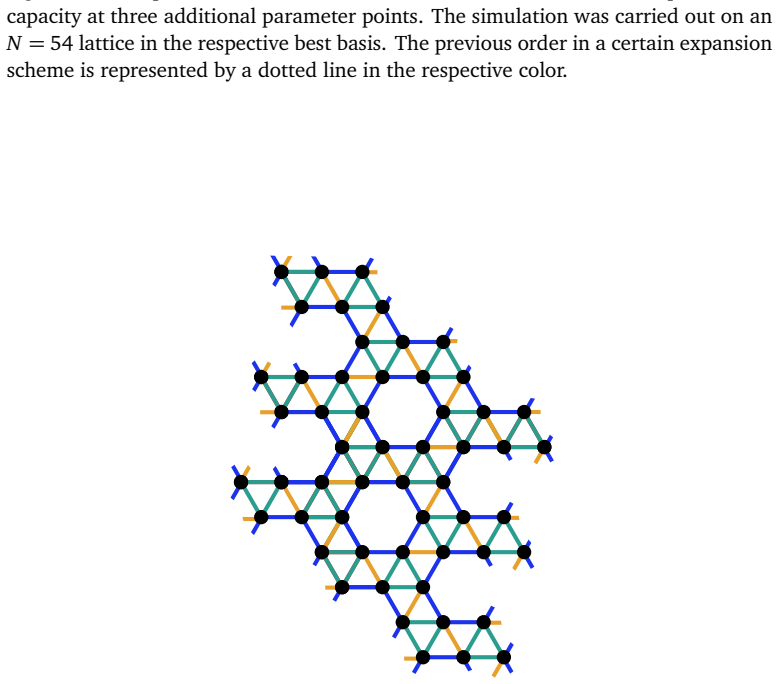
Summary. The manuscript proposes to alleviate the QMC sign problem by optimizing local unitary basis rotations on small clusters, using as a cost function a "generalized non-stoquasticity" S(U) (Eq. 8) — a noise-free, QMC-independent quantity that vanishes iff the bond Hamiltonian is stoquastic. The authors claim (i) that minimizing S(U) with Adam+LBFGS from Haar-random starts yields bases whose measured average sign ⟨s⟩ exceeds that of the computational and cluster eigenbases over large regions of parameter space, and (ii) that local minima of S coincide with local maxima of ⟨s⟩ and the gradients of the two quantities are aligned during optimization. The method is validated on the fully frustrated ladder (where it recovers the known sign-free rung basis exactly, S=0), applied to the triangular ladder (where genuinely complex non-orthogonal optima outperform both reference bases), and then used to map a "computational phase diagram" of the anisotropic maple-leaf lattice Heisenberg antiferromagnet at N=54. Along the star-lattice line the optimized 3-spin basis extends reachable temperatures from T≈0.3 to T≈0.15, and specific-heat data agree with independent NLCE results at several parameter points, resolving a low-T minimum of C/N. The paper also documents an unusual non-monotonic low-temperature sign behavior off the J_t=J_h line and gives a physical explanation via the signed/unsigned ground-state mismatch.
Significance. If the results hold — and the central practical claims are directly measured rather than inferred — this is a useful and broadly applicable contribution. The method is cheap (the cost function requires no QMC), generalizes the stoquasticity-based approach of Ref. [32] from orthogonal to full unitary rotations (thereby recovering the Marshall rotation as a special case), and produces concrete, verifiable gains: a factor-of-four reduction in accessible temperature along the star-lattice line (Fig. 7a), a full computational phase diagram of the MLL (Figs. 1, 6), and specific-heat data at the isotropic and star-lattice points that agree with independent NLCE results and resolve a low-T minimum inaccessible to naive bases (Fig. 9). The recovery of the exact S=0 stoquastic basis for the fully frustrated ladder (Fig. 2a) is a clean validation, and the demonstration that genuinely complex (non-orthogonal) optima exist (§3.2) justifies the U(d) generalization. The multi-start histogram (App. B), the analysis of sign recovery in the dimer phase (§4.3), and the external NLCE benchmarking at five parameter points are welcome, falsifiable checks. The paper is appropriately honest about the near
major comments (3)
- [§3.3, Fig. 4, Eq. (12)] §3.3, Fig. 4 (gradient-alignment evidence): the claim that ∇S and ∇⟨s⟩ are aligned — which is what licenses S as a surrogate rather than the procedure being multi-start random search followed by QMC selection of the best basis — rests on finite-difference gradients (Eq. (12), ε=0.075) of a noisy observable at two points of a single run on an N=20 triangular ladder. The comparison in the middle panel is visual ('pointing roughly in the same direction'), with no cosine similarity, no error bars on ∂s/∂θ_i, and no statistics over runs or points. Component-wise sign agreement in 32 dimensions is a weak directional test. Given that this claim appears in the abstract ('These minima coincide with optima of the average sign'), it should be quantified: report the cosine similarity ⟨∇S·∇s⟩/(|∇S||∇s|) with Monte Carlo error bars, at several points along several trajectories.
- [§4.2, App. A, Figs. 2/6] §4.2 and App. A: the entire landscape/gradient analysis (Figs. 2, 4, 11) is performed for the U(4)×U(4) Givens parametrization on ladders, but the paper's main application — the MLL computational phase diagram, Figs. 1(b) and 6 — uses U(8)×U(8) with the exponential-map parametrization of Eq. (9), for which App. A itself states that 'the geometric meaning of individual parameter directions remains unclear.' No alignment or trajectory check of any kind is shown for the 3-spin clustering. Since the red regions of Fig. 6 are the headline result, at least one analogue of Fig. 2 (⟨s⟩ vs S along an optimization trajectory) for a representative MLL point in the red region is needed to establish that the surrogate mechanism demonstrated on ladders actually operates in the U(8) case. If it does not, the abstract's mechanistic claim should be scoped to where it is verified.
- [Abstract, §2.2, §3.2, Fig. 3] Abstract and §2.2, Eq. (11): the abstract states the minima of S 'coincide with optima of the average sign' unconditionally, while the body is appropriately careful — S=0 is sufficient but not necessary (Eq. (11)), and Fig. 3 shows S is not even an ordinal proxy globally (the best-sign basis has higher S than the rung eigenbasis, as the authors note in §3.2). The abstract should be qualified to match the body's own caveats (e.g., 'local minima of S are observed to coincide with local maxima of the sign for the models studied'), otherwise the headline overstates what is demonstrated. This is a wording change, but it is load-bearing because it defines what readers take the method to guarantee.
minor comments (6)
- [§3.1, Fig. 2] §3.1, text below Fig. 2: 'the average sign remains near zero and only starts to increase sharply once the cost function falls below a certain threshold (in Figure 2 at S≈10)' — but the horizontal axis of Fig. 2 spans S≈0–1. Presumably a different threshold or axis scale is meant; please reconcile.
- [§4.2] §4.2: 'For every (θ,φ) on the grid, we perform multiple optimizations with 100 random initializations and select the basis that yields the best sign performance.' Selection by measured ⟨s⟩ requires an SSE run per candidate basis at every grid point; please state the number of QMC evaluations per grid point and how temperature was chosen for the selection, since this bears on the advertised cost advantage of the noise-free surrogate.
- [§3.2, Fig. 6] §3.2: the claim that no crossing of sign–temperature curves between distinct bases is observed, and that basis ranking is system-size independent, is stated only for the triangular ladder; a sentence clarifying whether this was also checked on the MLL would help, since Fig. 6's basis-color map is temperature-dependent (compare T=0.5 and T=0.2 panels).
- [§1, §4.1–4.2, App. C] Typos/formatting: 'infamoussign problem' (§1, missing space); repeated 'Interestingly ,' (space before comma, §1 and §4.1); 'clusters life on a bipartite effective superlattice' → 'lie' (§4.2); 'shows there a inflection point' → 'an inflection point' (§4.2); 'better conditioned' landscape claim in App. C is supported by a single 1D line cut through one minimum — the phrase 'energy landscape' in App. C should read 'cost landscape'.
- [Figs. 1, 6] Fig. 1(b) and Fig. 6 duplicate essentially the same information at T=0.5; consider merging or clarifying that Fig. 1(b) is a subset of Fig. 6, and state the grid resolution used for the (θ,φ) maps.
- [§2.2, references] Ref. [34] (Murota & Todo, 2025) addresses local basis transformations for sign mitigation and appears closely related; a brief comparative sentence in §2.2 on how the present unitary optimization differs would situate the contribution more precisely.
Circularity Check
No significant circularity: S(U) is an independent Hamiltonian-only cost; average sign and NLCE benchmarks are measured separately.
full rationale
The derivation chain does not reduce outputs to inputs by construction. Generalized non-stoquasticity S(U) (Eq. 8) is defined solely from off-diagonal phases of the rotated bond Hamiltonian and is evaluated without QMC. Optimization (Adam+LBFGS over local unitaries) therefore does not fit to the average sign. The average sign 〈s〉 is subsequently measured in independent SSE runs in each candidate basis (computational, cluster eigenbases, and optimized bases), and thermodynamic observables are cross-checked against ED and external NLCE. The claim that local minima of S coincide with maxima of 〈s〉 is an empirical numerical observation (Figs. 2–4, App. C), not a definitional identity; the paper itself states that S=0 is only sufficient, not necessary, and that S is not a global ordinal proxy for sign (Eq. 11 and Fig. 3). Self-citations to prior NLCE/MLL work supply comparison data and context, not the load-bearing justification of the optimization method. Extending Hangleiter et al.’s non-stoquasticity cost from O(d) to U(d) is incremental prior-art use, not a self-citation uniqueness import. No fitted-input-as-prediction, ansatz-smuggling, or renaming circularity is present. Weaknesses in the gradient-alignment evidence (thin, ladder-only) are correctness/robustness issues, not circularity.
Axiom & Free-Parameter Ledger
free parameters (3)
- Adam iteration count and cosine-annealing schedule =
~4000 Adam steps; relative tol 1e-9
- Number of Haar-random multi-starts =
100
- Finite-difference step ε for gradient comparison =
0.075
axioms (5)
- domain assumption SSE configuration weights and the reweighting formula 〈O〉 = 〈O s〉_|W| / 〈s〉_|W| correctly estimate thermal observables when the average sign is measurable.
- domain assumption Local unitary rotations on fixed small clusters (2-site or 3-site) are expressive enough to meaningfully reduce the sign problem for the models considered.
- ad hoc to paper Generalized non-stoquasticity S(U) = Σ_{i≠j} (1/2)(|[U† h_b U]_{ij}| − Re[U† h_b U]_{ij}) is a useful surrogate whose local minima track average-sign maxima.
- domain assumption When the effective superlattice is bipartite, independent unitaries on the two sublattices are allowed (Marshall-type staggering).
- standard math Standard real analysis / unitary-group parametrizations (Givens products, exponential map of Hermitian generators) cover U(d) for the cluster sizes used.
invented entities (1)
-
Generalized non-stoquasticity S(U) for complex bond Hamiltonians
independent evidence
read the original abstract
The sign problem breaks the polynomial scaling of Quantum Monte Carlo methods. We alleviate it by rotation of the local basis of the Hilbert space, such that the phase of off-diagonal matrix elements of the rotated Hamiltonian is minimized. These minima coincide with optima of the average sign. We benchmark our method for frustrated Heisenberg antiferromagnets in one dimension and on the two-dimensional maple-leaf lattice. Our approach reveals more efficient bases with improved sign in a large part of the parameter space for all models considered, enabling us to reach lower temperatures, on par with state-of-the-art numerical linked cluster expansions which we directly compare to.
Figures


Reference graph
Works this paper leans on
-
[1]
H. T. Diep, Frustrated Spin Systems , World Scientific, doi:10.1142/5697 (2005)
doi:10.1142/5697 2005
-
[2]
Balents, Spin liquids in frustrated magnets , Nature 464(7286), 199 (2010), doi:10.1038/nature08917
L. Balents, Spin liquids in frustrated magnets , Nature 464(7286), 199 (2010), doi:10.1038/nature08917
-
[3]
L. Savary and L. Balents, Quantum spin liquids: a review , Reports on Progress in Physics 80(1), 016502 (2016), doi:10.1088/0034-4885/80/1/016502
-
[4]
T. Fennell, P. P. Deen, A. R. Wildes, K. Schmalzl, D. Prabhakaran, A. T. Boothroyd, R. J. Aldus, D. F. McMorrow and S. T. Bramwell, Magnetic coulomb phase in the spin ice ho2ti2o7, Science 326(5951), 415 (2009), doi:10.1126/science.1177582
-
[5]
C. L. Henley, The “coulomb phase” in frustrated systems, Annual Review of Condensed Matter Physics 1(Volume 1, 2010), 179 (2010), doi:10.1146/annurev-conmatphys-070909-104138
-
[6]
D. Lozano-Gómez, O. Benton, M. J. P. Gingras and H. Yan, An Atlas of Classical Pyrochlore Spin Liquids , doi:10.48550/arXiv.2411.03547 (2025)
-
[7]
M. Hermele, M. P. A. Fisher and L. Balents, Pyrochlore photons: The U(1) spin liquid in a S= 1 2 three-dimensional frustrated magnet , Phys. Rev. B 69, 064404 (2004), doi:10.1103/PhysRevB.69.064404
-
[8]
B. Gao, F. Desrochers, D. W. Tam, D. M. Kirschbaum, P. Steffens, A. Hiess, D. H. Nguyen, Y. Su, S.-W. Cheong, S. Paschen, Y. B. Kim and P. Dai, Neutron scattering and thermodynamic evidence for emergent photons and fractionalization in a pyrochlore spin ice , Nature Physics 21(8), 1203 (2025), doi:10.1038/s41567-025-02922-9
-
[9]
C. Castelnovo, R. Moessner and S. L. Sondhi, Magnetic monopoles in spin ice , Nature 451(7174), 42 (2008), doi:10.1038/nature06433
-
[10]
D. J. P. Morris, D. A. Tennant, S. A. Grigera, B. Klemke, C. Castelnovo, R. Moessner, C. Czternasty, M. Meissner, K. C. Rule, J.-U. Hoffmann, K. Kiefer, S. Gerischer et al., Dirac Strings and Magnetic Monopoles in the Spin Ice Dy2Ti2O7 , Science 326(5951), 411 (2009), doi:10.1126/science.1178868
-
[11]
C. Broholm, R. J. Cava, S. A. Kivelson, D. G. Nocera, M. R. Norman and T. Senthil, Quantum spin liquids , Science 367(6475), eaay0668 (2020), doi:10.1126/science.aay0668
-
[12]
S. R. White, Density matrix formulation for quantum renormalization groups, Phys. Rev. Lett. 69, 2863 (1992), doi:10.1103/PhysRevLett.69.2863
-
[13]
Schollw\"ock, The density-matrix renormalization group, Rev
U. Schollw\"ock, The density-matrix renormalization group, Rev. Mod. Phys. 77, 259 (2005), doi:10.1103/RevModPhys.77.259
-
[14]
U. Schollwöck, The density-matrix renormalization group in the age of matrix product states , Annals of Physics 326(1), 96 (2011), doi:10.1016/j.aop.2010.09.012, January 2011 Special Issue
-
[15]
I. Hagym\'asi, R. Sch\"afer, R. Moessner and D. J. Luitz, Possible inversion symmetry breaking in the s=1/2 pyrochlore heisenberg magnet, Phys. Rev. Lett. 126, 117204 (2021), doi:10.1103/PhysRevLett.126.117204
-
[16]
F. Becca and S. Sorella, Variational Monte Carlo, p. 101–102, Cambridge University Press, doi:10.1017/9781316417041 (2017)
-
[17]
J. Oitmaa, C. Hamer and W. Zheng, Series Expansion Methods for Strongly Interacting Lattice Models, Cambridge University Press, doi:10.1017/CBO9780511584398 (2006)
-
[18]
B. Bernu, L. Pierre, K. Essafi and L. Messio, Effect of perturbations on the kagome S= 1 2 antiferromagnet at all temperatures , Phys. Rev. B 101, 140403 (2020), doi:10.1103/PhysRevB.101.140403
-
[19]
M. G. Gonzalez, B. Bernu, L. Pierre and L. Messio, Ground-state and thermodynamic properties of the spin- 1 2 Heisenberg model on the anisotropic triangular lattice , SciPost Phys. 12, 112 (2022), doi:10.21468/SciPostPhys.12.3.112
-
[20]
N. Niggemann, B. Sbierski and J. Reuther, Frustrated quantum spins at finite temperature: Pseudo-Majorana functional renormalization group approach , Phys. Rev. B 103, 104431 (2021), doi:10.1103/PhysRevB.103.104431
-
[21]
N. Niggemann, J. Reuther and B. Sbierski, Quantitative functional renormalization for three-dimensional quantum Heisenberg models , SciPost Phys. 12, 156 (2022), doi:10.21468/SciPostPhys.12.5.156
-
[22]
B. Schneider, J. Reuther, M. G. Gonzalez, B. Sbierski and N. Niggemann, Temperature flow in pseudo-Majorana functional renormalization for quantum spins , Phys. Rev. B 109, 195109 (2024), doi:10.1103/PhysRevB.109.195109
-
[23]
F. Bippus, B. Schneider and B. Sbierski, Pseudo-Majorana functional renormalization for frustrated XXZ spin- 1 2 models with field or magnetization along the spin- Z direction at finite temperature , Phys. Rev. B 111, 054420 (2025), doi:10.1103/PhysRevB.111.054420
-
[24]
M. Rigol, T. Bryant and R. R. P. Singh, Numerical linked-cluster approach to quantum lattice models, Phys. Rev. Lett. 97, 187202 (2006), doi:10.1103/PhysRevLett.97.187202
-
[25]
M. Rigol, T. Bryant and R. R. P. Singh, Numerical linked-cluster algorithms. i. spin systems on square, triangular, and kagom\'e lattices, Phys. Rev. E 75, 061118 (2007), doi:10.1103/PhysRevE.75.061118
-
[26]
M. Rigol, T. Bryant and R. R. P. Singh, Numerical linked-cluster algorithms. II . t - J models on the square lattice , Phys. Rev. E 75, 061119 (2007), doi:10.1103/PhysRevE.75.061119
-
[27]
R. Sch\"afer, I. Hagym\'asi, R. Moessner and D. J. Luitz, Pyrochlore S= 1 2 Heisenberg antiferromagnet at finite temperature , Phys. Rev. B 102, 054408 (2020), doi:10.1103/PhysRevB.102.054408
-
[28]
Sch\"afer, Magnetic Frustration in Three Dimensions , Dissertation, TU Dresden, Dresden, https://nbn-resolving.org/urn:nbn:de:bsz:14-qucosa2-829375 (2022)
R. Sch\"afer, Magnetic Frustration in Three Dimensions , Dissertation, TU Dresden, Dresden, https://nbn-resolving.org/urn:nbn:de:bsz:14-qucosa2-829375 (2022)
2022
-
[29]
M. Troyer and U.-J. Wiese, Computational Complexity and Fundamental Limitations to Fermionic Quantum Monte Carlo Simulations , Phys. Rev. Lett. 94, 170201 (2005), doi:10.1103/PhysRevLett.94.170201
-
[30]
T. Nakamura, Vanishing of the negative-sign problem of quantum Monte Carlo simulations in one-dimensional frustrated spin systems , Phys. Rev. B 57, R3197 (1998), doi:10.1103/PhysRevB.57.R3197
-
[31]
H. Shinaoka, Y. Nomura, S. Biermann, M. Troyer and P. Werner, Negative sign problem in continuous-time quantum Monte Carlo: Optimal choice of single-particle basis for impurity problems , Phys. Rev. B 92, 195126 (2015), doi:10.1103/PhysRevB.92.195126
-
[32]
D. Hangleiter, I. Roth, D. Nagaj and J. Eisert, Easing the Monte Carlo sign problem , Science Advances 6(33), eabb8341 (2020), doi:10.1126/sciadv.abb8341
-
[33]
G. Pan and Z. Y. Meng, The sign problem in quantum Monte Carlo simulations , In T. Chakraborty, ed., Encyclopedia of Condensed Matter Physics (Second Edition), pp. 879--893. Academic Press, Oxford, second edition edn., ISBN 978-0-323-91408-6, doi:10.1016/B978-0-323-90800-9.00095-0 (2024)
-
[34]
K. Murota and S. Todo, Local Basis Transformation to Mitigate Negative Sign Problems , doi:10.48550/arXiv.2501.18069 (2025)
-
[35]
J.-L. Wynen, E. Berkowitz, S. Krieg, T. Luu and J. Ostmeyer, Machine learning to alleviate Hubbard-model sign problems , Phys. Rev. B 103, 125153 (2021), doi:10.1103/PhysRevB.103.125153
-
[36]
M. Rodekamp, E. Berkowitz, C. G \"a ntgen, S. Krieg, T. Luu and J. Ostmeyer, Mitigating the Hubbard sign problem with complex-valued neural networks , Phys. Rev. B 106, 125139 (2022), doi:10.1103/PhysRevB.106.125139
-
[37]
S. Chandrasekharan and U.-J. Wiese, Meron-cluster solution of fermion sign problems, Phys. Rev. Lett. 83, 3116 (1999), doi:10.1103/PhysRevLett.83.3116
-
[38]
Z.-X. Li, Y.-F. Jiang and H. Yao, Solving the fermion sign problem in quantum monte carlo simulations by majorana representation, Phys. Rev. B 91, 241117(R) (2015), doi:10.1103/PhysRevB.91.241117
-
[39]
A. Alexandru, G. m. c. Ba s s ar, P. F. Bedaque and N. C. Warrington, Complex paths around the sign problem, Rev. Mod. Phys. 94, 015006 (2022), doi:10.1103/RevModPhys.94.015006
-
[40]
F. Alet, K. Damle and S. Pujari, Sign-Problem-Free Monte Carlo Simulation of Certain Frustrated Quantum Magnets , Phys. Rev. Lett. 117, 197203 (2016), doi:10.1103/PhysRevLett.117.197203
-
[41]
A. Honecker, S. Wessel, R. Kerkdyk, T. Pruschke, F. Mila and B. Normand, Thermodynamic properties of highly frustrated quantum spin ladders: Influence of many-particle bound states , Phys. Rev. B 93, 054408 (2016), doi:10.1103/PhysRevB.93.054408
-
[42]
S. Wessel, B. Normand, F. Mila and A. Honecker, Efficient Quantum Monte Carlo simulations of highly frustrated magnets: the frustrated spin-1/2 ladder , SciPost Phys. 3, 005 (2017), doi:10.21468/SciPostPhys.3.1.005
-
[43]
J. D'Emidio, S. Wessel and F. Mila, Reduction of the sign problem near T=0 in quantum Monte Carlo simulations , Phys. Rev. B 102, 064420 (2020), doi:10.1103/PhysRevB.102.064420
-
[44]
A. Honecker, L. Weber, P. Corboz, F. Mila and S. Wessel, Quantum Monte Carlo simulations of highly frustrated magnets in a cluster basis: The two-dimensional Shastry-Sutherland model , Journal of Physics: Conference Series 2207(1), 012032 (2022), doi:10.1088/1742-6596/2207/1/012032
-
[45]
L. Weber, A. Honecker, B. Normand, P. Corboz, F. Mila and S. Wessel, Quantum Monte Carlo simulations in the trimer basis: first-order transitions and thermal critical points in frustrated trilayer magnets , SciPost Phys. 12, 054 (2022), doi:10.21468/SciPostPhys.12.2.054
-
[46]
L. Weber, N. Caci and S. Wessel, Cluster quantum Monte Carlo study of two-dimensional weakly coupled frustrated trimer antiferromagnets , Phys. Rev. B 106, 035141 (2022), doi:10.1103/PhysRevB.106.035141
-
[47]
Marshall, Antiferromagnetism , Proceedings of the Royal Society of London
W. Marshall, Antiferromagnetism , Proceedings of the Royal Society of London. A. Mathematical and Physical Sciences 232(1188), 48 (1955), doi:10.1098/rspa.1955.0200
arXiv 1955
-
[48]
P. L. Ebert, Y. Iqbal and A. Wietek, Competing Paramagnetic Phases in the Maple-Leaf Heisenberg Antiferromagnet , doi:10.48550/arXiv.2601.05308 (2026)
-
[49]
A. W. Sandvik, Stochastic Series Expansion Methods , doi:10.48550/arXiv.1909.10591 (2019)
-
[50]
F. Alet, S. Wessel and M. Troyer, Generalized directed loop method for quantum Monte Carlo simulations , Phys. Rev. E 71, 036706 (2005), doi:10.1103/PhysRevE.71.036706
-
[51]
E. Y. Loh, J. E. Gubernatis, R. T. Scalettar, S. R. White, D. J. Scalapino and R. L. Sugar, Sign problem in the numerical simulation of many-electron systems , Phys. Rev. B 41, 9301 (1990), doi:10.1103/PhysRevB.41.9301
-
[52]
N. Hatano and M. Suzuki, Representation basis in quantum monte carlo calculations and the negative-sign problem, Physics Letters A 163(4), 246 (1992), doi:10.1016/0375-9601(92)91006-D
-
[53]
P. Henelius and A. W. Sandvik, Sign problem in Monte Carlo simulations of frustrated quantum spin systems , Phys. Rev. B 62, 1102 (2000), doi:10.1103/PhysRevB.62.1102
-
[54]
R. Levy and B. K. Clark, Mitigating the sign problem through basis rotations, Phys. Rev. Lett. 126, 216401 (2021), doi:10.1103/PhysRevLett.126.216401
-
[55]
J. Klassen and B. M. Terhal, Two-local qubit H amiltonians: when are they stoquastic? , Quantum 3, 139 (2019), doi:10.22331/q-2019-05-06-139
-
[56]
W. R. Clements, P. C. Humphreys, B. J. Metcalf, W. S. Kolthammer and I. A. Walmsley, Optimal design for universal multiport interferometers , Optica 3(12), 1460 (2016), doi:10.1364/OPTICA.3.001460, 1603.08788
Pith/arXiv arXiv 2016
-
[57]
M. Reck, A. Zeilinger, H. J. Bernstein and P. Bertani, Experimental realization of any discrete unitary operator , Phys. Rev. Lett. 73, 58 (1994), doi:10.1103/PhysRevLett.73.58
-
[58]
D. P. Kingma and J. Ba, Adam: A Method for Stochastic Optimization , doi:10.48550/arXiv.1412.6980 (2017)
-
[59]
D. C. Liu and J. Nocedal, On the limited memory BFGS method for large scale optimization , Mathematical Programming 45(1), 503 (1989), doi:10.1007/BF01589116
-
[60]
F. Mezzadri, How to generate random matrices from the classical compact groups, doi:10.48550/arXiv.math-ph/0609050 (2007)
-
[61]
P. Ghosh, T. M\"uller and R. Thomale, Another exact ground state of a two-dimensional quantum antiferromagnet , Phys. Rev. B 105, L180412 (2022), doi:10.1103/PhysRevB.105.L180412
-
[62]
M. Adhikary, A. Ralko and B. Kumar, Quantum paramagnetism and magnetization plateaus in a kagome-honeycomb Heisenberg antiferromagnet , Phys. Rev. B 104, 094416 (2021), doi:10.1103/PhysRevB.104.094416
-
[63]
A. Reingruber, N. Caci, S. Wessel and J. Richter, Thermodynamics of the spin- 1 2 Heisenberg antiferromagnet on the star lattice , Phys. Rev. B 109, 125120 (2024), doi:10.1103/PhysRevB.109.125120
-
[64]
J. Sonnenschein, A. Maity, C. Liu, R. Thomale, F. Ferrari and Y. Iqbal, Candidate quantum spin liquids on the maple-leaf lattice, Phys. Rev. B 110, 014414 (2024), doi:10.1103/PhysRevB.110.014414
-
[65]
S. Wessel, I. Niesen, J. Stapmanns, B. Normand, F. Mila, P. Corboz and A. Honecker, Thermodynamic properties of the shastry-sutherland model from quantum monte carlo simulations, Phys. Rev. B 98, 174432 (2018), doi:10.1103/PhysRevB.98.174432
-
[66]
R. Schäfer, P. L. Ebert, N. Hassan, J. Reuther, D. J. Luitz and A. Wietek, Thermodynamics of the heisenberg antiferromagnet on the maple-leaf lattice, Zeitschrift für Naturforschung A (2026), doi:10.1515/zna-2025-0382
-
[67]
B. Tang, E. Khatami and M. Rigol, A short introduction to numerical linked-cluster expansions, Computer Physics Communications 184(3), 557 (2013), doi:10.1016/j.cpc.2012.10.008
-
[68]
F. Machado, S. Chern, M. P. Zaletel and N. Y. Yao, A dipolar chiral spin liquid on the breathed kagome lattice, doi:10.48550/arXiv.2603.25784 (2026)
-
[69]
A. B. Harris, A. J. Berlinsky and C. Bruder, Ordering by quantum fluctuations in a strongly frustrated heisenberg antiferromagnet, Journal of Applied Physics 69(8), 5200 (1991), doi:10.1063/1.348098
discussion (0)
Sign in with ORCID, Apple, or X to comment. Anyone can read and Pith papers without signing in.