REVIEW 5 major objections 5 minor 38 references
New Tools are Needed for Tracking Adherence to AI Model Behavioral Use Clauses
T0 review · 5 major / 5 minor · reviewed 2026-08-07 · deepseek-v4-flash
Pith's one-line read Behavioral-use AI licenses are spreading without the compliance-tracking tools needed to make them work.
desk verdict Useful new adoption data for AI licensing, but the 'urgently needed' adherence-tracking conclusion outruns the evidence; worth reviewing with revisions. read the letter →
The pith
A machine-rendered reading of the paper's core claim, the machinery that carries it, and where it could break.
The reading
What carries the argument
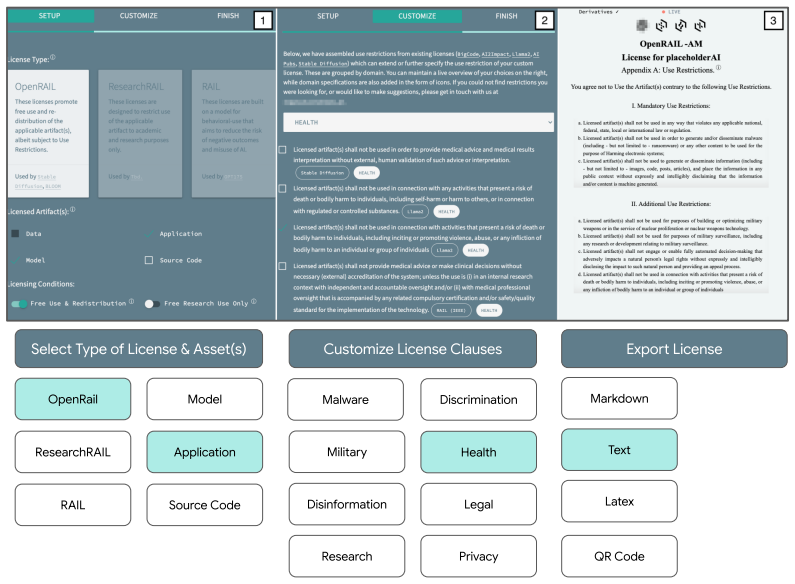
The central object is the behavioral-use clause, a license term restricting how an AI asset may be used, often collected under the name Responsible AI Licenses (RAIL). The paper's analytic machinery is a 25-clause taxonomy of such restrictions together with a three-flavor license generator—research-only, proprietary, and open—whose mandatory and optional clause structure shapes user choices. The taxonomy lets the authors measure which restrictions are selected together, and a bi-gram text-overlap analysis (comparing consecutive word pairs across licenses) shows that clause wording has converged across major model families. These tools support the argument that licensing language is already standardized enough for tracking tools to be built.
What would settle it
Conduct a representative audit of public applications and API endpoints that use models released under behavioral-use licenses, and measure the rate of detectable violations of clauses such as disinformation or military-use prohibitions; if violations are rare and no demand for enforcement surfaces, the claim that new tracking tools are urgently needed would be undercut.
Extended reading notes
Core claim
On the paper's own terms, the discovery is a measured gap in the responsible-AI licensing lifecycle: creation and customization of behavioral-use licenses are now supported and demonstrably used, but adoption and adherence tracking are not. The authors base this on two datasets—308 licenses generated through their publicly available license generator and license metadata from over 1.7 million models on a major public model hub—which show that behavioral-use clauses are being adopted by a sizable and growing share of released models, that users actively customize clauses when given tooling, and that clause language is converging on a shared 25-clause vocabulary. They take the position that the natural next step, urgently needed, is tooling to track how licenses are adopted and whether licensed assets are used in line with behavioral restrictions, and they point to watermarking, model fingerprinting, and community reporting as starting points.
Load-bearing premise
The paper's recommendation rests on the assumption that growing adoption of these licenses and the existence of creation tools imply a real, urgent need for new compliance-tracking tools—without evidence that violations currently occur at scale or that such tools would change behavior.
Editorial extensions
If this is right
- Behavioral-use licensing will likely keep growing: in the hub sample, 12.1% of licensed models carried such licenses, and the share has increased over time.
- The standardization gap is small enough to bridge: most customized licenses drew from a common set of 25 clauses, and bi-gram overlap shows many licenses share nearly identical wording.
- License-creation tooling is validated by demand: 308 customized licenses were generated organically over 14 months, with models the most-licensed artifact.
- The missing layer is verification, not creation: existing tools help authors write licenses but provide no systematic way to check whether downstream users comply.
- If adherence tools are not built, the paper predicts cynicism about enforceability will grow and violations may increase, undercutting the responsible-use intent of these licenses.
Reading between the lines
- Editorial inference: if adherence tracking becomes standard, the practical force of behavioral-use clauses will depend less on license text and more on provable provenance, making model fingerprinting and output watermarking infrastructure as important as the licenses themselves.
- Editorial inference: a testable next step is to embed machine-readable clause metadata alongside released model weights, so automated scanners can flag mismatches between a license and actual application behavior.
- Editorial inference: because behavioral violations are semantic and context-dependent, any adherence tool will likely need a human-in-the-loop reporting layer similar to open-source license complaint channels, not just automated detection.
- Editorial inference: the convergence on a 25-clause vocabulary suggests enforcement efforts could prioritize a small set of high-stakes restrictions, such as disinformation and military use, rather than trying to cover all clauses at equal depth.
Editorial analysis
A structured set of objections, weighed in public.
Referee Report
Summary. The paper studies the adoption of behavioral-use clauses in AI licenses and argues that new tools are needed to track adherence to those clauses. It presents two empirical analyses: (i) a field study of 308 licenses generated over 14 months using the authors' RAIL license generator, examining clause choices across artifact types, and (ii) a large-scale analysis of 1.7 million HuggingFace model repositories, reporting that 12.1% of models carry RAIL-type licenses and that clause language overlaps substantially across popular licenses. On this basis, the paper concludes that license creation and customization are now supported, but tools for tracking adoption and adherence are severely lacking and 'urgently needed.'
Significance. If the empirical claims hold, the paper provides useful and timely descriptive evidence about the diffusion of behavioral-use clauses in AI licensing. The HuggingFace-scale analysis and the field deployment of the license generator are concrete contributions, and the observed convergence on a small set of clause configurations is of interest to license designers, policymakers, and researchers. Credit is due for making the generator publicly available and for grounding the discussion in two real datasets. However, the paper's central policy claim—that adherence-tracking tools are 'urgently needed'—rests on premises that the empirical studies do not establish. The paper is best read as a position piece with supporting descriptive data; its strength lies in the adoption measurements, not in the demonstration of an adherence gap or of the efficacy of possible tracking tools.
major comments (5)
- [Section 4] The central claim that adherence-tracking tools are 'urgently needed' rests on the untested premise that non-compliance with behavioral-use clauses is a real, nontrivial problem that tracking tools would mitigate. The paper provides no documented violations, no measurement of violation rates, no survey of license creators or users about observed non-compliance, and no evidence that proposed tools (model fingerprinting, watermarking, community monitoring) would reduce violations. The assertion that developers might 'short-circuit' model performance to promote adherence (citing [38]) is speculative and does not substitute for evidence. I recommend either adding a study of actual or reported violations, or substantially softening the 'urgently needed' conclusion to a call for research.
- [Section 3] The headline figure that RAIL licenses account for 12.1% of models is ambiguous and not reproducible as stated. The text says 1,704,180 models were analyzed and 'almost 650,000 had licenses,' but it does not specify whether 12.1% is a percentage of all models or of licensed models. The text also says 61.5% use Open Source licenses; these two percentages cannot both be percentages of all 1.7M models if only 650k have licenses. Please clarify the denominator, describe how RAIL status was identified (e.g., license name matching, manual review, metadata field), and report exclusion criteria and any deduplication.
- [Table 1 and Figure 2[B]] The identification of the ten mandatory clauses is internally inconsistent. Section 2 states that the first 10 clauses are mandatory and 'therefore present in all licenses,' but Table 1's last column shows 100% selection only for clauses 1, 2, 5, 6, 8, 10, 12, 13, 16, and 20, not for clauses 3, 4, 7, 9, and 11. Figure 2[B] appears to label a different set of 10 clauses as mandatory (1, 2, 3, 4, 5, 6, 8, 7, 9, 11). Since the analysis of 'mandatory versus optional' clauses and the convergence claim depend on this distinction, the inconsistency needs to be resolved and the mandatory set explicitly defined.
- [Table 1] The mapping of behavioral-use clauses onto the 15 listed external licenses (via checkmarks) is not accompanied by a coding protocol. The convergence claim—that 'most continue use clauses from a relatively short list'—relies on these qualitative judgments, but no inter-rater reliability, source-quote alignment, or handling of paraphrased or split clauses is reported. For a table central to the paper's convergence narrative, the method should be described or the claim should be presented as an informal observation.
- [Section 5] The paper cites Lemley and Henderson's 'The mirage of AI terms of use restrictions' [18] but does not engage with its argument. Since [18] directly challenges the enforceability and practical effect of behavioral-use clauses, it is directly relevant to the paper's premise that adherence tracking is needed. The authors should state how their proposal responds to the enforceability critique, for example by explaining why tracking tools would overcome the identified legal and technical obstacles.
minor comments (5)
- [Section 2 and Conclusion] The timespan is inconsistent: Section 2 says data were collected over 14 months, while the Conclusion says 'N=308 licenses created in 12-month.' Please align these figures.
- [Section 2] The text says 'We adopt the Open Source license generator proposed by McDuff et al.' while the Abstract says 'We created and deployed a custom AI licenses generator.' Please clarify the authorship and provenance of the generator to avoid confusion.
- [Figure 2 captions] There are several typos in the figure captions and labels: 'Licesnse' should be 'License,' 'Whick Clasuses' should be 'Which Clauses,' and 'Figure 2[C] shows shows' has a duplicated word.
- [Section 4] There are typos: 'they many be less effective' should be 'they may be less effective,' and 'enforcability' should be 'enforceability.' The Introduction also contains 'behaviorial' for 'behavioral.'
- [Section 3] The number '1,704,180' is used in the text, but the abstract says '1.7 million'; also, 'almost 650,000 had licenses' is not tied to the plotted counts in Figure 4[A]. Please reconcile these numbers and state the exact licensed-model count used for percentages.
Circularity Check
No significant circularity: the central claim is a stated position supported by external adoption measurements; only a minor self-referential element (the authors' own license generator) prevents a 0.
full rationale
The paper's empirical backbone is independent of its conclusion in the sense required for circularity. The generator study (Section 2) records usage events (N=308 licenses) of a publicly deployed tool; the HuggingFace study (Section 3) analyzes 1.7M model repositories using external metadata. These are measurements of adoption, not constructions that force the paper's call for adherence-tracking tools. The claim that 'new tools are needed for tracking the adoption of, and adherence to, behavioral use clauses' is explicitly introduced as 'we take the position' (Abstract, Section 1), i.e., a normative recommendation, not a mathematical consequence of the data. The only self-referential element is that the generator and clause taxonomy come from the authors' own prior work [26], so the 'interest in tools that support license creation' finding partly measures the authors' own artifact; this is a minor self-citation that is not load-bearing because the HuggingFace analysis and the bi-gram overlap analysis are external and independent. The reviewers' concern that no violation data are presented and that the urgency premise is asserted rather than demonstrated is a support/evidence limitation, not a circular reduction: no equation or fitted parameter makes a prediction equal to an input. Accordingly, there is no step that exhibits a by-construction equivalence, and the circularity score is low.
Assumptions & free parameters
assumptions (2)
- domain assumption Behavioral-use clauses in AI licenses can be meaningfully classified and compared across documents.
- domain assumption HuggingFace model hub license metadata is complete and accurate enough to support the 12.1% RAIL adoption figure.
Cite this review
Pith. "Pith review of New Tools are Needed for Tracking Adherence to AI Model Behavioral Use Clauses." pith.science (2026). https://pith.science/paper/6I2HBJKI
@misc{pith2026250522287,
  author       = {Pith},
  title        = {Pith review of: New Tools are Needed for Tracking Adherence to AI Model Behavioral Use Clauses},
  year         = {2026},
  howpublished = {\url{https://pith.science/paper/6I2HBJKI}},
  note         = {Machine review of arXiv:2505.22287}
}
read the original abstract
Foundation models have had a transformative impact on AI. A combination of large investments in research and development, growing sources of digital data for training, and architectures that scale with data and compute has led to models with powerful capabilities. Releasing assets is fundamental to scientific advancement and commercial enterprise. However, concerns over negligent or malicious uses of AI have led to the design of mechanisms to limit the risks of the technology. The result has been a proliferation of licenses with behavioral-use clauses and acceptable-use-policies that are increasingly being adopted by commonly used families of models (Llama, Gemma, Deepseek) and a myriad of smaller projects. We created and deployed a custom AI licenses generator to facilitate license creation and have quantitatively and qualitatively analyzed over 300 customized licenses created with this tool. Alongside this we analyzed 1.7 million models licenses on the HuggingFace model hub. Our results show increasing adoption of these licenses, interest in tools that support their creation and a convergence on common clause configurations. In this paper we take the position that tools for tracking adoption of, and adherence to, these licenses is the natural next step and urgently needed in order to ensure they have the desired impact of ensuring responsible use.
Figures


Figures from the paper (1 more)

Reference graph
Works this paper leans on
-
[38]
Improving alignment and robustness with circuit breakers, 2024
Andy Zou, Long Phan, Justin Wang, Derek Duenas, Maxwell Lin, Maksym Andriushchenko, Rowan Wang, Zico Kolter, Matt Fredrikson, and Dan Hendrycks. Improving alignment and robustness with circuit breakers, 2024. A Broader Impacts Licenses have broad implications. The open source community has contributed substantially to the development of software and to th...
work page 2024
-
[18]
Mark A. Lemley and Peter Henderson. The mirage of artificial intelligence terms of use restrictions. Research Paper 2025-04, Princeton University Program in Law & Public Affairs, 2024
work page 2025
-
[1]
arXiv preprint arXiv:2411.02265, 2024
Hunyuan-large: An open-source moe model with 52 billion activated parameters by tencent. arXiv preprint arXiv:2411.02265, 2024
arXiv 2024
-
[2]
Marah Abdin, Jyoti Aneja, Hany Awadalla, Ahmed Awadallah, Ammar Ahmad Awan, Nguyen Bach, Amit Bahree, Arash Bakhtiari, Jianmin Bao, Harkirat Behl, et al. Phi-3 technical report: A highly capable language model locally on your phone.arXiv preprint arXiv:2404.14219, 2024
arXiv 2024
-
[3]
Ebtesam Almazrouei, Hamza Alobeidli, Abdulaziz Alshamsi, Alessandro Cappelli, Ruxandra Cojocaru, Merouane Debbah, Etienne Goffinet, Daniel Heslow, Julien Launay, Quentin Malartic, et al. Falcon-40B: an open large language model with state-of-the-art performance.Findings of the Association for Computational Linguistics: ACL, 2023:10755–10773, 2023
work page 2023
-
[4]
Qwen technical report.arXiv preprint arXiv:2309.16609, 2023
Jinze Bai, Shuai Bai, Yunfei Chu, Zeyu Cui, Kai Dang, Xiaodong Deng, Yang Fan, Wenbin Ge, Yu Han, Fei Huang, et al. Qwen technical report.arXiv preprint arXiv:2309.16609, 2023
arXiv 2023
-
[5]
Behavioral use licensing for responsible ai
Danish Contractor, Daniel McDuff, Julia Katherine Haines, Jenny Lee, Christopher Hines, Brent Hecht, Nicholas Vincent, and Hanlin Li. Behavioral use licensing for responsible ai. In Proceedings of the 2022 ACM Conference on Fairness, Accountability, and Transparency, pages 778–788, 2022
work page 2022
-
[6]
Ze Cui. orcasound/orca-eye-aye. original-date: 2023-03-17T19:11:42Z
work page 2023
Show all 38 references
-
[7]
A corpus for multilingual analysis of online terms of service
Kasper Drazewski, Andrea Galassi, Agnieszka JABŁONOWSKA, Francesca Lagioia, Marco Lippi, Hans-Wolfgang Micklitz, Giovanni Sartor, Giacomo Tagiuri, and Paolo Torroni. A corpus for multilingual analysis of online terms of service. Association for Computational Linguistics, 2021
2021
-
[8]
Modelgo: A practical tool for machine learning license analysis
Moming Duan, Qinbin Li, and Bingsheng He. Modelgo: A practical tool for machine learning license analysis. InProceedings of the ACM Web Conference 2024, WWW ’24, page 1158–1169, New York, NY , USA, 2024. Association for Computing Machinery
2024
-
[9]
they’ve stolen my gpl-licensed model!
Moming Duan, Rui Zhao, Linshan Jiang, Nigel Shadbolt, and Bingsheng He. "they’ve stolen my gpl-licensed model!": Toward standardized and transparent model licensing, 2024
2024
-
[10]
The stable signature: Rooting watermarks in latent diffusion models, 2023
Pierre Fernandez, Guillaume Couairon, Hervé Jégou, Matthijs Douze, and Teddy Furon. The stable signature: Rooting watermarks in latent diffusion models, 2023
2023
-
[11]
VaViM and VaV AM: Autonomous driving through video generative modeling, 2024
Florent Bartoccioni, Elias Ramzi, Victor Besnier, Shashanka Venkataramanan, Tuan-Hung Vu, Yihong Xu, Loick Chambon, Spyros Gidaris, Serkan Odabas, David Hurych, Renaud Marlet, Alexandre Boulch, Mickael Chen, Eloi Zablocki, Andrei Bursuc, Eduardo Valle, and Matthieu Cord. VaViM...
2024
-
[12]
Granite 3.0 language models, 2024
IBM Granite Team. Granite 3.0 language models, 2024
2024
-
[13]
Alfonso Guarino, Nicola Lettieri, Delfina Malandrino, and Rocco Zaccagnino. A machine learning-based approach to identify unlawful practices in online terms of service: analysis, implementation and evaluation.Neural Computing and Applications, 33:17569–17587, 2021
2021
-
[14]
AMD- hummingbird: Towards an efficient text-to-video model, 2025
Takashi Isobe, He Cui, Dong Zhou, Mengmeng Ge, Dong Li, and Emad Barsoum. AMD- hummingbird: Towards an efficient text-to-video model, 2025
2025
-
[15]
Albert Q. Jiang, Alexandre Sablayrolles, Antoine Roux, Arthur Mensch, Blanche Savary, Chris Bamford, Devendra Singh Chaplot, Diego de las Casas, Emma Bou Hanna, Florian Bressand, Gianna Lengyel, Guillaume Bour, Guillaume Lample, Lélio Renard Lavaud, Lucile Saulnier, Marie-Anne...
2024
-
[16]
Factorizephys: Matrix factorization for multidi- mensional attention in remote physiological sensing
Jitesh Joshi, Sos Agaian, and Youngjun Cho. Factorizephys: Matrix factorization for multidi- mensional attention in remote physiological sensing. InThe Thirty-eighth Annual Conference on Neural Information Processing Systems, 2024
2024
-
[17]
Robust distortion- free watermarks for language models, 2024
Rohith Kuditipudi, John Thickstun, Tatsunori Hashimoto, and Percy Liang. Robust distortion- free watermarks for language models, 2024. 10
2024
-
[19]
Minimax-01: Scaling foundation models with lightning attention.arXiv preprint arXiv:2501.08313, 2025
Aonian Li, Bangwei Gong, Bo Yang, Boji Shan, Chang Liu, Cheng Zhu, Chunhao Zhang, Congchao Guo, Da Chen, Dong Li, et al. Minimax-01: Scaling foundation models with lightning attention.arXiv preprint arXiv:2501.08313, 2025
2025 arXiv
-
[20]
Licensenet: Proactively safeguarding intellectual property of ai models through model license.Journal of Systems Architecture, 159:103330, 2025
Peihao Li, Jie Huang, and Shuaishuai Zhang. Licensenet: Proactively safeguarding intellectual property of ai models through model license.Journal of Systems Architecture, 159:103330, 2025
2025
-
[21]
Starcoder: may the source be with you!arXiv preprint arXiv:2305.06161, 2023
Raymond Li, Loubna Ben Allal, Yangtian Zi, Niklas Muennighoff, Denis Kocetkov, Chenghao Mou, Marc Marone, Christopher Akiki, Jia Li, Jenny Chim, et al. Starcoder: may the source be with you!arXiv preprint arXiv:2305.06161, 2023
2023 arXiv
-
[22]
Deepseek-v2: A strong, economical, and efficient mixture-of-experts language model.arXiv preprint arXiv:2405.04434, 2024
Aixin Liu, Bei Feng, Bin Wang, Bingxuan Wang, Bo Liu, Chenggang Zhao, Chengqi Dengr, Chong Ruan, Damai Dai, Daya Guo, et al. Deepseek-v2: A strong, economical, and efficient mixture-of-experts language model.arXiv preprint arXiv:2405.04434, 2024
2024 arXiv
-
[23]
Deepseek-v3 technical report.arXiv preprint arXiv:2412.19437, 2024
Aixin Liu, Bei Feng, Bing Xue, Bingxuan Wang, Bochao Wu, Chengda Lu, Chenggang Zhao, Chengqi Deng, Chenyu Zhang, Chong Ruan, et al. Deepseek-v3 technical report.arXiv preprint arXiv:2412.19437, 2024
2024 arXiv
-
[24]
Instella: Fully open language models with stellar performance, 2025
Jiang Liu, Jialian Wu, Xiaodong Yu, Sudhanshu Ranjan Prakamya Mishra, Zicheng Liu, Chaitanya Manem, Yusheng Su, Pratik Prabhanjan Brahma, Gowtham Ramesh, Ximeng Sun, Ze Wang, and Emad Barsoum. Instella: Fully open language models with stellar performance, 2025
2025
-
[25]
The responsible foundation model development cheatsheet: A review of tools & resources.Transactions on Machine Learning Research
Shayne Longpre, Stella Biderman, Alon Albalak, Hailey Schoelkopf, Daniel McDuff, Sayash Kapoor, Kevin Klyman, Kyle Lo, Gabriel Ilharco, Nay San, et al. The responsible foundation model development cheatsheet: A review of tools & resources.Transactions on Machine Learning Research
-
[26]
Position: Standardization of behavioral use clauses is necessary for the adoption of responsible licensing of ai
Daniel McDuff, Tim Korjakow, Scott Cambo, Jesse Josua Benjamin, Jenny Lee, Yacine Jernite, Carlos Muñoz Ferrandis, Aaron Gokaslan, Alek Tarkowski, Joseph Lindley, et al. Position: Standardization of behavioral use clauses is necessary for the adoption of responsible licensing ...
2024
-
[27]
Colin Raffel, Noam Shazeer, Adam Roberts, Katherine Lee, Sharan Narang, Michael Matena, Yanqi Zhou, Wei Li, and Peter J. Liu. Exploring the limits of transfer learning with a unified text-to-text transformer.J. Mach. Learn. Res., 21(1), January 2020
2020
-
[28]
High- resolution image synthesis with latent diffusion models
Robin Rombach, Andreas Blattmann, Dominik Lorenz, Patrick Esser, and Björn Ommer. High- resolution image synthesis with latent diffusion models. InProceedings of the IEEE/CVF conference on computer vision and pattern recognition, pages 10684–10695, 2022
2022
-
[29]
Salmon-computer-vision/salmon-computer-vision
SalmonVision. Salmon-computer-vision/salmon-computer-vision. original-date: 2020-09- 14T21:14:11Z
2020
-
[30]
Instella-VL-1b: First AMD vision language model, 2025
Ximeng Sun, Aditya Singh, Gowtham Ramesh, Jiang Liu, Ze Wang, Sudhanshu Ranjan, Pratik Prabhanjan Brahma, Prakamya Mishra, Jialian Wu, Xiaodong Yu, Yusheng Su, Emad Barsoum, and Zicheng Liu. Instella-VL-1b: First AMD vision language model, 2025
2025
-
[31]
Cube: A roblox view of 3d intelligence, 2025
Foundation AI Team, Kiran Bhat, Nishchaie Khanna, Karun Channa, Tinghui Zhou, Yiheng Zhu, Xiaoxia Sun, Charles Shang, Anirudh Sudarshan, Maurice Chu, Daiqing Li, Kangle Deng, Jean-Philippe Fauconnier, Tijmen Verhulsdonck, Maneesh Agrawala, Kayvon Fatahalian, Alexander Weiss, C...
2025
-
[32]
Gemma: Open models based on gemini research and technology.arXiv preprint arXiv:2403.08295, 2024
Gemma Team, Thomas Mesnard, Cassidy Hardin, Robert Dadashi, Surya Bhupatiraju, Shreya Pathak, Laurent Sifre, Morgane Rivière, Mihir Sanjay Kale, Juliette Love, et al. Gemma: Open models based on gemini research and technology.arXiv preprint arXiv:2403.08295, 2024. 11
2024 arXiv
-
[33]
Gemma 2: Improving open language models at a practical size.arXiv preprint arXiv:2408.00118, 2024
Gemma Team, Morgane Riviere, Shreya Pathak, Pier Giuseppe Sessa, Cassidy Hardin, Surya Bhupatiraju, Léonard Hussenot, Thomas Mesnard, Bobak Shahriari, Alexandre Ramé, et al. Gemma 2: Improving open language models at a practical size.arXiv preprint arXiv:2408.00118, 2024
2024 arXiv
-
[34]
Llama 2: Open foundation and fine-tuned chat models.arXiv preprint arXiv:2307.09288, 2023
Hugo Touvron, Louis Martin, Kevin Stone, Peter Albert, Amjad Almahairi, Yasmine Babaei, Nikolay Bashlykov, Soumya Batra, Prajjwal Bhargava, Shruti Bhosale, et al. Llama 2: Open foundation and fine-tuned chat models.arXiv preprint arXiv:2307.09288, 2023
2023 arXiv
-
[35]
Global atmospheric data assimilation with multi-modal masked autoencoders
Thomas J Vandal, Kate Duffy, Daniel McDuff, Yoni Nachmany, and Chris Hartshorn. Global atmospheric data assimilation with multi-modal masked autoencoders. 2024
2024
-
[36]
Bloom: A 176b-parameter open-access multilingual language model.arXiv preprint arXiv:2211.05100, 2022
BigScience Workshop, Teven Le Scao, Angela Fan, Christopher Akiki, Ellie Pavlick, Suzana Ili´c, Daniel Hesslow, Roman Castagné, Alexandra Sasha Luccioni, François Yvon, et al. Bloom: A 176b-parameter open-access multilingual language model.arXiv preprint arXiv:2211.05100, 2022
2022 arXiv
-
[37]
Instructional fingerprinting of large language models, 2024
Jiashu Xu, Fei Wang, Mingyu Derek Ma, Pang Wei Koh, Chaowei Xiao, and Muhao Chen. Instructional fingerprinting of large language models, 2024
2024
Reviewed August 7, 2026 · model on record in the stance chip above.
Discussion (0). Sign in to comment.