REVIEW 5 major objections 5 minor 61 references
A formula-free transformer can predict the correct molecule from an infrared spectrum alone for about one in three unseen experimental samples, and the gain comes from treating expert and layer mixing as fuzzy data fusion rather than weight
Reviewed by Pith at T0; open to challenge. T0 means a machine referee read the full paper against a public rubric. the ladder, T0–T4 →
A formula-free transformer with fuzzy MoE aggregation and contrastive alignment improves IR-to-SMILES elucidation, reaching 31.8% Top-1 on experimental NIST spectra, but the >10-point gains occur only on the QM9S subset.
T0 review reviewed 2026-08-01 challenge →
load-bearing objection The fuzzy-MoE gains are likely inflated by a 2x active-parameter confound; the paper is still worth a referee for the encoder fusion and experimental setup. the 5 major comments →
Data Fusion and Contrastive Alignment for Unconstrained IR Molecular Structure Elucidation
The pith
A machine-rendered reading of the paper's core claim, the machinery that carries it, and where it could break.
The reading
Core claim
This paper claims that unconstrained, formula-free IR-to-SMILES structure elucidation is substantially improved by two modifications to the encoder-decoder transformer: a Mixture-of-Experts decoder in which expert outputs are aggregated by non-additive order-statistic (LOSN) or Choquet-integral (ChIMP) fusion instead of a weighted sum, and a contrastive loss that aligns the spectral encoder's pooled output with a spectrum-agnostic SMILES encoder's CLS embedding. With both changes plus LOSN-based encoder-layer fusion, the model reaches 31.83% Top-1, 50.13% Top-5, and 57.23% Top-10 accuracy on experimental spectra after fine-tuning from simulated pretraining, and improves Top-K accuracy by mor
What carries the argument
The central mechanism is non-additive aggregation over ranked inputs. The Linear Order Statistic Neuron (LOSN) applies learned weights to expert outputs sorted by magnitude per dimension, so aggregation depends on rank rather than source identity. The 2-additive Choquet integral (ChIMP) adds learned pairwise interaction terms over sorted inputs, so expert coalitions can be synergistic or redundant. These operators replace the standard linear convex sum at two points that are conventionally linear: the decoder's Mixture-of-Experts layer, where they fuse expert sub-networks, and the encoder's layer mixing, where they fuse intermediate spectral representations. A contrastive InfoNCE-style loss
Load-bearing premise
The load-bearing premise is that molecular-dynamics force-field simulated infrared spectra are similar enough to real measured IR that pretraining on 633,000 synthetic spectra transfers to experimental data after fine-tuning on only 3,889 measured spectra; if that spectral-realism gap is wide, the reported accuracies and fragment conclusions may not carry over to other instruments or broader chemistry.
What would settle it
Measure the fine-tuned model's Top-1 accuracy on experimental spectra recorded by a different infrared instrument, with a different resolution or sample preparation, without any retuning; if accuracy collapses relative to the in-distribution experimental test set, the simulated-to-experimental transfer claim fails.
If this is right
- Formula-free IR-only structure elucidation reaches about 32% Top-1 accuracy on held-out experimental spectra, so de novo prediction no longer depends on a known molecular formula.
- The ablations imply that non-additive fusion is a better inductive bias than linear gating for structurally heterogeneous generation, not merely a training trick.
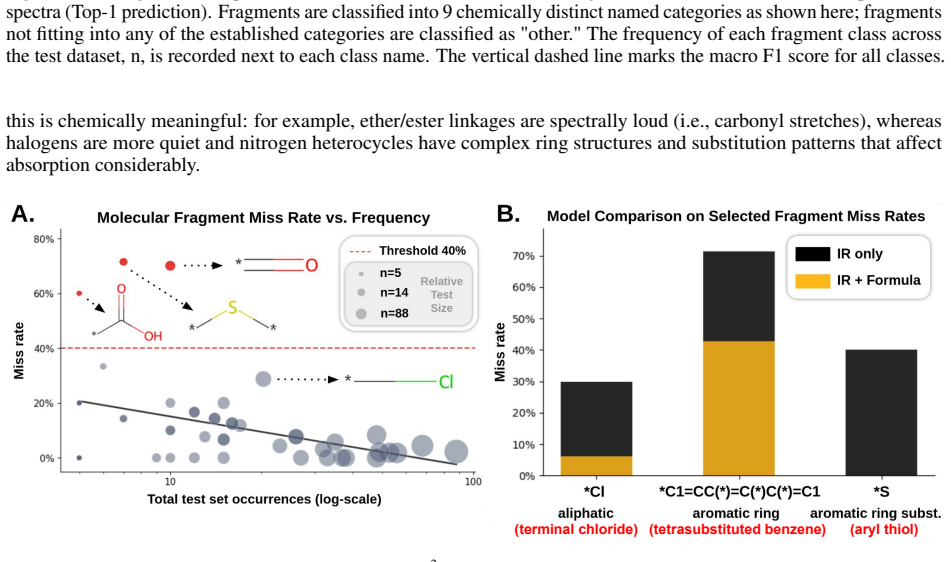
- Because spectral information largely suffices, the practical bottleneck is resolving small, spectrally quiet fragments; targeted data augmentation, higher spectral resolution, or instrument-specific fine-tuning should narrow that gap.
- The contrastive alignment also yields a spectrum-to-molecule retrieval space with high R@K accuracy, offering a second route to identification independent of beam generation.
- Pretraining on simulated molecular-dynamics spectra followed by fine-tuning on a small experimental set is a workable recipe, provided the simulations are close enough to real measurements.
Where Pith is reading between the lines
- Beyond the paper: the learned retrieval space could be used at inference time to rerank or prune beam-search candidates, a straightforward extension the paper does not test.
- Beyond the paper: because the fragment analysis implicates quiet groups that a formula resolves, an auxiliary formula-prediction head (kept out of the decoder input) may recover much of the formula-conditioned advantage without compromising the formula-free claim.
- Beyond the paper: the same fuzzy MoE aggregation should transfer to other spectral modalities or multi-source structure elucidation, where expert redundancy and synergy are chemically meaningful; this is conjecture, not a claim of the paper.
- Beyond the paper: the observed performance drop at high SMILES augmentation likely comes from the contrastive loss treating augmented copies of the same molecule as negatives; treating same-molecule augmentations as positives is a testable fix.
Editorial analysis
A structured set of objections, weighed in public.
Referee Report
Summary. This manuscript proposes a formula-free encoder-decoder transformer for IR-to-SMILES structure elucidation. It replaces the standard dense decoder FFN with an MoE layer whose expert outputs are combined by linear convex sum, LOSN, or 2-additive Choquet (ChIMP), and fuses encoder layer outputs with LOSN/ChIMP. It also adds a CoCa-style contrastive alignment loss. Experiments on IBM-MD simulated spectra, QM9S, and NIST experimental spectra after fine-tuning report Top-1/5/10 accuracy; the best model (MoE-LOSN) achieves 27.12/44.62/53.96 on IBM-MD and 31.83/50.13/57.23 on NIST. The abstract claims >10 pp improvement over the dense FFN baseline on QM9S. The paper also introduces substructure-level fragment evaluation, including BRICS and custom sp3-cut fragmentation.
Significance. The formula-free setting is a genuine contribution: most prior IR-to-structure work conditions on a molecular formula, and removing this constraint is practically relevant. The substructure evaluation methodology is a useful diagnostic that goes beyond exact-match accuracy. The manuscript provides detailed ablations and promises open source code. However, the central architectural claim — that non-additive LOSN/ChIMP aggregation is responsible for the observed gains — is undermined by an active-parameter confound in the decoder ablation. There are also internal inconsistencies in the ChIMP and temperature specifications, and the headline improvement is supported only on one dataset. These issues must be resolved before the empirical conclusions can be accepted.
major comments (5)
- [Section 5.4, Table 3 vs Section 3.3, Eqs. (8)-(9)] The decoder ablation is not capacity-controlled. The text states MoE-LCS uses 8 experts with k=4 and that the active parameters match the dense FFN. MoE-LOSN and MoE-ChIMP aggregate over all E=8 expert outputs per Eqs. (8)-(9), so they activate and compute twice as many expert FFN parameters. The observed gains, e.g., QM9S Top-1 63.28 vs 55.58 (MoE-LOSN vs MoE-LCS) and 63.28 vs 52.15 (vs dense FFN), may therefore reflect 2x active expert capacity rather than the aggregation operator. The paper acknowledges a load-balancing asymmetry but not this parameter-count asymmetry. Please add controlled comparisons: e.g., a top-4 LCS with matched active parameters, a dense FFN with doubled width, or fMoE variants restricted to the same expert subset.
- [Appendix A.3, Table 5 vs Section 3.1, Eq. (3)] The contrastive temperature x03C4 is specified as 'learned, initialized at 0.07' in Table 5, while the main text says 'initialized to 1 and exponentiated during training.' Since x03C4 directly scales the InfoNCE logits, this inconsistency changes the effective loss. Please clarify whether x03C4 is the temperature itself or its log-scale parameter, and report the actual initial value used in the experiments.
- [Appendix A.3, Table 6 and Eq. (9)] ChIMP group size is specified as 64 with 8 groups for d_model=512, but Eq. (9) applies the Choquet integral per output dimension over E=8 expert outputs. If the Choquet integral is applied per group of 64 dimensions, the number of learned interaction terms and the sorting semantics differ from the per-dimension description. If it is applied per dimension, the 'group size' is irrelevant. This needs clarification because the parameter count and the operation depend on it.
- [Abstract and Table 3] The claim of 'over 10 percentage points' improvement is only supported on QM9S (Top-1: 63.28 vs 52.15 for dense FFN). On IBM-MD the improvement is 2.91 pp and on NIST 4.62 pp. The abstract should qualify the claim by dataset, or the main text should explicitly restrict the headline to QM9S.
- [Tables 1-3] No variance or statistical significance information is reported. Several comparisons in Table 3 are small (e.g., MoE-ChIMP vs MoE-LCS on NIST: +1.00 Top-1, -2.85 Top-5, +3.41 Top-10). Without multiple seeds or confidence intervals, it is unclear which differences are meaningful. In addition, Table 1's prior-baseline numbers are taken from different papers without confirming identical preprocessing (resolution, duplicate removal, atom filters, test splits); the 'state-of-the-art' statement should be restricted to the setup actually matched.
minor comments (5)
- [Section 5.4] Typo: 'wheras' should be 'whereas'.
- [Appendix A.2, Eq. (16)] The notation 'A_{x03C0(j)} = 0' should presumably be 'A_{x03C0(0)} = x2205' (empty set) in the definition of the Choquet integral.
- [Section 5.3] The sentence 'the observed performance differences are purely attributable to the inductive bias of the aggregation operator' overstates the evidence; parameter counts are close but not identical, and training dynamics differ.
- [Table 4] The formula-conditioned variants (Dense FFN with formula; MoE-LOSN with formula) are not described in the Methods. Please specify how the formula is injected and whether this matches the prior formula-conditioned baselines.
- [Figure 1] Caption punctuation: 'In(B)' and 'In(A)' should be formatted consistently (e.g., 'In (B)' and 'In (A)').
Circularity Check
No significant circularity: main claims rest on held-out empirical ablations; self-citations supply operator definitions, not evidence of efficacy.
full rationale
The paper's central claims are empirical and externally anchored: Table 3 compares MoE-LOSN/MoE-ChIMP/MoE-LCS/dense FFN on held-out IBM-MD, QM9S, and NIST test sets; Table 1 benchmarks against prior work (Alberts et al., Wu et al.). No reported accuracy or retrieval number is a refit of its own target. The self-citations to LOSN (Veal et al. 2019), ChIMP (Islam et al. 2020), and ELOS (Kakula et al. 2020) define the aggregation operators and are used as architectural building blocks ('In previous work, we formalized the extended linear order statistic (ELOS)... This generalization is utilized for the LOSN in this work,' Sec. 3.2); they are not invoked to prove that the operators improve IR-to-SMILES accuracy. That proof is the paper's own ablation. The only explicit self-referential caveat is in Sec. 3.3: 'because MoE-LOSN and MoE-ChIMP aggregate over all E expert outputs... they are subject to no comparable collapse pressure and are trained without it. This asymmetry should be taken into account... not a controlled one.' That caveat concerns expert-utilization analysis, not the accuracy claims. A real confound exists in Table 3: Sec. 5.4 says 'The total active parameters of these 4 experts match the parameter count of the dense FFN for consistency,' but Eqs. 8-9 define MoE-LOSN/ChIMP as aggregating over all E=8 experts, so those variants have 2x active expert parameters. This is a capacity confound and a correctness risk, but it is not a circular reduction: including more experts does not by construction force the observed ordering (MoE-ChIMP underperforms MoE-LOSN), and no equation equates the fuzzy aggregation output with the comparison target. On the circularity question, the derivation chain is self-contained.
Axiom & Free-Parameter Ledger
free parameters (7)
- contrastive temperature τ =
0.07 (initialized; learned)
- alignment loss weight λ =
1.0
- beam width =
10
- number of experts E =
8
- top_k =
4
- SMILES enumeration degree =
6
- ChIMP group size =
64
axioms (6)
- domain assumption PCFF molecular-dynamics simulated IR spectra approximate experimental IR sufficiently for transfer learning
- domain assumption SMILES string sequence (with canonicalization and InChI equivalence) is a valid target representation for molecular structure
- standard math InfoNCE contrastive loss on in-batch negatives yields a latent geometry where retrieval R@K is meaningful
- domain assumption Beam search with width 10 and validity filtering approximates the model's true top-K distribution
- ad hoc to paper The custom sp3-cut fragmentation and BRICS decomposition provide chemically meaningful error decompositions
- ad hoc to paper The model's failure modes reflect spectral information content rather than decoder capacity limits
Cite this review
Pith. "Pith review of Data Fusion and Contrastive Alignment for Unconstrained IR Molecular Structure Elucidation." pith.science (2026). https://pith.science/paper/6IFBXAAV
@misc{pith2026260726164,
  author       = {Pith},
  title        = {Pith review of: Data Fusion and Contrastive Alignment for Unconstrained IR Molecular Structure Elucidation},
  year         = {2026},
  howpublished = {\url{https://pith.science/paper/6IFBXAAV}},
  note         = {Machine review of arXiv:2607.26164}
}
read the original abstract
Automated molecular structure elucidation from infrared (IR) spectroscopy data has seen significant advancements in recent years, but its broad applicability is limited by a reliance on pre-determined chemical formulas provided as auxiliary model inputs. This limits model predictions to isomer identification rather than full molecular structure prediction. Although transformer models have been shown to identify molecular isomers with high accuracy, their reliability for unconstrained structure elucidation is comparatively low and poorly understood. In this work, we propose and evaluate key modifications to the traditional encoder-decoder transformer. To better address the vast chemical space of the unconstrained problem, we implement a novel Mixture-of-Experts (MoE) decoder module that utilizes non-additive aggregation via linear-order statistics and the Choquet integral. We further modify the transformer to utilize these non-additive operators when aggregating spectral representations as well. Together with an auxiliary contrastive alignment loss term, these enhancements improve Top-K prediction accuracy by over 10 percentage points compared to baseline IR-only models. Through sub-structure fragment analysis of molecular predictions, we further confirm that infrared spectra encode the vast majority of relevant chemical information, implying that the higher performance of isomer-ranking models is largely due to underrepresented or overlapping absorption bands for molecules in the explored chemical space. Ultimately, by demonstrating the efficacy of automated molecular structure elucidation from measured IR spectra, this work serves to significantly broaden the utility of AI in analytical chemistry.
Figures




Reference graph
Works this paper leans on
-
[1]
Klein.Organic Chemistry
David R. Klein.Organic Chemistry. Wiley Global Education, 2013. 15 arXivTemplateA PREPRINT
2013
-
[2]
Griffiths.Handbook of Vibrational Spectroscopy
Peter R. Griffiths.Handbook of Vibrational Spectroscopy. Wiley Global Education, 2006
2006
-
[3]
Interpretation of infrared spectra, a practical approach.Encyclopedia of analytical chemistry, 12:10815–10837, 2000
John Coates et al. Interpretation of infrared spectra, a practical approach.Encyclopedia of analytical chemistry, 12:10815–10837, 2000
2000
-
[4]
Elsevier, 2017
Peter Larkin.Infrared and Raman spectroscopy: principles and spectral interpretation. Elsevier, 2017
2017
-
[5]
Marvin Alberts, Federico Zipoli, and Teodoro Laino. Leveraging infrared spectroscopy for automated structure elucidation.Chemistry Communications, 7, 2024. doi:https://doi.org/10.1038/s42004-024-01341-w
-
[6]
Mikhail Elyashberg and Dimitris Argyropoulos. Computer-assisted structure elucidation (case): Current and future perspectives.Magnetic Resonance in Chemistry, 59:667–668, 07 2021. doi:10.1002/mrc.5162
-
[7]
Jonathan A. Fine, Anand A. Rajasekar, Krupal P. Jethava, and Gaurav Chopra. Spectral deep learn- ing for prediction and prospective validation of functional groups.Chem. Sci., 11:4618–4630, 2020. doi:https://doi.org/10.1039/C9SC06240H
-
[8]
Abigail A. Enders, Nicole M. North, Chase M. Fensore, Juan Velez-Alvarez, and Heather C. Allen. Functional group identification for ftir spectra using image-based machine learning models.Analytical Chemistry, 93(28): 9711–9718, 2021. doi:https://doi.org/10.1021/acs.analchem.1c00867. PMID: 34190551
-
[9]
Guwon Jung, Son Gyo Jung, and Jacqueline M Cole. Automatic materials characterization from infrared spectra using convolutional neural networks.Chemical Science, 14(13):3600–3609, 2023. doi:https://doi.org/10.1039/D2SC05892H
-
[10]
Guy W. Bemis and Mark A. Murcko. The properties of known drugs. 1. molecular frameworks.Journal of Medicinal Chemistry, 39(15):2887–2893, 1996. doi:https://doi.org/10.1021/jm9602928. PMID: 8709122
-
[11]
Gomez, Lukasz Kaiser, and Illia Polosukhin
Ashish Vaswani, Noam Shazeer, Niki Parmar, Jakob Uszkoreit, Llion Jones, Aidan N. Gomez, Lukasz Kaiser, and Illia Polosukhin. Attention is all you need, 2023. URLhttps://arxiv.org/abs/1706.03762
Pith/arXiv arXiv 2023
-
[12]
Wenjin Wu, Aleš Leonardis, Jianbo Jiao, Jun Jiang, and Linjiang Chen. Transformer-based models for predicting molecular structures from infrared spectra using patch-based self-attention.The Journal of Physical Chemistry A, 129(8):2077–2085, 2025. doi:https://doi.org/10.1021/acs.jpca.4c05665. PMID: 39951543
-
[13]
Marvin Alberts, Federico Zipoli, and Teodoro Laino. Setting new benchmarks in ai-driven infrared structure elucidation.Digital Discovery, 4:1936–1943, 2025. doi:https://doi.org/10.1039/D5DD00131E
-
[14]
An image is worth 16x16 words: Transformers for image recognition at scale, 2021
Alexey Dosovitskiy et al. An image is worth 16x16 words: Transformers for image recognition at scale, 2021. URLhttps://arxiv.org/abs/2010.11929
Pith/arXiv arXiv 2021
-
[15]
Smiles, a chemical language and information system
David Weininger. Smiles, a chemical language and information system. 1. introduction to methodol- ogy and encoding rules.Journal of Chemical Information and Computer Sciences, 28(1):31–36, 1988. doi:https://doi.org/10.1021/ci00057a005
-
[16]
Yongqi Jin, Jun-Jie Wang, Fanjie Xu, Xiaohong Ji, Zhifeng Gao, Linfeng Zhang, Guolin Ke, Rong Zhu, and Weinan E. Nmr-solver: Automated structure elucidation via large-scale spectral matching and physics-guided fragment optimization, 2025. URLhttps://arxiv.org/abs/2509.00640
Pith/arXiv arXiv 2025
-
[17]
Unraveling molecular structure: A multimodal spectroscopic dataset for chemistry, 2024
Marvin Alberts, Oliver Schilter, Federico Zipoli, Nina Hartrampf, and Teodoro Laino. Unraveling molecular structure: A multimodal spectroscopic dataset for chemistry, 2024. URL https://arxiv.org/abs/2407. 17492
2024
-
[18]
Lewis, Magnus J
Martin Priessner, Richard J. Lewis, Magnus J. Johansson, Jonathan M. Goodman, Jon Paul Janet, and Anna Tomberg. Enhancing molecular structure elucidation with reasoning-capable llms.Digital Discovery, 5:1237–1251,
-
[19]
Na, Kibum Kim, and Chanyoung Park
Heewoong Noh, Namkyeong Lee, Gyoung S. Na, Kibum Kim, and Chanyoung Park. Ir-agent: Expert-inspired llm agents for structure elucidation from infrared spectra, 2025. URL https://arxiv.org/abs/2508.16112
Pith/arXiv arXiv 2025
-
[20]
Outrageously large neural networks: The sparsely-gated mixture-of-experts layer
Noam Shazeer, Azalia Mirhoseini, Krzysztof Maziarz, Andy Davis, Quoc Le, Geoffrey Hinton, and Jeff Dean. Outrageously large neural networks: The sparsely-gated mixture-of-experts layer. InInternational Conference on Learning Representations, 2017. URLhttps://openreview.net/forum?id=B1ckMDqlg
2017
-
[21]
Switch transformers: Scaling to trillion parameter models with simple and efficient sparsity.Journal of Machine Learning Research, 23(120):1–39, 2022
William Fedus, Barret Zoph, and Noam Shazeer. Switch transformers: Scaling to trillion parameter models with simple and efficient sparsity.Journal of Machine Learning Research, 23(120):1–39, 2022. URL http: //jmlr.org/papers/v23/21-0998.html
2022
-
[22]
Anderson, Grant Scott, James M Keller, Timothy C
Charlie Veal, Alex Yang, Alex Hurt, Muhammad Aminul Islam, Derek T. Anderson, Grant Scott, James M Keller, Timothy C. Havens, and Bo Tang. Linear order statistic neuron. In2019 IEEE International Conference on Fuzzy Systems (FUZZ-IEEE), pages 1–6, 2019. doi:https://doi.org/10.1109/FUZZ-IEEE.2019.8858802. 16 arXivTemplateA PREPRINT
arXiv 2019
-
[23]
Muhammad Aminul Islam, Derek T. Anderson, Anthony J. Pinar, Timothy C. Havens, Grant Scott, and James M. Keller. Enabling explainable fusion in deep learning with fuzzy integral neural networks.IEEE Transactions on Fuzzy Systems, 28(7):1291–1300, 7 2020. doi:https://doi.org/10.1109/tfuzz.2019.2917124
arXiv 2020
-
[24]
Colin Zhang and Yang Ha. Toward complete molecular structure prediction from infrared spec- troscopy using deep learning.Journal of chemical information and modeling, 66, 12 2025. doi:https://doi.org/10.1021/acs.jcim.5c01834
-
[25]
Representation learning with contrastive predictive coding,
Aaron van den Oord, Yazhe Li, and Oriol Vinyals. Representation learning with contrastive predictive coding,
-
[26]
Learning transferable visual models from natural language supervision, 2021
Alec Radford, Jong Wook Kim, Chris Hallacy, Aditya Ramesh, Gabriel Goh, Sandhini Agarwal, Girish Sastry, Amanda Askell, Pamela Mishkin, Jack Clark, Gretchen Krueger, and Ilya Sutskever. Learning transferable visual models from natural language supervision, 2021. URLhttps://arxiv.org/abs/2103.00020
Pith/arXiv arXiv 2021
-
[27]
Coca: Contrastive captioners are image-text foundation models.Transactions on Machine Learning Research, 2022
Jiahui Yu, Zirui Wang, Vijay Vasudevan, Legg Yeung, Mojtaba Seyedhosseini, and Yonghui Wu. Coca: Contrastive captioners are image-text foundation models.Transactions on Machine Learning Research, 2022. ISSN 2835-8856. URLhttps://openreview.net/forum?id=Ee277P3AYC
2022
-
[28]
Yuyang Wang, Jianren Wang, Zhonglin Cao, and Amir Barati Farimani. Molecular contrastive learn- ing of representations via graph neural networks.Nature Machine Intelligence, 4:1–9, 03 2022. doi:https://doi.org/10.1038/s42256-022-00447-x
-
[29]
Pau Rocabert-Oriols, Camilla Lo Conte, Núria López, and Javier Heras-Domingo. Multi-modal con- trastive learning for chemical structure elucidation with vibraclip.Digital Discovery, 4:3818–3827, 2025. doi:https://doi.org/10.1039/D5DD00269A
-
[30]
Adrian Mirza, Luc Patiny, and Kevin Maik Jablonka. End-to-end multimodal structure elucidation from raw spectra combining contrastive learning and evolutionary algorithms.Nature Communications, 17(5013), 2026. doi:https://doi.org/10.1038/s41467-026-73846-y
-
[31]
Toshiaki Murofushi and Michio Sugeno. A theory of fuzzy measures: Representations, the choquet integral, and null sets.Journal of Mathematical Analysis and Applications, 159(2):532–549, 1991. ISSN 0022-247X. doi:https://doi.org/10.1016/0022-247X(91)90213-J
-
[32]
R.R. Yager. On ordered weighted averaging aggregation operators in multicriteria decisionmaking.IEEE Transactions on Systems, Man, and Cybernetics, 18(1):183–190, 1988. doi:https://doi.org/10.1109/21.87068
doi:10.1109/21.87068 1988
-
[33]
Generalized choquet fuzzy integral fusion
Sansanee Auephanwiriyakul, James M Keller, and Paul D Gader. Generalized choquet fuzzy integral fusion. Information Fusion, 3(1):69–85, 2002. ISSN 1566-2535. doi:https://doi.org/10.1016/S1566-2535(01)00054-9
-
[34]
Michel Grabisch and Christophe Labreuche. A decade of application of the choquet and sugeno integrals in multi-criteria decision aid.Annals of Operations Research, 175, 04 2008. doi:https://doi.org/10.1007/s10288-007- 0064-2
-
[35]
Xing Shi, Inkit Padhi, and Kevin Knight. Does string-based neural mt learn source syntax? InProceedings of the 2019 Conference on Empirical Methods in Ntural Language Processing, pages 1526–1534, 01 2016. doi:https://doi.org/10.18653/v1/D16-1159
-
[36]
Peters, Mark Neumann, Mohit Iyyer, Matt Gardner, Christopher Clark, Kenton Lee, and Luke Zettlemoyer
Matthew E. Peters, Mark Neumann, Mohit Iyyer, Matt Gardner, Christopher Clark, Kenton Lee, and Luke Zettlemoyer. Deep contextualized word representations. InProceedings of the 2018 Conference of the North American Chapter of the Association for Computational Linguistics: Human Language Technologies, V olume 1 (Long Papers), pages 2227–2237, New Orleans, L...
-
[37]
Exploiting deep representations for neural machine translation
Zi-Yi Dou, Zhaopeng Tu, Xing Wang, Shuming Shi, and Tong Zhang. Exploiting deep representations for neural machine translation. InProceedings of the 2018 Conference on Empirical Methods in Natural Language Processing, pages 4253–4262, Brussels, Belgium, October-November 2018. Association for Computational Linguistics. doi:https://doi.org/10.18653/v1/D18-1457
-
[38]
Gtrans: Grouping and fusing transformer layers for neural machine translation
Jian Yang, Yuwei Yin, Liqun Yang, Shuming Ma, Haoyang Huang, Dongdong Zhang, Furu Wei, and Zhoujun Li. Gtrans: Grouping and fusing transformer layers for neural machine translation. IEEE/ACM Trans. Audio, Speech and Lang. Proc., 31:1489–1498, November 2022. ISSN 2329-9290. doi:https://doi.org/10.1109/TASLP.2022.3221040
arXiv 2022
-
[39]
Adaptive mixtures of local experts.Neural Computation, 3:79–87, 03 1991
Robert Jacobs, Michael Jordan, Steven Nowlan, and Geoffrey Hinton. Adaptive mixtures of local experts.Neural Computation, 3:79–87, 03 1991. doi:https://doi.org/10.1162/neco.1991.3.1.79
-
[40]
From sparse to soft mixtures of experts
Joan Puigcerver, Carlos Riquelme Ruiz, Basil Mustafa, and Neil Houlsby. From sparse to soft mixtures of experts. InInternational Conference on Learning Representations, volume 2024, 17 arXivTemplateA PREPRINT pages 28435–28445, 2024. URL https://proceedings.iclr.cc/paper_files/paper/2024/file/ 79fea214543ba263952ac3f4e5452b14-Paper-Conference.pdf
2024
-
[41]
Soft merging of experts with adaptive routing.Transac- tions on Machine Learning Research, 2024
Mohammed Muqeeth, Haokun Liu, and Colin Raffel. Soft merging of experts with adaptive routing.Transac- tions on Machine Learning Research, 2024. ISSN 2835-8856. URL https://openreview.net/forum?id= 7I199lc54z. Featured Certification
2024
-
[42]
Stanton R. Price, Steven R. Price, and Derek T. Anderson. Introducing fuzzy layers for deep learn- ing. In2019 IEEE International Conference on Fuzzy Systems (FUZZ-IEEE), pages 1–6. IEEE, 6 2019. doi:https://doi.org/10.1109/fuzz-ieee.2019.8858790
arXiv 2019
-
[43]
Jimmy Lei Ba, Jamie Ryan Kiros, and Geoffrey E. Hinton. Layer normalization, 2016. URL https://arxiv. org/abs/1607.06450
Pith/arXiv arXiv 2016
-
[44]
Extended linear order statistic (elos) aggregation and regression
Siva Krishna Kakula, Anthony Pinar, Timothy Havens, and Derek Anderson. Extended linear order statistic (elos) aggregation and regression. In2020 IEEE International Conference on Fuzzy Systems (FUZZ-IEEE), 07 2020. doi:https://doi.org/10.1109/FUZZ48607.2020.9177595
arXiv 2020
-
[45]
Michel Grabisch. k-order additive discrete fuzzy measures and their representation.Fuzzy Sets and Systems, 92 (2):167–189, 1997. ISSN 0165-0114. doi:https://doi.org/10.1016/S0165-0114(97)00168-1. Fuzzy Measures and Integrals
-
[46]
W. E. Wallace. Infrared spectra. InNIST Chemistry WebBook, NIST Standard Reference Database Number 69. National Institute of Standards and Technology, Gaithersburg, MD 20899, 2024
2024
-
[47]
Zihan Zou, Yujin Zhang, Lijun Liang, Mingzhi Wei, Jiancai Leng, Jun Jiang, Yi Luo, and Wei Hu. A deep learning model for predicting selected organic molecular spectra.Nature Computational Science, 3:1–8, 11 2023. doi:https://doi.org/10.1038/s43588-023-00550-y
-
[48]
Hunter, Costas Bekas, and Alpha A
Philippe Schwaller, Teodoro Laino, Théophile Gaudin, Peter Bolgar, Christopher A. Hunter, Costas Bekas, and Alpha A. Lee. Molecular transformer: A model for uncertainty-calibrated chemical reaction prediction.ACS Central Science, 5(9):1572–1583, 2019. doi:https://doi.org/10.1021/acscentsci.9b00576. PMID: 31572784
-
[49]
Smiles enumeration as data augmentation for neural network modeling of molecules, 2017
Esben Jannik Bjerrum. Smiles enumeration as data augmentation for neural network modeling of molecules, 2017. URLhttps://arxiv.org/abs/1703.07076
Pith/arXiv arXiv 2017
-
[50]
rdkit/rdkit: 2026_03_3 (Q1 2026) Release
Greg Landrum et al. rdkit/rdkit: 2026_03_3 (Q1 2026) Release. URL https://zenodo.org/records/ 20446949
2026
-
[51]
Stephen Heller, Alan McNaught, Stephen Stein, Dmitrii Tchekhovskoi, and Igor Pletnev. Inchi - the worldwide chemical structure identifier standard.Journal of cheminformatics, 5:7, 01 2013. doi:10.1186/1758-2946-5-7
-
[52]
Dávid Bajusz, Anita Rácz, and Károly Héberger. Why is tanimoto index an appropriate choice for fingerprint-based similarity calculations?Journal of Cheminformatics, 7(20), 05 2015. doi:https://doi.org/10.1186/s13321-015- 0069-3
-
[53]
Machine learning molecular dynamics for the simulation of infrared spectra.Chem
Michael Gastegger, Jörg Behler, and Philipp Marquetand. Machine learning molecular dynamics for the simulation of infrared spectra.Chem. Sci., 8, 08 2017. doi:https://doi.org/10.1039/C7SC02267K
-
[54]
Jörg Degen, Christof Wegscheid-Gerlach, Andrea Zaliani, and Matthias Rarey. On the art of compiling and using ’drug-like’ chemical fragment spaces.ChemMedChem, 3:1503–7, 10 2008. doi:https://doi.org/10.1002/cmdc.200800178
-
[55]
The national research platform: Stretched, multi-tenant, scientific kubernetes cluster
Derek Weitzel et al. The national research platform: Stretched, multi-tenant, scientific kubernetes cluster. In Practice and Experience in Advanced Research Computing 2025: The Power of Collaboration, PEARC ’25, New York, NY , USA, 2025. Association for Computing Machinery. doi:https://doi.org/10.1145/3708035.3736060
arXiv 2025
-
[56]
Improving language understanding by generative pre-training, 2018
Alec Radford, Karthik Narasimhan, Tim Salimans, Ilya Sutskever, et al. Improving language understanding by generative pre-training, 2018
2018
-
[57]
Roformer: Enhanced transformer with rotary position embedding, 2023
Jianlin Su, Yu Lu, Shengfeng Pan, Ahmed Murtadha, Bo Wen, and Yunfeng Liu. Roformer: Enhanced transformer with rotary position embedding, 2023. URLhttps://arxiv.org/abs/2104.09864
Pith/arXiv arXiv 2023
-
[58]
Jerret Ross, Brian Belgodere, Vijil Chenthamarakshan, Inkit Padhi, Youssef Mroueh, and Payel Das. Large-scale chemical language representations capture molecular structure and properties.Nature Machine Intelligence, 4(12): 1256–1264, 2022. doi:https://doi.org/10.1038/s42256-022-00580-7
-
[59]
Pinar, Muhammad Aminul Islam, Derek T
Siva Krishna Kakula, Anthony J. Pinar, Muhammad Aminul Islam, Derek T. Anderson, and Timothy C. Havens. Novel regularization for learning the fuzzy choquet integral with limited training data.IEEE Transactions on Fuzzy Systems, 29(10):2890–2901, 2021. doi:https://doi.org/10.1109/TFUZZ.2020.3009722. 18 arXivTemplateA PREPRINT A Implementation Details A.1 A...
arXiv 2021
-
[2019]
URLhttps://arxiv.org/abs/1807.03748
-
[2026]
doi:https://doi.org/10.1039/D5DD00359H
This paper was first reviewed by deepseek-v4-flash on August 1, 2026.
discussion (0)
Sign in with ORCID, Apple, or X to comment. Anyone can read and Pith papers without signing in.