REVIEW 5 major objections 5 minor 34 references
Question-Answer Extraction from Scientific Articles Using Knowledge Graphs and Large Language Models
T0 review · 5 major / 5 minor · reviewed 2026-08-06 · deepseek-v4-flash
Pith's one-line read Triplet-based QA extraction beats paragraph-based extraction in expert scores, and fine-tuning the relation extractor on scientific text is decisive for triplet quality.
desk verdict Solid two-pipeline QA generation paper with a clean new saliency formula, but the 'fine-tuning is crucial' claim rests on a circular LLM-as-judge evaluation that needs redoing. read the letter →
The pith
A machine-rendered reading of the paper's core claim, the machinery that carries it, and where it could break.
The reading
What carries the argument
The load-bearing mechanism is the triplet saliency score that decides which entity-relationship triplets deserve questions. For a triplet $T=(h,r,t)$, the score is $S_T = S^{\text{graph}}_T \cdot S^{\text{semantic}}_T$, where $S^{\text{graph}}_T = \min(S_h, S_t) \cdot \text{tf-idf}_{\text{triplet}}(T)$, with $S_h = \text{tf-idf}_{\text{entity}}(h)\cdot \text{pagerank}(h)$ and similarly for $S_t$. The tf-idf terms compare frequency inside the article against frequency across the corpus, so triplets that are central in the article but rare in the literature rank higher; the semantic term multiplies this by the similarity of the triplet to the article's title, abstract, and keywords. The triplets themselves come from a BART-based relation extractor (REBEL) fine-tuned on LLM-generated triplets from a representative 5% of the corpus. This score is what connects 'novelty relative to the literature' to the questions an LLM is later asked to produce.
What would settle it
Replace the LLM judge with a second, independently-prompted LLM that has never seen the fine-tuning triplets, and also verify that none of the 50 evaluation articles fall inside the 5% fine-tuning sample; if the fine-tuned model's win rate drops toward 50 percent or overlap is found, the claim that domain fine-tuning is crucial is unsupported.
Extended reading notes
Core claim
The paper claims that a knowledge-graph-based QA extraction pipeline captures the main ideas of scientific articles better than a paragraph-based pipeline and better than a plain LLM given the whole article. The KG pipeline fine-tunes a BART-based relation extractor (REBEL) on scientific text, constructs a knowledge graph per domain, ranks entity-relationship triplets using a saliency score, and feeds the top triplets to an LLM for question and answer generation. In subject-matter-expert evaluations on Computer Science and Life Sciences articles, the KG method scores higher than CCQG on every question metric (relevance, specificity, clarity) and every answer metric (relevance, factuality, specificity, completeness, grammatical correctness, reference relevance). The paper further claims that fine-tuning the triplet extraction model on a representative 5% of the scientific corpus is decisive: the fine-tuned REBEL achieves a 73.5 win rate and 0.78 accuracy, versus 26.5 and 0.58 for the off-the-shelf model, and that the proposed triplet saliency method outperforms frequency-only baselines in identifying novel, article-specific triplets.
Load-bearing premise
The entire comparison rests on trusting the LLM judge's quality scores, but that same LLM generated the training triplets, so the judge may simply be rewarding outputs that look like its own; the paper also does not state whether the 50 evaluation articles overlap with the 5% fine-tuning sample.
Editorial extensions
If this is right
- Automated literature triage becomes feasible: researchers can scan an article's key contributions as a short list of Q&A pairs before deciding to read it in full.
- Domain-adaptive relation extraction becomes a standard requirement: fine-tuning a general-purpose triplet extractor on scientific text is necessary for high-quality knowledge graphs, so domain-specific fine-tuning should be part of any scientific KG pipeline.
- Corpus-level triplet saliency, not just in-document frequency, is the right signal for identifying novel claims, which can improve novelty-oriented summarization and research discovery tools.
- The generated QA datasets (hundreds of thousands of prompts) can fine-tune small open LLMs to produce scientific questions and answers with high ROUGE scores, reducing dependence on large proprietary models for this task.
- Because each answer is generated with supporting source sentences, the QA pairs carry provenance, making them usable as auditable evaluation probes for question-answering and retrieval-augmented generation systems.
Reading between the lines
- The triplet saliency score could be repurposed as a general novelty detector for other units of scientific text, such as methods or datasets, and for other genres like patents or clinical guidelines, not just for QA generation.
- A blind preference study where human experts see only the answers, without knowing whether they came from the KG or paragraph pipeline, would separate the effect of content selection from the effect of prompt phrasing on perceived quality.
- If the judge-overlap concern is resolved by testing with an independent LLM judge, the clustering-based 5% fine-tuning strategy offers a cost-effective recipe for adapting open relation extractors to specialized corpora, which could extend to non-English scientific text.
- The generated QA pairs, complete with source paragraph references, could serve directly as a benchmark suite for evaluating how well retrieval-augmented generation systems ground their answers in scientific evidence.
Editorial analysis
A structured set of objections, weighed in public.
Referee Report
Summary. The paper proposes two approaches for generating Question-Answer (QA) pairs from full-text scientific articles: a Core Context-based QA Generation method (CCQG) that selects salient paragraphs and uses an LLM to generate and answer questions, and a Knowledge Graph-based method that first fine-tunes the REBEL relation extraction model on a scientific corpus to build a per-domain KG, then scores triplet saliency using a TF-IDF-like measure with PageRank and semantic similarity, and finally feeds the salient triplets to an LLM for QA generation. The central claims are that the KG-based method better captures the main ideas of articles, as supported by higher Subject Matter Expert (SME) scores on all metrics in both domains (Tables 1 and 2), and that fine-tuning the REBEL extractor is crucial, as supported by GPT-4-judged triplet quality scores in Table 5 (win rate 73.5 vs. 26.5; accuracy 0.78 vs. 0.58). The paper also presents automatic LLM-based evaluation, an inter-annotator agreement analysis, and a downstream experiment fine-tuning zephyr-7b-beta on the generated QA data.
Significance. If the results hold, the paper offers a practical pipeline for turning scientific articles into structured QA summaries, with a plausible mechanism for leveraging corpus-level knowledge. The strongest asset is the SME evaluation on 200 QAs, which is independent of the LLM generators and covers both questions and answers across multiple quality dimensions. The paper also makes a concrete contribution by showing how a small, topic-diverse fine-tuning set for REBEL can be constructed via clustering (Section 3.2.1). However, the reliability of the headline claims is weakened by the absence of significance tests for the SME differences, and by the heavy reliance on GPT-4 as both the labeler and the judge in triplet evaluation. These issues are load-bearing because the abstract and Section 5.1 assert superiority of the KG-based method and Section 5.2 asserts that fine-tuning is 'crucial'. The downstream fine-tuning experiment (Section 5.4) is an interesting application, though its reported ROUGE scores are suspiciously high and need clarification.
major comments (5)
- [Section 5.1, Tables 1 and 2] The claim that the KG-based method outperforms CCQG in SME evaluation rests solely on aggregate normalized scores, e.g., question relevance 0.93 vs. 0.86 for Computer Science and 0.95 vs. 0.83 for Life Sciences. No significance test, confidence interval, per-article variance, or number of QAs per cell is provided. With only 200 QAs in total (20 articles per domain, top-5 QAs per article), the observed differences could easily arise from a few outlier articles or QAs. Please report per-article scores and a paired statistical test (e.g., Wilcoxon signed-rank on article-level aggregates) for each metric and each domain, or explicitly temper the claim to 'numerically higher' if the differences are not significant.
- [Section 4.1 vs. Section 3.2.1] The triplet evaluation uses 50 Computer Science articles from the same 20,000-article corpus from which a 5% fine-tuning sample was drawn via clustering (Section 3.2.1). The paper never states that the 50 evaluation articles are disjoint from the documents used to generate the fine-tuning labels. If overlap exists, the fine-tuned REBEL's higher win rate and accuracy in Table 5 could partly reflect memorization of the training distribution, not generalizable improvement. Please state explicitly whether the 50 evaluation articles are disjoint from the fine-tuning set, and, if not, re-run the evaluation on a held-out disjoint set.
- [Sections 3.2.1 and 4.2.2, Table 5] The triplet extraction evaluation is circular in an important sense: the fine-tuning labels were generated by an LLM, and the judge for triplet quality is GPT-4, presumably from the same model family. If GPT-4 systematically assigns higher quality to triplets that resemble its own generation style, the fine-tuned model, which was trained to imitate that style, will be rewarded regardless of true triplet correctness. This compromises the strong conclusion that fine-tuning is 'crucial' (abstract and Section 5.2). Please add a human evaluation on a sample of triplets, or use a judge from a different model family (and ideally a different generation paradigm), or at least explicitly acknowledge this confound and soften the causal claim.
- [Section 5.3, Figure 6] The salient triplet extraction comparison also relies on GPT-4 as the source of relevance labels for computing win rate and MRR, with no human validation or analysis of judge bias. Because the triplets being ranked come from the fine-tuned REBEL model, which was trained on LLM-generated labels, the evaluation of the saliency method is not fully independent of the LLM. While this is a secondary result, the paper should either justify why this reliance is acceptable or provide a small human-judged validation set to confirm that GPT-4's preferences align with human judgments for this task.
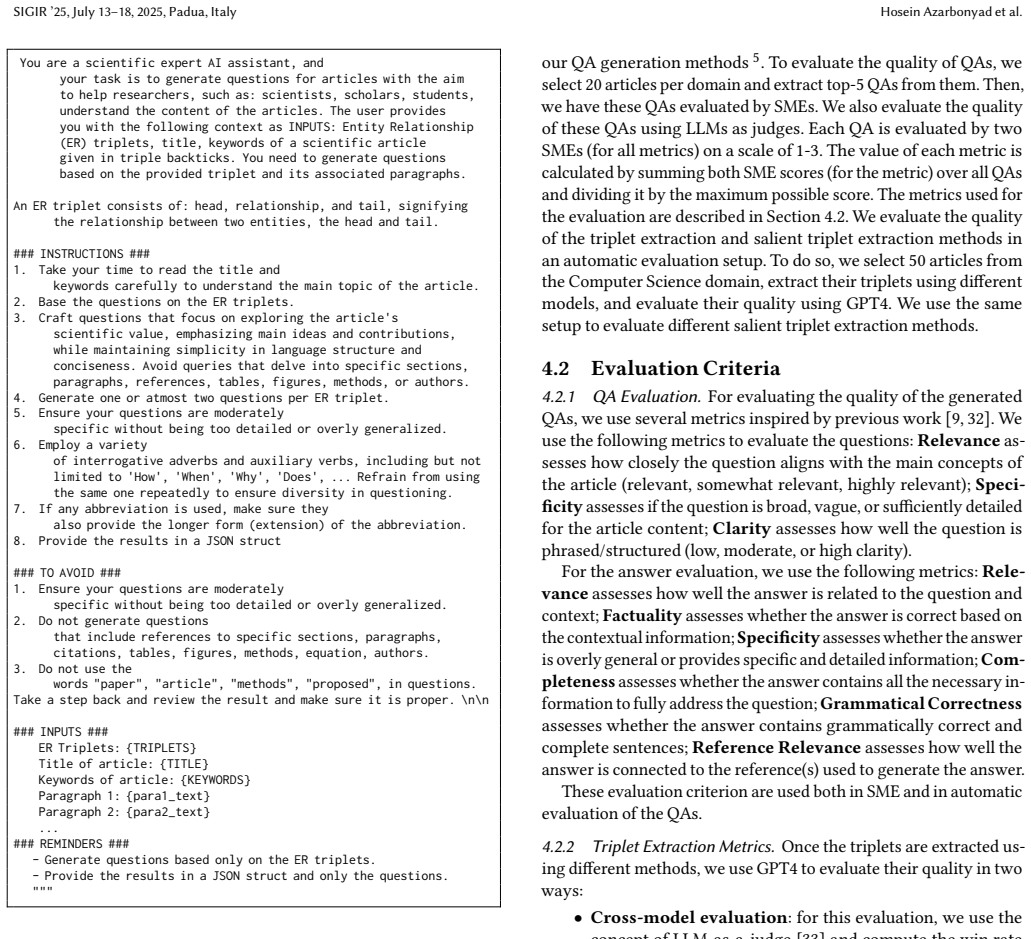
- [Section 5.4, Table 6] The downstream fine-tuning experiment reports ROUGE-1 of 0.89 for question generation and 0.96 for answer generation on the 20% evaluation split. These values are unusually high for generative text and suggest that the targets may be largely extractive or that the evaluation set overlaps with the training distribution in a trivial way. Please clarify whether the generated answers are mostly copied from the provided paragraphs (which the answer prompt explicitly allows), and discuss what the ROUGE scores imply for the usefulness of this dataset for training new models.
minor comments (5)
- [Section 5.3] The text contains a typo: 'Computer Science cropus' should be 'Computer Science corpus'.
- [Section 3.2.4] The selection of top-m = 10 triplet groups is presented without sensitivity analysis; a brief justification or a small ablation would help the reader understand how sensitive the downstream QA quality is to this hyperparameter.
- [Section 4.1] The description of the dataset says 'we select 20 articles per domain and extract top-5 QAs from them,' but it is unclear whether the top-5 QAs are chosen from the full generated set or from the ranked list after filtering; please clarify the selection procedure.
- [Section 4.4] Only the general sentence-transformer model name is given; for reproducibility, the exact truncation/window sizes used for chunking articles for triplet extraction should also be reported.
- [Table 4] The baseline QA example asks questions about specific diseases and clinical features, while the CCQG and KG questions are more general; this example does not clearly demonstrate the superiority of the KG method and could be replaced with a less cherry-picked comparison.
Circularity Check
The 'fine-tuning is crucial' claim rests on a partially circular evaluation loop: the triplet labels used to fine-tune REBEL are LLM-generated, and the triplet 'quality' is then judged by GPT-4, so Table 5 partly measures agreement with the judge's own output style.
-
fitted input called prediction
[Section 3.2.1 (fine-tuning data creation) and Section 4.2.2 / Table 5 (triplet quality evaluation)]
"To create a text-to-ER triplet dataset with D, we feed the articles in chunks to an LLM to generate the ER triplets for each article. We then use the (chunk, triplet) pair to fine-tune the REBEL model as our triplet extraction model. ... Once the triplets are extracted using different methods, we use GPT4 to evaluate their quality ... ask GPT4 to assign a binary label per triplet reflecting whether the triplet is correctly extracted or not."
The fine-tuned REBEL is fitted to reproduce LLM-generated triplet labels, and its 'quality' is then measured by GPT-4, an LLM judge. The reported win rate (73.5 vs 26.5) and accuracy (0.78 vs 0.58) therefore partly reward the fine-tuned model for conforming to the judge's own extraction style rather than to an independent ground truth; no human triplet-level evaluation is reported. This makes the abstract's claim that fine-tuning is 'crucial' an evaluation-loop artifact to an unknown degree, though the downstream QA comparison is independently human-rated.
full rationale
Most of the paper's headline QA result is not circular: the KG-based QA advantage over CCQG is grounded in SME judgments on relevance, specificity, clarity, factuality, etc. (Section 5.1, Tables 1-2), which are external to the generators. The main circularity is confined to RQ2/triplet extraction: the fine-tuning labels are produced by an LLM and the triplet-quality judge is GPT-4, so Table 5's large win for the fine-tuned REBEL is partly a self-agreement effect rather than a demonstration of intrinsic extraction quality. There is also an unstated possible overlap between the 5% fine-tuning sample (Section 3.2.1) and the 50 CS articles used for triplet evaluation (Section 4.1), which would further inflate the fine-tuned model's scores; this is a leakage risk rather than a demonstrated circular reduction. Because the central QA claim retains independent human grounding, the partial circularity in the triplet-evaluation chain does not collapse the whole paper; score 4 rather than 6+.
Assumptions & free parameters
free parameters (6)
- Salient paragraph similarity threshold =
0.7
- Top-m triplet groups =
10
- Max paragraphs per question K =
3
- Max questions per article section =
2
- Fine-tuning sample fraction =
5%
- LLM temperature =
0
assumptions (6)
- domain assumption Sentence transformers yield valid semantic similarities for paragraphs and triplets.
- domain assumption REBEL and its fine-tuned variant extract correct ER triplets from scientific text.
- domain assumption LLM-generated triplets for a 5% representative sample are adequate training labels for REBEL.
- domain assumption GPT-4 provides reliable and unbiased quality judgments for triplets and salient triplets.
- domain assumption Title, abstract, and keywords faithfully represent an article's main content.
- domain assumption SelfCheckGPT reliably detects hallucinated answers.
Cite this review
Pith. "Pith review of Question-Answer Extraction from Scientific Articles Using Knowledge Graphs and Large Language Models." pith.science (2026). https://pith.science/paper/6INYVEVC
@misc{pith2026250713827,
  author       = {Pith},
  title        = {Pith review of: Question-Answer Extraction from Scientific Articles Using Knowledge Graphs and Large Language Models},
  year         = {2026},
  howpublished = {\url{https://pith.science/paper/6INYVEVC}},
  note         = {Machine review of arXiv:2507.13827}
}
read the original abstract
When deciding to read an article or incorporate it into their research, scholars often seek to quickly identify and understand its main ideas. In this paper, we aim to extract these key concepts and contributions from scientific articles in the form of Question and Answer (QA) pairs. We propose two distinct approaches for generating QAs. The first approach involves selecting salient paragraphs, using a Large Language Model (LLM) to generate questions, ranking these questions by the likelihood of obtaining meaningful answers, and subsequently generating answers. This method relies exclusively on the content of the articles. However, assessing an article's novelty typically requires comparison with the existing literature. Therefore, our second approach leverages a Knowledge Graph (KG) for QA generation. We construct a KG by fine-tuning an Entity Relationship (ER) extraction model on scientific articles and using it to build the graph. We then employ a salient triplet extraction method to select the most pertinent ERs per article, utilizing metrics such as the centrality of entities based on a triplet TF-IDF-like measure. This measure assesses the saliency of a triplet based on its importance within the article compared to its prevalence in the literature. For evaluation, we generate QAs using both approaches and have them assessed by Subject Matter Experts (SMEs) through a set of predefined metrics to evaluate the quality of both questions and answers. Our evaluations demonstrate that the KG-based approach effectively captures the main ideas discussed in the articles. Furthermore, our findings indicate that fine-tuning the ER extraction model on our scientific corpus is crucial for extracting high-quality triplets from such documents.
Figures


Figures from the paper (3 more)


Reference graph
Works this paper leans on
-
[1]
Nitin Agarwal, Ravi Shankar Reddy, GVR Kiran, and Carolyn Rose. 2011. Scisumm: a multi-document summarization system for scientific articles. In Proceedings of the ACL-HLT 2011 system demonstrations. 115–120
work page 2011
-
[2]
Chris Alberti, Daniel Andor, Emily Pitler, Jacob Devlin, and Michael Collins. 2019. Synthetic QA Corpora Generation with Roundtrip Consistency. InProceedings of the 57th Annual Meeting of the Association for Computational Linguistics . 6168–6173
work page 2019
-
[3]
Isabel Cachola, Kyle Lo, Arman Cohan, and Daniel Weld. 2020. TLDR: Extreme Summarization of Scientific Documents. In Findings of the Association for Computational Linguistics: EMNLP 2020. 4766–4777
work page 2020
-
[4]
Jeffrey C Carver, Edgar Hassler, Elis Hernandes, and Nicholas A Kraft. 2013. Identi- fying barriers to the systematic literature review process. In2013 ACM/IEEE inter- national symposium on empirical software engineering and measurement. 203–212
work page 2013
-
[5]
Ryan Clancy, Ihab F Ilyas, Jimmy Lin, and DR Cheriton. 2019. Knowledge graph construction from unstructured text with applications to fact verification and beyond. In Proceedings of the Second Workshop on Fact Extraction and VERification (FEVER). 39–46
work page 2019
-
[6]
Arman Cohan and Nazli Goharian. 2018. Scientific document summarization via citation contextualization and scientific discourse. International Journal on Digital Libraries 19 (2018), 287–303
work page 2018
-
[7]
John Dagdelen, Alexander Dunn, Sanghoon Lee, Nicholas Walker, Andrew S Rosen, Gerbrand Ceder, Kristin A Persson, and Anubhav Jain. 2024. Structured information extraction from scientific text with large language models.Nature Communications 15, 1 (2024), 1418
work page 2024
-
[8]
Nan Duan, Duyu Tang, Peng Chen, and Ming Zhou. 2017. Question Generation for Question Answering. InProceedings of the 2017 Conference on Empirical Methods in Natural Language Processing. 866–874
work page 2017
Show all 34 references
-
[9]
Shahul Es, Jithin James, Luis Espinosa Anke, and Steven Schockaert. 2024. RAGAs: Automated Evaluation of Retrieval Augmented Generation. In Proceedings of the 18th Conference of the European Chapter of the Association for Computational Linguistics: System Demonstrations. 150–158
2024
-
[10]
John Giorgi, Gary Bader, and Bo Wang. 2022. A sequence-to-sequence approach for document-level relation extraction. In Proceedings of the 21st Workshop on Biomedical Language Processing. 10–25
2022
-
[11]
Maarten Grootendorst. 2022. BERTopic: Neural topic modeling with a class-based TF-IDF procedure. arXiv preprint arXiv:2203.05794 (2022)
2022 arXiv
-
[12]
Pere-Lluís Huguet Cabot and Roberto Navigli. 2021. REBEL: Relation Extraction By End-to-end Language generation. InFindings of the Association for Computational Linguistics: EMNLP 2021. 2370–2381
2021
-
[13]
Jonathan M Jeschke, Sophie Lokatis, Isabelle Bartram, and Klement Tockner. 2019. Knowledge in the dark: scientific challenges and ways forward.Facets 4, 1 (2019), 423–441
2019
-
[14]
Xin Ji and Wen Zhao. 2021. SKGSUM: Abstractive Document Summarization with Semantic Knowledge Graphs. In 2021 International Joint Conference on Neural Networks (IJCNN). 1–8
2021
-
[15]
Jiaxin Ju, Ming Liu, Huan Yee Koh, Yuan Jin, Lan Du, and Shirui Pan. 2021. Leveraging Information Bottleneck for Scientific Document Summarization. In Findings of the Association for Computational Linguistics: EMNLP 2021. 4091–4098
2021
-
[16]
Marina Litvak and Mark Last. 2008. Graph-based keyword extraction for single-document summarization. In Coling 2008: Proceedings of the workshop multi-source multilingual information extraction and summarization. 17–24
2008
-
[17]
Potsawee Manakul, Adian Liusie, and Mark Gales. 2023. SelfCheckGPT: Zero-Resource Black-Box Hallucination Detection for Generative Large Language Models. In The 2023 Conference on Empirical Methods in Natural Language Processing. 9004–9017
2023
-
[18]
Jose L Martinez-Rodriguez, Ivan López-Arévalo, and Ana B Rios-Alvarado. 2018. Openie-based approach for knowledge graph construction from text. Expert Systems with Applications 113 (2018), 339–355
2018
-
[19]
Aman Mehta, Aashay Singhal, and Kamalakar Karlapalem. 2019. Scalable Knowledge Graph Construction over Text using Deep Learning based Predicate Mapping. 705–713
2019
-
[20]
Santosh Kumar Mishra, Naveen Saini, Sriparna Saha, and Pushpak Bhattacharyya
-
[21]
Feng Nan, Ramesh Nallapati, Zhiguo Wang, Cicero Nogueira dos Santos, Henghui Zhu, Dejiao Zhang, Kathleen McKeown, and Bing Xiang. 2021. Entity-level Factual Consistency of Abstractive Text Summarization. In Proceedings of the 16th Conference of the European Chapter of the Asso...
2021
-
[22]
Bhargavi Paranjape, Matthew Lamm, and Ian Tenney. 2022. Retrieval-guided Counterfactual Generation for QA. InProceedings of the 60th Annual Meeting of the Association for Computational Linguistics (Volume 1: Long Papers). 1670–1686
2022
-
[23]
Pontus Plavén-Sigray, Granville James Matheson, Björn Christian Schiffler, and William Hedley Thompson. 2017. The readability of scientific texts is decreasing over time. Elife 6 (2017), e27725
2017
-
[24]
Rafael Rafailov, Archit Sharma, Eric Mitchell, Christopher D Manning, Stefano Ermon, and Chelsea Finn. 2024. Direct preference optimization: Your language model is secretly a reward model. Advances in Neural Information Processing Systems 36 (2024)
2024
-
[25]
Pratiksha Rajesh Rao, Tanay Navneet Jhawar, Yash Avinash Kachave, and Vaishali Hirlekar. 2022. Generating QA from Rule-based Algorithms. In2022 International Conference on Electronics and Renewable Systems (ICEARS). 1697–1703
2022
-
[26]
Feiliang Ren, Longhui Zhang, Xiaofeng Zhao, Shujuan Yin, Shilei Liu, and Bochao Li. 2022. A simple but effective bidirectional framework for relational triple extraction. In Proceedings of the fifteenth ACM international conference on web search and data mining. 824–832
2022
-
[27]
Michael Stewart and Wei Liu. 2020. Seq2kg: an end-to-end neural model for domain agnostic knowledge graph (not text graph) construction from text. In Proceedings of the International Conference on Principles of Knowledge Representation and Reasoning, Vol. 17. 748–757
2020
-
[28]
Md Arafat Sultan, Shubham Chandel, Ramón Fernandez Astudillo, and Vittorio Castelli. 2020. On the Importance of Diversity in Question Generation for QA. In Proceedings of the 58th Annual Meeting of the Association for Computational Linguistics. 5651–5656
2020
-
[29]
Duyu Tang, Nan Duan, Tao Qin, Zhao Yan, and Ming Zhou. 2017. Question answer- ing and question generation as dual tasks.arXiv preprint arXiv:1706.02027 (2017)
2017 arXiv
-
[30]
Somin Wadhwa, Silvio Amir, and Byron Wallace. [n. d.]. Revisiting relation extraction in the era of large language models. In Proceedings of the conference of the Association for Computational Linguistics, Vol. 2023. 15566–15589
2023
-
[31]
Benfeng Xu, Quan Wang, Yajuan Lyu, Yabing Shi, Yong Zhu, Jie Gao, and Zhendong Mao. 2022. EmRel: joint representation of entities and embedded relations for multi-triple extraction. In Proceedings of the 2022 conference of the north american chapter of the association for comp...
2022
-
[32]
Hao Yu, Aoran Gan, Kai Zhang, Shiwei Tong, Qi Liu, and Zhaofeng Liu. 2024. Evaluation of Retrieval-Augmented Generation: A Survey. arXiv preprint arXiv:2405.07437 (2024)
2024 arXiv
-
[33]
Lianmin Zheng, Wei-Lin Chiang, Ying Sheng, Siyuan Zhuang, Zhanghao Wu, Yonghao Zhuang, Zi Lin, Zhuohan Li, Dacheng Li, Eric Xing, et al. 2023. Judging llm-as-a-judge with mt-bench and chatbot arena.Advances in Neural Information Processing Systems 36 (2023), 46595–46623
2023
-
[2022]
Applied Intelligence 52, 2 (2022), 1520–1543
Scientific document summarization in multi-objective clustering framework. Applied Intelligence 52, 2 (2022), 1520–1543
2022
Reviewed August 6, 2026 · model on record in the stance chip above.
Discussion (0). Continue with ORCID to comment.