REVIEW 2 major objections 3 minor 60 references
This paper proposes that squeezing the mechanical mode of a levitated particle exponentially enhances the gravity-induced coupling, giving a gravimeter whose time-normalized sensitivity improves as e^{-r} while preserving the mass advantage
Reviewed by Pith at T0; open to challenge. T0 means a machine referee read the full paper against a public rubric. the ladder, T0–T4 →
T0 review · deepseek-v4-flash
2026-08-02 12:57 UTC pith:6IQS23VW
load-bearing objection Rotating-frame error kills the central e^r enhancement; the QFI math is fine but the Hamiltonian is wrong. the 2 major comments →
Mechanical Squeezed-Fock Gravimeter
The pith
A machine-rendered reading of the paper's core claim, the machinery that carries it, and where it could break.
Core claim
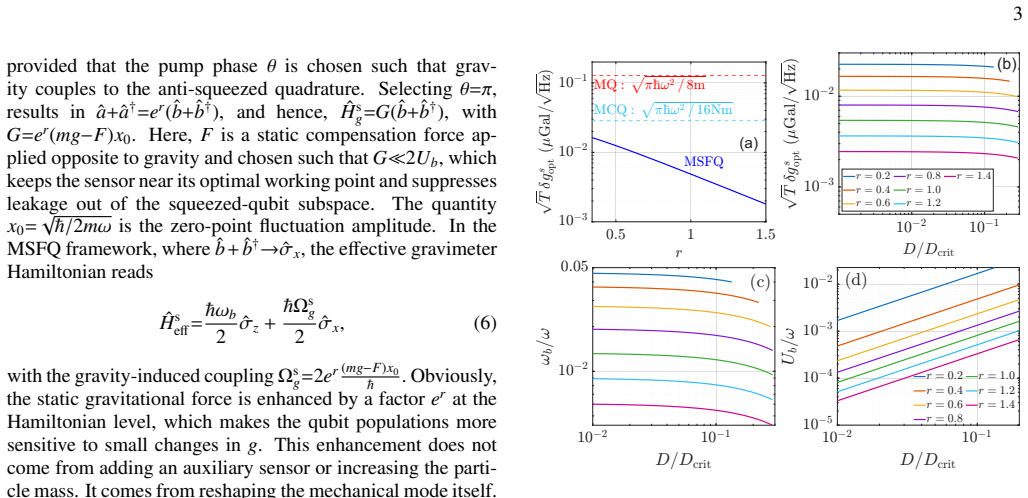
The paper's central claim is that squeezing the mechanical mode of a levitated particle converts a static gravitational force into an exponentially enhanced transverse coupling in the qubit subspace, while preserving the direct mass scaling of the mechanical coupling. With the pump phase θ=π, the displacement operator obeys â+â†=e^r(b̂+b̂†), mapping the force term (mg−F)x0(â+â†) to G(b̂+b̂†) with G=e^r(mg−F)x0; in the two-level subspace this becomes (ℏΩ_g^s/2)σ_x with Ω_g^s=2e^r(mg−F)x0/ℏ. For a weak force (Ω_g^s≪ω_b), the quantum Fisher information for estimating g is F_Q≃(8me^{2r}/ℏωω_b²)sin²(ω_b t/2), which peaks at t=π/ω_b and is saturated by the excited squeezed-Fock population measurem
What carries the argument
The key object is the mechanical squeezed-Fock qubit (MSFQ): the two lowest eigenstates of a Duffing mechanical oscillator driven by a detuned two-phonon pump. The pump amplitude A_p and detuning δ fix the squeezing parameter through tanh(2r)=A_p/δ; the effective qubit splitting is ω_b=√(δ²−A_p²)−D(8cosh²r sinh²r+4 sinh⁴r), while the effective anharmonicity U_b=D(3cosh(4r)+1)/4 grows like e^{4r}, protecting the qubit subspace from leakage. The load-bearing identity is â+â†=e^r(b̂+b̂†) at pump phase θ=π, which turns the static force into a transverse qubit field Gσ_x and produces the exponential gain. The same Bogoliubov transformation maps ordinary mechanical damping into anisotropic qubit n
Load-bearing premise
The whole exponential gain rests on the assumption that a static gravitational force in the laboratory frame becomes a static transverse qubit coupling in the squeezed-Fock frame—if the force instead oscillates at the pump frequency and averages away, the enhancement disappears.
What would settle it
Derive the exact time dependence of the transformed force term in the interaction picture with respect to the effective squeezed Hamiltonian and check whether a static σ_x survives the RWA; if the force term oscillates at ≈ω_p and averages away, the predicted exponential enhancement is refuted.
If this is right
- Sensitivity of a levitated-particle gravimeter improves exponentially with the squeezing parameter while retaining the √m mass enhancement, reaching competitive sub-µGal/√Hz performance at moderate r.
- A simple population measurement of the squeezed-Fock excited state is provably optimal in the weak-force regime, so no complex readout is needed in the coherent limit.
- Tuning the Duffing nonlinearity simultaneously lowers ω_b (lengthening the optimal interrogation time and tightening the sensitivity bound) and raises the effective anharmonicity U_b (suppressing leakage), so the sensor's operating point is set by the RWA-validity boundary.
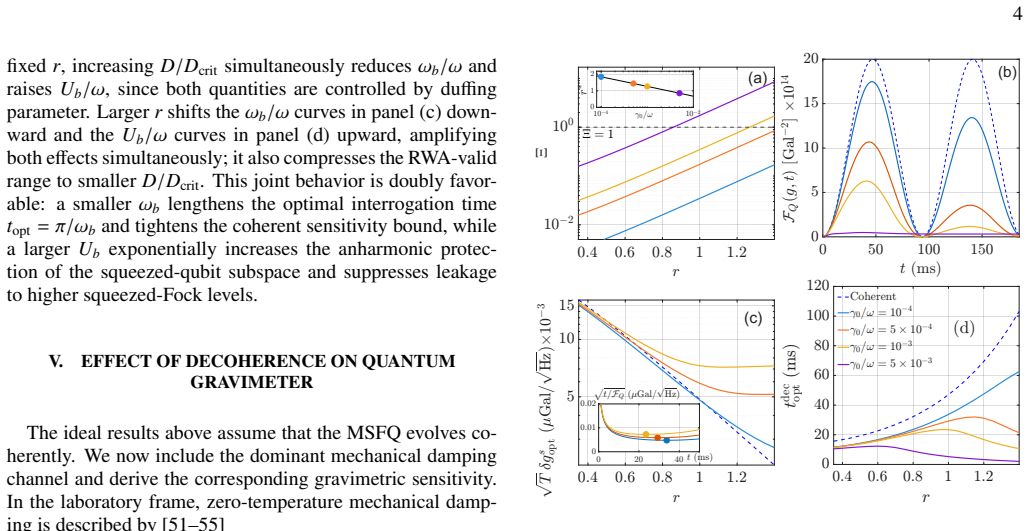
- Under damping, squeezing converts isotropic dissipation into anisotropic noise with one strongly enhanced rate Γ_y∝e^{2r}; the optimal squeezing is therefore capped by Γ_eff/ω_b≲1, and the readout must be rotated along the SLD direction.
- Since only a stable Kerr-type squeezed spectrum with low leakage is needed, the scheme generalizes beyond Duffing nonlinearities to any anharmonic mechanism that produces such a spectrum.
Where Pith is reading between the lines
- Editorial inference: the exponential gain depends on the static lab-frame force surviving as a static σ_x in the rotating frame; if the force term acquires e^{±iω_p t} phases and is dropped by the same RWA that produced the effective Hamiltonian, the enhancement would vanish—this step deserves explicit verification.
- Because the sensor measures g only relative to the compensation force F, it is a relative gravimeter; slow drifts or fluctuations in F would enter directly as apparent gravity signals, so the calibration route of applying a known test force (as in the paper's Appendix B) is essential in practice.
- The scheme's sensitivity improves as ω_b is reduced, but this also lengthens the optimal interrogation time and makes the system more susceptible to the anisotropic decoherence channel, suggesting a multivariate optimization over r, D, and γ_0 rather than a single best squeezing value.
- If the static-force mapping fails, a natural fallback would be to modulate the compensation force or the trap stiffness at the qubit frequency to convert the static gravity signal into a resonant drive, but that would trade away the exponential e^r enhancement claimed here.
Editorial analysis
A structured set of objections, weighed in public.
Referee Report
Summary. The manuscript proposes a levitated-mechanics gravimeter based on a Duffing oscillator driven by a detuned two-phonon pump, encoding a squeezed-Fock qubit in the center-of-mass motion. It claims that a static gravitational force couples to the anti-squeezed quadrature in this basis, producing a Hamiltonian-level e^r enhancement and a time-normalized sensitivity sqrt(T)δg_opt ≃ e^{-r}√(πℏωω_b/8m). The paper derives exact QFI and CFI expressions, argues that a squeezed-Fock population measurement saturates the QFI in the weak-force regime, and extends the analysis to zero- and finite-temperature mechanical damping with anisotropic qubit decoherence and SLD-optimized readout. The analytic machinery in Appendices A–C is detailed and internally consistent once the effective qubit Hamiltonian of Eq. (6) is accepted.
Significance. If the central Hamiltonian mapping were correct, the result would be significant: a mass-enhanced static gravimeter whose sensitivity improves exponentially with squeezing, with explicit QFI saturation and a practical decoherence trade-off. The paper is genuinely useful in its careful treatment of the QFI/CFI for a damped qubit and in its closed-form Bloch-equation solution. However, the physical basis of the enhancement is invalid as presented, so these strengths do not support the paper's central claim.
major comments (2)
- [Section IV, Eq. (6)] The mapping from the lab-frame static force to a time-independent Gσ_x term omits the transformation to the rotating frame. Under U0(t)=e^{-iω_p â†ât}, the force term becomes (mg−F)x0(â e^{-iω_p t}+â†e^{iω_p t}), not (mg−F)x0(â+â†). With θ=π and â=cosh r b̂+sinh r b̂†, moving to the interaction picture with respect to H0=ω_b b̂†b̂ leaves only terms rotating at frequencies ω_p±ω_b. In the regime used in Figs. 1 and 2 (δ/ω=0.05), ω_p≈0.95ω and ω_b≲0.05ω, so these frequencies are much larger than the 2ω_b and 4ω_b terms that Appendix A drops in its RWA. Consequently, the same RWA that produces Eq. (5) removes the force term, and the time-independent σ_x term in Eq. (6) does not appear. The e^r-enhanced Rabi frequency Ω_g^s and Eq. (9) are therefore unsupported; a static force produces at most an off-resonant displacement or Floquet correction, not cumulative population transfer.
- [Appendix C, Eq. (C4)] The same omission propagates into the decoherence analysis. The projection of â onto the squeezed-qubit subspace uses the instantaneous Bogoliubov relation â→cosh r σ_- + sinh r σ_+ without the rotating-frame phases e^{±iω_p t}. The anisotropic rates in Eq. (15) are therefore rates for an effective model whose gravitational coupling has not been established. The master-equation solution method itself is sound, but it is applied to a Hamiltonian derived from an invalid step.
minor comments (3)
- [Throughout] The text uses the spacing 'RW A' instead of 'RWA', and there are minor typos such as 'coresponding'.
- [Fig. 1] The axis labels contain rendering artifacts (e.g., 'pT/gsopt' and '7Gal/pHz'); final figures should use standard SI notation and clear subscripts.
- [Appendix B, Eq. (B16)] The relative-uncertainty propagation formula assumes independent errors but does not state this assumption; the covariance terms should be mentioned for completeness.
Circularity Check
No significant circularity; Eq. (9) follows from the model and QFI calculus, not from a fit or self-citation.
full rationale
The central result, Eq. (9), is obtained by combining the effective squeezed-qubit Hamiltonian (Eq. (6)) with the standard pure-state QFI formula (Eqs. (B6)-(B8)) and then taking the weak-force limit; it is not equivalent by construction to any fitted quantity. The parameter Omega_g^s is linked to g through the algebraic identity a+a^dagger = e^r(b+b^dagger) at theta=pi, which is a derivation step, not a fitted input. Appendix B explicitly separates parameter calibration from estimation: fitting P1(t) yields omega_b and Omega from the same data, and the combined scale factor 2e^r x0/hbar can be calibrated independently with a test force. There is no self-citation chain: the load-bearing MSFQ framework [48] and the MQ/MCQ benchmarks [26] are external works by other authors. The only overlapping citation is [51], a review reference for quantum estimation theory, and it is not load-bearing. The possible dropped e^{±i omega_p t} phase in Section IV is a validity/correctness concern about the rotating-frame and RWA treatment, not a circularity: the sensitivity formula is not forced by its own inputs. Therefore no circular step can be exhibited, and the paper is best described as self-contained with respect to the circularity criteria; the small score 1 merely reflects the presence of one minor non-load-bearing self-citation.
Axiom & Free-Parameter Ledger
axioms (6)
- domain assumption Duffing nonlinearity of strength D with the given sign is present in levitated optomechanical systems and dominates the anharmonic splitting.
- domain assumption The two-phonon pump and Bogoliubov transformation, together with the RWA, reduce the driven Duffing oscillator to the effective squeezed-Fock Hamiltonian Eq. (5).
- domain assumption The static lab-frame gravity force maps to a time-independent transverse field e^r G σ_x in the squeezed-Fock qubit frame.
- domain assumption The two-level truncation is valid: leakage to higher squeezed-Fock states is negligible because G≪2U_b and the RWA is satisfied.
- domain assumption Mechanical damping is Markovian and described by the standard Lindblad dissipator in the lab frame, with zero- and finite-temperature contributions given by γ0 and n_th.
- standard math Quantum estimation theory: the QFI and SLD formulas used are valid for the pure and mixed qubit states considered.
read the original abstract
Levitated mechanical systems are promising candidates for quantum gravimetry, as gravity couples directly to their center-of-mass motion, enabling the large mass of a mesoscopic particle to serve as a sensing resource. In this paper, we propose a mechanical squeezed-Fock qubit gravimeter using a Duffing oscillator that is driven by a detuned two-phonon pump. In the squeezed-Fock basis, the gravitational force couples to the anti-squeezed quadrature, which enhances the gravity-induced transition rate while preserving the direct mass scaling of the mechanical force coupling. We show that sensitivity improves with reduced effective qubit splitting that is controlled by the squeezing parameter and the Duffing nonlinearity. We further analyze mechanical damping and show that squeezing converts ordinary dissipation into anisotropic qubit noise, setting a practical trade-off between signal amplification and decoherence rate. These results identify the mechanical squeezed-Fock qubit as a new platform for quantum-enhanced gravimetry.
Figures


Reference graph
Works this paper leans on
-
[1]
Stray, A
B. Stray, A. Lamb, A. Kaushik, J. V ovrosh, A. Rodgers, J. Winch, F. Hayati, D. Boddice, A. Stabrawa, A. Niggebaum, M. Langlois, Y .-H. Lien, S. Lellouch, S. Roshanmanesh, K. Ri- dley, G. de Villiers, G. Brown, T. Cross, G. Tuckwell, A. Fara- marzi, N. Metje, K. Bongs, and M. Holynski, Quantum sensing for gravity cartography, Nature602, 590 (2022)
2022
-
[2]
S. E. Crawford, G. R. Lander, H. P. Paudel, M. R. Slot, N. Lalam, J. Wuenschell, R. Pingree, R. Oueid, R. Wright, M. Buric, M. M. Brister, and Y . Duan, Quantum sensing for emerging energy technologies, Nat. Rev. Clean Technol.1, 861 (2025)
2025
-
[3]
Forster, A
F. Forster, A. G ¨untner, P. Jousset, M. Reich, B. M¨annel, J. Hin- derer, and K. Erbas, Environmental and anthropogenic gravity contributions at the theistareykir geothermal field, north Ice- land, Geothermal Energy9, 26 (2021)
2021
-
[4]
X. Wu, Z. Pagel, B. S. Malek, T. H. Nguyen, F. Zi, D. S. Scheirer, and H. M ¨uller, Gravity surveys using a mobile atom interferometer, Science Advances5, eaax0800 (2019)
2019
-
[5]
Krelina, Quantum technology for military applications, EPJ Quantum Technol.8, 24 (2021)
M. Krelina, Quantum technology for military applications, EPJ Quantum Technol.8, 24 (2021)
2021
-
[6]
Ye and P
J. Ye and P. Zoller, Essay: Quantum sensing with atomic, molecular, and optical platforms for fundamental physics, Phys. Rev. Lett.132, 190001 (2024)
2024
-
[7]
Poli, F.-Y
N. Poli, F.-Y . Wang, M. G. Tarallo, A. Alberti, M. Prevedelli, and G. M. Tino, Precision measurement of gravity with cold atoms in an optical lattice and comparison with a classical gravimeter, Phys. Rev. Lett.106, 038501 (2011)
2011
-
[8]
Kasevich and S
M. Kasevich and S. Chu, Atomic interferometry using stimu- lated Raman transitions, Phys. Rev. Lett.67, 181 (1991)
1991
-
[9]
Peters, K
A. Peters, K. Y . Chung, and S. Chu, Measurement of gravita- tional acceleration by dropping atoms, Nature400, 849 (1999)
1999
-
[10]
Geiger, A
R. Geiger, A. Landragin, S. Merlet, and F. Pereira Dos Santos, High-accuracy inertial measurements with cold-atom sensors, A VS Quantum Science2, 024702 (2020)
2020
-
[11]
J. Wei, J. Huang, and C. Lee, Adaptive robust high-precision atomic gravimetry, Phys. Rev. Res.7, L012064 (2025)
2025
-
[12]
Bidel, N
Y . Bidel, N. Zahzam, C. Blanchard, A. Bonnin, M. Cadoret, A. Bresson, D. Rouxel, and M. F. Lequentrec-Lalancette, Ab- solute marine gravimetry with matter-wave interferometry, Nat. Commun.9, 627 (2018)
2018
-
[13]
Hu, B.-L
Z.-K. Hu, B.-L. Sun, X.-C. Duan, M.-K. Zhou, L.-L. Chen, S. Zhan, Q.-Z. Zhang, and J. Luo, Demonstration of an ultrahigh-sensitivity atom-interferometry absolute gravimeter, Phys. Rev. A88, 043610 (2013)
2013
-
[14]
M ´enoret, P
V . M ´enoret, P. Vermeulen, N. Le Moigne, S. Bonvalot, P. Bouyer, A. Landragin, and B. Desruelle, Gravity measure- ments below 10 −9g with a transportable absolute quantum gravimeter, Sci. Rep.8, 12300 (2018)
2018
-
[15]
Zhang, L.-L
T. Zhang, L.-L. Chen, Y .-B. Shu, W.-J. Xu, Y . Cheng, Q. Luo, Z.-K. Hu, and M.-K. Zhou, Ultrahigh-sensitivity bragg atom gravimeter and its application in testing lorentz violation, Phys. Rev. Applied20, 014067 (2023)
2023
-
[16]
Peters, K
A. Peters, K. Y . Chung, and S. Chu, High-precision gravity measurements using atom interferometry, Metrologia38, 25 (2001)
2001
-
[17]
Le Gou”et, T
J. Le Gou”et, T. E. Mehlst”aubler, J. Kim, S. Merlet, A. Clairon, A. Landragin, and F. Pereira Dos Santos, Limits to the sensitiv- ity of a low noise compact atomic gravimeter, Appl. Phys. B92, 133 (2008)
2008
-
[18]
Merlet, J
S. Merlet, J. Le Gou”et, Q. Bodart, A. Clairon, A. Landragin, F. Pereira Dos Santos, and P. Rouchon, Operating an atom in- terferometer beyond its linear range, Metrologia46, 87 (2009)
2009
-
[19]
Zhou, Z.-K
M.-K. Zhou, Z.-K. Hu, X.-C. Duan, B.-L. Sun, L.-L. Chen, Q.- Z. Zhang, and J. Luo, Performance of a cold-atom gravime- ter with an active vibration isolator, Phys. Rev. A86, 043630 (2012)
2012
-
[20]
Griggs, M
C. Griggs, M. Moody, R. Norton, H. Paik, and K. Venkateswara, Sensitive superconducting gravity gra- diometer constructed with levitated test masses, Phys. Rev. Applied8, 064024 (2017)
2017
-
[21]
L. Liu, Y . Li, G. Chen, Q. Xu, Y . Qiu, N. Zhang, L. Chen, and X. Liu, Progress in the development of a spherical supercon- ducting gravimeter based on squid detection, Rev. Sci. Instrum. 96, 10.1063/5.0292856 (2025)
-
[22]
Rademacher, J
M. Rademacher, J. Millen, and Y . L. Li, Quantum sensing with nanoparticles for gravimetry: when bigger is better, Adv. Opt. Technol.9, 227 (2020)
2020
-
[23]
Gonzalez-Ballestero, M
C. Gonzalez-Ballestero, M. Aspelmeyer, L. Novotny, R. Quidant, and O. Romero-Isart, Levitodynamics: levita- tion and control of microscopic objects in vacuum, Science 374, eabg3027 (2021)
2021
-
[24]
S. Bose, I. Fuentes, A. A. Geraci, S. M. Khan, S. Qvarfort, M. Rademacher, M. Rashid, M. Toro ˇs, H. Ulbricht, and C. C. Wanjura, Massive quantum systems as interfaces of quantum mechanics and gravity, Rev. Mod. Phys.97, 015003 (2025)
2025
-
[25]
Dania, D
L. Dania, D. S. Bykov, F. Goschin, M. Teller, A. Kassid, and T. E. Northup, Ultrahigh quality factor of a levitated nanome- chanical oscillator, Phys. Rev. Lett.132, 133602 (2024)
2024
-
[26]
X.-W. Huo, J.-H. An, and P.-B. Li, Quantum gravimetry with mechanical qubits (2026), arXiv:2604.14950 [quant-ph]
Pith/arXiv arXiv 2026
-
[27]
Deli ´c, M
U. Deli ´c, M. Reisenbauer, K. Dare, D. Grass, V . Vuleti ´c, N. Kiesel, and M. Aspelmeyer, Cooling of a levitated nanopar- ticle to the motional quantum ground state, Science367, 892 (2020)
2020
-
[28]
Tebbenjohanns, M
F. Tebbenjohanns, M. L. Mattana, M. Rossi, M. Frimmer, and L. Novotny, Quantum control of a nanoparticle optically levi- tated in cryogenic free space, Nature595, 378 (2021)
2021
-
[29]
Magrini, P
L. Magrini, P. Rosenzweig, C. Bach, A. Deutschmann-Olek, S. G. Hofer, S. Hong, N. Kiesel, A. Kugi, and M. Aspelmeyer, Real-time optimal quantum control of mechanical motion at room temperature, Nature595, 373 (2021)
2021
-
[30]
Kamba, R
M. Kamba, R. Shimizu, and K. Aikawa, Quantum squeezing of a levitated nanomechanical oscillator, Science389, 1225 (2025)
2025
-
[31]
Marti, U
S. Marti, U. von L ¨upke, O. Joshi, Y . Yang, M. Bild, A. Oma- hen, Y . Chu, and M. Fadel, Quantum squeezing in a nonlinear mechanical oscillator, Nat. Phys.20, 1448 (2024)
2024
-
[32]
Piotrowski, D
J. Piotrowski, D. Windey, J. Vijayan, C. Gonzalez-Ballestero, A. de los R´ıos Sommer, N. Altundaˇs, A. Blais, O. Romero-Isart, R. Quidant, and U. Deli´c, Simultaneous ground-state cooling of two mechanical modes of a levitated nanoparticle, Nat. Phys. 19, 1009 (2023)
2023
-
[33]
Scala, M
M. Scala, M. S. Kim, G. W. Morley, P. F. Barker, and S. Bose, Matter-wave interferometry of a levitated thermal nano-oscillator induced and probed by a spin, Phys. Rev. Lett. 111, 180403 (2013)
2013
-
[34]
Wang, J.-F
L.-Y . Wang, J.-F. Wei, K.-F. Cui, S.-L. Su, L.-L. Yan, H.-Z. Guo, C.-X. Shan, and G. Chen, Enhanced gravity sensing by a levitated mesoscopic nanoparticle, Phys. Rev. Lett.135, 120803 (2025)
2025
-
[35]
Qvarfort, A
S. Qvarfort, A. Serafini, P. F. Barker, and S. Bose, Gravime- try through non-linear optomechanics, Nat. Commun.9, 3690 15 (2018)
2018
-
[36]
P.-B. Li, Y . Zhou, W.-B. Gao, and F. Nori, Enhancing spin- phonon and spin-spin interactions using linear resources in a hybrid quantum system, Phys. Rev. Lett.125, 153602 (2020)
2020
-
[37]
Li, Z.-L
P.-B. Li, Z.-L. Xiang, P. Rabl, and F. Nori, Hybrid quantum de- vice with nitrogen-vacancy centers in diamond coupled to car- bon nanotubes, Phys. Rev. Lett.117, 015502 (2016)
2016
-
[38]
Rips and M
S. Rips and M. J. Hartmann, Quantum information process- ing with nanomechanical qubits, Phys. Rev. Lett.110, 120503 (2013)
2013
-
[39]
Pistolesi, A
F. Pistolesi, A. N. Cleland, and A. Bachtold, Proposal for a nanomechanical qubit, Phys. Rev. X11, 031027 (2021)
2021
-
[40]
Samanta, S
C. Samanta, S. L. De Bonis, C. B. Møller, R. Tormo-Queralt, W. Yang, C. Urgell, B. Stamenic, B. Thibeault, Y . Jin, D. A. Czaplewski, F. Pistolesi, and A. Bachtold, Nonlinear nanome- chanical resonators approaching the quantum ground state, Nat. Phys.19, 1340 (2023)
2023
-
[41]
P. Sharma, J. Koch, and E. Ginossar, Towards a micromechan- ical qubit based on quantized oscillations in superfluid helium (2025), arXiv:2409.02028
Pith/arXiv arXiv 2025
-
[42]
Savel’ev, X
S. Savel’ev, X. Hu, and F. Nori, Quantum electromechanics: Qubits from buckling nanobars, New J. Phys.8, 105 (2006)
2006
-
[43]
Savel’ev, A
S. Savel’ev, A. L. Rakhmanov, X. Hu, A. Kasumov, and F. Nori, Quantum electromechanics: Quantum tunneling near resonance and qubits from buckling nanobars, Phys. Rev. B75, 165417 (2007)
2007
-
[44]
S. Rips, I. Wilson-Rae, and M. J. Hartmann, Nonlinear nanome- chanical resonators for quantum optoelectromechanics, Phys. Rev. A89, 013854 (2014)
2014
-
[45]
Fl ¨uhmann, T
C. Fl ¨uhmann, T. L. Nguyen, M. Marinelli, V . Negnevitsky, K. Mehta, and J. P. Home, Encoding a qubit in a trapped-ion mechanical oscillator, Nature566, 513 (2019)
2019
-
[46]
Y . Yang, I. Kladari´c, M. Drimmer, U. von L¨upke, D. Lenterman, J. Bus, S. Marti, M. Fadel, and Y . Chu, A mechanical qubit, Science386, 783 (2024)
2024
-
[47]
Pistolesi, The journey to a mechanical qubit, Science386, 728 (2024)
F. Pistolesi, The journey to a mechanical qubit, Science386, 728 (2024)
2024
-
[48]
Qiao, J.-H
Y .-F. Qiao, J.-H. An, and P.-B. Li, Mechanical squeezed-fock qubit: Towards quantum weak-force sensing, Phys. Rev. Lett. 136, 040801 (2026)
2026
-
[49]
C. W. Helstrom, Quantum detection and estimation theory, J. Stat. Phys.1, 231 (1969)
1969
-
[50]
M. G. A. Paris, Quantum estimation for quantum technology, Int. J. Quantum Inf.7, 125 (2009)
2009
-
[51]
Montenegro, C
V . Montenegro, C. Mukhopadhyay, R. Yousefjani, S. Sarkar, U. Mishra, M. G. A. Paris, and A. Bayat, Review: Quantum metrology and sensing with many-body systems, Phys. Rep. 1134, 1 (2025)
2025
-
[52]
S. L. Braunstein and C. M. Caves, Statistical distance and the geometry of quantum states, Phys. Rev. Lett.72, 3439 (1994)
1994
-
[53]
C. W. Gardiner and P. Zoller,Quantum Noise: A Handbook of Markovian and Non-Markovian Quantum Stochastic Methods with Applications to Quantum Optics, 3rd ed. (Springer, Berlin, 2004)
2004
-
[54]
Breuer and F
H.-P. Breuer and F. Petruccione,The Theory of Open Quantum Systems(Oxford University Press, Oxford, 2002)
2002
-
[55]
Aspelmeyer, T
M. Aspelmeyer, T. J. Kippenberg, and F. Marquardt, Cavity op- tomechanics, Rev. Mod. Phys.86, 1391 (2014)
2014
-
[56]
A. A. Clerk, M. H. Devoret, S. M. Girvin, F. Marquardt, and R. J. Schoelkopf, Introduction to quantum noise, measurement, and amplification, Rev. Mod. Phys.82, 1155 (2010)
2010
-
[57]
R. Fazio, J. Keeling, L. Mazza, and M. Schir `o, Many-body open quantum systems, SciPost Physics Lecture Notes99, 10.21468/SciPostPhysLectNotes.99 (2025)
-
[58]
Gieseler, L
J. Gieseler, L. Novotny, and R. Quidant, Thermal nonlinearities in a nanomechanical oscillator, Nature Phys.9, 806 (2013)
2013
-
[59]
Delic, M
U. Delic, M. Reisenbauer, K. Dare, D. Grass, V . Vuleti ´c, N. Kiesel, and M. Aspelmeyer, Cooling of a levitated nanopar- ticle to the motional quantum ground state, Science367, 892 (2020)
2020
-
[60]
Ranjit, M
G. Ranjit, M. Cunningham, K. Casey, and A. A. Geraci, At- tonewton force detection using microspheres in a dual-beam optical trap in high vacuum, Phys. Rev. A93, 053801 (2016)
2016
discussion (0)
Sign in with ORCID, Apple, or X to comment. Anyone can read and Pith papers without signing in.