Diffusion-warm sampling of the XY model enables fast thermalization at scale
Pith reviewed 2026-07-01 01:44 UTC · model grok-4.3
The pith
A temperature-conditioned diffusion model trained on small XY lattices generates accurate configurations for larger lattices that let MCMC thermalize an order of magnitude faster.
A machine-rendered reading of the paper's core claim, the machinery that carries it, and where it could break.
Core claim
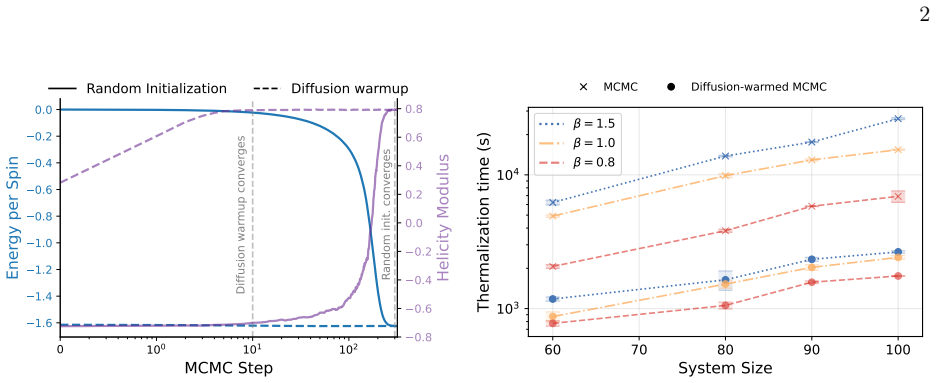
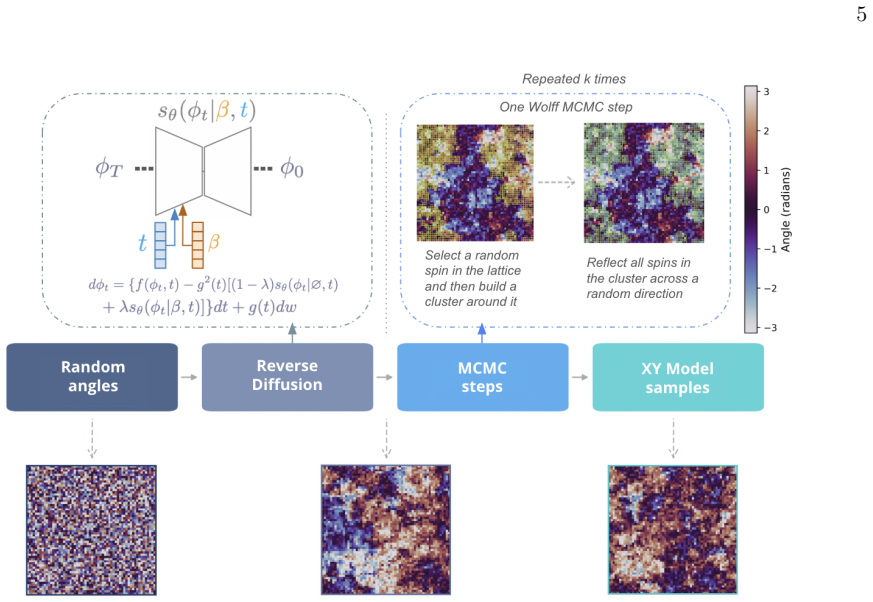
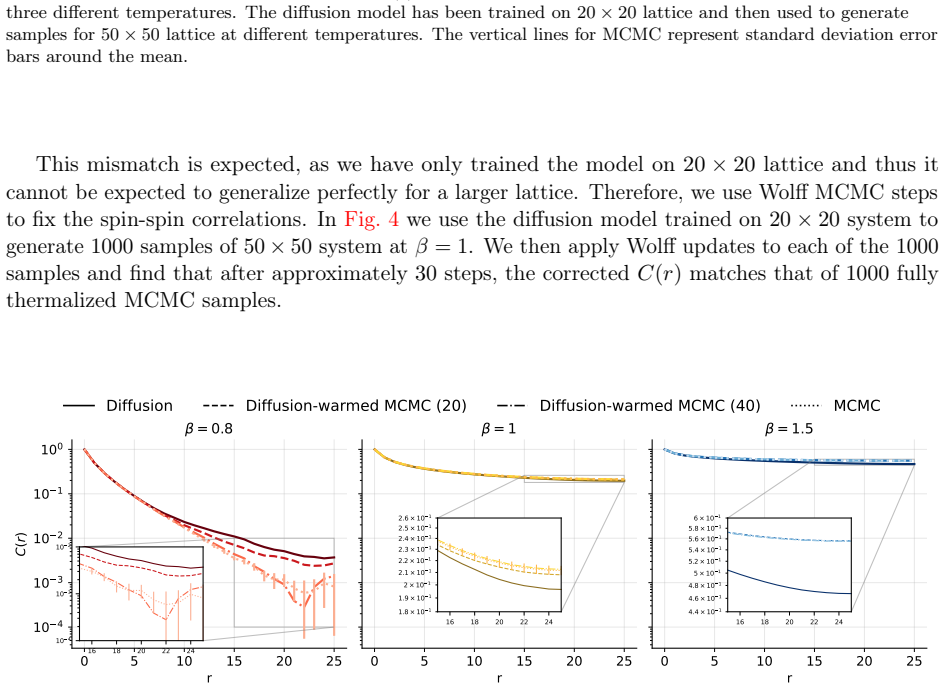
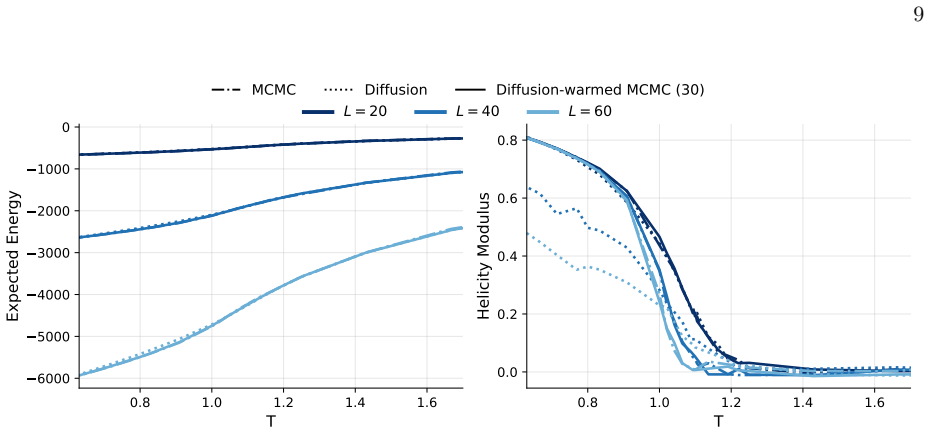
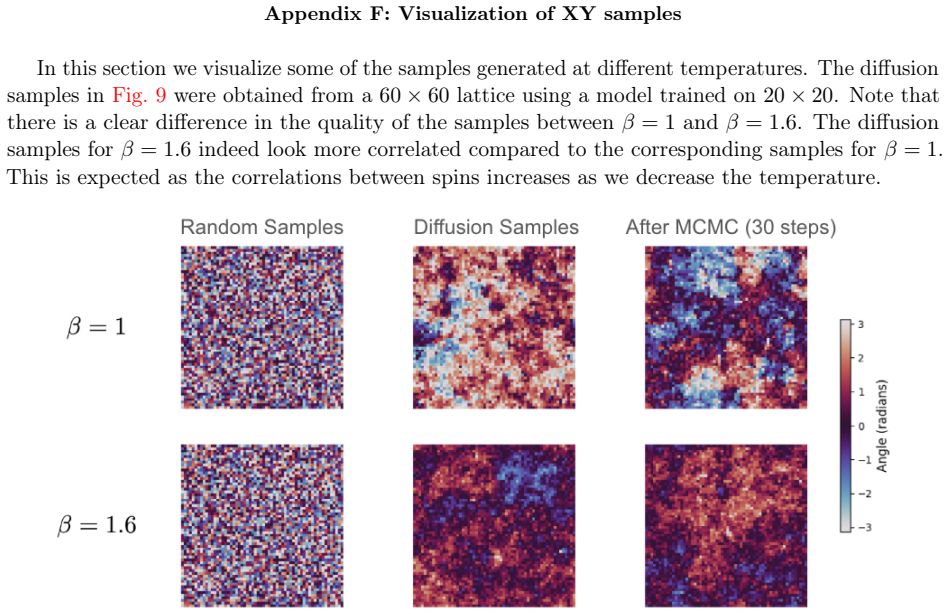
Training a temperature-conditioned diffusion model on smaller-size XY model lattices enables the generation of accurate samples in larger lattice sizes. By tracking physically important observables of the model, such as spin correlations, our experiments demonstrate that diffusion sampling followed by a few MCMC steps reduces the thermalization time by an order of magnitude relative to the standard MCMC with random initialization. This supplies a route to scalable sampling of continuous-state spin systems.
What carries the argument
Temperature-conditioned diffusion model that maps smaller-lattice training data to warm-start configurations for MCMC on larger XY lattices.
If this is right
- Sampling becomes feasible on lattice sizes too large for direct diffusion training or for slow random-start MCMC.
- Only a small number of MCMC steps after diffusion generation suffice to reach equilibrium.
- The technique extends MCMC to continuous-symmetry spin models where size generalization has been a bottleneck.
- Generative models can now be used to initialize simulations of condensed-matter systems at previously inaccessible scales.
Where Pith is reading between the lines
- If the size-independent accuracy holds, one diffusion model could serve as a reusable initializer across a wide range of lattice sizes.
- The reduction in thermalization cost could make finite-size scaling studies near the XY model's Kosterlitz-Thouless transition more routine.
- Analogous warm-start diffusion sampling might be tested on the Heisenberg model or other O(n) spin systems.
- The approach could be combined with cluster algorithms or other advanced MCMC updates to push scales even farther.
Load-bearing premise
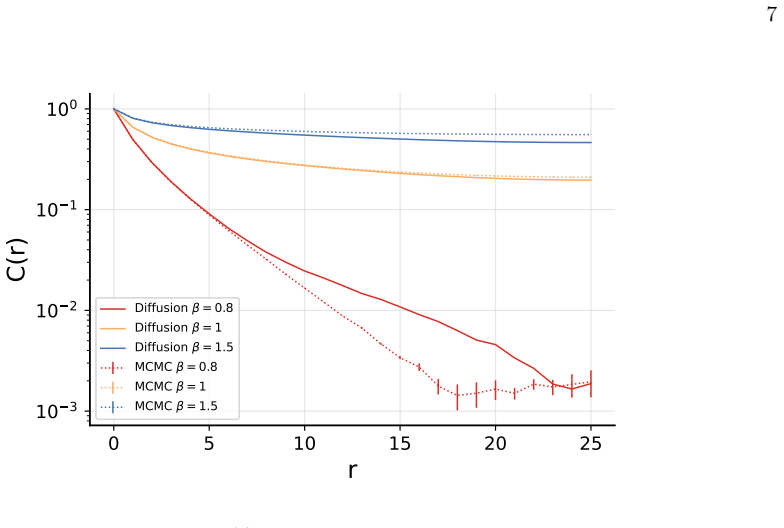
The diffusion model produces large-lattice configurations whose spin correlations and other observables match those of the true thermal ensemble at the target size, without systematic size-dependent errors.
What would settle it
On an intermediate lattice size where both long equilibrated MCMC and the hybrid method can be compared at high statistics, any statistically significant mismatch in measured two-point spin correlations or susceptibility would falsify the accuracy claim.
Figures
read the original abstract
We introduce a novel technique for scalable sampling of spin-system states with continuous symmetries using diffusion models. By applying our approach to the XY model, a fundamental continuous-spin model in condensed matter physics, we show that our technique addresses the shortfalls of the Markov chain Monte Carlo (MCMC) in generalization to varying system sizes. More specifically, we show that training a temperature-conditioned diffusion model on smaller-size XY model lattices enables the generation of accurate samples in larger lattice sizes. By tracking physically important observables of the model, such as spin correlations, our experiments demonstrate that diffusion sampling followed by a few MCMC steps reduces the thermalization time by an order of magnitude relative to the standard MCMC with random initialization. Our study provides valuable insight as to how generative models can be used to study continuous-state condensed matter systems at scale.
Editorial analysis
A structured set of objections, weighed in public.
Referee Report
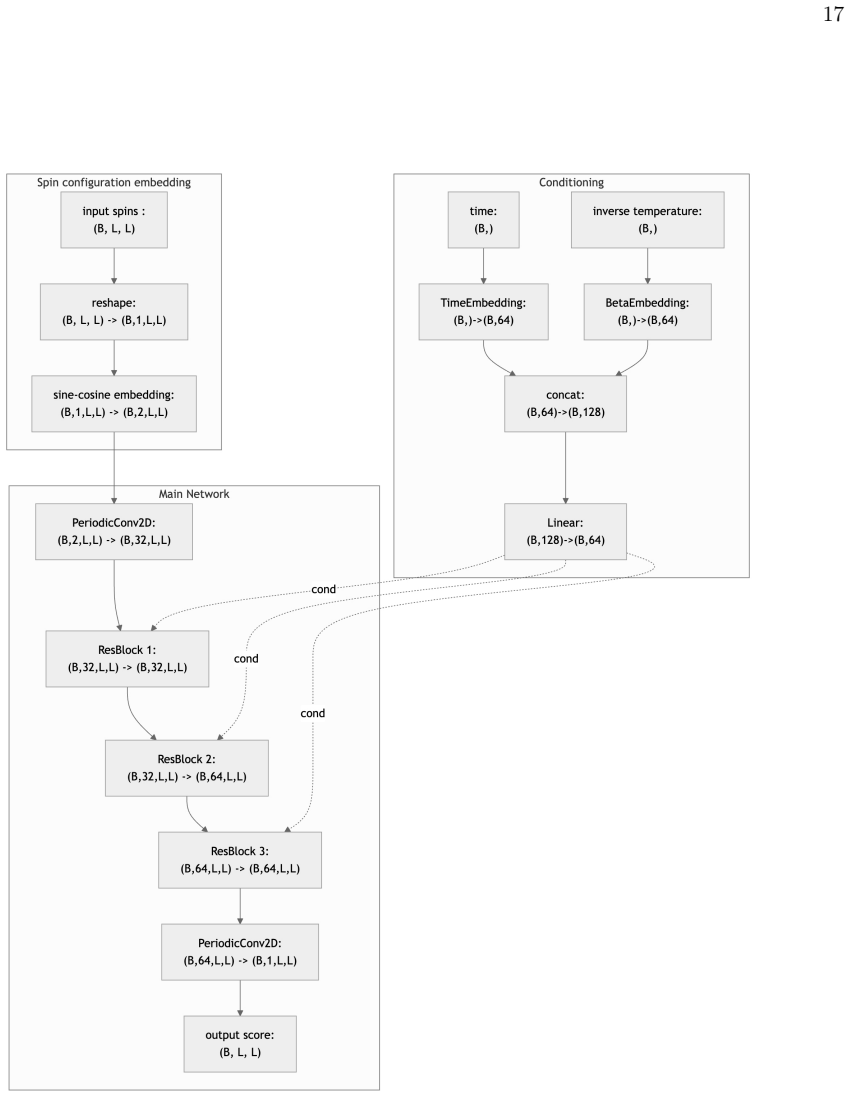
Summary. The paper introduces a diffusion-warm sampling technique for the XY model. It claims that a temperature-conditioned diffusion model trained only on smaller lattices generates accurate samples for larger lattices, and that diffusion sampling followed by a few MCMC steps reduces thermalization time by an order of magnitude relative to standard MCMC from random initialization, as verified by tracking spin correlations and other observables.
Significance. If the generalization to larger lattices holds without undetected biases, the approach would offer a practical route to faster equilibration in continuous-spin models, addressing a known limitation of MCMC at scale. The empirical demonstration of size extrapolation in a generative model for a physically relevant system is a concrete strength.
major comments (3)
- [Abstract] Abstract: the claim that 'accuracy was demonstrated' by tracking spin correlations provides no quantitative error bars, training/validation split details, or finite-size scaling checks; this prevents verification of the central empirical claim that samples match the true thermal distribution on larger lattices.
- [Experiments] The central claim requires that diffusion outputs on large lattices match the Boltzmann measure beyond the reported spin correlations (e.g., vortex configurations, higher-order angular correlations, or KT-transition finite-size corrections). No such checks are described, leaving open the possibility of mode collapse or size-dependent extrapolation artifacts that would invalidate the order-of-magnitude thermalization reduction.
- [Results] The reported order-of-magnitude thermalization speedup after 'a few MCMC steps' is load-bearing for the practical utility claim, yet lacks explicit metrics (e.g., integrated autocorrelation times with uncertainties) or ablation against alternative warm-start methods.
minor comments (1)
- [Abstract] Abstract: the phrase 'diffusion-warm sampling' is used without a concise definition; adding one sentence would improve immediate readability.
Simulated Author's Rebuttal
We thank the referee for their careful reading and constructive comments. We address each major comment point by point below and will revise the manuscript accordingly to strengthen the presentation of our results.
read point-by-point responses
-
Referee: [Abstract] Abstract: the claim that 'accuracy was demonstrated' by tracking spin correlations provides no quantitative error bars, training/validation split details, or finite-size scaling checks; this prevents verification of the central empirical claim that samples match the true thermal distribution on larger lattices.
Authors: We agree that the abstract is brief and omits these specifics. The main text reports error bars on spin correlations, describes the training/validation procedure, and includes finite-size scaling analysis. We will revise the abstract to briefly reference these quantitative elements for improved clarity. revision: yes
-
Referee: [Experiments] The central claim requires that diffusion outputs on large lattices match the Boltzmann measure beyond the reported spin correlations (e.g., vortex configurations, higher-order angular correlations, or KT-transition finite-size corrections). No such checks are described, leaving open the possibility of mode collapse or size-dependent extrapolation artifacts that would invalidate the order-of-magnitude thermalization reduction.
Authors: We acknowledge that additional observables would provide stronger validation against mode collapse or artifacts. We will add analysis of vortex configurations and higher-order angular correlations in the revised experiments section. revision: yes
-
Referee: [Results] The reported order-of-magnitude thermalization speedup after 'a few MCMC steps' is load-bearing for the practical utility claim, yet lacks explicit metrics (e.g., integrated autocorrelation times with uncertainties) or ablation against alternative warm-start methods.
Authors: We will include integrated autocorrelation times with uncertainties and ablations against alternative warm-start methods in the updated results section to provide more rigorous support for the speedup. revision: yes
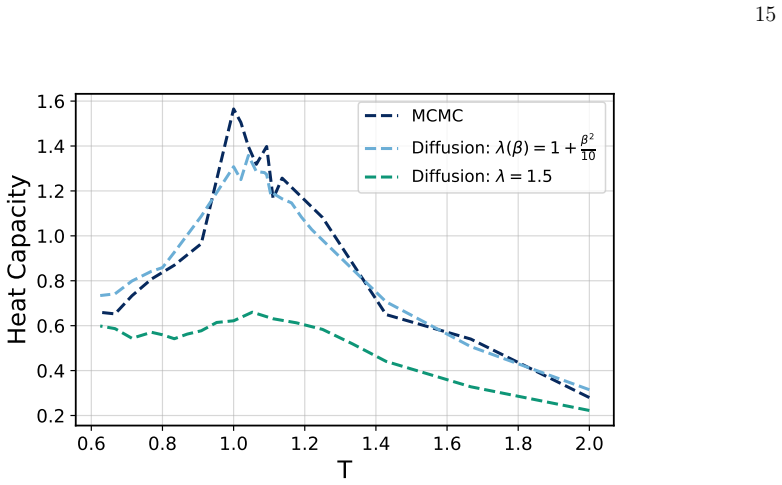
Circularity Check
No circularity in empirical sampling claims
full rationale
The paper reports an empirical technique: training a temperature-conditioned diffusion model on small XY lattices to generate samples for larger lattices, followed by limited MCMC steps that reduce observed thermalization time by an order of magnitude. All load-bearing claims are experimental measurements of observables (spin correlations) on generated configurations, which are independently falsifiable against exact or high-precision benchmarks and do not reduce to any fitted parameter, self-citation, or definitional identity within the paper's own equations. No derivation chain, uniqueness theorem, or ansatz is invoked that collapses to the inputs by construction.
Axiom & Free-Parameter Ledger
axioms (1)
- domain assumption A temperature-conditioned diffusion model can learn to sample from the equilibrium distribution of the XY model on finite lattices.
Reference graph
Works this paper leans on
-
[1]
In practice, thermalization time is estimated using long MCMC runs by monitoring convergence of all observables
and different observables may converge at different rates [12, 30]. In practice, thermalization time is estimated using long MCMC runs by monitoring convergence of all observables. While convergence of observables does not imply that a system has reached equilibrium [11], this is the best that can be done for such physics systems as there is no clear metr...
2000
-
[2]
Brian D.O. Anderson. Reverse-time diffusion equation models.Stochastic Processes and their Applications, 12(3):313–326, 1982. URL:https://www.sciencedirect.com/science/article/pii/ 0304414982900515,doi:10.1016/0304-4149(82)90051-5
-
[3]
V. L. Berezinskii. Destruction of Long-range Order in One-dimensional and Two-dimensional Systems having a Continuous Symmetry Group I. Classical Systems.Sov. Phys. JETP, 32:493–500, 1971
1971
-
[4]
The sample size required in importance sampling
Sourav Chatterjee and Persi Diaconis. The sample size required in importance sampling, 2017. URL: https://arxiv.org/abs/1511.01437,arXiv:1511.01437
work page internal anchor Pith review Pith/arXiv arXiv 2017
- [5]
-
[6]
The Markov chain Monte Carlo revolution.Bulletin of the American Mathematical Society, 46:179–205, 2008
Persi Diaconis. The Markov chain Monte Carlo revolution.Bulletin of the American Mathematical Society, 46:179–205, 2008. URL:https://api.semanticscholar.org/CorpusID:14905050
2008
-
[7]
Jian Ding, Eyal Lubetzky, and Yuval Peres. The Mixing Time Evolution of Glauber Dynamics for the Mean-Field Ising Model.Communications in Mathematical Physics, 289(2):725–764, Jul 2009. doi:10.1007/s00220-009-0781-9
-
[8]
Robert G. Edwards and Alan D. Sokal. Dynamic critical behavior of Wolff’s collective-mode Monte Carlo algorithm for the two-dimensionalO(n)nonlinear σ model.Phys. Rev. D, 40:1374–1377, Aug 1989. URL:https://link.aps.org/doi/10.1103/PhysRevD.40.1374,doi:10.1103/PhysRevD.40.1374
-
[9]
Julio F. Fernández, Manuel F. Ferreira, and Jolanta Stankiewicz. Critical behavior of the two-dimensional XY model: A Monte Carlo simulation.Phys. Rev. B, 34:292–300, Jul 1986. URL:https://link.aps. org/doi/10.1103/PhysRevB.34.292,doi:10.1103/PhysRevB.34.292
-
[10]
David Fitzek, Yi Hong Teoh, H P Cyrus Fung, Gebremedhin A Dagnew, Ejaaz Merali, M Schuyler Moss, Benjamin MacLellan, and Roger G Melko. RydbergGpt.Machine Learning: Science and Technology, 6(4):045057, Dec 2025.doi:10.1088/2632-2153/ae1d0b
-
[11]
VegardFlovik, FerranMacià, andErikWahlström. Describingsynchronizationandtopologicalexcitations in arrays of magnetic spin torque oscillators through the Kuramoto model.Scientific Reports, 6(1):32528, Sep 2016.doi:10.1038/srep32528
-
[12]
Luis Pedro García-Pintos, Noah Linden, Artur S. L. Malabarba, Anthony J. Short, and Andreas Winter. Equilibration Time scales of Physically Relevant Observables.Phys. Rev. X, 7:031027, Aug 2017. URL: https://link.aps.org/doi/10.1103/PhysRevX.7.031027,doi:10.1103/PhysRevX.7.031027. 11
-
[13]
Christian Gogolin and Jens Eisert. Equilibration, thermalisation, and the emergence of statistical mechanics in closed quantum systems.Reports on Progress in Physics, 79(5):056001, Apr 2016. doi:10.1088/0034-4885/79/5/056001
-
[14]
PhD thesis, Waterloo U., 2017
Lauren Elizabeth Hayward Sierens.Simulating quantum matter through lattice field the- ories. PhD thesis, Waterloo U., 2017. URL: https://uwspace.uwaterloo.ca/items/ 14b662dd-a5dd-4ed1-b4f7-bcd5f1baad57
2017
-
[15]
Denoising Diffusion Probabilistic Models
Jonathan Ho, Ajay Jain, and Pieter Abbeel. Denoising Diffusion Probabilistic Models, 2020. URL: https://arxiv.org/abs/2006.11239,arXiv:2006.11239
work page internal anchor Pith review Pith/arXiv arXiv 2020
-
[16]
Classifier-Free Diffusion Guidance
Jonathan Ho and Tim Salimans. Classifier-Free Diffusion Guidance, 2022. URL:https://arxiv.org/ abs/2207.12598,arXiv:2207.12598
work page internal anchor Pith review Pith/arXiv arXiv 2022
-
[17]
Riemannian Diffusion Models, 2022
Chin-Wei Huang, Milad Aghajohari, Avishek Joey Bose, Prakash Panangaden, and Aaron Courville. Riemannian Diffusion Models, 2022. URL:https://arxiv.org/abs/2208.07949, arXiv:2208.07949
-
[18]
Phys., 1925,31, 253–258, doi:10.1007/BF02980577
Ernst Ising. Beitrag zur Theorie des Ferromagnetismus.Zeitschrift für Physik, 31(1):253–258, Feb 1925. doi:10.1007/BF02980577
-
[19]
Torsional Diffusion for Molecular Conformer Generation.arXiv preprint arXiv:2206.01729, 2022
Bowen Jing, Gabriele Corso, Jeffrey Chang, Regina Barzilay, and Tommi Jaakkola. Torsional Diffusion for Molecular Conformer Generation.arXiv preprint arXiv:2206.01729, 2022. URL:https://arxiv. org/abs/2206.01729
-
[20]
Jorge V. José, Leo P. Kadanoff, Scott Kirkpatrick, and David R. Nelson. Renormalization, vortices, and symmetry-breaking perturbations in the two-dimensional planar model.Phys. Rev. B, 16:1217–1241, Aug 1977. URL:https://link.aps.org/doi/10.1103/PhysRevB.16.1217, doi:10.1103/PhysRevB. 16.1217
-
[21]
Adam: A Method for Stochastic Optimization
Diederik P. Kingma and Jimmy Ba. Adam: A Method for Stochastic Optimization, 2017. URL: https://arxiv.org/abs/1412.6980,arXiv:1412.6980
work page internal anchor Pith review Pith/arXiv arXiv 2017
-
[22]
J M Kosterlitz and D J Thouless. Ordering, metastability and phase transitions in two-dimensional systems.Journal of Physics C: Solid State Physics, 6(7):1181, Apr 1973.doi:10.1088/0022-3719/6/ 7/010
-
[23]
Qian-Rui Lee and Daw-Wei Wang. Efficient Identification of Critical Transitions via flow Matching: A Scalable Generative Approach for Many-Body Systems, 2026. URL:https://arxiv.org/abs/2508. 15318,arXiv:2508.15318
-
[24]
Curse-of-dimensionality revisited: Collapse of importance sampling in very large scale systems
Bo Li, Thomas Bengtsson, and Peter Bickel. Curse-of-dimensionality revisited: Collapse of importance sampling in very large scale systems. 01 2005. URL: https://statistics.berkeley.edu/sites/ default/files/tech-reports/696.pdf
2005
-
[25]
Ilaria Maccari, Lara Benfatto, and Claudio Castellani. Uniformly Frustrated XY Model: Strengthening of the Vortex Lattice by Intrinsic Disorder.Condensed Matter, 6(4), 2021. URL:https://www.mdpi. com/2410-3896/6/4/42,doi:10.3390/condmat6040042
-
[26]
Enhancing deep neural networks through complex-valued representations and kuramoto synchronization dynamics.Transactions on Machine Learning Research, 2025
Sabine Muzellec, Andrea Alamia, Thomas Serre, and Rufin VanRullen. Enhancing deep neural networks through complex-valued representations and kuramoto synchronization dynamics.Transactions on Machine Learning Research, 2025. URL:https://openreview.net/forum?id=zx6QGmBL43
2025
-
[27]
Boltzmann Generators -- Sampling Equilibrium States of Many-Body Systems with Deep Learning
Frank Noé, Simon Olsson, Jonas Köhler, and Hao Wu. Boltzmann Generators – Sampling Equilibrium states of Many-Body Systems with Deep Learning, 2019. URL:https://arxiv.org/abs/1812.01729, arXiv:1812.01729
work page internal anchor Pith review Pith/arXiv arXiv 2019
-
[28]
Oliveira, Binquan Luan, Pierre M
Felipe L. Oliveira, Binquan Luan, Pierre M. Esteves, Mathias Steiner, and Rodrigo Neumann Bar- ros Ferreira. pymser-An Open-Source Library for Automatic Equilibration Detection in Molecular Simulations.Journal of Chemical Theory and Computation, 20(19):8559–8568, September 2024. URL: http://dx.doi.org/10.1021/acs.jctc.4c00417,doi:10.1021/acs.jctc.4c00417
-
[29]
FiLM: Visual Reasoning with a General Conditioning Layer
Ethan Perez, Florian Strub, Harm de Vries, Vincent Dumoulin, and Aaron Courville. FiLM: Visual Reasoning with a General Conditioning Layer, 2017. URL: https://arxiv.org/abs/1709.07871, arXiv:1709.07871
work page internal anchor Pith review Pith/arXiv arXiv 2017
-
[30]
R. B. Potts. Some generalized order-disorder transformations.Mathematical Proceedings of the Cambridge Philosophical Society, 48(1):106–109, 1952.doi:10.1017/S0305004100027419
-
[31]
Peter Reimann. Typical fast thermalization processes in closed many-body systems.Nature Communi- cations, 7(1):10821, Mar 2016.doi:10.1038/ncomms10821
-
[32]
CO-PUBLISHED WITH IMPERIAL COLLEGE PRESS,
David Ruelle.Statistical Mechanics. CO-PUBLISHED WITH IMPERIAL COLLEGE PRESS,
-
[33]
worldscientific.com/doi/pdf/10.1142/4090,doi:10.1142/4090
URL: https://www.worldscientific.com/doi/abs/10.1142/4090, arXiv:https://www. worldscientific.com/doi/pdf/10.1142/4090,doi:10.1142/4090. 12
-
[34]
Anders W. Sandvik. Computational Studies of Quantum Spin Systems.AIP Conference Proceed- ings, 1297(1):135–338, 11 2010.arXiv:https://pubs.aip.org/aip/acp/article-pdf/1297/1/135/ 11407753/135_1_online.pdf,doi:10.1063/1.3518900
-
[35]
Time Complexity in Deep Learning Models.Procedia Computer Science, 215:202–210, 2022
Bhoomi Shah and Hetal Bhavsar. Time Complexity in Deep Learning Models.Procedia Computer Science, 215:202–210, 2022. 4th International Conference on Innovative Data Communication Technology and Application. URL: https://www.sciencedirect.com/science/article/pii/S1877050922020944, doi:10.1016/j.procs.2022.12.023
-
[36]
Generative Modeling by Estimating Gradients of the Data Distribution
Yang Song and Stefano Ermon. Generative Modeling by Estimating Gradients of the Data Distribution. InAdvances in Neural Information Processing Systems, pages 11895–11907, 2019. URL: https: //arxiv.org/abs/1907.05600
work page internal anchor Pith review Pith/arXiv arXiv 2019
-
[37]
Score-Based Generative Modeling through Stochastic Differential Equations
Yang Song, Jascha Sohl-Dickstein, Diederik P Kingma, Abhishek Kumar, Stefano Ermon, and Ben Poole. Score-Based Generative Modeling through Stochastic Differential Equations. InInternational Conference on Learning Representations, 2021. URL:https://openreview.net/forum?id=PxTIG12RRHS
2021
-
[38]
Yuntai Song. Monte Carlo simulation with Wolff algorithm for scaling behavior of two dimensional XY model with KT phase transition.Journal of Physics: Conference Series, 2649(1):012055, Nov 2023. doi:10.1088/1742-6596/2649/1/012055
-
[39]
Yun-Zhou Sun, Qin Wu, Xiao-Li Yang, Yan Zhou, Lan-Yan Zhu, Quan Chen, and Qing An. Numerical Studies of Vortices and Helicity Modulus in the Two-Dimensional Generalized XY Model.Frontiers in Physics, Volume10-2022, 2022. URL: https://www.frontiersin.org/journals/physics/articles/ 10.3389/fphy.2022.851322,doi:10.3389/fphy.2022.851322
-
[40]
Y Takeda, S Tamate, Y Yamamoto, H Takesue, T Inagaki, and S Utsunomiya. Boltzmann sampling for an XY model using a non-degenerate optical parametric oscillator network.Quantum Science and Technology, 3(1):014004, Nov 2017.doi:10.1088/2058-9565/aa923b
-
[41]
Simulating the classical XY model with a laser network
Shuhei Tamate, Yoshihisa Yamamoto, Alireza Marandi, Peter McMahon, and Shoko Utsunomiya. Simulating the classical XY model with a laser network, 2016. URL:https://arxiv.org/abs/1608. 00358,arXiv:1608.00358
work page internal anchor Pith review Pith/arXiv arXiv 2016
-
[42]
Collective Monte Carlo Updating for Spin Systems.Phys
Ulli Wolff. Collective Monte Carlo Updating for Spin Systems.Phys. Rev. Lett., 62:361–364, Jan
-
[43]
URL:https://link.aps.org/doi/10.1103/PhysRevLett.62.361, doi:10.1103/PhysRevLett. 62.361
-
[44]
Xin Ye, Wenjia Zhang, and Zuyuan He. Integrated spatial photonic XY Ising sampler based on a high-uniformity 1 x 8 multi-mode interferometer.Photon. Res., 13(5):1419–1427, May 2025. URL: https://opg.optica.org/prj/abstract.cfm?URI=prj-13-5-1419,doi:10.1364/PRJ.542991. Appendix A: Finding thermalization time In this section we describe how we computed the ...
-
[45]
Initialize an empty clusterC, an empty queueQ and an empty listM containing sites which have been visited
-
[46]
Choose a random site(k, l)in the lattice and add the site(k, l)to the cluster C, the queueQ and listM
-
[47]
choose a random2dimensional unit vectorv
-
[48]
Now we reflect all the spins in the cluster
whileQis not empty (a) remove a spinsfromQ (b) for each neighbourn of s, if n is not present inM then add n to C, Q and M with probability padd = 1−exp (min (0,−2β(s·v)(n·v))) The cluster is formed when the queueQ is empty. Now we reflect all the spins in the cluster. Let’s say the set of all spins in the cluster is denoted bySc. These spins are reflected...
-
[49]
7 we compare the performance of the annealed guidance with a fixed guidance scale of1.5
In Fig. 7 we compare the performance of the annealed guidance with a fixed guidance scale of1.5. Note that no Wolff steps have been done on the diffusion samples here and we can see that the heat capacity of the diffusion samples produced by the annealed CFG method are clearly better than the samples produced by the fixed guidance scale. Appendix E: Exper...
discussion (0)
Sign in with ORCID, Apple, or X to comment. Anyone can read and Pith papers without signing in.