A hidden ultra-relativistic spine in the jet of a neutrino-associated blazar
Pith reviewed 2026-06-29 01:30 UTC · model grok-4.3
The pith
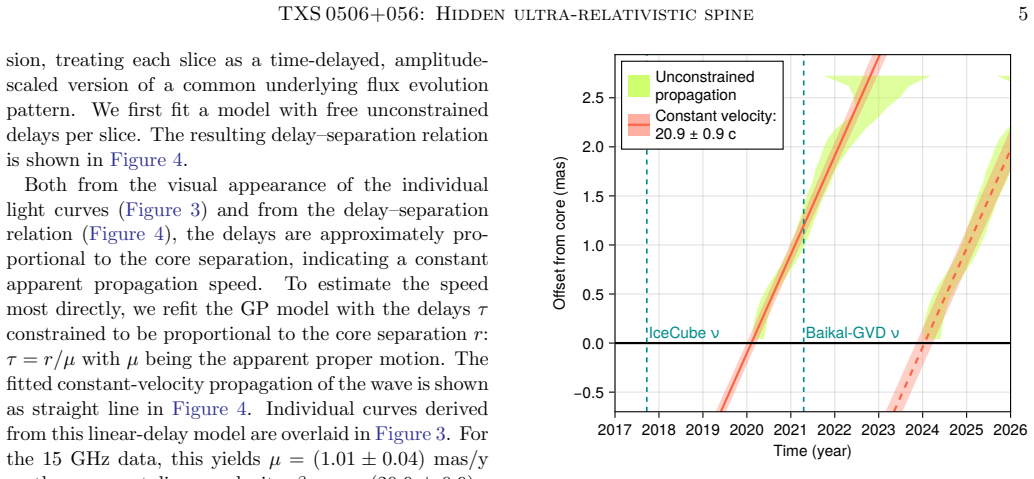
A disturbance moving at 21 times light speed reveals an ultra-relativistic spine inside the jet of the neutrino blazar TXS 0506+056.
A machine-rendered reading of the paper's core claim, the machinery that carries it, and where it could break.
Core claim
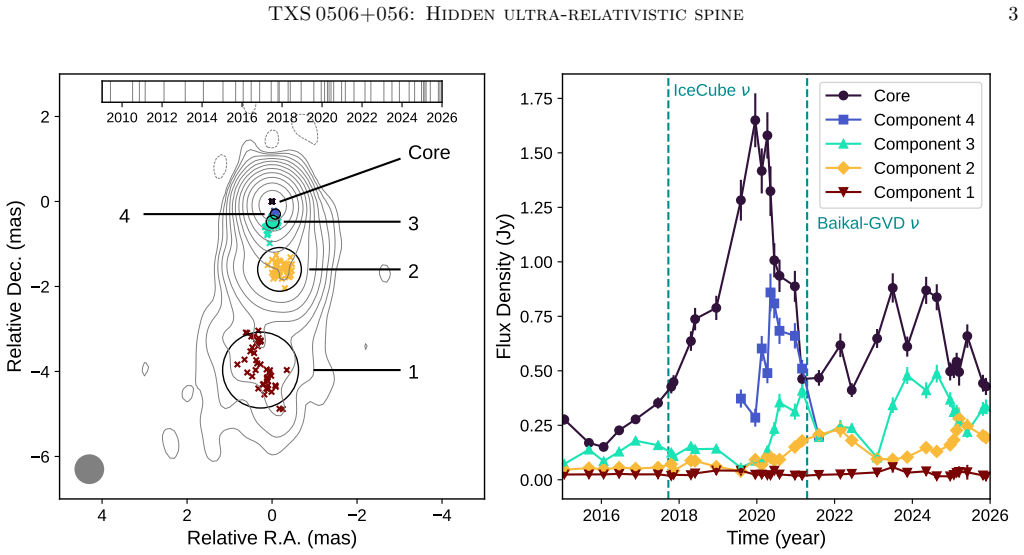
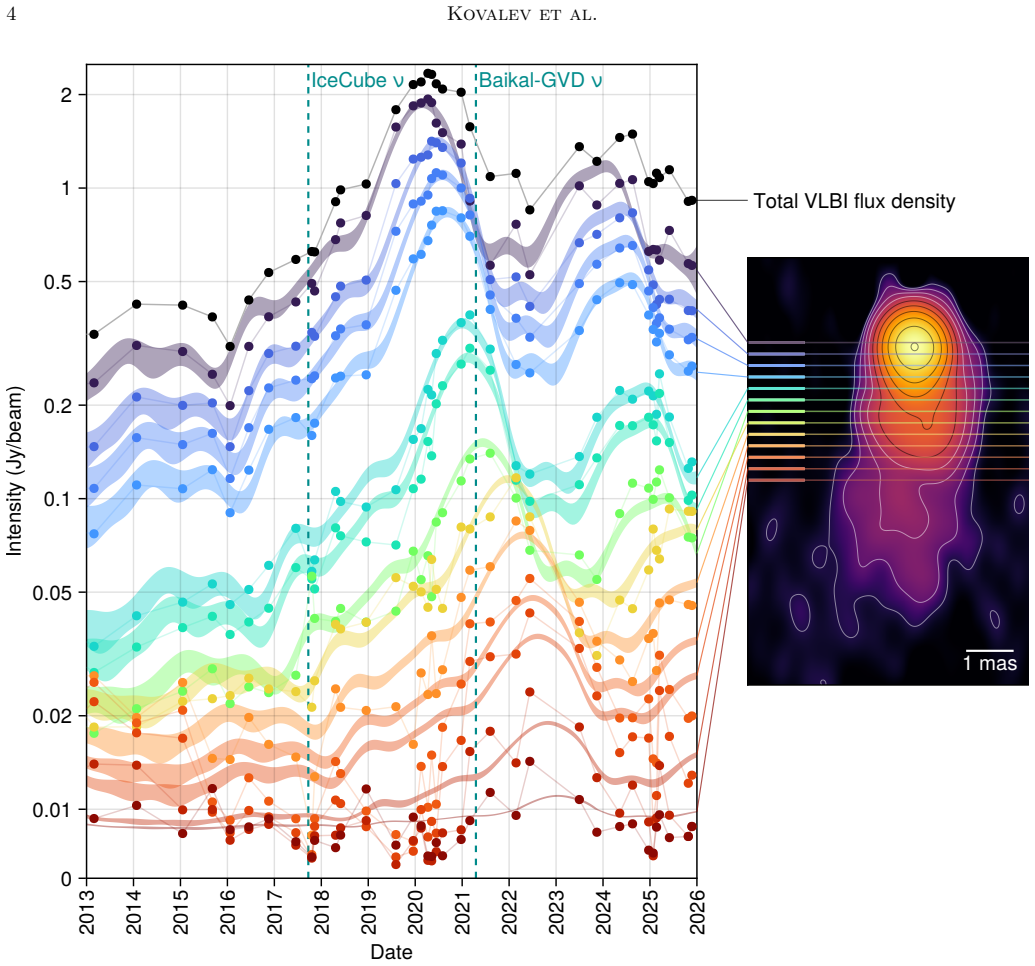
In TXS 0506+056 a disturbance propagates at an apparent speed of 21 plus or minus 1 times the speed of light. We interpret this motion as the signature of a stratified jet containing an ultra-relativistic spine with Lorentz factor greater than 20 embedded in a slower outer sheath. As the disturbance travels along the spine it progressively illuminates the sheath, producing the observed delayed radio flare and accounting for the offset between neutrino arrival and radio brightening. The same sequence repeats in a second neutrino-associated event.
What carries the argument
The ultra-relativistic spine (Gamma greater than 20) inside a slower sheath; the spine carries the fast disturbance that illuminates the sheath and links neutrino production to the delayed radio flare.
If this is right
- Standard VLBI speed measurements can miss the true bulk Lorentz factor when slower sheath emission dominates the images.
- Neutrino production in blazars requires the extreme conditions supplied only by the spine.
- The multi-year offset between neutrino detection and radio flare arises naturally from progressive sheath illumination.
- The same spine-sheath geometry and timing pattern should appear in other neutrino-associated blazars.
Where Pith is reading between the lines
- Many blazars previously classified as slow may contain undetected fast spines once longer time baselines are examined.
- Multi-messenger campaigns could search for recurring fast disturbances coinciding with future neutrino alerts.
- The model supplies a concrete way to predict which blazars are most likely to produce detectable high-energy neutrinos.
Load-bearing premise
The measured 21c apparent speed traces the bulk motion of an ultra-relativistic spine rather than projection effects, pattern speed within the sheath, or selection of particular observing epochs.
What would settle it
Additional VLBI epochs that show no component moving faster than roughly 10c, or that place the fastest features at the same position angle and distance as the sheath features already mapped.
Figures
read the original abstract
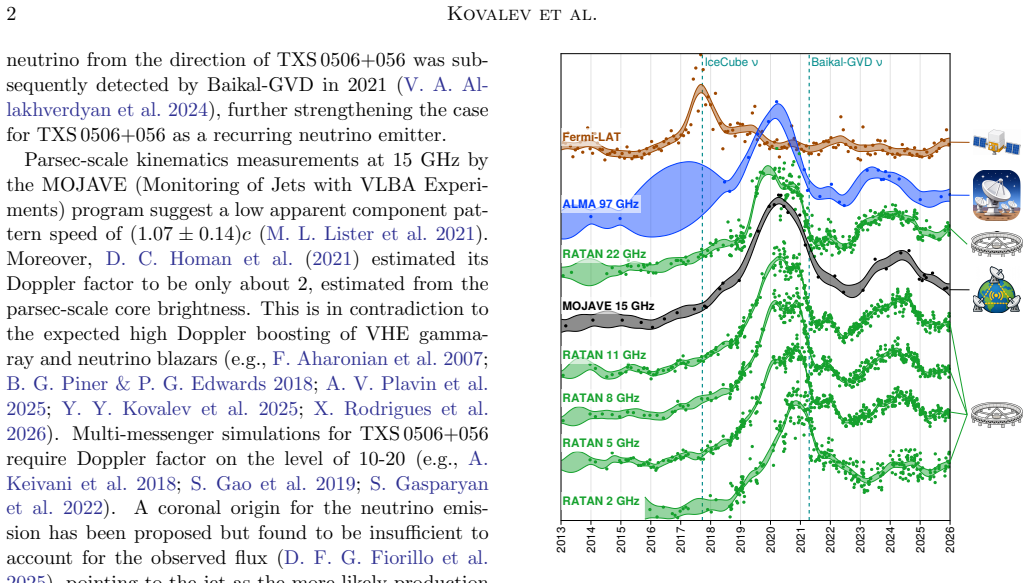
Supermassive black holes launch powerful jets of plasma that can accelerate particles to extreme energies, but the physical conditions required to produce high-energy neutrinos remain unknown. In the blazar TXS 0506+056, the first source individually linked to a high-energy neutrino, radio images had seemed to reveal a jet too slow to sustain the extreme conditions required for neutrino production. Here we resolve this tension using long-term radio monitoring, particularly Very Long Baseline Interferometry (VLBI) imaging. We uncover a disturbance in emission propagating with an apparent speed of 21+-1 times the speed of light, that is masked by slower, radio-bright features that dominated earlier analyses. We interpret this as the signature of a stratified jet: an ultra-relativistic spine with Lorentz factor Gamma>20 embedded within a slower outer sheath. As the disturbance travels along the spine, it progressively illuminates the sheath, producing the delayed radio flare and naturally accounting for the years-long offset between neutrino and radio emission. The same pattern recurs in a second neutrino-associated event, pointing to a repeatable multi-messenger engine. These findings challenge the standard interpretation of VLBI jet speeds and establish a concrete, testable framework connecting structured jets to the sources of the Universe's highest-energy neutrinos.
Editorial analysis
A structured set of objections, weighed in public.
Referee Report
Summary. The paper claims that long-term VLBI monitoring of the neutrino-associated blazar TXS 0506+056 reveals a previously undetected disturbance propagating at an apparent speed of 21±1 c. This feature, masked by slower radio-bright components in earlier analyses, is interpreted as the signature of an ultra-relativistic spine (Lorentz factor Γ>20) embedded in a slower outer sheath. The spine-sheath structure is invoked to explain the delayed radio flare after the neutrino event and is said to recur in a second neutrino-associated flare, providing a repeatable multi-messenger engine and challenging standard VLBI speed interpretations.
Significance. If the central measurement and interpretation hold, the result would supply a concrete, observationally grounded framework linking stratified jets to high-energy neutrino production. It would directly address the tension between apparently subluminal VLBI speeds and the extreme conditions needed for neutrino emission, while offering falsifiable predictions for future multi-epoch VLBI campaigns on other neutrino blazars.
major comments (3)
- [Abstract and §3] Abstract and §3 (data analysis): The reported apparent speed of 21±1 c is stated without the error budget, the precise criteria used to select the VLBI epochs and components for the proper-motion fit, or the quantitative assessment of how much slower features dominate the images. These details are load-bearing for the claim that the disturbance is real and not an artifact of feature selection.
- [§4] §4 (interpretation): The mapping from the observed β_app = 21 to a bulk spine Lorentz factor Γ>20 assumes that the tracked feature directly traces the spine flow velocity rather than a pattern speed, sheath illumination effect, or projection artifact. No quantitative radiative-transfer modeling of sheath illumination or comparison to simulated stratified jets is provided to test this assumption.
- [§5] §5 (repeatability): The assertion that the same stratified-jet pattern recurs in a second neutrino-associated event is presented without an explicit side-by-side comparison of the component-fitting procedures, epoch selection, and error analysis between the two events, which is required to substantiate the claim of a repeatable engine.
minor comments (2)
- Figure captions should explicitly label which components are tracked for the 21 c motion and which are the slower sheath features.
- The first introduction of the Lorentz factor Γ in the main text should include a brief reminder of its definition to aid readers unfamiliar with the notation.
Simulated Author's Rebuttal
We thank the referee for the constructive and detailed comments. We address each major point below and have revised the manuscript to incorporate additional methodological details and clarifications where appropriate.
read point-by-point responses
-
Referee: [Abstract and §3] The reported apparent speed of 21±1 c is stated without the error budget, the precise criteria used to select the VLBI epochs and components for the proper-motion fit, or the quantitative assessment of how much slower features dominate the images. These details are load-bearing for the claim that the disturbance is real and not an artifact of feature selection.
Authors: We agree these details strengthen the presentation. The ±1 c uncertainty is the standard error from the linear fit to component positions versus time, including VLBI positional errors. In the revision we expand §3 to list the full error budget, epoch selection criteria (all resolved MOJAVE and supplementary VLBI data 2009–2023), and component identification rules based on consistent position, flux, and spectral index. We also add a quantitative flux comparison showing the fast feature contributes 10–20% of the core flux while slower components dominate the total emission, explaining why it was previously masked. revision: yes
-
Referee: [§4] The mapping from the observed β_app = 21 to a bulk spine Lorentz factor Γ>20 assumes that the tracked feature directly traces the spine flow velocity rather than a pattern speed, sheath illumination effect, or projection artifact. No quantitative radiative-transfer modeling of sheath illumination or comparison to simulated stratified jets is provided to test this assumption.
Authors: The Γ>20 lower limit follows directly from the relativistic aberration formula with the viewing angle constrained by the source’s gamma-ray variability. We acknowledge that pattern speeds or illumination effects remain possible alternatives. The revised §4 will include an explicit discussion of these alternatives and the reasons the bulk-flow interpretation is favored by the recurrence and timing data. Full radiative-transfer simulations of stratified jets lie beyond the scope of this primarily observational paper. revision: partial
-
Referee: [§5] The assertion that the same stratified-jet pattern recurs in a second neutrino-associated event is presented without an explicit side-by-side comparison of the component-fitting procedures, epoch selection, and error analysis between the two events, which is required to substantiate the claim of a repeatable engine.
Authors: We will add a dedicated comparison subsection and table in §5 that tabulates the component-fitting procedures, epoch selections, and error analyses for both events side by side, demonstrating methodological consistency. revision: yes
Circularity Check
No significant circularity; result is direct observational measurement
full rationale
The paper presents the 21c apparent speed as a direct VLBI measurement from long-term monitoring data, with the stratified-jet interpretation offered as a separate physical reading rather than a mathematical derivation. No equations, fitted parameters renamed as predictions, or self-citation chains are shown that would reduce the central claim to its inputs by construction. The derivation chain is therefore self-contained against external VLBI observables.
Axiom & Free-Parameter Ledger
axioms (1)
- standard math Apparent superluminal motion in jets is produced by relativistic beaming and projection effects under special relativity
invented entities (1)
-
ultra-relativistic spine
no independent evidence
Reference graph
Works this paper leans on
-
[1]
Aartsen, M. G., Ackermann, M., Adams, J., et al. 2018a, Science, 361, eaat1378, doi: 10.1126/science.aat1378
-
[2]
Aartsen, M. G., Ackermann, M., Adams, J., et al. 2018b, Science, 361, 147, doi: 10.1126/science.aat2890 10Kovalev et al
-
[3]
Abdollahi, S., Ajello, M., Baldini, L., et al. 2023, ApJS, 265, 31, doi: 10.3847/1538-4365/acbb6a
-
[4]
Acciari, V. A., Aniello, T., Ansoldi, S., et al. 2022, ApJ, 927, 197, doi: 10.3847/1538-4357/ac531d
-
[5]
Aharonian, F., Akhperjanian, A. G., Bazer-Bachi, A. R., et al. 2007, ApJL, 664, L71, doi: 10.1086/520635
-
[6]
Allakhverdyan, V. A., Avrorin, A. D., Avrorin, A. V., et al. 2024, MNRAS, 527, 8784, doi: 10.1093/mnras/stad3653
-
[7]
2015, A&A, 575, A55, doi: 10.1051/0004-6361/201425081
Angelakis, E., Fuhrmann, L., Marchili, N., et al. 2015, A&A, 575, A55, doi: 10.1051/0004-6361/201425081
-
[8]
Ansoldi, S., Antonelli, L. A., Arcaro, C., et al. 2018, ApJL, 863, L10, doi: 10.3847/2041-8213/aad083 Astropy Collaboration, Price-Whelan, A. M., Lim, P. L., et al. 2022, ApJ, 935, 167, doi: 10.3847/1538-4357/ac7c74
-
[9]
Blandford, R. D., & K¨ onigl, A. 1979, ApJ, 232, 34, doi: 10.1086/157262
-
[10]
Britzen, S., Fendt, C., B¨ ottcher, M., et al. 2019, A&A, 630, A103, doi: 10.1051/0004-6361/201935422
-
[11]
Daly, R. A., & Marscher, A. P. 1988, Astrophys. J., 334, 539, doi: 10.1086/166858 de Gouveia Dal Pino, E. M., Rodr´ ıguez-Ram´ ırez, J. C., & del Valle, M. V. 2025, MNRAS, 537, 3895, doi: 10.1093/mnras/staf251 de Witt, A., Jacobs, C. S., Gordon, D., et al. 2023, AJ, 165, 139, doi: 10.3847/1538-3881/aca012
-
[12]
S., Barrett, J., Blackburn, L., et al
Doeleman, S. S., Barrett, J., Blackburn, L., et al. 2023, Galaxies, 11, 107, doi: 10.3390/galaxies11050107
-
[13]
Eppel, F., Arshakian, T. G., Benke, P., et al. 2026, A&A, submitted Fichet de Clairfontaine, G., Meliani, Z., Zech, A., & Hervet, O. 2021, A&A, 647, A77, doi: 10.1051/0004-6361/202039654
-
[14]
Winter, W. 2025, ApJ, 986, 104, doi: 10.3847/1538-4357/add267
-
[15]
M., Perucho, M., Mimica, P., & Ros, E
Fromm, C. M., Perucho, M., Mimica, P., & Ros, E. 2016, A&A, 588, A101, doi: 10.1051/0004-6361/201527139
-
[16]
2019, Nature Astronomy, 3, 88, doi: 10.1038/s41550-018-0610-1
Gao, S., Fedynitch, A., Winter, W., & Pohl, M. 2019, Nature Astronomy, 3, 88, doi: 10.1038/s41550-018-0610-1
-
[17]
2022, MNRAS, 509, 2102, doi: 10.1093/mnras/stab2688
Gasparyan, S., B´ egu´ e, D., & Sahakyan, N. 2022, MNRAS, 509, 2102, doi: 10.1093/mnras/stab2688
-
[18]
2005, A&A, 432, 401, doi: 10.1051/0004-6361:20041404
Ghisellini, G., Tavecchio, F., & Chiaberge, M. 2005, A&A, 432, 401, doi: 10.1051/0004-6361:20041404
-
[19]
Gomez, J. L., Marti, J. M. A., Marscher, A. P., Ibanez, J. M. A., & Marcaide, J. M. 1995, ApJL, 449, L19, doi: 10.1086/309623
-
[20]
Hardee, P. E. 2000, ApJ, 533, 176, doi: 10.1086/308656
-
[21]
Hardee, P. E. 2007, ApJ, 664, 26, doi: 10.1086/518409
-
[22]
Homan, D. C., Cohen, M. H., Hovatta, T., et al. 2021, ApJ, 923, 67, doi: 10.3847/1538-4357/ac27af
-
[23]
Hovatta, T., Lindfors, E., Kiehlmann, S., et al. 2021, A&A, 650, A83, doi: 10.1051/0004-6361/202039481
-
[24]
Calibration and imaging of 7 mm VLBA observations of the AGN jet in M 87
Janssen, M., Goddi, C., van Bemmel, I. M., et al. 2019, A&A, 626, A75, doi: 10.1051/0004-6361/201935181
-
[25]
Broderick, A. E. 2023, Galaxies, 11, 92, doi: 10.3390/galaxies11050092
-
[26]
Kalashev, O., Kivokurtseva, P., & Troitsky, S. 2023, JCAP, 2023, 007, doi: 10.1088/1475-7516/2023/12/007
-
[27]
2018, ApJ, 864, 84, doi: 10.3847/1538-4357/aad59a
Keivani, A., Murase, K., Petropoulou, M., et al. 2018, ApJ, 864, 84, doi: 10.3847/1538-4357/aad59a
-
[28]
Komatsu, E., Dunkley, J., Nolta, M. R., et al. 2009, ApJS, 180, 330, doi: 10.1088/0067-0049/180/2/330
-
[29]
V., & Pariiskii, I
Korolkov, D. V., & Pariiskii, I. N. 1979, S&T, 57, 324
1979
-
[30]
Kovalev, Y. A., Kardashev, N. S., Kovalev, Y. Y., et al. 2020, Advances in Space Research, 65, 745, doi: 10.1016/j.asr.2019.04.034
-
[31]
Bogdantsov, A. B. 2002, PASA, 19, 83, doi: 10.1071/AS01109
-
[32]
Kovalev, Y. Y., Nizhelsky, N. A., Kovalev, Y. A., et al. 1999, A&AS, 139, 545, doi: 10.1051/aas:1999406
-
[33]
Kovalev, Y. Y., Pushkarev, A. B., G´ omez, J. L., et al. 2025, A&A, 700, L12, doi: 10.1051/0004-6361/202555400
-
[34]
Kramarenko, I. G., Pushkarev, A. B., Kovalev, Y. Y., et al. 2022, MNRAS, 510, 469, doi: 10.1093/mnras/stab3358
-
[35]
Kun, E., Biermann, P. L., & Gergely, L. ´A. 2019, MNRAS, 483, L42, doi: 10.1093/mnrasl/sly216
-
[36]
Kun, E., Bartos, I., Hadi, B., et al. 2026, Upstream neutrino production and delayed jet emission in the blazar GB6 J1542+6129, https://arxiv.org/abs/2605.00785
Pith/arXiv arXiv 2026
-
[37]
Kutkin, A. M., Pashchenko, I. N., Sokolovsky, K. V., et al. 2019, MNRAS, 486, 430, doi: 10.1093/mnras/stz885
-
[38]
Li, X., An, T., Mohan, P., & Giroletti, M. 2020, ApJ, 896, 63, doi: 10.3847/1538-4357/ab8f9f
-
[39]
Liodakis, I., Romani, R. W., Filippenko, A. V., et al. 2018, MNRAS, 480, 5517, doi: 10.1093/mnras/sty2264
-
[40]
Lipunov, V. M., Kornilov, V. G., Zhirkov, K., et al. 2020, ApJL, 896, L19, doi: 10.3847/2041-8213/ab96ba
-
[41]
Lister, M. L., Aller, M. F., Aller, H. D., et al. 2018, ApJS, 234, 12, doi: 10.3847/1538-4365/aa9c44
-
[42]
Lister, M. L., Homan, D. C., Kellermann, K. I., et al. 2021, ApJ, 923, 30, doi: 10.3847/1538-4357/ac230f
-
[43]
Lobanov, A. P. 1998, A&A, 330, 79, doi: 10.48550/arXiv.astro-ph/9712132
work page internal anchor Pith review Pith/arXiv arXiv doi:10.48550/arxiv.astro-ph/9712132 1998
-
[44]
2010, ApJ, 722, 197, doi: 10.1088/0004-637X/722/1/197
Lyutikov, M., & Lister, M. 2010, ApJ, 722, 197, doi: 10.1088/0004-637X/722/1/197
-
[45]
McKinney, J. C. 2006, MNRAS, 368, 1561, doi: 10.1111/j.1365-2966.2006.10256.x TXS 0506+056: Hidden ultra-relativistic spine11
-
[46]
2015, A&A, 574, A67, doi: 10.1051/0004-6361/201424566
Mertens, F., & Lobanov, A. 2015, A&A, 574, A67, doi: 10.1051/0004-6361/201424566
-
[47]
2007, ApJ, 662, 835, doi: 10.1086/518106
Mizuno, Y., Hardee, P., & Nishikawa, K.-I. 2007, ApJ, 662, 835, doi: 10.1086/518106
-
[48]
2018, ApJL, 854, L32, doi: 10.3847/2041-8213/aaad5e
Paiano, S., Falomo, R., Treves, A., & Scarpa, R. 2018, ApJL, 854, L32, doi: 10.3847/2041-8213/aaad5e
-
[49]
2020, ApJ, 891, 115, doi: 10.3847/1538-4357/ab76d0
Petropoulou, M., Murase, K., Santander, M., et al. 2020, ApJ, 891, 115, doi: 10.3847/1538-4357/ab76d0
-
[50]
Petrov, L. Y., & Kovalev, Y. Y. 2025, ApJS, 276, 38, doi: 10.3847/1538-4365/ad8c36
-
[51]
Piner, B. G., & Edwards, P. G. 2018, ApJ, 853, 68, doi: 10.3847/1538-4357/aaa425
-
[52]
Lobanov, A. P. 2019, MNRAS, 485, 1822, doi: 10.1093/mnras/stz504
-
[53]
Plavin, A. V., Kovalev, Y. Y., & Troitsky, S. V. 2025, ApJ, 991, 33, doi: 10.3847/1538-4357/adf54f
-
[54]
2017, MNRAS, 468, 4992, doi: 10.1093/mnras/stx854
Savolainen, T. 2017, MNRAS, 468, 4992, doi: 10.1093/mnras/stx854
-
[55]
2026, A&A, 706, A351, doi: 10.1051/0004-6361/202556986
Rodrigues, X., Rieger, F., Bohdan, A., & Padovani, P. 2026, A&A, 706, A351, doi: 10.1051/0004-6361/202556986
-
[56]
Ros, E., Kadler, M., Perucho, M., et al. 2020, A&A, 633, L1, doi: 10.1051/0004-6361/201937206
-
[57]
Shepherd, M. C. 1997, in Astronomical Society of the Pacific Conference Series, Vol. 125, Astronomical Data Analysis Software and Systems VI, ed. G. Hunt & H. Payne, 77
1997
-
[58]
Sikora, M., Begelman, M. C., & Rees, M. J. 1994, ApJ, 421, 153, doi: 10.1086/173633
-
[59]
I., Yuan, C., Vasilopoulos, G., et al
Stathopoulos, S. I., Yuan, C., Vasilopoulos, G., et al. 2026, Delayed Radio Flares in Neutrino-associated Blazars: The Case of TXS 0506+056, https://arxiv.org/abs/2604.01196
arXiv 2026
-
[60]
, archivePrefix = "arXiv", eprint =
Tavecchio, F., & Ghisellini, G. 2008, MNRAS, 385, L98, doi: 10.1111/j.1745-3933.2008.00441.x
-
[61]
2015, MNRAS, 451, 1502, doi: 10.1093/mnras/stv1023
Tavecchio, F., & Ghisellini, G. 2015, MNRAS, 451, 1502, doi: 10.1093/mnras/stv1023
-
[62]
2014, ApJL, 793, L18, doi: 10.1088/2041-8205/793/1/L18
Tavecchio, F., Ghisellini, G., & Guetta, D. 2014, ApJL, 793, L18, doi: 10.1088/2041-8205/793/1/L18
-
[63]
Tsybulev, P. G., Nizhelskii, N. A., Dugin, M. V., et al. 2018, Astrophysical Bulletin, 73, 494, doi: 10.1134/S1990341318040132
discussion (0)
Sign in with ORCID, Apple, or X to comment. Anyone can read and Pith papers without signing in.