REVIEW 3 major objections 4 minor 45 references
The geometry of absolute separability and other convex matrix properties from spectrum
T0 review · 3 major / 4 minor · reviewed 2026-08-05 · deepseek-v4-flash
Pith's one-line read The spectra of absolute-PPT bipartite states form a spectrahedron for every $m\le n$, with all faces exposed and a rank formula for face dimensions.
desk verdict Solid new geometry for APPT spectra; the main LMI theorem rests on a cited lemma and the exponential volume claim outruns the proof. read the letter →
The pith
A machine-rendered reading of the paper's core claim, the machinery that carries it, and where it could break.
The reading
What carries the argument
The carrying object is the permutation-indexed block matrix $L(\lambda)=\bigoplus_{\pi\in\widetilde{S}} L_\pi(\lambda)$, where $\widetilde{S}$ is a reduced set of permutations of the $mn$ eigenvalues and each $L_\pi(\lambda)$ is the $m\times m$ symmetric matrix defined by the index maps $p(i,j)$ and $q(i,j)$. These maps split the $m^2$ active spectral coordinates into diagonal and off-diagonal entries, and permutations acting only on the remaining $mn-m^2$ coordinates produce redundant blocks. This object converts the quantifier over all global unitaries in the definition of absolute PPT into a finite family of linear matrix inequalities, yields the topological boundary as a union of irreduc
What would settle it
A concrete check would be to take a small case such as $m=n=3$, generate spectra that satisfy the known absolute-PPT inequalities of [16], and test whether $L_\pi(\lambda)\ge 0$ for every permutation; a single violation would refute Theorem 4.1. Independently, the face-dimension formula would fail if any proper face's constraint matrix $C$ had rank outside $\{0\}\cup\{m,\ldots,mn-1\}$, and Conjecture 6.7 could be tested by a global SDP or branch-and-bound optimization for $m=5$ searching for an APPT spectrum with purity higher than the polytope's closed-form maximum.
Extended reading notes
Core claim
On its own terms, the paper establishes that for every $m\le n$ the set $\mathrm{APPT}_{m,n}$ of absolute-PPT spectra is a spectrahedron: $$\mathrm{APPT}_{m,n}=\Delta_{mn-1}\cap $L^{{-1}}$\left(\bigoplus_{\pi\in\widetilde{S}} S_m^+\right),$$ where $L(\lambda)$ is the block diagonal matrix formed by the $m\times m$ matrices $L_\pi(\lambda)$. Each $L_\pi(\lambda)$ has diagonal entries $2\lambda_{\pi(p(i,i))}$ and off-diagonal entries $\lambda_{\pi(p(i,j))}-\lambda_{\pi(q(i,j))}$, with explicit index maps $p,q$ selecting $m^2$ of the $mn$ spectral coordinates. The paper then uses the kernel subspaces of these matrices to characterize faces: a face is determined by demanding $U_\pi\subseteq\ker L_\p
Load-bearing premise
The load-bearing external premise is the known absolute-PPT criterion, specifically the lemma cited as [16, Lemma 3], which Theorem 4.1 invokes by reference: if that lemma, or its applicability to all $m\le n$, is incomplete, then the spectrahedron representation of $\mathrm{APPT}_{m,n}$, the exposed-face corollary, and the rank-based dimension formula all inherit the failure.
Editorial extensions
If this is right
- If the spectrahedral description is correct, membership of a spectrum in $\mathrm{APPT}_{m,n}$ is a semidefinite feasibility problem, so optimizing linear functionals over absolute-PPT spectra becomes a conic-optimization question.
- Every face of $\mathrm{APPT}_{m,n}$ is exposed; the dimension of a face is $(mn-1)-\mathrm{rank}(C)$, extreme points are exactly the spectra with $\mathrm{rank}(C)=mn-1$, and maximal proper faces have dimension $mn-m-1$.
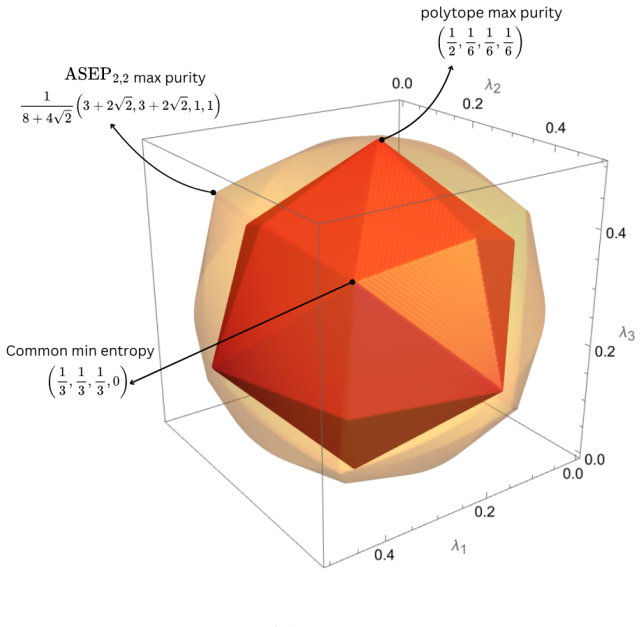
- For qubit-qudit systems the maximal-face equations become explicit linear relations, recovering and organizing known extreme-point structure for $\mathrm{ASEP}_{2,n}$.
- Since $\mathrm{ASEP}_{m,n}$ is semialgebraic while $\mathrm{APPT}_{m,n}$ is a spectrahedron, exhibiting any non-exposed extreme point of $\mathrm{ASEP}_{m,n}$ would prove absolute separability is strictly smaller than absolute PPT.
- The inscribed polytope $\mathcal{P}_{m,n}$ supplies closed-form lower bounds on maximum purity, upper bounds on minimum von Neumann entropy, and an exact relative volume; numerical estimates indicate the relative volume of $\mathrm{APPT}_{m,n}$ decays exponentially in $n$ at nearly the polytope's rate.
Reading between the lines
- Beyond the paper, the spectrahedral description suggests that the maximum-purity conjecture could be attacked with symmetry-reduced semidefinite programming; the numerics reported stop at $m=4$, so a certified SDP computation for $m=5$ would be a natural next check.
- Inference: the rank formula for face dimensions invites a purely combinatorial enumeration of faces by assigning a kernel subspace to each active permutation, which could produce the full face lattice of $\mathrm{APPT}_{m,n}$ for small $m,n$ without sampling spectra.
- Inference: if the polytope $\mathcal{P}_{m,n}$ is eventually shown to lie inside $\mathrm{ASEP}_{m,n}$—a containment the paper leaves open—then its exact purity, entropy, and volume bounds immediately become bounds on absolute separability, and the comparison of the two sets reduces to their boundaries outside the polytope.
- Inference: the exposedness of every APPT face gives a concrete separation strategy: search for non-exposed extreme points of $\mathrm{ASEP}_{m,n}$. The paper's explicit face equations provide a finite algebraic system on which such a search could be based.
Editorial analysis
A structured set of objections, weighed in public.
Referee Report
Summary. The paper studies the convex geometry of the sets of spectra of bipartite absolutely separable (ASEP) and absolute-PPT (APPT) states. The central technical claim is a permutation-symmetric reformulation of Hildebrand's absolute PPT criterion: for m≤n, λ∈APPT_{m,n} iff L_π(λ)≥0 for all π∈S_{mn}, where L_π is an m×m matrix whose entries are linear forms in the permuted spectrum. This yields the advertised spectrahedral representation APPT_{m,n}=Δ_{mn-1}∩{⊕_π L_π(λ)≥0}. From it the paper derives a determinantal description of the boundary, a kernel-based description of all faces, a rank formula for face dimensions, and the conclusion that every face is exposed. In the quantitative part, an inscribed polytope P_{m,n} is defined via Gershgorin-type sufficient conditions; its maximal purity, minimal von Neumann entropy and relative volume are computed. The paper also gives a Monte-Carlo study suggesting that the relative volume of APPT_{m,n} decays exponentially in n with a rate close to that of the polytope, and states a conjecture that the maximal purity of APPT_{m,n} equals that of P_{m,n} for all m,n except m=n=2.
Significance. If the central equivalence is correct, the paper makes a substantial contribution: it gives a finite spectrahedral description of APPT_{m,n} for all m≤n, with all faces exposed, an explicit kernel-based characterization of faces and extreme points, and a dimension formula governed by the rank of a permutation-block matrix. The use of Gershgorin arguments to obtain a concrete inscribed polytope and the exact computation of its purity, entropy and volume are valuable and in part already go beyond previous work. The numerical fits for the volume decay are interesting and provide a concrete testable conjecture. However, the paper's headline volume statement in the abstract is stronger than what is rigorously proved, and the main spectrahedral representation relies on an external lemma whose proof is not reproduced. Both points need to be addressed before the paper can be accepted as is.
major comments (3)
- [Theorem 4.1, Eqs. (7)-(8)] The step from the continuum of unitary constraints Tr(U diag(λ) U† (|ψ⟩⟨ψ|)^Γ)≥0 to the finite family L_π(λ)≥0 for all π∈S_mn is the load-bearing point of the whole paper, but the proof only says 'see the proof of [16, Lemma 3]' and does not reproduce it. Since this equivalence is what makes APPT_{m,n} a spectrahedron and is inherited by Theorem 4.3, Proposition 5.4, Corollaries 5.7, 5.10, and 5.12, the reader cannot verify that the LMI family is exactly the absolute PPT condition, especially without any ordering assumption on λ. Please either give a self-contained proof of the equivalence, or state precisely which statement of [16] is being used and why it applies to the unordered, permutation-symmetric setting.
- [Abstract and Section 6.3] The abstract states that the relative spectral volume of APPT_{m,n} decays exponentially in n 'by a constant multiplicative factor of the relative volume of the inscribed polytope'. The rigorous content of Section 6.3 is Theorem 6.16, which only gives the lower bound vol_rel(APPT_{m,n})≥max{vol_rel(BALL), vol_rel(P_{m,n})}. The exponential decay statement is supported by the numerical log-linear fits in Eq. (71) and Table 1, not by a proof. No upper bound of vol_rel(APPT) relative to vol_rel(P) is established. Please either prove the claimed asymptotic relation or weaken the abstract and Section 7 to state the lower bound and the numerical evidence.
- [Proposition 6.14] The derivation of the exact relative volume of P_{m,n} applies Lasserre's formula (62) to coefficients h(u_i) that are not pairwise distinct. The text says that an 'identical weights condition' from [40, Sec. 2.1] applies, but the limiting expression is not stated. Since the formula (63) is used as a rigorous lower bound and feeds into the quantitative claims, the limiting argument should be written out explicitly, or the statement should be restricted to the cases where the formula can be obtained by a limiting argument from (62).
minor comments (4)
- [Introduction, p. 2] There is a typo 'and and identify' in the first paragraph of the introduction.
- [Figure 2 caption] The caption reads 'and its the convex hull'; this should be 'and its convex hull'.
- [Eq. (5)] The index functions p(i,j) and q(i,j) are central but somewhat opaque; a small example or one-line enumeration for m=2 would help the reader.
- [Section 6.3, Eq. (71)] The fit log10 vol ≈ C_m + γ_m n is presented without error bars or number of Monte Carlo samples; adding these would make the numerical comparison more reliable.
Circularity Check
No significant circularity: the spectrahedral description imports an external, independently established criterion (Hildebrand) and the quantitative bounds are proven from Gershgorin, not from fitted values.
full rationale
The paper's central claim that APPT_{m,n} is a spectrahedron is grounded in Theorem 4.1, which takes Hildebrand's absolute-PPT criterion as external input. The proof explicitly delegates the key reduction from continuous unitary orbits to finite permutations: 'see the proof of [16, Lemma 3]'. This is a genuine external citation, not a self-citation, and the cited result does not depend on the present paper's conclusions. All subsequent facial and dimensional statements (Theorems 5.2-5.4, Corollaries 5.7-5.10) are derived from standard spectrahedra kernel theory applied to the LMI representation, and no equation reduces to a quantity that was fitted earlier in the paper. The polytope P_{m,n} bounds on purity, entropy, and volume are proven directly via Gershgorin's theorem and simplex geometry, with numerical results explicitly presented as numerics rather than as analytical predictions. The only concern is the load-bearing external lemma [16, Lemma 3], which is not reproduced in the paper; this is a correctness or verification risk, not a circularity, because it is an independent result and does not presuppose the target claims. No uniqueness theorem from the authors is invoked, and no self-citation chain carries the argument. Therefore the derivation is self-contained relative to its stated external premises, and no circular step is present.
Assumptions & free parameters
free parameters (1)
- γ_m, log-linear decay slope of APPT_{m,n} relative volume =
m=2: -0.7625; m=3: -1.7454; m=4: -2.9033
assumptions (8)
- standard math Krein-Milman theorem and conic version
- standard math Hardy-Littlewood-Pólya majorization and Schur convexity
- standard math Tarski-Seidenberg quantifier elimination
- standard math Lasserre's simplex section volume formula
- standard math Determinant preserver theorem for symmetric matrices
- domain assumption Hildebrand's absolute PPT criterion, including the lemma used in Theorem 4.1
- domain assumption Johnston's equality ASEP_{2,n}=APPT_{2,n}
- domain assumption Semialgebraicity of the set of separable states
Cite this review
Pith. "Pith review of The geometry of absolute separability and other convex matrix properties from spectrum." pith.science (2026). https://pith.science/paper/6KSKWTVF
@misc{pith2026260803390,
  author       = {Pith},
  title        = {Pith review of: The geometry of absolute separability and other convex matrix properties from spectrum},
  year         = {2026},
  howpublished = {\url{https://pith.science/paper/6KSKWTVF}},
  note         = {Machine review of arXiv:2608.03390}
}
abstract
We investigate the geometric structure of the set of spectra of bipartite absolute separable states ($\mathrm{ASEP}_{m,n}$) and absolute positive partial transpose states ($\mathrm{APPT}_{m,n}$), i.e., bipartite quantum states that remain separable or PPT respectively, under all global unitary transformations. First, we establish general geometric properties of absolute convex sets of matrices, their spectra and extreme points. Regarding absolute separability, we present a permutation-symmetric reformulation of the absolute PPT criterion and use it to demonstrate that $\mathrm{APPT}_{m,n}$ is a spectrahedron for all $m\leq n$: in particular, all its faces are exposed. In contrast, while $\mathrm{ASEP}_{2,n}$ is also a spectrahedron, we prove that in general $\mathrm{ASEP}_{m,n}$ is a semialgebraic set for all $m\leq n$. Furthermore, we provide a complete characterization of the faces and extreme points of $\mathrm{APPT}_{m,n}$ and demonstrate that the dimension of a face is determined by the rank of a certain matrix, with maximal proper faces having dimension $(mn-m-1)$. In the quantitative setting, we provide a rigorous lower bound on the maximal attainable purity of $\mathrm{APPT}_{m,n}$ via an inscribed polytope $\mathcal{P}_{m,n}$ and conjecture that the maximal purity of $\mathrm{APPT}_{m,n}$ (along with its spectra) coincides with the polytope for arbitrary dimensions except when $m=n=2$. Additionally, we also provide a rigorous upper bound on the minimal von Neumann entropy of $\mathrm{APPT}_{m,n}$ and demonstrate numerically that the minimum entropy eventually coincides with the polytope $\mathcal{P}_{m,n}$ as the local system dimension $n$ increases. Finally, we show that the relative spectral volume of $\mathrm{APPT}_{m,n}$ decays exponentially in $n$ by a constant multiplicative factor of the relative volume of the inscribed polytope $\mathcal{P}_{m,n}$.
Figures


Figures from the paper (8 more)




Reference graph
Works this paper leans on
-
[16]
Positive partial transpose from spectra,
R. Hildebrand, “Positive partial transpose from spectra,”Physical Review A, vol. 76, no. 5, Nov. 2007.doi:10.1103/PhysRevA.76.052325
-
[1]
Discussion of probability relations between separated systems,
E. Schr¨ odinger, “Discussion of probability relations between separated systems,”Mathematical Proceedings of the Cambridge Philosophical Society, vol. 31, no. 4, pp. 555–563, Oct. 1935.doi: 10.1017/s0305004100013554
-
[2]
Can quantum-mechanical description of physical reality be considered complete?
A. Einstein, B. Podolsky, and N. Rosen, “Can quantum-mechanical description of physical reality be considered complete?”Physical Review, vol. 47, no. 10, pp. 777–780, May 1935.doi:10.1103/ PhysRev.47.777
work page 1935
-
[3]
R. Horodecki, P. Horodecki, M. Horodecki, and K. Horodecki, “Quantum entanglement,”Reviews of Modern Physics, vol. 81, no. 2, pp. 865–942, Jun. 2009.doi:10.1103/RevModPhys.81.865
-
[4]
Quantum cryptography based on Bell’s theorem,
A. K. Ekert, “Quantum cryptography based on Bell’s theorem,”Physical Review Letters, vol. 67, no. 6, pp. 661–663, Aug. 1991.doi:10.1103/PhysRevLett.67.661
-
[5]
Teleporting an unknown quantum state via dual classical and Einstein-Podolsky-Rosen channels,
C. H. Bennett, G. Brassard, C. Cr´ epeau, R. Jozsa, A. Peres, and W. K. Wootters, “Teleporting an unknown quantum state via dual classical and Einstein-Podolsky-Rosen channels,”Physical Review Letters, vol. 70, no. 13, pp. 1895–1899, Mar. 1993.doi:10.1103/PhysRevLett.70.1895 40
-
[6]
Proposed experiment to test local hidden-variable theories,
J. F. Clauser, M. A. Horne, A. Shimony, and R. A. Holt, “Proposed experiment to test local hidden-variable theories,”Physical Review Letters, vol. 23, pp. 880–884, 15 Oct. 1969.doi:10. 1103/PhysRevLett.23.880
work page 1969
-
[7]
Quantum states with Einstein-Podolsky-Rosen correlations admitting a hidden- variable model,
R. F. Werner, “Quantum states with Einstein-Podolsky-Rosen correlations admitting a hidden- variable model,”Physical Review A, vol. 40, no. 8, pp. 4277–4281, Oct. 1989.doi:10 . 1103 / PhysRevA.40.4277
work page 1989
Show all 45 references
-
[8]
Classical deterministic complexity of Edmonds’ Problem and quantum entanglement,
L. Gurvits, “Classical deterministic complexity of Edmonds’ Problem and quantum entanglement,” inProceedings of the Thirty-Fifth Annual ACM Symposium on Theory of Computing, ser. STOC ’03, New York, NY, USA: Association for Computing Machinery, 2003, pp. 10–19,isbn: 1581136749...
2003
-
[9]
Strong NP-hardness of the quantum separability problem,
S. Gharibian, “Strong NP-hardness of the quantum separability problem,”Quantum Information and Computation, vol. 10, pp. 343–360, 2010
2010
-
[10]
Separability criterion for density matrices,
A. Peres, “Separability criterion for density matrices,”Physical Review Letters, vol. 77, no. 8, pp. 1413–1415, Aug. 1996.doi:10.1103/PhysRevLett.77.1413
1996 doi
-
[11]
Separability of mixed states: Necessary and suf- ficient conditions,
M. Horodecki, P. Horodecki, and R. Horodecki, “Separability of mixed states: Necessary and suf- ficient conditions,”Physical Letters A, vol. 223, no. 1–2, pp. 1–8, 1996.doi:10 . 1016 / S0375 - 9601(96)00706-2
1996
-
[12]
Entanglement detection,
O. G¨ uhne and G. T´ oth, “Entanglement detection,”Physics Reports, vol. 474, no. 1-6, pp. 1–75, Apr. 2009.doi:10.1016/j.physrep.2009.02.004
2009 doi
-
[13]
Geometry of entangled states,
M. Ku´ s and K. ˙Zyczkowski, “Geometry of entangled states,”Physical Review A, vol. 63, no. 3, Feb. 2001, Art. no. 032307.doi:10.1103/PhysRevA.63.032307
2001 doi
-
[14]
Knill,Separability from spectrum, Open problems in quantum information theory, 2003
E. Knill,Separability from spectrum, Open problems in quantum information theory, 2003. [Online]. Available:http://qig.itp.uni-hannover.de/qiproblems/15
2003
-
[15]
Is separability from spectrum determined by the partial transpose?
S. Arunachalam, N. Johnston, and V. Russo, “Is separability from spectrum determined by the partial transpose?”Quantum Information and Computation, vol. 15, no. 7–8, pp. 0694–0720, 2015
2015
-
[17]
Separability from spectrum for qubit-qudit states,
N. Johnston, “Separability from spectrum for qubit-qudit states,”Physical Review A, vol. 88, no. 6, Dec. 2013, Art. no. 062330.doi:10.1103/PhysRevA.88.062330
2013 doi
-
[18]
The inverse eigenvalue problem for entanglement witnesses,
N. Johnston and E. Patterson, “The inverse eigenvalue problem for entanglement witnesses,”Linear Algebra and its Applications, vol. 550, pp. 1–27, 2018.doi:10.1016/j.laa.2018.03.043
2018 doi
-
[19]
Sufficient criteria for absolute separability in arbitrary dimensions via linear map inverses,
J. Abellanet-Vidal, G. M¨ uller-Rigat, G. Rajchel-Mieldzio´ c, and A. Sanpera, “Sufficient criteria for absolute separability in arbitrary dimensions via linear map inverses,”Reports on Progress in Physics, vol. 88, no. 10, 2025, Art. no. 107601.doi:10.1088/1361-6633/ae0cfa
2025 doi
-
[20]
Spectral criteria for absolute positive partial transpose (PPT) in qudit- qudit state systems,
L. Xiong and N.-S. Sze, “Spectral criteria for absolute positive partial transpose (PPT) in qudit- qudit state systems,”Journal of Mathematical Physics, vol. 67, no. 1, Jan. 2026, Art. no. 012201. doi:10.1063/5.0273779
2026 doi
- [21]
-
[22]
The set of separable states has no finite semidefinite representation except in dimension 3×2,
H. Fawzi, “The set of separable states has no finite semidefinite representation except in dimension 3×2,”Communications in Mathematical Physics, vol. 386, no. 3, pp. 1319–1335, 2021.doi:10. 1007/s00220-021-04163-2
2021
-
[23]
Witness of mixed separable states useful for entanglement creation,
N. Ganguly, J. Chatterjee, and A. S. Majumdar, “Witness of mixed separable states useful for entanglement creation,”Physical Review A, vol. 89, no. 5, May 2014, Art. no. 052304.doi:10. 1103/PhysRevA.89.052304
2014
-
[24]
Extreme points of sets of absolutely separable and positive partial transpose states,
Z. Song and L. Chen, “Extreme points of sets of absolutely separable and positive partial transpose states,”Physical Review A, vol. 112, no. 2, Aug. 2025, Art. no. 022409.doi:10.1103/7pnp-qgrq 41
2025 doi
-
[25]
Characterizing the boundary of the set of absolutely separable states and their generation via noisy environments,
S. Halder, S. Mal, and A. Sen(De), “Characterizing the boundary of the set of absolutely separable states and their generation via noisy environments,”Physical Review A, vol. 103, 5 May 2021, Art. no. 052431.doi:10.1103/PhysRevA.103.052431
2021 doi
-
[26]
Extreme points of absolutely PPT states with exactly three distinct eigenvalues,
N. Wang, L. Chen, and Z. Song, “Extreme points of absolutely PPT states with exactly three distinct eigenvalues,”preprint arXiv:2603.20717, 2026.doi:10.48550/arXiv.2603.20717
2026 doi
-
[27]
R. T. Rockafellar,Convex analysis. Princeton university press, 1997, vol. 28
1997
-
[28]
Barvinok,A Course in Convexity(Graduate Studies in Mathematics)
A. Barvinok,A Course in Convexity(Graduate Studies in Mathematics). American Mathematical Society, 2002, vol. 54
2002
-
[29]
Boyd and L
S. Boyd and L. Vandenberghe,Convex Optimization. Cambridge University Press, 2004
2004
-
[30]
Bochnak, M
J. Bochnak, M. Coste, and M.-F. Roy,Real Algebraic Geometry(Ergebnisse der Mathematik und ihrer Grenzgebiete; Modern Surveys in Mathematics). Springer Verlag, 1998, vol. 36.doi: 10.1007/978-3-662-03718-8
1998 doi
-
[31]
The geometry of spectrahedra,
C. Vinzant, “The geometry of spectrahedra,” inProceedings of Symposia in Applied Mathematics, vol. 77, Providence, RI, USA: American Mathematical Society, 2020, pp. 11–35
2020
-
[32]
Extreme points of gram spectrahedra of binary forms,
C. Scheiderer, “Extreme points of gram spectrahedra of binary forms,”Discrete & Computational Geometry, vol. 67, no. 4, pp. 1174–1190, 2022.doi:10.1007/s00454-022-00385-w
2022 doi
-
[33]
Spectrahedra and their shadows,
T. Netzer, “Spectrahedra and their shadows,” Habilitation thesis, Universit¨ at Leipzig, 2012. [On- line]. Available:https://www.mathematik.uni-leipzig.de/preprints/p1207.0070.pdf
2012 arXiv
-
[34]
Some geometric results in semidefinite programming,
M. Ramana and A. J. Goldman, “Some geometric results in semidefinite programming,”Journal of Global Optimization, vol. 7, no. 1, pp. 33–50, 1995.doi:10.1007/BF01100204
1995 doi
-
[35]
Tent and M
K. Tent and M. Ziegler,A course in model theory. Cambridge University Press, 2012
2012
-
[36]
Positive reduction from spectra,
M. A. Jivulescu, N. Lupa, I. Nechita, and D. Reeb, “Positive reduction from spectra,”Linear Algebra and its Applications, vol. 469, pp. 276–304, 2015.doi:10.1016/j.laa.2014.11.031
2015 doi
-
[37]
R. A. Horn and C. R. Johnson,Matrix analysis. Cambridge university press, 1985.doi:12
1985
-
[38]
Largest separable balls around the maximally mixed bipartite quantum state,
L. Gurvits and H. N. Barnum, “Largest separable balls around the maximally mixed bipartite quantum state,”Physical Review A, vol. 66, 6 Dec. 2002, Art. no. 062311.doi:10.1103/PhysRevA. 66.062311
2002 doi
-
[39]
On the maximum purity of absolutely separable bipartite states,
H. P. Dung and V. T. Khoi, “On the maximum purity of absolutely separable bipartite states,” preprint arXiv:2510.19508, 2025.doi:10.48550/arXiv.2510.19508
2025 doi
-
[40]
Volume of slices and sections of the simplex in closed form,
J.-B. Lasserre, “Volume of slices and sections of the simplex in closed form,”Optimization Letters, vol. 9, no. 7, pp. 1263–1269, 2015.doi:10.1007/s11590-015-0898-z
2015 doi
-
[41]
Volume of the set of separable states,
K. ˙Zyczkowski, P. Horodecki, A. Sanpera, and M. Lewenstein, “Volume of the set of separable states,”Physical Review A, vol. 58, no. 2, pp. 883–892, Aug. 1998.doi:10.1103/PhysRevA.58.883
1998 doi
-
[42]
Volume estimation by Monte Carlo methods,
D. S. Fok and D. Crevier, “Volume estimation by Monte Carlo methods,”Journal of Statistical Computation and Simulation, vol. 31, no. 4, pp. 223–235, 1989.doi:10.1080/00949658908811145
1989 doi
-
[43]
Determinant preserving transformations on symmetric matrix spaces,
C. Cao and X. Tang, “Determinant preserving transformations on symmetric matrix spaces,”The Electronic Journal of Linear Algebra, vol. 11, pp. 205–211, Jan. 2004.doi:10 . 13001 / 1081 - 3810.1133
2004
-
[44]
Sur une g´ en´ eralisation du groupe orthogonal ` a quatre variables,
J. Dieudonn´ e, “Sur une g´ en´ eralisation du groupe orthogonal ` a quatre variables,”Archiv der Math- ematik, vol. 1, no. 4, pp. 282–287, 1948.doi:10.1007/bf02038756
1948 doi
-
[45]
Hartshorne,Algebraic Geometry(Graduate Texts in Mathematics)
R. Hartshorne,Algebraic Geometry(Graduate Texts in Mathematics). Springer, 1977, vol. 52.doi: 10.1007/978-1-4757-3849-0 42 A Proofs of certain results in Subsection 4.2 In this section, we prove Lemmas 4.4 and 4.5, and Theorem 4.6, which we restate for the reader’s convenience...
1977 doi
Reviewed August 5, 2026 · model on record in the stance chip above.
Discussion (0). Continue with ORCID to comment.