REVIEW 2 major objections 2 minor 17 references
FacProcessTwin: An LLM-Based System for Process Twin Development
T0 review · 2 major / 2 minor · reviewed 2026-06-27 · grok-4.3
Pith's one-line read FacProcessTwin uses an LLM to generate accurate process twins from documentation in roughly one-sixth the manual time while deferring safety-critical data bindings to operators.
desk verdict FacProcessTwin gives a concrete LLM pipeline for end-to-end process twin creation on real manufacturing flows, with usable numbers, but the single-site evaluation and thin ground-truth details keep the accuracy claims from traveling far. read the letter →
The pith
A machine-rendered reading of the paper's core claim, the machinery that carries it, and where it could break.
The reading
What carries the argument
LLM-driven generation of the full process model combined with automatic data binding and interactive human-in-the-loop governance for ambiguous or safety-critical steps.
What would settle it
A follow-up evaluation on additional manufacturers or flows where mean F1 drops below 80 percent or the one-sixth time reduction does not hold would falsify the performance claims.
Extended reading notes
Core claim
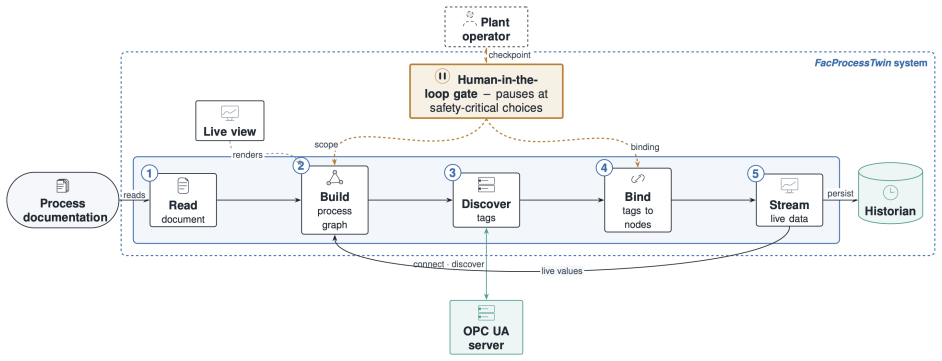
FacProcessTwin leverages a large language model to generate a complete process model from plant documentation and natural-language operator input, automatically binds model steps to live operational data, and renders the result as an interactive process diagram that allows manufacturing personnel to monitor and correct autonomous decisions such as resolving uncertainty at safety-critical binding steps.
Load-bearing premise
The ground truth process models used for F1 scoring are complete and accurate representations of real production flows, and the 16 flows in the case study are representative enough for the accuracy and time claims to generalize.
Editorial extensions
If this is right
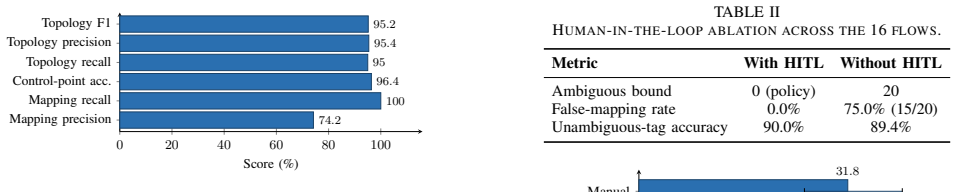
- Process twins can be developed with mean F1 accuracy of 95.2 percent against ground truth on the evaluated flows.
- Each twin requires roughly one-sixth the manual development time.
- Human-in-the-loop governance at ambiguous tags results in zero mis-bindings where a single-pass baseline mis-binds 75 percent of the time.
- The generated models capture process steps, equipment and product-specific settings, and variations within the same product across chilled, frozen, and aseptic categories.
Reading between the lines
- The same LLM-plus-human-oversight pattern could reduce development time for other classes of digital twins that also require binding models to live sensor streams.
- If the interactive diagram is extended to accept ongoing operator corrections, the system might support incremental updates rather than full rebuilds when processes change.
- Adoption in regulated industries would likely depend on logging every deferral decision to maintain audit trails for the bindings.
Signed reviews
Editorial analysis
A structured set of objections, weighed in public.
Referee Report
Summary. The paper presents FacProcessTwin, an LLM-based system for developing process twins that generates complete process models (steps, equipment settings, variations) from plant documentation and operator natural-language input, automatically binds steps to live operational data, and renders an interactive diagram with human-in-the-loop governance for monitoring and correcting autonomous decisions such as ambiguous bindings. In a real-world case study at an Australian food manufacturer covering 16 flows across chilled, frozen, and aseptic categories, it reports a mean F1 of 95.2% against ground truth, a six-fold reduction in development time versus manual baselines, and 0% mis-binds at safety-critical ambiguous tags (versus 75% for a single-pass baseline) due to deferral to operators.
Significance. If the results hold, this demonstrates a viable LLM-assisted approach to lowering the high cost of process twin development while incorporating safeguards for safety-critical elements, which could accelerate adoption of process-level (vs. asset-level) digital twins in manufacturing. The real-world case study with quantitative metrics on accuracy, time, and binding correctness is a strength, as is the explicit human-in-the-loop mechanism. No machine-checked artifacts or parameter-free derivations are reported.
major comments (2)
- [§4] §4 (Evaluation): The construction of the ground truth process models against which the 95.2% mean F1 is computed is not described (e.g., whether created independently by domain experts from primary sources separate from the LLM inputs or documentation used by the system). This detail is load-bearing for interpreting the accuracy claim.
- [§5] §5 (Results): The time-reduction claim (each twin built in roughly 1/6 the manual time) lacks a precise definition of the manual baseline tasks measured and the protocol for timing across the 16 flows, which is load-bearing for the efficiency result.
minor comments (2)
- [Abstract and §5] The abstract and §5 do not specify the exact definition of F1 (e.g., which model elements—steps, settings, bindings—are treated as true positives) or how it is aggregated across flows.
- [Figures] Figure captions for the interactive diagram could more explicitly label the human-in-the-loop correction interface to clarify the governance flow.
Simulated Author's Rebuttal
We thank the referee for their detailed review and constructive feedback on the evaluation and results sections. We address each major comment below and will revise the manuscript to incorporate the requested clarifications.
read point-by-point responses
-
Referee: [§4] §4 (Evaluation): The construction of the ground truth process models against which the 95.2% mean F1 is computed is not described (e.g., whether created independently by domain experts from primary sources separate from the LLM inputs or documentation used by the system). This detail is load-bearing for interpreting the accuracy claim.
Authors: We agree that the construction of the ground truth process models is not described in sufficient detail in the current manuscript. The ground truth was developed independently by domain experts at the plant using primary process documentation and operational records that were not supplied as inputs to FacProcessTwin. In the revised manuscript we will add an explicit subsection in §4 describing the ground-truth creation protocol, the experts involved, and the steps taken to ensure separation from the LLM inputs. revision: yes
-
Referee: [§5] §5 (Results): The time-reduction claim (each twin built in roughly 1/6 the manual time) lacks a precise definition of the manual baseline tasks measured and the protocol for timing across the 16 flows, which is load-bearing for the efficiency result.
Authors: We acknowledge that the manuscript does not provide a precise definition of the manual baseline tasks or the timing protocol. The manual baseline consisted of the complete sequence of steps performed by domain experts: eliciting process steps, equipment settings and variations from documentation, constructing the model, and performing data bindings. Timing was recorded for each of the 16 flows using the same experts and a consistent stopwatch protocol under controlled conditions. We will expand §5 to include these definitions and protocol details. revision: yes
Circularity Check
No circularity: empirical evaluation against independent ground truth and manual baselines.
full rationale
The paper presents an LLM-based system evaluated via F1 scores on 16 flows against separately constructed ground truth models and time measurements against manual baselines. No equations, fitted parameters, predictions, or first-principles derivations are claimed. No self-citations are used to justify uniqueness or load-bearing premises. The evaluation setup does not reduce any reported result to quantities defined by the system's own outputs or prior author work; ground truth and manual times are external to the FacProcessTwin pipeline.
Assumptions & free parameters
assumptions (1)
- domain assumption Large language models can extract accurate process step, equipment, and variation information from plant documentation and natural-language operator input.
Cite this review
Pith. "Pith review of FacProcessTwin: An LLM-Based System for Process Twin Development." pith.science (2026). https://pith.science/paper/6KW4F4KL
@misc{pith2026260617666,
  author       = {Pith},
  title        = {Pith review of: FacProcessTwin: An LLM-Based System for Process Twin Development},
  year         = {2026},
  howpublished = {\url{https://pith.science/paper/6KW4F4KL}},
  note         = {Machine review of arXiv:2606.17666}
}
read the original abstract
Process twins provide real-time representations of entire production processes. By capturing how process steps interact, rather than monitoring a single machine in isolation as an asset-based digital twin does, they have the potential to drive efficiency gains across the whole process. However, developing a process twin is costly. It requires accurately modelling the entire production process: its process steps, the equipment and product-specific settings each step uses, and its process variations. The resulting model must then be bound to live operational data. We present FacProcessTwin, a system that leverages a large language model (LLM) to reduce this development time, building a process twin from a plant's process documentation and natural-language input from an operator. FacProcessTwin generates this complete process model and then automatically binds its process steps to live operational data. The generated model and its data bindings are rendered as an interactive process diagram through which manufacturing personnel can monitor and correct the system's autonomous decisions, such as resolving uncertainty at safety-critical binding steps. We evaluate FacProcessTwin through a real-world case study of an Australian food manufacturer, covering 16 production process flows that span chilled, frozen, and aseptic shelf-stable product categories and include process variations within the same product. The results show that FacProcessTwin generates these process models accurately (a mean F1 of 95.2% against ground truth) and builds each twin in roughly a sixth of the manual time. Its human-in-the-loop governance then keeps the safety-critical bindings correct: at ambiguous tags where a single-pass baseline silently mis-binds 75.0% of the time, FacProcessTwin defers to the operator and mis-binds none.
Figures
Reference graph
Works this paper leans on
-
[1]
Digital twin: Enabling technologies, challenges and open research,
A. Fuller, Z. Fan, C. Day, and C. Barlow, “Digital twin: Enabling technologies, challenges and open research,”IEEE access, vol. 8, pp. 108 952–108 971, 2020
2020
-
[2]
Five-dimension digital twin model and its ten applications,
F. Tao, W. Liu, M. Zhang, T.-l. Hu, Q. Qi, H. Zhang, F. Sui, T. Wang, H. Xu, Z. Huanget al., “Five-dimension digital twin model and its ten applications,”Comput. Integr . Manuf. Syst, vol. 25, no. 1, pp. 1–18, 2019
2019
-
[3]
Digital twins of food process operations: the next step for food process models?
P. Verboven, T. Defraeye, A. K. Datta, and B. Nicolai, “Digital twins of food process operations: the next step for food process models?” Current Opinion in F ood Science, vol. 35, pp. 79–87, 2020
2020
-
[4]
Digital twin-enabled process control in the food industry: proposal of a framework based on two case studies,
G. P. C. Tancredi, E. Bottani, and G. Vignali, “Digital twin-enabled process control in the food industry: proposal of a framework based on two case studies,”International Journal of Production Research, vol. 62, no. 12, pp. 4331–4348, 2024
2024
-
[5]
A methodology for estimating the cost of a digital twin,
S. Su, A. Nassehi, A. McClenaghan, A. Langridge, and B. Hicks, “A methodology for estimating the cost of a digital twin,”Journal of Manufacturing Systems, vol. 80, pp. 841–858, 2025
2025
-
[6]
Automatic generation of a simulation-based digital twin of an industrial process plant,
G. S. Martinez, S. Sierla, T. Karhela, and V . Vyatkin, “Automatic generation of a simulation-based digital twin of an industrial process plant,” inIECON 2018-44th Annual Conference of the IEEE Industrial Electronics Society. IEEE, 2018, pp. 3084–3089
2018
-
[7]
Towards semi-automatic generation of a steady state digital twin of a brownfield process plant,
S. Sierla, L. Sorsam ¨aki, M. Azangoo, A. Villberg, E. Hyt ¨onen, and V . Vyatkin, “Towards semi-automatic generation of a steady state digital twin of a brownfield process plant,”Applied Sciences, vol. 10, no. 19, p. 6959, 2020
2020
-
[8]
A model-based approach to auto- mated digital twin generation in manufacturing,
A. Alexopoulos, A. Bompotas, N. R. Kalogeropoulos, P. Kechagias, A. P. Kalogeras, and C. Alexakos, “A model-based approach to auto- mated digital twin generation in manufacturing,” in2025 10th South- East Europe Design Automation, Computer Engineering, Computer Networks and Social Media Conference (SEEDA-CECNSM). IEEE, 2025, pp. 1–6
2025
Show all 17 references
-
[9]
Control industrial automation system with large language model agents,
Y . Xia, N. Jazdi, J. Zhang, C. Shah, and M. Weyrich, “Control industrial automation system with large language model agents,” in2025 IEEE 30th International Conference on Emerging Technologies and Factory Automation (ETF A). IEEE, 2025, pp. 1–8
2025
-
[10]
Leveraging llm agents and digital twins for fault handling in process plants,
M. S. Gill, J. Vyas, A. Markaj, F. Gehlhoff, and M. Mercang ¨oz, “Leveraging llm agents and digital twins for fault handling in process plants,” in2025 IEEE 30th International Conference on Emerging Technologies and Factory Automation (ETF A). IEEE, 2025, pp. 1– 8
2025
-
[11]
Generation of asset administration shell with large language model agents: Toward semantic interoperability in digital twins in the context of industry 4.0,
Y . Xia, Z. Xiao, N. Jazdi, and M. Weyrich, “Generation of asset administration shell with large language model agents: Toward semantic interoperability in digital twins in the context of industry 4.0,”IEEE Access, vol. 12, pp. 84 863–84 877, 2024
2024
-
[12]
Digital twins supporting efficient digital industrial transforma- tion,
D. Bamunuarachchi, D. Georgakopoulos, A. Banerjee, and P. P. Jayara- man, “Digital twins supporting efficient digital industrial transforma- tion,”Sensors, vol. 21, no. 20, p. 6829, 2021
2021
-
[13]
A digital twins platform for digital manufacturing,
M. Gunaratne, D. Georgakopoulos, and A. Banerjee, “A digital twins platform for digital manufacturing,”Electronics, vol. 15, no. 3, p. 583, 2026
2026
-
[14]
Large language model-assisted digital twin for remote monitoring and control of advanced reactors,
Z. N. Ndum, D. Lim, J. Ford, S. Adu, J. Tao, Y . Hassan, and Y . Liu, “Large language model-assisted digital twin for remote monitoring and control of advanced reactors,”Progress in Nuclear Energy, vol. 192, p. 106172, 2026
2026
-
[15]
Assetops- bench: Benchmarking ai agents for task automation in industrial asset operations and maintenance,
D. Patel, S. Lin, J. Rayfield, N. Zhou, C. Shyalika, S. R. Yarrabothula, R. Vaculin, N. Martinez, F. O’donncha, and J. Kalagnanam, “Assetops- bench: Benchmarking ai agents for task automation in industrial asset operations and maintenance,”arXiv preprint arXiv:2506.03828, 2025
2025
-
[16]
Smartpilot: Agent-based copilot for intelligent manufacturing,
C. Shyalika, R. Prasad, A. Al Ghazo, D. L. Eswaramoorthi, S. Shree Muthuselvam, and A. Sheth, “Smartpilot: Agent-based copilot for intelligent manufacturing,” inProceedings of the 24th International Conference on Autonomous Agents and Multiagent Systems, 2025, pp. 3053–3055
2025
-
[17]
Low-cost digital manufacturing solution for process manufacturing smes-lesson and experiences from real-world pilot,
A. Banerjee, P. P. Jayaraman, K. Fizza, S. Wang, J. Jin, and H. Ghaderi, “Low-cost digital manufacturing solution for process manufacturing smes-lesson and experiences from real-world pilot,” inIET Conference Proceedings CP885, vol. 2024, no. 11. IET, 2024, pp. 109–115
2024
Reviewed June 27, 2026 · model on record in the stance chip above.
Discussion (0). Continue with ORCID to comment.