Quantum Fluctuations of the Black Hole Horizon
Pith reviewed 2026-06-29 03:08 UTC · model grok-4.3
The pith
Black hole horizons have a quantum width that depends on probe resolution and often exceeds the Planck length.
A machine-rendered reading of the paper's core claim, the machinery that carries it, and where it could break.
Core claim
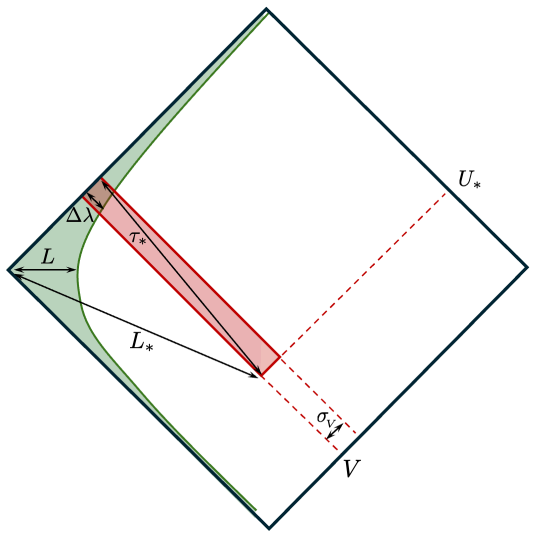
We propose a definition of the quantum width by a physical experiment involving the last moment a signal emitted from an ingoing light ray can escape to infinity. Calculations of this observable for spherically symmetric black holes in perturbative quantum gravity reveal that the quantum width depends on the resolution of the probe, and is often much larger than the Planck scale. For example, for Schwarzschild black holes in four dimensions in a particular regime of parameters, a piece of the horizon of size σ_⊥ has quantum width roughly √(l_P r_s²/σ_⊥).
What carries the argument
Quantum width defined via the latest escape moment of a signal from an ingoing light ray to distant observers.
If this is right
- The horizon position fluctuates by an amount that grows as the inverse square root of the transverse size being measured.
- Quantum effects on the horizon become more visible when the probe resolves smaller regions.
- The width is not a fixed microscopic scale but varies with how the horizon is observed.
- This scaling holds within perturbative quantum gravity for four-dimensional Schwarzschild geometries in the stated parameter regime.
Where Pith is reading between the lines
- The resolution dependence may link to how different observers or detectors interact with the near-horizon region.
- Similar scaling could appear in other spherically symmetric solutions once the same escape-time definition is applied.
- The result suggests that horizon uncertainty participates in larger-scale quantum processes rather than remaining confined to Planckian distances.
Load-bearing premise
The proposed definition of quantum width, based on the last moment a signal from an ingoing light ray can escape to infinity, correctly captures the physical quantum uncertainty of the horizon.
What would settle it
A direct computation of the escape-time distribution for light rays near a black hole horizon that yields a width independent of transverse resolution or equal to the Planck length.
Figures
read the original abstract
Classical black holes have sharply defined event horizons, but quantum mechanically the horizon acquires a quantum uncertainty, called the `quantum width' by Marolf. We propose a definition of the quantum width by a physical experiment involving the last moment a signal emitted from an ingoing light ray can escape to infinity. Calculations of this observable for spherically symmetric black holes in perturbative quantum gravity reveal that the quantum width depends on the resolution of the probe, and is often much larger than the Planck scale. For example, for Schwarzschild black holes in four dimensions in a particular regime of parameters, a piece of the horizon of size $\sigma_\perp$ has quantum width roughly $\sqrt{l_P r_s^2/\sigma_\perp}$.
Editorial analysis
A structured set of objections, weighed in public.
Referee Report
Summary. The manuscript proposes a definition of the quantum width of black hole horizons based on the last moment at which a signal from an ingoing null ray can still escape to future null infinity. It reports perturbative quantum gravity calculations for spherically symmetric black holes showing that this width depends on the transverse resolution σ_⊥ of the probe and can greatly exceed the Planck length; the central example is the scaling √(l_P r_s²/σ_⊥) for a horizon patch of a 4D Schwarzschild black hole in a stated regime of parameters.
Significance. If the definition is shown to be equivalent to metric fluctuations and the calculations are supplied with explicit steps and error control, the result would indicate that horizon quantum fluctuations are resolution-dependent and potentially macroscopic, providing a concrete observable that could connect perturbative quantum gravity to thought-experiment probes of black-hole structure.
major comments (2)
- [Abstract] Abstract: the claim that calculations exist in perturbative quantum gravity is stated without any derivation steps, error estimates, or explicit regime boundaries, so the reported scaling √(l_P r_s²/σ_⊥) cannot be verified or reproduced from the given information.
- [Definition of quantum width] Definition of quantum width (via last-escape time of ingoing null rays): no derivation is supplied showing that this global causal observable is equivalent (up to O(1) factors) to the variance of the horizon-generating null surface under metric perturbations δg_μν in the same perturbative expansion; the observable is sensitive to the location of the would-be horizon but does not automatically measure local metric fluctuations on the horizon itself.
minor comments (1)
- [Abstract] Notation for the transverse size σ_⊥ and the regime of parameters should be defined explicitly with inequalities rather than left as 'a particular regime'.
Simulated Author's Rebuttal
We thank the referee for their careful reading and constructive comments on our manuscript. We address the major comments point by point below, indicating where revisions will be made.
read point-by-point responses
-
Referee: [Abstract] Abstract: the claim that calculations exist in perturbative quantum gravity is stated without any derivation steps, error estimates, or explicit regime boundaries, so the reported scaling √(l_P r_s²/σ_⊥) cannot be verified or reproduced from the given information.
Authors: The perturbative calculations, including the explicit steps for the signal escape timing in the linearized quantum gravity expansion, the error estimates from neglected higher-order terms, and the regime boundaries (σ_⊥ ≫ l_P with the resulting width macroscopic for the given patch), are contained in Sections 3–5 of the manuscript. The abstract provides only the summary result. We will revise the abstract to include a concise outline of the key steps, the leading-order scaling derivation, and the stated parameter regime. revision: yes
-
Referee: [Definition of quantum width] Definition of quantum width (via last-escape time of ingoing null rays): no derivation is supplied showing that this global causal observable is equivalent (up to O(1) factors) to the variance of the horizon-generating null surface under metric perturbations δg_μν in the same perturbative expansion; the observable is sensitive to the location of the would-be horizon but does not automatically measure local metric fluctuations on the horizon itself.
Authors: We agree that the current manuscript does not supply an explicit derivation establishing the equivalence (up to O(1) factors) between the last-escape-time observable and the variance of the horizon null surface under δg_μν. In the perturbative regime the escape-time shift is linearly determined by the line integral of δg_μν along the null geodesic; for a horizon patch this reduces to the local metric fluctuation on the would-be horizon. We will add a dedicated subsection in Section 2 that derives this relation within the same perturbative expansion and clarifies the sense in which the observable measures horizon fluctuations. revision: yes
Circularity Check
No significant circularity; definition and perturbative calculation are independent
full rationale
The paper proposes an explicit operational definition of quantum width via the last-escape-time observable for ingoing null rays, then computes the value of that observable in perturbative quantum gravity for spherically symmetric black holes. This is a standard define-then-calculate procedure whose output is the evaluated quantity rather than a tautological renaming or a fitted parameter relabeled as a prediction. No load-bearing step reduces by the paper's own equations to a self-citation chain, an imported uniqueness theorem, or an ansatz smuggled from prior work by the same authors. The result's dependence on probe resolution follows directly from the stated definition and is not presented as an independent first-principles prediction.
Axiom & Free-Parameter Ledger
Reference graph
Works this paper leans on
-
[1]
Marolf,On the quantum width of a black hole horizon,Springer Proc
D. Marolf,On the quantum width of a black hole horizon,Springer Proc. Phys.98 (2005) 99–112. [arXiv:hep-th/0312059]
Pith/arXiv arXiv 2005
-
[2]
M. Parikh and J. Pereira,Quantum uncertainty in the area of a black hole,JHEP09 (2025) 137. [arXiv:2412.21160]
arXiv 2025
-
[3]
Freivogel and U
B. Freivogel and U. Moitra.To appear, (2026)
2026
-
[4]
B. L. Hu and A. Roura,Fluctuations of an evaporating black hole from back reaction of its Hawking radiation: Questioning a premise in earlier work,Int. J. Theor. Phys. 46(2007) 2204–2217. [arXiv:gr-qc/0601088]
Pith/arXiv arXiv 2007
-
[5]
B. L. Hu and A. Roura,Black hole fluctuations and dynamics from back-reaction of Hawking radiation: Current work and further studies based on stochastic gravity, in 7th Asia-Pacific International Conference on Gravitation and Astrophysics (ICGA7 2005), pp. 236–250, 2006, [arXiv:gr-qc/0610066]
Pith/arXiv arXiv 2005
-
[6]
Verlinde and K
E. Verlinde and K. M. Zurek,Spacetime Fluctuations in AdS/CFT,JHEP04(2020)
2020
-
[7]
E. P. Verlinde and K. M. Zurek,Observational signatures of quantum gravity in inter- ferometers,Phys. Lett. B822(2021) 136663. [arXiv:1902.08207]
arXiv 2021
-
[8]
K. M. Zurek,On vacuum fluctuations in quantum gravity and interferometer arm fluctuations,Phys. Lett. B826(2022) 136910. [arXiv:2012.05870]
arXiv 2022
-
[9]
T. Banks and K. M. Zurek,Conformal description of near-horizon vacuum states, Phys. Rev. D104(2021) 126026. [arXiv:2108.04806]
arXiv 2021
-
[10]
Y. Zhang and K. M. Zurek,Stochastic description of near-horizon fluctuations in Rindler-AdS,Phys. Rev. D108(2023) 066002. [arXiv:2304.12349]
arXiv 2023
- [11]
-
[12]
T. Banks and W. Fischler,Fluctuations and Correlations in Causal Diamonds, [arXiv:2311.18049]
-
[13]
L. Ciambelli, T. He and K. M. Zurek,From Asymptotically Flat Gravity to Finite Causal Diamonds,Phys. Rev. Lett.136(2026) 191501. [arXiv:2512.09018]
Pith/arXiv arXiv 2026
-
[14]
L. Ciambelli, T. He, M. S. Klinger and K. M. Zurek,Mapping the Infrared Phase Space of Gravity to Finite Subregions, [arXiv:2606.12515]. 28
-
[15]
K. Fransen, T. He and K. M. Zurek,Thermodynamics of a spherically symmetric causal diamond in Minkowski spacetime,JHEP12(2025) 125. [arXiv:2507.22977]
arXiv 2025
-
[16]
T. He, P. Mitra and K. M. Zurek,Effective Density Matrix for Vacua in Asymptoti- cally Flat Gravity,Phys. Rev. Lett.136(2026) 211501. [arXiv:2509.13401]
Pith/arXiv arXiv 2026
-
[17]
Banks,The hydrodynamic approach to quantum gravity,Int
T. Banks,The hydrodynamic approach to quantum gravity,Int. J. Mod. Phys. D34 (2025) 2544020. [arXiv:2505.15941]
arXiv 2025
-
[18]
L. Freidel and R. Oberfrank,Geometric noise spectrum in interferometers, [arXiv: 2601.17849]
-
[19]
L. Aalsma and S.-E. Bak,Modular fluctuations in cosmology,Phys. Rev. D112 (2025) 026017. [arXiv:2503.04886]
arXiv 2025
-
[20]
D. Carney, M. Karydas and A. Sivaramakrishnan,Response of interferometers to the vacuum of quantum gravity,Phys. Rev. D113(2026) 106002. [arXiv:2409.03894]
Pith/arXiv arXiv 2026
-
[21]
S.-E. Bak, M. Parikh, S. Sarkar and F. Setti,Quantum gravity fluctuations in the timelike Raychaudhuri equation,JHEP05(2023) 125. [arXiv:2212.14010]
arXiv 2023
-
[22]
S.-E. Bak, M. Parikh, S. Sarkar and F. Setti,Quantum-gravitational null Raychaud- huri equation,JHEP07(2024) 214. [arXiv:2312.17214]
arXiv 2024
-
[23]
B. Bonga and I. Khavkine,Quantum astrometric observables II: time delay in lin- earized quantum gravity,Phys. Rev. D89(2014) 024039. [arXiv:1307.0256]
Pith/arXiv arXiv 2014
-
[24]
Strominger,Lectures on the Infrared Structure of Gravity and Gauge Theory
A. Strominger,Lectures on the Infrared Structure of Gravity and Gauge Theory. Princeton University Press, 2018
2018
-
[25]
T. McLoughlin, A. Puhm and A.-M. Raclariu,The SAGEX review on scattering am- plitudes chapter 11: soft theorems and celestial amplitudes,J. Phys. A55(2022) 443012. [arXiv:2203.13022]
arXiv 2022
-
[26]
G. J. Turiaci,Les Houches lectures on two-dimensional gravity and holography,Sci- Post Phys. Lect. Notes113(2026) 1. [arXiv:2412.09537]
arXiv 2026
-
[27]
Y. Gu, A. Kitaev and P. Zhang,A two-way approach to out-of-time-order correlators, JHEP03(2022) 133. [arXiv:2111.12007]
arXiv 2022
-
[28]
D. Stanford, S. Vardhan and S. Yao,Scramblon loops,JHEP10(2024) 073. [arXiv: 2311.12121]
arXiv 2024
-
[29]
D. Kabat, G. Lifschytz and D. A. Lowe,Constructing local bulk observables in inter- acting AdS/CFT,Phys. Rev. D83(2011) 106009. [arXiv:1102.2910]
Pith/arXiv arXiv 2011
-
[30]
P. Kovtun, D. T. Son and A. O. Starinets,Holography and hydrodynamics: Diffusion on stretched horizons,JHEP10(2003) 064. [arXiv:hep-th/0309213]. 29
Pith/arXiv arXiv 2003
discussion (0)
Sign in with ORCID, Apple, or X to comment. Anyone can read and Pith papers without signing in.