REVIEW 3 major objections 5 minor 23 references
Socratic RL: A Novel Framework for Efficient Knowledge Acquisition through Iterative Reflection and Viewpoint Distillation
T0 review · 3 major / 5 minor · reviewed 2026-08-15 · deepseek-v4-flash
Pith's one-line read Socratic-RL proposes replacing outcome-only rewards with a Teacher AI that writes transferable reasoning principles, then learns to write better ones.
desk verdict A clearly written blueprint for a Teacher-Student reflection loop that honestly flags its own gaps, but the central meta-learning loop is not formally closed and there is zero empirical validation. read the letter →
The pith
A machine-rendered reading of the paper's core claim, the machinery that carries it, and where it could break.
The reading
What carries the argument
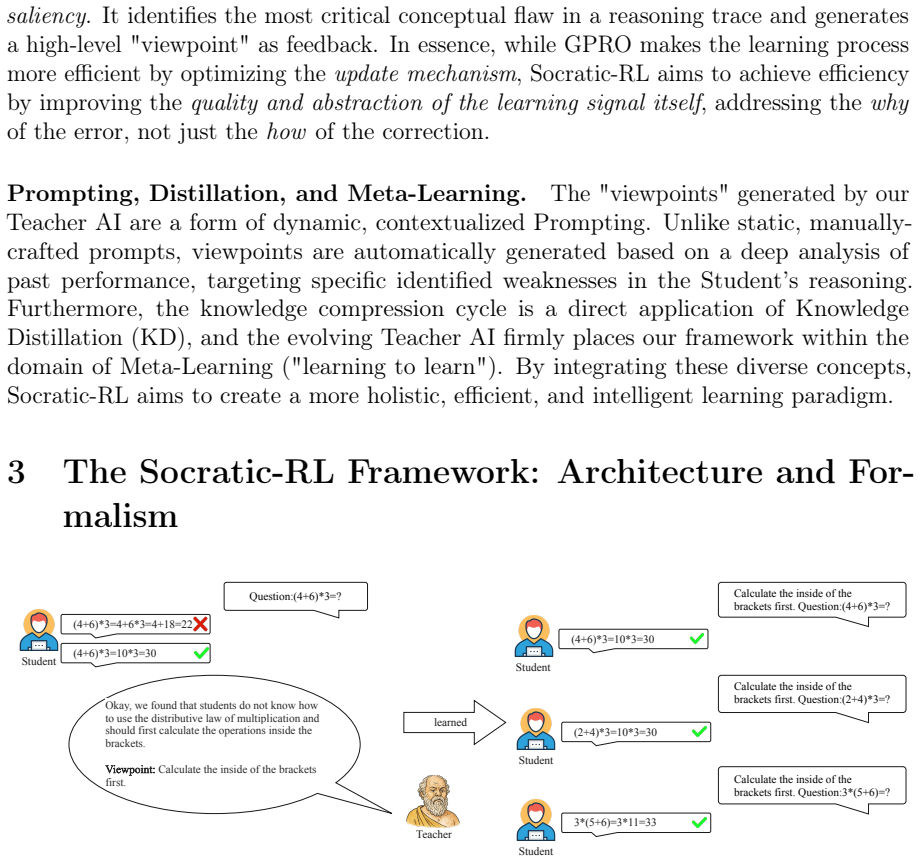
The load-bearing object is the viewpoint — a short, human-readable, transferable principle extracted from a trace (for example, 'operations inside parentheses must be evaluated first'). The load-bearing mechanisms are three: the utility function $U(v)$, the average probe-task score with $v$ minus the average without $v$, which turns the Teacher's teaching quality into a reward the Teacher can be trained on; the meta-learning loop that updates the Teacher using that utility; and the policy-distillation loss, the KL divergence between the viewpoint-guided Student and the unguided new Student, which compresses the viewpoint library into weights. These three pieces convert reflection from an ad-hoc prompt into a closed training loop: trace $\rightarrow$ viewpoint $\rightarrow$ Student behavior $\rightarrow$ measured uplift $\rightarrow$ Teacher update.
What would settle it
Run the proposed Phase 1 experiment: train a Student on multi-step arithmetic with Socratic-RL and with outcome-based RL under matched compute, and compare episodes-to-accuracy. The central claim fails if Socratic-RL is not substantially more sample-efficient, or if viewpoints selected by the trained Teacher give no larger probe-task uplift than randomly sampled viewpoints from the same traces.
Extended reading notes
Core claim
The paper's central claim is that current RL for LLMs fails not because of the optimization machinery but because the reward signal is too thin: a scalar final-answer score cannot tell a model why it was wrong. Socratic-RL's proposal is to insert a decoupled Teacher AI between the environment and the Student, have the Teacher read the Student's full reasoning trace, identify the causal root of the error, and synthesize a short 'viewpoint' (a portable principle such as 'evaluate parentheses before multiplying') that is prepended to the Student's context on future attempts. The Teacher is not fixed: its own parameters are updated by a meta-learning objective that rewards viewpoints by the measured uplift they produce on a set of probe tasks. When viewpoints accumulate, a distillation stage trains a new Student to imitate the viewpoint-guided policy, compressing the principles into parameters so the context window does not fill up. The discovery, if the framework works, is that process-level causal feedback can be generated automatically, improved automatically, and compressed automatically into a model's weights.
Load-bearing premise
The entire self-improvement loop rests on the assumption that a viewpoint's measured uplift on probe tasks is a reliable, stable signal for training the Teacher; if that estimate is noisy or can be gamed, the Teacher's principles can drift and the loop stops improving.
Editorial extensions
If this is right
- If Socratic-RL works as proposed, outcome-based RL should be beaten in sample efficiency on objective domains such as arithmetic, because each viewpoint transfers to every task sharing the same failure mode.
- The growing set of viewpoints becomes a human-readable audit trail, so the system's learned principles can be inspected and diagnosed instead of living only in weights.
- The distillation step keeps the prompt context bounded, so the framework can keep accumulating knowledge without hitting context-window limits.
- The meta-learning loop means the Teacher's teaching skill is itself improvable by automated feedback, unlike fixed critics, so the system can get better at learning how to learn.
- A rule-based Teacher in a constrained domain can validate the core loop before scaling to an LLM-based Teacher.
Reading between the lines
- The paper's logic implies a concrete testable transfer law: one viewpoint should reduce error rates on all probes that share its underlying structure, and the size of that reduction is a direct measure of viewpoint quality.
- Nothing in the paper prevents the Teacher from gaming $U(v)$ by producing viewpoints that boost probe tasks while failing on the real distribution; guarding against that would require measuring viewpoint utility on held-out tasks drawn from a different source.
- The decoupled architecture suggests a scaling advantage the paper does not state explicitly: the Teacher can be a smaller, cheaper model than the Student if trace analysis, not task solving, is the bottleneck, because viewpoint quality depends on causal insight rather than raw problem-solving ability.
Signed reviews
Editorial analysis
A structured set of objections, weighed in public.
Referee Report
Summary. The paper introduces Socratic Reinforcement Learning (Socratic-RL), a framework for LLM training in which a decoupled Teacher AI analyzes student interaction traces, generates structured textual 'viewpoints' as process-level feedback, and iteratively improves its own viewpoint-generation ability through a meta-learning loop. A separate distillation mechanism compresses accumulated viewpoints into the Student's parameters. The manuscript provides a formal notation for the components, an illustrative arithmetic example, a comparison with RLHF/RLAIF/DPO/CAI/Self-Refine, a discussion of challenges (evaluation subjectivity, stability, computational cost, teacher drift), and a phased research roadmap. It contains no experiments and no formal proofs; the central technical contribution is the framework description and the identification of the meta-learning objective.
Significance. If fully realized, the idea of an evolving Teacher that produces causal process-level feedback and compresses it into a Student would be a meaningful contribution beyond static RLAIF critics and self-refine loops, with potential sample-efficiency and interpretability benefits. The paper is also unusually honest about stability risks and includes a concrete validation roadmap. However, the manuscript is a conceptual blueprint, not a validated method: the key meta-learning loop is under-specified, and the claimed benefits are not yet demonstrated. Its value at this stage depends on the venue's tolerance for position papers; as a research contribution it needs substantial elaboration.
major comments (3)
- [Section 3.3 / Algorithm 1 Phase 3] The meta-learning loop is not formally closed. U(v) is defined as an expected score uplift over probe tasks, but no update rule for the Teacher parameters θ_T is given. Algorithm 1 Phase 3 merely says 'Update π_T using feedback on the utility of past viewpoints from V_KB (see Section 3.3)', and Section 3.3 provides no optimization objective, gradient estimator, or loss function. Since the iterative self-improvement of the Teacher is described in the Abstract and Section 3.3 as 'a key innovation', this is a load-bearing omission. The authors should specify at least one concrete estimator (e.g., REINFORCE with U(v) as reward, or DPO on viewpoint preference pairs ranked by U(v)) and discuss variance or stability of that estimator.
- [Sections 3.3 and 3.4] U(v) is evaluated under the current Student policy π_S, but Phase 4 of Algorithm 1 periodically replaces π_S via knowledge distillation. Consequently the Teacher's training signal is non-stationary: a viewpoint that improves the pre-distillation Student may not improve the post-distillation Student, and viewpoint rankings can invert across distillation rounds. The paper does not analyze this non-stationarity or propose a mitigation (e.g., evaluating viewpoints under a fixed reference Student or across several Student versions). This directly undermines the central self-improvement claim, because the Teacher may be optimizing against a moving target. Section 5's discussion of instability and bias amplification does not address this specific mechanics of the loop.
- [Abstract and Sections 5-7] The abstract claims 'enhanced sample efficiency, superior interpretability, and a more scalable architecture', but the manuscript contains no experiments and no formal performance analysis to support these claims. If the paper is intended as a position paper, these benefits should be consistently framed as hypotheses or potential advantages rather than asserted outcomes; if it is intended as a research paper, at least a proof-of-concept in a constrained domain (as outlined in Phase 1 of Section 7) is required. As written, the only illustration is the arithmetic example in Figure 1 and Section 3.2, which does not establish any of the claimed benefits quantitatively.
minor comments (5)
- [Section 1, last paragraph] The final sentence of Section 1 ends with the truncated phrase 'foundational conc'; it should read 'foundational concepts'.
- [Section 3.3] The notation 'p ∼ P_probe' is used in the definition of U(v), but P_probe is not formally defined. Please define it as a probability distribution over a task set or specify how probe tasks are sampled.
- [Section 3.4] The KL divergence expression 'D_KL(π_S(·|Input,v; θ_S) ∥ π'_S(·|Input; θ'_S))' should indicate over which variable the KL is computed (typically the token distribution) and should clarify that the two policies have different conditioning contexts by design.
- [Table 1] For the RLAIF row, the primary feedback type is listed as 'Natural Language Critiques (Outcome)', but in many RLAIF formulations the critiques target intermediate reasoning steps and are process-oriented. Consider revising the parenthetical to avoid overgeneralization.
- [Figure 1] The figure caption is only 'A high-level overview of the Socratic-RL framework.' A more descriptive caption explaining the arrows, the role of each panel, and the flow from error to viewpoint to successful application would improve readability.
Circularity Check
No circular derivation: the proposed framework defines a viewpoint utility and a meta-learning loop, but neither the framework's equations nor its citations force the claimed outcome; all empirical benefits are presented as a roadmap, not as fitted predictions.
full rationale
The paper's derivation chain is a proposal rather than a fitted computation. The core objects are defined independently: the Teacher policy generates viewpoints from traces (v ∼ π_T(τ; θ_T)), the Student policy conditions on active viewpoints (π_S(a_t | s_t, V; θ_S)), and viewpoint quality is defined by a utility U(v) that measures Student score uplift on probe tasks. Nothing in these definitions is equivalent, by construction, to the claimed outcomes of enhanced sample efficiency, interpretability, or scalability; those are presented as a 'pathway' and a 'blueprint.' No parameter is fitted and later relabeled as a prediction, and no empirical benchmark is reported, so the fitted-input pattern is absent. The meta-learning loop in Algorithm 1 Phase 3 is admittedly underspecified: Section 7 Phase 2 states that training methods such as 'RL with utility rewards vs. DPO on viewpoint pairs' still need to be implemented and compared, and that the central goal is to demonstrate measurable improvement. That is an acknowledged open engineering task, not a circular step in an argument. The limitations in Section 5 — model collapse, bias amplification, teacher drift — are explicitly identified as risks of self-referential training loops, which shows the paper does not claim the loop is guaranteed beneficial by definition. The references are external related work such as RLAIF, Self-Refine, DPO, and CAI, and no load-bearing citation depends on the present author's prior results. There is therefore no equation of the form Eq. X = Eq. Y by construction, no renamed fitted parameter, and no self-citation chain forcing the conclusion. Score 0.
Assumptions & free parameters
assumptions (4)
- domain assumption Outcome-based reward signals are insufficient and process-oriented feedback improves LLM reasoning.
- domain assumption An AI Teacher can extract causally useful 'viewpoints' from interaction traces.
- domain assumption The utility function U(v) is a valid and optimizable measure of viewpoint quality.
- domain assumption Knowledge distillation can compress viewpoint-guided behavior into a new Student without catastrophic forgetting.
invented entities (1)
-
Viewpoint
Cite this review
Pith. "Pith review of Socratic RL: A Novel Framework for Efficient Knowledge Acquisition through Iterative Reflection and Viewpoint Distillation." pith.science (2026). https://pith.science/paper/6L5DHGZO
@misc{pith2026250613358,
  author       = {Pith},
  title        = {Pith review of: Socratic RL: A Novel Framework for Efficient Knowledge Acquisition through Iterative Reflection and Viewpoint Distillation},
  year         = {2026},
  howpublished = {\url{https://pith.science/paper/6L5DHGZO}},
  note         = {Machine review of arXiv:2506.13358}
}
read the original abstract
Current Reinforcement Learning (RL) methodologies for Large Language Models (LLMs) often rely on simplistic, outcome-based reward signals (e.g., final answer correctness), which limits the depth of learning from each interaction. This paper introduces Socratic Reinforcement Learning (Socratic-RL), a novel, process-oriented framework designed to address this limitation. Socratic-RL operates on the principle that deeper understanding is achieved by reflecting on the causal reasons for errors and successes within the reasoning process itself. The framework employs a decoupled "Teacher-Student" architecture, where a "Teacher AI" analyzes interaction histories, extracts causal insights, and formulates them into structured "viewpoints." These viewpoints, acting as distilled guidance, are then used by a "Student AI" to enhance its subsequent reasoning. A key innovation is the iterative self-improvement of the Teacher AI, enabling its reflective capabilities to evolve through a meta-learning loop. To manage the accumulation of knowledge, a distillation mechanism compresses learned viewpoints into the Student's parameters. By focusing on process rather than just outcome, Socratic-RL presents a pathway toward enhanced sample efficiency, superior interpretability, and a more scalable architecture for self-improving AI systems. This paper details the foundational concepts, formal mechanisms, synergies, challenges, and a concrete research roadmap for this proposed framework.
Figures

Reference graph
Works this paper leans on
-
[1]
Zhihong Shao, Peiyi Wang, Qihao Zhu, Runxin Xu, Junxiao Song, Xiao Bi, Haowei Zhang, Mingchuan Zhang, YK Li, Y Wu, et al. Deepseekmath: Pushing the limits of mathematical reasoning in open language models.arXiv preprint arXiv:2402.03300, 2024
arXiv 2024
-
[2]
Daya Guo, Dejian Yang, Haowei Zhang, Junxiao Song, Ruoyu Zhang, Runxin Xu, Qihao Zhu, Shirong Ma, Peiyi Wang, Xiao Bi, et al. Deepseek-r1: Incentivizing rea- soning capability in llms via reinforcement learning.arXiv preprint arXiv:2501.12948, 2025
arXiv 2025
-
[3]
Understanding r1-zero-like training: A critical perspective.arXiv preprint arXiv:2503.20783, 2025
Zichen Liu, Changyu Chen, Wenjun Li, Penghui Qi, Tianyu Pang, Chao Du, Wee Sun Lee, and Min Lin. Understanding r1-zero-like training: A critical perspective.arXiv preprint arXiv:2503.20783, 2025
arXiv 2025
-
[4]
Gpt-4 technical report.arXiv preprint arXiv:2303.08774, 2023
Josh Achiam, Steven Adler, Sandhini Agarwal, Lama Ahmad, Ilge Akkaya, Flo- rencia Leoni Aleman, Diogo Almeida, Janko Altenschmidt, Sam Altman, Shyamal Anadkat, et al. Gpt-4 technical report.arXiv preprint arXiv:2303.08774, 2023
arXiv 2023
-
[5]
Kimi Team, Angang Du, Bofei Gao, Bowei Xing, Changjiu Jiang, Cheng Chen, Cheng Li, Chenjun Xiao, Chenzhuang Du, Chonghua Liao, et al. Kimi k1. 5: Scaling reinforcement learning with llms.arXiv preprint arXiv:2501.12599, 2025
arXiv 2025
-
[6]
Right question is already half the answer: Fully unsupervised llm reasoning incentivization
Qingyang Zhang, Haitao Wu, Changqing Zhang, Peilin Zhao, and Yatao Bian. Right question is already half the answer: Fully unsupervised llm reasoning incentivization. arXiv preprint arXiv:2504.05812, 2025
arXiv 2025
-
[7]
Zhihang Lin, Mingbao Lin, Yuan Xie, and Rongrong Ji. Cppo: Accelerating the training of group relative policy optimization-based reasoning models.arXiv preprint arXiv:2503.22342, 2025
arXiv 2025
-
[8]
Wei Xiong, Jiarui Yao, Yuhui Xu, Bo Pang, Lei Wang, Doyen Sahoo, Junnan Li, Nan Jiang, Tong Zhang, Caiming Xiong, et al. A minimalist approach to llm reasoning: from rejection sampling to reinforce.arXiv preprint arXiv:2504.11343, 2025
arXiv 2025
Show all 23 references
-
[9]
Vapo: Efficient and reliable reinforcement learning for advanced reasoning tasks.arXiv preprint arXiv:2504.05118, 2025
Yufeng Yuan, Qiying Yu, Xiaochen Zuo, Ruofei Zhu, Wenyuan Xu, Jiaze Chen, Chengyi Wang, TianTian Fan, Zhengyin Du, Xiangpeng Wei, et al. Vapo: Efficient and reliable reinforcement learning for advanced reasoning tasks.arXiv preprint arXiv:2504.05118, 2025
2025 arXiv
-
[10]
Open-reasoner-zero: An open source approach to scaling up reinforce- ment learning on the base model.arXiv preprint arXiv:2503.24290, 2025
Jingcheng Hu, Yinmin Zhang, Qi Han, Daxin Jiang, Xiangyu Zhang, and Heung- Yeung Shum. Open-reasoner-zero: An open source approach to scaling up reinforce- ment learning on the base model.arXiv preprint arXiv:2503.24290, 2025
2025 arXiv
-
[11]
Not all rollouts are useful: Down-sampling rollouts in llm reinforcement learning.arXiv preprint arXiv:2504.13818, 2025
Yixuan Even Xu, Yash Savani, Fei Fang, and Zico Kolter. Not all rollouts are useful: Down-sampling rollouts in llm reinforcement learning.arXiv preprint arXiv:2504.13818, 2025
2025 arXiv
-
[12]
Openai o1 system card.arXiv preprint arXiv:2412.16720, 2024
OpenAI. Openai o1 system card.arXiv preprint arXiv:2412.16720, 2024
2024 arXiv
-
[13]
Gemini: A family of highly capable multimodal models.arXiv preprint arXiv:2312.11805, 2023
Gemini Team, Rohan Anil, Sebastian Borgeaud, et al. Gemini: A family of highly capable multimodal models.arXiv preprint arXiv:2312.11805, 2023. 10
2023 arXiv
-
[14]
The claude 3 model family: Opus, sonnet, haiku
Anthropic. The claude 3 model family: Opus, sonnet, haiku. 2024
2024
-
[15]
Deepseek-v2: A strong, economical, and efficient mixture-of-experts language model.arXiv preprint arXiv:2405.04434, 2024
DeepSeek-AI. Deepseek-v2: A strong, economical, and efficient mixture-of-experts language model.arXiv preprint arXiv:2405.04434, 2024
2024 arXiv
-
[16]
Training language models to follow instructions with human feedback.Advances in Neural Information Processing Systems, 35:27730–27744, 2022
Long Ouyang, Jeff Wu, Xu Jiang, Diogo Almeida, Carroll L Wainwright, Pamela Mishkin, Chong Zhang, Sandhini Agarwal, Katarina Slama, Alex Ray, et al. Training language models to follow instructions with human feedback.Advances in Neural Information Processing Systems, 35:27730–...
2022
-
[17]
Rlhf workflow: From reward modeling to online rlhf.arXiv preprint arXiv:2405.07863, 2024
Hanze Dong, Wei Xiong, Bo Pang, Haoxiang Wang, Han Zhao, Yingbo Zhou, Nan Jiang, Doyen Sahoo, Caiming Xiong, and Tong Zhang. Rlhf workflow: From reward modeling to online rlhf.arXiv preprint arXiv:2405.07863, 2024
2024 arXiv
-
[18]
Rlaif: Scaling reinforcement learning from human feedback with ai feedback
Harrison Lee, Samrat Phatale, Hassan Mansoor, Kellie Ren Lu, Thomas Mesnard, Johan Ferret, Colton Bishop, Ethan Hall, Victor Carbune, and Abhinav Rastogi. Rlaif: Scaling reinforcement learning from human feedback with ai feedback. 2023
2023
-
[19]
Self- refine: Iterative refinement with self-feedback.Advances in Neural Information Processing Systems, 36:46534–46594, 2023
Aman Madaan, Niket Tandon, Prakhar Gupta, Skyler Hallinan, Luyu Gao, Sarah Wiegreffe, Uri Alon, Nouha Dziri, Shrimai Prabhumoye, Yiming Yang, et al. Self- refine: Iterative refinement with self-feedback.Advances in Neural Information Processing Systems, 36:46534–46594, 2023
2023
-
[20]
Direct preference optimization: Your language model is secretly a reward model.Advances in Neural Information Processing Systems, 36:53728–53741, 2023
Rafael Rafailov, Archit Sharma, Eric Mitchell, Christopher D Manning, Stefano Ermon, and Chelsea Finn. Direct preference optimization: Your language model is secretly a reward model.Advances in Neural Information Processing Systems, 36:53728–53741, 2023
2023
-
[21]
Constitutional ai: Harmlessness from ai feedback, 2022
Yuntao Bai, Saurav Kadavath, Sandipan Kundu, Amanda Askell, Jackson Kernion, Tom Conerly, Chengan Jaeger, Tom Henighan, Dawn Drain, Deep Ganguli, Zac Hatfield-Dodds, Jared Kaplan, Sam McCandlish, Tom Brown, and Dario Amodei. Constitutional ai: Harmlessness from ai feedback, 2022
2022
-
[22]
Beyond the 80/20 rule: High- entropy minority tokens drive effective reinforcement learning for llm reasoning.arXiv preprint arXiv:2506.01939, 2025
Shenzhi Wang, Le Yu, Chang Gao, Chujie Zheng, Shixuan Liu, Rui Lu, Kai Dang, Xionghui Chen, Jianxin Yang, Zhenru Zhang, et al. Beyond the 80/20 rule: High- entropy minority tokens drive effective reinforcement learning for llm reasoning.arXiv preprint arXiv:2506.01939, 2025
2025 arXiv
-
[23]
Seed-grpo: Semantic entropy enhanced grpo for uncertainty-aware policy optimization.arXiv preprint arXiv:2505.12346, 2025
Minghan Chen, Guikun Chen, Wenguan Wang, and Yi Yang. Seed-grpo: Semantic entropy enhanced grpo for uncertainty-aware policy optimization.arXiv preprint arXiv:2505.12346, 2025. 11
2025 arXiv
Reviewed August 15, 2026 · model on record in the stance chip above.
Discussion (0). Continue with ORCID to comment.