Lect\=uraAgents: A Multi-Agent Framework for Adaptive Personalized AI-Assisted Learning and Embodied Teaching
Pith reviewed 2026-06-27 04:04 UTC · model grok-4.3
The pith
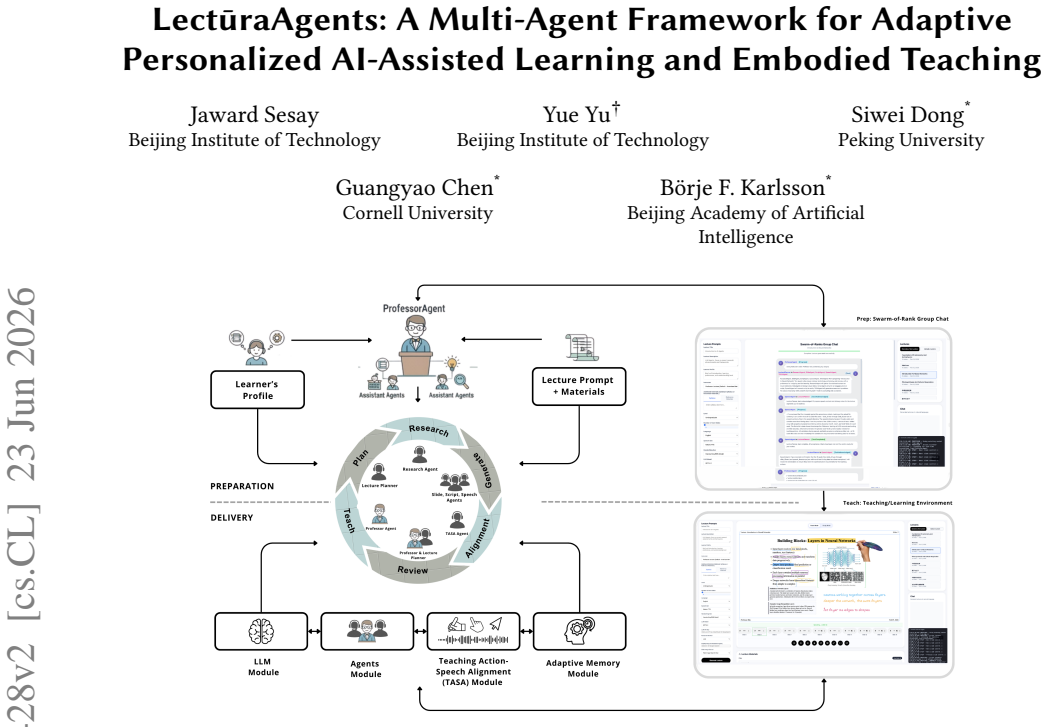
A multi-agent AI system lets a lead ProfessorAgent coordinate specialists to generate and deliver lectures with visible embodied teaching actions tailored to each learner.
A machine-rendered reading of the paper's core claim, the machinery that carries it, and where it could break.
Core claim
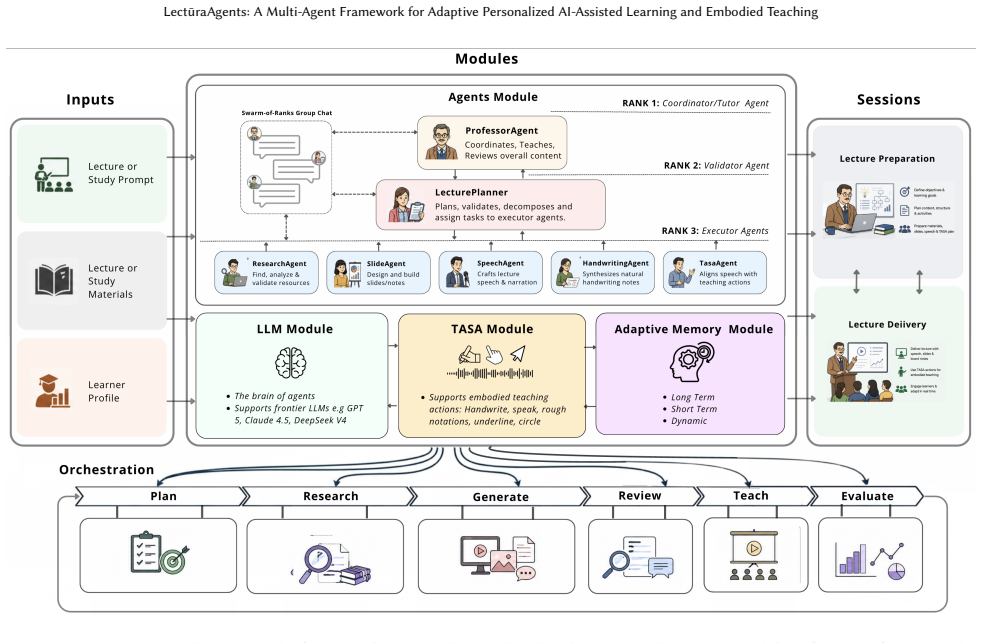
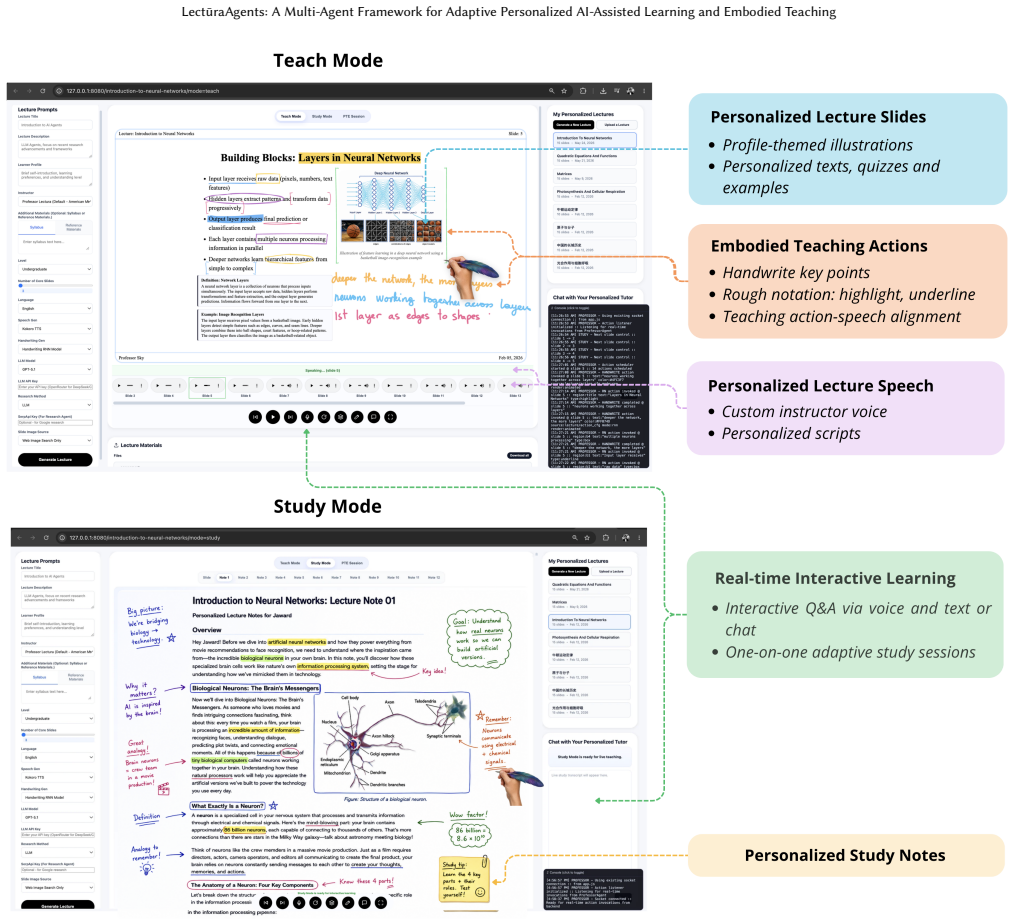
LectūraAgents is a hierarchical multi-agent framework in which a ProfessorAgent directs specialized agents to research, plan, review, and deliver lecture content while executing visible teaching actions such as handwrite, highlight, and underline. The framework incorporates an adaptive embodied teaching mechanism and the Teaching Action-Speech Alignment (TASA) algorithm, which uses salience-based heuristics and temporal semantic segmentation to produce action sequences matched to learner profiles. When tested on high school, undergraduate, and graduate courses, the generated materials and actions receive higher scores from expert educators on content quality, embodied teaching quality, asses
What carries the argument
The ProfessorAgent-led hierarchical multi-agent architecture together with the Teaching Action-Speech Alignment (TASA) algorithm that generates coherent sequences of visible teaching actions aligned to speech and learner profiles.
If this is right
- Lecture content and teaching actions score higher on educator rubrics than those from existing single-agent or non-embodied systems.
- The same architecture supports courses at high school, undergraduate, and graduate levels with consistent quality gains.
- Visible actions such as handwriting and highlighting are produced in coherent sequences matched to the spoken content.
- Adaptation occurs through both content selection and delivery style based on individual learner profiles.
Where Pith is reading between the lines
- Adding live student feedback loops could allow the ProfessorAgent to revise actions mid-lecture rather than relying only on pre-set profiles.
- The embodied action component could transfer to virtual-reality or physical-robot settings where the same alignment logic drives real gestures.
- The multi-agent division of labor might apply to other sequential expert tasks such as step-by-step technical training or diagnostic reasoning.
Load-bearing premise
Expert educator rubric scores on generated materials from sample courses are enough to establish that the system produces real personalization and pedagogical effectiveness for diverse learners.
What would settle it
A controlled experiment that directly measures student test scores, retention, or engagement after exposure to LectūraAgents lectures versus baseline methods or human instruction.
Figures
read the original abstract
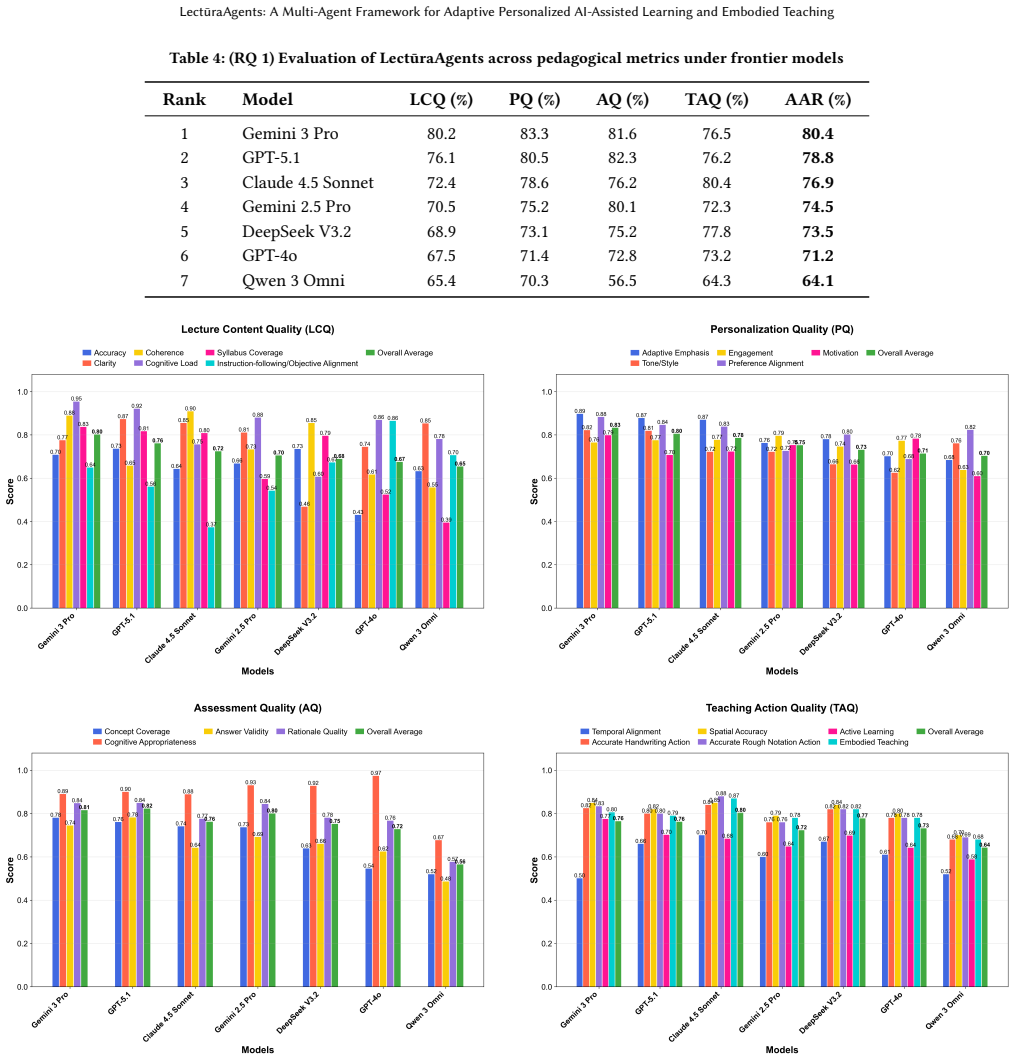
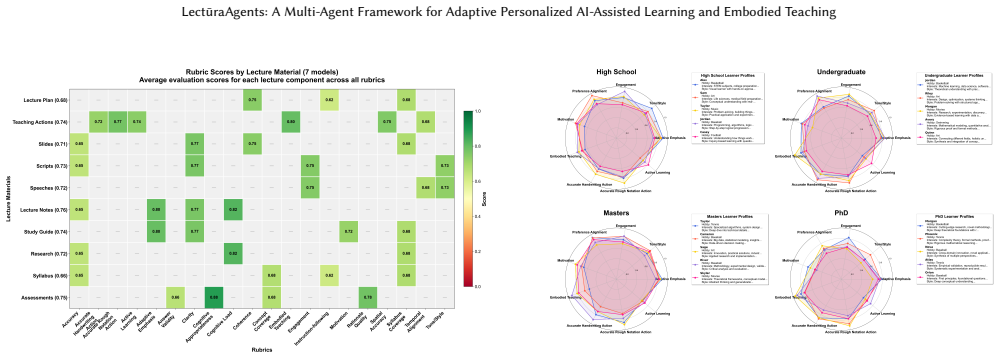
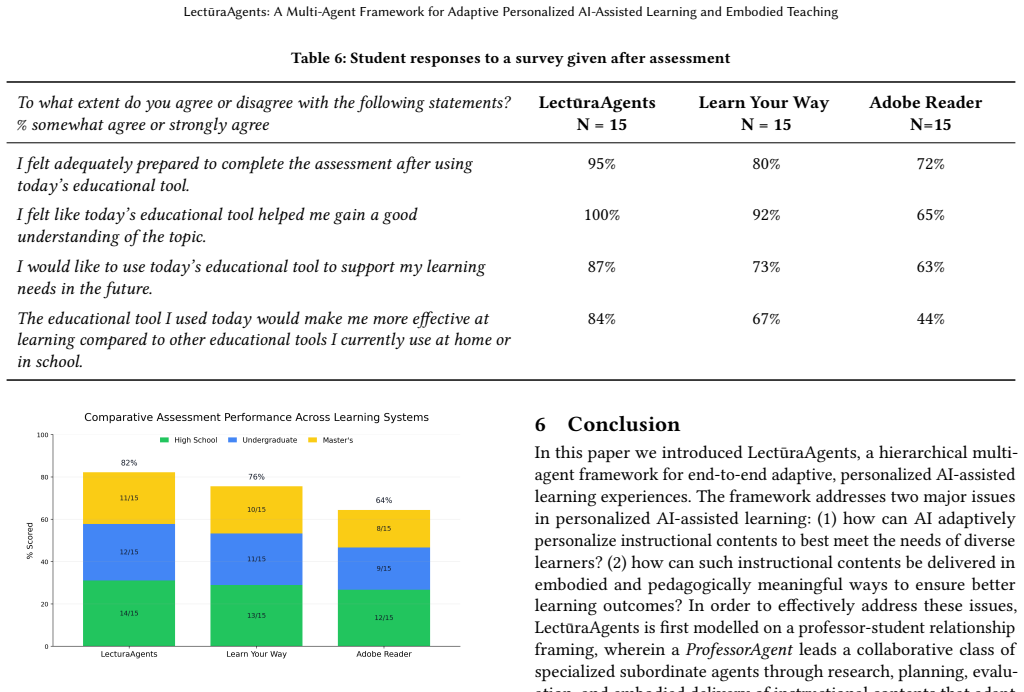
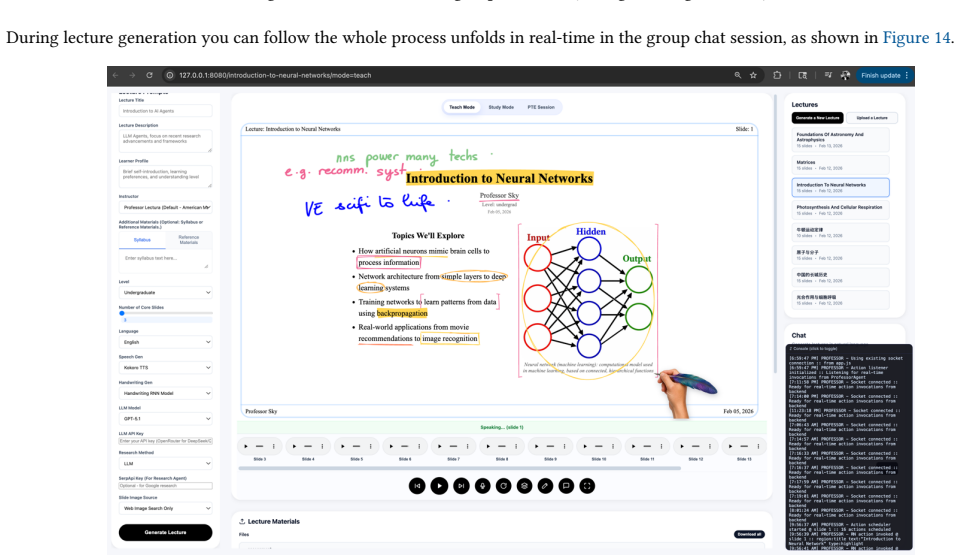
Effective personalized AI-assisted learning demands systems that can not only generate accurate learner-specific educational materials, but also dynamically adapt their instruction to diverse learners. However, existing educational agents have primarily focused on lecture content automation and simulations, which often fall short of modelling multimodal and embodied instructional methods tailored for the individual learner. To this end, we propose Lect\=uraAgents - a multi-agent framework that enables personalized learning through end-to-end adaptive embodied teaching. At its core, Lect\=uraAgents mirrors a professor-student relationship, in which a ProfessorAgent leads a collaborative team of specialized subordinate agents through research, planning, review, and embodied delivery of lecture contents that adapt to a learner's needs. The framework offers three main contributions: (1) a hierarchical multi-agent architecture for end-to-end personalized learning; (2) an adaptive embodied teaching mechanism, wherein the ProfessorAgent executes visible and pedagogically motivated teaching actions (e.g., handwrite, highlight, underline, etc.) over contents in a teaching environment; and (3) a Teaching Action-Speech Alignment (TASA) algorithm that employs salience-based heuristics and temporal semantic segmentation to generate coherent teaching action sequences aligned with learner profiles. We evaluate Lect\=uraAgents on diverse courses at high school, undergraduate, and graduate levels using sample-specific rubric-based analysis; with generated lecture materials and teaching actions assessed and validated by expert educators. Experimental results show consistent gains in lecture content quality, embodied teaching quality, assessment, and personalization over existing approaches, positioning Lect\=uraAgents as a pedagogically well-grounded framework for personalized learning at scale.
Editorial analysis
A structured set of objections, weighed in public.
Referee Report
Summary. The manuscript proposes LectūraAgents, a hierarchical multi-agent framework for personalized AI-assisted learning and embodied teaching. A ProfessorAgent coordinates subordinate agents to handle research, planning, review, and delivery of lecture content that adapts to learner profiles. The framework introduces an embodied teaching mechanism with visible actions (e.g., handwrite, highlight) and the TASA algorithm, which uses salience-based heuristics and temporal semantic segmentation to align teaching actions with speech. Evaluation is performed on sample courses spanning high school to graduate levels via expert educator rubric-based analysis of generated materials and actions, with reported gains in content quality, embodied teaching quality, assessment, and personalization relative to existing approaches.
Significance. If the evaluation concerns are addressed, the work could advance multi-agent educational systems by integrating embodied actions and profile-adaptive alignment in a structured architecture. The TASA heuristic offers a concrete mechanism for coherence that is absent from many content-generation agents. However, the current evidence base limits claims about real pedagogical effectiveness at scale.
major comments (2)
- [Evaluation] Evaluation section: The central claim of 'consistent gains in ... personalization' and the positioning of LectūraAgents as 'pedagogically well-grounded for personalized learning at scale' rests entirely on expert rubric scores for generated artifacts. No direct learner-outcome measures (pre/post knowledge tests, retention, engagement, or adaptation success rates across learner profiles) are reported, so the adaptive-personalization claim lacks falsifiable evidence of effectiveness on actual learners.
- [TASA Algorithm] TASA algorithm description: The algorithm is presented as employing salience-based heuristics and temporal semantic segmentation to produce coherent action sequences aligned with learner profiles, yet the manuscript provides neither pseudocode, explicit equations, nor a worked example showing how a specific learner profile modifies the salience scores or segmentation boundaries. This omission makes it impossible to verify that the mechanism is profile-adaptive rather than generic.
minor comments (2)
- [Abstract] Abstract and title contain LaTeX artifacts (e.g., 'Lect\=uraAgents') that should be rendered correctly as 'LectūraAgents' for readability.
- [References] Ensure that all baseline systems referenced in the experimental comparison are accompanied by full citations in the reference list.
Simulated Author's Rebuttal
We thank the referee for the thoughtful and constructive comments. We address each major point below and will revise the manuscript to moderate claims and add missing technical details.
read point-by-point responses
-
Referee: [Evaluation] Evaluation section: The central claim of 'consistent gains in ... personalization' and the positioning of LectūraAgents as 'pedagogically well-grounded for personalized learning at scale' rests entirely on expert rubric scores for generated artifacts. No direct learner-outcome measures (pre/post knowledge tests, retention, engagement, or adaptation success rates across learner profiles) are reported, so the adaptive-personalization claim lacks falsifiable evidence of effectiveness on actual learners.
Authors: We agree this is a substantive limitation. Our evaluation relies on expert educator rubric validation of generated content and actions, which demonstrates improvements in quality and alignment but does not include direct learner outcome data. We will revise the manuscript to tone down claims of effectiveness 'at scale' and 'pedagogically well-grounded for personalized learning,' explicitly note the absence of learner studies as a limitation, and add a forward-looking discussion on the need for future pre/post testing and engagement metrics. revision: yes
-
Referee: [TASA Algorithm] TASA algorithm description: The algorithm is presented as employing salience-based heuristics and temporal semantic segmentation to produce coherent action sequences aligned with learner profiles, yet the manuscript provides neither pseudocode, explicit equations, nor a worked example showing how a specific learner profile modifies the salience scores or segmentation boundaries. This omission makes it impossible to verify that the mechanism is profile-adaptive rather than generic.
Authors: We acknowledge the description was insufficiently detailed. In the revision we will add: (1) pseudocode for the full TASA procedure, (2) explicit equations for salience scoring (including the profile-modulation term) and temporal segmentation boundaries, and (3) a concrete worked example showing how a specific learner profile (e.g., 'visual learner' with high visual salience weight) alters both the salience vector and the resulting action-segment boundaries. revision: yes
Circularity Check
No circularity in framework proposal or rubric evaluation
full rationale
The paper describes a hierarchical multi-agent architecture, an embodied teaching mechanism, and the TASA algorithm using salience-based heuristics and temporal semantic segmentation. Evaluation relies on sample-specific rubric-based analysis validated by expert educators, with reported gains over existing approaches. No equations, fitted parameters renamed as predictions, self-definitional constructs, or load-bearing self-citations appear in the abstract or described contributions. The derivation chain consists of a proposed system design plus external expert assessment rather than any reduction of outputs to inputs by construction.
Axiom & Free-Parameter Ledger
Reference graph
Works this paper leans on
-
[1]
Ming Yang and Feng Wen. 2023. AI-powered personalized learning journeys: Revolutionizing information management for college students in online platforms.J. Inf. Syst. Eng. Manag.8, 1 (2023). Article 23196. doi:10.55267/iadt.07.14079
-
[2]
Hadi Farhood, Matthew Nyden, Amir Beheshti, and Stephan Müller. 2025. Artificial intelligence-based personalized learn- ing in education: A systematic literature review.Discover Artif. Intell.5 (2025). Article 331. doi:10.1007/s44163-025-00598-x
-
[3]
LearnLM Team, Alicia Martín, Amir Globerson, Amy Wang, Anirudh Shekhawat, Anna Iurchenko, Anisha Choudhury, Avinatan Hassidim, Ayça Çakmakli, Ayelet Shasha Evron, 12 Lect¯uraAgents: A Multi-Agent Framework for Adaptive Personalized AI-Assisted Learning and Embodied Teaching Charlie Yang, Courtney Heldreth, Diana Akrong, Gal Eli- dan, Hairong Mu, Ian Li, I...
arXiv 2025
-
[4]
Jian Peng and Yu Li. 2025. Frontiers of artificial intelligence for personalized learning in higher education: A systematic review of leading articles.Appl. Sci.15, 18 (2025). Article 10096. doi:10.3390/app151810096
-
[5]
Meghan Novack and Susan Goldin-Meadow. 2015. Learning from gesture: How our hands change our minds.Educ. Psychol. Rev.27, 3 (2015), 405–412. doi:10.1007/s10648-015-9325-3
-
[6]
Hanne Marie Hegna and Trine Ørbæk. 2024. Traces of em- bodied teaching and learning: A review of empirical studies in higher education.Teach. High. Educ.29, 2 (2024), 420–444. doi:10.1080/13562517.2021.1989582
-
[7]
Johnson-Glenberg and Cathy Megowan-Romanowicz
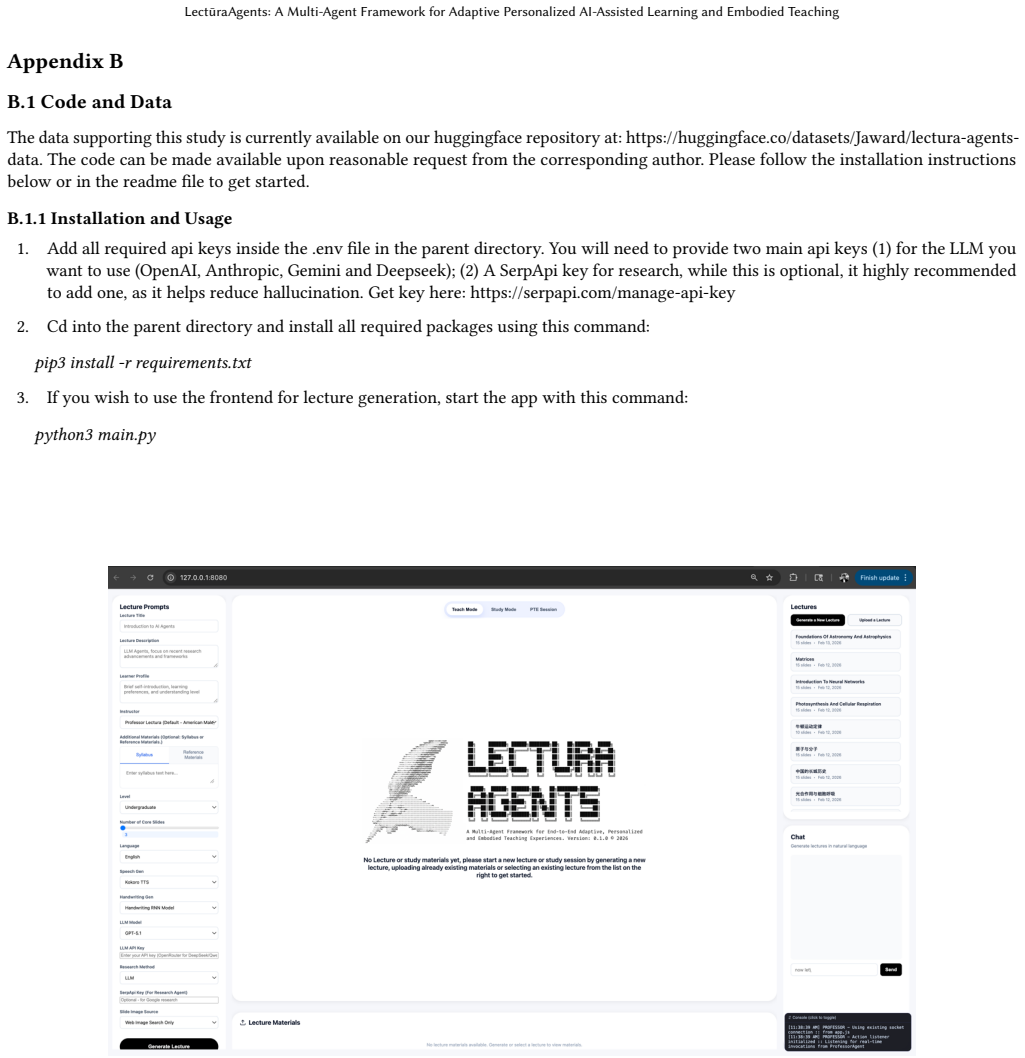
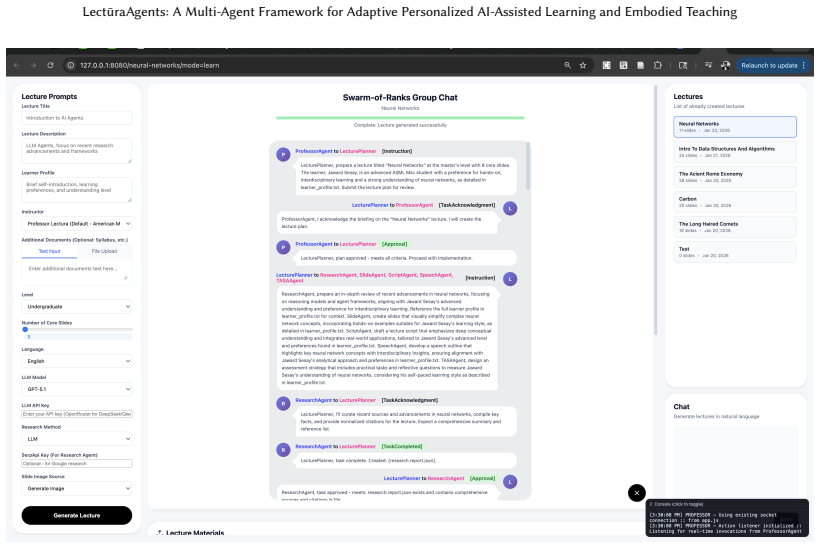
Mina C. Johnson-Glenberg and Cathy Megowan-Romanowicz
-
[8]
Embodied science and mixed reality: How gesture and motion capture affect physics education.Cogn. Res.: Princ. Implic.2 (2017). Article 24. doi:10.1186/s41235-017-0060-9
-
[9]
Shuo Wang, Tianyi Xu, Haoliang Li, Chen Zhang, Jian Liang, Jian Tang, Philip S. Yu, and Qingsong Wen. 2024. Large lan- guage models for education: A survey and outlook. Preprint at https://arxiv.org/abs/2403.18105. arXiv:2403.18105 doi:10. 48550/arXiv.2403.18105
arXiv 2024
-
[10]
Lijia Chen, Peng Chen, and Zhijun Lin. 2020. Artificial intel- ligence in education: A review.IEEE Access8 (2020), 75264– 75278. doi:10.1109/ACCESS.2020.2988510
-
[11]
Shubham Sharma, Piyush Mittal, Mohit Kumar, and Vineet Bhardwaj. 2025. The role of large language models in person- alized learning: A systematic review of educational impact. Discover Sustain.6 (2025). Article 243. doi:10.1007/s43621-025- 01094-z
-
[12]
Emma Chen, Jae-Eun Lee, Jialin Lin, and Kenneth Koedinger
-
[13]
InPro- ceedings of the 11th ACM Conference on Learning @ Scale (L@S ’24)
GPTutor: Great personalized tutor with large language models for personalized learning content generation. InPro- ceedings of the 11th ACM Conference on Learning @ Scale (L@S ’24). ACM, Atlanta, GA, USA. doi:10.1145/3657604.3664718
-
[16]
En Sun and Li Tai. 2025. MultiTutor: Collaborative LLM agents for multimodal student support. InProceedings of the Innovation and Responsibility in AI-Supported Education Work- shop (Proc. Mach. Learn. Res., Vol. 273). 174–190. Available at https://proceedings.mlr.press/v273/sun25a.html. https: //proceedings.mlr.press/v273/sun25a.html
2025
-
[17]
Michael Vaccaro, Matthew Friday, and Andrea Zaghi. 2025. Multi-agentic LLMs for personalizing STEM texts.Appl. Sci. 15 (2025). Article 7579. doi:10.3390/app15137579
-
[18]
Qiang Yang, Yifan Yang, Shiqi An, Tianhao Hao, and Guang Xu. 2025. LLM-based collaborative agents with pedagogy- guided interaction modeling for timely instructive feedback generation. InProceedings of the 34th International Joint Conference on Artificial Intelligence (IJCAI ’25). 9972–9980. doi:10.24963/ijcai.2025/1108
-
[19]
Yifan Ma, Shuo Hu, Zhu Bo, Yifan Wang, Yuxuan Kang, Shiyu Liu, and Kang Hao Cheong. 2025. EduVerse: A user-defined multi-agent simulation space for education scenarios. Preprint at https://arxiv.org/abs/2510.05650. arXiv:2510.05650 doi:10. 48550/arXiv.2510.05650
arXiv 2025
-
[20]
Meng Yue, Weinan Lyu, Walid Mifdal, Jaemin Suh, Yiming Zhang, and Ziyu Yao. 2024. MathVC: An LLM-simulated multi-character virtual classroom for mathematics education. Preprint at https://arxiv.org/abs/2404.06711. arXiv:2404.06711 doi:10.48550/arXiv.2404.06711
-
[21]
Hao Li, Jifan Yu, Xinyu Cong, Yifan Dang, Daniel Zhang-Li, Lin Mi, Yi Zhan, Huiqin Liu, and Zhiyuan Liu. 2025. Which type of students can LLMs act? Investigating authentic sim- ulation with graph-based human–AI collaborative systems. Preprint at https://arxiv.org/abs/2502.11678. arXiv:2502.11678 doi:10.48550/arXiv.2502.11678
-
[23]
Haein Jin, Minji Yoo, Jihye Park, Yejin Lee, Xin Wang, and Joonhwan Kim. 2025. TeachTune: Reviewing pedagogical agents against diverse student profiles with simulated stu- dents. InProceedings of the CHI Conference on Human Factors in Computing Systems (CHI ’25). ACM, New York, NY, USA. Article 1073. doi:10.1145/3706598.3714054
-
[24]
Rui Jia, Mingyuan Zhang, Feng Liu, Bin Jiang, Kun Kuang, and Zhiwei Dai. 2025. EduAgentQG: A multi-agent workflow framework for personalized question generation. Preprint at https://arxiv.org/abs/2511.11635. arXiv:2511.11635 doi:10. 48550/arXiv.2511.11635
arXiv 2025
-
[26]
Jing Liu, Zhi Huang, Tian Xiao, Jun Sha, Jiarui Wu, Qi Liu, Shuo Wang, and Enhong Chen. 2024. SocraticLM: Exploring Socratic personalized teaching with large language models. InAdvances in Neural Information Processing Systems, Vol. 37
2024
-
[27]
Chowdhury, Vojtěch Zouhar, and Mrinmaya Sachan
Sayan P. Chowdhury, Vojtěch Zouhar, and Mrinmaya Sachan
-
[28]
InProceedings of the 11th ACM Conference on Learning @ Scale (L@S ’24)
AutoTutor meets large language models: A language model tutor with rich pedagogy and guardrails. InProceedings of the 11th ACM Conference on Learning @ Scale (L@S ’24). ACM, New York, NY, USA, 5–15. doi:10.1145/3657604.3662041 13 Lect¯uraAgents: A Multi-Agent Framework for Adaptive Personalized AI-Assisted Learning and Embodied Teaching
-
[29]
Xuejiang Wang, Chee-Poh Lee, and Bilge Mutlu. 2025. Learn- Mate: Enhancing online education with LLM-powered per- sonalized learning plans and support. InExtended Abstracts of the CHI Conference on Human Factors in Computing Systems (CHI EA ’25). ACM, New York, NY, USA. doi:10.1145/3706599. 3719857
-
[31]
Kia Karbasi, Kevin Hong, Mohammad Amin Samadi, and Gre- gory Pottie. 2025. Multi-agent collaborative framework for math problem generation. InProceedings of the 18th Inter- national Conference on Educational Data Mining. 613–618. doi:10.5281/zenodo.15870246
-
[32]
Songlin Xu, Xinyu Zhang, and Lianhui Qin. 2024. EduA- gent: Generative student agents in learning. Preprint at https://arxiv.org/abs/2404.07963. arXiv:2404.07963 doi:10. 48550/arXiv.2404.07963
arXiv 2024
-
[33]
Weibo Gao, Qi Liu, Linan Yue, Fangzhou Yao, Rui Lv, Zheng Zhang, Hao Wang, and Zhenya Huang. 2025. Agent4Edu: Generating learner response data by generative agents for intelligent education systems. InProceedings of the AAAI Conference on Artificial Intelligence, Vol. 39. 23923–23932. doi:10.1609/aaai.v39i22.34565
-
[34]
Yao Shi, Rongkeng Liang, and Yong Xu. 2025. EducationQ: Evaluating LLMs’ teaching capabilities through multi-agent dialogue framework. InProceedings of the 63rd Annual Meeting of the Association for Computational Linguistics. 32799–32828. doi:10.18653/v1/2025.acl-long.1576
-
[35]
Jana Gonnermann-Müller, Jennifer Haase, Konstantin Fackeldey, and Sebastian Pokutta. 2025. FACET: Teacher-centred LLM-based multi-agent systems— Towards personalized educational worksheets. Preprint at https://arxiv.org/abs/2508.11401. arXiv:2508.11401 doi:10.48550/arXiv.2508.11401
work page internal anchor Pith review Pith/arXiv arXiv doi:10.48550/arxiv.2508.11401 2025
-
[36]
Xian Peng, Pan Yuan, Dong Li, Junlong Cheng, Qin Fang, and Zhi Liu. 2025. KELE: A multi-agent framework for structured Socratic teaching with large language models. InFindings of the Association for Computational Linguistics: EMNLP 2025. Association for Computational Linguistics, Suzhou, China, 16342–16362. doi:10.18653/v1/2025.findings-emnlp.888
-
[37]
Hao Yao, Wenjie Xu, Jacob Turnau, Nathan Kellam, and Hui Wei. 2025. Instructional agents: LLM agents on automated course material generation for teaching faculties. Preprint at https://arxiv.org/abs/2508.19611. arXiv:2508.19611 doi:10. 48550/arXiv.2508.19611
arXiv 2025
-
[38]
Xueqiao Zhang, Chao Zhang, Jianwen Sun, Jun Xiao, Yi Yang, and Yawei Luo. 2025. EduPlanner: LLM-based multi-agent systems for customized and intelligent instructional design. IEEE Trans. Learn. Technol.18 (2025), 416–427. doi:10.1109/ TLT.2025.3561332
arXiv 2025
-
[39]
Tianfu Wang, Yi Zhan, Jianxun Lian, Zhengyu Hu, Nicholas Jing Yuan, Qi Zhang, Xing Xie, and Hui Xiong. 2025. LLM-powered multi-agent framework for goal-oriented learn- ing in intelligent tutoring systems. InCompanion Proceedings of the ACM Web Conference 2025. ACM, New York, NY, USA, 510–519. doi:10.1145/3701716.3715244
-
[40]
Zheyuan Zhang, Daniel Zhang-Li, Jifan Yu, Linlu Gong, Jin- chang Zhou, Zhanxin Hao, Jianxiao Jiang, Jie Cao, Huiqin Liu, Zhiyuan Liu, Lei Hou, and Juanzi Li. 2025. Simulating classroom education with LLM-empowered agents. InPro- ceedings of NAACL-HLT 2025. 10364–10379. doi:10.18653/v1/ 2025.naacl-long.520
-
[41]
Jiahuan Pei, Fanghua Ye, Xin Sun, Wentao Deng, Koen Hindriks, and Junxiao Wang. 2025. Conversational educa- tion at scale: A multi-LLM agent workflow for procedural learning and pedagogic quality assessment. Preprint at https://arxiv.org/abs/2507.05528. arXiv:2507.05528 doi:10. 48550/arXiv.2507.05528
arXiv 2025
-
[42]
Richard C. Atkinson and Richard M. Shiffrin. 1968. Human memory: A proposed system and its control processes. In Psychology of Learning and Motivation. Vol. 2. Academic Press, New York, 89–195. doi:10.1016/S0079-7421(08)60422-3
-
[43]
Nelson Cowan. 2008. What are the differences between long- term, short-term, and working memory? InProg. Brain Res. Vol. 169. 323–338. doi:10.1016/S0079-6123(07)00020-9
-
[44]
Yu Su, Qi Liu, Qi Liu, Zhenya Huang, Yuting Yin, Enhong Chen, Chao Ding, Shuwei Wei, and Guoping Hu. 2018. Exercise- enhanced sequential modeling for student performance pre- diction. InProceedings of the AAAI Conference on Artificial Intelligence, Vol. 32. doi:10.1609/aaai.v32i1.11864
-
[45]
Qi Liu, Shiwei Tong, Chuanren Liu, Hongke Zhao, Enhong Chen, Haiping Ma, and Shijin Wang. 2019. Exploiting cog- nitive structure for adaptive learning. InProceedings of the 25th ACM SIGKDD International Conference on Knowledge Dis- covery & Data Mining. ACM, New York, NY, USA, 627–635. doi:10.1145/3292500.3330922
-
[46]
Zhenya Huang, Qi Liu, Yuying Chen, Le Wu, Keli Xiao, En- hong Chen, Haiping Ma, and Guoping Hu. 2020. Learning or forgetting? A dynamic approach for tracking the knowledge proficiency of students.ACM Trans. Inf. Syst.38, 2 (2020). Article 19. doi:10.1145/3379507
-
[47]
Ilie Gligorea, Marius Cioca, Romana Oancea, Andra-Teodora Gorski, Hortensia Gorski, and Paul Tudorache. 2023. Adaptive learning using artificial intelligence in e-learning: A literature review.Educ. Sci.13, 12 (2023). Article 1216. doi:10.3390/ educsci13121216
2023
-
[48]
Yeo, and Kang Hao Cheong
Le Ying Tan, Shiyu Hu, Darren J. Yeo, and Kang Hao Cheong
-
[49]
Artificial intelligence-enabled adaptive learning plat- forms: A review.Comput. Educ.: Artif. Intell.9 (2025). Article 100429. doi:10.1016/j.caeai.2025.100429
-
[50]
Graham Hardaker and Louise E. Glenn. 2025. Artificial intelligence for personalized learning: A systematic litera- ture review.Int. J. Inf. Learn. Technol.42, 1 (2025), 1–14. doi:10.1108/IJILT-07-2024-0160
-
[51]
Raffaella Folgieri, Marisa Gil, Miriam Bait, and Claudio Luc- chiari. 2024. AI-powered personalised learning platforms for EFL learning: Preliminary results. InProceedings of the 16th International Conference on Computer Supported Education, Vol. 2. 255–261. doi:10.5220/0012672000003693 14 Lect¯uraAgents: A Multi-Agent Framework for Adaptive Personalized ...
-
[52]
María Fernanda Contrino, María Reyes-Millán, Paola Vázquez- Villegas, and José Membrillo-Hernández. 2024. Using an adap- tive learning tool to improve student performance and satis- faction in online and face-to-face education for a more per- sonalized approach.Smart Learn. Environ.11 (2024). Article 6. doi:10.1186/s40561-024-00292-y
-
[53]
Yajun Chen. 2025. Evaluation of the impact of AI-driven personalized learning platform on medical students’ learning performance.Front. Med.12 (2025). Article 1610012. doi:10. 3389/fmed.2025.1610012
arXiv 2025
-
[54]
Timo Schick, Jane Dwivedi-Yu, Roberto Dessì, Roberta Raileanu, Maria Lomeli, Eric Hambro, Luke Zettlemoyer, Nicola Cancedda, and Thomas Scialom. 2023. Tool- former: Language models can teach themselves to use tools. InAdvances in Neural Information Processing Sys- tems. https://proceedings.neurips.cc/paper_files/paper/ 2023/hash/d842425e4bf79ba039352da0f6...
2023
-
[55]
Shunyu Yao, Jeffrey Zhao, Dian Yu, Nan Du, Izhak Shafran, Karthik Narasimhan, and Yuan Cao. 2023. ReAct: Synergizing reasoning and acting in language models. InProceedings of the International Conference on Learning Representations. https: //openreview.net/forum?id=WE_vluYUL-X
2023
-
[56]
Noah Shinn, Federico Cassano, Edward Berman, Ashwin Gopinath, Karthik Narasimhan, and Shunyu Yao. 2023. Re- flexion: Language agents with verbal reinforcement learning. Preprint at https://arxiv.org/abs/2303.11366. arXiv:2303.11366 doi:10.48550/arXiv.2303.11366
work page internal anchor Pith review Pith/arXiv arXiv doi:10.48550/arxiv.2303.11366 2023
-
[57]
Zhendong Chu, Shen Wang, Jian Xie, Tinghui Zhu, Yibo Yan, Jingheng Ye, Aoxiao Zhong, Xuming Hu, Jing Liang, Philip S. Yu, and Qingsong Wen. 2025. LLM Agents for Edu- cation: Advances and Applications. InFindings of the Associa- tion for Computational Linguistics: EMNLP 2025. Association for Computational Linguistics, Suzhou, China, 13782–13810. doi:10.186...
-
[58]
Mayer, and Hui Liu
Feifei Wang, Wenqing Li, Richard E. Mayer, and Hui Liu
-
[59]
Animated pedagogical agents as aids in multime- dia learning: Effects on eye-fixations during learning and learning outcomes.J. Educ. Psychol.110, 2 (2018), 250–268. doi:10.1037/edu0000221
-
[60]
Wenqing Li, Feifei Wang, Richard E. Mayer, and Hui Liu. 2019. Getting the point: Which kinds of gestures by pedagogical agents improve multimedia learning?J. Educ. Psychol.111, 8 (2019), 1382–1395. doi:10.1037/edu0000352
-
[61]
Graesser, Katja Wiemer-Hastings, Peter M
Arthur C. Graesser, Katja Wiemer-Hastings, Peter M. Wiemer- Hastings, and Roger J. Kreuz. 1999. AutoTutor: A simulation of a human tutor.Cogn. Syst. Res.1 (1999), 35–51. doi:10.1016/ S1389-0417(99)00005-4
1999
-
[62]
Nye, Arthur C
Benjamin D. Nye, Arthur C. Graesser, and Xiangen Hu. 2014. AutoTutor and family: A review of 17 years of natural language tutoring.Int. J. Artif. Intell. Educ.24 (2014), 427–469. doi:10. 1007/s40593-014-0029-5
2014
-
[63]
Tao Xu, Yuan Liu, Yaru Jin, Yueyao Qu, Jie Bai, Wenlan Zhang, and Yun Zhou. 2025. From recorded to AI-generated in- structional videos: A comparison of learning performance and experience.Br. J. Educ. Technol.56, 4 (2025), 1463–1487. doi:10.1111/bjet.13530
-
[64]
Alexander Holmberg. 2025. Generating narrated lecture videos from slides with synchronized highlights. Preprint at https://arxiv.org/abs/2505.02966. arXiv:2505.02966 doi:10. 48550/arXiv.2505.02966
arXiv 2025
-
[65]
Tushar Aggarwal and Aarohi Bhand. 2025. PASS: Presenta- tion automation for slide generation and speech. Preprint at https://arxiv.org/abs/2501.06497. arXiv:2501.06497 doi:10. 48550/arXiv.2501.06497
arXiv 2025
-
[66]
hexgrad. 2025. Kokoro-82M. Hugging Face model repository. Open-weight text-to-speech model. https://huggingface.co/ hexgrad/Kokoro-82M
2025
-
[67]
Alec Radford, Jong Wook Kim, Tao Xu, Greg Brockman, Chris- tine McLeavey, and Ilya Sutskever. 2023. Robust speech recog- nition via large-scale weak supervision. InProceedings of the 40th International Conference on Machine Learning (Proc. Mach. Learn. Res., Vol. 202). 28492–28518. arXiv:2212.04356 doi:10.48550/arXiv.2212.04356
work page internal anchor Pith review Pith/arXiv arXiv doi:10.48550/arxiv.2212.04356 2023
-
[68]
Rough Notation. 2020. Rough notation library. GitHub repository at https://github.com/rough-stuff/rough-notation. https://github.com/rough-stuff/rough-notation
2020
-
[69]
Alex Graves. 2013. Generating sequences with recurrent neural networks. Preprint at https://arxiv.org/abs/1308.0850. arXiv:1308.0850 doi:10.48550/arXiv.1308.0850
work page internal anchor Pith review Pith/arXiv arXiv doi:10.48550/arxiv.1308.0850 2013
-
[70]
Mariska H. Knol, Conor V. Dolan, Gideon J. Mellenbergh, and Han L. J. van der Maas. 2016. Measuring the quality of university lectures: Development and validation of the Instructional Skills Questionnaire (ISQ).PLOS ONE11, 2 (2016). e0149163. doi:10.1371/journal.pone.0149163
-
[71]
Rakshith S. Srinivasa, Zora Che, Chen Bo Calvin Zhang, Diego Mares, Ernesto Hernandez, Jayeon Park, Dean Lee, Guillermo Mangialardi, Charmaine Ng, Ed-Yeremai Hernan- dez Cardona, Anisha Gunjal, Yunzhong He, Bing Liu, and Chen Xing. 2025. TutorBench: A benchmark to assess tu- toring capabilities of large language models. Preprint at https://arxiv.org/abs/2...
arXiv 2025
-
[72]
Add all required api keys inside the .env file in the parent directory. You will need to provide two main api keys (1) for the LLM you want to use (OpenAI, Anthropic, Gemini and Deepseek); (2) A SerpApi key for research, while this is optional, it highly recommended to add one, as it helps reduce hallucination. Get key here: https://serpapi.com/manage-api-key
-
[73]
Cd into the parent directory and install all required packages using this command: pip3 install -r requirements.txt
-
[74]
If you wish to use the frontend for lecture generation, start the app with this command: python3 main.py Figure 13: Frontend view (with no generated lecture) This will open the teaching environment in your browser at: http://127.0.0.1:8080/. The page should look like Figure 13: There will be a few already generated lectures in the right Lectures pane for ...
-
[75]
Your Lecture Title Goes Here
If you wish to use the terminal for lecture generation, run this command: python3 lecture_prep.py \ --lecture_title "Your Lecture Title Goes Here" \ 26 Lect¯uraAgents: A Multi-Agent Framework for Adaptive Personalized AI-Assisted Learning and Embodied Teaching --lecture_desc "Describe the kind of lecture you want here" \ --learner_profile "Add details abo...
-
[76]
Intro to Data Structures and Algorithms
Example prompt: python3 lecture_prep.py \ --lecture_title "Intro to Data Structures and Algorithms" \ --lecture_desc "A Computer Science lecture for a highschooler who likes basketball. Ensure covering these topics and more: 1. Introduction to Data Types and Abstraction 2. Introduction to Algorithms 3. Algorithm Vs Program. Understanding Data Structures 4...
-
[77]
To view the generated lecture in the teaching environment run this command: python3 lecture_delivery.py --lecture <lecture folder name> The folder could be, for example,intro-to-data-structures-and-algorithms. 27
discussion (0)
Sign in with ORCID, Apple, or X to comment. Anyone can read and Pith papers without signing in.