REVIEW 4 major objections 4 minor 97 references
LAOStrain response of carbon black-polymer hydrogels: insights from rheo-TRUSAXS and rheo-electric experiment
T0 review · 4 major / 4 minor · reviewed 2026-08-04 · deepseek-v4-flash
Pith's one-line read Two carbon-black hydrogels yield by different routes, set by one ratio
desk verdict Rich LAOStrain dataset with a convincing conductive-gel mechanism, but the insulating-gel mechanism leans on a q_max shift that could just be fragmentation, so the dual-mechanism story needs tightening. read the letter →
The pith
A machine-rendered reading of the paper's core claim, the machinery that carries it, and where it could break.
The reading
What carries the argument
The central experiment couples large-amplitude oscillatory shear (LAOStrain) with time-resolved ultra-small-angle X-ray scattering (TRUSAXS) and simultaneous DC electrical conductivity measurements. TRUSAXS probes CB microstructure from ~0.1 to a few microns, while conductivity reports on connectivity at longer scales beyond the SAXS window. The critical CMC-to-CB mass ratio r_c, previously identified from linear rheology and impedance, is the organizing parameter that separates conductive from insulating microstructures and predicts the qualitative yielding behavior.
What would settle it
A dilute CB-CMC dispersion with weak interparticle correlations could be sheared while monitoring the Kratky peak: if the peak shifts without strong structure-factor contributions, the distance interpretation fails. Alternatively, cryo-TEM of sheared insulating gels would directly show whether particles are closer or merely fragmented.
Extended reading notes
Core claim
The paper establishes that the non-linear yielding of CB-CMC hydrogels under LAOStrain is controlled by the critical polymer-to-particle ratio r_c. Conductive hydrogels (r < r_c) yield at low strain by rupturing the percolated CB network at length scales above a few microns, evidenced by a drop in DC conductivity; beyond yielding, strong shear creates a transient percolated network of CB clusters that raises conductivity above the initial value. Insulating hydrogels (r > r_c) yield at much larger strain; rheo-TRUSAXS shows a decrease in average interparticle distance and cluster fragmentation, accompanied by a tenfold conductivity increase, yet still below conductive gels. These distinct mec
Load-bearing premise
The interpretation that the Kratky peak shift in insulating gels corresponds to a decrease in average center-to-center distance assumes the scattering peak is governed by the structure factor; the paper itself notes that for polydisperse attractive scatterers, the peak can be partly due to the form factor, so the shift could instead reflect cluster fragmentation.
Editorial extensions
If this is right
- The ratio r_c can be used as a design variable to set whether a hydrogel yields abruptly at low strain or ductilely at high strain.
- The transient conductivity increase under strong shear in conductive gels could enable shear-addressable electrical switching in soft materials.
- The lack of TRUSAXS signal in conductive gels indicates failure occurs by localized brittle rupture, not gradual particle rearrangement.
- The hysteresis in insulating gels implies that shear history permanently alters microstructure on experimental timescales, which must be accounted for in processing.
- Electrical harmonics can serve as a sensitive probe of network breakage and reformation during oscillation, relating mechanical and electrical nonlinearities.
Reading between the lines
- The transient re-percolation may be a general feature of percolated colloidal networks under oscillatory shear, suggesting a way to control electrical properties without changing composition.
- The assumption that the Kratky peak shift in insulating gels reflects reduced interparticle distance could be tested by contrast-matched SANS under identical shear.
- The relation between conductivity harmonics and mechanical power could be extended to other conductive composites to infer internal restructuring rates from electrical signals alone.
Editorial analysis
A structured set of objections, weighed in public.
Referee Report
Summary. This manuscript reports a combined rheo-TRUSAXS and rheo-electric study of the Large Amplitude Oscillatory Shear (LAOStrain) response of carbon black–carboxymethylcellulose (CB-CMC) hydrogels. Building on the authors’ prior identification of a critical polymer-to-particle ratio r_c separating conductive (percolated CB network) from insulating (polymer-matrix, CB-crosslinked) gels, the paper characterizes the yielding behavior of more than one hundred compositions. The central claims are: (i) both gel types show a type III yielding scenario with a G'' overshoot and monotonic G' decrease; (ii) conductive gels yield at small strains, their DC conductivity drops at yield, and at larger amplitudes the conductivity recovers and even exceeds its rest value, which is interpreted as shear-induced formation of a transient, dynamically percolated CB network; (iii) insulating gels yield at much larger strains, their Kratky-peak q_max shifts to larger q, interpreted as both fragmentation of CB clusters and a decrease in average CB–CB distance, concomitant with a tenfold conductivity increase; and (iv) the nonlinear observables collapse into two regimes separated by r_c. The paper combines rheology, intra-cycle Fourier/Chebyshev analysis, time-resolved electrical conductivity, and time-resolved USAXS, with a detailed Appendix on the harmonic coupling between mechanical power and conductivity.
Significance. If the central claims hold, the paper is significant for the physics of yielding in colloid–polymer hydrogels: it proposes two distinct microscopic mechanisms—brittle-like rupture of a percolated CB network versus matrix-dominated yielding with particle-scale reorganization—controlled by a single compositional parameter, r_c. The experimental scope is unusually broad: more than 100 compositions were measured, and the rheo-electric data provide time-resolved, mechanically coupled conductivity spectra with a quantitative harmonic model (Eq. 11 and Appendix F). The ESRF data are made available via DOI. The rheo-TRUSAXS experiments on the insulating gels are the main direct structural evidence and are potentially very valuable. However, the structural interpretation contains an ambiguity that is load-bearing for the insulating-gel mechanism, and several internal numerical inconsistencies in key parameters (yield strain, power-law exponents) need to be resolved before the paper can be accepted.
major comments (4)
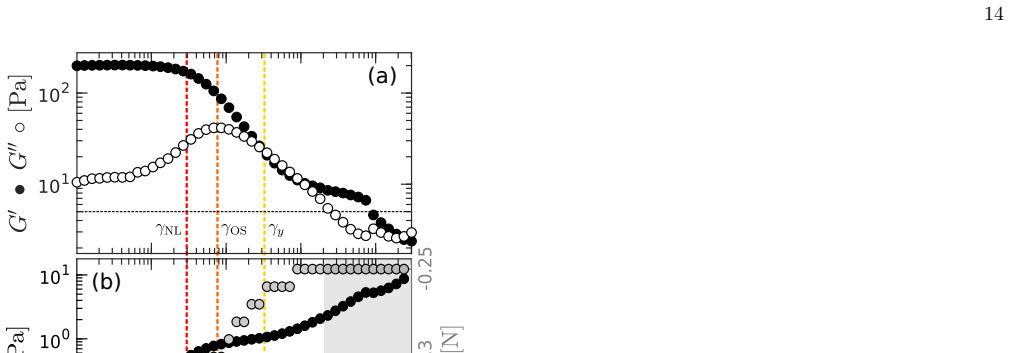
- [Abstract; §IV A; §IV D] The quantitative anchor of the paper—the yield strain—is inconsistent. The abstract states conductive gels yield at γ_y ≃ 6%, while §IV A gives γ_y ≃ 3% for the representative conductive gel (c_CMC = 0.01%, x_CB = 6%). For the insulating gel, §IV A gives γ_y ≃ 60%, but §IV D later refers to “the yield point, previously identified at γ_y ≃ 70% for this sample composition”, citing Fig. 3(b). Since γ_y is central to the binary classification and to the mechanism contrast, these internal contradictions must be corrected and a single, clearly defined criterion should be used consistently.
- [§IV A, Figs. 3 and 5] The power-law exponents are also presented inconsistently. The caption of Fig. 3 and the surrounding text quote ν′ = 0.92, ν′′ = 0.65 for the conductive gel and ν′ = 0.71, ν′′ = 0.34 for the insulating gel, whereas the discussion of Fig. 5 states that for conductive gels ν′ ≃ 1.5 and ν′′ ≃ 1 with ν′/ν′′ ≃ 1.5, and that insulating gels reach ν′/ν′′ ≃ 5. If the representative curves in Fig. 3 are fitted over a different strain range, the fitting ranges and criteria should be stated explicitly; as written, the reader cannot determine which exponent set characterizes the two classes.
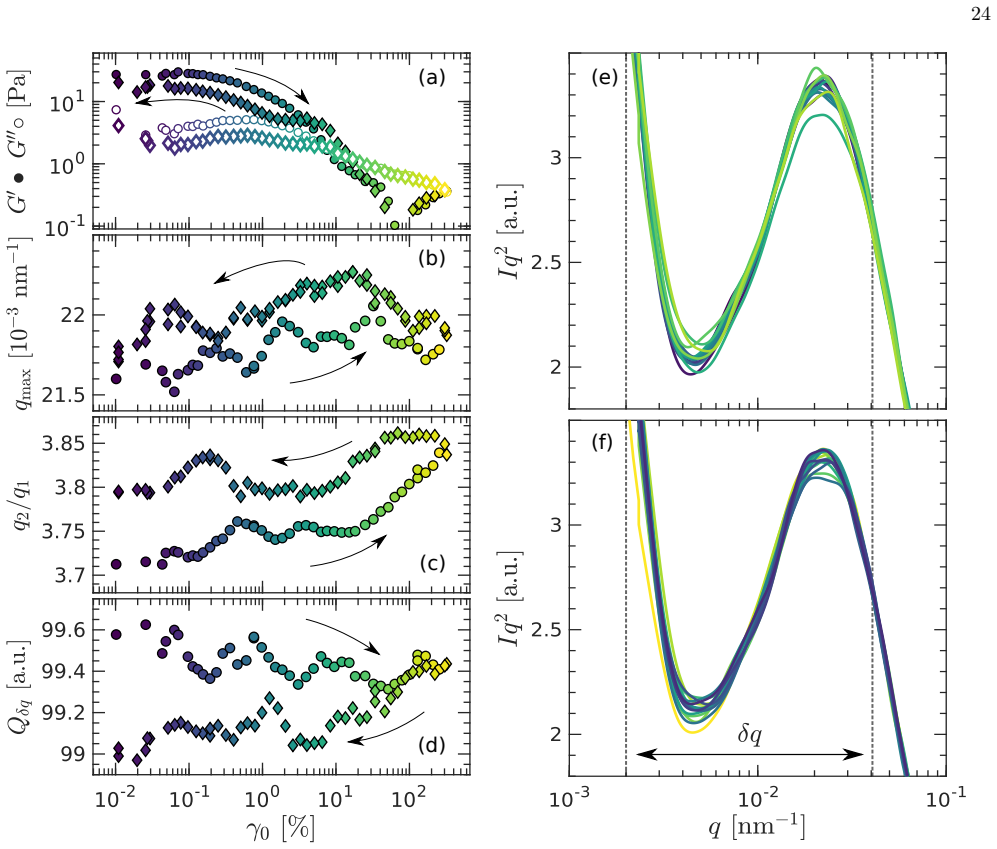
- [§IV D; §III] The central structural evidence for the insulating-gel mechanism is the Kratky-peak shift q_max from 1.4×10⁻² to 2.2×10⁻² nm⁻¹. The text first calls this “the signature of the fragmentation of CB clusters under shear” and later concludes that shear “brings the CB particles and clusters closer together.” But §III explicitly warns that for polydisperse attractive systems q_max mixes form- and structure-factor contributions, so a form-factor change (fragmentation) alone can produce the same peak shift without any decrease in center-to-center distance. Since the conductivity increase is then attributed to reduced interparticle spacing, the two statements are not equivalent. Please separate these contributions (e.g., by modeling the form factor or using a structure-factor-sensitive invariant), or explicitly rephrase the conclusion as one of two alternatives.
- [§IV D; §II B] The rheo-TRUSAXS experiment on the insulating gel was performed on a sample aged only 3 min after preshear, at which G′ < G′′ at 1 rad/s, whereas the rheo-electric and rheological protocols use a 20-min recovery. The microstructural changes (q_max shift) and the conductivity increase are therefore not measured on the same material state, and the coupling between them is inferred across different aging times. Please demonstrate that the 3-min structure gives the same strain-induced evolution as the 20-min state, or weaken the combined mechanistic claim.
minor comments (4)
- [Fig. 11(c); Fig. 20(c)] The caption states q₂ = 4×10⁻² mm⁻¹; given the text and the q-axis, this should presumably be nm⁻¹. Please correct the unit.
- [Eq. (11); Appendix F] The text writes b_n ≃ a_{n−1}, but Eq. (F6) includes a_{n+1} and a phase term. State more explicitly the condition under which the a_{n+1} contribution is negligible in the reported strain range.
- [§IV A] The sentence “all experiments are conducted at a fixed frequency” is later qualified by the frequency-dependent study in Appendix B. Rephrase as “unless otherwise stated,” or move the qualification into the main text.
- [§IV C; §V] The transient shear-induced percolated network in conductive gels is presented initially as a hypothesis (“consistent with”), but the Discussion states it more categorically. Since the USAXS window shows no structural signal at these length scales, add one sentence reminding the reader that this aspect is inferred from conductivity and is not directly observed.
Circularity Check
No significant circularity: the nonlinear observables are measured independently and the r_c threshold is an external input from prior work, not a fitted prediction.
full rationale
The paper's central claims are empirical: LAOStrain rheology, rheo-TRUSAXS, and rheo-electric conductivity are measured as functions of strain amplitude for conductive and insulating CB-CMC hydrogels. The binary separation of nonlinear observables (γ_NL, γ_y, γ_OS, overshoot amplitude) across the polymer-to-particle ratio r is a measured outcome, and r_c was fixed beforehand from linear viscoelastic and electrical impedance spectroscopy in prior work [39]; the new data are not used to define r_c. The rheo-electric harmonic analysis in Eq. (11) fits a constant c1, but it is used only to test consistency between electrical and mechanical harmonics, not to force the main yielding scenarios. The only notable weakness is the interpretation of the Kratky peak shift q_max in insulating gels: Section III explicitly states that q_max reflects a partially decoupled combination of form factor and structure factor, so the shift could stem from cluster fragmentation rather than a decrease in center-to-center distance. This is an interpretive ambiguity or a correctness risk, not a circular derivation: the paper does not define q_max as the interparticle distance, and the conductivity increase is an independent measurement used to infer closer CB-CB contacts. No fitted parameter is renamed as a prediction, no load-bearing self-citation chain supplies the central result, and no uniqueness theorem is imported from the authors' prior work. The derivation chain is therefore self-contained with respect to the paper's main qualitative conclusions.
Assumptions & free parameters
free parameters (1)
- c1 (conductivity-power coupling constant) =
40 ± 5 mS·cm^-1·Pa^-1 (with γ0 expressed in strain units), Eq. (F18); also c1 in Eq. (11)
assumptions (4)
- domain assumption The scattered intensity is dominated by carbon black because its scattering length density contrast is about 20 times that of CMC/water.
- domain assumption The position of the Kratky peak q_max reflects the most probable center-to-center distance between CB aggregates, with form factor and structure factor contributions partially decoupled.
- domain assumption DC conductivity is a direct real-time measure of the connectivity of the CB percolated network.
- domain assumption The strain field is homogeneous in the rheo-electric parallel-plate geometry (negligible wall slip).
invented entities (1)
-
Transient, dynamically percolated network of CB clusters under large-amplitude shear in conductive hydrogels
independent evidence
Cite this review
Pith. "Pith review of LAOStrain response of carbon black-polymer hydrogels: insights from rheo-TRUSAXS and rheo-electric experiment." pith.science (2026). https://pith.science/paper/6MWYAPNU
@misc{pith2026250908966,
  author       = {Pith},
  title        = {Pith review of: LAOStrain response of carbon black-polymer hydrogels: insights from rheo-TRUSAXS and rheo-electric experiment},
  year         = {2026},
  howpublished = {\url{https://pith.science/paper/6MWYAPNU}},
  note         = {Machine review of arXiv:2509.08966}
}
read the original abstract
Colloid-polymer hydrogels are encountered in various applications, from flow batteries to drug delivery. Here, we investigate hydrogels composed of hydrophobic colloidal soot particles -- carbon black (CB) -- and carboxymethylcellulose (CMC), a food-grade polymer functionalized with hydrophobic groups binding physically to CB. As described in [Legrand et al., Macromolecules 56, 2298-2308 (2023)], CB-CMC hydrogels exist in two flavors: either electrically conductive when featuring a percolated network of CB particles decorated by CMC, or insulating where isolated CB particles act as physical cross-linkers within the CMC matrix. We compare these two types of CB-CMC hydrogels under Large Amplitude Oscillatory Shear (LAOS), combining rheometry with Time-Resolved Ultra-Small-Angle X-ray Scattering (TRUSAXS) and electrical conductivity measurements. Both types of hydrogels exhibit a "type III" yielding scenario, characterized by an overshoot in G'' and a monotonic decrease in G', although the underlying microscopic mechanisms differ markedly. Conductive CB-CMC hydrogels display a yield strain (6%) concomitant with a drop in DC conductivity, indicative of the macroscopic rupture of the percolated CB network at length scales larger than a few microns, beyond USAXS resolution. At larger strain amplitudes, the conductivity of the fluidized sample increases again, exceeding its initial value, consistent with shear-induced formation of a transient, dynamically percolated network of CB clusters. In contrast, insulating CB-CMC hydrogels exhibit a larger yield strain (60%), beyond which the sample flows and the average distance between CB particles decreases. This reorganization is concomitant with a more than tenfold increase in conductivity, although it remains below that of conductive hydrogels at rest.
Figures


Figures from the paper (17 more)




Reference graph
Works this paper leans on
-
[1]
The results are reported in Fig
Lissajous-Bowditch (LB) curves We now go beyond the cycle-averaged rheological re- sponse of CB-CMC hydrogels to oscillatory shear, and ex- amine the intra-cycle stress response for increasing strain amplitudes. The results are reported in Fig. 7 as nor- malized Lissajous-Bowditch (LB), i.e., parametric plots of the shear stressσas a function of strainγ[F...
-
[2]
Fourier Transform Rheology In order to get more quantitative insight into the intra- cycle stress response, we turn to Fourier Transform rhe- ology [75, 77, 78]. In particular, the stress response to the sinusoidal strain inputγ(t) =γ 0 sin(ωt) can be de- composed into an elastic and a viscous component, which readsτ(t) =τ elast(t) +τ visc(t). This is don...
-
[3]
Plan France 2030
Chebyshev decomposition A complementary approach to Fourier Transform rhe- ology, pioneered in refs. [48, 81] considers the decompo- sition of the non-linear stress response into Chebyshev polynomials. The elastic and viscous stresses,τ elast(γ) andτ visc( ˙γ), are expressed as follows: τelast(γ) =γ 0 X k,odd ekTk γ γ0 ,(3) τvisc( ˙γ) =ωγ0 X k,odd vkTk ˙γ...
-
[4]
This contribution was determined by performing a strain sweep atω= 2πrad.s −1 with an empty shear cell
Impact of the wire on rheological measurements The copper wire closing the electrical circuit results in a residual torque that may affect mechanical measure- ments. This contribution was determined by performing a strain sweep atω= 2πrad.s −1 with an empty shear cell. The effective elastic modulusG wire measured as a function of the strain amplitudeγ 0 a...
-
[5]
Impact of the wire deformation on electrical measurements During LAOStrain experiments, the wire moves, which may impact electrical measurements. We address this is- sue by performing time-resolved rheo-electrical measure- ments on EGaIn alloy (Gallium-Indium eutectic 75.5%- 24.5% wt., ThermoFisher), a liquid metal at room tem- perature, which behaves as ...
-
[6]
Schexnailder and G
P. Schexnailder and G. Schmidt, Nanocomposite polymer hydrogels, Colloid Polym. Sci.287, 1 (2009)
2009
-
[7]
E. A. Appel, M. W. Tibbitt, M. J. Webber, B. A. Mattix, O. Veiseh, and R. Langer, Self-assembled hydrogels uti- lizing polymer–nanoparticle interactions, Nature Com.6, 6295 (2015)
2015
-
[8]
J. J. Richards, A. D. Scherbarth, N. J. Wagner, and P. D. Butler, Mixed ionic/electronic conducting surface layers adsorbed on colloidal silica for flow battery applications, ACS Appl. Mater. Interfaces8, 24089 (2016)
2016
Show all 97 references
-
[9]
Costa, E
C. Costa, E. Lizundia, and S. Lanceros-M´ endez, Poly- mers for advanced lithium-ion batteries: State of the art and future needs on polymers for the different bat- tery components, Prog. Energy Combust. Sci.79, 100846 (2020)
2020
-
[10]
Meslam, A
M. Meslam, A. A. Elzatahry, and M. Youssry, Promising aqueous dispersions of carbon black for semisolid flow battery application, Colloids Surf. A: Physicochem. Eng. Asp. , 129376 (2022)
2022
-
[11]
J. E. Smay, G. M. Gratson, R. F. Shepherd, J. Ce- 25 sarano III, and J. A. Lewis, Directed colloidal assembly of 3d periodic structures, Adv. Mater.14, 1279 (2002)
2002
-
[12]
J. J. Richards and J. B. Hipp, The black powder behind battery power, Physics Today77, 26 (2024)
2024
-
[13]
W. Poon, A. Pirie, and P. Pusey, Gelation in colloid– polymer mixtures, Faraday Discuss.101, 65 (1995)
1995
-
[14]
Bergenholtz, W
J. Bergenholtz, W. C. Poon, and M. Fuchs, Gelation in model colloid- polymer mixtures, Langmuir19, 4493 (2003)
2003
-
[15]
Laurati, G
M. Laurati, G. Petekidis, N. Koumakis, F. Cardinaux, A. B. Schofield, J. M. Brader, M. Fuchs, and S. U. Egelhaaf, Structure, dynamics, and rheology of colloid- polymer mixtures: From liquids to gels, J. Chem. Phys. 130(2009)
2009
-
[16]
Koumakis and G
N. Koumakis and G. Petekidis, Two step yielding in attractive colloids: transition from gels to attractive glasses, Soft Matter7, 2456 (2011)
2011
-
[17]
Sprakel, S
J. Sprakel, S. Lindstr¨ om, T. Kodger, and D. Weitz, Stress enhancement in the delayed yielding of colloidal gels, Phys. Rev. Lett.106, 248303 (2011)
2011
-
[18]
Laurati, S
M. Laurati, S. Egelhaaf, and G. Petekidis, Nonlinear rhe- ology of colloidal gels with intermediate volume fraction, J. Rheol.55, 673 (2011)
2011
-
[19]
H. K. Chan and A. Mohraz, Two-step yielding and di- rectional strain-induced strengthening in dilute colloidal gels, Phys. Rev. E85, 041403 (2012)
2012
-
[20]
Moghimi, A
E. Moghimi, A. B. Schofield, and G. Petekidis, Yielding and resolidification of colloidal gels under constant stress, J. Condens. Matter Phys.33, 284002 (2021)
2021
-
[21]
Koumakis, E
N. Koumakis, E. Moghimi, R. Besseling, W. C. Poon, J. F. Brady, and G. Petekidis, Tuning colloidal gels by shear, Soft Matter11, 4640 (2015)
2015
-
[22]
Moghimi, A
E. Moghimi, A. R. Jacob, N. Koumakis, and G. Petekidis, Colloidal gels tuned by oscillatory shear, Soft Matter13, 2371 (2017)
2017
-
[23]
Colombo, P
G. Colombo, P. Leh´ ericey, F. J. Mu¨ uller, M. V. Majji, H. R. Vutukuri, J. W. Swan, and J. Vermant, Kinetic pathways to gelation and effects of flow-induced struc- turing in depletion gels, Ind. Eng. Chem. Res. (2025)
2025
-
[24]
Dolan and S
A. Dolan and S. F. Edwards, Theory of the stabilization of colloids by adsorbed polymer, Proc. R. Soc. A: Math. Phys. Eng. Sci.337, 509 (1974)
1974
-
[25]
´A. G. Garc ´ ıa, M. M. Nagelkerke, R. Tuinier, and M. Vis, Polymer-mediated colloidal stability: on the transition between adsorption and depletion, Adv. Colloid Interface Sci.275, 102077 (2020)
2020
-
[26]
Iler, Relation of particle size of colloidal silica to the amount of a cationic polymer required for flocculation and surface coverage, J
R. Iler, Relation of particle size of colloidal silica to the amount of a cationic polymer required for flocculation and surface coverage, J. Colloid Interface Sci.37, 364 (1971)
1971
-
[27]
Otsubo, Elastic percolation in suspensions flocculated by polymer bridging, Langmuir6, 114 (1990)
Y. Otsubo, Elastic percolation in suspensions flocculated by polymer bridging, Langmuir6, 114 (1990)
1990
-
[28]
M. J. Gallegos, D. D. Soetrisno, F. Safi Samghabadi, and J. C. Conrad, Effects of polymer molecular weight on structure and dynamics of colloid–polymer bridging systems, J. Phys. Chem. B.127, 3969 (2023)
2023
-
[29]
K. Wong, P. Lixon, F. Lafuma, P. Lindner, O. A. Char- riol, and B. Cabane, Intermediate structures in equilib- rium flocculation, J. Colloid Interface Sci.153, 55 (1992)
1992
-
[30]
Spalla and B
O. Spalla and B. Cabane, Growth of colloidal aggregates through polymer bridging, Colloid Polym. Sci.271, 357 (1993)
1993
-
[31]
Zebrowski, V
J. Zebrowski, V. Prasad, W. Zhang, L. Walker, and D. Weitz, Shake-gels: shear-induced gelation of laponite– peo mixtures, Colloids Surf. A: Physicochem. Eng. Asp. 213, 189 (2003)
2003
-
[32]
D. C. Pozzo and L. M. Walker, Reversible shear gelation of polymer–clay dispersions, Colloids Surf. A: Physic- ochem. Eng. Asp.240, 187 (2004)
2004
-
[33]
Kamibayashi, H
M. Kamibayashi, H. Ogura, and Y. Otsubo, Shear- thickening flow of nanoparticle suspensions flocculated by polymer bridging, J. Colloid Interface Sci.321, 294 (2008)
2008
-
[34]
Banerjee, J
D. Banerjee, J. H. Lew, and P. F. Luckham, On the rhe- ological properties of silica–poly (ethylene-oxide) disper- sions:” shake-gels” ii the effect of silica concentration and molecular weight of polymer, Colloids Surf. A: Physic- ochem. Eng. Asp.703, 135195 (2024)
2024
-
[35]
Otsubo and K
Y. Otsubo and K. Umeya, Rheological properties of silica suspensions in polyacrylamide solutions, J. Rheol.28, 95 (1984)
1984
-
[36]
Otsubo and K
Y. Otsubo and K. Watanabe, Rheological studies on bridging flocculation, Colloids Surf.50, 341 (1990)
1990
-
[37]
Cabane, K
B. Cabane, K. Wong, P. Lindner, and F. Lafuma, Shear induced gelation of colloidal dispersions, J. Rheol.41, 531 (1997)
1997
-
[38]
Dehne, F
H. Dehne, F. Hecht, and A. Bausch, The mechanical properties of polymer–colloid hybrid hydrogels, Soft mat- ter13, 4786 (2017)
2017
-
[39]
Dellatolas, M
I. Dellatolas, M. Bantawa, B. Damerau, M. Guo, T. Di- voux, E. Del Gado, and I. Bischofberger, Local mecha- nism governs global reinforcement of nanofiller-hydrogel composites, ACS nano17, 20939 (2023)
2023
-
[40]
Le Gulluche, N
A.-C. Le Gulluche, N. Pantoustier, A. Brˆ ulet, O. Sanseau, P. Sotta, and A. Marcellan, Role of polymer– particle adhesion in the reinforcement of hybrid hydro- gels, Macromolecules56, 8024 (2023)
2023
-
[41]
Pickrahn, B
K. Pickrahn, B. Rajaram, and A. Mohraz, Relation- ship between microstructure, dynamics, and rheology in polymer-bridging colloidal gels, Langmuir26, 2392 (2010)
2010
-
[42]
Adibnia and R
V. Adibnia and R. J. Hill, Viscoelasticity of near-critical silica-polyacrylamide hydrogel nanocomposites, Polymer 112, 457 (2017)
2017
-
[43]
E. E. Pashkovski, J. G. Masters, and A. Mehreteab, Vis- coelastic scaling of colloidal gels in polymer solutions, Langmuir19, 3589 (2003)
2003
-
[44]
Legrand, S
G. Legrand, S. Manneville, G. H. McKinley, and T. Di- voux, Dual origin of viscoelasticity in polymer-carbon black hydrogels: a rheometry and electrical spectroscopy study, Macromolecules56, 2298 (2023)
2023
-
[45]
J. D. Keller, Sodium carboxymethylcellulose (cmc), in Food hydrocol.(CRC Press, 2020) pp. 43–109
2020
-
[46]
C. G. Lopez, R. H. Colby, and J. T. Cabral, Electro- static and hydrophobic interactions in nacmc aqueous so- lutions: Effect of degree of substitution, Macromolecules 51, 3165 (2018)
2018
-
[47]
DeButts, J
E. DeButts, J. Hudy, and J. Elliott, Rheology of sodium carboxymethylcellulose solutions, Ind. Eng. Chem.49, 94 (1957)
1957
-
[48]
J. H. Park, S. H. Kim, and K. H. Ahn, Role of car- boxymethyl cellulose binder and its effect on the prepara- tion process of anode slurries for li-ion batteries, Colloids Surf. A Physicochem. Eng. Asp.664, 131130 (2023)
2023
-
[49]
Herv´ eou, G
L. Herv´ eou, G. Legrand, T. Divoux, and G. P. Baeza, Un- derstanding polymer–colloid gels: a solvent perspective using low-field nmr, Soft Matter21, 342 (2025). 26
2025
-
[50]
Legrand,Understanding Hydrogel Formation in Dis- persions of Carbon black and Carboxymethylcellulose : Rheological, Electrical and Structural Perspectives, Ph
G. Legrand,Understanding Hydrogel Formation in Dis- persions of Carbon black and Carboxymethylcellulose : Rheological, Electrical and Structural Perspectives, Ph. D. thesis, Ecole Normale Sup´ erieure de Lyon (2024)
2024
-
[51]
Legrand, G
G. Legrand, G. P. Baeza, S. Manneville, and T. Divoux, Rheological properties of acid-induced carboxymethylcel- lulose hydrogels, Cellulose32, 903 (2025)
2025
-
[52]
J. J. Richards, J. B. Hipp, J. K. Riley, N. J. Wagner, and P. D. Butler, Clustering and percolation in suspensions of carbon black, Langmuir33, 12260 (2017)
2017
-
[53]
R. H. Ewoldt, A. Hosoi, and G. H. McKinley, New mea- sures for characterizing nonlinear viscoelasticity in large amplitude oscillatory shear, J. Rheol.52, 1427 (2008)
2008
-
[54]
Erfanian, M
E. Erfanian, M. Kamkar, D. Williams, Y. Za- mani Keteklahijani, R. Salehiyan, S. S. Ray, M. Arjmand, and U. Sundararaj, Dielectrorheology of aspect-ratio- tailored carbon nanotube/polyethylene composites under large deformations: Implications for high-temperature dielectrics, ...
2021
-
[55]
Paulovicova, M
K. Paulovicova, M. Rajnak, J. Tothova, B. Dolnik, M. Timko, and P. Kopcansky, Rheodielectric study of transformer-oil-based ferrofluids, Phys. Rev. E111, 045403 (2025)
2025
-
[56]
Bauland, G
J. Bauland, G. Legrand, S. Manneville, T. Divoux, A. Poulesquen, and T. Gibaud, Anti-thixotropic dy- namics in attractive colloidal dispersions: a shear re- structuring driven by elastic stresses, arXiv preprint arXiv:2501.16532 (2025)
2025 arXiv
-
[57]
Narayanan, M
T. Narayanan, M. Sztucki, T. Zinn, J. Kieffer, A. Homs- Puron, J. Gorini, P. Van Vaerenbergh, and P. Boesecke, Performance of the time-resolved ultra-small-angle X-ray scattering beamline with the extremely brilliant source, J. Appl. Crystallogr.55, 98 (2022)
2022
-
[58]
Lindner and T
P. Lindner and T. Zemb, Neutron, x-ray and light scat- tering : introduction to an investigative tool for colloidal and polymeric systems (1991)
1991
-
[59]
G. P. Baeza, J. Oberdisse, A. Alegria, K. Saalw¨ achter, M. Couty, and A.-C. Genix, Depercolation of aggregates upon polymer grafting in simplified industrial nanocom- posites studied with dielectric spectroscopy, Polymer73, 131 (2015)
2015
-
[60]
G. P. Baeza, A.-C. Genix, C. Degrandcourt, L. Petitjean, J. Gummel, R. Schweins, M. Couty, and J. Oberdisse, Effect of grafting on rheology and structure of a simplified industrial nanocomposite silica/sbr, Macromolecules46, 6621 (2013)
2013
-
[61]
G. P. Baeza, A.-C. Genix, N. Paupy-Peyronnet, C. De- grandcourt, M. Couty, and J. Oberdisse, Revealing nanocomposite filler structures by swelling and small- angle x-ray scattering, Faraday discussions186, 295 (2016)
2016
-
[62]
G. P. Baeza, A.-C. Genix, C. Degrandcourt, L. Petit- jean, J. Gummel, M. Couty, and J. Oberdisse, Multiscale filler structure in simplified industrial nanocomposite sil- ica/sbr systems studied by saxs and tem, Macromolecules 46, 317 (2013)
2013
-
[63]
Genix and J
A.-C. Genix and J. Oberdisse, Determination of the lo- cal density of polydisperse nanoparticle assemblies, Soft Matter13, 8144 (2017)
2017
-
[64]
Donnet,Carbon black: science and technology (CRC Press, 1993)
J.-B. Donnet,Carbon black: science and technology (CRC Press, 1993)
1993
-
[65]
K. Hyun, S. H. Kim, K. H. Ahn, and S. J. Lee, Large am- plitude oscillatory shear as a way to classify the complex fluids, J. Non-Newton. Fluid Mech.107, 51 (2002)
2002
-
[66]
Z. Xu, Y. Song, and Q. Zheng, Payne effect of carbon black filled natural rubber compounds and their carbon black gels, Polymer185, 121953 (2019)
2019
-
[67]
X. Fan, H. Xu, Q. Zhang, D. Xiao, Y. Song, and Q. Zheng, Insight into the weak strain overshoot of car- bon black filled natural rubber, Polymer167, 109 (2019)
2019
-
[68]
X. Shi, S. Sun, A. Zhao, H. Zhang, M. Zuo, Y. Song, and Q. Zheng, Influence of carbon black on the payne effect of filled natural rubber compounds, Composites Science and Technology203, 108586 (2021)
2021
-
[69]
J. M. Hart, W. D. Carswell, V. Garc ´ ıa-Sakai, B. Frick, S. C. Boothroyd, L. R. Hutchings, N. Clarke, and R. L. Thompson, Structural and dynamic origins of payne ef- fect reduction by steric stabilization in silica reinforced poly (butadiene) nanocomposites, Polymer Composites (2025)
2025
-
[70]
G. J. Donley, P. K. Singh, A. Shetty, and S. A. Rogers, Elucidating theG ′′ overshoot in soft materials with a yield transition via a time-resolved experimental strain decomposition, Proc. Natl. Acad. Sci. U.S.A.117, 21945 (2020)
2020
-
[71]
F. J. M¨ uller, L. Isa, and J. Vermant, Toughening colloidal gels using rough building blocks, Nat. Comm.14, 5309 (2023)
2023
-
[72]
Laurati, S
M. Laurati, S. Egelhaaf, and G. Petekidis, Plastic re- arrangements in colloidal gels investigated by laos and ls-echo, J. Rheol.58, 1395 (2014)
2014
-
[73]
Miyazaki, H
K. Miyazaki, H. M. Wyss, D. A. Weitz, and D. R. Re- ichman, Nonlinear viscoelasticity of metastable complex fluids, Europhys. Lett.75, 915 (2006)
2006
-
[74]
H. M. Wyss, K. Miyazaki, J. Mattsson, Z. Hu, D. R. Reichman, and D. A. Weitz, Strain-rate frequency su- perposition: A rheological probe of structural relaxation in soft materials, Phys. Rev. Lett.98, 238303 (2007)
2007
-
[75]
Koumakis, A
N. Koumakis, A. Pamvouxoglou, A. Poulos, and G. Pe- tekidis, Direct comparison of the rheology of model hard and soft particle glasses, Soft Matter8, 4271 (2012)
2012
-
[76]
M. E. Helgeson, N. J. Wagner, and D. Vlassopoulos, Vis- coelasticity and shear melting of colloidal star polymer glasses, J. Rheol.51, 297 (2007)
2007
-
[77]
Eckman, A
N. Eckman, A. K. Grosskopf, G. Jiang, K. Kamani, M. S. Huang, B. Schmittlein, S. C. Heilshorn, S. Rogers, and E. A. Appel, Crosslink strength governs yielding behav- ior in dynamically crosslinked hydrogels, Biomater. Sci. (2025)
2025
-
[78]
Radhakrishnan and S
R. Radhakrishnan and S. M. Fielding, Shear banding in large amplitude oscillatory shear (laostrain and laostress) of soft glassy materials, J. Rheol.62, 559 (2018)
2018
-
[79]
Perge, N
C. Perge, N. Taberlet, T. Gibaud, and S. Manneville, Time dependence in large amplitude oscillatory shear: A rheo-ultrasonic study of fatigue dynamics in a colloidal gel, J. Rheol.58, 1331 (2014)
2014
-
[80]
K. Hyun, M. Wilhelm, C. O. Klein, K. S. Cho, J. G. Nam, K. H. Ahn, S. J. Lee, R. H. Ewoldt, and G. H. McKinley, A review of nonlinear oscillatory shear tests: Analysis and application of large amplitude oscillatory shear (laos), Prog. Polym. Sci.36, 1697 (2011)
2011
-
[81]
S. A. Rogers, B. M. Erwin, D. Vlassopoulos, and M. Cloitre, A sequence of physical processes determined and quantified in laos: Application to a yield stress fluid, J. Rheol.55, 435 (2011)
2011
-
[82]
Wilhelm, Fourier-transform rheology, Macromol
M. Wilhelm, Fourier-transform rheology, Macromol. Mater. Eng.287, 83 (2002)
2002
-
[83]
R. H. Ewoldt, Defining nonlinear rheological material 27 functions for oscillatory shear, J. Rheol.57, 177 (2013)
2013
-
[84]
M. D. Graham, Wall slip and the nonlinear dynamics of large amplitude oscillatory shear flows, J. Rheol.39, 697 (1995)
1995
-
[85]
Atalık and R
K. Atalık and R. Keunings, On the occurrence of even harmonics in the shear stress response of viscoelastic flu- ids in large amplitude oscillatory shear, Journal of non- newtonian fluid mechanics122, 107 (2004)
2004
-
[86]
K. S. Cho, K. Hyun, K. H. Ahn, and S. J. Lee, A geomet- rical interpretation of large amplitude oscillatory shear response, J. Rheol.49, 747 (2005)
2005
-
[87]
Kamkar, R
M. Kamkar, R. Salehiyan, T. B. Goudoulas, M. Abbasi, C. Saengow, E. Erfanian, S. Sadeghi, G. Natale, S. A. Rogers, A. J. Giacomin,et al., Large amplitude oscilla- tory shear flow: Microstructural assessment of polymeric systems, Prog. Polym. Sci.132, 101580 (2022)
2022
-
[88]
R. H. Ewoldt and N. A. Bharadwaj, Low-dimensional intrinsic material functions for nonlinear viscoelasticity, Rheol. Acta52, 201 (2013)
2013
-
[89]
N´ ebouy, L
M. N´ ebouy, L. Chazeau, J. Morthomas, C. Fusco, P. Dieudonn´ e-George, and G. P. Baeza, Flow-induced crystallization of a multiblock copolymer under large am- plitude oscillatory shear: Experiments and modeling, J. Rheol.65, 405 (2021)
2021
-
[90]
Fournier, J
S. Fournier, J. Chevalier, S. Perez-Robles, C. Carotenuto, M. Minale, H. Reveron, and G. P. Baeza, Spreading ce- ramic stereolithography pastes: Insights from shear-and orthogonal-rheology, J. Rheol.68, 83 (2024)
2024
-
[91]
Helal, T
H. Helal, T. Divoux, and G. H. McKinley, Simultaneous rheo-electric measurements of strongly conductive com- plex fluids, Phys. Rev. Applied6, 064004 (2016)
2016
-
[92]
Colombo and E
J. Colombo and E. Del Gado, Stress localization, stiffen- ing, and yielding in a model colloidal gel, J. Rheol.58, 1089 (2014)
2014
-
[93]
Gibaud, C
T. Gibaud, C. Perge, S. B. Lindstr¨ om, N. Taberlet, and S. Manneville, Multiple yielding processes in a colloidal gel under large amplitude oscillatory stress, Soft Matter 12, 1701 (2016)
2016
-
[94]
Gordon, M
R. Gordon, M. Kassar, and N. Willenbacher, Effect of polymeric binders on dispersion of active particles in aqueous lifepo4-based cathode slurries as well as on me- chanical and electrical properties of corresponding dry layers, ACS omega5, 11455 (2020)
2020
-
[95]
M. K. Burdette-Trofimov, B. L. Armstrong, A. M. Rogers, L. Heroux, M. Doucet, G. Yang, N. D. Phillip, M. K. Kidder, and G. M. Veith, Understanding binder– silicon interactions during slurry processing, J. Phys. Chem. C124, 13479 (2020)
2020
-
[96]
C. D. Reynolds, S. D. Hare, P. R. Slater, M. J. Simmons, and E. Kendrick, Rheology and structure of lithium-ion battery electrode slurries, Energy Technol.10, 2200545 (2022)
2022
-
[97]
Y. Wang, A. V. Pisapati, X. F. Zhang, and X. Cheng, Re- cent developments in nanomaterial-based shear-sensitive drug delivery systems, Adv. Healthc. Mater.10, 2002196 (2021)
2021
Reviewed August 4, 2026 · model on record in the stance chip above.
Discussion (0). Continue with ORCID to comment.