REVIEW 2 major objections 4 minor 115 references
Real-time topological rate at non-zero momentum in quenched QCD
T0 review · 2 major / 4 minor · reviewed 2026-08-16 · deepseek-v4-flash
Pith's one-line read The real-time topological rate at non-zero momentum is computable from Euclidean lattice correlators; at T≈1.24T_c the on-shell rate grows linearly in momentum up to p/T≈9.4.
desk verdict First lattice values of the momentum-dependent topological rate, a plausible proof of concept — but the claimed linear rise leans on a smearing-width limit they never take and a subset fit. read the letter →
The pith
A machine-rendered reading of the paper's core claim, the machinery that carries it, and where it could break.
The reading
What carries the argument
The argument runs on the Hansen–Lupo–Tantalo (HLT) method, a modification of the Backus–Gilbert approach that solves the inverse problem $G_E(\tau,p)=-\int_0^\infty \frac{d\omega}{\pi}\,\rho(\omega,p)K(\omega,\tau)$ by minimizing a functional that balances deviation of the reconstructed smearing kernel from a target of width $\sigma$ against statistical noise of the correlator. The inversion is done on $\rho(\omega,p)/\omega$, which is finite at $\omega=0$, and the rate is recovered through the Kubo relation $\Gamma_{\mathrm{top}}=f(\omega)\,2T\,(\rho/\omega)$ with $f(\omega)=(\omega/T)/(1-e^{-\omega/T})$. Finite smearing width enters through $\Gamma_{\mathrm{top}}|_\sigma = \Gamma_{\mathrm{top}} + C\sigma^2 + O(\sigma^4)$, which the paper uses to argue that the observed mild $\sigma$-dependence justifies quoting results at $\sigma/T=1.75$. The other two limits — continuum $a\to0$ and zero smoothing radius $R_s\to0$ of the cooled charge density — are taken either before or after the inversion, and the two routes cross-check each other.
What would settle it
Using the same HLT data already computed at $\sigma/T=1.25$ through $2.50$, perform the $\sigma\to0$ quadratic extrapolation $\Gamma_{\mathrm{top}}|_\sigma = \Gamma_{\mathrm{top}} + C\sigma^2$ at fixed $(\omega,p)$. If the extrapolated values move outside the quoted errors — especially at $p/T\gtrsim6$ — or if the linear slope $c_1$ of the on-shell rate changes by more than its error, the central claim of controlled error and linear growth is not established.
Extended reading notes
Core claim
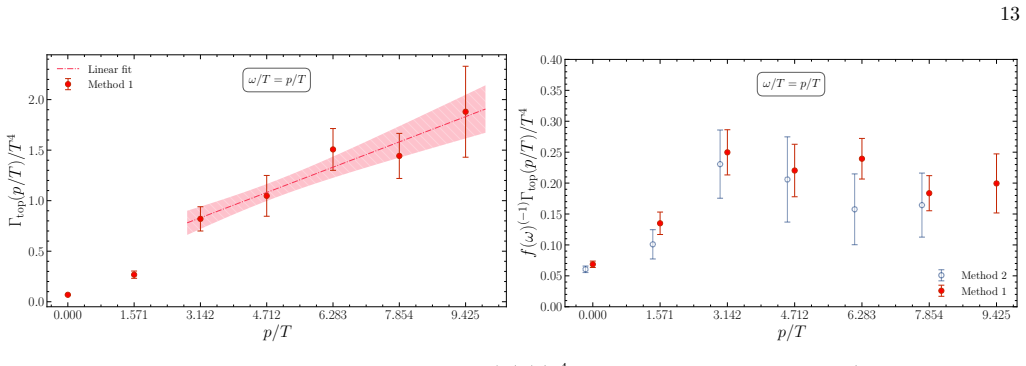
The central claim is that the spectral density $\rho(\omega,p)$ of the topological charge density correlator can be recovered at non-zero momentum with controlled systematics by applying the HLT method to $G_E(\tau,p)$, and that the resulting rate $\Gamma_{\mathrm{top}}(\omega,p)=2\rho(\omega,p)/(1-e^{-\omega/T})$ is trustworthy for $\omega/T\lesssim10$ and $p/T\lesssim9.4$. The paper demonstrates this in quenched QCD at $T\simeq1.24\,T_c$ using three lattice spacings and an aspect ratio $LT=4$, in two independent orders of limits: first double-extrapolate the correlator then invert, or first invert then extrapolate the rate; both agree. The on-shell rate $\Gamma_{\mathrm{top}}(\omega=p,p)$ is found to grow approximately linearly with $p$, a behavior the paper shows arises because the growth of $\Gamma_{\mathrm{top}}$ with $\omega$ at fixed $p$ wins over its suppression with $p$ at fixed $\omega$. This matches the semiclassical expectation for asymptotically large momenta and temperatures, and it is the first lattice benchmark for the momentum dependence of the topological rate.
Load-bearing premise
The paper quotes all rates at a single HLT smearing width, $\sigma/T=1.75$, having seen only mild dependence on $\sigma$ and having not performed the $\sigma\to0$ extrapolation that its own quadratic scaling formula would allow.
Editorial extensions
If this is right
- At $T\simeq1.24\,T_c$ the on-shell topological rate increases approximately linearly with $p$ up to $p/T\simeq9.4$, with a best-fit slope between $0.158$ and $0.226$ in units of $T^4$ depending on the fitting range.
- Off-shell data show $\Gamma_{\mathrm{top}}$ growing with energy at fixed momentum and decreasing with momentum at fixed energy; the on-shell rise is the net balance of these two effects.
- The two independent orders for taking the continuum and zero-smoothing limits give compatible determinations, indicating that the main systematic effects are under control.
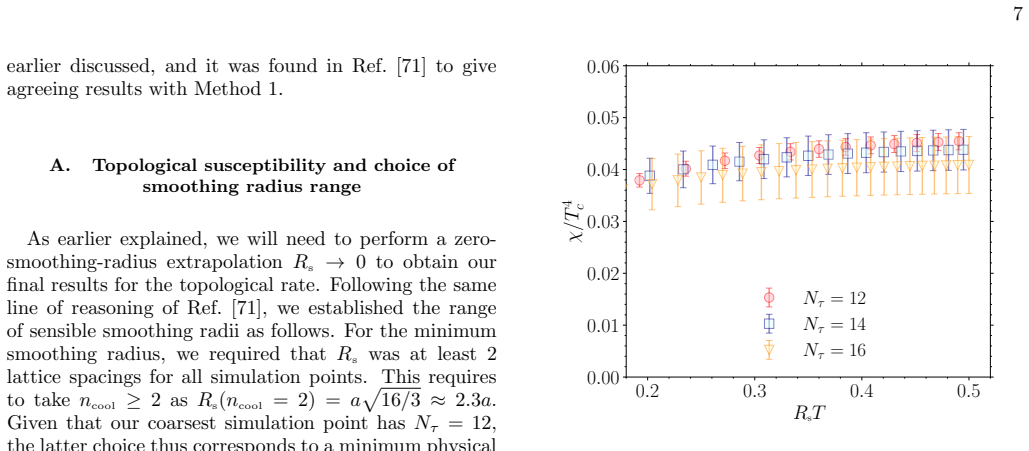
- The continuum extrapolation of the topological susceptibility is independent of the smoothing radius and agrees with a previous gradient-flow determination at the same temperature, validating the chosen smoothing radii.
Reading between the lines
- If the linear growth persists in full QCD, axion production in the early universe has to be treated with a momentum-dependent rate: high-momentum axions would be produced relatively faster than the zero-momentum sphaleron rate alone would suggest.
- The HLT pipeline demonstrated here is portable: any Euclidean correlator with resolvable spectral density, such as energy-momentum or conserved-current correlators at non-zero momentum, could be subjected to the same three-limit control.
- A direct test of the observed linearity would be a second temperature, e.g., $T\simeq2\,T_c$: if the slope does not follow the semiclassical scaling $p\,(\alpha_s T)^3$ with $\alpha_s(T)$, the linear rise at $T\simeq1.24\,T_c$ is an infrared phenomenon rather than the onset of the asymptotic regime.
Signed reviews
Editorial analysis
A structured set of objections, weighed in public.
Referee Report
Summary. The manuscript presents a proof-of-concept lattice calculation of the real-time topological rate Γ_top(ω,p) at T≈1.24T_c in quenched QCD, using the HLT inverse-problem method applied to Euclidean correlators of the smoothed topological charge density at nonzero spatial momentum, with LT=4 and Nτ=12,14,16. Two extraction routes are used: Method 1 double-extrapolates the correlator to the continuum and to zero smoothing radius before the HLT inversion; Method 2 inverts finite-lattice correlators and takes the limits directly on Γ_top. The main physics result is the on-shell rate Γ_top(ω=p,p), which the authors find to grow approximately linearly with p/T up to p/T≈9.4, with off-shell results showing growth in ω at fixed p and suppression in p at fixed ω. The paper also reports a continuum-extrapolated topological susceptibility χ/T_c^4=0.0363(87) consistent with Ref. [106], and an appendix cross-checks the time-reversal-breaking sequential cooling implementation against gradient flow and randomized cooling.
Significance. If the extracted values are reliable, this is the first non-perturbative lattice estimate of the momentum-dependent topological rate, and it provides useful input for momentum-dependent axion-production calculations. The study has genuine strengths: two independent analysis routes agree within errors; the continuum limits are smooth and nearly flat; the smoothing-radius window is anchored by a susceptibility cross-check against an independent determination; the error budget includes statistical and HLT λ-stability fluctuations; and the cooling-systematics check in Appendix A is careful. The main caveat is that the absolute values and the 'linear increase' conclusion rest on a fixed HLT smearing width rather than on the σ→0 extrapolation advertised in the method, and the linear-fit evidence is less stable than the abstract suggests; for these reasons the central claim is plausible but not yet fully established.
major comments (2)
- [Sec. III B, Eq. (34), Fig. 8] The paper's stated protocol is to control the vanishing-smearing-width limit, and Eq. (34) explicitly provides the quadratic-in-σ extrapolation Γ_top|_σ = Γ_top + Cσ² + O(σ⁴), yet the final values are quoted at σ/T=1.75 solely because the dependence over σ/T∈[1.25,2.5] is described as 'rather mild'. This is not a control of the σ→0 limit. Because the off-shell rate grows steeply with ω at fixed p (Fig. 9), the smeared on-shell value receives positive contamination from ω>p, and the coefficient C in Eq. (34) should be treated as a function of p; a p-dependent O(σ²) shift could therefore directly mimic or distort the claimed linear rise in Sec. IV. The observed flatness over a factor-four range in σ² with relative errors of 15–40% cannot exclude a common offset of order 0.1–0.3 T⁴. The authors should either perform the σ→0 extrapolation that Eq. (34) allows, or explicitly quote the results as σ/T=1.75-smoothed rates with an estimated σ-systematic propagated through the momentum-dependence analysis.
- [Sec. III D, Eqs. (43)-(47), Table II] The evidence for the headline linear increase is not as robust as the abstract's wording suggests. The fit to all seven points has reduced χ²=10.2/5, while the slopes for p/T≥0, ≥1, and ≥2 are c1=0.180(13), 0.226(24), and 0.158(43), respectively, central values that vary by more than the quoted errors on individual fits; the power-law fit gives α=1.20(11) with χ²/dof=6.76/4. This fit-range dependence, combined with the fact that the selected fit in Fig. 12 excludes the p=0 point, means the 'linear increase' conclusion is dominated by a subset of the data. The paper should report a scan of c1 as a function of the minimum p/T and add a model-averaged or fit-range systematic to the slope before claiming a linear increase.
minor comments (4)
- [Sec. III C] The text says the results of Sec. III A (Method 1) are being cross-checked, but Method 1 is described and applied in Sec. III B; the cross-reference should be corrected.
- [Table II, note] The note contains a typo: 'For method 2, we could not provide a result with Method 2 due to...' should read 'For method 2, we could not provide a result for p/T≈9.4 because this momentum is close to the cutoff scale for Nτ=12'.
- [Fig. 12 caption] The right panel divides the data by f(ω); the caption should state explicitly that this division removes the kinematic prefactor of Eq. (20) so that Method 1 and Method 2 are compared on the same quantity.
- [Sec. II C] The sentence introducing Eq. (34) states that one can use the quadratic prediction to perform a σ→0 extrapolation, but Sec. III B does not perform it; the wording should be aligned with what is actually done, or the extrapolation should be added.
Circularity Check
No significant circularity: the non-zero-momentum topological rate is obtained by inverting lattice Euclidean correlators, with no target result fed back into the extraction.
full rationale
The central claim, the momentum dependence of the real-time topological rate, is produced by a genuine inverse-problem pipeline: lattice Monte Carlo data for the Euclidean correlator G_E(τ,p) are the independent input; the HLT inversion reconstructs ρ(ω,p)/ω; and Γ_top(ω,p) follows from the Kubo-type formula in Eq. (5). No fitted parameter is renamed as a prediction, and no target observable is inserted into the inversion. The quoted values at σ/T=1.75 without a σ→0 extrapolation are a systematic-uncertainty concern, not a circularity, because the σ-dependence is checked empirically and Eq. (34) is only used to motivate a mild quadratic dependence. The self-citations to Refs. [71,72] supply the method, but that method's zero-momentum control was previously validated against the independent determination in Ref. [36], so the citation is real evidence rather than a load-bearing self-citation. The perturbative formula Eq. (42) is used only for qualitative comparison after the fact; the reported linear slope c1=0.158(43) for p/T≥2 comes from a fit to the lattice-extracted on-shell points, not from Eq. (42). The off-shell results (Fig. 9) are also independent outputs used to interpret the on-shell behavior, not inputs that enforce it. Accordingly, the derivation chain is self-contained with respect to the claimed predictions.
Assumptions & free parameters
free parameters (4)
- HLT target smearing width σ/T =
1.75 (center of [1.25, 2.5])
- HLT regularization parameters λ1, λ2 =
chosen per reconstructed-kernel figure of merit dλ
- Continuum extrapolation coefficient C1(τ,p;R_s) =
fitted, not quoted
- Zero-smoothing extrapolation coefficient C2(τ,p) =
fitted, not quoted
assumptions (5)
- standard math Kubo formula connecting the Euclidean correlator to the spectral density and the topological rate (Eqs. 5-7)
- domain assumption Reflection positivity of the continuum topological-charge correlator, G_E(τ,p)<0 for τ>0
- domain assumption Gradient-flow theorem: the topological-charge density correlator at small flow time receives linear corrections in t_GF, hence quadratic in R_s (Refs. [109,110])
- domain assumption Hansen-Lupo-Tantalo inversion reconstructs the smeared spectral density with controlled bias when dλ is small
- domain assumption On-shell identification ω=p for axion-like particles (Eq. 35)
Cite this review
Pith. "Pith review of Real-time topological rate at non-zero momentum in quenched QCD." pith.science (2026). https://pith.science/paper/6N3JBN63
@misc{pith2026260812066,
  author       = {Pith},
  title        = {Pith review of: Real-time topological rate at non-zero momentum in quenched QCD},
  year         = {2026},
  howpublished = {\url{https://pith.science/paper/6N3JBN63}},
  note         = {Machine review of arXiv:2608.12066}
}
abstract
We present a proof-of-concept numerical study of the real-time topological rate at non-zero momentum in quenched lattice QCD at a temperature $T\simeq 1.24 \, T_c \simeq 360$ MeV, as an important step toward the determination of this quantity in full QCD. Our strategy, already applied to compute the sphaleron rate in pure Yang--Mills and in full QCD, extracts the rate from the resolution of an appropriate inverse problem, solved applying the Hansen--Lupo--Tantalo (HLT) method to the thermal Euclidean time-correlator of the topological charge density. This method requires to control three different limits: continuum limit, limit of vanishing smearing width used in the HLT inverse problem resolution, and limit of vanishing smoothing radius used in the topological charge density correlator computation. Our lattice calculation is based on the standard Wilson discretization for the gauge action, and on three gauge ensembles with up to $N_\tau=16$ temporal points to achieve a controlled continuum limit. In all cases we employed an aspect ratio $LT=4$, which allowed us to compute the topological rate up to momenta as large as $p/T \sim 10$.
Figures


Figures from the paper (9 more)



Reference graph
Works this paper leans on
-
[106]
S. Borsanyi, M. Dierigl, Z. Fodor, S. D. Katz, S. W. Mages, D. Nogradi, J. Redondo, A. Ringwald, and K. K. Szabo, Phys. Lett. B752, 175 (2016), arXiv:1508.06917 [hep-lat]
arXiv 2016
- [1]
-
[2]
F. Bianchini, G. G. di Cortona, and M. Valli, Phys. Rev. D110, 123527 (2024), arXiv:2310.08169 [hep-ph]
arXiv 2024
-
[3]
C. A. J. O’Hare, PoSCOSMICWISPers, 040 (2024), arXiv:2403.17697 [hep-ph]
arXiv 2024
-
[4]
K. V. Berghaus, M. Drewes, and S. Zell, Phys. Rev. Lett.135, 171002 (2025), arXiv:2503.18829 [hep-ph]
arXiv 2025
- [5]
-
[6]
K. Bouzoud, J. Ghiglieri, M. Laine, and G. S. S. Sakoda, JHEP05(2026), 034, arXiv:2601.08221 [hep-ph]
arXiv 2026
-
[7]
Arzaet al.,preprint(2026), arXiv:2603.03433 [hep- ph]
A. Arzaet al.,preprint(2026), arXiv:2603.03433 [hep- ph]
arXiv 2026
Show all 115 references
-
[8]
Barbieri, L
N. Barbieri, L. Caloni, M. Gerbino, M. Lattanzi, and L. Visinelli, JCAP07(2026), 099, arXiv:2602.11100 [astro-ph.CO]
2026 arXiv
-
[9]
D. E. Kharzeev, L. D. McLerran, and H. J. Warringa, Nucl. Phys. A803, 227 (2008), arXiv:0711.0950 [hep- ph]
2008 arXiv
-
[10]
Fukushima, D
K. Fukushima, D. E. Kharzeev, and H. J. Warringa, Phys. Rev. D78, 074033 (2008), arXiv:0808.3382 [hep- ph]
2008 arXiv
-
[11]
D. E. Kharzeev, Prog. Part. Nucl. Phys.75, 133 (2014), arXiv:1312.3348 [hep-ph]
2014 arXiv
-
[12]
D. E. Kharzeev, J. Liao, and P. Tribedy, Int. J. Mod. Phys. E33, 2430007 (2024), arXiv:2405.05427 [nucl-th]
2024 arXiv
-
[13]
L. D. McLerran, E. Mottola, and M. E. Shaposhnikov, Phys. Rev. D43, 2027 (1991)
1991
-
[14]
G. D. Moore and M. Tassler, JHEP02(2011), 105, arXiv:1011.1167 [hep-ph]
2011 arXiv
-
[15]
D’Onofrio, K
M. D’Onofrio, K. Rummukainen, and A. Tranberg, Phys. Rev. Lett.113, 141602 (2014), arXiv:1404.3565 [hep-ph]
2014 arXiv
-
[16]
Guin and S
S. Guin and S. Sharma, Phys. Rev. D114, 014520 (2026), arXiv:2604.07256 [hep-lat]
2026 arXiv
-
[17]
Bonati, M
C. Bonati, M. D’Elia, M. Mariti, G. Martinelli, M. Mesiti, F. Negro, F. Sanfilippo, and G. Villadoro, JHEP03(2016), 155, arXiv:1512.06746 [hep-lat]
2016 arXiv
-
[18]
Petreczky, H.-P
P. Petreczky, H.-P. Schadler, and S. Sharma, Phys. Lett. B762, 498 (2016), arXiv:1606.03145 [hep-lat]
2016 arXiv
-
[19]
Borsanyiet al., Nature539, 69 (2016), arXiv:1606.07494 [hep-lat]
S. Borsanyiet al., Nature539, 69 (2016), arXiv:1606.07494 [hep-lat]
2016 arXiv
-
[20]
Trunin, F
A. Trunin, F. Burger, E.-M. Ilgenfritz, M. P. Lom- bardo, and M. M¨ uller-Preussker, J. Phys. Conf. Ser. 668, 012123 (2016), arXiv:1510.02265 [hep-lat]
2016 arXiv
-
[21]
Burger, E.-M
F. Burger, E.-M. Ilgenfritz, M. P. Lombardo, M. M¨ uller- Preussker, and A. Trunin, Nucl. Phys. A967, 880 (2017), arXiv:1705.01847 [hep-lat]
2017 arXiv
-
[22]
Bonati, M
C. Bonati, M. D’Elia, G. Martinelli, F. Negro, F. Sanfilippo, and A. Todaro, JHEP11(2018), 170, arXiv:1807.07954 [hep-lat]
2018 arXiv
-
[23]
Burger, E.-M
F. Burger, E.-M. Ilgenfritz, M. P. Lombardo, and A. Trunin, Phys. Rev. D98, 094501 (2018), arXiv:1805.06001 [hep-lat]
2018 arXiv
-
[24]
M. P. Lombardo and A. Trunin, Int. J. Mod. Phys. A 35, 2030010 (2020), arXiv:2005.06547 [hep-lat]
2020 arXiv
-
[25]
Athenodorou, C
A. Athenodorou, C. Bonanno, C. Bonati, G. Clemente, F. D’Angelo, M. D’Elia, L. Maio, G. Martinelli, F. Sanfilippo, and A. Todaro, JHEP10(2022), 197, arXiv:2208.08921 [hep-lat]
2022 arXiv
-
[26]
A. Y. Kotov, M. P. Lombardo, and A. Trunin, JHEP 09(2025), 045, arXiv:2502.15407 [hep-lat]
2025 arXiv
-
[27]
Bresciani, M
M. Bresciani, M. D. Brida, L. Giusti, and M. Pepe, Phys. Rev. Lett.134, 201904 (2025), arXiv:2501.11603 [hep-lat]
2025
-
[28]
M. C` e, L. Giusti, D. Laudicina, M. Pepe, and P. Rescigno, JHEP05(2025), 044, arXiv:2502.07674 [hep-lat]
2025
-
[29]
Bresciani, M
M. Bresciani, M. D. Brida, L. Giusti, and M. Pepe, Phys. Rev. D113, 034506 (2026), arXiv:2511.09160 [hep-lat]
2026
-
[30]
H. B. Meyer, Eur. Phys. J. A47, 86 (2011), arXiv:1104.3708 [hep-lat]
2011 arXiv
-
[31]
H. B. Meyer, PoSLATTICE2015, 014 (2016), arXiv:1512.06634 [hep-lat]
2016 arXiv
- [32]
-
[33]
Rothkopf, EPJ Web Conf.274, 01004 (2022), arXiv:2211.10680 [hep-lat]
A. Rothkopf, EPJ Web Conf.274, 01004 (2022), arXiv:2211.10680 [hep-lat]
2022 arXiv
-
[34]
A. Y. Kotov, JETP Letters108, 352 (2018)
2018
-
[35]
Altenkort, A
L. Altenkort, A. M. Eller, O. Kaczmarek, L. Mazur, G. D. Moore, and H.-T. Shu, Phys. Rev. D103, 114513 (2021), arXiv:2012.08279 [hep-lat]
2021 arXiv
-
[36]
Barroso Mancha and G
M. Barroso Mancha and G. D. Moore, JHEP01(2023), 155, arXiv:2210.05507 [hep-lat]
2023 arXiv
-
[37]
Boito, M
D. Boito, M. Golterman, K. Maltman, and S. Peris, Phys. Rev. D107, 034512 (2023), arXiv:2210.13677 [hep-lat]
2023 arXiv
-
[38]
Horak, J
J. Horak, J. M. Pawlowski, J. Rodr´ ıguez-Quintero, J. Turnwald, J. M. Urban, N. Wink, and S. Zafeiropou- los, Phys. Rev. D105, 036014 (2022), arXiv:2107.13464 [hep-ph]
2022 arXiv
-
[39]
Del Debbio, T
L. Del Debbio, T. Giani, and M. Wilson, Eur. Phys. J. C82, 330 (2022), arXiv:2111.05787 [hep-ph]
2022 arXiv
-
[40]
Candido, L
A. Candido, L. Del Debbio, T. Giani, and G. Petrillo, PoSLATTICE2022, 098 (2023), arXiv:2302.14731 [hep-lat]
2023 arXiv
-
[41]
Altenkort, A
L. Altenkort, A. M. Eller, O. Kaczmarek, L. Mazur, G. D. Moore, and H.-T. Shu, Phys. Rev. D103, 014511 (2021), arXiv:2009.13553 [hep-lat]
2021 arXiv
-
[42]
Altenkort, A
L. Altenkort, A. M. Eller, A. Francis, O. Kaczmarek, L. Mazur, G. D. Moore, and H.-T. Shu, Phys. Rev. D 108, 014503 (2023), arXiv:2211.08230 [hep-lat]
2023 arXiv
-
[43]
Altenkort, O
L. Altenkort, O. Kaczmarek, R. Larsen, S. Mukherjee, P. Petreczky, H.-T. Shu, and S. Stendebach (HotQCD), Phys. Rev. Lett.130, 231902 (2023), arXiv:2302.08501 [hep-lat]
2023 arXiv
-
[44]
Tikhonov, Soviet Math
A. Tikhonov, Soviet Math. Dokl.4, 1035 (1963)
1963
-
[45]
N. Y. Astrakhantsev, V. V. Braguta, and A. Y. Kotov, Phys. Rev. D98, 054515 (2018), arXiv:1804.02382 [hep- lat]
2018 arXiv
-
[46]
Astrakhantsev, V
N. Astrakhantsev, V. V. Braguta, M. D’Elia, A. Y. Ko- tov, A. A. Nikolaev, and F. Sanfilippo, Phys. Rev. D 102, 054516 (2020), arXiv:1910.08516 [hep-lat]
2020 arXiv
-
[47]
Backus and F
G. Backus and F. Gilbert, Geophysical Journal Interna- tional16, 169 (1968)
1968
-
[48]
B. B. Brandt, A. Francis, B. J¨ ager, and H. B. Meyer, Phys. Rev. D93, 054510 (2016), arXiv:1512.07249 [hep- lat]
2016 arXiv
-
[49]
B. B. Brandt, A. Francis, H. B. Meyer, and D. Robaina, Phys. Rev. D92, 094510 (2015), arXiv:1506.05732 [hep- 16 lat]
2015 arXiv
-
[50]
Bruno, L
M. Bruno, L. Giusti, and M. Saccardi, Phys. Rev. D 111, 094515 (2025), arXiv:2407.04141 [hep-lat]
2025 arXiv
- [51]
-
[52]
Giusti, M
L. Giusti, M. Saccardi, and D. Toniolo,preprint(2026), arXiv:2606.28167 [hep-lat]
2026 arXiv
-
[53]
Abbott, S
R. Abbott, S. Fields, W. I. Jay, P. Oare, and M. Sac- cardi,preprint(2026), arXiv:2605.20509 [hep-lat]
2026 arXiv
-
[54]
De Santis,preprint(2026), arXiv:2607.03311 [hep- lat]
A. De Santis,preprint(2026), arXiv:2607.03311 [hep- lat]
2026 arXiv
-
[55]
Hansen, A
M. Hansen, A. Lupo, and N. Tantalo, Phys. Rev. D99, 094508 (2019), arXiv:1903.06476 [hep-lat]
2019 arXiv
-
[56]
Bulava, M
J. Bulava, M. T. Hansen, M. W. Hansen, A. Patella, and N. Tantalo, JHEP07(2022), 034, arXiv:2111.12774 [hep-lat]
2022 arXiv
-
[57]
Alexandrouet al.(Extended Twisted Mass Collabo- ration (ETMC)), Phys
C. Alexandrouet al.(Extended Twisted Mass Collabo- ration (ETMC)), Phys. Rev. Lett.130, 241901 (2023), arXiv:2212.08467 [hep-lat]
2023 arXiv
-
[58]
Frezzotti, N
R. Frezzotti, N. Tantalo, G. Gagliardi, F. Sanfilippo, S. Simula, and V. Lubicz, Phys. Rev. D108, 074510 (2023), arXiv:2306.07228 [hep-lat]
2023 arXiv
-
[59]
Evangelista, R
A. Evangelista, R. Frezzotti, N. Tantalo, G. Gagliardi, F. Sanfilippo, S. Simula, and V. Lubicz (Extended Twisted Mass), Phys. Rev. D108, 074513 (2023), arXiv:2308.03125 [hep-lat]
2023 arXiv
-
[60]
Alexandrouet al.(Extended Twisted Mass), Phys
C. Alexandrouet al.(Extended Twisted Mass), Phys. Rev. Lett.132, 261901 (2024), arXiv:2403.05404 [hep- lat]
2024 arXiv
-
[61]
Frezzotti, N
R. Frezzotti, N. Tantalo, G. Gagliardi, F. Sanfilippo, S. Simula, V. Lubicz, G. Martinelli, and C. T. Sachra- jda, Phys. Rev. D109, 114506 (2024), arXiv:2402.03262 [hep-lat]
2024 arXiv
-
[62]
Bennettet al., Phys
E. Bennettet al., Phys. Rev. D110, 074509 (2024), arXiv:2405.01388 [hep-lat]
2024 arXiv
-
[63]
Almirante, N
G. Almirante, N. Astrakhantsev, V. V. Braguta, M. D’Elia, L. Maio, M. Naviglio, F. Sanfilippo, and A. Trunin, Phys. Rev. D111, 034505 (2025), arXiv:2406.18504 [hep-lat]
2025 arXiv
-
[64]
De Santiset al., Phys
A. De Santiset al., Phys. Rev. Lett.135, 121901 (2025), arXiv:2504.06064 [hep-lat]
2025
-
[65]
De Santiset al., Phys
A. De Santiset al., Phys. Rev. D112, 054503 (2025), arXiv:2504.06063 [hep-lat]
2025
-
[66]
Bennettet al.(TELOS), Phys
E. Bennettet al.(TELOS), Phys. Rev. D112, 074515 (2025), arXiv:2506.19804 [hep-lat]
2025
-
[67]
Di Carlo, F
M. Di Carlo, F. Erben, and M. T. Hansen, JHEP07 (2025), 229, arXiv:2504.16189 [hep-lat]
2025 arXiv
-
[68]
Di Palma, R
R. Di Palma, R. Frezzotti, G. Gagliardi, V. Lubicz, G. Martinelli, C. T. Sachrajda, F. Sanfilippo, S. Sim- ula, and N. Tantalo,preprint(2026), arXiv:2605.22742 [hep-lat]
2026 arXiv
- [69]
-
[70]
Del Debbio, A
L. Del Debbio, A. Lupo, M. Panero, and N. Tantalo, Eur. Phys. J. C85, 185 (2025), arXiv:2409.04413 [hep- lat]
2025 arXiv
-
[71]
Bonanno, F
C. Bonanno, F. D’Angelo, M. D’Elia, L. Maio, and M. Naviglio, Phys. Rev. D108, 074515 (2023), arXiv:2305.17120 [hep-lat]
2023 arXiv
-
[72]
Bonanno, F
C. Bonanno, F. D’Angelo, M. D’Elia, L. Maio, and M. Naviglio, Phys. Rev. Lett.132, 051903 (2024), arXiv:2308.01287 [hep-lat]
2024 arXiv
- [73]
-
[74]
Francis, O
A. Francis, O. Kaczmarek, M. Laine, T. Neuhaus, and H. Ohno, Phys. Rev. D91, 096002 (2015), arXiv:1503.05652 [hep-lat]
2015 arXiv
-
[75]
Creutz, Phys
M. Creutz, Phys. Rev. D21, 2308 (1980)
1980
-
[76]
A. D. Kennedy and B. J. Pendleton, Phys. Lett. B156, 393 (1985)
1985
-
[77]
Creutz, Phys
M. Creutz, Phys. Rev. D36, 515 (1987)
1987
-
[78]
Cabibbo and E
N. Cabibbo and E. Marinari, Phys. Lett. B119, 387 (1982)
1982
-
[79]
Sommer, PoSLATTICE2013, 015 (2014), arXiv:1401.3270 [hep-lat]
R. Sommer, PoSLATTICE2013, 015 (2014), arXiv:1401.3270 [hep-lat]
2014 arXiv
-
[80]
Borsanyiet al., JHEP09(2022), 010, arXiv:1203.4469 [hep-lat]
S. Borsanyiet al., JHEP09(2022), 010, arXiv:1203.4469 [hep-lat]
2022 arXiv
-
[81]
Borsanyi, K
S. Borsanyi, K. R., Z. Fodor, D. A. Godzieba, P. Parotto, and D. Sexty, Phys. Rev. D105, 074513 (2022), arXiv:2202.05234 [hep-lat]
2022 arXiv
-
[82]
Campostrini, A
M. Campostrini, A. Di Giacomo, and H. Panagopoulos, Phys. Lett. B212, 206 (1988)
1988
-
[83]
Campostrini, A
M. Campostrini, A. Di Giacomo, H. Panagopoulos, and E. Vicari, Nucl. Phys. B329, 683 (1990)
1990
-
[84]
D’Elia, Nucl
M. D’Elia, Nucl. Phys. B661, 139 (2003), arXiv:hep- lat/0302007 [hep-lat]
2003
-
[85]
Vicari and H
E. Vicari and H. Panagopoulos, Phys. Rept.470, 93 (2009), arXiv:0803.1593 [hep-th]
2009 arXiv
-
[86]
Alles, M
B. Alles, M. D’Elia, A. Di Giacomo, and R. Kirchner, Nucl. Phys. B Proc. Suppl.63, 510 (1998), arXiv:hep- lat/9709074
1998
-
[87]
Vicari, Nucl
E. Vicari, Nucl. Phys. B554, 301 (1999), arXiv:hep- lat/9901008
1999
-
[88]
Horvath, A
I. Horvath, A. Alexandru, J. B. Zhang, Y. Chen, S. J. Dong, T. Draper, K. F. Liu, N. Mathur, S. Tamhankar, and H. B. Thacker, Phys. Lett. B617, 49 (2005), arXiv:hep-lat/0504005
2005 arXiv
-
[89]
Chowdhury, A
A. Chowdhury, A. K. De, A. Harindranath, J. Maiti, and S. Mondal, JHEP11(2012), 029, arXiv:1208.4235 [hep-lat]
2012 arXiv
-
[90]
Fukaya, S
H. Fukaya, S. Aoki, G. Cossu, S. Hashimoto, T. Kaneko, and J. Noaki (JLQCD), Phys. Rev. D92, 111501 (2015), arXiv:1509.00944 [hep-lat]
2015 arXiv
-
[91]
Mazur, L
L. Mazur, L. Altenkort, O. Kaczmarek, and H.-T. Shu, PoSLATTICE2019, 219 (2020), arXiv:2001.11967 [hep-lat]
2020 arXiv
-
[92]
Berg, Phys
B. Berg, Phys. Lett. B104, 475 (1981)
1981
-
[93]
Iwasaki and T
Y. Iwasaki and T. Yoshie, Phys. Lett. B131, 159 (1983)
1983
-
[94]
S. Itoh, Y. Iwasaki, and T. Yoshie, Phys. Lett. B147, 141 (1984)
1984
-
[95]
Teper, Phys
M. Teper, Phys. Lett. B162, 357 (1985)
1985
-
[96]
Ilgenfritz, M
E.-M. Ilgenfritz, M. Laursen, G. Schierholz, M. M¨ uller- Preussker, and H. Schiller, Nucl. Phys. B268, 693 (1986)
1986
-
[97]
Alles, L
B. Alles, L. Cosmai, M. D’Elia, and A. Papa, Phys. Rev. D62, 094507 (2000), arXiv:hep-lat/0001027 [hep-lat]
2000 arXiv
-
[98]
Albaneseet al.(APE), Phys
M. Albaneseet al.(APE), Phys. Lett. B192, 163 (1987)
1987
-
[99]
Morningstar and M
C. Morningstar and M. J. Peardon, Phys. Rev. D69, 054501 (2004), arXiv:hep-lat/0311018
2004 arXiv
-
[100]
L¨ uscher, JHEP08(2010), 071, [Erratum: JHEP03 (2014) 092], arXiv:1006.4518 [hep-lat]
M. L¨ uscher, JHEP08(2010), 071, [Erratum: JHEP03 (2014) 092], arXiv:1006.4518 [hep-lat]
2010 arXiv
-
[101]
Bonati and M
C. Bonati and M. D’Elia, Phys. Rev. DD89, 105005 (2014), arXiv:1401.2441 [hep-lat]
2014 arXiv
-
[102]
Alexandrou, A
C. Alexandrou, A. Athenodorou, and K. Jansen, Phys. Rev. D92, 125014 (2015), arXiv:1509.04259 [hep-lat]
2015 arXiv
-
[103]
Alexandrou, A
C. Alexandrou, A. Athenodorou, K. Cichy, A. Dro- mard, E. Garcia-Ramos, K. Jansen, U. Wenger, and 17 F. Zimmermann, Eur. Phys. J. C80, 424 (2020), arXiv:1708.00696 [hep-lat]
2020 arXiv
-
[104]
W. I. Jay and M. Saccardi,preprint(2026), arXiv:2606.19503 [hep-lat]
2026 arXiv
-
[105]
Grilli di Cortona, E
G. Grilli di Cortona, E. Hardy, J. Pardo Vega, and G. Villadoro, JHEP01(2016), 034, arXiv:1511.02867 [hep-ph]
2016 arXiv
-
[107]
Bonanno, JHEP01(2026), 039, arXiv:2510.08006 [hep-lat]
C. Bonanno, JHEP01(2026), 039, arXiv:2510.08006 [hep-lat]
2026
-
[108]
Lucini, A
B. Lucini, A. Rago, and E. Rinaldi, Phys. Lett. B712, 279 (2012), arXiv:1202.6684 [hep-lat]
2012 arXiv
-
[109]
M. C` e, C. Consonni, G. P. Engel, and L. Giusti, Phys. Rev. D92, 074502 (2015), arXiv:1506.06052 [hep-lat]
2015 arXiv
-
[110]
M. C` e, M. Garc´ ıa Vera, L. Giusti, and S. Schaefer, Phys. Lett. B762, 232 (2016), arXiv:1607.05939 [hep-lat]
2016 arXiv
-
[111]
Giusti and M
L. Giusti and M. L¨ uscher, Eur. Phys. J. C79, 207 (2019), arXiv:1812.02062 [hep-lat]
2019 arXiv
-
[112]
Bonanno, JHEP01(2024), 116, arXiv:2311.06646 [hep-lat]
C. Bonanno, JHEP01(2024), 116, arXiv:2311.06646 [hep-lat]
2024 arXiv
-
[113]
Mass´ o, F
E. Mass´ o, F. Rota, and G. Zsembinszki, Phys. Rev. D 66, 023004 (2002), arXiv:hep-ph/0203221
2002 arXiv
-
[114]
Graf and F
P. Graf and F. D. Steffen, Phys. Rev. D83, 075011 (2011), arXiv:1008.4528 [hep-ph]
2011 arXiv
-
[115]
D. J. Gross, R. D. Pisarski, and L. G. Yaffe, Rev. Mod. Phys.53, 43 (1981)
1981
Reviewed August 16, 2026 · model on record in the stance chip above.
Discussion (0). Continue with ORCID to comment.