REVIEW 3 major objections 4 minor 15 references
Sum Rule of Femtoscopic Correlation Function
T0 review · 3 major / 4 minor · reviewed 2026-08-14 · deepseek-v4-flash
Pith's one-line read The paper proves an exact integral identity for the difference of two femtoscopic correlation functions, repairing a 1995 sum rule whose momentum integral diverged for interacting pairs.
desk verdict Useful, honest femtoscopy sum-rule paper with a real UV-divergence fix, but the attractive-Coulomb case leans on an unadvertised subtraction and the regulator identity is not pointwise justified for exact Coulomb wave functions. read the letter →
The pith
A machine-rendered reading of the paper's core claim, the machinery that carries it, and where it could break.
The reading
What carries the argument
The load-bearing object is the completeness (closure) relation for the two-particle wave functions, Eq. (9), used in the form $\int \frac{d^3q}{(2\pi)^3}(|\varphi_q(r)|^2-1) = \pm \delta^{(3)}(2r) - \sum_\alpha |\varphi_\alpha(r)|^2$. For the regulator pair—nonidentical particles with no bound states—this integral is zero (Eq. (17)), which is exactly the piece that makes the original single-function integral divergent. The improved sum rule therefore works by cancellation: $R$ and $\tilde{R}$ share the same large-$q$ tail, and their difference falls fast enough for the momentum integral to exist.
What would settle it
Take an exactly solvable two-particle system with a known shallow bound state (e.g., a delta-shell or separable potential) and compute the correlation functions $R$ and $\tilde{R}$ from the exact wave functions for several source radii; evaluate the left side of Eq. (18) with a momentum cutoff and compare with $\pm\pi^3D_r(0)-A$. If the saturated value differs from the right side by more than the numerical error, the sum rule fails. For the neutron-proton case, the same check can be made experimentally: measure the triplet and singlet correlation functions and ask whether $4\pi\int dq\, q^2(R_t-R_s)$ equals $-A_D$ over a range of source sizes.
Extended reading notes
Core claim
The central claim is Eq. (18): for two correlation functions $R(q)$ and $\tilde{R}(q)$ built from the same source, with $\tilde{R}$ a regulator whose pair has no bound states and whose continuum completeness is that of free nonidentical particles, $\int d^3 q\,(R(q)-\tilde{R}(q)) = \pm \pi^3 D_r(0) - \sum_\alpha A_\alpha$, where $D_r$ is the relative source distribution and $A_\alpha$ are bound-state formation rates. The proof runs through the quantum-mechanical closure relation: the integral over $q$ of $(|\varphi_q(r)|^2-1)$ equals a delta term at $2r$ minus the bound-state densities, and for the nonidentical regulator that integral vanishes identically. Subtracting the two correlation functions cancels the common ultraviolet tail, so the momentum integral converges and the $r$- and $q$-integrations can be interchanged. The result restores the physical content of the original 1995 sum rule—integrated correlation measures source size and bound-state production—without its divergence.
Load-bearing premise
The central assumption is that the regulator pair's scattering states are complete in exactly the same way as free waves, so the momentum integral of $|\tilde{\varphi}_q(r)|^2-1$ vanishes; for neutron-proton this reduces to trusting an approximate asymptotic wave function that the sum rule itself shows is valid only for sources larger than about 2 fm.
Editorial extensions
If this is right
- Any femtoscopic correlation function computed in an approximate model must satisfy Eq. (18); checking the integrated difference against $\pm\pi^3D_r(0)-\sum_\alpha A_\alpha$ gives a quantitative test of the model's accuracy and range of validity.
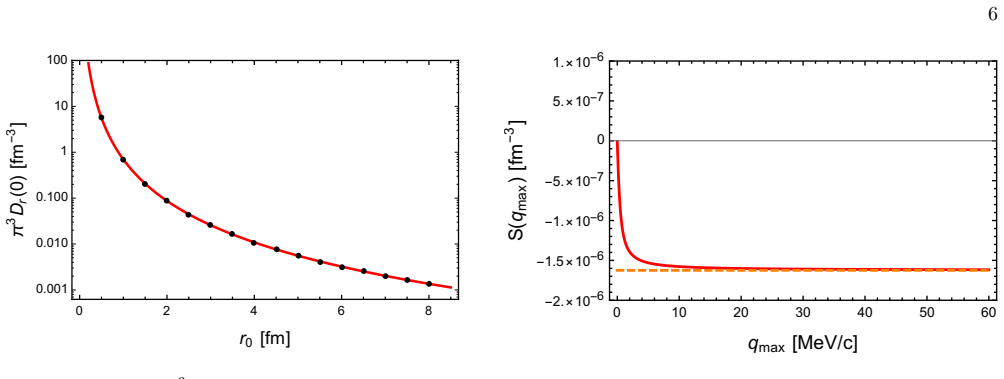
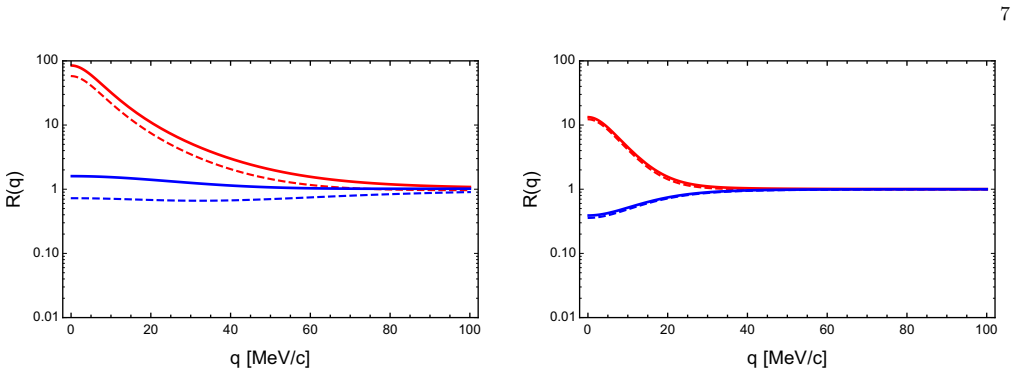
- For exact Coulomb repulsion between identical pions, the integrated difference of symmetrized and unsymmetrized correlation functions reproduces $\pi^3D_r(0)$ once $q_{\rm max}r_0 \gtrsim 1.5$, so the rule is verified for an exactly solvable case.
- For the Coulomb-attractive case the same subtraction strategy works, but an extra analytic subtraction is needed (Eq. (28)) because the sum of Gamow factors still has a linearly divergent integrand; the rule then matches $-8\pi^2\zeta(3)/a_B^3$.
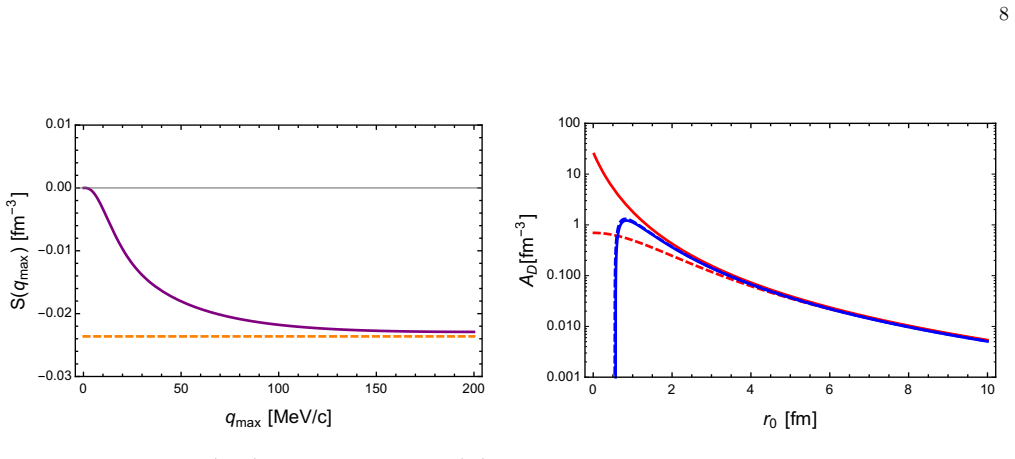
- For neutron-proton pairs, the sum rule supplies the deuteron formation rate $A_D$ from the triplet-singlet correlation difference; the model is reliable only for source radius $r_0 > 2$ fm, and the commonly used correction factor (35) does not extend it much below that.
Reading between the lines
- The same regulator strategy could test models with open inelastic channels (e.g., $K^-p$ or $p\bar{p}$), provided the regulator is chosen to carry the same channel content; the completeness relation would then include the inelastic states explicitly.
- Because the sum rule holds for any source function, it could be used as a data-driven consistency check in experimental femtoscopy, comparing extracted sources and interaction parameters without committing to a specific model.
- In the attractive case the extra subtraction in Eq. (28) shows that a regulator need not be a physical correlation function; one could construct purely formal regulators that cancel even the strongest divergent tails, at the price of adding known subtraction constants.
- A natural extension is to apply the rule to correlation functions computed with realistic, energy-dependent and coupled-channel potentials; the failure of the rule would localize the regime where the approximate wave function or the completeness assumption breaks down.
Signed reviews
Editorial analysis
A structured set of objections, weighed in public.
Referee Report
Summary. This manuscript revisits the femtoscopic sum rule of Mrówczyński (1995), which equates the momentum-space integral of a two-particle correlation function to a source-density term and bound-state formation rates via the quantum-mechanical completeness relation. The authors identify that for interacting pairs the original momentum integral is ultraviolet divergent, and propose an improved sum rule for a difference (or sum) of two correlation functions with the same large-momentum asymptotics, Eq. (18): ∫ d³q (R(q) − R̃(q)) = ±π³ D_r(0) − Σ_α A_α. The regulator R̃ is chosen to describe a pair of nonidentical particles without bound states, so that its own momentum integral is supposed to vanish. The rule is tested on exact Coulomb correlation functions for same-sign pions (repulsive case) and opposite-sign pions (attractive case), and is then used to assess the Lednicky–Lyuboshits neutron-proton correlation function, leading to the conclusion that the asymptotic np wave function is reliable for source radii r0 ≳ 2 fm.
Significance. If established, Eq. (18) provides a model-independent, parameter-free integral constraint that any femtoscopic correlation function must satisfy, and it would be a useful benchmark for approximate calculations; the paper's use of exact Coulomb wave functions and the neutron-proton example convincingly illustrate the intended application. The paper also deserves credit for clearly exposing the ultraviolet problem of the original sum rule and for testing the proposed rule against independently computed exact correlation functions rather than fitting parameters. However, the derivation contains a distributional gap at Eq. (17), and the attractive-Coulomb case is explicitly divergent even after the regulator, requiring an extra subtraction that is not derived from the completeness relation. These issues affect the central claim, so the result is promising but not yet fully established as stated.
major comments (3)
- [Section IV, Eq. (17)] The assertion ∫ d³q/(2π)³ (|φ̃_q(r)|² − 1) = 0 for the regulator is not an ordinary identity for exact Coulomb wave functions. For the repulsive Coulomb regulator used in Sec. V.A, |φ̃_q(0)|² equals the Gamow factor G_+(q), and G_+(q) − 1 ∼ π/(a_B q) at large q, so the integral 4π ∫ q² dq (G_+(q) − 1) diverges linearly. Eq. (17) can at best hold as a distributional identity away from r = 0, and the pointwise substitution into Eq. (16), together with the interchange of q- and r-integrations, requires a regularization that the paper does not specify.
- [Section V.B, Eqs. (27)-(28)] The attractive-Coulomb sum rule does not follow from the completeness-based derivation as written. Even after applying the regulator, Eq. (27) shows q²(G_+(q) + G_−(q) − 2) → 2π²/(3a_B²), so the integral in Eq. (24) is linearly divergent; the paper subtracts the nonphysical term 2π²/(3a_B² q²) to obtain Eq. (28). This subtraction is not derived from Eq. (17) or Eq. (18), and the finite-source case is explicitly left unresolved in the text ('We have not been able to convincingly show...'). The abstract's claim that the improved sum rule works for exact Coulomb correlation functions is therefore too broad without a clearly stated regularization prescription.
- [Section IV, Eqs. (16)-(18)] The derivation of the main result relies on changing the order of q- and r-integrations after assuming that both integrals converge, as the paper itself notes. For the Coulomb regulators used in the tests, the q-integrals are not absolutely convergent, so Eq. (18) is not rigorously established by the argument given. The numerical saturation seen in Figs. 2-4 is encouraging evidence that the final relation can be made to work, but it does not supply the missing justification. I recommend reformulating the sum rule distributionally, or at least stating explicitly the cutoff or symmetric-integration prescription under which Eq. (17) and Eq. (18) hold.
minor comments (4)
- [General notation] The regulator correlation function is written as R̃ in the text but sometimes appears as ~R in equations; the notation should be defined once after Eq. (16) and used consistently throughout.
- [Section V.B, Eq. (21)] The passage from the finite-source formation rate A_{nlm} defined by Eq. (13) to the point-like-source expression A_{nlm} = (2π)³|φ_{nlm}(0)|² in Eq. (23) should be displayed explicitly, including the use of D_r(r) = δ³(r).
- [Section V.B, Eq. (22)] The spelling 'Gamov factor' should be 'Gamow factor' in Eq. (22) and the surrounding text.
- [Fig. 8] The numerical procedure for extracting the deuteron formation rate from the integrated correlation function should be described briefly in the text, since the figure compares four independent computations and no error estimates are given.
Circularity Check
No significant circularity: the improved sum rule is derived from the quantum-mechanical completeness relation and tested against independent exact Coulomb and model correlation functions.
full rationale
The central derivation, Eq. (18), follows from substituting the standard completeness relation (9) into the difference of two correlation functions. The regulator correlation function is not fitted to the target quantity; its contribution is dropped via Eq. (17), which is asserted on the physical ground of a nonidentical pair with no bound states. The authors re-derive the original 1995 sum rule rather than importing it, so self-citation of [4] is not load-bearing. The exact Coulomb correlation functions used for testing are taken from prior work [5], but they are independent inputs computed from the Coulomb problem, not quantities forced to satisfy the sum rule. The neutron-proton application uses external scattering parameters and the Lednicky-Lyuboshits model, and no fitted parameter is relabeled as a prediction. Any mathematical issue with Eq. (17) for exact Coulomb wave functions would be a correctness concern about regularization, not circularity, because the sum rule is not assumed by the regulator's construction. Thus no circular step is present; the mild score reflects only the presence of self-citations, which are not load-bearing.
Assumptions & free parameters
free parameters (1)
- source radius r0 =
2 fm, 3 fm, 6 fm in examples
assumptions (4)
- standard math Quantum completeness relation for the two-particle wave functions, Eq. (9).
- domain assumption Correlation function is given by Eq. (5) with a q-independent and spin-independent source function D_r(r).
- domain assumption Regulator correlation function has no bound states and its wave functions satisfy the free completeness relation, Eq. (17).
- domain assumption Non-relativistic treatment of the relative motion of the pair.
Cite this review
Pith. "Pith review of Sum Rule of Femtoscopic Correlation Function." pith.science (2026). https://pith.science/paper/6OELWB7B
@misc{pith2026190803178,
  author       = {Pith},
  title        = {Pith review of: Sum Rule of Femtoscopic Correlation Function},
  year         = {2026},
  howpublished = {\url{https://pith.science/paper/6OELWB7B}},
  note         = {Machine review of arXiv:1908.03178}
}
read the original abstract
A correlation function of two particles with small relative velocities obeys a sum rule - the momentum integral of the function is determined due to the completeness of quantum states of the particles. The original sum rule derived in 1995 suffered from a serious problem: the momentum integral was ultraviolet divergent in physically interesting cases. We resolve the problem by considering the sum rule not of a single correlation function but of a sum or difference of two appropriately chosen correlation functions. The improved sum rule is shown to work well for the exact Coulomb correlation functions. We argue that the sum rule can be used to test an accuracy and range of applicability of correlation functions computed in approximate models. The neutron-proton correlation function is discussed as an example.
Figures

Figures from the paper (1 more)
Reference graph
Works this paper leans on
-
[1]
D. H. Boal, C. K. Gelbke, and B. K. Jennings, Rev. Mod. Phys. 62, 553 (1990)
1990
-
[2]
M. A. Lisa, S. Pratt, R. Soltz, and U. Wiedemann, Ann. Rev. Nucl. Part. Sci. 55, 357 (2005)
work page 2005
- [3]
- [4]
- [5]
-
[6]
S. E. Koonin, Phys. Lett. B 70, 43 (1977)
1977
-
[7]
R. Lednicky and V. L. Lyuboshits, Sov. J. Nucl. Phys. 35, 770 (1982) [Yad. Fiz. 35, 1316 (1981)]
work page 1982
-
[8]
Schiff, Quantum Mechanics (McGraw-Hill, New York, 1968)
L.I. Schiff, Quantum Mechanics (McGraw-Hill, New York, 1968)
work page 1968
Show all 15 references
-
[9]
Maj and St
R. Maj and St. Mr´ owczy´ nski, Phys. Rev. C80, 034907 (2009)
2009
-
[10]
V. M. Shapoval, Y. M. Sinyukov, and I. A. Karpenko, Phys. Rev. C 88, 064904 (2013)
2013
-
[11]
V. A. Babenko and N. M. Petrov, Phys. Atom. Nucl. 71 (2008) 1730 [Yad. Fiz. 71 (2008) 1761]
2008
-
[12]
Hodgson, Nuclear Reactions and Nuclear Structure (Clarendon Press, Oxford, 1971)
P.E. Hodgson, Nuclear Reactions and Nuclear Structure (Clarendon Press, Oxford, 1971)
1971
-
[13]
McCarthy, Introduction to Nuclear Theory (John Wiley & Sons, New York, 1968)
I.E. McCarthy, Introduction to Nuclear Theory (John Wiley & Sons, New York, 1968)
1968
-
[14]
Acharya et al
S. Acharya et al. [ALICE Collaboration], Phys. Rev. C 99, 024001 (2019)
2019
-
[15]
Blum and M
K. Blum and M. Takimoto, Phys. Rev. C 99, 044913 (2019)
2019
Reviewed August 14, 2026 · model on record in the stance chip above.
Discussion (0). Continue with ORCID to comment.