REVIEW 4 major objections 3 minor
SQGen trains a quantum image generator classically under gate constraints, then deploys it as a shallow native circuit that produces images end-to-end with no classical decoder.
Reviewed by Pith at T0; open to challenge. T0 means a machine referee read the full paper against a public rubric. the ladder, T0–T4 →
T0 review · grok-4.5
2026-07-15 09:58 UTC pith:6OFYYXFO
load-bearing objection Abstract-only pitch for a decoder-free QTT quantum image generator; architecture sketch is concrete, but the load-bearing classical-to-native transfer and plateau/noise claims have zero supporting equations or numbers. the 4 major comments →
SQGen: Structured Quantum Image Generation with Latent-Modulated Quantized Tensor Trains
The pith
A machine-rendered reading of the paper's core claim, the machinery that carries it, and where it could break.
Core claim
SQGen is a full quantum generator built on a quantized tensor train with latent modulation that, after classical training under gate-compatibility constraints and a torus latent prior, maps one-to-one onto a compact native quantum circuit and generates images end-to-end from a shallow circuit with no classical decoder in the inference path.
What carries the argument
The quantized tensor train (QTT) with latent-modulated re-uploading: each site operates on an ancilla bond register plus two physical qubits encoding one row bit and one column bit; each re-uploading rotation is split into a trainable main angle path plus an additive latent term that vanishes when the latent is disabled.
Load-bearing premise
That parameters learned by the classically trained, gate-compatible differentiable model transfer faithfully enough to the shallow native quantum circuit for usable image-scale generation without a classical decoder.
What would settle it
Transfer the trained parameters to real quantum hardware, generate samples from a standard image dataset (for example downscaled MNIST), and check whether the output pixel distribution stays statistically close to the training distribution; a sharp drop in fidelity or total mode collapse would falsify the claim.
If this is right
- Image generation can run entirely on the quantum device with no classical decoder in the inference path.
- Training stays classical and differentiable, so standard optimizers can be used while still producing a deployable quantum circuit.
- Local QTT structure keeps the circuit shallow, limiting exposure to hardware noise.
- Latent modulation with a torus prior supplies controllable sample diversity without enlarging circuit depth.
- The same classical-to-quantum transfer can be applied to other structured generative tasks that admit a tensor-train factorization.
Where Pith is reading between the lines
- If the classical-to-quantum transfer preserves quality at larger image sizes, the same bond-promotion pattern could serve as a template for other high-dimensional quantum generators that currently rely on classical decoders.
- The torus latent prior plus additive angle modulation may generalize to any data indexed by multi-scale bit strings, not only images.
- Successful hardware runs would indicate that promoting bond indices to ancilla qubits is a practical way to control entanglement and trainability on NISQ devices.
- Failure of the transfer on real hardware would isolate the gap between the classical surrogate and the true noise model as the next concrete bottleneck to close.
Editorial analysis
A structured set of objections, weighed in public.
Referee Report
Summary. The manuscript proposes SQGen, a quantum image generator built on a quantized tensor train (QTT) with latent modulation. Bond indices of the target pixel distribution are promoted to ancilla bond qubits so each site acts on a bond register plus two physical qubits encoding row/column bits. Re-uploading rotations are factorized into a trainable main-path angle plus an additive latent term. Training is performed classically on a differentiable, gate-compatible surrogate with a torus latent prior; after training, operators map one-to-one onto native gates, producing a compact circuit with no classical decoder at inference. The abstract claims stable training, barren-plateau mitigation, end-to-end image generation from a shallow circuit, and promising real-hardware feasibility.
Significance. If validated, decoder-free image-scale generation from a shallow, classically pre-trained native circuit that remains trainable under NISQ noise would be a concrete advance for quantum generative modeling. The QTT bond-to-ancilla construction and angle-level latent modulation are specific architectural ideas that, if they demonstrably control entanglement growth and gradient variance, would be useful to the community. The classical-to-native one-to-one transfer under gate-compatibility constraints is also a practical contribution, provided the mapping and its depth scaling are made explicit and checked.
major comments (4)
- The abstract asserts that promoting QTT bond indices to ancilla bond qubits together with latent-modulated re-uploading mitigates barren plateaus, yet supplies no gradient-variance analysis, light-cone/entanglement argument, or depth-vs-resolution scaling. This mitigation is load-bearing for the trainability claim and cannot be assessed from the available text alone.
- The central transfer claim—that a classically trained, gate-compatible differentiable surrogate maps parameter-for-parameter onto a shallow native circuit—is stated without the explicit form of the surrogate, the gate-compatibility constraints, or circuit-depth scaling with image resolution. Without those elements the one-to-one mapping remains an unchecked assertion.
- End-to-end generation “with no classical decoder in the inference path” is a core claim, but the abstract does not specify the measurement/readout protocol that converts the shallow circuit’s output into image-scale pixels. That protocol is essential to verifying that no classical decoder is required.
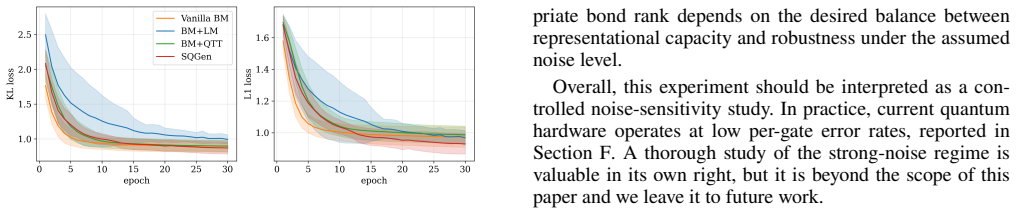
- “Promising feasibility on real quantum hardware” and “trains stably” are asserted without hardware metrics, device specifications, error bars, loss curves, baselines, or image-quality numbers. These empirical claims are load-bearing for the paper’s practical conclusions and are not evidenced in the available material.
minor comments (3)
- The abstract is dense; even a one-sentence schematic of bond-qubit promotion and of the main-path-plus-latent angle factorization would improve readability.
- The “torus prior” is introduced without a brief definition of the latent distribution or why it is appropriate for the additive latent angles.
- Terms such as “quantized tensor train (QTT)” and “re-uploading” would benefit from a short parenthetical or standard citation cue for non-specialist readers of the abstract.
Circularity Check
Abstract-only review: no derivation chain, equations, or self-citations available to exhibit circular reduction.
full rationale
Only the abstract is available; the full text, equations, training procedure, circuit constructions, and citations are not present. Circularity analysis requires quoting specific paper text and exhibiting a reduction (e.g., Eq. X equals Eq. Y by construction, or a fitted parameter renamed as a prediction). The abstract describes a hybrid pipeline: classical differentiable training under gate-compatibility constraints with a torus latent prior, followed by a claimed one-to-one map of operators to native quantum gates, yielding a decoder-free circuit. That is a methodological claim about transfer, not a self-definitional loop or fitted-input-called-prediction that can be checked from the given text. No uniqueness theorems, ansatz citations, or self-citation chains appear. Per the hard rules, absence of full text precludes manufacturing circularity; the honest finding is score 0 with empty steps. The reader's moderate score and the skeptic's load-bearing attack concern unverified transfer and mitigation claims (correctness/evidence risk), not circularity by construction.
Axiom & Free-Parameter Ledger
free parameters (2)
- trainable main-path rotation angles
- latent additive angle terms
axioms (3)
- domain assumption Gate-compatibility constraints allow a classical differentiable model to train parameters that map one-to-one onto native quantum gates.
- ad hoc to paper Torus prior is an appropriate latent distribution for the latent modulation terms.
- domain assumption Promoting QTT bond indices to ancilla bond qubits yields local site circuits (bond register + two physical qubits for row/column bits) that remain shallow and trainable on NISQ hardware.
invented entities (2)
-
SQGen architecture (latent-modulated QTT quantum generator)
no independent evidence
-
Latent modulation of re-uploading rotations (main path + additive latent term)
no independent evidence
read the original abstract
Generating images directly from quantum systems is an attractive but unresolved goal on NISQ hardware. Existing quantum generators face several coupled obstacles: barren plateaus that block trainability, expensive quantum circuit preparation, and hardware noise that erodes quantum information with depth. A further difficulty is producing image-scale output without a classical decoder, whose use would otherwise break the end-to-end quantum advantage. We propose SQGen, a full quantum generator built on a quantized tensor train (QTT) with a latent modulation architecture. Specifically, SQGen promotes the QTT bond index of the target pixel distribution to ancilla bond qubits, so that each circuit site operates locally on a bond register plus the two physical qubits that carry the row- and column-bit of one image scale. We further introduce latent modulation: each re-uploading rotation is factorized at the angle level into a trainable main path plus an additive latent term, reducing to the trainable main path when the latent term is disabled. During training, we create a differentiable model in the classical system under gate-compatibility constraints, with a torus prior as the latent distribution. After training, every operator maps one-to-one to a native quantum gate, yielding a compact, deployable quantum circuit with no classical decoder in the inference path. Together, these design choices address the obstacles raised above. Extensive experiments on image datasets and synthetic data demonstrate that SQGen trains stably, generates images end-to-end from a shallow circuit with no classical decoder, and shows promising feasibility on real quantum hardware.
Figures




discussion (0)
Sign in with ORCID, Apple, or X to comment. Anyone can read and Pith papers without signing in.