REVIEW 4 major objections 6 minor 1 cited by
This paper introduces PELM, the first audio large-language-model framework that unifies speech editing detection with word-level content localization, reporting near-perfect detection on manually spliced audio and large gains on neural-edit
Reviewed by Pith at T0; open to challenge. T0 means a machine referee read the full paper against a public rubric. the ladder, T0–T4 →
T0 review · deepseek-v4-flash
2026-08-03 06:56 UTC pith:6PATNCQZ
load-bearing objection Useful dataset and a reasonable task formulation, but the method's headline numbers rest on a prior from the very baseline it beats, the prompt leaks edit information unless carefully specified, and the paper's own tables disagree. the 4 major comments →
Unifying Speech Editing Detection and Content Localization via Prior-Enhanced Audio LLMs
The pith
A machine-rendered reading of the paper's core claim, the machinery that carries it, and where it could break.
Core claim
The central claim is that speech editing detection and content localization are not two separate tasks but one structured text-generation task, and that an audio LLM can solve both at once if explicitly grounded in low-level acoustic evidence. By injecting word-level forgery probabilities—derived by aggregating frame-level detector outputs over forced-aligned word boundaries—into the prompting context, and by training with a centroid-based acoustic consistency loss that pulls bona-fide frame features together and pushes anomalous frames away, PELM mitigates two known failure modes of audio LLMs: forgery bias (over-predicting forgery) and semantic-priority bias (fixating on meaning and missin
What carries the argument
The central object is the prior-enhanced prompt: a word-level probability sequence computed by an off-the-shelf frame-level detector (BAM), aggregated over words aligned with the Montreal Forced Aligner, and rendered as structured text ('Word:ForgeryProbability') alongside the audio and an instruction. This prompt hands the LLM explicit acoustic anomaly cues it would otherwise ignore. The second piece is the acoustic consistency-aware loss, which computes each audio frame's cosine distance to the utterance centroid; bona-fide audio is pulled tighter around the centroid, while the top-K% of anomalous frames in edited audio are pushed beyond a margin. Together they force the audio encoder to p
Load-bearing premise
The gains rest on the assumption that the word-level forgery probabilities computed by a frame-level detector trained on manually spliced audio are accurate and well-calibrated on neural-edited audio, and that the transcript supplied in the prompt is the edited utterance's own content rather than the source script, since a source transcript would leak deletion and addition edits.
What would settle it
Take the AiEdit test set and re-run PELM's evaluation with the word-level prior replaced by random probabilities (same distribution, no signal): if detection and localization accuracy remain high, the audio LLM is solving the task alone and the prior is decorative; if they collapse, the claimed capability is substantially borrowed from the frame detector. Separately, swap the transcript in the user prompt between the edited text and the pre-edit source text; if localization on delete/add samples swings sharply, annotation leakage rather than acoustic grounding explains part of the result.
If this is right
- Detection and localization of speech edits can be performed in a single pass by a generative model, without frame-level supervision at inference time.
- Word-level forgery priors from acoustic detectors are a portable way to calibrate audio LLMs, and are shown to be the decisive component in the ablations.
- AiEdit provides a public benchmark for add/delete/modify neural edits across English and Chinese, enabling fair comparison and further study.
- Because PELM outputs structured natural language, its answers are directly auditable by humans (which word, which operation), rather than a confidence map.
- The framework transfers across base models (Qwen2.5-Omni at 3B and 7B outperform Qwen2-Audio), suggesting model-scale dependence rather than architecture-specific tuning.
Where Pith is reading between the lines
- If PELM's prior is reliable, the same prompting strategy could be applied to other fine-grained audio forensics tasks—replay detection, voice-conversion localization, or tampering in music and audio events—where frame-level detectors exist but lack global context.
- The sensitivity of the method to the transcript included in the prompt remains untested; if the transcript is the pre-edit source text, deletion and addition edits could be trivially revealed, so the reported gains need validation with transcript-controlled ablations.
- Because the frame-level detector was trained on manual-splicing data, its priors on neural edits may be systematically miscalibrated; a detector trained on AiEdit itself could push localization EER further down.
- The structured output format makes the system directly usable as a forensic audit tool, but it also ties accuracy to the text alignment—so word-boundary errors from the aligner will propagate into the answers.
Editorial analysis
A structured set of objections, weighed in public.
Referee Report
Summary. The paper introduces AiEdit, a large bilingual (English/Chinese) speech-editing dataset of roughly 140 hours containing addition, deletion, and modification operations generated by several neural speech-editing systems, and proposes PELM, an Audio-LLM framework that reformulates speech editing detection and content localization as structured audio question answering. PELM injects a word-level probabilistic prior derived from a frame-level detector (BAM) into the LLM prompt and adds an acoustic consistency-aware loss that pulls bona fide frames toward a centroid and pushes top-K anomalous frames away. Experiments on HumanEdit and AiEdit report state-of-the-art detection and localization results, with headline localization EERs of 0.57% on HumanEdit and 9.28% on AiEdit.
Significance. If the reported results are valid, the paper makes two useful contributions: AiEdit appears to be the first public bilingual benchmark covering add/delete/modify edits from modern neural editing systems, and the unified AQA formulation is a reasonable direction for exploiting Audio-LLM reasoning in forgery localization. The dataset construction protocol (Table 8) includes held-out editing models in the test split, which is a good design choice, and the dataset is released publicly. However, the central SOTA claim is not cleanly supported: the proposed model consumes the output of one of its baselines (BAM) as a privileged input, and the ablation table shows that this prior, not the LLM, is the main source of performance. The prompt also includes an uncharacterized transcript that may leak edit information. These issues must be resolved before the numerical claims can be accepted.
major comments (4)
- [§4.2, §5.1, Table 4] The word-level prior injected into PELM is generated by the open-source BAM model, and BAM is also listed as a peer baseline in Table 2. This makes the comparison not apples-to-apples. Table 4 shows that the prior alone achieves localization EER 0.49% on HumanEdit and 9.41% on AiEdit, while standalone BAM is 3.78% and 15.89%, and full PELM is 0.55% and 8.37%. Thus most of PELM's advantage over BAM comes from feeding BAM's own output as privileged input. The paper should either report BAM as an internal component with explicit oracle-feature framing, or include the no-prior ablated model (23.90%/35.87%) as the honest Audio-LLM baseline, and should state the comparison this way. Note also that on HumanEdit, full PELM has a worse EER than the prior alone (0.55% vs 0.49%), which contradicts the §5.5 claim that the acoustic constraint 'further improves robustness.'
- [Table 2 vs. Table 4] The full PELM configuration is reported inconsistently. Table 2 gives HumanEdit localization EER 0.57% and AiEdit localization EER 9.28%. Table 4, which is explicitly labeled as reporting localization AUC/EER, gives the same full configuration as 0.55% and 8.37% on the same datasets. One of these sets of numbers must be wrong, and the abstract quotes the Table 2 values. This discrepancy matters because the differences are small and there are no confidence intervals or multiple-seed results, so the stated SOTA margins are not established as robust.
- [Appendix D, §4.2] The prompt template includes 'This speech content is <content>' but the paper never specifies whether <content> is the source text before editing, the target text after editing, or an ASR transcript of the presented audio. If it is the source text, then addition/deletion/modification edits can be inferred directly from text-to-audio mismatch, leaking the label through the prompt. If it is the target text, the model is told the exact lexical content, which may trivially expose edits through inconsistency with the audio or via the word-level prior list. This is a load-bearing ambiguity: the prompt content must be neutral with respect to the editing operation, or the reported EERs cannot be interpreted. Please clarify and, if needed, rerun the main experiments with a sanitized transcript.
- [§5.1, §5.3] The training/evaluation protocol for the reproduced baselines is under-specified. It is not stated whether TDL, CFPRF, AGO, and BAM are trained on AiEdit's training split, on HumanEdit, or on their original official training sets, nor whether PELM and all baselines use the same training utterances. Given that BAM is also used to produce PELM's prior, the paper should report how BAM's training data intersects with the evaluation sets. All results are single-run point estimates; with margins as small as 0.55% vs. 0.63% EER, the claim of 'significant outperformance' needs at least variance estimates, bootstrap confidence intervals, or multiple seeds.
minor comments (6)
- [Abstract] The phrase 'achieving equal error rates (EER) of 0.57% and 9.28% (localization)' should name the datasets explicitly for readability.
- [§5.5 / Table 4] The 'Frame Detector' row is BAM's standalone performance, but this is not stated in the caption. Add a note to prevent confusion.
- [Table 1] The MOS column for AiEdit reports a single value '3.77±0.36' rather than separate real/fake MOS values as for previous datasets. Clarify what was measured.
- [Appendix A, Table 5] There are typographical issues: 'Onlyonecontinuous insertion point' and 'Onlyonecontinuous deletion region' need spacing; also 'start or endof' is missing a space.
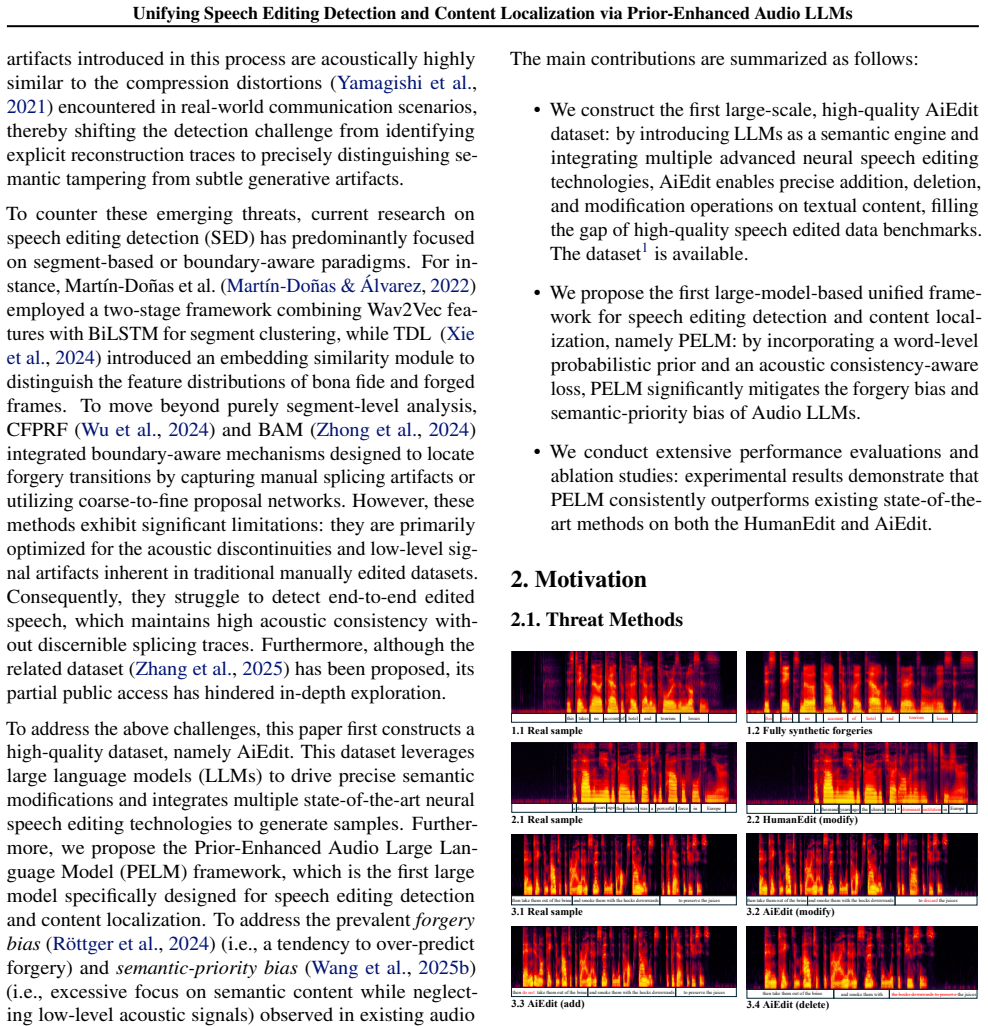
- [Figure 1] The spectrogram captions contain garbled concatenated text (e.g., 'thendo not take them out of the brine' repeated). This makes the intended real/edited comparison hard to follow.
- [§4.3 / Appendix B] The hyperparameters margin=0.9 and topk=0.1 are used in Eq. (4) but are not defined until Appendix B; define them at first use.
Circularity Check
No circularity: the BAM-as-prior comparison is confounded, but the derivation does not reduce to its inputs by construction.
full rationale
The paper's derivation chain is y = M(A, Q, Qp) (Eq. 1), trained with the cross-entropy loss Lce (Eq. 2) and the acoustic consistency loss Laudio (Eq. 4). The word-level prior Qp is produced by an external frame-level detector, the open-source BAM model (Zhong et al., 2024), with word boundaries from MFA (§5.1); it is an input feature, not a fitted parameter renamed as a prediction. The paper does not define the prior in terms of the target output, nor does any equation make the output equivalent to the prior. The comparison with BAM is indeed problematic: PELM consumes BAM's own frame-level probabilities as a privileged prompt while BAM is evaluated without access to its own output, and Table 4 shows the prior is the dominant component (AiEdit localization EER drops from 35.87% to 9.41% when the prior is added). This is a benchmarking fairness / information-leakage concern, not circularity by construction: the LLM is trained on labeled data and its textual output is not equal to the prior. There is no load-bearing self-citation chain, no imported uniqueness theorem, and no ansatz smuggled in via citation. Under the requested circularity rubric, the honest finding is therefore no significant circularity (score 0), while the confounded baseline comparison should be reported as a correctness risk.
Axiom & Free-Parameter Ledger
free parameters (4)
- acoustic consistency loss weight λ =
0.5
- margin =
0.9
- topk =
0.1
- LoRA rank and alpha =
r=32, α=64
axioms (4)
- domain assumption Frame-level tampering probabilities from BAM, aggregated by word boundaries, are reliable acoustic cues.
- domain assumption The transcript supplied in the prompt does not trivially reveal the edit type.
- ad hoc to paper Bona fide frames cluster tightly around a centroid while edited speech has separable top-K anomalous frames.
- domain assumption Word-level labels derived by difflib from LLM-generated source-target text pairs are correct.
read the original abstract
Existing speech editing detection (SED) datasets are predominantly constructed using manual splicing or limited editing operations, resulting in restricted diversity and poor coverage of realistic editing scenarios. Meanwhile, current SED methods rely heavily on frame-level supervision to detect observable acoustic anomalies, which fundamentally limits their ability to handle deletion-type edits, where the manipulated content is entirely absent from the signal. To address these challenges, we present a unified framework that bridges speech editing detection and content localization through a generative formulation based on Audio Large Language Models (Audio LLMs). We first introduce AiEdit, https://huggingface.co/datasets/JunXueTech/AiEdit, a large-scale bilingual dataset (approximately 140 hours) that covers addition, deletion, and modification operations using state-of-the-art end-to-end speech editing systems, providing a more realistic benchmark for modern threats. Building upon this, we reformulate SED as a structured text generation task, enabling joint reasoning over edit type identification, and content localization. To enhance the grounding of generative models in acoustic evidence, we propose a prior-enhanced prompting strategy that injects word-level probabilistic cues derived from a frame-level detector. Furthermore, we introduce an acoustic consistency-aware loss that explicitly enforces the separation between normal and anomalous acoustic representations in the latent space. Experimental results demonstrate that the proposed approach consistently outperforms existing methods across both detection and localization tasks.
Figures


Forward citations
Cited by 1 Pith paper
-
AT-ADD: All-Type Audio Deepfake Detection Challenge Evaluation Plan
AT-ADD introduces standardized tracks and datasets for evaluating audio deepfake detectors on speech under real-world conditions and on diverse unknown audio types to promote generalization beyond speech-centric methods.
Reference graph
Works this paper leans on
-
[1]
Must originate from the original context
-
[2]
Delete Removes a segment of text from the original sentence
Onlyonecontinuous insertion point is allowed per sample. Delete Removes a segment of text from the original sentence
-
[3]
Removal of words at thestart or endof the sentence is strictly prohibited to preserve context integrity
-
[4]
Modify Replaces a segment of the original text with new content
Onlyonecontinuous deletion region is allowed. Modify Replaces a segment of the original text with new content
-
[5]
The replacement must maintain a similar length to the original segment
-
[6]
Onlyonemodification region is allowed (i.e., one replacement). Finally, to ensure reproducibility, the detailed hyperparameters and environmental settings used for the parallel text editing tool are listed in Table 6. Table 6.Hyperparameters and settings for the Qwen-based parallel text editing tool. Parameter Value Description Model Name Qwen3-max The ba...
arXiv 1993
-
[7]
No evidence of speech editing was detected
If the speech is completely authentic, output: "No evidence of speech editing was detected."
-
[8]
If any editing (added/modified/deleted) is detected, output:
-
[9]
Yes, '<exact_text>' was [Type] in speech. The [Type] MUST be one of the following: added, modified
If the editing is added or modified, output: "Yes, '<exact_text>' was [Type] in speech. The [Type] MUST be one of the following: added, modified."
-
[10]
Yes, some words were deleted in speech
If the editing is deleted, output: "Yes, some words were deleted in speech."
-
[11]
Treat every speech fairly
-
[12]
Output ONLY the result string
Do not output any other text or explanation. Output ONLY the result string. Output Examples: No evidence of speech editing was detected. Yes, ' 不 ' was added in speech. Yes, 'dull' was modified in speech. Yes, some words were deleted in speech. User Prompt <audio>The uploaded speech is a speech recording. Please analyze whether the speech has been edited....
discussion (0)
Sign in with ORCID, Apple, or X to comment. Anyone can read and Pith papers without signing in.