REVIEW 3 major objections 5 minor 2 cited by
Collective dynamics in heavy and light-ion collisions -- II) Determining the origin of collective behavior in high-energy collisions
T0 review · 3 major / 5 minor · reviewed 2026-08-12 · deepseek-v4-flash
Pith's one-line read A single flow ratio W, calibrated from 0 (ideal fluid) to 1 (free streaming), measures how hydrodynamic a collision is, and kinetic-theory simulations confirm it.
desk verdict A genuinely new two-energy ratio observable for hydrodynamization, but the geometry-cancellation premise needs an experimental check before the calibration can be trusted. read the letter →
The pith
A machine-rendered reading of the paper's core claim, the machinery that carries it, and where it could break.
The reading
What carries the argument
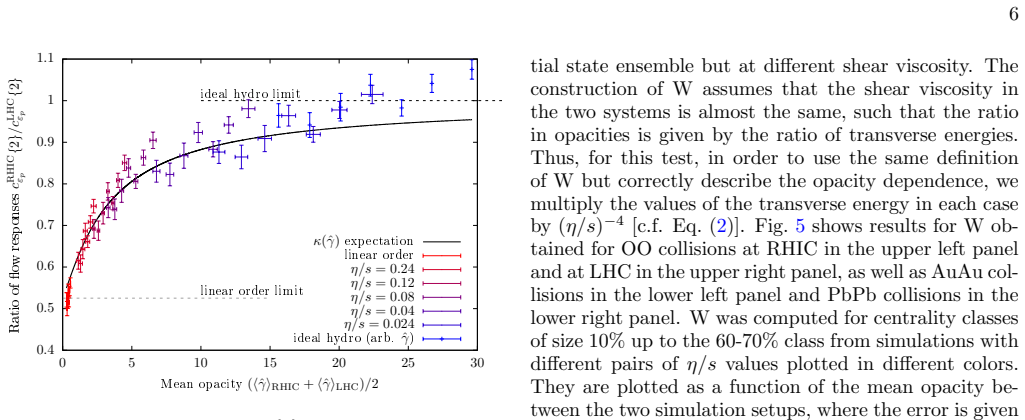
The load-bearing object is the universal flow response curve $\kappa(\hat{\gamma})$, the ratio of final elliptic flow to initial ellipticity as a function of the opacity $\hat{\gamma} = \frac{1}{5\eta/s}\left(\frac{R}{\pi}\frac{dE_0^\perp}{d\eta}\right)^{1/4}$. This curve is linear at small opacity, saturates to a constant at large opacity, and is extracted from kinetic-theory data with a Pad\'e fit. The proposed observable is $W = \frac{2}{k}\frac{\log\left(c_{\varepsilon_p}\{2k\}|_A / c_{\varepsilon_p}\{2k\}|_B\right)}{\log\left(\langle dE_\perp/d\eta\rangle_A / \langle dE_\perp/d\eta\rangle_B\right)}$, which approximates $d\log\kappa/d\log\hat{\gamma}$ evaluated between the two energy ensembles $A$ and $B$. Two cancellations carry the argument: cumulant ratios such as $c_{\varepsilon_p}\{4\}/c_{\varepsilon_p}\{2\}^2$ eliminate the response and expose geometry, while ratios between RHIC and LHC ensembles of the same nucleus eliminate geometry and expose the response. The transverse-energy ratio in the denominator stands in for the opacity ratio under the assumption that the two ensembles have the same specific shear viscosity and radius.
What would settle it
Measure $W$ in oxygen\u2013oxygen collisions at RHIC (200 GeV) and LHC (7 TeV) using the proposed cumulant and transverse-energy ratios; if the extracted values do not follow the predicted calibration curve $d\log\kappa/d\log\hat{\gamma}$ as a function of the mean opacity, or fall outside the $[0,1]$ interval, the universal-response interpretation fails.
Extended reading notes
Core claim
Starting from the observation that the elliptic flow response coefficient $\kappa = \varepsilon_p/\epsilon_2$ collapses onto a single universal curve when plotted against a dimensionless opacity $\hat{\gamma}$, the paper derives a cumulant ratio whose logarithm is the logarithmic slope of that curve. In event-by-event simulations in conformal relaxation-time kinetic theory, this ratio is shown to follow the predicted calibration curve for oxygen\u2013oxygen collisions at RHIC and LHC energies, across a range of shear viscosities and centrality classes. The quantity $W$ therefore provides a calibrated, experimentally accessible measure of the degree of hydrodynamization: $W=0$ in the ideal hydrodynamic limit, $W=1$ in the noninteracting limit, and monotonic values in between, with the paper suggesting $W \lesssim 0.5$ as the hydrodynamic threshold. The same procedure applied to published lead\u2013lead data at 2.76 and 5.02 TeV gives values compatible with the calibration curve, placing lead\u2013lead collisions in the hydrodynamic regime.
Load-bearing premise
The construction assumes that the initial-state geometry of oxygen\u2013oxygen collisions is essentially the same at RHIC and LHC, so the ratio of flow cumulants cancels the eccentricities and leaves only the response ratio; the paper verifies this within its initial-state model for OO, but shows the same cancellation fails for PbPb versus AuAu at roughly the ten-percent level.
Editorial extensions
If this is right
- In oxygen\u2013oxygen collisions at RHIC and LHC, a measured $W$ yields the mean opacity $\langle\hat{\gamma}\rangle$ of each centrality class, effectively a measurement of the local interaction rate that controls hydrodynamization.
- Cumulant ratios such as $c_{\varepsilon_p}\{4\}/c_{\varepsilon_p}\{2\}^2$ become clean probes of initial-state geometry and nuclear structure, independent of how the flowing matter responds.
- The calibration curve maps $W$ to a hydrodynamization threshold: the paper\u2019s kinetic-theory results suggest that systems with $W \lesssim 0.5$ (opacity $\hat{\gamma} \gtrsim 3$) can be treated as hydrodynamic.
- Existing lead\u2013lead data already produce $W$ values compatible with the calibration curve, indicating that large systems at LHC sit in the hydrodynamic regime; the same test in OO collisions will settle the small-system question.
- Nonconformal effects from a realistic equation of state do not destroy the ordering of systems by interaction rate, so $W$ remains interpretable once an adjusted calibration curve is used.
Reading between the lines
- The same two-energy ratio logic should apply to higher harmonics ($v_3$, $v_4$) and to identified-particle flow, which would test whether the universal response curve is truly harmonic-independent and extend the calibration beyond elliptic flow.
- A practical consequence the paper leaves implicit is that the limiting experimental systematic for $W$ will be the precision of $dE_\perp/d\eta$ at both energies, since the denominator enters through a logarithm; future runs should prioritize transverse-energy measurements in OO collisions.
- If the LHC OO run yields $W \lesssim 0.5$ in mid-central classes, the small-system collectivity debate would shift decisively toward hydrodynamic explanations, and escape-based models would have to reproduce the same $W$ to remain viable.
- The failure of the geometry cancellation for PbPb versus AuAu suggests a built-in cross-check: if the cumulant ratio $c\{4\}/c\{2\}^2$ in OO collisions at RHIC and LHC differs beyond a few percent, the model-independent version of $W$ should be mistrusted.
Editorial analysis
A structured set of objections, weighed in public.
Referee Report
Summary. The paper proposes an observable W, built from ratios of elliptic-flow cumulants and transverse-energy yields in collisions of the same ion species at two center-of-mass energies. The authors argue that W approximates the logarithmic derivative d log kappa / d log gamma_hat of the flow response curve, with limits W=1 in the free-streaming limit and W=0 in the ideal-hydrodynamic limit, and they calibrate W using Padé fits to conformal RTA kinetic-theory simulations. The construction is validated in event-by-event simulations for OO, PbPb, and AuAu collisions, tested against a nonconformal hydrodynamic setup, and applied to existing PbPb data at 2.76 and 5.02 TeV as a first exploratory extraction.
Significance. If W can be measured reliably for OO collisions at RHIC and LHC, it would provide a genuinely new experimental discriminator between hydrodynamic and few-rescattering explanations of small-system collectivity. The paper is strong in that it derives the observable from a clear physical decomposition of geometry and response, validates the response-factorization assumption on event-by-event kinetic-theory simulations across a wide opacity range, and makes the plot data publicly available. It also honestly identifies the main failure mode of the construction in the PbPb/AuAu comparison. The main significance is therefore conditional: the proposal is attractive and well-motivated, but its utility hinges on the same-nucleus geometry-cancellation premise, which is currently checked only within a single initial-state model.
major comments (3)
- [Sec. II D–E, Eq. (19), Fig. 7] The central premise that initial-state geometry cancels between the RHIC and LHC ensembles is validated only within the trento model for OO. The paper itself shows in Fig. 7 that the analogous cancellation fails for PbPb vs AuAu at the ~10% level, which spoils W for those systems. Since W is linear in the geometry mismatch through the additive term (2/k) Delta log c_epsilon{2k}/Delta log(E_perp), a few-percent eccentricity-cumulant mismatch can shift W by roughly 0.1, a significant fraction of the intended 0-to-1 range. The authors mention in Sec. II E that IP-Glasma-based analyses could introduce larger geometry differences, but they do not provide an independent, model-insensitive test of the same-nucleus equality. I would ask the authors to make the test explicit: before W is used, the experimental OO cumulant ratio c{4}/c{2}^2 should be compared between RHIC and LHC, since Eq. (14) shows this ratio is geometry-dominated and insensitive to the response mechanism.
- [Sec. II E, Eqs. (8)–(9), (A6), Figs. 5–6] The calibration curves d log kappa/d log gamma_hat and f_work(gamma_hat) are Padé fits to the same simulation ensembles from which W is then computed. The agreement in Figs. 5 and 6 is therefore to a significant extent a self-consistency check rather than an independent validation. The comparison with the kappa curve from the previous study in Fig. 1 is only a partial external check, because that curve is scaled by an arbitrary factor 0.93. Consequently, the opacity estimates in Table II do not include systematic uncertainties from the choice of fit ansatz or from the particular centrality samples used for calibration. I request an out-of-sample validation, for example fitting the Padé forms to half of the centrality classes and testing on the other half, or quoting a systematic band that accounts for the fit-ansatz freedom.
- [Sec. III, Figs. 9–11] The nonconformal test shows that a constant rescaling of the conformal response curve fails at RHIC energies: in Fig. 10 the ratio kappa_LHC/kappa_RHIC acquires an additional centrality dependence already in ideal hydrodynamics, and the nonconformal results deviate from the scaled conformal curve in central and peripheral classes. The authors rescue interpretability by restricting to mid-central collisions or by rescaling with the ideal-hydrodynamic ratio, and the resulting calibration band in Fig. 11 is quite broad. Since the paper's central proposal includes OO collisions at RHIC, this means the current calibration is not yet quantitative for the RHIC end of the program. The abstract and conclusion should either state this limitation explicitly or be accompanied by a more systematic nonconformal calibration, for instance with different equations of state and switching-time scans that go beyond the single vHLLE implementation.
minor comments (5)
- [Eq. (19)] The meaning of k and the factor 2/k in the definition of W should be spelled out: a reader can easily confuse c{2k} with the 2k-th moment rather than the 2k-th order cumulant, and the k-dependence of the geometry-mismatch term is otherwise obscure.
- [Fig. 10 caption] There is a typo in the caption: 'unadultered' should be 'unadulterated'.
- [Sec. II F] The conversion from particle-number-weighted v2 to energy-weighted flow via Ref. [20] is central to the PbPb extraction, but the paper only states the rescaling factors (1.33 and 1.34) without giving the formula. Please quote or reference the relevant equation of that work.
- [Eq. (24)] The approximate inverse calibration gamma_hat = 2.5 (1-W)^0.78 / W is presented without derivation, validity range, or uncertainty estimate. It should be stated where this approximation deviates from the exact numerical inversion of the calibration curve.
- [Table II] The columns labelled 'actual gamma_hat' and 'mean gamma_hat estimates' are confusing: it should be clarified that the estimates come from plugging the simulation W values at 4 pi eta/s = 1.5 into the inverse calibration, and whether the quoted asymmetric errors include only propagated statistical errors or also calibration-systematic effects.
Circularity Check
Calibration for W is a fit to the same simulations from which W is computed, making the opacity 'estimates' a closed-loop consistency check rather than a prediction.
-
fitted input called prediction
[Sec. II B/E, Table II; App. A Eqs. (A5)-(A6); Sec. II B Eqs. (8)-(9)]
"Comparison of mean opacity values computed from initial profiles of several centrality classes of OO collisions at RHIC and LHC with the estimates obtained by plugging results for the observable W from simulations at a shear viscosity of 4πη/s = 1.5 into the calibration curve given in Eq. (A5)."
The calibration curve in Eq. (A5) is built from Pade fits to κ(γ̂) (Eq. 9, with parameters 'obtained by a fit to the data') and f_work(γ̂) (Eq. A6), fitted to the same event-by-event kinetic-theory ensembles from which the W values in Table II are computed. Under Eqs. (13), (15), and (18), W is (to within the stated approximations) a finite-difference realization of d log κ/d log γ̂ evaluated between the very RHIC/LHC data points that went into the fit. Inverting that fitted curve to 'estimate' γ̂ from W is therefore a closed loop: the curve is constructed from the same κ(γ̂) and transverse-energy data that W summarizes. Agreement in Table II and in Figs.
-
self citation load bearing
[Sec. II E (discussion after Fig. 6) and Sec. IV conclusion]
"The black dashed line shows the limit of applicability of hydrodynamics at γ̂ = 3 as established in our previous work [5, 6], which corresponds to W = 0.5."
The paper's interpretive conclusion that 'a system can be considered hydrodynamic if W ≲ 0.5' (Sec. IV) is anchored to the self-cited threshold γ̂ = 3 from Refs. [5,6] by the same authors. No independent derivation or external criterion for 'hydrodynamization' is provided here; the new calibration curve only translates that self-cited threshold into a W value. This is a secondary, load-bearing self-citation for the absolute hydrodynamization claim, though the construction of W itself does not depend on this threshold.
full rationale
The construction of W is not self-definitional: W is an experimental ratio of flow cumulants and transverse energies, and its limiting values W = 0 (ideal hydro) and W = 1 (noninteracting) follow from the general linear/saturation behavior of the flow response κ(γ̂). The circularity is in the validation and calibration loop. The Pade curves for κ(γ̂) (Eq. 9) and f_work(γ̂) (Eq. A6) are fitted to the same kinetic-theory ensembles whose cumulants and energies are then inserted into W; through Eqs. (15) and (18), W becomes a finite-difference version of d log κ/d log γ̂ on those same points. Hence Figs. 5-6 and Table II confirm internal consistency (factorization of the mean response, the energy-ratio approximation, and fit quality) rather than an independent ability of W to measure the absolute opacity or the degree of hydrodynamization. An external check exists: the PbPb experimental extraction in Sec. II F is compatible with the calibration curve, but its horizontal opacity axis is supplied by the same trento + η/s = 0.12 setup, so it only partially breaks the loop. The same-nucleus geometry premise behind Eq. (15) is verified within trento for OO and shown in the paper to fail at the ~10% level for PbPb vs AuAu (Sec. II E, Fig. 7); the authors flag this as a limitation, and it is a correctness risk rather than a circular step. Overall, the proposed observable is plausible and has independent potential, but the paper's central 'calibrated measure' claim is currently validated against the very fit used to define the calibration, warranting partial circularity.
Assumptions & free parameters
free parameters (5)
- Pade fit parameters for elliptic response curve kappa(gamma_hat) =
a = 0.217(31), b = 0.845(73)
- Pade fit parameters for work function f_work(gamma_hat) =
a = 0.341(7), b = 0.0111(13), c = 0.00477(90)
- Shear viscosity for experimental opacity estimate =
4 pi eta/s = 1.5 (eta/s = 0.12)
- Nonconformal rescaling factor =
0.8
- Hydrodynamic response fit parameters =
kappa_0,hyd = -0.0896(4), kappa_LO,hyd = 0.271(3); f_0,hyd = 0.840(2), a_hyd = 0.280(7), c_hyd = 0.221(8)
assumptions (7)
- domain assumption The opacity measure gamma_hat in Eq. (2) captures the relevant interaction strength of the system.
- domain assumption A universal opacity-dependent response curve kappa(gamma_hat) exists across collision systems.
- domain assumption Conformal RTA Boltzmann kinetics is an adequate effective description spanning free streaming to ideal hydrodynamics.
- ad hoc to paper Event-by-event fluctuations of the flow response delta_kappa are negligible, so <|epsilon_p|^n> approximately equals <kappa>^n <|epsilon_2|^n>.
- domain assumption Initial geometries of same-ion collisions at RHIC and LHC are nearly identical.
- ad hoc to paper Final transverse energy ratio approximates initial transverse energy ratio, up to work-function corrections.
- ad hoc to paper The chosen Pade ansatze (Eqs. 8, 9, A6, B1, B2) correctly interpolate between free-streaming and ideal-hydro limits.
Cite this review
Pith. "Pith review of Collective dynamics in heavy and light-ion collisions -- II) Determining the origin of collective behavior in high-energy collisions." pith.science (2026). https://pith.science/paper/6QFLR7NG
@misc{pith2026241119709,
  author       = {Pith},
  title        = {Pith review of: Collective dynamics in heavy and light-ion collisions -- II) Determining the origin of collective behavior in high-energy collisions},
  year         = {2026},
  howpublished = {\url{https://pith.science/paper/6QFLR7NG}},
  note         = {Machine review of arXiv:2411.19709}
}
read the original abstract
Exploiting the first measurements of the same ion species in OO collisons at RHIC and LHC, we propose an observable to distinguish whether collective behavior builds up through a hydrodynamic expansion of a strongly interacting QGP or few final state re-scatterings. Our procedure allows to disentangle the effects of the initial state geometry and the dynamical response mechanism on anisotropic flow. We validate its ability to discriminate between systems with different interaction rates using results from event-by-event simulations in kinetic theory.
Figures


Figures from the paper (10 more)


Forward citations
Cited by 2 Pith papers
-
Measurement of the azimuthal anisotropy of charged particles in $\sqrt{s_{\mathrm{NN}}}=5.36$ TeV $^{16}$O$+^{16}$O and $^{20}$Ne$+^{20}$Ne collisions with the ATLAS detector
First measurements of v_n (n=2-4) in 5.36 TeV O+O and Ne+Ne collisions show enhanced v2 in central neon collisions consistent with prolate nuclear deformation.
-
Collective dynamics in heavy and light-ion collisions -- I) Kinetic Theory vs. Hydrodynamics
Event-by-event simulations show elliptic flow in heavy and light ion collisions follows a universal opacity-dependent response curve; hydrodynamics is accurate only above opacity around 3, and oxygen collisions expose...
Reference graph
Works this paper leans on
-
[1]
B. B. Abelev et al. (ALICE), Phys. Rev. C 90, 054901 (2014), arXiv:1406.2474 [nucl-ex]
arXiv 2014
-
[2]
M. Aaboud et al. (ATLAS), Eur. Phys. J. C 77, 428 (2017), arXiv:1705.04176 [hep-ex]
arXiv 2017
-
[3]
A. M. Sirunyan et al. (CMS), Phys. Rev. Lett. 120, 092301 (2018), arXiv:1709.09189 [nucl-ex]
arXiv 2018
-
[4]
J. F. Grosse-Oetringhaus and U. A. Wiedemann, (2024), arXiv:2407.07484 [hep-ex]
arXiv 2024
-
[5]
V. E. Ambrus, S. Schlichting, and C. Werthmann, Phys. Rev. D 107, 094013 (2023), arXiv:2211.14379 [hep-ph]
arXiv 2023
-
[6]
V. E. Ambrus, S. Schlichting, and C. Werthmann, Phys. Rev. Lett. 130, 152301 (2023), arXiv:2211.14356 [hep- ph]
arXiv 2023
-
[7]
V. E. Ambrus, S. Schlichting, and C. Werthmann, (2024), arXiv:2411.19708 [hep-ph]
arXiv 2024
-
[8]
C. Werthmann, V. E. Ambrus, and S. Schlichting, “Plot data for ”collective dynamics in heavy and light-ion col- lisions – ii) determining the origin of collective behavior in high-energy collisions”,” (2025)
work page 2025
Show all 25 references
-
[9]
S. H. Lim, J. Carlson, C. Loizides, D. Lonardoni, J. E. Lynn, J. L. Nagle, J. D. Orjuela Koop, and J. Ouellette, Phys. Rev. C 99, 044904 (2019), arXiv:1812.08096 [nucl- th]
2019 arXiv
-
[10]
TGlauberMC on HepForge
“TGlauberMC on HepForge.” https://tglaubermc. hepforge.org, v3.2
-
[11]
Rybczy´ nski and W
M. Rybczy´ nski and W. Broniowski, Phys. Rev. C 100, 064912 (2019), arXiv:1910.09489 [hep-ph]
2019 arXiv
-
[12]
Nijs and W
G. Nijs and W. van der Schee, Phys. Rev. C 106, 044903 (2022), arXiv:2110.13153 [nucl-th]
2022 arXiv
-
[13]
V. E. Ambrus,, S. Schlichting, and C. Werthmann, Phys. Rev. D 105, 014031 (2022), arXiv:2109.03290 [hep-ph]
2022 arXiv
-
[14]
R. S. Bhalerao, M. Luzum, and J.-Y. Ollitrault, Phys. Rev. C 84, 034910 (2011), arXiv:1104.4740 [nucl-th]
2011 arXiv
-
[15]
Giacalone, L
G. Giacalone, L. Yan, J. Noronha-Hostler, and J.-Y. Ollitrault, Phys. Rev. C 95, 014913 (2017), arXiv:1608.01823 [nucl-th]
2017 arXiv
- [16]
-
[17]
Acharya et al
S. Acharya et al. (ALICE), Phys. Lett. B 845, 137730 (2023), arXiv:2204.10210 [nucl-ex]
2023 arXiv
-
[18]
Singh, G
P. Singh, G. Giacalone, B. Schenke, and S. Schlicht- ing, EPJ Web Conf.296, 10005 (2024), arXiv:2312.07462 [hep-ph]
2024 arXiv
- [19]
-
[20]
Kurkela, U
A. Kurkela, U. A. Wiedemann, and B. Wu, Eur. Phys. J. C 79, 965 (2019), arXiv:1905.05139 [hep-ph]
2019 arXiv
-
[21]
Karpenko, P
I. Karpenko, P. Huovinen, and M. Bleicher, Comput. Phys. Commun. 185, 3016 (2014), arXiv:1312.4160 [nucl- th]
2014 arXiv
-
[22]
Steinheimer, S
J. Steinheimer, S. Schramm, and H. Stocker, J. Phys. G 38, 035001 (2011), arXiv:1009.5239 [hep-ph]
2011 arXiv
-
[23]
Zhang, J
C. Zhang, J. Chen, G. Giacalone, S. Huang, J. Jia, and Y.-G. Ma, (2024), arXiv:2404.08385 [nucl-th]
2024 arXiv
-
[24]
Giacalone et al., (2024), arXiv:2402.05995 [nucl-th]
G. Giacalone et al., (2024), arXiv:2402.05995 [nucl-th]
2024 arXiv
-
[25]
Giacalone et al., (2024), arXiv:2405.20210 [nucl-th]
G. Giacalone et al., (2024), arXiv:2405.20210 [nucl-th]
2024 arXiv
Reviewed August 12, 2026 · model on record in the stance chip above.
Discussion (0). Continue with ORCID to comment.