REVIEW 5 major objections 4 minor 34 references
On the gravitational entropy of accelerating black holes
T0 review · 5 major / 4 minor · reviewed 2026-08-14 · deepseek-v4-flash
Pith's one-line read This paper tests a Weyl-curvature measure of gravitational entropy on accelerating black holes and finds it works except for the rotating charged case, which requires a modified entropy scalar or vector.
desk verdict The static and charged accelerating black hole entropy calculations are solid, but the rotating case swaps in a different, unjustified measure that does not reduce to the paper's own Schwarzschild limit, undercutting the central claim. read the letter →
The pith
A machine-rendered reading of the paper's core claim, the machinery that carries it, and where it could break.
The reading
What carries the argument
The object carrying the argument is the entropy vector field $\Psi = P\,\mathbf{e}_r$, whose flux through the horizon is the gravitational entropy and whose divergence is the entropy density $s = k_s|\nabla\cdot\Psi|$. The scalar $P$ begins as the ratio $P^2 = W/K$ (Weyl scalar over Kretschmann scalar) and is later redefined as $P = C_{abcd}C^{abcd}$ for the rotating charged case. For non-rotating metrics the density is computed with the induced three-metric $h_{ij}$; for rotating metrics, where $g_{t\varphi}\neq 0$ blocks that route, the paper uses the four-dimensional determinant through $s = k_s/\sqrt{-g}\,\partial_r(\sqrt{-g}P)$, and in one variant adds a $\partial_\theta$ term. This vector-field-and-determinant machinery produces the entropy values, the horizon area proportionality, and the singularity structure on which the conclusions rest.
What would settle it
Evaluate the original surface-integral entropy $S_\sigma = k_s\int_\sigma \Psi\cdot d\boldsymbol{\sigma}$ on a horizon-adapted spatial slice of the rotating charged C-metric using the three-metric prescription of the paper; if the resulting entropy density is finite and free of the extra singularities, the paper's claim that the original prescription fails for this case is refuted.
Extended reading notes
Core claim
The paper claims that the phenomenological gravitational entropy prescription—entropy as the flux of a vector field $\Psi = P\,\mathbf{e}_r$ with $P^2 = W/K$, where $W$ is the Weyl scalar and $K$ the Kretschmann scalar—works pretty well for accelerating non-rotating and charged non-rotating black holes, and also for the vacuum accelerating rotating black hole once the density is evaluated from the four-dimensional metric determinant. For the accelerating rotating charged C-metric, however, the prescription produces an entropy density with extra singularities and is judged inadequate. The paper then shows that a well-behaved entropy density for this case is obtained either by replacing $P$ with $P = C_{abcd}C^{abcd}$, which removes all singularities except the ring singularity, or by giving $\Psi$ additional angular components, which removes them but introduces new singularities at $\theta=0$ and $\theta=\pi$.
Load-bearing premise
The rotating-case analysis depends on the assumption that replacing the original three-dimensional entropy surface formula with a four-dimensional derivative formula, and in the charged rotating case redefining the key scalar as the Weyl contraction, is physically legitimate; the paper adopts these replacements without deriving them, so if they are unjustified the rotating-case conclusions do not follow.
Editorial extensions
If this is right
- For accelerating non-rotating and charged black holes, the horizon entropy stays proportional to the horizon area (up to the conical-deficiency factor), so the Bekenstein-Hawking area law survives in accelerated settings.
- The vacuum accelerating rotating black hole yields a well-behaved entropy density from the four-dimensional determinant, and it reduces to the known Kerr entropy density as $\alpha\to 0$.
- The original $P^2=W/K$ construction is inadequate for rotating charged accelerating black holes; this case forces a modified definition of the entropy scalar or vector.
- With $P = C_{abcd}C^{abcd}$, the rotating charged C-metric has a finite entropy density except at the ring singularity, so a workable entropy measure exists for that case.
- Adding angular components to $\Psi$ also regularizes the density but introduces new singularities at $\theta=0$ and $\theta=\pi$, which limits that alternative.
Reading between the lines
- The paper does not say whether the singularity in the original prescription is physical or an artifact of the coordinate choice; a covariant, hypersurface-independent entropy functional would be needed to decide that.
- One natural extension would be to apply the redefined $P = C_{abcd}C^{abcd}$ to other axisymmetric spacetimes, such as Kerr-Newman with a cosmological constant, to test whether rotation-plus-charge is the generic trigger of the failure.
- Because the modified density no longer has zeros tied to the horizons, the repair may buy regularity at the cost of the entropy-density/horizon connection; checking monotonic growth in a dynamical evolution would test whether it behaves like a true entropy.
- Extending beyond the paper, the recovered $\alpha\to 0$ limits suggest the framework is consistent with known non-accelerating cases, but since only stationary configurations are tested, time-dependent accelerating mergers remain an open direction.
Signed reviews
Editorial analysis
A structured set of objections, weighed in public.
Referee Report
Summary. The manuscript tests the phenomenological gravitational entropy prescription of Rudjord, Grøn and Sigbjørn and Romero et al. on accelerating black holes described by the C-metric. Four families are considered: non-rotating, non-rotating charged, rotating, and rotating charged. For each family the authors compute the Weyl and Kretschmann scalars, the scalar P, the total gravitational entropy on the horizons, and the entropy density, checking limits to Schwarzschild, Reissner-Nordström and Kerr. For the rotating charged case they report that the original prescription produces a singular entropy density, and they propose two modifications: redefining P as the Weyl scalar C_abcd C^abcd, or adding angular components to the vector field Ψ. The central claim is that the original prescription works for the first three families but fails for the rotating charged case, and that the modified definitions provide a well-behaved entropy density.
Significance. If correct, the paper would extend a phenomenological Weyl-curvature entropy to accelerating black holes and identify a limitation for rotating charged spacetimes. Its strengths are the explicit evaluation of curvature scalars and the recovery of the Schwarzschild, Reissner-Nordström and Kerr limits with no fitted parameters. However, the rotating and rotating-charged results are computed with an entropy-density formula that is not the divergence of the original 3-space definition, and the failure of the original measure in the rotating charged case is asserted without writing the offending expression. The significance of the main claim is therefore currently limited by a load-bearing derivation gap.
major comments (5)
- [§IV.C, Eq. (35); §IV.D, Eq. (40)] The entropy density for the rotating and rotating-charged accelerating black holes is defined as s = k_s/√(-g) ∂_r(√(-g)P), using the full four-dimensional determinant g, whereas the original prescription of Eqs. (2)–(7) defines s = k_s |∇·Ψ| with the divergence computed in the spatial metric h_ij of Eq. (5). No derivation or limiting argument connects these two expressions. The statement in §V that the spatial metric cannot be calculated because g_tφ ≠ 0 is incorrect: Eq. (5) defines h_ij for any stationary metric with g_00 ≠ 0, including axisymmetric metrics, so the original 3-space entropy density could in principle be computed. Consequently, the rotating-case plots and conclusions are statements about a different measure and do not establish the behavior of the original prescription.
- [§IV.D, after Eq. (40)] The central claim that the original measure fails for the rotating charged C-metric is not checkable, because the exact expression for the entropy density obtained from Eq. (40) is never written out; the paper says only that the result is lengthy and then presents plots in FIG. 9. Without the explicit expression or a reproducible symbolic form, the reader cannot verify the location of the claimed singularities or the claim that they are not coordinate artifacts. This omission is load-bearing for the subsequent decision to modify the definition.
- [§IV.D, Eq. (41)] The modified definition P = C_abcd C^abcd is introduced post hoc after the original measure appears to fail. This P has dimensions of inverse length to the fourth power, unlike the dimensionless P defined by P^2 = W/K in Eq. (4). With this redefinition the integral S_σ = k_s ∫ Ψ·dσ no longer has the dimension of an entropy, and no horizon-area or Bekenstein-Hawking limit is computed for Eq. (42). The proposed resolution is therefore not shown to be compatible with the original entropy proposal.
- [§V, Eq. (43)] The further modification s = k_s/√(-g) |∂_r(√(-g)P) + ∂_θ(√(-g)P)| is not the covariant divergence of a vector field in either the 3-space metric h_ij or the 4-space metric g_μν. Even if Ψ were given angular components, the 3-space divergence would be (1/√h)∂_i(√h Ψ^i). As written, Eq. (43) is an ad hoc prescription, and the conclusions drawn from Eqs. (44)–(45) about the original proposal do not follow.
- [§IV.C, Eqs. (33)–(34)] For the uncharged rotating C-metric the ratio P^2 = W/K equals 1 by Eq. (32), so the area-proportional total entropy in Eq. (34) is a direct consequence of the choice P = 1 and the integration domain, not of an independent computation of the entropy density. The claim that the prescription works well for rotating black holes therefore rests entirely on the unjustified density formula in Eq. (35).
minor comments (4)
- [Eq. (21)] The displayed entropy-density formula is ambiguous because the placement of the factor involving √h_rr is unclear; it should be written as s = k_s/√h |∂_r(√h P/√h_rr)|, consistent with Eq. (7).
- [Eqs. (44)–(45)] Equations (44) and (45) are extremely long and effectively unreadable in the main text; they should be simplified, moved to an appendix or supplementary material, or replaced by their key properties.
- [References and text] Reference [20] contains corrupted author names (“ß. Rudjord, ß. Grèn”), and “Krestchmann” in Eq. (4) should be “Kretschmann”.
- [Eqs. (21), (35), (42)] The text does not consistently indicate whether the plotted entropy density is the absolute value defined in Eq. (7); several displayed formulae such as Eq. (21) and Eq. (35) are written without absolute-value signs.
Circularity Check
Mild tautological area-law check for Ricci-flat cases; explicit entropy densities remain non-circular, though the rotating-case formula is an external ansatz rather than a derivation.
-
self definitional
[Sec. IV.A, Eqs. (16)-(20); see also Sec. IV.C, Eq. (33)]
"For this C-metric, we get P² = 1. Therefore we assume that P = +1 ... From equation (20) it is evident that the gravitational entropy is proportional to the area of the event horizon of the black hole, as in the case of the Bekenstein-Hawking entropy [22, 23]."
For the vacuum C-metric, Ricci-flatness gives K = W, so the definition P² = W/K forces P = 1. The entropy definition S = k_s ∫_σ Ψ·dσ with Ψ = P e_r then reduces to S = k_s ∫_σ dσ = k_s times the horizon area. Thus the area-law 'success' for the non-rotating and rotating uncharged accelerating black holes is an identity of the prescription applied to any Ricci-flat spacetime, not an independent confirmation. The explicit entropy-density expressions (Eqs. 21 and 35) do contain additional metric-dependent content, so this tautology does not by itself determine the paper's central rotating-case claims.
full rationale
The paper applies an existing phenomenological definition; no parameter is fitted and no self-citation chain forces the conclusions. The only constructional circularity is the P=1 area-law check in the Ricci-flat cases: because W=K in vacuum, the prescription's surface integral becomes the horizon area identically, so citing the resulting area proportionality as evidence that the definition 'works' is not an independent test. The entropy-density computations, which carry the paper's main new content, are not forced by that identity. The rotating-case replacement of the 3-space divergence by a 4D radial derivative and the later switch to P = C_abcd C^abcd are borrowed from external Ref. [21]; whether or not this is physically justified, it is an imported assumption rather than a reduction of the paper's outputs to its own fitted inputs, so it does not count as circularity. The claim that the rotating charged case 'fails' under one measure and 'works' under another is a computed property of the chosen measures, not a self-referential definition. Overall circularity is minor.
Assumptions & free parameters
assumptions (5)
- standard math The Weyl tensor decomposition of the Riemann tensor, Eq. (1), and the definitions of Weyl scalar W and Kretschmann scalar K, Eqs. (12)-(14), are valid.
- domain assumption The C-metric line elements (8)-(11) describe accelerating black holes with horizons at r=2m, r±=m±√(m²-a²-e²), and r=1/α, with the stated deficiency factor C.
- domain assumption The Rudjord, Grøn and Sigbjørn entropy prescription (Ψ=P e_r, P²=W/K, S=∫Ψ·dσ, s=k_s|∇·Ψ|) is a valid phenomenological measure of black hole gravitational entropy.
- ad hoc to paper For axisymmetric spacetimes the entropy density can be evaluated from the 4D metric determinant using s=k_s/√(-g)|∂_r(√(-g)P)| (and later with an additional θ term).
- ad hoc to paper For the rotating charged BH, P may be redefined as P=C_abcd C^abcd (Eq. 41) and later Ψ may include angular components (Eq. 43) to obtain a well-behaved entropy density.
Cite this review
Pith. "Pith review of On the gravitational entropy of accelerating black holes." pith.science (2026). https://pith.science/paper/6QJUHUTX
@misc{pith2026190806763,
  author       = {Pith},
  title        = {Pith review of: On the gravitational entropy of accelerating black holes},
  year         = {2026},
  howpublished = {\url{https://pith.science/paper/6QJUHUTX}},
  note         = {Machine review of arXiv:1908.06763}
}
abstract
In this paper we have examined the validity of a proposed definition of gravitational entropy in the context of accelerating black hole solutions of the Einstein field equations, which represent the realistic black hole solutions. We have adopted a phenomenological approach proposed in Rudjord et al [20] and expanded by Romero et al [21], in which the Weyl curvature hypothesis is tested against the expressions for the gravitational entropy. Considering the $C$-metric for the accelerating black holes, we have evaluated the gravitational entropy and the corresponding entropy density for four different types of black holes, namely, non-rotating black hole, non-rotating charged black hole, rotating black hole and rotating charged black hole. We end up by discussing the merits of such an analysis and the possible reason of failure in the particular case of rotating charged black hole and comment on the possible resolution of the problem.
Figures

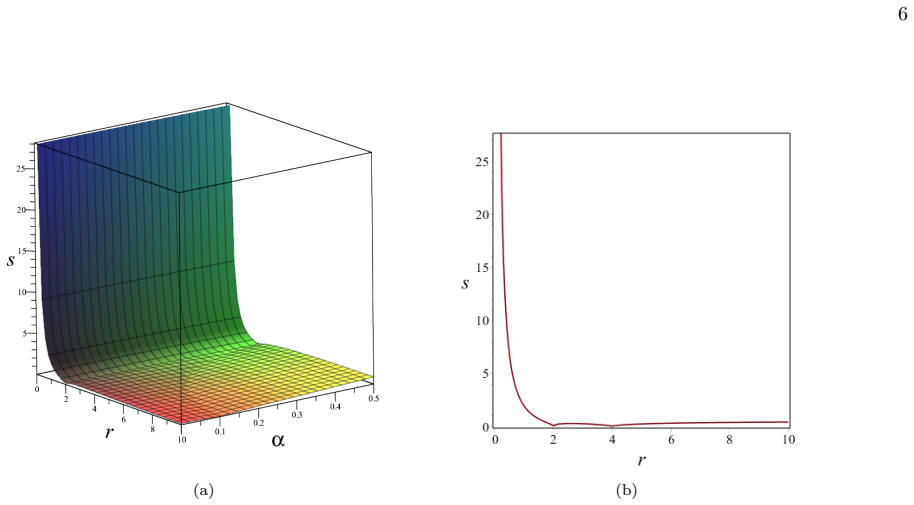

Figures from the paper (8 more)




Reference graph
Works this paper leans on
-
[1]
T. Levi-Civita, Atti Accad. Naz. Lincei, Cl. Sci. Fis., Mat. Nat. Rend.26, 307 (1917)
work page 1917
-
[2]
(b) Plot showing the variation of the gravitational entropy density for the accelerating non-rotating charged BH with respect to the radial coordinater and the chargee, whereα= 0.45, m= 1, ks = 1, andθ= π 2. If we substitutea = 0 in (34), then we get back the expression (20) for the entropy of the non-rotating accelerating black holes. We see that as the ...
-
[3]
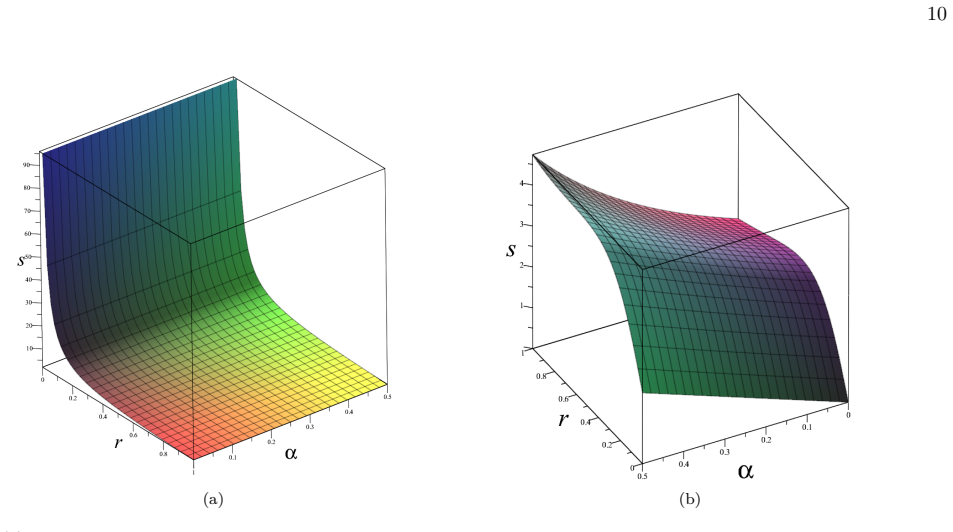
Moreover, we observe that except forθ= π 2, the gravitational entropy density remains finite atr = 0 for all other values ofθ. 10 (a) (b) FIG. 6: (a) Plot showing the variation of the gravitational entropy density for the accelerating rotating BH with respect to the radial coordinater and the acceleration parameterα, where a = 0.5, m = 1, ks = 1, andθ= π
-
[4]
This figure clearly shows that at the ring singularity ( r = 0, θ= π 2 ) the gravitational entropy density diverges. (b) Plot showing the variation of the gravitational entropy density for the accelerating rotating BH with respect to the radial coordinater and the acceleration parameter α, wherea = 0.5, m= 1, ks = 1, andθ= π
- [5]
-
[6]
This figure shows that atr = 0 and θ= π 6, the gravitational entropy density is finite. D. Rotating charged accelerating black hole For the rotating charged black hole, the Weyl scalarW is W = 48 (αrcos (θ)−1)6 ( r2 +a2 (cos (θ))2 )6× ( ( e2rα+am (aα+ 1) ) a2 cos3θ+ ( 2ae2r2α+ 3a2m (aα−1)r +a2e2) cos2θ + ( −e2αr3−3am (aα+ 1)r2 + 2ae2r ) cos (θ)−r2( m (aα−1)...
-
[7]
(b) Plot showing the variation of the gravitational entropy density for the accelerating rotating BH with respect to the radial coordinater and the rotation parameter a, whereα= 0.25, m= 1, ks = 1, andθ= π 4. FIG. 8: Plot showing the variation of the gravitational entropy density for the accelerating rotating BH with respect to the radial coordinater for ...
-
[8]
(b) Plot showing the variation of the gravitational entropy density for the accelerating rotating charged BH with respect to the radial coordinate r and the rotation parametera, fore = 0.6, α= 0.45, m= 1, ks = 1, andθ= π 4. In FIG. 9 we find that the gravitational entropy density is not smooth, but contains several singularities. The above analysis clearly...
Show all 34 references
-
[9]
(a) (b) FIG
Although the entropy density function (42) vanishes at the conformal infinityr = 1 αcos(θ), we cannot simply associate the zeroes of the entropy density function with the horizons, because according to this modified definition, the expression (42) does not have such factors, and ...
-
[10]
(b) Plot showing the variation of the gravitational entropy density for the accelerating rotating charged BH with respect to the radial coordinate r and the acceleration parameterα, wheree = 0.25, a= 0.5, m= 1, ks = 1, andθ= π 4. V. DISCUSSIONS We now discuss the possibility o...
-
[11]
He suggested that the Weyl curvature tensor could be used as a measure of the gravitational entropy
proposed that we must assign an entropy function to the gravitational field itself. He suggested that the Weyl curvature tensor could be used as a measure of the gravitational entropy. The Weyl tensorCαβγδin n dimensions is expressed as [12] Cαβγδ=Rαβγδ− 1 (n−2)(gαγRβδ+gβδRαγ−g...
1908 arXiv
-
[12]
Weyl, Ann
H. Weyl, Ann. Phys. (Berlin)59, 185 (1918)
1918
-
[13]
Ehlers and W
J. Ehlers and W. Kundt, inGravitation: An Introduction to Current Research , edited by L. Witten ( JohnWiley, New York, 1962)
1962
-
[14]
Kinnersiey AND M
W. Kinnersiey AND M. Walker, Phys. Rev. D2, 1359 (1970)
1970
-
[15]
P. S. Letelier and S. R. Oliveira, Phys. Rev. D,64, 064005 (2001)
2001
-
[16]
O. J. C. Dias and J. P. S. Lemos, Phys. Rev. D67, 064001 (2003)
2003
-
[17]
Krtous, Phys
P. Krtous, Phys. Rev. D72, 124019 (2005)
2005
-
[18]
Podolsky, Czech
J. Podolsky, Czech. J. Phys.52, 1 (2002)
2002
-
[19]
J. B. Griffiths, P. Krtous and J. Podolsky, Class. Quantum Grav.23, 6745 (2006)
2006
-
[20]
Penrose, Proc
R. Penrose, Proc. First Marcel Grossmann Meeting on General Relativity, ed R. Ruffini (Amsterdam: North-Holland) 173 (1977)
1977
-
[21]
Chandrasekhar, The Mathematical Theory of Black Holes , Oxford university press, New York (1983)
S. Chandrasekhar, The Mathematical Theory of Black Holes , Oxford university press, New York (1983)
1983
-
[22]
Penrose, Ann
R. Penrose, Ann. N.Y. Acad. Sci.571, 249 (1989)
1989
-
[23]
Bolejko, Phys
K. Bolejko, Phys. Rev. D97, 083515 (2018)
2018
-
[24]
Clifton, G.F.R
T. Clifton, G.F.R. Ellis and R. Tavakol, Class. Quantum Grav.30, 125009 (2013)
2013
-
[25]
W. B. Bonnor, Phys. Lett. A 122, 305 (1987)
1987
-
[26]
J. M. M. Senovilla, Class. Quantum Grav.17, 2799 (2000)
2000
-
[27]
Pelavas and K
N. Pelavas and K. Lake, Phys. Rev. D62, 044009 (2000)
2000
-
[28]
Pelavas and A
N. Pelavas and A. Coley, Int. J. Theor. Phys.45, 1258 (2006)
2006
-
[29]
Rudjord, ß
ß. Rudjord, ß. GrÃÿn and H. SigbjÃÿrn, Phys. Scr.77, 055901 (2008)
2008
-
[30]
G. E. Romero, R. Thomas and D. Pérez, Int. J. Theor. Phys.51, 925 (2012)
2012
-
[31]
S. W. Hawking, Commun. Math. Phys.43, 199 (1975)
1975
-
[32]
J. D. Bekenstein, Phys. Rev. D7, 2333 (1973)
1973
-
[33]
Podolsky, M
J. Podolsky, M. Ortaggio, and P. Krtous, Phys. Rev. D68, 124004 (2003)
2003
-
[34]
J. B. Griffiths and J. Podolsky,Exact space-times in Einstein ’s General Relativity, Cambridge university press, New York (2009)
2009
Reviewed August 14, 2026 · model on record in the stance chip above.
Discussion (0). Continue with ORCID to comment.