REVIEW 4 major objections 4 minor 3 cited by
Exploring BSM Higgs couplings in single top-quark production
T0 review · 4 major / 4 minor · reviewed 2026-08-14 · deepseek-v4-flash
Pith's one-line read The Matrix Element Method at NLO QCD can measure the top-Higgs CP-mixing angle to within about a degree, with about 20 fb⁻¹ of LHC data sufficient for a 5σ deviation from the Standard Model when detection efficiencies are ignored.
desk verdict A clean NLO MEM closure test for tH CP mixing; the quoted luminosities are idealized signal-only numbers and should be labeled as such. read the letter →
The pith
A machine-rendered reading of the paper's core claim, the machinery that carries it, and where it could break.
The reading
What carries the argument
The load-bearing mechanism is the Matrix Element Method likelihood: for each event with kinematic variables $x$, a weight $P(x|\alpha) = \frac{1}{\sigma(\alpha)}\int d^n y\, \frac{d^n\sigma(y|\alpha)}{dy_1\cdots dy_n}\, W(y,x)$ is computed from fixed-order NLO QCD matrix elements, and the estimator $\hat\alpha$ is read off from the minimum of the negative log-likelihood over the event sample. The paper assumes a perfect detector, $W(y,x)=\delta(y-x)$, and describes each event by seven kinematic variables: the pseudo-rapidity of the top-tagged jet, and the energy, pseudo-rapidity, and azimuthal angle of the hardest light jet and of the Higgs boson. All weights are generated at NLO QCD accuracy because, as the paper stresses, the NLO corrections to $pp\to tH$ are large (up to about $+32\%$) and depend on $\alpha$, so a leading-order implementation would be unreliable. A secondary but essential piece is the CP-violating Yukawa parametrization with $a=1$, $b=2/3$, which keeps the $gg\to H$ cross section fixed and lets $\alpha$ interpolate continuously between the CP-even ($\alpha=0^\circ$) and CP-odd ($\alpha=180^\circ$) limits.
What would settle it
Generate pseudo-data that include the dominant Standard Model backgrounds (e.g., $t\bar t H$, $tWH$, $t\bar t$+jets, $W$+jets) and a realistic detector transfer function with jet-energy smearing, then rerun the NLO Matrix Element likelihood extraction; if the recovered $\alpha$ is biased by more than the quoted $\pm 0.9^\circ$ at $300~\mathrm{fb}^{-1}$, or if the luminosity needed for a $5\sigma$ signal rises well above $20~\mathrm{fb}^{-1}$, the paper's idealized projections would fail under real LHC conditions.
Extended reading notes
Core claim
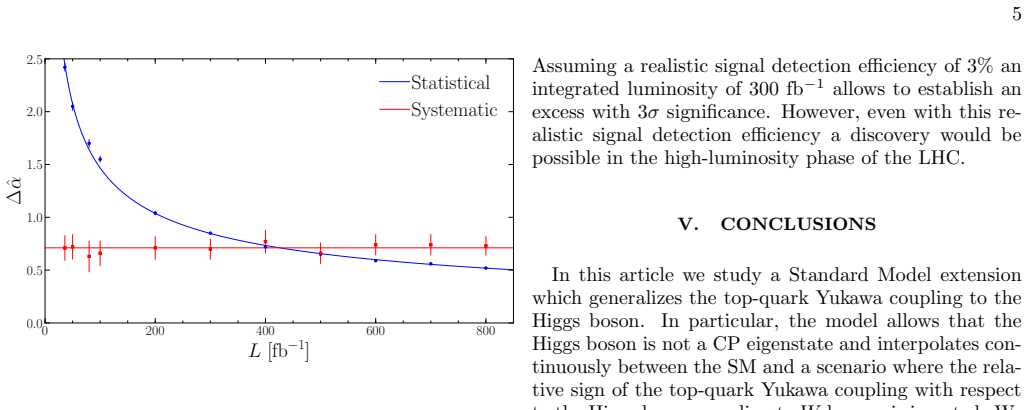
The central claim is that the Matrix Element Method, evaluated with fixed-order NLO QCD event weights, turns the rare $pp\to tH$ process into a precision probe of the top-Higgs interaction. The paper works with a specific beyond-Standard-Model scenario in which the top-quark Yukawa coupling is a mixture of CP-even and CP-odd terms, $L_{t\bar t H} = -\frac{y_t}{\sqrt{2}}(a\cos\alpha\,\bar t t + i b\sin\alpha\,\bar t\gamma_5 t)H$, with $a=1$ and $b=2/3$ chosen so that the gluon-fusion Higgs cross section is unchanged for any $\alpha$. In this scenario the inclusive cross section cannot separate the Standard Model from $\alpha$ values below about $25^\circ$, because the interference terms are suppressed by the fiducial cuts, but the likelihood built from NLO event weights recovers a benchmark input of $\alpha = 22.5^\circ$ as $\hat\alpha = 22.5^\circ \pm 0.9^\circ$ (stat.) $^{+0.8^\circ}_{-0.6^\circ}$ (sys.) at $300~\mathrm{fb}^{-1}$. The authors further estimate that about $20~\mathrm{fb}^{-1}$ would give a $5\sigma$ signal in the idealized case of a perfect detector and signal-only pseudo-data, while a few-percent signal efficiency would push discovery to the high-luminosity LHC, with theory uncertainties no longer limiting beyond roughly $L \approx 425~\mathrm{fb}^{-1}$.
Load-bearing premise
The load-bearing premise is the paper's own idealization, stated at Eq. (8) and in the Section IV pseudo-data setup: a perfect detector and signal-only NLO events with no background, so all quoted luminosities and the sub-degree precision apply only to a signal-only, perfect-detector world.
Editorial extensions
If this is right
- The CP-mixing angle $\alpha$ becomes a measurable LHC observable: a sub-degree determination from $pp\to tH$ events is possible with $300~\mathrm{fb}^{-1}$, and the extraction stops improving with statistics beyond roughly $L \approx 425~\mathrm{fb}^{-1}$, where the constant $\pm 0.7^\circ$ scale-uncertainty term dominates.
- A $5\sigma$ discovery of a CP-violating top-Higgs coupling at the benchmark level $\alpha = 22.5^\circ$ requires only about $20~\mathrm{fb}^{-1}$ in the idealized signal-only case; with a few-percent signal efficiency, $300~\mathrm{fb}^{-1}$ gives $3\sigma$ and the high-luminosity LHC reaches $5\sigma$.
- Because the likelihood weights are fixed-order NLO QCD predictions, the method inherits their accuracy; the paper shows this matters, since the NLO corrections are large (up to about $+32\%$) and $\alpha$-dependent, so leading-order analyses of this process would be unreliable.
- The same machinery can be applied to other rare processes and to alternative BSM scenarios such as two-Higgs-doublet models, which the paper notes as an equivalent target for the technique.
Reading between the lines
- Replacing the perfect-detector transfer function $\delta(y-x)$ with realistic jet-energy smearing would likely widen the statistical uncertainty on $\hat\alpha$; the quoted sub-degree precision should be read as the method's idealized resolving power in the best case.
- With no backgrounds in the pseudo-data, the $20~\mathrm{fb}^{-1}$ discovery figure is a lower bound; including $t\bar t H$, $tWH$, and multijet backgrounds could plausibly raise the required luminosity by an order of magnitude, an effect the paper does not quantify.
- The near-zero $\sin\alpha$ and $\cos\alpha\sin\alpha$ coefficients in the fiducial cross section are a consequence of the chosen phase-space cuts; a different cut design that preserves the CP-odd phase-space region could make even the inclusive cross section sensitive to $\alpha$, an option the paper leaves implicit.
- The per-event likelihood could be combined with the measured $t\bar t H$ cross section in a joint fit to separate the size and sign of the top-Higgs coupling, disentangling degeneracies that neither measurement alone can resolve; the paper does not perform this combination.
Signed reviews
Editorial analysis
A structured set of objections, weighed in public.
Referee Report
Summary. The paper studies a Standard Model extension in which the top-quark Yukawa coupling to the Higgs boson is a mixture of CP-even and CP-odd terms parameterized by an angle alpha, focusing on pp -> tH production at the LHC. The authors compute fiducial and total cross sections at LO and NLO QCD, show that the inclusive cross section is insensitive to small alpha (up to about 25 degrees), and then apply the Matrix Element Method with NLO event weights to extract alpha. Using pseudo-data generated at NLO for alpha = 22.5 degrees and a perfect-detector transfer function, they report alpha = 22.5 +/- 0.9 degrees (stat.) +0.8/-0.6 degrees (sys.) at 300 fb^-1, and estimate that about 20 fb^-1 would allow a 5-sigma discovery if signal detection efficiencies are ignored, while a 3% efficiency would still allow 3-sigma at 300 fb^-1 and a 5-sigma discovery in the high-luminosity phase.
Significance. If the sensitivity projections were realistic, this would be a valuable demonstration that NLO-accurate Matrix Element Methods can substantially improve the extraction of CP-violating top-Higgs couplings in a very challenging final state. The strengths of the paper include the NLO cross-section calculation, which is cross-checked against aMC@NLO, the transparent parametrization of the fiducial cross section, and the use of a standard maximum-likelihood framework. However, the quantitative claims in Section IV rest on signal-only pseudo-data, a delta-function detector transfer function, and the same NLO calculation used for both event generation and MEM weights. The paper is therefore best read as a closure test of the method rather than as a direct LHC sensitivity projection; the numerical projections are conditional on several idealizations that are not modeled.
major comments (4)
- [Section IV, Eq. (5)] The probability density in Eq. (5) contains only the tH signal contribution, and the pseudo-data of Section IV are generated as pure NLO tH events with no background processes. Since Eq. (5) is used as the likelihood in Eq. (7), the quoted discovery luminosity of about 20 fb^-1 and the 3-sigma estimate at 300 fb^-1 in Section IV are sensitivities of the MEM in a pure, perfectly reconstructed signal sample, not LHC projections. In a real measurement the likelihood would need a background component, otherwise the estimator is biased and the required luminosity can change substantially; please either include a background model in both the likelihood and the pseudo-data or explicitly relabel the claims as idealized sensitivity limits.
- [Section IV, pseudo-data] The pseudo-data are generated with the same NLO calculation used to compute the MEM weights, including the same renormalization/factorization scale choice and the same coupling parametrization. This makes the exercise a closure test: a common error in the event-weight definition or in the fixed-order calculation would not be revealed by the likelihood fit, and the quoted statistical uncertainties reflect only the internal consistency of the method. I would like to see at least one validation with an independent event sample, for example aMC@NLO with a different scale choice or a parton-shower-matched sample, before the central sensitivity numbers are used as projections.
- [Section III, Eq. (8)] The transfer function W(y,x)=delta(y-x) assumes a perfect detector. The manuscript itself notes in Section III that jet-energy variables should include nontrivial jet-energy scales, yet E_j and E_H enter the likelihood in Eq. (9). The effect of detector resolution on the extracted alpha is therefore not assessed; with realistic energy smearing the statistical precision and the discovery luminosity would change, likely in the direction of degraded sensitivity. Please add a smearing model or move this limitation to the abstract and conclusion.
- [Section IV, Eq. (10) and Table I] The uncertainty labeled [sys.] in Eq. (10) and Table I is obtained only from renormalization/factorization scale variation. This is a valid perturbative check, but it is not a complete theory-systematic uncertainty: PDF uncertainties, background normalization, and detector-related systematics are not included. Calling this quantity 'systematic' without qualification is misleading; either relabel it as a scale uncertainty or extend the systematic budget.
minor comments (4)
- [Section IV] In the sentence 'a determination of the mixing angle could envisaged', 'envisaged' should be 'be envisaged'.
- [Section III, Eq. (9)] The definition of the top-tagged jet and how the top-quark four-vector is reconstructed are not given, although eta_t is one of the MEM variables in Eq. (9). Please specify the jet algorithm and the reconstruction procedure used to obtain the top-tagged jet.
- [Eq. (3)] The coefficient of cos(alpha)sin(alpha) is quoted as 0.00; the numerical uncertainty on this coefficient should be given so the reader can judge the statement that it is 'compatible with zero'.
- [Section IV] The '5-sigma discovery' estimate is stated without specifying the test statistic or how the significance is computed; a short description, such as a likelihood-ratio or Neyman-Pearson construction, would improve reproducibility.
Circularity Check
No significant circularity: the MEM extraction is an in-model closure test with explicit assumptions, and the self-cited NLO formalism is methodologically supported, not a fitted-input prediction.
full rationale
The central numbers in Section IV are expressly framed as a simulated measurement: unweighted NLO events are generated at alpha = 22.5 degrees and then analyzed with the NLO likelihood of Eq. (5) under the perfect-detector transfer function W(y,x)=delta(y-x) of Eq. (8). Because the pseudo-data and the likelihood come from the same differential cross-section calculation, the recovery of the input angle and the quoted 20 fb^-1 discovery luminosity are closure-test projections of the assumed BSM model, not empirical determinations. That is a significant modeling limitation - signal-only, no background, perfect detector, and the benchmark scenario a=1, b=2/3 taken from Refs. [21,28] - but it is not circularity under the rules of this review: no fitted parameter is renamed as an independent prediction, and no equation reduces to its input by construction. The paper's use of the authors' prior NLO Matrix Element Method papers [36-39] is a methodological self-citation; it is not a uniqueness theorem, and the cross-section calculation is independently cross-checked against aMC@NLO and by the paper's own LO/NLO comparison. These self-citations are therefore not load-bearing in a way that would force the conclusion.
Assumptions & free parameters
free parameters (4)
- a =
1
- b =
2/3
- alpha (CP-mixing angle) =
22.5 degrees in pseudo-data
- signal detection efficiency =
3%
assumptions (4)
- domain assumption The BSM top-Higgs interaction is described by the Lagrangian in Eq. (1) from the Higgs characterisation framework [28].
- ad hoc to paper Pseudo-data are generated at NLO QCD using the same calculation as the MEM event weights.
- ad hoc to paper The transfer function is a delta function, i.e., perfect detector response (Eq. 8).
- ad hoc to paper Background contributions are neglected in the simulated measurement.
Cite this review
Pith. "Pith review of Exploring BSM Higgs couplings in single top-quark production." pith.science (2026). https://pith.science/paper/6QKOV73B
@misc{pith2026190809100,
  author       = {Pith},
  title        = {Pith review of: Exploring BSM Higgs couplings in single top-quark production},
  year         = {2026},
  howpublished = {\url{https://pith.science/paper/6QKOV73B}},
  note         = {Machine review of arXiv:1908.09100}
}
read the original abstract
In this article we study a Standard Model extension modifying the top-quark Yukawa coupling to the Higgs boson by allowing a mixture of CP-odd and -even couplings. Single top-quark production in association with an additional Higgs boson provides a natural laboratory to search for such extensions. However, because of the small cross section the experimental analysis is challenging. Already the measurement of the cross section for this process is highly non-trivial. Furthermore, using only cross section measurements, a certain parameter region would escape detection. Using an explicit BSM scenario we show that employing the Matrix Element Method a precise measurement becomes feasible. Ignoring signal detection efficiencies an integrated luminosity of about 20 fb^-1 would allow a discovery. Assuming signal detection efficiencies at the level of a few percent a potential signal could be established in the high luminosity phase of the LHC.
Figures


Figures from the paper (2 more)

Forward citations
Cited by 3 Pith papers
-
Simulation-Prior Independent Neural Unfolding Procedure
SPINUP is a neural-unfolding method that fits a parton-level generative model directly to detector-level data through a learned forward simulator, aiming to remove the simulation-prior bias.
-
Probing the $CP$ nature of the top quark Yukawa at hadron colliders
A new charge-blind CP-odd observable in top-antitop-Higgs production could let the HL-LHC probe the CP-violating top Yukawa down to about 0.5 and a 27 TeV HE-LHC down to about 0.1 at 2σ.
-
Sensitivity to $\mathcal{CP}$-violating effective couplings in the top-Higgs sector
Combining ttbar H and single-top H production at the LHC can separate the real and imaginary parts of a CP-violating top Yukawa coupling, with projected HL-LHC constraints about twice as strong as current ATLAS bounds.
Reference graph
Works this paper leans on
-
[1]
G. Aad et al. [ATLAS Collaboration], “Observation of a new particle in the search for the Standard Model Higgs boson with the ATLAS detector at the LHC,” Phys. Lett. B 716, 1 (2012)
work page 2012
-
[2]
Observation of a New Boson at a Mass of 125 GeV with the CMS Experiment at the LHC,
S. Chatrchyan et al. [CMS Collaboration], “Observation of a New Boson at a Mass of 125 GeV with the CMS Experiment at the LHC,” Phys. Lett. B 716, 30 (2012)
work page 2012
-
[3]
Theory and phenomenology of two-Higgs-doublet models,
G. C. Branco, P. M. Ferreira, L. Lavoura, M. N. Rebelo, M. Sher and J. P. Silva, “Theory and phenomenology of two-Higgs-doublet models,” Phys. Rept. 516, 1 (2012)
work page 2012
-
[4]
The Minimal composite Higgs model,
K. Agashe, R. Contino and A. Pomarol, “The Minimal composite Higgs model,” Nucl. Phys. B 719, 165 (2005)
work page 2005
-
[5]
Unitarity Bound on the Scale of Fermion Mass Generation,
T. Appelquist and M. S. Chanowitz, “Unitarity Bound on the Scale of Fermion Mass Generation,” Phys. Rev. Lett. 59, 2405 (1987) Erratum: [Phys. Rev. Lett. 60, 1589 (1988)]
work page 1987
-
[6]
A. M. Sirunyan et al. [CMS Collaboration], “Measure- ment of the top quark Yukawa coupling from t¯t kinematic distributions in the lepton+jets final state in proton- proton collisions at √s = 13 TeV,” arXiv:1907.01590 [hep-ex]
arXiv 1907
-
[7]
Observation of ttH production,
A. M. Sirunyan et al. [CMS Collaboration], “Observation of ttH production,” Phys. Rev. Lett. 120, no. 23, 231801 (2018)
work page 2018
-
[8]
M. Aaboud et al. [ATLAS Collaboration], “Observation of Higgs boson production in association with a top quark pair at the LHC with the ATLAS detector,” Phys. Lett. B 784, 173 (2018)
work page 2018
Show all 46 references
-
[9]
On the associate production of a neutral intermediate mass Higgs boson with a single top quark at the LHC and SSC,
G. Bordes and B. van Eijk, “On the associate production of a neutral intermediate mass Higgs boson with a single top quark at the LHC and SSC,” Phys. Lett. B 299, 315 (1993)
1993
-
[10]
As- sociated production of Higgs and single top at hadron colliders,
F. Maltoni, K. Paul, T. Stelzer and S. Willenbrock, “As- sociated production of Higgs and single top at hadron colliders,” Phys. Rev. D 64, 094023 (2001)
2001
-
[11]
Lifting degeneracies in Higgs couplings us- ing single top production in association with a Higgs bo- son,
M. Farina, C. Grojean, F. Maltoni, E. Salvioni and A. Thamm, “Lifting degeneracies in Higgs couplings us- ing single top production in association with a Higgs bo- son,” JHEP 1305, 022 (2013)
2013
-
[12]
Single top and Higgs associated production as a probe of the Htt cou- pling sign at the LHC,
S. Biswas, E. Gabrielli and B. Mele, “Single top and Higgs associated production as a probe of the Htt cou- pling sign at the LHC,” JHEP 1301, 088 (2013) 6
2013
-
[13]
Effect of Anoma- lous Couplings on the Associated Production of a Single Top Quark and a Higgs Boson at the LHC,
P. Agrawal, S. Mitra and A. Shivaji, “Effect of Anoma- lous Couplings on the Associated Production of a Single Top Quark and a Higgs Boson at the LHC,” JHEP1312, 077 (2013)
2013
-
[14]
Angular Correla- tions in Associated Production of Single Top and Higgs with and without anomalous Wtb Couplings,
S. F. Taghavi and M. M. Najafabadi, “Angular Correla- tions in Associated Production of Single Top and Higgs with and without anomalous Wtb Couplings,” Int. J. Theor. Phys. 53, no. 12, 4326 (2014)
2014
-
[15]
Single top production in association with a Z boson at the LHC,
J. Campbell, R. K. Ellis and R. R¨ ontsch, “Single top production in association with a Z boson at the LHC,” Phys. Rev. D 87, 114006 (2013)
2013
-
[16]
Dis- entangling Higgs-Top Couplings in Associated Produc- tion,
J. Ellis, D. S. Hwang, K. Sakurai and M. Takeuchi, “Dis- entangling Higgs-Top Couplings in Associated Produc- tion,” JHEP 1404, 004 (2014)
2014
-
[17]
Probing the Top-Yukawa Coupling in Associated Higgs produc- tion with a Single Top Quark,
J. Chang, K. Cheung, J. S. Lee and C. T. Lu, “Probing the Top-Yukawa Coupling in Associated Higgs produc- tion with a Single Top Quark,” JHEP 1405, 062 (2014)
2014
-
[18]
Anomalous Top- Higgs Couplings and Top Polarisation in Single Top and Higgs Associated Production at the LHC,
A. Kobakhidze, L. Wu and J. Yue, “Anomalous Top- Higgs Couplings and Top Polarisation in Single Top and Higgs Associated Production at the LHC,” JHEP 1410, 100 (2014)
2014
-
[19]
Enhancing thj Production from Top-Higgs FCNC Couplings,
L. Wu, “Enhancing thj Production from Top-Higgs FCNC Couplings,” JHEP 1502, 061 (2015)
2015
-
[20]
Bounding the top Yukawa cou- pling with Higgs-associated single-top production,
C. Englert and E. Re, “Bounding the top Yukawa cou- pling with Higgs-associated single-top production,” Phys. Rev. D 89, no. 7, 073020 (2014)
2014
-
[21]
Higgs production in association with a single top quark at the LHC,
F. Demartin, F. Maltoni, K. Mawatari and M. Zaro, “Higgs production in association with a single top quark at the LHC,” Eur. Phys. J. C 75, no. 6, 267 (2015)
2015
-
[22]
Constraining anomalous Higgs boson couplings to the heavy flavor fermions using matrix element techniques,
A. V. Gritsan, R. R¨ ontsch, M. Schulze and M. Xiao, “Constraining anomalous Higgs boson couplings to the heavy flavor fermions using matrix element techniques,” Phys. Rev. D 94, no. 5, 055023 (2016)
2016
-
[23]
Unraveling the CP phase of top-Higgs coupling in associated production at the LHC,
S. D. Rindani, P. Sharma and A. Shivaji, “Unraveling the CP phase of top-Higgs coupling in associated production at the LHC,” Phys. Lett. B 761, 25 (2016)
2016
-
[24]
Probing the Higgs Yukawa coupling to the top quark at the LHC via single top+Higgs production,
V. Barger, K. Hagiwara and Y. J. Zheng, “Probing the Higgs Yukawa coupling to the top quark at the LHC via single top+Higgs production,” Phys. Rev. D 99, no. 3, 031701 (2019)
2019
-
[25]
Single-top associated production with a Z or H boson at the LHC: the SMEFT interpretation,
C. Degrande, F. Maltoni, K. Mimasu, E. Vryonidou and C. Zhang, “Single-top associated production with a Z or H boson at the LHC: the SMEFT interpretation,” JHEP 1810, 005 (2018)
2018
-
[26]
Search for the associated production of a Higgs boson with a single top quark in proton-proton collisions at √s = 8 TeV,
V. Khachatryan et al. [CMS Collaboration], “Search for the associated production of a Higgs boson with a single top quark in proton-proton collisions at √s = 8 TeV,” JHEP 1606, 177 (2016)
2016
-
[27]
Search for associated production of a Higgs boson and a single top quark in proton-proton collisions at√s = 13 TeV,
A. M. Sirunyan et al. [CMS Collaboration], “Search for associated production of a Higgs boson and a single top quark in proton-proton collisions at√s = 13 TeV,” Phys. Rev. D 99, no. 9, 092005 (2019)
2019
-
[28]
A framework for Higgs characteri- sation,
P. Artoisenet et al., “A framework for Higgs characteri- sation,” JHEP 1311, 043 (2013)
2013
-
[29]
FastJet User Manual,
M. Cacciari, G. P. Salam and G. Soyez, “FastJet User Manual,” Eur. Phys. J. C 72, 1896 (2012)
2012
-
[30]
The automated computation of tree- level and next-to-leading order differential cross sections, and their matching to parton shower simulations,
J. Alwall et al. , “The automated computation of tree- level and next-to-leading order differential cross sections, and their matching to parton shower simulations,” JHEP 1407, 079 (2014)
2014
-
[31]
Dynamical Likelihood Method for Recon- struction of Events With Missing Momentum. 1: Method and Toy Models,
K. Kondo, “Dynamical Likelihood Method for Recon- struction of Events With Missing Momentum. 1: Method and Toy Models,” J. Phys. Soc. Jap. 57, 4126 (1988)
1988
-
[32]
Dynamical likelihood method for reconstruc- tion of events with missing momentum. 2: Mass spectra for 2→ 2 processes,
K. Kondo, “Dynamical likelihood method for reconstruc- tion of events with missing momentum. 2: Mass spectra for 2→ 2 processes,” J. Phys. Soc. Jap. 60, 836 (1991)
1991
-
[33]
The Matrix Element Method and QCD Radiation,
J. Alwall, A. Freitas, and O. Mattelaer, “The Matrix Element Method and QCD Radiation,” Phys. Rev. D83 (2011) 074010
2011
-
[34]
The Ma- trix Element Method at Next-to-Leading Order,
J. M. Campbell, W. T. Giele, and C. Williams, “The Ma- trix Element Method at Next-to-Leading Order,” JHEP 11 (2012) 043
2012
-
[35]
Matrix element method at next-to-leading order for arbitrary jet algorithms,
R. Baumeister and S. Weinzierl, “Matrix element method at next-to-leading order for arbitrary jet algorithms,” Phys. Rev. D95 (2017)
2017
-
[36]
Extending the Matrix Ele- ment Method beyond the Born approximation: Calcu- lating event weights at next-to-leading order accuracy,
T. Martini and P. Uwer, “Extending the Matrix Ele- ment Method beyond the Born approximation: Calcu- lating event weights at next-to-leading order accuracy,” JHEP 1509, 083 (2015)
2015
-
[37]
The Matrix Element Method at next-to-leading order QCD for hadronic collisions: Single top-quark production at the LHC as an example appli- cation,
T. Martini and P. Uwer, “The Matrix Element Method at next-to-leading order QCD for hadronic collisions: Single top-quark production at the LHC as an example appli- cation,” JHEP 1805, 141 (2018)
2018
-
[38]
The Matrix Element Method at next-to- leading order QCD using the example of single top-quark production at the LHC,
T. Martini, “The Matrix Element Method at next-to- leading order QCD using the example of single top-quark production at the LHC,” arXiv:1807.06859 [hep-ph]
-
[39]
Predicting event weights at next-to-leading order QCD for jet events de- fined by 2 → 1 jet algorithms,
M. Kraus, T. Martini and P. Uwer, “Predicting event weights at next-to-leading order QCD for jet events de- fined by 2 → 1 jet algorithms,” arXiv:1901.08008 [hep- ph]
1901 arXiv
-
[40]
Cowan, Statistical data analysis
G. Cowan, Statistical data analysis . Oxford University Press, 1998
1998
-
[41]
Measurement of the Top Quark Mass in the Dilepton Channel,
B. Abbott et al. [D0 Collaboration], “Measurement of the Top Quark Mass in the Dilepton Channel,” Phys. Rev. D 60, 052001 (1999)
1999
-
[42]
A precision measurement of the mass of the top quark,
V. M. Abazov et al. [D0 Collaboration], “A precision measurement of the mass of the top quark,” Nature 429, 638 (2004)
2004
-
[43]
Precision mea- surement of the top quark mass from dilepton events at CDF II,
A. Abulencia et al. [CDF Collaboration], “Precision mea- surement of the top quark mass from dilepton events at CDF II,” Phys. Rev. D 75, 031105 (2007)
2007
-
[44]
Observation of Single Top Quark Production,
V. M. Abazov et al. [D0 Collaboration], “Observation of Single Top Quark Production,” Phys. Rev. Lett. 103, 092001 (2009)
2009
-
[45]
First Observa- tion of Electroweak Single Top Quark Production,
T. Aaltonen et al. [CDF Collaboration], “First Observa- tion of Electroweak Single Top Quark Production,” Phys. Rev. Lett. 103, 092002 (2009)
2009
-
[46]
Evidence for sin- gle top-quark production in the s-channel in proton- proton collisions at√s =8 TeV with the ATLAS detector using the Matrix Element Method,
G. Aad et al. [ATLAS Collaboration], “Evidence for sin- gle top-quark production in the s-channel in proton- proton collisions at√s =8 TeV with the ATLAS detector using the Matrix Element Method,” Phys. Lett. B 756, 228 (2016)
2016
Reviewed August 14, 2026 · model on record in the stance chip above.
Discussion (0). Continue with ORCID to comment.