REVIEW 3 major objections 5 minor 32 references
The supernova Hubble diagram points to a kinematic law: light speed tracks the cosmic expansion rate exactly.
Reviewed by Pith at T0; open to challenge. T0 means a machine referee read the full paper against a public rubric. the ladder, T0–T4 →
T0 review · deepseek-v4-flash
2026-08-03 11:38 UTC pith:6QM6QPCQ
load-bearing objection The central claim is built on a wrong redshift formula: Appendix A uses coordinate time rather than proper time, so the inferred c∝ȧ relation is an artifact of that error. the 3 major comments →
An intrinsic kinematic relation boldsymbol{c=frac{c₀}{H₀}\,dot{a}}\, inferred from Type Ia supernovae
The pith
A machine-rendered reading of the paper's core claim, the machinery that carries it, and where it could break.
Core claim
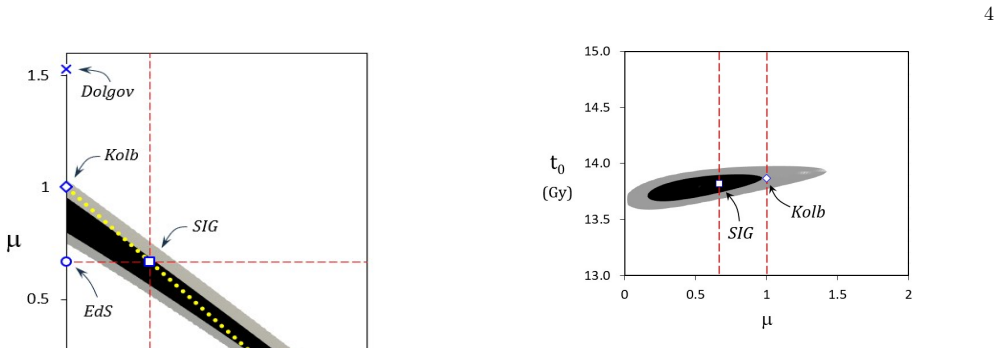
The paper's central discovery is an empirical degeneracy, not a dynamical model. Using the Pantheon sample of 1,048 Type Ia supernovae and a cosmological family with a=(t/t0)^μ and c=c0 a^{-ζ}, the authors derive a modified luminosity distance that depends on the product η=(1+ζ)μ. The likelihood contours in the {μ,ζ} plane are not scattered: they track the line η=1, equivalently (1+ζ)μ=1, with a width of roughly 0.2 in η. Because c=c0a^{-ζ} and a=(t/t0)^μ, the identity η=1 gives c = μ^{-1} c0 t0 da/dt = (c0/H0) da/dt, so the speed of light is strictly proportional to the expansion rate at all times. The authors emphasize that no prior theoretical consideration forced this relation; it emerge
What carries the argument
Central is the modified redshift relation 1+z = a^{-(1+ζ)}F^{1+ζ}(z), where c varies as a^{-ζ} and F(z) is a one-parameter interpolation function accounting for wavelength-calibration ('yardstick') differences between the supernova host galaxy and the Milky Way. A varying c means the standard 1+z=a^{-1} fails; the correct frequency ratio is a^{1+ζ}, and F(z) converts frequency ratio to observed wavelength ratio. In the resulting luminosity distance formula d_L^{MW} = (c_MW t0/(1-η)) (1+z)/F(z) [1 - ((1+z)/F^{1+ζ})^{1-1/η}], only η=(1+ζ)μ appears, so the data constrain η directly. The posterior peaks at η=1, which is the algebraic condition that turns the two power laws into c = (c0/H0) da/dt
Load-bearing premise
The inference depends entirely on the assumed 'yardstick' scaling—that both the emitted and the reference wavelengths in the relevant galaxies scale with the local value of c through the same exponent -ζ—and on the particular interpolation F(z) chosen for that ratio; if that scaling or interpolation is wrong, the data no longer determine the claimed c-∝-a-dot relation.
What would settle it
Re-fit the same supernova data with F(z) replaced by a fixed, independently measured wavelength-calibration function from high-redshift supernova spectra; if the posterior peak at η=1 leaves its position, the claimed relation is a byproduct of the chosen F(z), not of the data. A cheap first test is to set F≡1 and observe that the distance formula degenerates to a function of η alone.
If this is right
- Late-time acceleration is reinterpreted as a kinematic effect: high-redshift supernovae appear dimmer because the luminosity distance gains a z ln z term when c∝a-dot, so no dark energy is needed to fit the Pantheon data.
- The particular case μ=2/3, ζ=1/2 outperforms flat ΛCDM by Δχ²=2.8 (68% confidence) with the same number of free parameters, and along the whole η=1 locus the fits are at least as good as ΛCDM for ζ≲8.
- If the relation extends to early epochs, both the particle and event horizons diverge, resolving the horizon problem without inflation.
- The relation produces a conformally flat metric ds²=da²-a²(dr²+r²dΩ²) in which the scale factor acts as time, and it modifies the low-redshift Hubble law to z=(1+ζ)H0 d/c0, giving an independent observational test.
Where Pith is reading between the lines
- My inference: if c∝a-dot is a true kinematic law, then the cosmic acceleration read from supernovae is not a dynamical effect but a ruler effect—dark energy becomes an unnecessary substance, and theoretical effort should shift to varying-c gravity.
- My inference: the parameterization-independent claim could be sharpened by redoing the same fit on independent distance indicators such as gamma-ray bursts or quasars; the prediction is a fixed locus η=1 in the μ-ζ plane that calibration changes cannot mimic.
- My inference: the equivalence between the linear coasting model and the μ=2/3, ζ=1/2 case suggests the detectable content is the z ln z limb in the distance modulus at high z; experiments should target that specific functional form rather than the individual exponents.
Editorial analysis
A structured set of objections, weighed in public.
Referee Report
Summary. The paper analyzes a VSL power-law cosmology with scale factor a=(t/t0)^\mu and speed of light c=c0 a^{-\zeta}. It derives a modified Lema\^itre redshift relation 1+z=a^{-(1+\zeta)}F^{1+\zeta}(z), where F(z) is an assumed interpolation function, and a corresponding luminosity distance. Fitting the Pantheon SNeIa sample, the paper finds a posterior degeneracy along the locus (1+\zeta)\mu=1 and interprets this as an empirical law c=c0H0^{-1} da/dt. It further claims that this relation explains late-time acceleration without dark energy, resolves the horizon problem, and slightly outperforms flat \LambdaCDM in terms of \chi^2.
Significance. If the central claim were robust, the paper would offer a concrete, falsifiable alternative to dark energy and a new kinematic constraint on varying-speed-of-light cosmologies. The work uses public Pantheon data and provides a complete fitting procedure, which is a strength. However, the significance is severely limited: the redshift relation rests on an unproven yardstick scaling and an ad hoc function F(z); the statistical preference over \LambdaCDM is marginal (total \Delta\chi^2\approx2.8, driving a statement of only 68% CL); and the relation is inferred from the same data that established acceleration, with no independent prediction. The paper's strong language ('clearest and most decisive evidence') is not supported by the analysis as presented.
major comments (3)
- [Modifying the Lemaître redshift relation, Eqs. (12)-(15)] The entire sensitivity to \zeta, and hence the inference of \eta=1, comes from the unproven yardstick scaling c_MW\propto(\lambda^*_MW)^{-\zeta}, c_SN\propto\lambda_SN^{-\zeta} and from the arbitrary choice F(z)=1+(F_\infty-1)[1-(1+z)^{-2}]^2. The paper itself notes that without a non-constant F(z), the luminosity distance (16) is degenerate in \eta. Thus the posterior peak at \eta=1 is contingent on a functional form with no physical derivation. No robustness test with alternative F(z) is given. This is a load-bearing issue: if the yardstick assumption or the chosen F(z) is changed, the claimed empirical law could disappear.
- [Table I and Corollary 1] The best VSL models in Table I have \chi^2 per degree of freedom about 0.9856 versus 0.9882 for \LambdaCDM, a total \Delta\chi^2\approx2.8 over 1,048 data points. This is a weak preference, roughly 1.7\sigma, not 'the clearest and most decisive evidence' against \LambdaCDM. Moreover, the general parameter space has four free parameters (\mu,\zeta,t_0,F_\infty), while the special cases in Table I fix \mu,\zeta and use only (t_0,F_\infty), so the comparison with the two-parameter \LambdaCDM is not apples-to-apples. The claim that the model outperforms \LambdaCDM for all 0\le\zeta\lesssim8 along the locus is stated without a scan plot or a look-elsewhere correction. A proper model-comparison statistic (AIC/BIC or a marginal likelihood with a prior volume penalty) is needed before calling this an empirical law.
- [Corollary 2 and Conclusion] The relation c=c0H0^{-1}\dot a is derived by imposing \eta=1 on the assumed power-law forms. The paper calls it 'intrinsic' because it equates two dimensionally compatible quantities, but this criterion is not sufficient: many such relations could be written down. The inference is entirely within the Dolgov-Barrow parameterization, and the same Pantheon data that established acceleration are used to select \eta=1. No out-of-sample prediction or independent probe is provided. To support the 'empirical law' claim, the authors would need a genuinely model-independent reconstruction or a test with independent data (e.g., cosmic chronometers, BAO, or CMB distance information).
minor comments (5)
- [Appendix A and Eq. (11)] The derivation uses coordinate-time wavecrest intervals. This is internally consistent if cosmic coordinate time t is the proper time of comoving observers, so that the physical frequency is \nu=1/\delta t. The paper should state this convention explicitly; otherwise readers may infer a missing factor of c(a). The stress-test concern about proper-frequency corrections therefore does not land, but the ambiguity should be removed.
- [Abstract and Conclusions] The phrases 'clearest and most decisive evidence' and 'new empirical law' are overstated given the marginal \Delta\chi^2 and the model dependence. Please temper the claims throughout.
- [Figure 3] The construction of the \eta distribution in the lower panel is not fully specified: what priors on \mu,\zeta are used, how the width 0.2 is estimated, and what smoothing is applied? This should be described so the claimed 'prominent peak at \eta=1' is reproducible.
- [Table I] The SIG case gives H0=47.22 km/s/Mpc, far below local distance-ladder measurements. Calling this a 'resolution' of the Hubble tension is misleading; it is a very low value that itself is in tension with local H0 measurements.
- [General presentation] There are numerous typos, including missing spaces after 'We present' at the start, malformed subscripts such as '\muPan i', and an undefined domain of validity for Eq. (16) when \eta<1. The manuscript also relies heavily on self-citations to Refs. [8-10]; the novelty relative to those works should be made clearer.
Circularity Check
The inference of c∝ȧ rests on a self-cited ad hoc F(z) that breaks the η-degeneracy; without it the data cannot constrain ζ at all.
specific steps
-
ansatz smuggled in via citation
[Section 'Modifying the Lemaître redshift relation', Eq. (15)]
"A non-constant F(z) would break the η–degeneracy in Eq. (16). ... Adopting the practice in Ref.[8], we will model F(z) as F(z) = 1 + (F∞−1)[1−(1+z)^{-2}]^2 (15), which monotonically interpolates between F(z=0)=1 and F(z=∞)=F∞, where F∞ is an adjustable parameter."
The central empirical claim (η=1) is inferred only because Eq. (16) is η-degenerate when F(z)≡1; the degeneracy is broken by inserting an arbitrary F(z) taken from the author's own prior work. The posterior peak at η=1 is therefore not a direct reading of the SNe data but a consequence of the chosen self-cited fitting function. Had a different F(z) been used, the constraint on ζ — and hence on c∝ȧ — would change. This is a load-bearing ansatz presented as empirical inference.
-
self citation load bearing
[Section 'Modifying the Lemaître redshift relation', after Eq. (12), leading to Eq. (13)]
"Extending our elaborated explanation in Ref. [8], we will adopt the relationships c_MW ∝ (λ∗_MW)^{−ζ} and c_SN ∝ λ_SN^{−ζ}. Along with Eq. (12), they yield the redshift 1+z = λ_MW/λ∗_MW = a^{−(1+ζ)}(λ_SN/λ∗_MW)^{1+ζ} (13)."
The 'yardstick' scaling of c with atomic wavelengths is not derived in this paper; it is imported from the author's prior work and is the step that turns the standard VSL redshift into the modified form 1+z=a^{−(1+ζ)}F^{1+ζ}(z). Without this self-cited ansatz, the luminosity distance formula would lose its sensitivity to ζ, and the inference of the empirical locus (1+ζ)μ=1 would collapse. Thus the central result is constructed from self-cited assumptions rather than independently predicted.
full rationale
The paper fits the Dolgov–Barrow VSL model to the Pantheon SNeIa sample and finds a posterior ridge along (1+ζ)μ=1, which it interprets as an intrinsic kinematical relation c∝ȧ. This is not a case of simple Eq=Eq circularity: the data genuinely enter through the χ² fit, and the SIG case with μ=2/3, ζ=1/2 has the same number of free parameters as ΛCDM. However, the inference is heavily dependent on two load-bearing inputs imported from the author's own prior work: the 'yardstick' scaling c∝λ^{−ζ} and the ad hoc function F(z) of Eq. (15). The paper explicitly states that F(z) is what breaks the η-degeneracy of the distance–redshift relation; without it, the Pantheon data cannot constrain ζ at all. The claimed empirical law c∝ȧ is therefore not an independent prediction but a reparametrization of the fitted condition η=1, made identifiable only by a self-cited fitting ansatz. No external or out-of-sample test is provided. These issues are sufficient to raise the circularity score to 5, but not to 8–10, because the paper does present a genuine data fit and a model comparison rather than a purely definitional identity.
Axiom & Free-Parameter Ledger
free parameters (4)
- μ =
locus peak includes μ=2/3 (SIG) and μ=1 (Kolb); varied in contour
- ζ =
SIG ζ=1/2, Kolb ζ=0; varied in contour
- t0 =
Table I: 13.82 Gyr (SIG), 13.87 Gyr (Kolb), etc.
- F∞ =
SIG F∞=0.931, Kolb F∞=0.911
axioms (5)
- domain assumption VSL RW metric with c(a) as a metric coefficient (Eq. 3)
- domain assumption Power-law ansatz a=(t/t0)^μ and c=c0 a^{-ζ} (Eqs. 4–5)
- ad hoc to paper Yardstick scaling c_MW ∝ (λ*_MW)^{-ζ}, c_SN ∝ λ_SN^{-ζ} (Eq. 13)
- ad hoc to paper F(z)=1+(F∞−1)[1−(1+z)^{-2}]^2 (Eq. 15)
- domain assumption Pantheon SNeIa are standard candles with absolute magnitude M=−19.35
invented entities (1)
-
Yardstick wavelength λ*_MW
no independent evidence
read the original abstract
Based on the Hubble diagram of SNeIa, we present empirical evidence for a kinematic relation between the speed of light and the late-time cosmic expansion rate. To infer this relation, we employ the Dolgov-Barrow cosmology, described by Dolgov's power-law expansion $a=(t/t_0)^\mu$ and Barrow's varying-speed-of-light (VSL) $c=c_0\,a^{-\zeta}$. In this cosmology, light propagating through an expanding cosmic background undergoes an additional refraction induced by the variation of $c$ along its path, resulting in a modified Lema\^itre redshift relation $1+z=a^{-(1+\zeta)}$. The model yields a high-quality fit to the Pantheon SNeIa Hubble diagram and exhibits a remarkably tight posterior degeneracy along the locus $(1+\zeta)\,\mu=1$. In particular, the case ${\mu=2/3,\zeta=1/2}$, referred to as the VSL-Einstein-de Sitter case, is favored over flat $\Lambda$CDM by $\Delta\chi^2=2.8$, i.e. at 68% confidence level, despite having the same number of free parameters. The empirical relation $(1+\zeta)\,\mu=1$ entails that the speed of light is exactly proportional to the cosmic expansion rate, $c=c_0H_0^{-1}\,\dot a$, during late times, a synchronous behavior absent in the standard $\Lambda$CDM model. Although the empirical relation $(1+\zeta)\,\mu=1$ is inferred using the Dolgov-Barrow parameterization, the resulting expression $c=c_0H_0^{-1}\,\dot a$ is an intrinsic relation because it relates two physical quantities of the same dimension: speed of light and cosmic expansion rate. It is therefore independent of arbitrary choices of units or parameterization and encodes a purely kinematic correspondence between $c$ and $\dot a$. If confirmed by independent probes, this relation may point toward a more general kinematic principle governing late-time cosmic evolution. We discuss implications of this relation for late-time cosmology, including an alternative interpretation of cosmic acceleration.
Figures



Reference graph
Works this paper leans on
-
[1]
L. Perivolaropoulos and F. Skara,Challenges forΛCDM: An update, New Astron. Rev.95, 101659 (2022), arXiv:2105.05208 [astro-ph.CO]
Pith/arXiv arXiv 2022
-
[2]
E. Di Valentino, O. Mena, S. Pan, L. Visinelli, W. Yang, A. Melchiorri, D. F. Mota, A. G. Riess and J. Silk,In the realm of the Hubble tension—a review of solutions, Class. Quant. Grav.38(2021) 153001, arXiv:2103.01183 [astro- ph.CO]
Pith/arXiv arXiv 2021
-
[3]
P. Bull, Y. Arkrami, et al,BeyondΛCDM: Problems, so- lutions, and the road ahead, Physics of the Dark Universe 12(2016) 56, arXiv:1512.05356
Pith/arXiv arXiv 2016
-
[4]
W. L. Freedman,Measurements of the Hubble Constant: Tensions in Perspective, Astrophys. J.919(2021) 1, 16, arXiv:2106.15656 [astro-ph.CO]
Pith/arXiv arXiv 2021
-
[5]
A. Riess et al,Observational evidence from supernovae for an accelerating universe and a cosmological constant, As- tron. J.116, 1009 (1998), arXiv:astro-ph/9805201
Pith/arXiv arXiv 1998
-
[6]
Perlmutter et al,Measurements ofΩandΛfrom 42 high-redshift supernovae, Astron
S. Perlmutter et al,Measurements ofΩandΛfrom 42 high-redshift supernovae, Astron. J.517, 565 (1999), arXiv:astro-ph/9812133
Pith/arXiv arXiv 1999
-
[7]
A. Blanchard, M. Douspis, M. Rowan-Robinson and S. Sarkar,An alternative to the cosmological “concor- dance model”, Astron. Astrophys.412, 35-44 (2003), arXiv:astro-ph/0304237
Pith/arXiv arXiv 2003
-
[8]
H. K. Nguyen,New analysis of SNeIa Pantheon Catalog: Variable speed of light as an alternative to dark energy and late-time cosmic acceleration, JCAP04, 005 (2025), arXiv:2412.05262 [astro-ph.CO]
Pith/arXiv arXiv 2025
-
[9]
H. K. Nguyen,Dilaton-induced variations in Planck con- stant and speed of light: An alternative to Dark Energy, Phys. Lett. B862(2025) 139357, arXiv:2412.04257 [gr- qc]
Pith/arXiv arXiv 2025
-
[10]
H. K. Nguyen,A mechanism to generate varying speed of light via Higgs–dilaton coupling: Theory and cosmo- logical applications, Eur. Phys. J. C85, 393 (2025), arXiv:2408.02583 [gr-qc]
Pith/arXiv arXiv 2025
-
[11]
Einstein,On the influence of gravitation on the prop- agation of light,Annalen der Physik35, 898-908 (1911), Link to English translation
A. Einstein,On the influence of gravitation on the prop- agation of light,Annalen der Physik35, 898-908 (1911), Link to English translation
1911
-
[12]
Einstein,The speed of light and the statics of the grav- itational field,Annalen der Physik38, 355-369 (1912)
A. Einstein,The speed of light and the statics of the grav- itational field,Annalen der Physik38, 355-369 (1912)
1912
-
[13]
Einstein,Relativity and gravitation: Reply to a com- ment by M
A. Einstein,Relativity and gravitation: Reply to a com- ment by M. Abraham,Annalen der Physik38, 1059-1064 (1912)
1912
-
[14]
J. W. Moffat,Superluminary universe: A possible solu- tion to the initial value problem in cosmology, Int. J. Mod. Phys. D2, 351 (1993), arXiv:gr-qc/9211020
Pith/arXiv arXiv 1993
-
[15]
A. Albrecht and J. Magueijo,Time varying speed of light as a solution to cosmological puzzles,Phys. Rev. D59, 043516 (1999), arXiv:astro-ph/9811018
Pith/arXiv arXiv 1999
-
[16]
A. D. Dolgov,Higher spin fields and the problem of cos- mological constant, Phys. Rev. D55, 5881 (1997)
1997
-
[17]
J. D. Barrow,Cosmologies with varying light speed, Phys. Rev. D59, 043515 (1999), arXiv:astro-ph/9811022
Pith/arXiv arXiv 1999
-
[18]
E. W. Kolb,A Coasting Cosmology, Astrophys. J.344, 543 (1989), Link to pdf
1989
-
[19]
A. D. Dolgov, V. Halenka, and I. Tkachev,Power- law cosmology, SN Ia, and BAO, JCAP10(2014) 047, arXiv:1406.2445 [astro-ph.CO]
Pith/arXiv arXiv 2014
-
[20]
I. Tutusaus et al,Power law cosmology model compari- son with CMB scale information, Phys.Rev.D94(2016) 103511, arXiv:1610.03371 [astro-ph.CO]
Pith/arXiv arXiv 2016
-
[21]
The variable–cLemaître redshift formula produces the modified Hubble law:z= (1 +ζ)H 0 d c0 which differs from the conventional Hubble lawz=H 0d c by amultiplicative factor1 +ζ.The age of the universe is given byt0 = µ H0
-
[22]
D. M. Scolnic et al,The complete light-curve sample of spectroscopically confirmed Type Ia supernovae from Pan- STARRS1 and cosmological constraints from the Com- bined Pantheon Sample, Astrophys. J.859(2018) 2, 101, arXiv:1710.00845 [astro-ph.CO]
Pith/arXiv arXiv 2018
-
[23]
We used the following data file: archive.stsci.edu/hlsps /ps1cosmo/scolnic/data_fitres/hlsp_ps1cosmo_panstarrs_ gpc1_all_model_v1_ancillary-g10.fitres
-
[24]
More generally, consider a VSL RW metric ds2 =c 2(a)dt2−a2(t) ( dr2 1−κr2 +r2dΩ2) withκ∈{−1,0,1}. When˙a=Bc, its Ricci scalarR= 6 κ+B2 a2 is strictly proportional toa−2, and its Riemann tensor components Rθ rθr =Rφ rφr =− κ+B2 1−κr2;R r θθr =−Rφ θφθ = ( κ+B 2) r2; Rr φφr=Rθ φφθ= ( κ+B 2) r2 sin2θare independent ofa(t) andt
-
[25]
withκ∈{−1,0,1}, Metric (24) readsds 2 =da 2−a 2( dr2 1−κr2 +r 2dΩ2) and Metric (25) isds2 =e 2η[ dη2− ( dr2 1−κr2 +r 2dΩ2)]
For a general spatial curvature, i.e. withκ∈{−1,0,1}, Metric (24) readsds 2 =da 2−a 2( dr2 1−κr2 +r 2dΩ2) and Metric (25) isds2 =e 2η[ dη2− ( dr2 1−κr2 +r 2dΩ2)]
-
[26]
F. Melia and A. Shevchuk,TheR h =ctUniverse, MN- RAS419(2012) 2579, arXiv:1109.5189 [astro-ph.CO]
Pith/arXiv arXiv 2012
-
[27]
Sultana and D
J. Sultana and D. Kazanas,TheRh =ctuniverse in al- ternative theories of gravity, MNRAS472(2017) 2583
2017
-
[28]
M. K. Yennapureddy and F. Melia,Structure formation and the matter power-spectrum in theRh =ctuniverse, Phys. Dark Univ.31(2021) 100752, arXiv:2011.14053 [astro-ph.CO]
Pith/arXiv arXiv 2021
-
[29]
R. Monjo,What if the Universe Expands Linearly? A Lo- cal General Relativity to Solve the “Zero Active Mass” Problem, Astrophys. J.967(2024) 66, arXiv:2408.08339 [astro-ph.CO]
Pith/arXiv arXiv 2024
-
[30]
P. Raffai, A. Pataki, R. L. Böttger, A. Karsai and Gergely Dálya,Cosmic chronometers, Pantheon+ supernovae, and quasars favor coasting cosmologies over the flatΛCDM model, Astrophys. J.979(2025) 1, 51, arXiv:2412.15717 [astro-ph.CO]
Pith/arXiv arXiv 2025
-
[31]
Melia,The zero active mass condition in Friedmann Robertson–Walker cosmologies, Front
F. Melia,The zero active mass condition in Friedmann Robertson–Walker cosmologies, Front. Phys.12, 129802 (2017), arXiv:1602.01435 [physics.gen-ph]
Pith/arXiv arXiv 2017
-
[32]
D. Y. Kim, A. N. Lasenby and M. P. Hobson,Friedmann- Robertson-Walker models do not require zero active mass, MNRAS460(2016) L119-L122, arXiv:1601.07890 [astro- ph.CO]
Pith/arXiv arXiv 2016
discussion (0)
Sign in with ORCID, Apple, or X to comment. Anyone can read and Pith papers without signing in.