REVIEW 4 major objections 4 minor 23 references
Lasso Gripper: A String Shooting-Retracting Mechanism for Shape-Adaptive Grasping
T0 review · 4 major / 4 minor · reviewed 2026-08-07 · deepseek-v4-flash
Pith's one-line read This paper proposes a string-shooting, string-retracting "lasso gripper" and claims it grasps oversized, delicate, and moving objects with a drag-supported loop that extends a robot arm's workspace by 157 percent.
desk verdict The mechanism is a real new gripper concept; the modeling and workspace numbers are fitted and arbitrary, so treat them as illustrative, not validated. read the letter →
The pith
A machine-rendered reading of the paper's core claim, the machinery that carries it, and where it could break.
The reading
What carries the argument
The central object is the drag-supported string loop. A short segment of string is treated as a 2D curve in a Frenet-Serret frame subject to its weight $\mu ds\,\vec{g}$, tension $d(T\vec{\tau})/ds\,ds$, and linear air drag $-f\vec{\tau}\,ds$. Newton's balance yields an analytic loop shape $z_\pm(x)$ whose curvature is controlled by $R = \mu g/f$, with $x_\pm$ setting loop extent; $R<1$ is required for a finite loop. This curve is what turns the gripper from a point at the arm's tip into an extended reachable set, and it is the quantity whose fitted version is checked against experimental silhouettes.
What would settle it
Videotape the free loop at several launch speeds, extract the loop boundary, and test whether a single fitted $(R, x_+, x_-)$ reproduces all shapes; if $R$ must be changed with speed or the wheel exit constraint alters the loop, the model is fitted rather than predictive.
Extended reading notes
Core claim
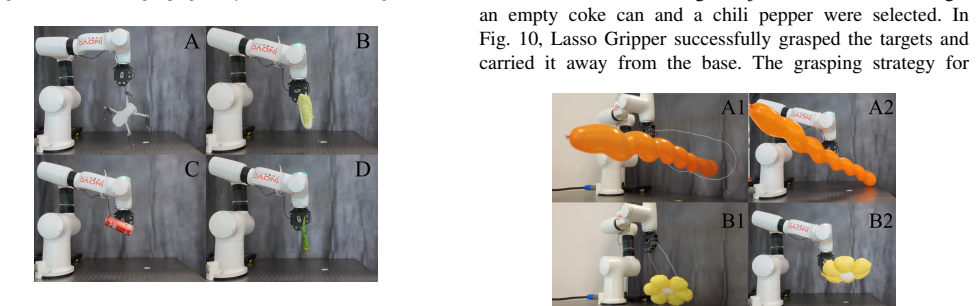
The central claim is that a string loop launched and retracted by four motor-driven wheels forms a stable, self-supporting loop whose shape is governed by a balance among tension, gravity, and linear air drag, and that this loop can serve as a universal end-effector. In the model, the loop's equilibrium is described by a Frenet-Serret balance that reduces to an integro-differential equation with an analytic solution $z_\pm(x)$ giving the top and bottom halves of the loop; the solution exists only when $R = \mu g/f < 1$, meaning drag outweighs weight. The paper reports that with fitted parameters $[R, x_+, x_-] = [0.33, 0.61\,\mathrm{m}, 0.12\,\mathrm{m}]$, the theoretical curve overlaps the measured loop boundary over 92.23% of the effective range. It then uses the loop as an extension of a six-axis arm and, via 200,000 Monte Carlo samples, reports that the workspace convex hull grows from $3.4620\,\mathrm{m^3}$ to $8.9002\,\mathrm{m^3}$, a 157.08% increase. In experiments, the gripper captures and transports a bull figure by the horns, a horse figure, a cabbage, a chili pepper, a drone, balloons up to 71 cm in diameter, and a balloon thrown through the loop mid-air.
Load-bearing premise
The calculation assumes the string is a perfectly flexible, inextensible 2D curve whose shape is set only by tension, gravity, and a constant linear drag coefficient, even though the gripper's wheels visibly deform the loop and the required ratio $R<1$ is asserted rather than measured.
Editorial extensions
If this is right
- A single string-loop end-effector can grasp objects larger than the gripper's own opening, because loop size is set by motor speed rather than jaw separation.
- Grasping force is a distributed tensile closure rather than concentrated fingertip pressure, so delicate targets such as balloons and vegetables can be lifted without visible deformation.
- The dynamic loop model predicts the string's 2D curve from a drag-to-weight ratio $R$, and its fitted curve overlaps the measured loop over 92.23% of the effective range.
- Mounted on a six-axis arm, the lasso extends the reachable workspace convex hull from $3.4620\,\mathrm{m^3}$ to $8.9002\,\mathrm{m^3}$, a 157.08% increase.
- The gripper can capture moving, airborne objects because the loop's large capture range tolerates position uncertainty.
Reading between the lines
- If the drag-supported loop model generalizes beyond the fitted case, the same idea could extend to aerial or mobile manipulators, where a lasso end-effector could capture moving targets from a distance rather than requiring the arm to reach them.
- The uniform-pressure claim suggests a testable comparison: instrument the string loop with force-sensitive thread or measure contact area, and compare contact stress with a parallel-jaw gripper on the same object.
- The loop model could be coupled with vision-based tracking to estimate $R$, $x_+$, and $x_-$ online, turning the static workspace analysis into closed-loop grasping.
- Multiple lassos or a net formed by several loops could distribute force further and stabilize large, deformable loads, as the paper hints at for future work.
Editorial analysis
A structured set of objections, weighed in public.
Referee Report
Summary. The paper presents the Lasso Gripper, a string-shooting and retracting end-effector for robotic grasping. The hardware uses four launch/retract motors plus a central winder, and the authors report a dynamical model of the self-supporting string loop based on prior string-shooter analyses, a workspace-extension analysis via Monte Carlo convex hulls, and qualitative demonstrations of grasping animal figures, vegetables, oversized balloons, and a thrown balloon. The paper's central quantitative claims are a 92.23% overlap between the model and a measured loop in Fig. 6 and a 157.08% workspace volume increase from 3.4620 m^3 to 8.9002 m^3.
Significance. If the hardware demonstrations are representative, the concept is a useful addition to grasping research, particularly for oversized, delicate, or moving objects that conventional antipodal grippers handle poorly. The open-source repository and demonstration video are valuable for reproducibility. However, the quantitative loop-shape and workspace results are not presently validated as predictions: the model parameters are fitted to the same data used for the overlap score, and the workspace calculation uses an unrelated, arbitrary parameter set. The qualitative grasping demonstrations are credible but do not by themselves substantiate the quantitative modeling claims.
major comments (4)
- [Section III-A, Fig. 6, Eq. (4)] The 92.23% overlap is a measure of fit quality, not a predictive validation. The parameters [R, x+, x-] = [0.33, 0.61 m, 0.12 m] are adjusted to match the blue sampling points in Fig. 3(B), and the overlap is then computed from those same points. To support the model as a predictive tool, the authors need to validate on held-out loops at different launch speeds, report repeated trials and error bars, or explicitly reframe the result as a best-fit demonstration.
- [Section III-A, Eqs. (2)-(4)] The claim that R = µg/f < 1 is asserted without any independent measurement of f, and the paper itself notes in the Fig. 6 text that the retraction wheels constrain the string in a way that differs from the modeling assumption. Since f is not measured and the wheel effects are acknowledged to alter the loop, the quantitative agreement with Eq. (4) does not establish the physical mechanism of aerodynamic support; an independent parameter identification or direct drag measurement is needed before the loop-shape results can be used for workspace analysis.
- [Section III-B, Fig. 8] The workspace computation uses [R, x+, x-] = [0.7, 0.2 m, 0.1 m] with no connection to the fitted parameters in Section III-A or to any measured launch speed. The 157.08% volume increase is the ratio of convex hull volumes, where the red workspace points are the furthest loop points at each arm pose; a rigid end-effector extension of comparable length would produce a similar offset. The number therefore does not test the string model and should be re-reported with uncertainty, parameter sensitivity, and a comparison against a simple reach-extension baseline.
- [Section IV, Figs. 9-13] The central 'gentle grasp' / 'uniform pressure' claim is supported only by qualitative visual evidence. No force or pressure measurement is reported along the string, and the comparison with the antipodal gripper is a single balloon-deformation observation. Since gentleness is stated as a key advantage over antipodal grippers, this claim should either be supported with quantitative force/pressure measurements or stated as a qualitative demonstration.
minor comments (4)
- [Section III-A, Eq. (1)] The term 'd(Tτ)/ds ds3' appears to contain a typo or formatting error; it should likely be 'd(Tτ)/ds ds' or similar.
- [Abstract and Section II-B] The abstract says the gripper is controlled by four motors, but Section II-B describes four launch/retract motors plus a central winding motor, i.e., five motors total. This inconsistency should be corrected.
- [Section III-A, Fig. 6] The phrase 'the intersection of the union between these two ranges is calculated to be 92.23%' is ambiguous; please define the sets and the overlap metric explicitly, e.g., as a Jaccard index or symmetric difference ratio.
- [Section III-B] The Monte Carlo method should report the number of trials, variance of the volume estimate, and the effect of the convex hull approximation; 200,000 samples are stated but no uncertainty is given.
Circularity Check
The Sec. III-A loop validation is circular: Eq. 4's shape parameters are adjusted to the same sampled loop and then compared with it, so the 92.23% overlap measures fit quality, not prediction; the 157.08% workspace number is a conditional calculation on arbitrary parameters, while the hardware demonstrations remain independent evidence.
-
fitted input called prediction
[Section III-A, 'Dynamics of the string loop', Eq. 4 and Fig. 6]
"The red curve is drawn according to Eq. 4, where the parameter [R, x+, x−] is adjusted as [0.33, 0.61m, 0.12m]. According to the X-coordinate of the experimental sampling points, a corresponding set of points is selected on the theoretical curve. The two sets of points form an effective grasping range, respectively. The intersection of the union between these two ranges is calculated to be 92.23%."
Eq. 4 contains three shape parameters [R, x+, x−], and the paper explicitly states they are 'adjusted' to match the blue experimental sampling points from Fig. 3(B). The same experimental points are then used, via their X-coordinates, to select theoretical points and to compute a 92.23% overlap. Because the parameters were fit to these very samples, the overlap is a goodness-of-fit statistic for the interpolation, not an independent validation or prediction. R is defined as µg/f, but f is never measured; setting R by fitting the curve makes the R < 1 existence condition an artifact of the fit rather than a measured physical property.
full rationale
The derivation chain has one genuinely circular quantitative link: the claimed validation of Eq. 4 in Section III-A. The three free parameters [R, x+, x−] are adjusted to the experimental loop sampled in Fig. 3(B), and the same points are then used to produce the 92.23% overlap figure; this is a fitted-input-called-prediction. The R<1 condition is likewise ensured by fitting rather than by independent drag-coefficient measurement, so the statement that aerodynamic drag surpasses gravity is not independently supported. The paper's own Fig. 6 note attributes residual error to the retraction-wheel direction constraint, which is one of the effects omitted by the model. The workspace extension in Section III-B is not circular in the same sense: it is a conditional geometric Monte Carlo calculation using a different, explicitly chosen parameter set [0.7, 0.2 m, 0.1 m] and the convex hull of the furthest loop point. The 157.08% figure therefore does not validate the model—it simply computes the geometric consequence of an assumed loop offset, which is a correctness/assumption risk rather than a reduction to the same data. There is no load-bearing self-citation: the dynamics originate from external fluid-mechanics references [21]-[23], and the physical grasping demonstrations (bull/horse figures, vegetables, balloons, moving objects) are independent evidence for the hardware concept. Because the central quantitative agreement claim reduces by construction while the overall hardware contribution stands, the circularity score is 6 (partial circularity), not higher.
Assumptions & free parameters
free parameters (3)
- R (mu g / f ratio) =
0.33 for loop validation; 0.7 for workspace simulation
- x+ =
0.61 m for validation; 0.2 m for workspace
- x- =
0.12 m for validation; 0.1 m for workspace
assumptions (5)
- standard math Frenet-Serret frame and Newton's second law for a moving string element.
- domain assumption The string is a perfectly flexible, one-dimensional curve with no bending stiffness, subject only to tension, gravity, and linear air drag per unit length.
- domain assumption The aerodynamic drag force always dominates gravity so R = mu g / f < 1, making the self-supporting loop solution finite.
- domain assumption The loop lies in one vertical plane defined by the ejection direction and gravity, with negligible roll and no effect from the retraction-wheel constraint on the free loop shape.
- domain assumption For the workspace analysis, the loop shape can be attached to the UR5 end effector as a fixed curve with parameters [R, x+, x-] = [0.7, 0.2 m, 0.1 m], and all convex hull points of the sampled loop are reachable.
Cite this review
Pith. "Pith review of Lasso Gripper: A String Shooting-Retracting Mechanism for Shape-Adaptive Grasping." pith.science (2026). https://pith.science/paper/6QV5FIMP
@misc{pith2026250614163,
  author       = {Pith},
  title        = {Pith review of: Lasso Gripper: A String Shooting-Retracting Mechanism for Shape-Adaptive Grasping},
  year         = {2026},
  howpublished = {\url{https://pith.science/paper/6QV5FIMP}},
  note         = {Machine review of arXiv:2506.14163}
}
read the original abstract
Handling oversized, variable-shaped, or delicate objects in transportation, grasping tasks is extremely challenging, mainly due to the limitations of the gripper's shape and size. This paper proposes a novel gripper, Lasso Gripper. Inspired by traditional tools like the lasso and the uurga, Lasso Gripper captures objects by launching and retracting a string. Contrary to antipodal grippers, which concentrate force on a limited area, Lasso Gripper applies uniform pressure along the length of the string for a more gentle grasp. The gripper is controlled by four motors-two for launching the string inward and two for launching it outward. By adjusting motor speeds, the size of the string loop can be tuned to accommodate objects of varying sizes, eliminating the limitations imposed by the maximum gripper separation distance. To address the issue of string tangling during rapid retraction, a specialized mechanism was incorporated. Additionally, a dynamic model was developed to estimate the string's curve, providing a foundation for the kinematic analysis of the workspace. In grasping experiments, Lasso Gripper, mounted on a robotic arm, successfully captured and transported a range of objects, including bull and horse figures as well as delicate vegetables. The demonstration video is available here: https://youtu.be/PV1J76mNP9Y.
Figures


Figures from the paper (9 more)




Reference graph
Works this paper leans on
-
[1]
Development of a three-axis gripper force sensor and the intelligent gripper using it
Gab-Soon Kim. Development of a three-axis gripper force sensor and the intelligent gripper using it. Sensors and Actuators A: Physical , 137(2):213–222, July 2007
work page 2007
-
[2]
Design of effective suction force sensible vacuum gripper by a 6-axis force sensor
Sou Izumi and Shuhei Ikemoto. Design of effective suction force sensible vacuum gripper by a 6-axis force sensor. Artificial Life and Robotics, 29(1):55–61, February 2024
work page 2024
-
[3]
The Fractal Hand-II: Reviving a Classic Mechanism for Contemporary Grasping Challenges
Malcolm GA Tisdale and Joel W Burdick. The fractal hand-ii: Reviving a classic mechanism for contemporary grasping challenges. arXiv preprint arXiv:2309.08766 , 2023
work page Pith review arXiv 2023
-
[4]
Closing the Loop with Liquid-Metal Sensing Skin for Autonomous Soft Robot Gripping
Jessica Yin, Tess Hellebrekers, and Carmel Majidi. Closing the Loop with Liquid-Metal Sensing Skin for Autonomous Soft Robot Gripping. In 2020 3rd IEEE International Conference on Soft Robotics (RoboSoft), pages 661–667, New Haven, CT, USA, May 2020. IEEE
work page 2020
-
[5]
DenseTact-Mini: An Optical Tactile Sensor for Grasping Multi-Scale Objects From Flat Surfaces
Won Kyung Do, Ankush Kundan Dhawan, Mathilda Kitzmann, and Monroe Kennedy III. DenseTact-Mini: An Optical Tactile Sensor for Grasping Multi-Scale Objects From Flat Surfaces, September 2023. arXiv:2309.08860 [cs]
work page Pith review arXiv 2023
-
[6]
Rui Peng, Zehao Wang, and Peng Lu. Aecom: An aerial continuum manipulator with imu-based kinematic modeling and tendon-slacking prevention. IEEE Transactions on Systems, Man, and Cybernetics: Systems, 53(8):4740–4752, 2023
work page 2023
-
[7]
California rodeo salinas lasso bull, 2006
David Monniaux. California rodeo salinas lasso bull, 2006. https: //commons.wikimedia.org/wiki/File:California_ rodeo_Salinas_lasso_bull_p1050544.jpg, Last accessed on 2024-09-10
work page 2006
-
[8]
A dual-mode and enclosing soft robotic gripper with stiffness-tunable and high-load capacity
Tete Hu, Xinjiang Lu, and Du Xu. A dual-mode and enclosing soft robotic gripper with stiffness-tunable and high-load capacity. Sensors and Actuators A: Physical , 354:114294, 2023
work page 2023
Show all 23 references
-
[9]
A soft robotic gripper with a belt loop actuated adhesion design for gentle handling of fragile object
Gen Chen, Junsong Wu, Zijian Zhang, Bolun Zhang, Zhongyi Chu, and Jing Cui. A soft robotic gripper with a belt loop actuated adhesion design for gentle handling of fragile object. IEEE Robotics and Automation Letters, 2024
2024
-
[10]
Design and development of a soft gripper with topology optimization
Hongying Zhang, Michael Yu Wang, Feifei Chen, Yiqiang Wang, A Senthil Kumar, and Jerry YH Fuh. Design and development of a soft gripper with topology optimization. In 2017 IEEE/RSJ international conference on intelligent robots and systems (IROS), pages 6239–6244. IEEE, 2017
2017
-
[11]
Design and Modeling of a Nested Bi-cavity-based Soft Growing Robot for Grasping in Constrained Environments
Haochen Yong, Fukang Xu, Chenfei Li, Han Ding, and Zhigang Wu. Design and Modeling of a Nested Bi-cavity-based Soft Growing Robot for Grasping in Constrained Environments. In 2024 IEEE International Conference on Robotics and Automation (ICRA) , pages 2346–2352, Yokohama, Japa...
2024
-
[12]
A low-cost underactuated compliant gripper with multifunctional jaws for precision manipulation
Xiantao Sun, Shang Yang, Yuxia Li, Weihai Chen, and Yan Jin. A low-cost underactuated compliant gripper with multifunctional jaws for precision manipulation. Sensors and Actuators A: Physical , 366:115047, 2024
2024
-
[13]
The velo gripper: A versatile single-actuator design for enveloping, parallel and fingertip grasps
Matei Ciocarlie, Fernando Mier Hicks, Robert Holmberg, Jeffrey Hawke, Michael Schlicht, Jeff Gee, Scott Stanford, and Ryan Bahadur. The velo gripper: A versatile single-actuator design for enveloping, parallel and fingertip grasps. The International Journal of Robotics Researc...
2014
-
[14]
A lightweight soft gripper driven by self-sensing super-coiled polymer actuator
Sen Wang, Hongxin Huang, Hailin Huang, Bing Li, and Ke Huang. A lightweight soft gripper driven by self-sensing super-coiled polymer actuator. IEEE Robotics and Automation Letters , 6(2):2775–2782, 2021
2021
-
[15]
Olukayode, K.O
O. Olukayode, K.O. Alawode, T.O. Ajewole, and W.O. Adedeji. Design and analysis of a novel light-weight, linear actuator driven flexible PET strips robotic gripper. UNIOSUN Journal of Engineering and Environmental Sciences, 5(1), March 2023
2023
-
[16]
A soft gripper with variable stiffness inspired by pan- golin scales, toothed pneumatic actuator and autonomous controller
Tao Sun, Yuanlong Chen, Tianyu Han, Chenlei Jiao, Binbin Lian, and Yimin Song. A soft gripper with variable stiffness inspired by pan- golin scales, toothed pneumatic actuator and autonomous controller. Robotics and Computer-Integrated Manufacturing , 61:101848, 2020
2020
-
[17]
Development of a bio-inspired soft gripper with claws
Mingjun Li, Manjia Su, Rongzhen Xie, Yihong Zhang, Haifei Zhu, Tao Zhang, and Yisheng Guan. Development of a bio-inspired soft gripper with claws. In 2017 IEEE International Conference on Robotics and Biomimetics (ROBIO), pages 828–833. IEEE, 2017
2017
-
[18]
String shooter-string launcher - physics of toys, Home- made Science with Bruce Yeany, 2014
Bruce Yeany. String shooter-string launcher - physics of toys, Home- made Science with Bruce Yeany, 2014. https://www.youtube. com/watch?v=rffAjZPmkuU, Last accessed on 2024-09-07
2014
-
[19]
How to make a diy string shooter - diy infinity string shooter, 2022
Sine Tech. How to make a diy string shooter - diy infinity string shooter, 2022. https://www.youtube.com/watch?v= iMbUSu9IeRw, Last accessed on 2024-09-07
2022
-
[20]
String shooting device, July 2 2024
Stephen Giovanni Fazio, Austin Mark Hillam, and Mark Gordon Hillam. String shooting device, July 2 2024. US Patent 12,025,399
2024
-
[21]
String shooter’s overall shape in ambient air
Abello, Margaux, Courson, Juliette, Maury, Arnaud, and Renaud, Julian. String shooter’s overall shape in ambient air. Emergent Scientist, 4:1, 2020
2020
-
[22]
The charmed string: self-supporting loops through air drag
Adrian Daerr, Juliette Courson, Margaux Abello, Wladimir Toutain, and Bruno Andreotti. The charmed string: self-supporting loops through air drag. Journal of Fluid Mechanics , 877:R2, 2019
2019
-
[23]
Propelled strings: rising from friction
Nicolas Taberlet, J ´er´emy Ferrand, and Nicolas Plihon. Propelled strings: rising from friction. Physical Review Letters, 123(14):144501, 2019
2019
Reviewed August 7, 2026 · model on record in the stance chip above.
Discussion (0). Continue with ORCID to comment.