Dark bubbles, dark dimensions and fat gravitons
Pith reviewed 2026-06-26 15:39 UTC · model grok-4.3
The pith
The dark bubble model realizes both the dark dimension proposal and fat graviton scenario with a micron-scale hierarchy.
A machine-rendered reading of the paper's core claim, the machinery that carries it, and where it could break.
Core claim
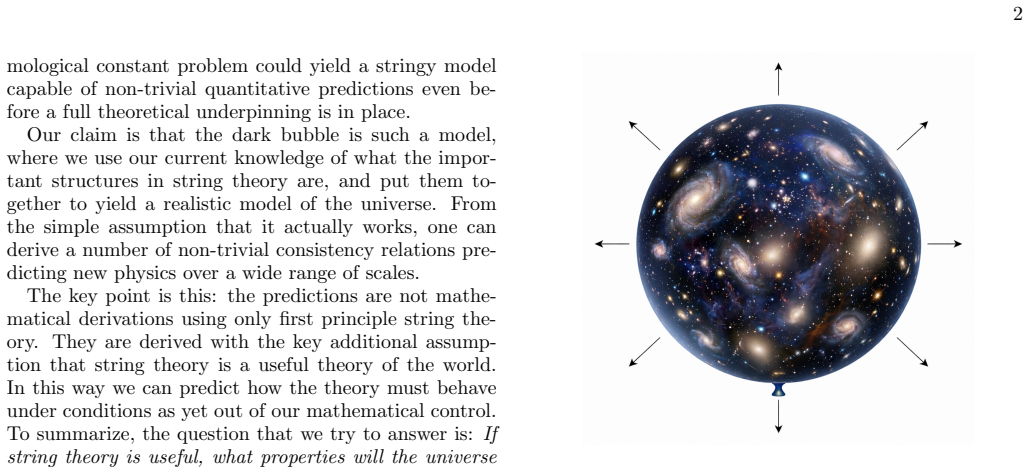
The dark bubble model provides a concrete realization of both the dark dimension proposal and Sundrum's fat graviton scenario, predicting a dark dimension of micron size, weakening of gravity at that scale, string scale of order tens of TeV, and measurable positive spatial curvature of the universe.
What carries the argument
The dark bubble construction, which uses de Sitter swampland instabilities to force accelerated expansion and generate the scale hierarchy.
If this is right
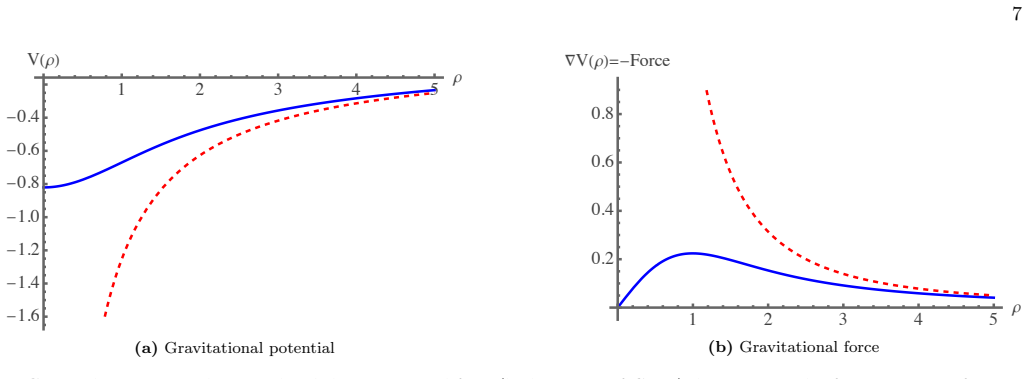
- Gravity weakens at distances comparable to the dark dimension scale, causing the force to fade at micron distances.
- The string scale sits at tens of TeV, altering expectations for high-energy physics.
- The universe exhibits measurable positive spatial curvature.
- Gravity effectively stops probing distances shorter than the dark dimension scale.
- The model unifies the dark dimension idea with the fat graviton picture in one framework.
Where Pith is reading between the lines
- Experiments searching for short-distance gravity deviations could directly test the micron-scale prediction.
- The TeV string scale suggests collider signals might appear at energies lower than usually assumed in string theory.
- Positive curvature measurements could distinguish this scenario from standard inflationary models.
- The hierarchy might guide searches for other string-derived effects at accessible scales.
Load-bearing premise
A consistent dark bubble construction must exist in string theory that produces the claimed hierarchy from the de Sitter instabilities without extra contradictions or fine-tuning.
What would settle it
Failure to detect positive spatial curvature in the universe or absence of gravity weakening at micron distances would contradict the model's predictions.
Figures
read the original abstract
The dark bubble model explains the existence of a positive cosmological constant by making explicit use of the instabilities underlying the de Sitter swampland conjectures to make the accelerated expansion of the universe inevitable. A distinctive consequence of the construction is a unique hierarchy connecting cosmological, gravitational, string, and higher-dimensional scales. In particular, the model naturally predicts the existence of a dark dimension of micron size, an idea that has been argued for on independent grounds in the literature. The same framework also predicts a weakening of gravity at distances of order the dark-dimension scale, leading to a fading of the gravitational force at micron distances. We argue that the dark bubble therefore provides a concrete realization of both the dark dimension proposal and Sundrum's fat graviton scenario, in which gravity effectively ceases to probe shorter distances. Additional predictions include a string scale of order tens of TeV and a measurable positive spatial curvature of the universe. We review these key aspects of the model, discuss their implications for gravity and cosmology, and highlight its key predictions.
Editorial analysis
A structured set of objections, weighed in public.
Referee Report
Summary. The paper claims that the dark bubble model explains the positive cosmological constant by utilizing instabilities from the de Sitter swampland conjectures to make accelerated expansion inevitable, producing a hierarchy of scales that predicts a micron-sized dark dimension, weakening of gravity at that scale (realizing Sundrum's fat graviton), a string scale of tens of TeV, and measurable positive spatial curvature. It positions the construction as a concrete realization of both the dark dimension proposal and fat graviton scenarios.
Significance. If an explicit, consistent string-theoretic realization of the dark bubble exists that derives the claimed hierarchy without extra tuning or swampland contradictions, the work would link swampland conjectures to testable cosmological and gravitational predictions, including curvature measurements and short-distance gravity deviations.
major comments (2)
- [Abstract] Abstract: the claim that the model 'naturally predicts' a micron-scale dark dimension and tens-of-TeV string scale is not supported by an independent derivation from the bubble parameters; these values are fixed by matching to the observed cosmological constant, reducing them to fitted quantities by construction rather than emergent predictions.
- The central claim that the dark bubble supplies a 'concrete realization' of the dark dimension and fat graviton scenarios requires an explicit brane/flux construction in string theory that produces the full scale hierarchy while remaining consistent with all other swampland bounds and introducing no additional fine-tuning. No such compactification data, derivation, or consistency check is provided.
minor comments (1)
- [Abstract] The abstract states that the paper 'reviews these key aspects of the model' but does not clearly separate model assumptions from derived results or cite the original dark bubble references for the instabilities used.
Simulated Author's Rebuttal
We thank the referee for their detailed report and for highlighting points that require clarification. We address each major comment below. Where the manuscript can be improved for precision, we indicate the planned revisions.
read point-by-point responses
-
Referee: [Abstract] Abstract: the claim that the model 'naturally predicts' a micron-scale dark dimension and tens-of-TeV string scale is not supported by an independent derivation from the bubble parameters; these values are fixed by matching to the observed cosmological constant, reducing them to fitted quantities by construction rather than emergent predictions.
Authors: We agree that the specific numerical values (micron scale and tens of TeV) are obtained by matching the model's output for the cosmological constant to its observed value. The construction does, however, derive a definite functional relation between the dark-dimension radius, the string scale, the bubble tension, and the de Sitter curvature scale that follows directly from the bubble nucleation dynamics and the swampland instabilities. Once the observed CC is inserted, the hierarchy is fixed without additional free parameters. The term 'naturally predicts' refers to this non-trivial linkage rather than to a parameter-free derivation of the absolute scale. We will revise the abstract and the relevant sections to state explicitly that the absolute scales are fixed by matching to the CC while the hierarchy itself is an output of the model. revision: yes
-
Referee: The central claim that the dark bubble supplies a 'concrete realization' of the dark dimension and fat graviton scenarios requires an explicit brane/flux construction in string theory that produces the full scale hierarchy while remaining consistent with all other swampland bounds and introducing no additional fine-tuning. No such compactification data, derivation, or consistency check is provided.
Authors: The manuscript presents the dark bubble as an effective realization motivated by string-theory and swampland considerations, rather than as a complete top-down compactification. No explicit brane/flux data or full consistency check with every swampland bound is supplied, because the work focuses on the cosmological and gravitational consequences of the model. A microscopic string embedding that realizes the required hierarchy without extra tuning would strengthen the claim and remains an open task. We will add a clarifying paragraph in the introduction and conclusions that delimits the present scope and identifies the construction of an explicit string realization as future work. revision: partial
- An explicit brane/flux compactification realizing the full dark-bubble hierarchy together with a complete check against all swampland bounds.
Circularity Check
No circularity: derivation presented as consequence of explicit construction
full rationale
The provided abstract and context describe the dark bubble model as using de Sitter swampland instabilities to explain positive Lambda, with a hierarchy of scales (micron dark dimension, tens of TeV string scale) presented as a distinctive consequence of the construction. No equations, self-citations, or steps are exhibited that reduce the numerical predictions to a fit of the observed cosmological constant by construction. The claims rest on the existence and consistency of the string-theoretic construction itself, which is an external assumption rather than an internal definitional loop. No load-bearing self-citation chain or ansatz smuggling is visible in the given material. This is the normal case of a model whose outputs follow from its stated premises without reduction to input data.
Axiom & Free-Parameter Ledger
free parameters (2)
- dark dimension size =
micron
- string scale =
tens of TeV
axioms (1)
- domain assumption de Sitter swampland conjectures hold and their instabilities explain the positive cosmological constant
invented entities (2)
-
dark bubble
no independent evidence
-
dark dimension
no independent evidence
Reference graph
Works this paper leans on
-
[1]
scenario
it was argued that all of this could be upheld while still satisfying the equivalence principle for the Standard model matter. Another way to argue for gravity becoming weaker at small scales is the non-renormalizability of quantum gravity itself. It is at small scales that these problems show up, and if gravity shuts itself off, the problems would go awa...
-
[2]
S. Banerjee, U. Danielsson, G. Dibitetto, S. Giri, and M. Schillo, Emergent de Sitter Cosmology from Decay- ing Anti–de Sitter Space, Phys. Rev. Lett.121, 261301 (2018), arXiv:1807.01570 [hep-th]
Pith/arXiv arXiv 2018
-
[3]
A. Strominger and C. Vafa, Microscopic origin of the Bekenstein-Hawking entropy, Phys. Lett. B379, 99 (1996), arXiv:hep-th/9601029
Pith/arXiv arXiv 1996
-
[4]
U. H. Danielsson and T. Van Riet, What if string theory has no de Sitter vacua?, Int. J. Mod. Phys. D27, 1830007 (2018), arXiv:1804.01120 [hep-th]
Pith/arXiv arXiv 2018
-
[5]
G. Obied, H. Ooguri, L. Spodyneiko, and C. Vafa, De Sit- ter Space and the Swampland, (2018), arXiv:1806.08362 [hep-th]
Pith/arXiv arXiv 2018
-
[6]
M. Montero, C. Vafa, and I. Valenzuela, The dark dimension and the Swampland, JHEP02, 022, arXiv:2205.12293 [hep-th]
-
[7]
P. Berglund, T. H¨ ubsch, and D. Minic, Stringy Bub- bles Solve de Sitter Troubles, Universe7, 363 (2021), arXiv:2109.01122 [hep-th]
arXiv 2021
-
[8]
Andriot, Dark energy from string theory: an intro- ductory review, (2026), arXiv:2603.25797 [hep-th]
D. Andriot, Dark energy from string theory: an intro- ductory review, (2026), arXiv:2603.25797 [hep-th]
Pith/arXiv arXiv 2026
-
[9]
A. G. Riesset al.(Supernova Search Team), Observa- tional evidence from supernovae for an accelerating uni- verse and a cosmological constant, Astron. J.116, 1009 (1998), arXiv:astro-ph/9805201
Pith/arXiv arXiv 1998
-
[10]
Sundrum, Fat gravitons, the cosmological constant and submillimeter tests, Phys
R. Sundrum, Fat gravitons, the cosmological constant and submillimeter tests, Phys. Rev. D69, 044014 (2004), arXiv:hep-th/0306106
Pith/arXiv arXiv 2004
-
[11]
S. Banerjee, U. Danielsson, G. Dibitetto, S. Giri, and M. Schillo, de Sitter Cosmology on an expanding bubble, JHEP10, 164, arXiv:1907.04268 [hep-th]
arXiv 1907
-
[12]
Randall and R
L. Randall and R. Sundrum, Large mass hierarchy from a small extra dimension, Physical Review Letters83, 3370–3373 (1999), arXiv:9905221 [hep-ph]
1999
-
[13]
Randall and R
L. Randall and R. Sundrum, An alternative to compact- ification, Physical Review Letters83, 4690–4693 (1999), arXiv:9906064 [hep-th]
1999
-
[14]
A. G. Adameet al.(DESI), DESI 2024 VI: cosmologi- cal constraints from the measurements of baryon acous- tic oscillations, JCAP02, 021, arXiv:2404.03002 [astro- ph.CO]
Pith/arXiv arXiv 2024
-
[15]
Efstathiou, Evolving dark energy or supernovae sys- tematics?, Mon
G. Efstathiou, Evolving dark energy or supernovae sys- tematics?, Mon. Not. Roy. Astron. Soc.538, 875 (2025), arXiv:2408.07175 [astro-ph.CO]
arXiv 2025
-
[16]
U. Danielsson and D. Panizo, Experimental tests of dark bubble cosmology, Phys. Rev. D109, 026003 (2024), arXiv:2311.14589 [hep-th]
arXiv 2024
-
[17]
U. Danielsson, O. Henriksson, and D. Panizo, Stringy realization of a small and positive cosmological constant in dark bubble cosmology, Phys. Rev. D107, 026020 (2023), arXiv:2211.10191 [hep-th]
arXiv 2023
-
[18]
H. Ooguri and C. Vafa, Non-supersymmetric AdS and the Swampland, Adv. Theor. Math. Phys.21, 1787 (2017), arXiv:1610.01533 [hep-th]
Pith/arXiv arXiv 2017
-
[19]
U. Danielsson and G. Dibitetto, Fate of stringy AdS vacua and the weak gravity conjecture, Phys. Rev. D96, 026020 (2017), arXiv:1611.01395 [hep-th]
Pith/arXiv arXiv 2017
-
[20]
S. Banerjee, U. Danielsson, and S. Giri, Bubble needs strings, JHEP21, 250, arXiv:2009.01597 [hep-th]
arXiv 2009
-
[21]
S. Banerjee, U. Danielsson, and S. Giri, Dark bubbles: decorating the wall, JHEP04, 085, arXiv:2001.07433 [hep-th]
arXiv 2001
-
[22]
Padilla, Infra-red modification of gravity from asym- metric branes, Class
A. Padilla, Infra-red modification of gravity from asym- metric branes, Class. Quant. Grav.22, 1087 (2005), arXiv:hep-th/0410033
Pith/arXiv arXiv 2005
-
[23]
S. Banerjee, U. Danielsson, and S. Giri, Dark bubbles and black holes, JHEP09, 158, arXiv:2102.02164 [hep-th]
-
[24]
U. Danielsson and V. Van Hemelryck, Charged Nariai black holes on the dark bubble, Class. Quant. Grav.41, 245011 (2024), arXiv:2405.13679 [hep-th]
arXiv 2024
-
[25]
Danielsson and S
U. Danielsson and S. Giri, Work in progress, (2026)
2026
-
[26]
S. Banerjee, U. Danielsson, and S. Giri, Features of a dark energy model in string theory, Phys. Rev. D108, 126009 (2023), arXiv:2212.14004 [hep-th]
arXiv 2023
-
[27]
U. Danielsson and S. Giri, Weak gravity at micron scales from dark bubble cosmology and its cosmolog- ical consequences, Phys. Rev. D113, 126010 (2026), arXiv:2511.21362 [hep-th]
Pith/arXiv arXiv 2026
-
[28]
S. Banerjee, U. Danielsson, and M. Zemsch, The dark bubbleography, JHEP02, 102, arXiv:2311.16242 [hep- th]
-
[29]
G. Compere and D. Marolf, Setting the boundary free in AdS/CFT, Class. Quant. Grav.25, 195014 (2008), arXiv:0805.1902 [hep-th]
Pith/arXiv arXiv 2008
-
[30]
P. S. Apostolopoulos, G. Siopsis, and N. Tetradis, Cosmology from an AdS Schwarzschild black hole via holography, Phys. Rev. Lett.102, 151301 (2009), arXiv:0809.3505 [hep-th]
Pith/arXiv arXiv 2009
-
[31]
S. Banerjee, S. Bhowmick, A. Sahay, and G. Siopsis, Gen- eralized Holographic Cosmology, Class. Quant. Grav.30, 075022 (2013), arXiv:1207.2983 [hep-th]
Pith/arXiv arXiv 2013
-
[32]
J. Garriga and T. Tanaka, Gravity in the brane world, Phys. Rev. Lett.84, 2778 (2000), arXiv:hep-th/9911055
Pith/arXiv arXiv 2000
-
[33]
Khoury, Fading gravity and self-inflation, Phys
J. Khoury, Fading gravity and self-inflation, Phys. Rev. D76, 123513 (2007), arXiv:hep-th/0612052
Pith/arXiv arXiv 2007
-
[34]
U. H. Danielsson, D. Panizo, R. Tielemans, and T. Van Riet, Higher-dimensional view on quan- tum cosmology, Phys. Rev. D104, 086015 (2021), arXiv:2105.03253 [hep-th]
arXiv 2021
-
[35]
Danielsson, S
U. Danielsson, S. Giri, V. Mohan, and L. Thorlacius, Work in progress, (2026)
2026
-
[36]
J. D. Bekenstein, The quantum mass spectrum of the Kerr black hole, Lett. Nuovo Cim.11, 467 (1974)
1974
-
[37]
V. F. Mukhanov, Are black holes quantized?, JETP Lett. 44, 63 (1986). 11
1986
-
[38]
J. D. Bekenstein and V. F. Mukhanov, Spectroscopy of the quantum black hole, Phys. Lett. B360, 7 (1995), arXiv:gr-qc/9505012
Pith/arXiv arXiv 1995
- [39]
-
[40]
U. Danielsson, D. Panizo, and V. Van Hemelryck, Self- gravitating electromagnetic waves in the dark bubble model, (2026), arXiv:2606.16547 [hep-th]
arXiv 2026
discussion (0)
Sign in with ORCID, Apple, or X to comment. Anyone can read and Pith papers without signing in.