REVIEW 4 major objections 3 minor 49 references
Neural Posterior Unfolding claims that a normalizing flow trained on simulated truth-versus-measured histogram pairs yields a full, calibrated posterior over unfolded cross sections, with accurate maximum-likelihood readout and correct unce
Reviewed by Pith at T0; open to challenge. T0 means a machine referee read the full paper against a public rubric. the ladder, T0–T4 →
T0 review · deepseek-v4-flash
2026-08-04 23:42 UTC pith:6S6YOHC4
load-bearing objection NPU is a credible proof-of-concept for flow-based binned unfolding, but the training prior is unspecified and the validation is mostly same-prior, so the UQ claims outrun the evidence. the 4 major comments →
Neural Posterior Unfolding
The pith
A machine-rendered reading of the paper's core claim, the machinery that carries it, and where it could break.
Core claim
The paper's central claim is that binned unfolding can be cast as an amortized neural posterior estimation problem. A normalizing flow is trained on pairs of particle-level and detector-level histograms to approximate p(t|m), the density of the true histogram t given the measured histogram m; after training, unfolding a new measurement is a maximum-likelihood optimization over t under the learned density. The claim is that this gives a full, properly calibrated posterior with correlations, that it reproduces the true spectrum in Gaussian and LHC-like tests, and that it handles degenerate response regions correctly by returning a broad posterior where iterative Bayesian unfolding would report
What carries the argument
The central object is a conditional normalizing flow—an invertible neural network that maps a simple base distribution to a flexible probability density—trained with a negative log-likelihood loss on (truth, measured) histogram pairs to approximate p(t|m). The measured histogram serves as the conditional input, and the output is a density over truth histograms. After training, a maximum-likelihood estimation step optimizes the learned log-density with respect to the truth vector to extract the unfolded spectrum from new data. This flow does the work that MCMC does in Fully Bayesian Unfolding, but amortized: the expensive density learning happens once, and each new dataset only needs the fast
Load-bearing premise
The load-bearing premise is that the simulated (truth, detector-level) pairs used to train the flow describe the same relationship as the real data, and that the distribution of truth histograms in training is close enough to the real spectrum that the likelihood dominates; otherwise the learned p(t|m) can be wrong and the unfolded result silently biased.
What would settle it
Take a trained NPU model and unfold pseudo-experiments whose true spectrum is deliberately far from the training prior, e.g. a Gaussian with a different mean and width under the same detector response; if the maximum-likelihood readout is visibly pulled toward the training distribution, or the posterior's credible intervals do not contain the true spectrum at the claimed rate, the accuracy claim fails outside the training regime.
If this is right
- Every unfolded cross section comes with a full posterior over bins, including correlations, rather than a single point estimate, so downstream physics statements can propagate the complete statistical uncertainty.
- In detector-degenerate regions, NPU reports wide credible intervals reflecting the true ambiguity, correcting the zero-uncertainty failure of iterative Bayesian unfolding.
- The amortized training makes re-unfolding with bootstrapped or newly arriving data cheap after one training pass: the paper reports about five minutes of training versus roughly 67 minutes for 100 pseudo-experiments with MCMC-based unfolding.
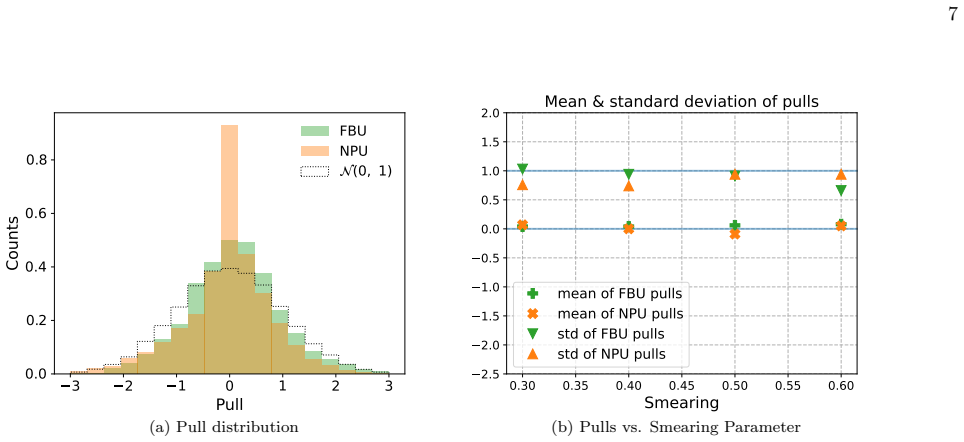
- NPU and FBU both pass pull-based calibration tests with means near zero and widths near one across tested smearing parameters, indicating the posterior is statistically well calibrated in the tested cases.
- The method reproduces truth for LHC-like jet substructure observables in simulation, making it a plausible candidate for analysis-ready unfolding at the LHC and beyond.
Where Pith is reading between the lines
- Inference: The two-bin degenerate argument implies that any regularized matrix-inversion method whose regularization acts on the truth vector—not just IBU—will understate uncertainty where response rows nearly coincide; NPU-style posterior estimation is a generic fix for that failure mode.
- Inference: Since the paper does not specify the training prior over truth histograms in detail, the method's reliability on data whose true spectrum is far outside that prior is untested; an obvious stress test is to train on one prior and unfold pseudo-data drawn from a different one.
- Inference: The flow's conditional density could be extended to include detector-systematic parameters such as smear widths and efficiencies by conditioning on them, turning the method into a joint statistical-plus-systematic unfolding.
- Inference: Because the flow provides a density over histograms, the same machinery is naturally suited to unbinned unfolding if the conditional density is defined over individual event-level observables instead of bin counts; the paper names this as a future direction.
Editorial analysis
A structured set of objections, weighed in public.
Referee Report
Summary. The paper introduces Neural Posterior Unfolding (NPU), a normalizing-flow-based method that learns the posterior p(t|m) over binned particle-level histograms t conditional on measured detector-level histograms m, using simulated (truth, measured) pairs. The unfolded result is obtained by maximizing the learned posterior over t. The paper also provides a modern Python implementation of Fully Bayesian Unfolding (FBU). The methods are first tested on a 2-bin degenerate-response example, where NPU returns a broad posterior while IBU incorrectly reports zero uncertainty on the bin ratio; then on an 8-bin Gaussian example with pull-based calibration checks; and finally on LHC-like jet substructure observables, using Herwig as pseudo-data and Pythia to build the response. The central claims are that NPU provides accurate unfolded central values, full posterior uncertainties that remain well-calibrated in weakly constrained regions, and fast amortized inference.
Significance. If the central claims hold, NPU would be a useful contribution to the unfolding literature: it offers amortized inference, direct posterior access, and a principled treatment of degenerate response regions where classical methods such as IBU are known to underestimate uncertainty. The paper also provides a modern, maintained FBU implementation and releases code, which are practical assets for the community. The conceptual demonstration on the 2-bin degenerate example is clear and valuable. However, the paper's load-bearing claims about posterior fidelity and calibration are not yet fully supported: the training prior for NPU is never specified, the Gaussian validation is same-prior, the acknowledged undercoverage at low smearing is not reconciled with the calibration conclusion, and the LHC example lacks quantitative agreement tests. These gaps are fixable, but they are central to the advertised advantages of the method.
major comments (4)
- [Sec. III and Sec. IV] The training prior for NPU is never specified. The method learns p(t|m) from (truth, measured) pairs, but the text never states how the truth histograms t are sampled in training. The only statement, in Sec. IV, that 'A uniform prior is also used for NPU (chosen based on the distribution of parameter points in the training sample)' is ambiguous and does not define a sampling distribution or range. Since the posterior in weakly constrained regions is dominated by the prior, an unspecified prior makes the uncertainty quantification claims unreproducible. Please specify the training pair generation procedure, including the prior over t, explicitly.
- [Sec. V.B, Table II] The Gaussian validation tests NPU only under the training prior. The simulation and natural datasets both have mu=0, sigma=1, so the test truth is drawn from the same distribution as the training samples. The pull tests in Fig. 4 therefore establish calibration under the training prior, not the ability to unfold a genuinely different true distribution. Since real data are not drawn from the simulation prior, this is a load-bearing gap. Please add a validation where the test truth is drawn from a different distribution (e.g., shifted mu or sigma) and report pulls/coverage, or otherwise demonstrate that the likelihood dominates the prior.
- [Sec. V.B, Fig. 4b and Sec. VI] The paper acknowledges that 'NPU appears to underestimate the variance at low smearing' (Fig. 4b), yet the conclusions state that both methods 'consistently produced pulls with mu=0 and sigma=1 across the tested smearing parameters.' These statements are contradictory. Undercoverage is a calibration failure that directly affects the central claim of reliable uncertainty quantification. Please quantify the pull standard deviations for each smearing value, report their statistical uncertainties, and either correct the conclusions or explain why this behavior is acceptable.
- [Sec. V.C, Fig. 5] The LHC example provides only a qualitative comparison between the unfolded result and the truth. The ratio-to-truth panels show agreement within bands, but no pulls, chi-square statistics, or coverage tests are reported for this mismatched-prior scenario. Given that this is the only external grounding of the method on a data distribution different from the training prior, a quantitative agreement test is necessary to support the claim that NPU 'accurately recovered their central values' and to validate the reported posterior widths.
minor comments (3)
- [Sec. II, Eq. (1)] The IBU update is written as t_j^{(n)} = sum_i Pr^{n-1}(truth_j|measure_i) Pr(measure_i). As written, this appears to be missing the normalization by total counts; the subsequent Eq. (2) is clearer. Please correct or clarify the notation.
- [Fig. 2(b) caption] The response matrix R is defined as R_ij = Pr(measure_i | truth_j), but the displayed matrix is labeled Pr(Truth | Reco). Please clarify whether the plotted matrix is the transpose of R or an element-wise conditional probability, and ensure the axes and colorbar labels are consistent.
- [Sec. VI] Typo: 'including including jet width' appears in the conclusions. Also, the references to 'T able' and 'Fig. 4' formatting should be checked for journal style.
Circularity Check
No significant circularity: NPU's learned posterior is trained on simulation pairs and applied to held-out/out-of-prior data; the main caveats are prior specification and validation scope, not circular reasoning.
full rationale
NPU trains a conditional normalizing flow on (truth, measured) simulation pairs to learn p(t|m), then obtains point estimates by maximizing this learned posterior over t (Algorithm 1). This is amortized neural posterior estimation; the training prior is an input, not a hidden re-use of the target. No equation in the paper equates a 'prediction' to a fitted parameter by construction. The Gaussian pull tests (Sec. V.B) use pseudo-experiments whose truth is drawn from the same Gaussian as the training sample; this checks calibration of the flow under the training prior, which is a legitimate self-consistency test, not a forced result—the flow could still be miscalibrated and the pulls could deviate from N(0,1). The physics example (Sec. V.C) provides an out-of-prior check by unfolding Herwig 'data' with a Pythia-based response, with agreement shown in Fig. 5. The paper's self-citations ([36,37] for datasets; [50] for an overview) are not load-bearing arguments. Sec. VI explicitly defers 'sensitivity to prior choices' to future work; that is a limitation of scope, but it does not make the derivation circular. Therefore no circular step can be exhibited with the specificity required.
Axiom & Free-Parameter Ledger
free parameters (3)
- NPU training prior over truth histograms =
not specified in paper
- Flow network hyperparameters =
3 layers + 1 conditional, 50-100 nodes, Swish, epochs 1000-1500, batch size 10^4, lr 10^-4
- FBU uniform prior width =
±5√t around t
axioms (4)
- domain assumption The response matrix R accurately models the detector response.
- standard math The observed counts follow a Poisson distribution given the true spectrum.
- domain assumption The normalizing flow converges to a faithful approximation of the posterior p(t|m) on the training distribution.
- domain assumption The training pairs (truth, measured histograms) are sampled from the same prior and response model that govern the data being unfolded.
Cite this review
Pith. "Pith review of Neural Posterior Unfolding." pith.science (2026). https://pith.science/paper/6S6YOHC4
@misc{pith2026250906370,
  author       = {Pith},
  title        = {Pith review of: Neural Posterior Unfolding},
  year         = {2026},
  howpublished = {\url{https://pith.science/paper/6S6YOHC4}},
  note         = {Machine review of arXiv:2509.06370}
}
read the original abstract
Differential cross section measurements are the currency of scientific exchange in particle and nuclear physics. A key challenge for these analyses is the correction for detector distortions, known as deconvolution or unfolding. Binned unfolding of cross section measurements traditionally rely on the regularized inversion of the response matrix that represents the detector response, mapping pre-detector (`particle level') observables to post-detector (`detector level') observables. In this paper we introduce Neural Posterior Unfolding, a modern, Bayesian approach that leverages normalizing flows for unfolding. By using normalizing flows for neural posterior estimation, NPU offers several key advantages including implicit regularization through the neural network architecture, fast amortized inference that eliminates the need for repeated retraining, and direct access to the full uncertainty in the unfolded result. In addition to introducing NPU, we implement a classical Bayesian unfolding method called Fully Bayesian Unfolding (FBU) in modern Python so it can also be studied. These tools are validated on simple Gaussian examples and then tested on simulated jet substructure examples from the Large Hadron Collider (LHC). We find that the Bayesian methods are effective and worth additional development to be analysis ready for cross section measurements at the LHC and beyond.
Figures



Reference graph
Works this paper leans on
-
[1]
Adye, inPHYSTAT 2011(CERN, Geneva, 2011) pp
T. Adye, inPHYSTAT 2011(CERN, Geneva, 2011) pp. 313–318, arXiv:1105.1160 [physics.data-an]
Pith/arXiv arXiv 2011
-
[2]
Arratiaet al., (2021), arXiv:2109.13243 [hep-ph]
M. Arratiaet al., (2021), arXiv:2109.13243 [hep-ph]
Pith/arXiv arXiv 2021
-
[3]
Huetschet al., (2024), arXiv:2404.18807 [hep-ph]
N. Huetschet al., (2024), arXiv:2404.18807 [hep-ph]
Pith/arXiv arXiv 2024
- [4]
-
[5]
Blobel, PHYSTAT2011 Proceedings , 240 (2011)
V. Blobel, PHYSTAT2011 Proceedings , 240 (2011)
work page 2011
-
[6]
Blobel, Data Analysis in High Energy Physics , 187 (2013)
V. Blobel, Data Analysis in High Energy Physics , 187 (2013). 3 Unlike cases of computationally expensive forward models, the generative model here is a simple product of Poisson distributions. However, the computational differences may be non–negligible when many bootstraps are required for classical uncertainty quantification. 10
work page 2013
-
[7]
R. Balasubramanian, L. Brenner, C. Burgard, G. Cowan, V. Croft, W. Verkerke, and P. Verschuuren, (2019), arXiv:1910.14654 [physics.data-an]
Pith/arXiv arXiv 2019
-
[8]
G. Choudalakis, “Fully bayesian unfolding,” (2012), arXiv:1201.4612 [physics.data-an]
Pith/arXiv arXiv 2012
-
[9]
G. Aadet al.(ATLAS), JHEP02, 107 (2014), arXiv:1311.6724 [hep-ex]
work page internal anchor Pith review Pith/arXiv arXiv 2014
-
[10]
G. Aadet al.(ATLAS), JHEP05, 061 (2015), arXiv:1501.07383 [hep-ex]
work page internal anchor Pith review Pith/arXiv arXiv 2015
-
[11]
O. Adrianiet al.(LHCf), Phys. Rev. D94, 032007 (2016), arXiv:1507.08764 [hep-ex]
Pith/arXiv arXiv 2016
-
[12]
G. Aadet al.(ATLAS), Eur. Phys. J. C76, 87 (2016), [Erratum: Eur.Phys.J.C 77, 564 (2017)], arXiv:1509.02358 [hep-ex]
work page internal anchor Pith review Pith/arXiv arXiv 2016
-
[13]
G. Aadet al.(ATLAS), Phys. Lett. B756, 52 (2016), arXiv:1512.06092 [hep-ex]
work page internal anchor Pith review Pith/arXiv arXiv 2016
-
[14]
G. Aadet al.(ATLAS), Phys. Rev. D94, 032006 (2016), arXiv:1604.05538 [hep-ex]
work page internal anchor Pith review Pith/arXiv arXiv 2016
-
[15]
Aadet al.(ATLAS), JHEP08, 159 (2016), arXiv:1606.00689 [hep-ex]
G. Aadet al.(ATLAS), JHEP08, 159 (2016), arXiv:1606.00689 [hep-ex]
Pith/arXiv arXiv 2016
-
[16]
M. Aaboudet al.(ATLAS), JHEP03, 113 (2017), arXiv:1612.07004 [hep-ex]
work page internal anchor Pith review Pith/arXiv arXiv 2017
-
[17]
C. Aidalaet al.(PHENIX), Phys. Rev. D99, 092003 (2019), arXiv:1901.08405 [hep-ex]
-
[18]
G. Aadet al.(ATLAS), Eur. Phys. J. C82, 374 (2022), arXiv:2110.05453 [hep-ex]
work page internal anchor Pith review Pith/arXiv arXiv 2022
-
[19]
G. Aadet al.(ATLAS), Phys. Rev. D108, 012022 (2023), arXiv:2204.12355 [hep-ex]
work page internal anchor Pith review Pith/arXiv arXiv 2023
-
[20]
G. Aadet al.(ATLAS), JHEP08, 077 (2023), arXiv:2208.12095 [hep-ex]
work page internal anchor Pith review Pith/arXiv arXiv 2023
-
[21]
Theano: A python framework for fast computation of mathematical expressions,
T. T. D. Team, R. Al-Rfou, G. Alain, A. Almahairi, C. Angermueller, D. Bahdanau, N. Ballas, F. Bastien, J. Bayer, A. Be- likov, A. Belopolsky, Y. Bengio, A. Bergeron, J. Bergstra, V. Bisson, J. B. Snyder, N. Bouchard, N. Boulanger-Lewandowski, X. Bouthillier, A. de Br´ ebisson, O. Breuleux, P.-L. Carrier, K. Cho, J. Chorowski, P. Christiano, T. Cooijmans,...
Pith/arXiv arXiv 2016
-
[22]
Variational inference with normalizing flows,
D. J. Rezende and S. Mohamed, “Variational inference with normalizing flows,” (2016), arXiv:1505.05770 [stat.ML]
Pith/arXiv arXiv 2016
- [24]
-
[25]
W. H. Richardson, J. Opt. Soc. Am.62, 55 (1972)
1972
-
[26]
L. B. Lucy, Astronomical Journal79, 745 (1974)
work page 1974
-
[27]
L. A. Shepp and Y. Vardi, IEEE transactions on medical imaging1, 113 (1982)
work page 1982
-
[28]
Efron, The Annals of Statistics7, 1 (1979)
B. Efron, The Annals of Statistics7, 1 (1979)
1979
-
[29]
TensorFlow: Large- scale machine learning on heterogeneous systems,
M. Abadi, A. Agarwal, P. Barham, E. Brevdo, Z. Chen, C. Citro, G. S. Corrado, A. Davis, J. Dean, M. Devin, S. Ghemawat, I. Goodfellow, A. Harp, G. Irving, M. Isard, Y. Jia, R. Jozefowicz, L. Kaiser, M. Kudlur, J. Levenberg, D. Man´ e, R. Monga, S. Moore, D. Murray, C. Olah, M. Schuster, J. Shlens, B. Steiner, I. Sutskever, K. Talwar, P. Tucker, V. Vanhouc...
work page 2015
-
[30]
J. V. Dillon, I. Langmore, D. Tran, E. Brevdo, S. Vasudevan, D. Moore, B. Patton, A. Alemi, M. D. Hoffman, and R. A. Saurous, CoRRabs/1711.10604(2017), 1711.10604
Pith/arXiv arXiv 2017
-
[31]
M. Germain, K. Gregor, I. Murray, and H. Larochelle, (2015), arXiv:1502.03509 [cs.LG]
Pith/arXiv arXiv 2015
-
[32]
G. Papamakarios, T. Pavlakou, and I. Murray, (2018), arXiv:1705.07057 [stat.ML]
Pith/arXiv arXiv 2018
-
[33]
P. Ramachandran, B. Zoph, and Q. V. Le, arXiv preprint arXiv:1710.05941 (2017)
Pith/arXiv arXiv 2017
-
[34]
J. Salvatier, T. V. Wiecki, and C. Fonnesbeck, PeerJ Computer Science2, e55 (2016)
work page 2016
-
[35]
M. D. Hoffman and A. Gelman, Journal of Machine Learning Research15, 1593 (2014)
2014
-
[36]
A. Andreassen, P. T. Komiske, E. M. Metodiev, B. Nachman, and J. Thaler, Phys. Rev. Lett.124, 182001 (2020), arXiv:1911.09107 [hep-ph]
Pith/arXiv arXiv 2020
-
[37]
Pythia/Herwig + Delphes Jet Datasets for OmniFold Unfolding,
A. Andreassen, P. Komiske, E. Metodiev, B. Nachman, and J. Thaler, “Pythia/Herwig + Delphes Jet Datasets for OmniFold Unfolding,” (2019)
work page 2019
-
[38]
Bellmet al., (2017), arXiv:1705.06919 [hep-ph]
J. Bellmet al., (2017), arXiv:1705.06919 [hep-ph]
Pith/arXiv arXiv 2017
-
[39]
T. Sj¨ ostrand, S. Ask, J. R. Christiansen, R. Corke, N. Desai, P. Ilten, S. Mrenna, S. Prestel, C. O. Rasmussen, and P. Z. Skands, Comput. Phys. Commun.191, 159 (2015), arXiv:1410.3012 [hep-ph]
Pith/arXiv arXiv 2015
-
[40]
ATLAS Collaboration, (2014),https://cds.cern.ch/record/1966419
arXiv 2014
-
[41]
J. de Favereau, C. Delaere, P. Demin, A. Giammanco, V. Lema ˆ ıtre, A. Mertens, and M. Selvaggi (DELPHES 3), JHEP 02, 057 (2014), arXiv:1307.6346 [hep-ex]
Pith/arXiv arXiv 2014
-
[42]
Chatrchyanet al.(CMS), JINST3, S08004 (2008)
S. Chatrchyanet al.(CMS), JINST3, S08004 (2008)
work page 2008
-
[43]
M. Cacciari, G. P. Salam, and G. Soyez, JHEP04, 063 (2008), arXiv:0802.1189 [hep-ph]
Pith/arXiv arXiv 2008
-
[44]
M. Cacciari, G. P. Salam, and G. Soyez, Eur. Phys. J.C72, 1896 (2012), arXiv:1111.6097 [hep-ph]
Pith/arXiv arXiv 2012
-
[45]
A. J. Larkoski, I. Moult, and B. Nachman, Physics Reports841, 1–63 (2020)
work page 2020
-
[46]
J. Thaler and K. Van Tilburg, Journal of High Energy Physics2011(2011), 10.1007/jhep03(2011)015
-
[47]
J. Thaler and K. Van Tilburg, Journal of High Energy Physics2012(2012), 10.1007/jhep02(2012)093
-
[48]
A. J. Larkoski, S. Marzani, G. Soyez, and J. Thaler, Journal of High Energy Physics2014(2014), 10.1007/jhep05(2014)146. 11
-
[49]
M. Dasgupta, A. Fregoso, S. Marzani, and G. P. Salam, Journal of High Energy Physics2013(2013), 10.1007/jhep09(2013)029
-
[50]
N. Huetsch, J. Mari˜ no Villadamigo, A. Shmakov, S. Diefenbacher, V. Mikuni, T. Heimel, M. J. Fenton, K. T. Greif, B. Nachman, D. Whiteson, A. Butter, and T. Plehn, SciPost Physics18(2025), 10.21468/scipostphys.18.2.070
discussion (0)
Sign in with ORCID, Apple, or X to comment. Anyone can read and Pith papers without signing in.