REVIEW 2 major objections 4 minor 47 references
A room-temperature CMOS photonic chip encodes three qubits in single-photon degrees of freedom and beats size-matched classical nets and a superconducting processor on ML benchmarks.
Reviewed by Pith at T0; open to challenge. T0 means a machine referee read the full paper against a public rubric. the ladder, T0–T4 →
T0 review · grok-4.5
2026-07-11 00:22 UTC pith:6SKU4RVD
load-bearing objection Solid room-temperature photonic hardware demo with a real noise comparison; the multi-class classical baselines look broken and undercut the accuracy-advantage claim. the 2 major comments →
Design and Benchmarking of a Quantum Photonic Chip
The pith
A machine-rendered reading of the paper's core claim, the machinery that carries it, and where it could break.
Core claim
RP000, a CMOS-compatible three-qubit photonic processor operating at room temperature, implements a graded multi-qubit encoding in single-photon modes and, when used inside quantum and hybrid quantum-classical classifiers, achieves higher test accuracy than classical networks of similar size on multiple datasets while exhibiting lower output error than the same circuit executed on a superconducting processor under matched conditions.
What carries the argument
The (Z2)3-graded encoding of three logical qubits into the momentum labels of a single photon, which lets a reconfigurable Mach-Zehnder mesh realize the layered Ry/Rz-plus-CNOT ansatz as mode-preserving linear-optical transformations without requiring photon-photon gates.
Load-bearing premise
The classical comparison networks are assumed to be fair, fully optimized counterparts of equal size; if those baselines were under-trained, the reported accuracy advantage disappears.
What would settle it
Re-train the classical multi-class networks with the same hyper-parameter budget and architecture search used for the hybrid models; if the classical accuracy then matches or exceeds the hybrid figures on the same train-test splits, the claimed quantum advantage is refuted.
If this is right
- Room-temperature photonic QPUs can be inserted into existing telecom-compatible ML pipelines without cryogenics.
- Photon-loss-as-rate-reduction rather than logical error simplifies error mitigation for variational algorithms.
- The graded-mode encoding supplies a compact route to parity-check operations needed by quantum error-correcting codes.
- Hybrid quantum-classical stacks of modest size already outperform pure classical nets of matching parameter count on selected tabular tasks.
Where Pith is reading between the lines
- If the same graded encoding extends cleanly to more modes, detector and source integration become the dominant remaining engineering barriers rather than fundamental optical limits.
- The multi-class classical accuracies near chance level suggest that a more aggressive classical baseline search would be the first independent replication target.
- Superior noise tolerance under matched shots implies photonic platforms may be preferable for shallow variational circuits even before fault tolerance.
Editorial analysis
A structured set of objections, weighed in public.
Referee Report
Summary. The manuscript presents RP000, a three-qubit photonic quantum processor fabricated on a 220-nm SOI platform with CMOS-compatible processes, operating at room temperature in the telecom C-band. Three logical qubits are encoded in the degrees of freedom of single photons and described via a (Z2)^3-graded Lie-algebraic framework. The authors calibrate on-chip unitaries (target-state probabilities >98%, average 99.04%, stable over 64 h), implement a layered Ry/Rz + CNOT Ansatz, and embed it in three QML architectures of increasing complexity (QuantumNN, Serial QC, Parallel QC). They report binary and multi-class classification results on STATLOG and YEAST, comparing noiseless simulation, the photonic chip, a superconducting device under matched circuits/angles/shots, and classical fully-connected networks whose parameter counts are matched to the quantum Ansatz. The headline claims are higher accuracy than the classical baselines in multiple settings and lower MAE/RMSE on sigmoid outputs relative to the superconducting processor.
Significance. A room-temperature, CMOS-compatible photonic processor with documented calibration stability and a direct, shot-matched noise comparison against a superconducting device is a useful experimental contribution to the photonic QML literature. The graded-algebra language, while largely descriptive, offers a compact way to discuss multi-degree-of-freedom encoding. If the accuracy advantage over classical networks of comparable size is robust under equal optimization, the work would strengthen the case for small photonic processors as practical feature extractors. The calibration data and the MAE/RMSE comparison under matched conditions are the most solid and immediately citable results.
major comments (2)
- Table II, multi-class rows: the classical counterparts of SerialQC are reported at exactly 31.31% accuracy on both STATLOG and YEAST, while the quantum hybrids reach 76.95% and 42.09%. For the class cardinalities of these datasets this figure is consistent with a near-constant or collapsed classifier. The text states only that HC is chosen so that the classical parameter count approximately matches the Ansatz; it does not report optimizer settings, epoch count, learning-rate schedule, early-stopping, or restarts for the classical baselines, whereas the quantum models receive an Optuna search of up to 80 configurations. Without evidence that the classical nets were trained to convergence under the same protocol, the multi-class accuracy advantage (the strongest numerical support for the abstract claim) is not secure.
- Section V and Table II: the abstract and conclusions assert that RP000 'achieves higher accuracy than classical networks of comparable size in multiple use cases.' For the binary QuantumNN rows the classical max accuracies (99.57%, 64.25%) already meet or exceed the chip results (97.74%, 63.12%), and only the average classical figures are lower. The multi-class SerialQC gap is therefore load-bearing for the headline claim; if that gap is an optimization artifact, the claim must be narrowed to the noise-tolerance comparison and the binary average-case results.
minor comments (4)
- Section III (Chip as Graded Paraparticle): the (Z2)^3-graded formalism is presented at length but is not used to derive any gate, calibration step, or experimental prediction in the benchmarking sections; a shorter pointer to the prior arXiv:2505.23232 would suffice.
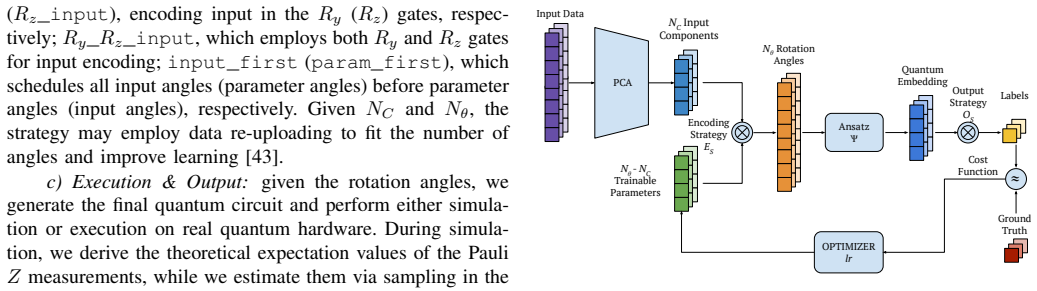
- Figure 1 caption and surrounding text: the Ansatz is described as containing CNOT gates, yet the photonic implementation is linear-optical; a brief remark on how the logical CNOTs are realized (or post-selected) would remove ambiguity.
- Table I and Section IV-A: the output strategy OS is listed as a hyperparameter for QuantumNN but is left blank for the hybrid models; a one-sentence clarification of how multi-class labels are obtained from the three-dimensional quantum embedding would help.
- References: several photonic QML benchmarking works (e.g., the open collaborative baseline arXiv:2510.25839 cited in the related-work section) could be discussed more explicitly when positioning the classical-control methodology.
Circularity Check
No load-bearing circularity: accuracy and noise-tolerance claims are empirical comparisons under a standard ML pipeline; graded-algebra language is only descriptive scaffolding from overlapping-author prior work.
full rationale
The paper's central claims (higher test accuracy than parameter-matched classical nets on STATLOG/YEAST binary and multi-class tasks; lower MAE/RMSE on sigmoid outputs versus a superconducting device under matched circuits, angles and shots) are obtained by direct execution/simulation of a fixed Ansatz, hyper-parameter search (Optuna, k-fold CV), and comparison against classical fully-connected baselines of comparable parameter count. No equation or prediction is obtained by fitting a free parameter to a subset of the same data and then re-labeling the fit as a first-principles result. The (Z2)^3-graded Lie-algebra language (Section III-c, citing arXiv:2505.23232 by overlapping authors) is used solely to describe the momentum-to-grade encoding already realized by the fabricated chip; it is never invoked to derive, force, or uniqueness-justify the reported accuracies or error metrics. Hyper-parameter choices (NC, ES, lr, HS, …) are ordinary validation-set tuning, not circular re-use of test-set information. Consequently the derivation chain does not reduce to its own inputs by construction. The only minor self-citation is non-load-bearing descriptive scaffolding, warranting a score of 1 rather than 0.
Axiom & Free-Parameter Ledger
free parameters (4)
- NC (PCA components)
- encoding strategy ES
- learning rate lr and hidden sizes HS/H1P/H2P/HC
- coincidence window and detector efficiencies η xyz
axioms (4)
- domain assumption Photon loss reduces detection rate but does not distort the conditional probability distribution of the detected photons.
- ad hoc to paper A classical fully-connected network with HC neurons chosen so that its parameter count approximately equals the quantum Ansatz parameter count is a fair baseline.
- domain assumption The (Z2)^3-graded Lie algebra correctly classifies the momentum-mode couplings realized by the photonic circuit.
- standard math Standard linear-optical components (MZIs, thermo-optic phase shifters) implement the intended unitary up to the calibrated residual error <2 %.
invented entities (2)
-
RP000 three-qubit photonic processor
no independent evidence
-
momentum-only (Z2)^3-graded paraparticle encoding
no independent evidence
read the original abstract
We present the design and benchmarking of RP000, a quantum photonic processor capable of encoding a quantum system in the degrees of freedom of single photons, based on standard CMOS-compatible manufacturing processes, and working at room temperature. We benchmark it against machine learning tasks, evaluating three quantum-classical architectures of increasing complexity. Our experimental results and simulations show that RP000 achieves higher accuracy than classical networks of comparable size in multiple use cases. Compared to a superconducting quantum processor, RP000 exhibits superior noise tolerance. These findings demonstrate that RP000 can provide a scalable route toward efficient quantum applications.
Figures



Reference graph
Works this paper leans on
-
[1]
Fusion- based quantum computation,
S. Bartolucci, P. Birchall, H. Bombin, H. Cable, C. Dawson, M. Gimeno- Segovia, E. Johnston, K. Kieling, N. Nickerson, M. Pantet al., “Fusion- based quantum computation,”Nature Communications, vol. 14, no. 1, p. 912, 2023
work page 2023
-
[2]
Quantum computational advantage with a programmable photonic processor,
L. S. Madsen, F. Laudenbach, M. F. Askarani, F. Rortais, T. Vincent, J. F. Bulmer, F. M. Miatto, L. Neuhaus, L. G. Helt, M. J. Collinset al., “Quantum computational advantage with a programmable photonic processor,”Nature, vol. 606, no. 7912, pp. 75–81, 2022
work page 2022
-
[3]
Bench- marking quantum computers,
T. Proctor, K. Young, A. D. Baczewski, and R. Blume-Kohout, “Bench- marking quantum computers,”Nature Reviews Physics, pp. 1–14, 2025
work page 2025
-
[4]
The source code will be made available by the authors upon reasonable request
“The source code will be made available by the authors upon reasonable request.”
-
[5]
M. A. Nielsen and I. L. Chuang,Quantum computation and quantum information. Cambridge university press, 2010
work page 2010
-
[6]
B. E. Saleh and M. C. Teich,Fundamentals of photonics, 2 volume set. john Wiley & sons, 2019
work page 2019
-
[7]
C. C. Gerry and P. L. Knight,Introductory quantum optics. Cambridge university press, 2023
work page 2023
-
[8]
Integrated photonic quantum technologies,
J. Wang, F. Sciarrino, A. Laing, and M. G. Thompson, “Integrated photonic quantum technologies,”Nature photonics, vol. 14, no. 5, pp. 273–284, 2020
work page 2020
-
[9]
Majid,Foundations of quantum group theory
S. Majid,Foundations of quantum group theory. Cambridge university press, 2000
work page 2000
-
[10]
A. Klimyk and K. Schm ¨udgen,Quantum groups and their representa- tions. Springer Science & Business Media, 2012
work page 2012
-
[11]
Four-qubit variational algorithms in silicon photonics with integrated entangled photon sources,
A. Baldazzi, M. Sanna, M. Borghi, S. Azzini, and L. Pavesi, “Four-qubit variational algorithms in silicon photonics with integrated entangled photon sources,”npj Quantum Information, vol. 11, no. 1, p. 107, 2025
work page 2025
-
[12]
Multidimensional quantum entanglement with large-scale integrated optics,
J. Wang, S. Paesani, Y . Ding, R. Santagati, P. Skrzypczyk, A. Salavrakos, J. Tura, R. Augusiak, L. Man ˇcinska, D. Baccoet al., “Multidimensional quantum entanglement with large-scale integrated optics,”Science, vol. 360, no. 6386, pp. 285–291, 2018
work page 2018
-
[13]
Programmable four-photon graph states on a silicon chip,
J. C. Adcock, C. Vigliar, R. Santagati, J. W. Silverstone, and M. G. Thompson, “Programmable four-photon graph states on a silicon chip,” Nature communications, vol. 10, no. 1, p. 3528, 2019
work page 2019
-
[14]
Chip-to-chip quantum teleportation and multi-photon entanglement in silicon,
D. Llewellyn, Y . Ding, I. I. Faruque, S. Paesani, D. Bacco, R. Santagati, Y .-J. Qian, Y . Li, Y .-F. Xiao, M. Huberet al., “Chip-to-chip quantum teleportation and multi-photon entanglement in silicon,”Nature Physics, vol. 16, no. 2, pp. 148–153, 2020
work page 2020
-
[15]
Advances in silicon quantum photonics,
J. C. Adcock, J. Bao, Y . Chi, X. Chen, D. Bacco, Q. Gong, L. K. Ox- enløwe, J. Wang, and Y . Ding, “Advances in silicon quantum photonics,” IEEE Journal of Selected Topics in Quantum Electronics, vol. 27, no. 2, pp. 1–24, 2020
work page 2020
-
[16]
A linear photonic swap test circuit for quantum kernel estimation,
A. Baldazzi, N. Leone, M. Sanna, S. Azzini, and L. Pavesi, “A linear photonic swap test circuit for quantum kernel estimation,”Quantum Science and Technology, vol. 9, no. 4, p. 045053, 2024
work page 2024
-
[17]
F. Toppan, “Hermitean versus holomorphic complex and quaternionic generalized supersymmetries of the m-theory. a classification,”J. Phys. A: Math. Theor., vol. 54, no. 11, p. 115203, 2021
work page 2021
-
[18]
F. Tamburini, N. Leone, M. Sanna, and R. Siagri, “Graded paraparticle algebra of majorana fields for multidimensional quantum computing with structured light,”arXiv preprint arXiv:2505.23232, May 2025. [Online]. Available: https://arxiv.org/abs/2505.23232
work page internal anchor Pith review Pith/arXiv arXiv 2025
-
[19]
Systematic benchmarking of quantum computers: status and recommendations
J. M. Lorenz, T. Monz, J. Eisert, D. Reitzner, F. Schopfer, F. Barbaresco, K. Kurowski, W. van der Schoot, T. Strohm, J. Senellartet al., “System- atic benchmarking of quantum computers: status and recommendations,” arXiv preprint arXiv:2503.04905, 2025
work page internal anchor Pith review Pith/arXiv arXiv 2025
-
[20]
Quantum certification and benchmarking,
J. Eisert, D. Hangleiter, N. Walk, I. Roth, D. Markham, R. Parekh, U. Chabaud, and E. Kashefi, “Quantum certification and benchmarking,” Nature Reviews Physics, vol. 2, no. 7, pp. 382–390, 2020
work page 2020
-
[21]
Randomized benchmarking of quantum gates,
E. Knill, D. Leibfried, R. Reichle, J. Britton, R. B. Blakestad, J. D. Jost, C. Langer, R. Ozeri, S. Seidelin, and D. J. Wineland, “Randomized benchmarking of quantum gates,”Physical Review A—Atomic, Molecu- lar, and Optical Physics, vol. 77, no. 1, p. 012307, 2008
work page 2008
-
[22]
Characterizing quan- tum gates via randomized benchmarking,
E. Magesan, J. M. Gambetta, and J. Emerson, “Characterizing quan- tum gates via randomized benchmarking,”Physical Review A—Atomic, Molecular, and Optical Physics, vol. 85, no. 4, p. 042311, 2012
work page 2012
-
[23]
Averaged circuit eigenvalue sampling
S. T. Flammia, “Averaged circuit eigenvalue sampling,”arXiv preprint arXiv:2108.05803, 2021
work page internal anchor Pith review Pith/arXiv arXiv 2021
-
[24]
E. T. Hockings, A. C. Doherty, and R. Harper, “Scalable noise character- ization of syndrome-extraction circuits with averaged circuit eigenvalue sampling,”PRX quantum, vol. 6, no. 1, p. 010334, 2025
work page 2025
-
[25]
Validating quantum computers using randomized model circuits,
A. W. Cross, L. S. Bishop, S. Sheldon, P. D. Nation, and J. M. Gambetta, “Validating quantum computers using randomized model circuits,”Physical Review A, vol. 100, no. 3, p. 032328, 2019
work page 2019
-
[26]
Benchmarking Quantum Processor Performance at Scale
D. C. McKay, I. Hincks, E. J. Pritchett, M. Carroll, L. C. Govia, and S. T. Merkel, “Benchmarking quantum processor performance at scale,” arXiv preprint arXiv:2311.05933, 2023
work page internal anchor Pith review Pith/arXiv arXiv 2023
-
[27]
Entanglement detection in the stabilizer for- malism,
G. T ´oth and O. G ¨uhne, “Entanglement detection in the stabilizer for- malism,”Physical Review A—Atomic, Molecular, and Optical Physics, vol. 72, no. 2, p. 022340, 2005
work page 2005
-
[28]
Efficient distributed inner product estimation via pauli sampling,
M. Hinsche, M. Ioannou, S. Jerbi, L. Leone, J. Eisert, and J. Carrasco, “Efficient distributed inner product estimation via pauli sampling,”arXiv preprint arXiv:2405.06544, 2024
-
[29]
The linpack benchmark: past, present and future,
J. J. Dongarra, P. Luszczek, and A. Petitet, “The linpack benchmark: past, present and future,”Concurrency and Computation: practice and experience, vol. 15, no. 9, pp. 803–820, 2003
work page 2003
-
[30]
Random circuit block-encoded matrix and a proposal of quantum linpack benchmark,
Y . Dong and L. Lin, “Random circuit block-encoded matrix and a proposal of quantum linpack benchmark,”Physical Review A, vol. 103, no. 6, p. 062412, 2021
work page 2021
-
[31]
Quantum windowed fourier transform and its application to quantum signal processing,
H. Yin, D. Lu, and R. Zhang, “Quantum windowed fourier transform and its application to quantum signal processing,”International Journal of Theoretical Physics, vol. 60, pp. 3896–3918, 2021
work page 2021
-
[32]
Using quantum computers for quantum simulation,
K. L. Brown, W. J. Munro, and V . M. Kendon, “Using quantum computers for quantum simulation,”Entropy, vol. 12, no. 11, pp. 2268– 2307, 2010
work page 2010
-
[33]
Benchmarking quantum copro- cessors in an application-centric, hardware-agnostic, and scalable way,
S. Martiel, T. Ayral, and C. Allouche, “Benchmarking quantum copro- cessors in an application-centric, hardware-agnostic, and scalable way,” IEEE Transactions on Quantum Engineering, vol. 2, pp. 1–11, 2021
work page 2021
-
[34]
Quas: Quantum application score for benchmarking the utility of quan- tum computers,
K. J. Mesman, W. van der Schoot, M. M ¨oller, and N. M. Neumann, “Quas: Quantum application score for benchmarking the utility of quan- tum computers,” in2024 IEEE International Conference on Quantum Computing and Engineering (QCE), vol. 1. IEEE, 2024, pp. 921–929
work page 2024
-
[35]
Application-oriented performance benchmarks for quantum computing,
T. Lubinski, S. Johri, P. Varosy, J. Coleman, L. Zhao, J. Necaise, C. H. Baldwin, K. Mayer, and T. Proctor, “Application-oriented performance benchmarks for quantum computing,”IEEE Transactions on Quantum Engineering, vol. 4, pp. 1–32, 2023
work page 2023
-
[36]
BenchQC: A Benchmarking Toolkit for Quantum Computation
N. Pollard and K. Choudhary, “Benchqc: A benchmarking toolkit for quantum computation,”arXiv preprint arXiv:2502.09595, 2025
work page internal anchor Pith review Pith/arXiv arXiv 2025
-
[37]
Quark: A framework for quantum computing application benchmarking,
J. R. Fin ˇzgar, P. Ross, L. H¨olscher, J. Klepsch, and A. Luckow, “Quark: A framework for quantum computing application benchmarking,” in 2022 IEEE international conference on quantum computing and engi- neering (QCE). IEEE, 2022, pp. 226–237
work page 2022
-
[38]
C. Notton, V . Apostolou, A. Senellart, A. Walsh, D. Wang, Y . Xie, S. Yang, I. Mejdoub, O. Zouhry, K.-C. Chenet al., “Establishing baselines for photonic quantum machine learning: Insights from an open, collaborative initiative,”arXiv preprint arXiv:2510.25839, 2025
-
[39]
Does provable absence of barren plateaus imply classical simulability?
M. Cerezo, M. Larocca, D. Garc ´ıa-Mart´ın, N. L. Diaz, P. Braccia, E. Fontana, M. S. Rudolph, P. Bermejo, A. Ijaz, S. Thanasilpet al., “Does provable absence of barren plateaus imply classical simulability?” Nature Communications, vol. 16, no. 1, p. 7907, 2025
work page 2025
-
[40]
Barren plateaus swamped with traps,
N. A. Nemkov, E. O. Kiktenko, and A. K. Fedorov, “Barren plateaus swamped with traps,”Physical Review A, vol. 111, no. 1, p. 012441, 2025
work page 2025
-
[41]
On quantum backpropagation, informa- tion reuse, and cheating measurement collapse,
A. Abbas, R. King, H.-Y . Huang, W. J. Huggins, R. Movassagh, D. Gilboa, and J. McClean, “On quantum backpropagation, informa- tion reuse, and cheating measurement collapse,”Advances in Neural Information Processing Systems, vol. 36, pp. 44 792–44 819, 2023
work page 2023
-
[42]
Principal component analysis: A natural approach to data exploration,
F. L. Gewers, G. R. Ferreira, H. F. D. Arruda, F. N. Silva, C. H. Comin, D. R. Amancio, and L. d. F. Costa, “Principal component analysis: A natural approach to data exploration,”ACM Computing Surveys (CSUR), vol. 54, no. 4, pp. 1–34, 2021
work page 2021
-
[43]
Data re-uploading for a universal quantum classifier,
A. P ´erez-Salinas, A. Cervera-Lierta, E. Gil-Fuster, and J. I. Latorre, “Data re-uploading for a universal quantum classifier,”Quantum, vol. 4, p. 226, 2020
work page 2020
-
[44]
Quantum Algorithms for Deep Convolutional Neural Networks
I. Kerenidis, J. Landman, and A. Prakash, “Quantum algorithms for deep convolutional neural networks,”arXiv preprint arXiv:1911.01117, 2019
work page internal anchor Pith review Pith/arXiv arXiv 1911
-
[45]
Better than classical? The subtle art of benchmarking quantum machine learning models
J. Bowles, S. Ahmed, and M. Schuld, “Better than classical? the subtle art of benchmarking quantum machine learning models,”arXiv preprint arXiv:2403.07059, 2024
work page internal anchor Pith review Pith/arXiv arXiv 2024
-
[46]
A. Srinivasan, “Statlog (Landsat Satellite),” UCI Machine Learning Repository, 1993, DOI: https://doi.org/10.24432/C55887
-
[47]
Expert system for predicting protein local- ization sites in gram-negative bacteria,
K. Nakai and M. Kanehisa, “Expert system for predicting protein local- ization sites in gram-negative bacteria,”Proteins: Structure, Function, and Bioinformatics, vol. 11, no. 2, pp. 95–110, 1991
work page 1991
discussion (0)
Sign in with ORCID, Apple, or X to comment. Anyone can read and Pith papers without signing in.