REVIEW 3 major objections 4 minor 26 references
Progressive Monitoring of Generative Model Training Evolution
T0 review · 3 major / 4 minor · reviewed 2026-08-11 · deepseek-v4-flash
Pith's one-line read The paper proposes a live, iteratively aligned 2D embedding of model states and data distributions that lets a trainer spot and correct demographic bias during GAN training, demonstrated on hair-color translation.
desk verdict A promising visual-analytics framework for catching GAN training biases, undermined by a self-contradictory FID result and an unvalidated embedding assumption. read the letter →
The pith
A machine-rendered reading of the paper's core claim, the machinery that carries it, and where it could break.
The reading
What carries the argument
The load-bearing object is the evolutionary embedding (EvolvED), a dimensionality-reduction technique that projects data extracted at regular training intervals into a shared 2D space and explicitly encodes and aligns each iteration with its predecessor: points from the same instance across iterations are vertically aligned, while each iteration forms a horizontally grouped cluster. The framework feeds different model elements into this embedding, including discriminator latent features and CLIP-encoded versions of real and generated images, so that cluster separation and overlap can be read as distributional behavior. It is what turns a sequence of high-dimensional snapshots into a single evolving picture that a human can inspect and act on.
What would settle it
Train an identical AttentionGAN on a CelebA split whose grey- and blond-hair gender ratios are deliberately balanced, run the monitoring framework, and check whether the grey-female and blond-male clusters still separate from the real data. If the separation persists without the demographic skew, the embedding is signaling projection artifacts; if it disappears, the clusters are a faithful indicator of data-driven bias that standard loss curves miss.
Extended reading notes
Core claim
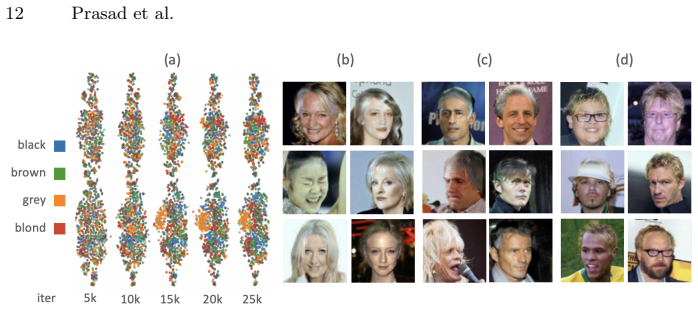
The central claim is that the evolution of high-dimensional model states, such as discriminator feature vectors and CLIP-encoded images, can be made interpretable with an evolutionary dimensionality-reduction embedding that encodes iteration order and aligns each step with the previous one. In the demonstrated GAN case, the embedding separates generated from real distributions and reveals subgroups the generator cannot render realistically: fake grey-haired women form a cluster away from real grey samples, and fake blond-haired men drift toward feminine features. The authors trace this to training-data imbalance and show that a mid-training intervention, pausing at 25,000 out of 200,000 iterations, adding web-scraped images, and resuming from iteration 5,000, removes the bias cluster and yields more realistic faces. This is offered as evidence that continuous representation-level monitoring can catch distributional failures that aggregate loss metrics miss.
Load-bearing premise
The framework assumes that the patterns visible in its 2D training map reflect what the model is actually doing, not just artifacts of how the map was drawn; if that fails, the detected biases and the fixes based on them are not justified.
Editorial extensions
If this is right
- The first run stops after 12.5% of the planned 200,000 iterations when the embedding shows a bias cluster, so early intervention can cut the compute spent before correction.
- Mid-training data augmentation with web-scraped, manually cleaned images and stratified sampling is presented as a workable correction for demographic bias in image translation.
- Aggregate loss and classification curves can improve while representation-level bias grows, so distributional embedding analysis adds information that standard training logs do not.
- The resume-from-checkpoint strategy after augmentation means the fix does not require starting the model from scratch.
- The same monitoring recipe is proposed for other generative model families, such as diffusion models, and for any model component that can be encoded as vectors.
Reading between the lines
- The paper's reported FID values for blond and grey hair move from 77.20 and 40.99 in the unaugmented model to 82.40 and 47.30 in the augmented one, opposite to the text's word 'improved'; a careful reader should weigh the qualitative embedding and image evidence, rather than this stated FID comparison, as the support for the improvement claim.
- A prospective test of the method would inject a controlled demographic skew into a training set and check whether the embedding's cluster separation appears before aggregate metrics move and predicts per-group error.
- Cluster separation alone identifies where the distribution goes wrong, not which attribute drives it; pairing the embedding with attribute classifiers or counterfactual edits would localize the bias more sharply.
- Deployment could be made automatic by converting the human read of cluster separation into a statistical drift alarm on the embedding, turning monitoring into a trigger for pausing and augmenting.
Editorial analysis
A structured set of objections, weighed in public.
Referee Report
Summary. The paper proposes a progressive analysis framework for monitoring deep generative model training, built around an evolutionary dimensionality-reduction technique that aligns embeddings of model representations and generated/real image distributions across training iterations. The framework is demonstrated on AttentionGAN trained for hair-color translation on CelebA: the authors report detecting biases (grey-haired women and blond-haired men generated unrealistically) within the first 25,000 iterations, pausing training, augmenting the dataset with web-scraped images, and resuming training to obtain improved outputs. The central demonstration is qualitative, based on inspecting 2D embeddings and sample images, with one quantitative FID comparison in Section 5.4.
Significance. If the core claims are supported, the work addresses a real need: early, interpretable detection of bias and failure modes during generative-model training, potentially saving substantial compute relative to post-hoc analysis. The paper gives a concrete workflow with a plausible intervention loop (extract, embed, inspect, pause, augment, resume), and it leverages external components (CLIP, AttentionGAN) that anchor the demonstration in established tools. The qualitative visual analysis is detailed and the figures are generally informative. However, the only quantitative result offered to support the intervention is internally contradictory as printed, and the faithfulness of the evolutionary embedding, which the entire detection mechanism rests on, is not independently validated. These issues are load-bearing for the paper's main claims.
major comments (3)
- [§5.4 (Quantitative analysis)] The sentence 'FID for blond and grey hair colors improved from 77.20, 40.99 for M1 to 82.4, 47.30 for M2' is inconsistent with the standard definition of FID, where lower values indicate better similarity to the real distribution. Both reported FID values increase for M2 (82.4 > 77.20 and 47.30 > 40.99), so the numbers as printed indicate degradation, not improvement. Because this is the only quantitative evidence offered for the claim that the augmentation intervention improved generated-data quality, the central demonstration is currently unsupported. The authors must re-verify and correct the values, or reinterpret the result; as written, the paper's own metric refutes its conclusion.
- [§3–§5.1 (Embedding faithfulness)] The bias detection and mitigation narrative is read almost entirely from 2D evolutionary embeddings produced by EvolvED [16], which is adopted from the authors' own prior work without independent validation in the training-monitoring context. The clusters in Figures 3 and 6, and the statement that generated grey-haired women 'do not overlap' with real grey-haired points, are treated as direct evidence of model bias. No quantitative check is reported that these 2D clusters correspond to actual high-dimensional distributional differences (e.g., neighborhood preservation, alignment stability across iterations, or a comparison with an independent dimensionality-reduction method). The use of CLIP and visual inspection of generated images provides partial grounding, but because the early-detection claim depends on the embedding's fidelity, the paper should add at least one concrete validation, such as measuring inter-group separation in the original feature space or comparing the evolutionary embedding against an alternative DR baseline.
- [§5.4 (Computational costs)] The claim that pausing at 25,000 of 200,000 iterations 'only used 12.5% of the computational resources for the first run' is not substantiated. Section 5.3 states that training was 'resumed from iteration 5000' after augmentation, while Section 5.4 evaluates the new model at iteration 25,000; the total compute must therefore include both the original run and the post-augmentation run, but no timing, energy, or GPU-hour data are reported. Please either clarify the timeline (whether M2 is resumed from iteration 5000 or from iteration 25,000) or replace the 12.5% claim with a measured comparison of total training cost.
minor comments (4)
- [Figure 10 caption] The caption says 'Final generated data of the new model with augmentations (M2) vs. the original without augmentations if the original training had been completed (M2)'; the second occurrence should be '(M1)'. The same caption also labels the augmented model '(M2)' in the parenthetical, which is correct but confusing next to the typo.
- [§5.4 (Evolution variations)] The phrase 'the greys are mixed more with the other data points' is informal; consider specifying which distributions are being compared (e.g., generated grey versus real non-grey) and reporting any quantitative measure of cluster overlap.
- [§5.3 (Data augmentation)] The description of the data-augmentation procedure is underspecified: 'stratified sampling strategy' and 'high-level manual cleanup' are not defined, which limits reproducibility. Please state the exact selection criteria and the resulting class balance.
- [§5.4 (Qualitative analysis)] The term 'what-if final outputs' is not defined, and the sentence referencing Figures 10b and 10d is ambiguous because the same subfigures are cited for both the biased M1 outputs and the improved M2 outputs. Clarify which subfigure shows which model.
Circularity Check
No significant circularity: the framework is an empirical application of a self-cited embedding tool with external corroboration; the FID reporting issue is a correctness concern, not circularity.
full rationale
The paper's claimed derivation chain is an empirical demonstration, not an analytic one. The monitoring framework adopts the evolutionary embedding method of [16] (same research group) as a visualization tool, but the bias claims do not reduce to that tool's outputs alone: clusters are interpreted together with real generated images (Figs 3, 5, 7, 9) and the quantitative claim rests on FID against the CelebA validation set, an external benchmark. CLIP and AttentionGAN are externally sourced components, so the demonstration is not self-justifying. I found no fitted parameter disguised as a prediction, no uniqueness theorem imported from the authors' prior work, and no equation in which an output equals an input by construction. The self-citation to EvolvED [16] is real but not load-bearing in a circular sense: the present paper does not validate EvolvED using its own conclusions. I do flag §5.4's statement that FID 'improved from 77.20, 40.99 for M1 to 82.4, 47.30 for M2': under the standard lower-is-better interpretation these numbers show degradation, which is an internal-consistency/correctness problem to be corrected by the authors, but it is not a circularity of the kind this review targets. Accordingly, the appropriate circularity score is 0.
Assumptions & free parameters
free parameters (2)
- Evolutionary embedding hyperparameters (EvolvED) =
not specified in this paper
- Monitoring interval (every 5000 iterations) and validation sample size (2000) =
n=5000, 2000 samples
assumptions (4)
- domain assumption The evolutionary embedding method preserves iteration-to-iteration alignment and meaningful neighborhoods in the 2D projection.
- domain assumption CLIP embeddings encode hair color and gender information sufficiently for this analysis.
- domain assumption The discriminator's max-pooled final feature vector is a meaningful reflection of the model's discriminative behavior.
- standard math Dimension reduction methods preserve the local neighborhood structure of high-dimensional data.
Cite this review
Pith. "Pith review of Progressive Monitoring of Generative Model Training Evolution." pith.science (2026). https://pith.science/paper/6SODU46D
@misc{pith2026241212755,
  author       = {Pith},
  title        = {Pith review of: Progressive Monitoring of Generative Model Training Evolution},
  year         = {2026},
  howpublished = {\url{https://pith.science/paper/6SODU46D}},
  note         = {Machine review of arXiv:2412.12755}
}
read the original abstract
While deep generative models (DGMs) have gained popularity, their susceptibility to biases and other inefficiencies that lead to undesirable outcomes remains an issue. With their growing complexity, there is a critical need for early detection of issues to achieve desired results and optimize resources. Hence, we introduce a progressive analysis framework to monitor the training process of DGMs. Our method utilizes dimensionality reduction techniques to facilitate the inspection of latent representations, the generated and real distributions, and their evolution across training iterations. This monitoring allows us to pause and fix the training method if the representations or distributions progress undesirably. This approach allows for the analysis of a models' training dynamics and the timely identification of biases and failures, minimizing computational loads. We demonstrate how our method supports identifying and mitigating biases early in training a Generative Adversarial Network (GAN) and improving the quality of the generated data distribution.
Figures


Figures from the paper (7 more)



Reference graph
Works this paper leans on
-
[16]
EvolvED: Evolutionary Embeddings to Understand the Generation Process of Diffusion Models
Prasad, V., van Gorp, H., Humer, C., Vilanova, A., Pezzotti, N.: The tree of diffu- sionlife:Evolutionaryembeddingstounderstandthegenerationprocessofdiffusion models. arXiv preprint arXiv:2406.17462 (2024) 2, 3, 4, 5, 6
work page Pith review arXiv 2024
-
[1]
In: International Conference on Learning Representations (2019) 2, 3
Bau, D., Zhu, J.Y., Strobelt, H., Zhou, B., Tenenbaum, J.B., Freeman, W.T., Torralba, A.: Visualizing and understanding generative adversarial networks. In: International Conference on Learning Representations (2019) 2, 3
work page 2019
-
[2]
IEEE transactions on pattern analysis and machine intelligence 44(11), 7327–7347 (2021) 1
Bond-Taylor, S., Leach, A., Long, Y., Willcocks, C.G.: Deep generative modelling: A comparative review of vaes, gans, normalizing flows, energy-based and autore- gressive models. IEEE transactions on pattern analysis and machine intelligence 44(11), 7327–7347 (2021) 1
work page 2021
-
[3]
Jeong, S., Liu, S., Berger, M.: Interactively assessing disentanglement in gans. In: Computer Graphics Forum. vol. 41, pp. 85–95. Wiley Online Library (2022) 3
work page 2022
-
[4]
Computational intelligence and neuroscience2020(1), 1459107 (2020) 1
Jin, L., Tan, F., Jiang, S.: Generative adversarial network technologies and appli- cations in computer vision. Computational intelligence and neuroscience2020(1), 1459107 (2020) 1
work page 2020
-
[5]
In: International conference on machine learning
Kim, B., Wattenberg, M., Gilmer, J., Cai, C., Wexler, J., Viegas, F., et al.: Inter- pretabilitybeyondfeatureattribution:Quantitativetestingwithconceptactivation vectors (tcav). In: International conference on machine learning. pp. 2668–2677. PMLR (2018) 2, 3
work page 2018
-
[6]
IEEE transactions on visualization and computer graphics 24(1), 77–87 (2017) 3
Liu, M., Shi, J., Cao, K., Zhu, J., Liu, S.: Analyzing the training processes of deep generative models. IEEE transactions on visualization and computer graphics 24(1), 77–87 (2017) 3
work page 2017
-
[7]
In: Proceedings of International Conference on Computer Vision (ICCV) (December
Liu, Z., Luo, P., Wang, X., Tang, X.: Deep learning face attributes in the wild. In: Proceedings of International Conference on Computer Vision (ICCV) (December
Show all 26 references
-
[8]
Advances in Neural Information Processing Systems 36 (2024) 1
Luccioni, S., Akiki, C., Mitchell, M., Jernite, Y.: Stable bias: Evaluating societal representations in diffusion models. Advances in Neural Information Processing Systems 36 (2024) 1
2024
-
[9]
Journal of machine learning research 9(11) (2008) 3, 4
Van der Maaten, L., Hinton, G.: Visualizing data using t-sne. Journal of machine learning research 9(11) (2008) 3, 4
2008
-
[10]
arXiv preprint arXiv:2403.00025 (2024) 1, 2
Manduchi, L., Pandey, K., Bamler, R., Cotterell, R., Däubener, S., Fellenz, S., Fischer, A., Gärtner, T., Kirchler, M., Kloft, M., et al.: On the challenges and opportunities in generative ai. arXiv preprint arXiv:2403.00025 (2024) 1, 2
2024 arXiv
-
[11]
arXiv preprint arXiv:1802.03426 (2018) 3 Progressive Monitoring of DGM Training 15
McInnes, L., Healy, J., Melville, J.: Umap: Uniform manifold approximation and projection for dimension reduction. arXiv preprint arXiv:1802.03426 (2018) 3 Progressive Monitoring of DGM Training 15
2018 arXiv
-
[12]
arXiv preprint arXiv:2401.09596 (2024) 2
Morales-Juarez, E., Fuentes-Pineda, G.: Efficient generative adversarial networks using linear additive-attention transformers. arXiv preprint arXiv:2401.09596 (2024) 2
2024 arXiv
-
[13]
In: Proceedings of the 32nd ACM International Conference on Information and Knowledge Management
Park, H., Lee, S., Hoover, B., Wright, A.P., Shaikh, O., Duggal, R., Das, N., Li, K., Hoffman, J., Chau, D.H.: Concept evolution in deep learning training: A uni- fied interpretation framework and discoveries. In: Proceedings of the 32nd ACM International Conference on Informa...
2023
-
[14]
In: Proceedings of the IEEE/CVF International Conference on Com- puter Vision
Park, J., Son, S., Lee, K.M.: Content-aware local gan for photo-realistic super- resolution. In: Proceedings of the IEEE/CVF International Conference on Com- puter Vision. pp. 10585–10594 (2023) 2, 3
2023
-
[15]
Pezzotti, N., Höllt, T., Van Gemert, J., Lelieveldt, B.P., Eisemann, E., Vilanova, A.:Deepeyes:Progressivevisualanalyticsfordesigningdeepneuralnetworks.IEEE transactions on visualization and computer graphics24(1), 98–108 (2017) 2, 3
2017
-
[17]
IEEE Transactions on Visualization and Computer Graphics30(2), 1502– 1515 (2022) 1
Prasad, V., van Sloun, R.J., van den Elzen, S., Vilanova, A., Pezzotti, N.: The transform-and-perform framework: Explainable deep learning beyond classifica- tion. IEEE Transactions on Visualization and Computer Graphics30(2), 1502– 1515 (2022) 1
2022
-
[18]
In: International conference on machine learning
Radford, A., Kim, J.W., Hallacy, C., Ramesh, A., Goh, G., Agarwal, S., Sastry, G., Askell, A., Mishkin, P., Clark, J., et al.: Learning transferable visual models from natural language supervision. In: International conference on machine learning. pp. 8748–8763. PMLR (2021) 5
2021
-
[19]
IEEE transactions on neural networks and learning systems34(4), 1972–1987 (2021) 6
Tang, H., Liu, H., Xu, D., Torr, P.H., Sebe, N.: Attentiongan: Unpaired image- to-image translation using attention-guided generative adversarial networks. IEEE transactions on neural networks and learning systems34(4), 1972–1987 (2021) 6
2021
-
[20]
IEEE transactions on visualization and computer graphics 24(6), 1905–1917 (2018) 2, 3
Wang, J., Gou, L., Yang, H., Shen, H.W.: Ganviz: A visual analytics approach to understand the adversarial game. IEEE transactions on visualization and computer graphics 24(6), 1905–1917 (2018) 2, 3
2018
-
[21]
Proceedings of Machine Learning and Systems 4, 795–813 (2022) 2
Wu, C.J., Raghavendra, R., Gupta, U., Acun, B., Ardalani, N., Maeng, K., Chang, G., Aga, F., Huang, J., Bai, C., et al.: Sustainable ai: Environmental implications, challenges and opportunities. Proceedings of Machine Learning and Systems 4, 795–813 (2022) 2
2022
-
[22]
arXiv preprint arXiv:2301.13721 (2023) 3
Yang, T., Wang, Y., Lv, Y., Zheng, N.: Disdiff: Unsupervised disentanglement of diffusion probabilistic models. arXiv preprint arXiv:2301.13721 (2023) 3
2023 arXiv
-
[23]
arXiv preprint arXiv:1506.06579 (2015) 2, 3
Yosinski, J., Clune, J., Nguyen, A., Fuchs, T., Lipson, H.: Understanding neural networks through deep visualization. arXiv preprint arXiv:1506.06579 (2015) 2, 3
2015 arXiv
-
[24]
In: Computer Vision–ECCV 2020: 16th European Conference, Glasgow, UK, August 23–28, 2020, Proceedings, Part XXII 16
Yu, N., Li, K., Zhou, P., Malik, J., Davis, L., Fritz, M.: Inclusive gan: Improving data and minority coverage in generative models. In: Computer Vision–ECCV 2020: 16th European Conference, Glasgow, UK, August 23–28, 2020, Proceedings, Part XXII 16. pp. 377–393. Springer (2020) 1, 3
2020
-
[25]
arXiv e-prints pp
Zhao, J., Liu, Z., Guo, X., Pan, L.: Codegan: Contrastive disentanglement for generative adversarial network. arXiv e-prints pp. arXiv–2103 (2021) 3
2021
-
[26]
Zhou,S.:OntheEvaluationofDeepGenerativeModels.StanfordUniversity(2021) 3
2021
Reviewed August 11, 2026 · model on record in the stance chip above.
Discussion (0). Continue with ORCID to comment.