REVIEW 4 major objections 5 minor 1 cited by
Qubit Health Analytics and Clustering for HPC-Integrated Quantum Processors
T0 review · 4 major / 5 minor · reviewed 2026-08-05 · deepseek-v4-flash
Pith's one-line read This paper claims that routine calibration logs alone—without extra benchmarks—can be clustered to separate reliable qubits from noisy ones, and that GHZ state experiments confirm circuits run better on the reliable group.
desk verdict Useful operational case study with rare 250-day calibration data, but the GHZ validation is confounded and the predictive claim is not established as reported. read the letter →
The pith
A machine-rendered reading of the paper's core claim, the machinery that carries it, and where it could break.
The reading
What carries the argument
Unsupervised clustering is the load-bearing mechanism. Each qubit gets a feature vector from the daily means of six calibration metrics, extended by a Node2Vec graph embedding of the 20-qubit connectivity graph so that both behavior and position count; the number of clusters is chosen by maximizing silhouette score. Before clustering, the paper establishes structure with autocorrelation functions (up to 30-day lags) and four cross-metric correlation measures (Pearson, Spearman, distance correlation, mutual information), which show that fidelity metrics move together, coherence times move together, and T1 has multi-day memory while fidelities forget within a day. The cluster assignments are t
What would settle it
Take the first 125 days of the calibration record, cluster qubits from that half alone, then run the same five-qubit GHZ circuits on the predicted stable and noisy clusters during the following 125 days; if the 'noisy' cluster matches or beats the 'stable' cluster in mean fidelity—or if GHZ fidelity differences vanish after controlling for the day of measurement—the central claim that clusters predict circuit reliability is falsified.
Extended reading notes
Core claim
Using 250 days of once-daily calibration data from a 20-qubit NISQ processor, the paper shows that fidelity metrics—readout, single-qubit, and two-qubit gate fidelity—form one tightly correlated block in all four correlation measures tested, while coherence times form a second block, with weak cross-block coupling. When qubits are clustered from their six-dimensional metric histories plus a Node2Vec embedding of the chip topology, KMeans, GMM, Spectral, and Node2Vec+KMeans all separate the qubits into a dominant stable cluster and a noisy minority. The experimental validation is direct: hourly runs of GHZ circuits show per-pair fidelity patterns that mirror the cluster map, and 5-qubit GHZ s
Load-bearing premise
The entire analysis assumes the 250-day calibration record is a clean mirror of qubit health—that the daily calibration procedure, pulse shapes, readout settings, and environment stayed consistent enough that every fluctuation in the metrics is due to the device itself, not to how the data was logged.
Editorial extensions
If this is right
- Qubit placement for jobs can be chosen from daily calibration logs alone, steering error-sensitive circuits to the stable cluster without running extra benchmarks.
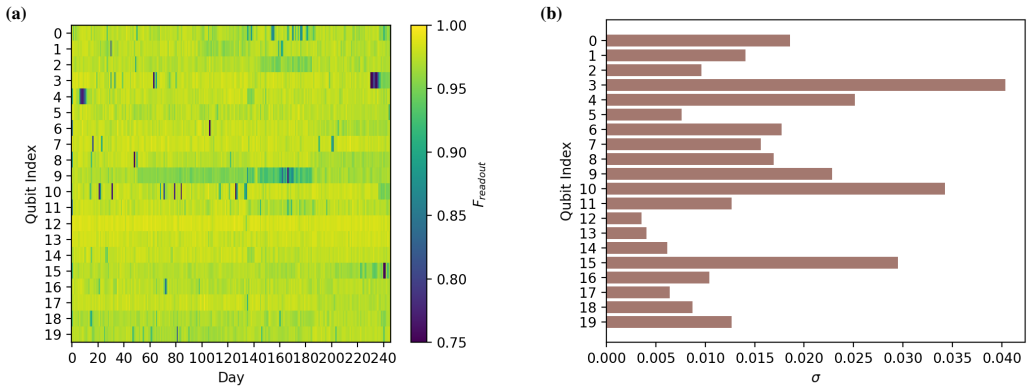
- Recalibration and diagnostic effort can be prioritized on the noisy cluster, such as qubits 3, 5, 10 and their coupled pairs, which show persistent variability.
- Because fidelity metrics are strongly correlated across the chip, monitoring a single representative fidelity (with coherence times as a second signal) is enough to trigger broad health alerts.
- The two warm-up events visible in gate-fidelity heatmaps mean global events can degrade large regions at once; cluster-aware scheduling should re-derive clusters after each cryogenic cycle.
- Autocorrelation results suggest T1 has multi-day memory while fidelity metrics lose memory after a day, so recalibration intervals can be set per metric class.
Reading between the lines
- A testable extension the authors leave implicit: cluster labels from the first half of the record should predict GHZ fidelity in the second half; if they do, the method is a genuine predictive model rather than a description of one window.
- The same clustering pipeline likely transfers to the 54- and 150-qubit chips mentioned in the conclusion, since it only needs daily calibration tables and a connectivity graph; the main risk is whether cluster structure remains stable as device scale grows.
- The strong cross-metric correlation block could be exploited for anomaly detection: a simultaneous drop in T1 and T2echo may be a leading indicator that a full recalibration is needed before gate fidelities visibly degrade.
- Beyond scheduling, cluster membership drift over time could itself be a health signal: a qubit moving from the stable to the noisy cluster may be developing a TLS or coupling defect before standard thresholds trip.
Editorial analysis
A structured set of objections, weighed in public.
Referee Report
Summary. The paper analyzes 250 days of calibration data from a 20-qubit IQM superconducting processor in an HPC environment. It studies temporal autocorrelation and cross-metric correlations of T1, T2, readout fidelity, and single-/two-qubit gate fidelities. The authors then apply unsupervised clustering (KMeans, GMM, Spectral, Node2Vec+KMeans) to group qubits into stable and noisy families, and report GHZ-state experiments that they interpret as validating the clusters. The paper concludes with recommendations for recalibration scheduling and circuit mapping in HPC-integrated quantum systems.
Significance. If the central claim were fully established, this would be a practically valuable contribution: daily calibration logs alone could identify reliability families of qubits that predict real circuit performance, informing HPC workload scheduling. The paper's strengths are its real long-term operational dataset (250 days, 20 qubits), the systematic comparison of four correlation methods, the use of multiple clustering algorithms, and the direct hardware validation attempt. These are concrete, reproducible-in-principle empirical contributions to a field where such longitudinal calibration studies are rare. The paper does not ship code or data, and the validation as reported is too weak to support the predictive claim, but the underlying framework is plausible and worth strengthening.
major comments (4)
- [Section IV, Fig. 9(b)] The GHZ validation is not sufficient to support the claim that 'circuits mapped to robust clusters indeed yield more reliable experimental outcomes.' (1) The two 5-qubit circuits overlap: {13,8,12,17,14} and {3,0,2,8,4} both contain qubit 8, so the comparison is not between disjoint stable and noisy qubit sets. (2) The reported fidelities 0.74±0.05 and 0.63±0.14 overlap within uncertainty, and no significance test, number of repetitions, or shot counts are given. (3) No temporal split is described; clusters are built from the 250-day calibration record, while the GHZ measurement window is not stated to be outside that record, so the agreement could be an in-sample descriptive correlation rather than out-of-sample prediction. (4) Readout error is not mitigated or corrected, and readout fidelity is one of the clustering features; GHZ fidelity extracted from measured populations can therefo
- [Section III.C] The clustering setup is under-specified in ways that affect the central claim of robust stable/noisy families. The paper states that the optimal number of clusters is chosen by maximizing the silhouette score, but it does not report silhouette values or the selected k. Node2Vec hyperparameters (embedding dimension, walk length, number of walks, context window, p, q) are not given, nor is it explained how the 6-dimensional metric feature vector and the graph embedding are concatenated and normalized. The claim that KMeans and Spectral 'give the same as' Node2Vec+KMeans is only qualitative; no cluster-agreement metric (e.g., adjusted Rand index) is provided. Without these details, it is hard to assess whether the stable/noisy split is intrinsic or an artifact of particular hyperparameters. Please report the full clustering pipeline and quantitative agreement across algorithms.
- [Sections II.D and III.B] The analysis relies on several time windows that are not defined. Section II.D discusses probability distributions computed over 'a representative time window' without specifying its start, end, or selection criterion. Section III.B computes metric correlations 'over 80 days after cool-down' but does not state which cool-down event (the paper mentions warm-ups at Day 130 and Day 180) or why 80 days was chosen. If these windows were chosen after inspecting the data, the reported correlations and cluster features could be influenced by selection bias. Please define the windows a priori or show that the clustering and correlation conclusions are stable across multiple sub-periods.
- [Section II, first paragraph after dataset description] The paper assumes 'no procedural drift' because the calibration schedule and pulse/readout configurations are fixed, yet the same section and Section II.C describe two cryogenic warm-up/cool-down cycles and incremental recalibration relying on prior parameters. These are procedural changes that visibly affect gate fidelities (the 'two pronounced boundaries' in Fig. 4). The clustering is performed over the entire 250-day record, so the stable/noisy classification may partly reflect qubit responses to these global events rather than intrinsic qubit health. I recommend showing that the clusters are stable when computed separately for the intervals before and after each warm-up, or that the clustering features account for the regime changes.
minor comments (5)
- [Section IV] Hadamard circuit results are mentioned as part of the hourly benchmarks but no Hadamard fidelity data are shown; either include them or remove the reference.
- [Section II.A] The notation for T2 is inconsistent: T2*, T2^echo, and T2 are used without a single consolidated definition. Please define all variants at first use and use consistent subscripts/superscripts throughout.
- [Section II.C] The text says 'qubit 6 has a sharpest drop' and 'qubit 3 exhibits persistent variability'; please adjust grammar and make clear whether these are the same qubits flagged by the standard-deviation bar plots.
- [Figure 8] The captions state that KMeans and Spectral give the same result as Node2Vec+KMeans, but the figure does not show those results. A quantitative cluster-comparison metric (e.g., adjusted Rand index) would be more informative than the verbal claim.
- [Section III.B] The phrase 'over 80 days after cool-down' is ambiguous: after which cool-down, and why 80 days? Please specify the exact date range and justify the choice.
Circularity Check
GHZ 'validation' re-measures the gate/readout fidelities used as clustering features, so the central claim partially reduces to its inputs.
-
fitted input called prediction
[Section III.C (feature vector construction) and Section IV (GHZ use case, Fig. 9)]
"We combine each qubit's temporal feature vector (e.g., daily means of 6 dimensional vector) with their topological connectivity (via Node2Vec graph embedding [40]). ... To further quantify the impact of clustering on operation, we compare the fidelity evolution of two representative 5-qubit GHZ circuits over time. ... The mean fidelity of good circuit is 0.74 ± 0.05, while the mean of bad circuit is 0.63 ± 0.14. This demonstrates that circuits mapped to robust clusters indeed yield more reliable experimental outcomes."
The 6-dimensional feature vector used for clustering includes the readout fidelity and single-/two-qubit gate fidelities described in Sections II.B and II.C. A GHZ-state fidelity is directly governed by exactly these same error sources: two-qubit CZ gate fidelities and readout fidelity. Thus the lower GHZ fidelity of the "bad" cluster is a re-measurement of the input features in a different circuit, not an independent confirmation that clustering predicts performance. The comparison is also not shown to be out-of-sample (clusters come from the 250-day record; the GHZ measurement window is not stated to be outside it) and the two 5-qubit sets overlap in qubit 8, so the reported gap is substantially forced by shared inputs.
full rationale
The paper is largely a descriptive data-analysis study: it computes autocorrelations, cross-metric correlations, and unsupervised clusters, and it compares several clustering algorithms. No fitted parameter is renamed as a prediction, and the self-citations to prior HPC-integration work are not load-bearing for the main clustering claim. The load-bearing validation step, however, is Section IV's GHZ experiment. Because the cluster features already include the readout and gate fidelities that dominate GHZ circuit error, the observed agreement between cluster labels and GHZ fidelities is substantially circular: the GHZ result re-measures the input features rather than demonstrating emergent predictive power. The overlapping circuit membership (qubit 8 appears in both the 'good' and 'bad' sets) and the absence of a stated out-of-sample or readout-error-corrected split reinforce that the comparison is not an independent test. This warrants a partial-circularity score of 6: the central 'validation' reduces in part, but not entirely, to the clustering inputs.
Assumptions & free parameters
free parameters (5)
- number of clusters k =
not reported (silhouette-maximizing)
- Node2Vec embedding hyperparameters =
not reported
- cross-metric correlation time window =
about 80 days after a cool-down
- representative time window for distributions =
unspecified
- T2/T1 ratio cutoff =
2.0
assumptions (4)
- domain assumption Standard quantum characterization protocols and nonlinear least-squares fits produce accurate values for T1, T2, and gate/readout fidelities
- domain assumption Fixed daily calibration schedule and consistent pulse/readout settings imply observed fluctuations reflect device and environmental variability, not procedural drift
- domain assumption GHZ state fidelity is a valid operational performance measure for validating qubit clusters
- ad hoc to paper Silhouette score maximization yields the correct number of intrinsic qubit clusters
Cite this review
Pith. "Pith review of Qubit Health Analytics and Clustering for HPC-Integrated Quantum Processors." pith.science (2026). https://pith.science/paper/6SRSXDRY
@misc{pith2026250821231,
  author       = {Pith},
  title        = {Pith review of: Qubit Health Analytics and Clustering for HPC-Integrated Quantum Processors},
  year         = {2026},
  howpublished = {\url{https://pith.science/paper/6SRSXDRY}},
  note         = {Machine review of arXiv:2508.21231}
}
read the original abstract
Quantum computing in supercomputing centers requires robust tools to analyze calibration datasets, predict hardware performance, and optimize operational workflows. This paper presents a data-driven framework for processing calibration metrics. Our model is based on a real calibration quality metrics dataset from our in-house 20-qubit NISQ device and for more than 250 days. We apply detailed data analysis to uncover temporal patterns and cross-metric correlations. Using unsupervised clustering, we identify stable and noisy qubits. We also validate our model using GHZ state experiments. Our study provides health indicators as well as hardware-driven maintenance and recalibration recommendations, thus motivating the integration of relevant schedulers with HPCQC workflows.
Figures


Figures from the paper (6 more)


Forward citations
Cited by 1 Pith paper
-
Review of Superconducting Qubit Devices and Their Large-Scale Integration
A review summarizing superconducting qubit types, DiVincenzo criteria implementations, coherence limits from defects, and large-scale integration strategies for quantum computing.
Reference graph
Works this paper leans on
-
[1]
M. A. Nielsen and I. L. Chuang, Quantum Computation and Quantum Information . Cambridge University Press, 2000
work page 2000
-
[2]
Noisy intermediate-scale quantum algorithms,
K. Bharti, A. Cervera-Lierta, T. H. Kyaw, T. Haug, S. Alperin-Lea, A. Anand, M. Degroote, H. Heimonen, J. S. Kottmann, T. Menke, W.-K. Mok, S. Sim, L.-C. Kwek, and A. Aspuru-Guzik, “Noisy intermediate-scale quantum algorithms,” Rev. Mod. Phys. , vol. 94, p. 015004, Feb 2022. [Online]. Available: https://link.aps.org/doi/10.1103/RevModPhys.94.015004
-
[3]
A. M. Dalzell, S. McArdle, M. Berta, P. Bienias, C.-F. Chen, A. Gily ´en, C. T. Hann, M. J. Kastoryano, E. T. Khabiboulline, A. Kubica, and et al., Quantum Algorithms: A Survey of Applications and End-to-end Complexities . Cambridge University Press, 2025
work page 2025
-
[4]
Quantum computing in the nisq era and beyond,
J. Preskill, “Quantum computing in the nisq era and beyond,” Quantum, vol. 2, p. 79, 2018
2018
-
[5]
A quantum engineer’s guide to superconducting qubits,
P. Krantz, M. Kjaergaard, F. Yan, T. P. Orlando, S. Gustavsson, and W. D. Oliver, “A quantum engineer’s guide to superconducting qubits,” Applied Physics Reviews, vol. 6, no. 2, p. 021318, 06 2019. [Online]. Available: https://doi.org/10.1063/1.5089550
-
[6]
Quantum supremacy using a programmable superconducting processor,
F. Arute, K. Arya, R. Babbush, D. Bacon, J. C. Bardin et al., “Quantum supremacy using a programmable superconducting processor,” Nature, vol. 574, no. 7779, pp. 505–510, 2019
work page 2019
-
[7]
High-performance computing with quantum processing units,
K. A. Britt and T. S. Humble, “High-performance computing with quantum processing units,” J. Emerg. Technol. Comput. Syst. , vol. 13, no. 3, Mar
-
[8]
Quantum computers for high-performance computing,
T. S. Humble, A. McCaskey, D. I. Lyakh, M. Gowrishankar, A. Frisch, and T. Monz, “Quantum computers for high-performance computing,” IEEE Micro, vol. 41, no. 5, pp. 15–23, 2021
2021
Show all 44 references
-
[9]
Accelerating hpc with quantum computing: It is a software challenge too,
M. Schulz, M. Ruefenacht, D. Kranzlm ¨uller, and L. B. Schulz, “Accelerating hpc with quantum computing: It is a software challenge too,” Computing in Science & Engineering , vol. 24, no. 4, pp. 60–64, 2022
2022
-
[10]
Integration of quantum accelerators with high performance computing – a review of quantum programming tools,
A. Elsharkawy, X.-T. M. To, P. Seitz, Y . Chen, Y . Stade, M. Geiger, Q. Huang, X. Guo, M. A. Ansari, C. B. Mendl, D. Kranzlm ¨uller, and M. Schulz, “Integration of quantum accelerators with high performance computing – a review of quantum programming tools,” 2023. [Online]. A...
2023
-
[12]
Qure: Qubit re-allocation in noisy intermediate-scale quantum computers,
A. A. Saki, M. Alam, and S. Ghosh, “Qure: Qubit re-allocation in noisy intermediate-scale quantum computers,” in 2019 56th ACM/IEEE Design Automation Conference (DAC) , 2019, pp. 1–6
2019
-
[13]
Not all qubits are created equal: A case for variability-aware policies for nisq-era quantum computers,
S. S. Tannu and M. K. Qureshi, “Not all qubits are created equal: A case for variability-aware policies for nisq-era quantum computers,” in Proceedings of the Twenty-F ourth International Conference on Architectural Support for Programming Languages and Operating Systems , ser...
2019
-
[14]
Timing and resource-aware mapping of quantum circuits to superconducting processors,
L. Lao, H. van Someren, I. Ashraf, and C. G. Almudever, “Timing and resource-aware mapping of quantum circuits to superconducting processors,” IEEE Transactions on Computer-Aided Design of Integrated Circuits and Systems , vol. 41, no. 2, pp. 359–371, 2022
2022
-
[15]
Calibration-aware transpilation for variational quantum optimization,
Y . Ji, S. Brandhofer, and I. Polian, “Calibration-aware transpilation for variational quantum optimization,” in 2022 IEEE International Conference on Quantum Computing and Engineering (QCE) , 2022, pp. 204–214
2022
-
[16]
Supermarq: A scalable quantum benchmark suite,
T. Tomesh, P. Gokhale, V . Omole, G. S. Ravi, K. N. Smith, J. Viszlai, X.-C. Wu, N. Hardavellas, M. R. Martonosi, and F. T. Chong, “Supermarq: A scalable quantum benchmark suite,” in 2022 IEEE International Symposium on High-Performance Computer Architecture (HPCA) , 2022, pp. 587–603
2022
-
[17]
A hybrid classical-quantum hpc workload,
A. Esposito, J. R. Jones, S. Cabaniols, and D. Brayford, “A hybrid classical-quantum hpc workload,” in 2023 IEEE International Conference on Quantum Computing and Engineering (QCE) , vol. 02, 2023, pp. 117–121
2023
-
[18]
Resource-aware scheduling of multiple quantum circuits on a hardware device,
D. Bhoumik, R. Majumdar, and S. Sur-Kolay, “Resource-aware scheduling of multiple quantum circuits on a hardware device,” 2024. [Online]. Available: https://arxiv.org/abs/2407.08930
2024 arXiv
-
[19]
Modular compilation for quantum chiplet architectures,
M. J. Jeng, N. V . Maruszewski, C. Selna, M. Gavrincea, K. N. Smith, and N. Hardavellas, “Modular compilation for quantum chiplet architectures,”
-
[20]
Conqure: A co-execution environment for quantum and classical resources,
A. Mahesh, S. Mittal, and F. Mueller, “Conqure: A co-execution environment for quantum and classical resources,” 2025. [Online]. Available: https://arxiv.org/abs/2505.02241
2025
-
[21]
Enabling efficient real-time calibration on cloud quantum machines,
Y . Liu, Z. Li, A. Robertson, X. Fu, and S. L. Song, “Enabling efficient real-time calibration on cloud quantum machines,” IEEE Transactions on Quantum Engineering, vol. 4, pp. 1–17, 2023
2023
-
[22]
Detecting crosstalk errors in quantum information processors,
M. Sarovar, T. Proctor, K. Rudinger, K. Young, E. Nielsen, and R. Blume-Kohout, “Detecting crosstalk errors in quantum information processors,” Quantum, vol. 4, p. 321, Sep. 2020. [Online]. Available: https://doi.org/10.22331/q-2020-09-11-321
2020 doi
-
[23]
Quantum crosstalk robust quantum control,
Z. Zhou, R. Sitler, Y . Oda, K. Schultz, and G. Quiroz, “Quantum crosstalk robust quantum control,” Phys. Rev. Lett. , vol. 131, p. 210802, Nov 2023. [Online]. Available: https://link.aps.org/doi/10.1103/PhysRevLett.131.210802
2023 doi
-
[24]
Physical qubit calibration on a directed acyclic graph,
J. Kelly, P. O’Malley, M. Neeley, H. Neven, and J. M. Martinis, “Physical qubit calibration on a directed acyclic graph,” 2018. [Online]. Available: https://arxiv.org/abs/1803.03226
2018 arXiv
-
[25]
Qibocal: an open-source framework for calibration of self-hosted quantum devices,
A. Pasquale, E. Pedicillo, J. Cereijo, S. Ramos-Calderer, A. Candido, G. Palazzo, R. Carobene, M. Gobbo, S. Efthymiou, Y . P. Tan, I. Roth, M. Robbiati, J. Wilkens, A. Orgaz-Fuertes, D. Fuentes-Ruiz, A. Giachero, F. Brito, J. I. Latorre, and S. Carrazza, “Qibocal: an open-sour...
2024 arXiv
-
[26]
QUAlibrate: Advanced User-Programmed Calibration Software for Large-Scale Quantum Computers,
S. Asaad and maxim v4s, “QUAlibrate: Advanced User-Programmed Calibration Software for Large-Scale Quantum Computers,” 5 2025, open-source calibration platform for quantum computers. Accessed: 2025-06-28. [Online]. Available: https://github.com/qua-platform/qualibrate
2025
-
[27]
Survey on quantum circuit compilation for noisy intermediate-scale quantum computers: Artificial intelligence to heuristics,
J. Kusyk, S. M. Saeed, and M. U. Uyar, “Survey on quantum circuit compilation for noisy intermediate-scale quantum computers: Artificial intelligence to heuristics,” IEEE Transactions on Quantum Engineering , vol. 2, pp. 1–16, 2021
2021
-
[28]
Learning high-accuracy error decoding for quantum processors,
J. Bausch, A. W. Senior, F. J. H. Heras, T. Edlich, A. Davies, M. Newman, C. Jones, K. Satzinger, M. Y . Niu, S. Blackwell, G. Holland, D. Kafri, J. Atalaya, C. Gidney, D. Hassabis, S. Boixo, H. Neven, and P. Kohli, “Learning high-accuracy error decoding for quantum processors...
2024 doi
-
[29]
Artificial intelligence for quantum computing,
Y . Alexeev, M. H. Farag, T. L. Patti, M. E. Wolf, N. Ares, A. Aspuru-Guzik, S. C. Benjamin, Z. Cai, Z. Chandani, F. Fedele, N. Harrigan, J.-S. Kim, E. Kyoseva, J. G. Lietz, T. Lubowe, A. McCaskey, R. G. Melko, K. Nakaji, A. Peruzzo, S. Stanwyck, N. M. Tubman, H. Wang, and T. ...
2024
-
[30]
Quantum computing and artificial intelligence: status and perspectives,
G. Acampora, A. Ambainis, N. Ares, L. Banchi, P. Bhardwaj, D. Binosi, G. A. D. Briggs, T. Calarco, V . Dunjko, J. Eisert, O. Ezratty, P. Erker, F. Fedele, E. Gil-Fuster, M. G ¨arttner, M. Granath, M. Heyl, I. Kerenidis, M. Klusch, A. F. Kockum, R. Kueng, M. Krenn, J. L ¨assig,...
-
[31]
Identification of malfunctioning quantum devices,
M. Skotiniotis, S. Llorens, R. Hotz, J. Calsamiglia, and R. Mu ˜noz Tapia, “Identification of malfunctioning quantum devices,” Phys. Rev. Res. , vol. 6, p. 033329, Sep 2024. [Online]. Available: https://link.aps.org/doi/10.1103/PhysRevResearch.6.033329
2024 doi
-
[32]
Prediction and real-time compensation of qubit decoherence via machine-learning,
S. Mavadia, V . Frey, J. Sastrawan, S. Dona, and M. J. Biercuk, “Prediction and real-time compensation of qubit decoherence via machine-learning,” Nature Communications, vol. 8, no. 1, p. 14106, 2017. [Online]. Available: https://www.nature.com/articles/ncomms14106
2017
-
[33]
Available: https://arxiv.org/abs/2505.23860
[Online]. Available: https://arxiv.org/abs/2505.23860
-
[34]
Calibration and performance evaluation of a superconducting quantum processor in an hpc center,
X. Deng, S. Pogorzalek, F. Vigneau, P. Yang, M. Schulz, and L. Schulz, “Calibration and performance evaluation of a superconducting quantum processor in an hpc center,” in ISC High Performance 2024 Research Paper Proceedings (39th International Conference) , 2024, pp. 1–9
2024
-
[35]
Garnet Quantum Processing Unit (QPU),
IQM Quantum Computers, “Garnet Quantum Processing Unit (QPU),” https://www.iqmacademy.com/qpu/garnet/, 2024, accessed: 30 June 2025
2024
-
[36]
Machine learning for predictive estimation of qubit dynamics subject to dephasing,
R. S. Gupta and M. J. Biercuk, “Machine learning for predictive estimation of qubit dynamics subject to dephasing,” Phys. Rev. Appl. , vol. 9, p. 064042, Jun 2018. [Online]. Available: https://link.aps.org/doi/10.1103/PhysRevApplied.9.064042
2018 doi
-
[37]
R. H. Shumway and D. S. Stoffer, Time Series Analysis and Its Applications: With R Examples , 4th ed. New York, NY: Springer, 2017. [Online]. Available: https://doi.org/10.1007/978-3-319-52452-8
2017 doi
-
[38]
B. V . Vishwas and A. Patel, Hands-on Time Series Analysis with Python , 1st ed. Berkeley, CA: Apress, 2020. [Online]. Available: https://link.springer.com/book/10.1007/978-1-4842-5992-4
2020 doi
-
[39]
G. E. P. Box, G. M. Jenkins, G. C. Reinsel, and G. M. Ljung, Time Series Analysis: F orecasting and Control , 5th ed. Wiley, 2015
2015
-
[40]
node2vec: Scalable feature learning for networks,
A. Grover and J. Leskovec, “node2vec: Scalable feature learning for networks,” in Proceedings of the 22nd ACM SIGKDD International Conference on Knowledge Discovery and Data Mining , ser. KDD ’16. New York, NY , USA: Association for Computing Machinery, 2016, p. 855–864. [Onli...
2016
-
[41]
A tutorial on spectral clustering,
U. von Luxburg, “A tutorial on spectral clustering,” Stat. Comput., vol. 17, no. 4, pp. 395–416, 2007. [Online]. Available: https://doi.org/10.1007/s11222- 007-9033-z
2007 doi
-
[42]
Hastie, R
T. Hastie, R. Tibshirani, and J. Friedman, The Elements of Statistical Learning: Data Mining, Inference, and Prediction , 2nd ed., ser. Springer Series in Statistics. New York, NY: Springer, 2009. [Online]. Available: https://link.springer.com/book/10.1007/978-0-387-84858-7
2009 doi
-
[45]
Towards a unified architectural representation in hpcqc: Extending sys-sage for quantum technologies,
D. Mishra, S. Vanecek, J. Echavarria, X. Deng, B. Mete, L. Schulz, and M. Schulz, “Towards a unified architectural representation in hpcqc: Extending sys-sage for quantum technologies,” in ISC High Performance 2025 Research Paper Proceedings (40th International Conference) , 2...
2025
- [2017]
-
[2025]
Available: https://arxiv.org/abs/2501.08478
[Online]. Available: https://arxiv.org/abs/2501.08478
Reviewed August 5, 2026 · model on record in the stance chip above.
Discussion (0). Sign in to comment.