REVIEW 4 major objections 6 minor 17 references
Context-Robust Knowledge Editing for Language Models
T0 review · 4 major / 6 minor · reviewed 2026-08-07 · deepseek-v4-flash
Pith's one-line read Context ahead of a fact makes knowledge edits fail; CoRE restores them
desk verdict A useful new benchmark and a plausible regularizer for context-robust knowledge editing, but the method's gains over MEMIT are not cleanly attributed between the new training prefixes and the variance penalty. read the letter →
The pith
A machine-rendered reading of the paper's core claim, the machinery that carries it, and where it could break.
The reading
What carries the argument
The load-bearing mechanism is a cross-prefix representation regularization term, Lprefix = (λ/(LD)) Σ_{ℓ∈L} Σ_{i<j} ||h^ℓ_i − h^ℓ_j||², which penalizes pairwise squared-L2 differences among hidden states generated under different prefix contexts at the layers being edited. It is paired with a change to how those prefixes are chosen: instead of MEMIT's small set of generic starters ('The', 'Therefore', 'Because', 'I', 'You'), CoRE uses sentences containing s, o, and o*, singly and in combination, so the key and value vectors are optimized against contexts that are actually semantically tied to the fact. CHED, the accompanying benchmark, supplies the stress test: prefix sentences generated around one-hop Wikidata neighbors of s, o, and o*, with low-frequency, highly distinctive hop words selected by the Freq-Sim criterion because they are the most distracting. The benchmark and the regularizer work together: CHED quantifies how badly prefix contexts break edited knowledge, while the Lprefix term is what lets CoRE keep the edited value vector stable across those contexts.
What would settle it
Train CoRE with its regularization applied only to random-word prefixes (not the s/o/o* contexts), then test on CHED: if CHED efficacy falls back to MEMIT levels while random-prefix efficacy stays high, the method memorized its training prefixes instead of producing context-invariant edited knowledge. Alternatively, hold out a disjoint set of CHED hop-word contexts built from different Wikidata relations and measure whether CoRE's reduction in cross-prefix value-vector variance persists on those unseen contexts.
Extended reading notes
Core claim
On the paper's own terms, the central claim is that context robustness is a distinct and previously under-measured failure mode of knowledge editing, and that it can be repaired by making the edited representation insensitive to which distractor prefix precedes the fact. CoRE implements this by first replacing MEMIT's generic prefix templates with context sentences built from the subject s, the original object o, and the new object o*, and then adding a loss term that shrinks the average pairwise L2 distance between the value-vector hidden states produced under those prefixes. The result is a value vector that encodes the new fact (s, r, o*) in a more context-invariant way, so that CHED's semantically related hop-word prefixes no longer pull generation back to o. The reported numbers on Llama-3-8B-Instruct—ohop efficacy 83.1% for CoRE-p+r versus 72.7% for MEMIT, with no-context efficacy actually higher at 92.4% versus 90.9%—support the claim that the robustness gain is not bought by sacrificing ordinary editing accuracy.
Load-bearing premise
CoRE assumes that reducing hidden-state variance on the s/o/o* prefix contexts it trains on will transfer to the semantically related but unseen hop-word contexts in CHED; if the regularization only compresses the trained contexts, the reported generalization gains would disappear.
Editorial extensions
If this is right
- If CHED is adopted as an evaluation standard, existing knowledge-editing methods will need to be re-benchmarked under realistic prefix contexts; current no-context scores overstate deployable edit success.
- If CoRE's regularization transfers to other locate-then-edit editors, adding the Lprefix term to MEMIT-style pipelines is a drop-in robustness improvement with little effect on general ability.
- Chat deployments should treat user-provided context as a high-distraction condition; the paper's user-vs-assistant results imply edits need to survive user-utterance framing, not just plain prefixes.
- Attention-based diagnostics like the Average Contribution Score could become a standard check for whether an edit method is suppressing distractor information rather than merely memorizing training prefixes.
- The strict generation-based efficacy criterion (must generate o*, must not generate o) would replace probability-based metrics in future knowledge-editing evaluations, since probability-based scores can be high while generation fails.
Reading between the lines
- A natural but untested extension is that the same variance-minimization principle should apply to other parametric memory locations (e.g., attention layers, LoRA adapters, or external memory): any edit that must survive varied contexts could benefit from penalizing representation spread across context perturbations.
- Because CHED's distractors are one-hop Wikidata neighbors, a stronger stress test would use multi-hop or conversational distractors that are only indirectly related to the fact; CoRE's current 83.1% ohop efficacy might drop further under such contexts, and the paper's own limitation section concedes hop-distance semantics are not controlled.
- The user-vs-assistant asymmetry suggests an instruction-tuning effect: models over-weight tokens marked as user input. A testable prediction is that placing the same distractor in a system prompt or in a quoted third-party source would distract less than placing it in the user turn.
- CoRE's success could be reinterpreted as lowering the effective dimensionality of the edited subspace, so a concrete diagnostic is to measure the rank or condition number of the edited value-vector subspace; lower spread should correlate with better generalization to unseen contexts.
Editorial analysis
A structured set of objections, weighed in public.
Referee Report
Summary. The paper introduces CHED, a benchmark that prepends semantically related prefix contexts (built from Wikidata one-hop words and GPT-generated sentences) to CounterFact editing prompts in order to measure whether knowledge editing methods remain robust when preceding context is present. It also proposes CoRE, a MEMIT-based editing method that (A) replaces MEMIT's generic prefix words with contexts built from the subject s, original object o, and target object o*, and (B) adds a cross-prefix regularizer Lprefix that penalizes pairwise L2 distances among hidden states across those prefix contexts. Experiments on multiple models (Llama-3, Mistral, GPT-J) and datasets (CHED, CounterFact, zsRE) report that CoRE improves context-robust efficacy while roughly preserving general ability, and the paper analyzes attention patterns and the user-vs-assistant distinction.
Significance. The paper addresses a genuinely under-explored problem: knowledge editing success is usually measured without preceding context, which can overestimate real-world reliability. The CHED dataset, the strict generation-based metric, and the random-word/random-context ablations are useful contributions, as is the released code and data. The core claim, however, is that CoRE's cross-prefix variance regularization is what drives the context-robustness gains; the current experimental design does not fully isolate that mechanism because the regularizer is only tested on top of new, answer-containing prefix contexts. The benchmark construction is also partially tuned to MEMIT, and several central numbers lack error bars. If the missing control and robustness analyses are provided, the paper would make a solid contribution; as it stands, the causal role of the regularizer is not established.
major comments (4)
- [§4.2, Eq. (3)-(4), Table 4] The design of CoRE changes two aspects of MEMIT simultaneously: the prefix contexts used for key-value extraction (from generic words to s/o/o* combinations) and the objective function (adding Lprefix). The comparison CoRE-p vs. CoRE-p+r in Table 4 shows only the marginal effect of Lprefix after the prefix change; it does not test whether Lprefix would help with MEMIT's original generic prefixes. Because the new training prefixes contain o and o*, they directly encode the edit answer in the input, and CHED's ohop/o*hop conditions are exactly the related-entity generalization cases such prefixes would teach. Therefore, the observed hop-word gains (e.g., ohop 80.1% for CoRE-p vs. 83.1% for CoRE-p+r, both above MEMIT's 72.7%) cannot be attributed to the variance regularizer alone. A control that applies Lprefix with MEMIT's generic prefixes, or an ablation that varies the prefix set and the regularizer orthogonally, is needed to support the claim in §5.3 that CoRE 'enhances context robustness' specifically through minimizing context-sensitive variance.
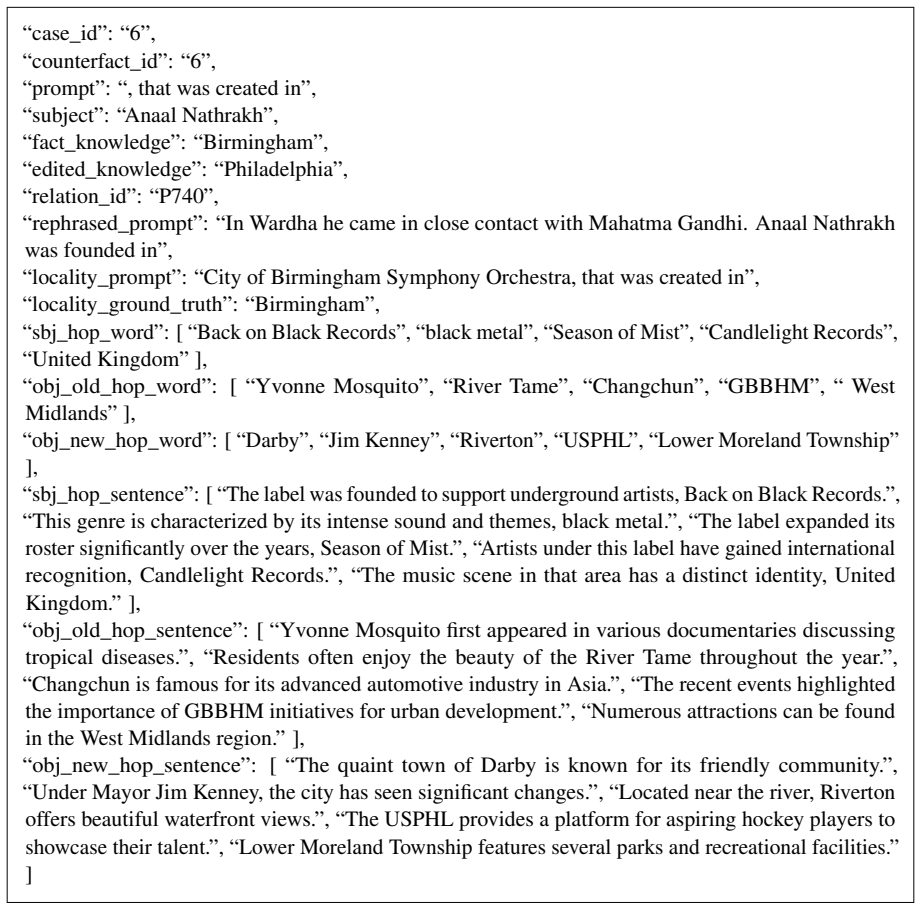
- [§3.2, Fig. 3, Table 9] The Freq-Sim hop-word selection criterion was chosen by maximizing the edit-success drop for MEMIT (e.g., 69.1% on ohop in Figure 3). This means the benchmark's difficulty is calibrated to a particular baseline. When comparing CoRE against other editing methods, the ranking may reflect MEMIT-specific susceptibility rather than a general property of context robustness. I recommend validating the selection with at least one additional editing method (e.g., PMET or EMMET) or showing that the relative ordering of methods is stable under alternative hop-word selection criteria.
- [§5.1, Tables 4 and 5] All key results are reported as single runs without variance estimates or significance tests. The margin between CoRE-p and CoRE-p+r on ohop (80.1 vs. 83.1) is small; without error bars on thousand-edit samples, this difference could be within sampling noise. Please report bootstrap confidence intervals or results over multiple random seeds for at least the main comparisons, especially those that distinguish CoRE-p and CoRE-p+r.
- [Appendix F.2] The hyperparameters L and lambda for CoRE were determined via parameter search using the same metrics as the MEMIT layer selection (Efficacy no-context, General Ability, N-gram Repetition). If this search was performed on the same evaluation suite that later reports the main results, the comparison is not fully held-out. Please specify whether the search used a separate validation split or the final test set, and provide a sensitivity analysis over lambda (at least for the CHED hop-word efficacy) to show that the reported gains are not an artifact of parameter tuning.
minor comments (6)
- [§3.2, Appendix A.7] The coherence scores for o* and o*hop prefix contexts are low (2.75 and 2.80 on a 1-5 scale); the claim of 'moderate plausibility' for the full benchmark should be qualified, since the edited-object conditions are noticeably less natural than the s and o conditions.
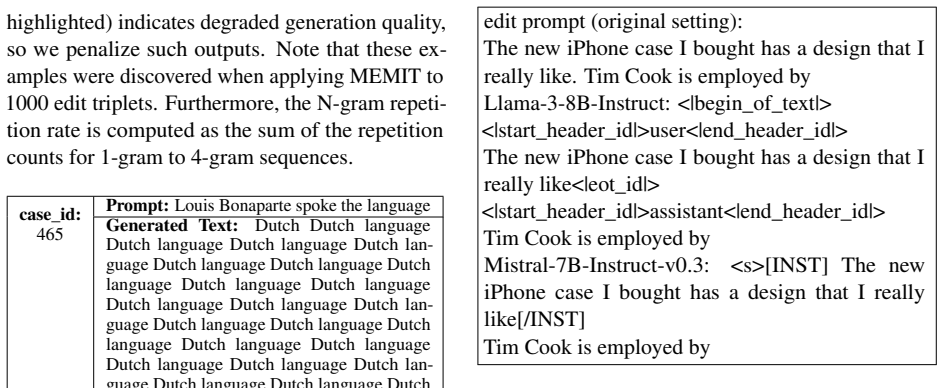
- [Figure 1] The token-level attention visualization appears garbled in the provided text (e.g., 'owi ings gc ...'); please check the rendering and ensure the figure is legible in the final PDF.
- [§5.4, Table 6] The user-vs-assistant finding is shown for Llama-3; please clarify whether Mistral exhibits the same pattern or explicitly state that the analysis is model-specific.
- [Eq. (4)] Please define D (the hidden-state dimension) in the text and state whether the layers ℓ∈L are the edited layers, the layers following the edit, or some other set; the current description leaves this ambiguous.
- [Table 4 caption] The caption mixes CHED and CounterFact columns is described in a footnote-style note; make the distinction explicit in the main text or in a clearer table layout to avoid misreading.
- [§2] There is a typo in 'evaluates a integrated multi-hop question'; it should be 'an integrated multi-hop question'.
Circularity Check
Partial circularity: CoRE's CHED s/o/o* results are partly optimized-on targets, while the hop-word CHED results remain independent evidence.
-
fitted input called prediction
[Section 4.2 (Diverse Prefix Contexts and Eq. 2-4); Section 5.3 and Table 4; Appendix C.2]
"First, we enhance the prefix contexts used for retrieving key and value vectors (xj in Equation (2)) by using s, o, and o∗. ... CoRE uses combinations of s, o, and o∗ as prefix contexts for each edit triplet (e.g., 's + o'). ... For further experimental details, the prefix contexts used in these experiments are from the CHED dataset, with 15 distinct prefix contexts per edit triplet."
In Equation (2), v* is chosen by minimizing -log P(o* | xj + p) over prefix contexts xj that are explicitly constructed from s, o, and o*, with Equation (3) adding Lprefix over hidden states from the same prefixes. Table 4 then reports CHED Efficacy in the columns labelled s, o, and o*, which are exactly the categories of prefix contexts used in that optimization. High efficacy on these conditions is therefore partly a training-objective fit rather than a context-robustness prediction. The shop/ohop/o*hop CHED conditions are not used in CoRE's prefix set, so those results provide independent transfer evidence; the circularity is limited to the exact-word CHED subset and to interpreting the hop-word gains as caused by Lprefix rather than by the answer-containing training prefixes.
full rationale
CoRE is a genuine optimization method: the Lprefix regularizer is defined on hidden-state variances and is not definitionally identical to the CHED evaluation metric. The strongest independent support is the CHED hop-word conditions, where CoRE also improves over MEMIT even though those prefix contexts are not directly used to optimize v*, together with zsRE and CounterFact results. The main circularity concern is that CHED's exact-word conditions (s, o, o*) are also the prefix contexts used in CoRE's key-value extraction and regularization, so the corresponding Table 4 numbers are partly train-set performance. The paper does not separately ablate the change from MEMIT's generic prefixes to answer-containing s/o/o* prefixes from the addition of Lprefix, leaving the causal role of the regularizer for hop-word generalization ambiguous; this is a benchmark/method co-adaptation caveat rather than a fully circular derivation. No load-bearing self-citation chain or imported uniqueness theorem is present, and the Limitations section's scope caveats are honest and non-circular.
Assumptions & free parameters
free parameters (5)
- lambda_reg (Equation 4) =
Llama-3: 0.04; Mistral-7B: 0.1; GPT-J: 0.0002
- layer_range_L =
Llama-3: 28 layers; Mistral-7B: 26 layers; GPT-J: 26 layers
- coRE_prefix_count =
15 (5 each for s, o, o*)
- Freq-Sim hop word selector =
10 lowest-frequency words, then 5 with highest cosine similarity to the main entity
- editing layer indices per model =
Llama-3: [3]; Mistral-7B: [4,5]; GPT-J: [2,3,4]
assumptions (5)
- domain assumption Transformer MLP layers behave as key-value associative memories, and editing their projection layer remaps keys to new values (MEMIT's premise, used as CoRE's starting point).
- domain assumption A Wikidata entity connected by any relation to s, o, or o* is a useful distractor for that fact.
- domain assumption GPT-4o-mini-generated sentences of at most 20 words are plausible stand-ins for real preceding context.
- domain assumption Generation-based success, requiring o* present and o absent within 50 tokens, is the right yardstick for editing.
- domain assumption The KL-divergence penalty in v* optimization preserves unrelated knowledge.
Cite this review
Pith. "Pith review of Context-Robust Knowledge Editing for Language Models." pith.science (2026). https://pith.science/paper/6TXOE3XL
@misc{pith2026250523026,
  author       = {Pith},
  title        = {Pith review of: Context-Robust Knowledge Editing for Language Models},
  year         = {2026},
  howpublished = {\url{https://pith.science/paper/6TXOE3XL}},
  note         = {Machine review of arXiv:2505.23026}
}
read the original abstract
Knowledge editing (KE) methods offer an efficient way to modify knowledge in large language models. Current KE evaluations typically assess editing success by considering only the edited knowledge without any preceding contexts. In real-world applications, however, preceding contexts often trigger the retrieval of the original knowledge and undermine the intended edit. To address this issue, we develop CHED -- a benchmark designed to evaluate the context robustness of KE methods. Evaluations on CHED show that they often fail when preceding contexts are present. To mitigate this shortcoming, we introduce CoRE, a KE method designed to strengthen context robustness by minimizing context-sensitive variance in hidden states of the model for edited knowledge. This method not only improves the editing success rate in situations where a preceding context is present but also preserves the overall capabilities of the model. We provide an in-depth analysis of the differing impacts of preceding contexts when introduced as user utterances versus assistant responses, and we dissect attention-score patterns to assess how specific tokens influence editing success.
Figures


Figures from the paper (7 more)



Reference graph
Works this paper leans on
-
[1]
- The generated sentences should feel like a natural precursor to the given sentence
Flow and Coherence: - Each sentence must smoothly lead into and set up the sentence: ‘{edit_prompt}’. - The generated sentences should feel like a natural precursor to the given sentence
-
[2]
- **Do not change the order** of the words in the **word list**
Word Usage: - Use each word from the **word list** exactly once, **in the exact order provided in the list**. - **Do not change the order** of the words in the **word list**. - Do not repeat any word across sentences - Exclude the following words entirely: ‘{exclude_words}’
-
[3]
Joint Knowledge Editing for Information Enrichment and Probability Promotion
Joint knowledge editing for information en- richment and probability promotion. arXiv preprint arXiv:2412.17872. Alon Talmor, Jonathan Herzig, Nicholas Lourie, and Jonathan Berant. 2019. CommonsenseQA: A ques- tion answering challenge targeting commonsense knowledge. In Proceedings of the 2019 Conference of the North American Chapter of the Association fo...
work page Pith review arXiv 2019
-
[4]
WikiGraphs: A Wikipedia text - knowledge graph paired dataset. In Proceedings of the Fif- teenth Workshop on Graph-Based Methods for Nat- ural Language Processing (TextGraphs-15), pages 67–82, Mexico City, Mexico. Association for Com- putational Linguistics. Peng Wang, Ningyu Zhang, Bozhong Tian, Zekun Xi, Yunzhi Yao, Ziwen Xu, Mengru Wang, Shengyu Mao, X...
-
[5]
Easyedit: An easy-to-use knowledge edit- ing framework for large language models. Preprint, arXiv:2308.07269. Yunzhi Yao, Peng Wang, Bozhong Tian, Siyuan Cheng, Zhoubo Li, Shumin Deng, Huajun Chen, and Ningyu Zhang. 2023. Editing large language models: Prob- lems, methods, and opportunities. In Proceedings of the 2023 Conference on Empirical Methods in Na...
arXiv 2023
-
[6]
A survey of large language models. Preprint, arXiv:2303.18223. Ce Zheng, Lei Li, Qingxiu Dong, Yuxuan Fan, Zhiyong Wu, Jingjing Xu, and Baobao Chang. 2023a. Can we edit factual knowledge by in-context learning? Preprint, arXiv:2305.12740. Ce Zheng, Lei Li, Qingxiu Dong, Yuxuan Fan, Zhiy- ong Wu, Jingjing Xu, and Baobao Chang. 2023b. Can we edit factual kn...
arXiv 2023
-
[10]
is known for its unique culture and history
Sentence Structure: - Each sentence must be concise (no longer than 20 words). - Avoid overly general statements or clichés (e.g., “is known for its unique culture and history” or “has historical significance”)
-
[11]
Output: - Generate exactly {len(one_hop)} sentences. - Each sentence must correspond to one word from the **word list**, in the same order as they appear in the list. - Return only the generated sentences, excluding the target sentence: ‘{edit_prompt}’. Word List: ‘{one_hop}’ Figure 7: Prompt template for generating prefix contexts using one-hop words. A....
Show all 17 references
-
[12]
Flow and Coherence Each sentence must lead smoothly and set up the sentence: ‘edit prompt’
-
[13]
Word Usage The sentence must include the hop word while excluding s, o, and o∗
-
[14]
WikiProject Football
Sentence Structure Each sentence should be no longer than 20 words and should avoid overly general state- ments or clichés. We performed a validation process on the ini- tially generated hop sentence dataset to ensure com- pliance with the Word Usage constraints. Specif- icall...
-
[15]
Read both Sentence 1 and Sentence 2 carefully
-
[16]
Determine if Sentence 2 follows from Sentence 1 and maintains theme
-
[17]
Tim Cook, who works for
Assign a score of 1–5 based on the coherence criteria above." Figure 8: Instruction Prompt for G-Eval 6 8 9 10 12 14 15 16 18 Number of Prefix Prompts 3 4 5 6 7Average Variance 1e 5 common words s s + o s + o + o * o o * Figure 9: Average Variance of Value Vectors by Differ- e...
1993
-
[39]
Brockhaus and Efron Encyclopedic Dictio- nary
This indicates a highly right-skewed distribu- tion, as skewness values greater than 1 generally suggest such behavior (Groeneveld and Meeden, 1984). A.2 Skewness Computation We calculate skewness using moments to describe the shape of hop words frequency distribution. The k-t...
1984
-
[2021]
Preprint, arXiv:2009.03300
Measuring massive multitask language under- standing. Preprint, arXiv:2009.03300. Evan Hernandez, Arnab Sen Sharma, Tal Haklay, Kevin Meng, Martin Wattenberg, Jacob Andreas, Yonatan Belinkov, and David Bau. 2024. Linearity of relation decoding in transformer language models. P...
2009 arXiv
-
[2024]
Preprint, arXiv:2407.21783
The llama 3 herd of models. Preprint, arXiv:2407.21783. Richard A Groeneveld and Glen Meeden. 1984. Measur- ing skewness and kurtosis. Journal of the Royal Sta- tistical Society Series D: The Statistician, 33(4):391– 399. Akshat Gupta, Anurag Rao, and Gopala Anu- manchipalli. ...
1984 arXiv
Reviewed August 7, 2026 · model on record in the stance chip above.
Discussion (0). Sign in to comment.