REVIEW 3 major objections 4 minor 99 references
Chemotactic aggregation dynamics of micro-swimmers in Brinkman flows
T0 review · 3 major / 4 minor · reviewed 2026-08-16 · deepseek-v4-flash
Pith's one-line read The paper argues that hydrodynamic resistance from a porous medium hampers auto-chemotactic aggregation of pusher micro-swimmers, even though linear stability analysis says the chemotactic instability is barely affected.
desk verdict Solid model extension with a plausible nonlinear result that needs saturation data to prove 'hampers' rather than 'delays'. read the letter →
The pith
A machine-rendered reading of the paper's core claim, the machinery that carries it, and where it could break.
The reading
What carries the argument
The load-bearing object is the coupled continuum system: a conservation equation for the swimmer orientation distribution $\Psi(x,p,t)$, a reaction-advection-diffusion equation for the chemo-attractant $C$, and the Stokes-Brinkman equations $-\nabla^2 u + \nabla q + \nu^2 u = \nabla\cdot \Sigma_p$, $\nabla\cdot u=0$, with active stress $\Sigma_p = \alpha \int \Psi (pp^T - I/3)\,dp$. Its analytical output is the pair of linear dispersion relations, Eqs. (17) and (18), whose uncoupled forms suggest that resistance $\nu$ barely shifts the chemotactic branch; its numerical output is the fully nonlinear coupling in which $\nu$ suppresses cluster formation. The nondimensional resistance $\nu = \ell_c/\sqrt{K_D}$ is the control parameter that carries the argument.
What would settle it
An experiment or particle-resolved simulation in a disordered obstacle array could vary the Darcy permeability $K_D$ while holding chemotactic sensing parameters fixed: the paper's claim predicts more numerous, smaller clusters and delayed onset as $K_D$ decreases. Seeing aggregation that is unchanged or accelerated by added obstacles would refute it.
Extended reading notes
Core claim
In the authors' model of a dilute suspension of elongated pusher swimmers in a Brinkman fluid with an auto-chemo-attractant, the linear stability of the uniform isotropic state is governed by two separate dispersion relations: one for hydrodynamic collective swimming and one for chemotaxis. The resistance parameter $\nu$ enters both, but in the chemotactic relation only through the reduced swimmer speed $h(\nu)=1/(1+\nu+\nu^2/9)$, so the predicted chemotactic growth rate shifts only slightly. Simulations of the fully nonlinear coupled system contradict that mild prediction: increasing $\nu$ delays the onset of aggregation, produces more numerous and smaller motile clusters, and lowers the peak concentration, entropy, and fluid velocity. The authors conclude that resistance hampers chemotactic aggregation because it slows individual swimmers and weakens the hydrodynamic interactions that help swimmers navigate toward chemical cues and join clusters, an effect invisible to the linear analysis.
Load-bearing premise
The model assumes dilute swimmer and obstacle suspensions, so direct swimmer-swimmer and swimmer-obstacle collisions are omitted; if collisions dominate in real porous media, the Brinkman friction term may miss the essential physics.
Editorial extensions
If this is right
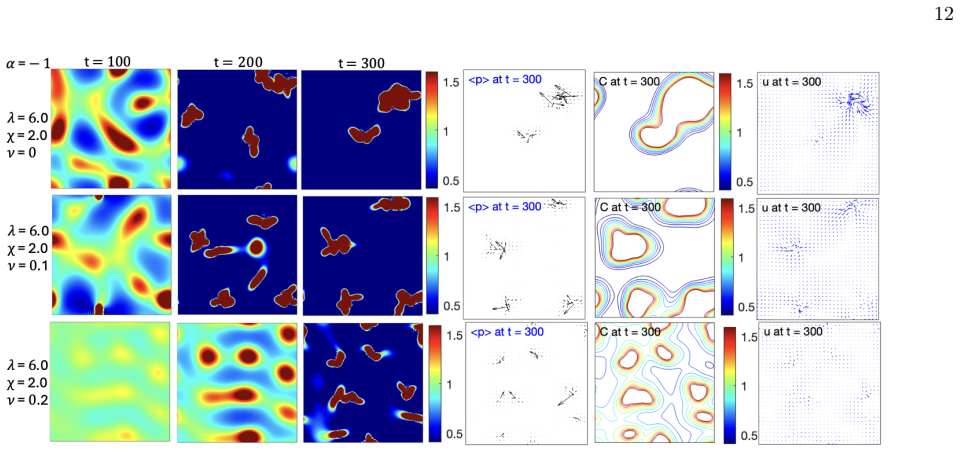
- In the chemotactic aggregation regime, increasing the resistance parameter $\nu$ yields more numerous and smaller motile clusters and delays the onset of aggregation.
- Above a critical resistance ($\nu_c \approx 0.279$ for the parameters studied), the hydrodynamic collective-swimming instability is suppressed for any wavenumber, so tumbling pushers revert to a uniform state.
- In the dynamic aggregation regime, resistance reduces the maximum swimmer concentration, fluid velocity, entropy, and input power, showing that the nonlinear coupling damps both hydrodynamic and chemotactic processes.
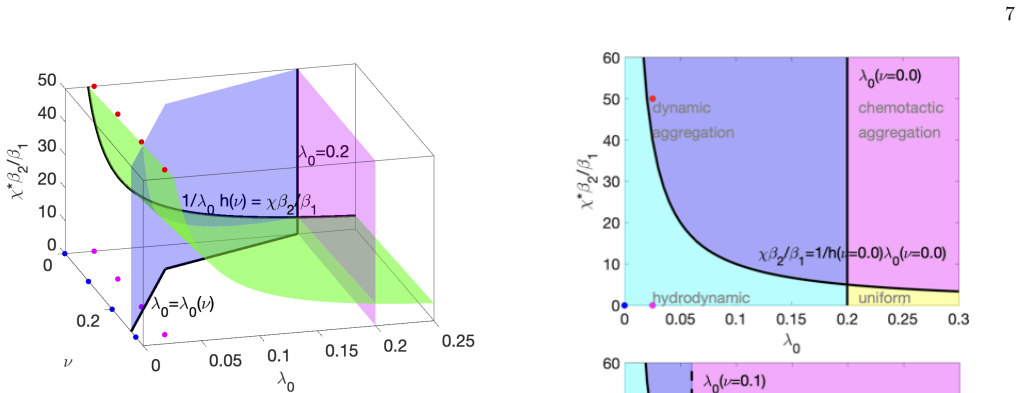
- The linear-theory phase diagram for elongated pushers contains four states—hydrodynamic collective swimming, chemotactic aggregation, dynamic aggregation, and uniform—and the hydrodynamic and dynamic-aggregation regions shrink as $\nu$ grows.
Reading between the lines
- A testable extension: tune the Darcy permeability $K_D$ in a gel or obstacle-array experiment with chemotactic bacteria and record cluster count and size; the paper's mechanism predicts cluster count should increase and mean size decrease as permeability drops.
- If the suppression comes from reduced individual motility and weaker hydrodynamic coupling rather than from impaired sensing, then other environments that slow swimmers—viscoelastic fluids, crowding, high viscosities—should also hamper aggregation even when the linear chemotactic instability persists.
- Because the linear chemotactic branch is independent of swimmer type and shape, the authors' result suggests nonlinear, flow-mediated effects, not the chemotactic response itself, set the aggregation threshold; comparing pusher and puller suspensions with matched linear growth rates would test this.
Signed reviews
Editorial analysis
A structured set of objections, weighed in public.
Referee Report
Summary. The manuscript extends a previously developed continuum model of micro-swimmers in Brinkman flows to include auto-chemotaxis. The swimmer orientation distribution is coupled to a chemoattractant field and to the active Stokes–Brinkman fluid equations. Linear stability analysis around the uniform isotropic state yields two dispersion relations, one for hydrodynamic collective swimming and one for chemotaxis; asymptotic and numerical solutions are used to construct a phase diagram of four dynamical regimes. Nonlinear simulations of the full system are run for parameter sets in the hydrodynamic, dynamic-aggregation, and chemotactic-aggregation regimes, with varying Brinkman resistance ν. The central claimed finding is that, although linear theory predicts resistance barely affects the chemotactic instability, nonlinear simulations show that resistance hampers chemotactic aggregation, producing more, smaller clusters and delaying aggregation onset.
Significance. If the central nonlinear result is correct, the paper makes a useful contribution to the active-matter-in-porous-media literature: it provides a phase diagram for autochemotactic pusher suspensions in Brinkman flows and identifies a genuine nonlinear effect of hydrodynamic resistance on chemotactic aggregation that is not captured by linear stability. The model connects to the authors' prior work and to Lushi–Goldstein–Shelley-type chemotactic suspension models, and it includes explicit statements of the model's dilute-suspension limitations and experimental parameter values. However, the strongest claim—that resistance persistently hampers aggregation rather than merely delaying its onset—is currently supported only by fixed-time snapshots and transient metrics, and the linear derivation contains inconsistencies that need to be resolved.
major comments (3)
- [§IV C, Figs. 11–12] The central claim that Brinkman resistance hampers chemotactic aggregation—producing more and smaller clusters—is inferred from snapshots at t = 100, 200, 300 and from time traces of max(Φ), max|u|, and related quantities. Because the linear theory itself predicts a smaller chemotactic growth rate σC for larger ν (Fig. 3), at any fixed observation time one would see smaller and more numerous clusters even if the long-time attractor were identical; the observed trend may therefore reflect delayed onset rather than a persistent hindering of aggregation. To support the causal statement in the abstract, the authors should provide either evidence that the dynamics have saturated at the final simulation times (e.g., plateaus in max(Φ) or in the cluster-size statistics) or time-resolved cluster-number and cluster-size statistics for each ν, demonstrating that the difference persists in the saturated state.
- [§III A, Eqs. (16)–(18)] The derivation of the two 'uncoupled' dispersion relations is not fully shown. Equation (16) contains the operator F1(Ψ) in the hydrodynamic term and G(Ψ) in the chemotactic term; applying F1 and G to Eq. (16) should in general yield a coupled 2×2 system for the two scalar moments, unless a decoupling condition or a symmetry assumption (e.g., axisymmetric perturbations with F2 = 0) is invoked. The authors should state this assumption explicitly and verify that the cross-coupling terms vanish; otherwise the separation into an independent hydrodynamic branch, Eq. (17), and an independent chemotactic branch, Eq. (18), is not justified. This point is load-bearing because the phase diagram in §III D is built from these separate criteria.
- [§III B–C, Eqs. (21) and following text] There is a direct inconsistency between the asymptotic expansion Eq. (21), which gives σC(0) = λ0(h(ν)−1) < 0 for ν > 0, and the statement in §III C that σC(0) = 0 (the latter is consistent with mass conservation of the total swimmer concentration). The numerical curves in Fig. 3 also appear to satisfy σC(0) = 0. This suggests that the O(1) term in Eq. (21) is spurious for ν > 0 and that the small-k expansion should be redone. Since the phase-boundary condition χβ2/β1 > 1/(λ0 h(ν)) is derived from this expansion, the quantitative location of the chemotactic-aggregation region may change, even if the qualitative conclusion that resistance weakly affects the linear chemotactic growth rate survives.
minor comments (4)
- [Fig. 7 caption] The caption contains a typo: 'purely tumbling swimmers with λ0−0.025' should read 'λ0 = 0.025'.
- [§IV A] The text says 'We do not show the dynamics for ν = 0 because the perturbations decay to zero' but Fig. 7 includes a non-tumbling Stokesian case; please clarify whether the ν = 0 tumbling case is omitted or shown, and distinguish it from the non-tumbling reference case.
- [§IV C, last paragraph] The sentence 'we did elaborate here on the effects of resistance in the chemotactic dynamics of puller suspensions' appears to contain a missing negation; given the following sentence ('This will be investigated in more detail in subsequent work'), it should presumably read 'we did not elaborate'.
- [Reference list] Several references have formatting errors, for example [78] includes '2102.10184' in the title field and [54] lacks a journal volume; please correct these before final submission.
Circularity Check
No significant circularity: the nonlinear suppression of chemotactic aggregation emerges from simulations and is not equivalent to any fitted input or imported prior result.
full rationale
The paper re-derives its linear stability results in the text: the hydrodynamic and chemotactic dispersion relations, Eqs. (17)–(18), follow from substituting plane-wave perturbations into the linearized conservation equation (12), with the ν=0 limit matching the published Stokes chemotaxis results of Lushi et al. [38,46,49]. The genuinely self-citational input is the single-swimmer Brinkman speed and active-stress model from the authors' forerunner work [86], notably UB=U0h(ν) and Σp=α∫Ψ(ppT−I/3)dp. That is a parameter-free micro-mechanical input used to build the model; it does not itself contain the paper's target claim, which is that in the full nonlinear system resistance produces more and smaller auto-chemotactic clusters. The nonlinear simulations start from random perturbations around the uniform isotropic state and are integrated forward, and the reported aggregation-suppression behavior is a dynamical output, not a quantity imposed by construction. No fitted parameter is renamed as a prediction, no uniqueness theorem is imported from the authors' prior work, and the phase diagram for ν=0 is checked against independent Stokes-suspension results. The paper's explicit caveats (dilute suspension, no direct swimmer–swimmer or swimmer–obstacle collisions, qualitative rather than quantitative predictions) are modeling limitations, not circular reductions. The internal k→0 discrepancy in the vicinity of Eq. (18) and the reliance on transient snapshots for the headline 'hampering' claim are correctness and evidence concerns, not cases where the derivation is equivalent to its inputs by construction.
Assumptions & free parameters
free parameters (4)
- Hydrodynamic collective swimming simulation parameters =
λ0=0.025, χ=0, α=-1, γ=1, D=dr=0.01
- Dynamic aggregation simulation parameters =
λ0=0.025, χ=50, β1=0.25, β2=0.25, Dc=0.05
- Auto-chemotactic aggregation simulation parameters =
λ0=6, χ=2, β1=0.1=β2, Dc=0.4
- Diffusion coefficients D and dr =
D=dr=0.01
assumptions (5)
- domain assumption Brinkman equations with constant permeability KD approximate a wet porous medium with sparse, stationary, sub-length-scale obstacles.
- domain assumption The suspension is dilute enough that direct swimmer-swimmer and swimmer-obstacle collisions can be neglected.
- domain assumption The chemotactic tumbling response takes the linearized biphasic form λ(p)=λ0(1-χ Dt C) when Dt C>1/χ and λ0 otherwise.
- domain assumption The chemo-attractant field is quasi-static in the linear stability analysis, satisfying Dc ∇²C - β1 C + β2 Φ = 0.
- domain assumption The swimmer disturbance flow is a Brinkmanlet dipole with dipole strength σ0 and the speed correction h(ν)=1/(1+ν+ν²/9).
Cite this review
Pith. "Pith review of Chemotactic aggregation dynamics of micro-swimmers in Brinkman flows." pith.science (2026). https://pith.science/paper/6TXT3RWL
@misc{pith2026250420925,
  author       = {Pith},
  title        = {Pith review of: Chemotactic aggregation dynamics of micro-swimmers in Brinkman flows},
  year         = {2026},
  howpublished = {\url{https://pith.science/paper/6TXT3RWL}},
  note         = {Machine review of arXiv:2504.20925}
}
read the original abstract
We study through analysis and simulations of a continuum model the collective chemotactic dynamics of micro-swimmers immersed in viscous Brinkman flows. The Brinkman viscous flow approximates with a resistance or friction term the presence of inert impurities or stationary obstacles immersed in the fluid, an environment that can be regarded as a wet porous medium. Analysis of the linearized system reveals that resistance primarily affects the development of collective swimming instabilities and barely affects chemotactic instabilities. We present a parameter phase space for the distinct types of dynamics we can expect in the case of auto-chemotactic bacteria-like pusher swimmers for varying medium resistance, chemotactic response strength, and hydrodynamic coupling strength values. Simulations of the full nonlinear system show that resistance impacts the collective dynamics for each of these states because it inhibits the hydrodynamic interactions and the emergence of the collective swimmer. Surprisingly, and not expected from the linear analysis predictions, we find that resistance also hampers the chemotactic aggregation of the swimmers because it impedes their ability to navigate efficiently and collectively towards chemical cues and assemble into clusters. We show simulations of the complex system for parameters sets from each of the phase-space regions and quantify the observed behavior. Lastly, we discuss the experimental values of the parameters and discuss possible future experimental realizations of this system.
Figures


Figures from the paper (9 more)




Reference graph
Works this paper leans on
-
[1]
T. J. Pedley and J. O. Kessler, Annual Review of Fluid Mechanics 24, 313 (1992)
1992
-
[2]
Lauga and T
E. Lauga and T. Powers, Reports on Progress in Physics 72, 096601 (2009)
2009
-
[3]
Ramaswamy, Annual Review of Condensed Matter Physics 1, 323 (2010)
S. Ramaswamy, Annual Review of Condensed Matter Physics 1, 323 (2010)
2010
-
[4]
M. C. Marchetti, J. F. Joanny, S. Ramaswamy, T. B. Liverpool, J. Prost, M. Rao, and R. Simha, Reviews of Modern Physics 85, 1143 (2013)
2013
-
[5]
Bechinger, R
C. Bechinger, R. D. Leonardo, H. Lowen, C. Reichhardt, G. Volpe, and G. Volpe, Reviews of Modern Physics 88, 045006 (2016)
2016
-
[6]
hydrodynamical collective swimming
From Fig. 2, a hydrodynamic instability for this tum- bling rate is expected for ν = 0, 0.1 but not for ν = 0.2. Fig. 7 shows simulations of the dynamics of an initially isotropic pusher suspension with basal tumbling with varying hydrodynamic resistance parameters ν = 0, 0.1. We do not show the dynamics for ν = 0 because the per- turbations decay to zero...
-
[7]
Saintillan, Annual Review of Fluid Mechanics 50, 563 (2018)
D. Saintillan, Annual Review of Fluid Mechanics 50, 563 (2018)
2018
-
[8]
G. Li, E. Lauga, and A. Ardekani, Journal of Non- Newtonian Fluid Mechanics 297, 104655 (2021)
2021
Show all 99 references
-
[9]
S. E. Spagnolie and P. T. Underhill, Annual Review of Condensed Matter Physics 14, 381 (2023)
2023
-
[10]
Dombrowski, L
C. Dombrowski, L. Cisneros, S. Chatkaew, R. E. Gold- stein, and J. O. Kessler, Physical Review Letters 93, 098103 (2004)
2004
-
[11]
M. J. Kim and K. S. Breuer, Physics of Fluids 16, L78 (2004)
2004
-
[12]
Tuval, L
I. Tuval, L. Cisneros, C. Dombrowski, C. Wogelmuth, J.O.Kessler, and R. Goldstein, Proceedings of the Na- tional Academy of Sciences of the United States of Amer- ica 102, 2277 (2005)
2005
-
[13]
Sokolov, I
A. Sokolov, I. S. Aranson, J. O. Kessler, and R. E. Gold- stein, Physical Review Letters 98, 158102 (2007)
2007
-
[14]
Sokolov, R
A. Sokolov, R. Goldstein, F. Feldchtein, and I. Aranson, Physical Review E 80, 031903 (2009)
2009
-
[15]
G. Mino, T. Mallouk, T. Darnige, M. Hoyos, J. Dauchet, J. Dunstan, R. Soto, Y. Wang, A. Rousselet, and E. Clement, Physical Review Letters106, 048102 (2011)
2011
-
[16]
Cisneros, J
L. Cisneros, J. Kessler, S. Ganguly, and R. Goldstein, Phys. Rev. E 83, 061907 (2011)
2011
-
[17]
Sokolov and I
A. Sokolov and I. Aranson, Phys. Rev. Lett. 109, 248109 (2012)
2012
-
[18]
Berg and D
H. Berg and D. Brown, Nature 239, 500 (1972)
1972
-
[19]
Macnab and D
R. Macnab and D. Koshland, Proceedings of the National Academy of Sciences of the United States of America 69, 2509 (1972)
1972
-
[20]
R. A. Simha and S. Ramaswamy, Physica A 306, 262 (2002)
2002
-
[21]
Hopkins and L
M. Hopkins and L. Fauci, Journal of Fluid Mechanics 455, 149 (2002)
2002
-
[22]
S. Park, P. M. Wolanin, E. A. Yuzbashyan, P. Silberzan, J. B. Stock, and R. H. Austinn, Science 301, 188 (2003)
2003
-
[23]
Hill and T
N. Hill and T. Pedley, Fluid Dynamics Research 37, 1 (2005)
2005
-
[24]
Hernandez-Ortiz, C
J. Hernandez-Ortiz, C. Stoltz, and M. Graham, Physical Review Letters 95, 204501 (2005)
2005
-
[25]
I. S. Aranson, A. Sokolov, J. O. Kessler, and R. E. Gold- stein, Physical Review E 75, 040901(R) (2007)
2007
-
[26]
Saintillan and M
D. Saintillan and M. J. Shelley, Physical Review Letters 99, 058102 (2007)
2007
-
[27]
Saintillan and M
D. Saintillan and M. J. Shelley, Physical Review Letters 100, 178103 (2008)
2008
-
[28]
Ishikawa and T
T. Ishikawa and T. J. Pedley, Physical Review Letters 100, 088103 (2008)
2008
-
[29]
Baskaran and M
A. Baskaran and M. C. Marchetti, Proceedings of the National Academy of Sciences of the United States of America 106, 15567 (2009)
2009
-
[30]
Hernandez-Ortiz, C
J. Hernandez-Ortiz, C. Stoltz, and M. Graham, Journal of Physics Condensed Matter 21, 204107 (2009)
2009
-
[31]
Subramanian and D
G. Subramanian and D. L. Koch, Journal of Fluid Me- chanics 632, 359 (2009)
2009
-
[32]
Hohenegger and M
C. Hohenegger and M. J. Shelley, Physical Review E 81, 046311 (2010)
2010
-
[33]
Pedley, Journal of Fluid Mechanics 647, 335 (2010)
T. Pedley, Journal of Fluid Mechanics 647, 335 (2010)
2010
-
[34]
Saragosti, V
J. Saragosti, V. Calvez, N. Bournaveas, B. Perthame, A. Buguin, and P. Silberzan, PLoS Computational Biol- ogy 10, e1000890 (2010)
2010
-
[35]
Saragosti, V
J. Saragosti, V. Calvez, N. Bournaveas, B. Perthame, A. Buguin, and P. Silberzan, Proceedings of the National Academy of Sciences of the United States of America 108, 16235 (2011)
2011
-
[36]
Subramanian and D
G. Subramanian and D. L. Koch, Annual Review of Fluid Mechanics 43, 637 (2011)
2011
-
[37]
Saintillan and M
D. Saintillan and M. Shelley, Journal of the Royal Society Interface (2011)
2011
-
[38]
T. V. Kasyap and D. L. Koch, Physical Review Letters 108, 038101 (2012)
2012
-
[39]
Lushi, R
E. Lushi, R. E. Goldstein, and M. J. Shelley, Physical Review E 86, 040902(R) (2012)
2012
-
[40]
Ezhilan, M
B. Ezhilan, M. J. Shelley, and D. Saintillan, Physics of Fluids 25, 070607 (2013)
2013
-
[41]
Dunkel, S
J. Dunkel, S. Heidenreich, K. Drescher, H. H. Wensink, M. Bar, and R. E. Goldstein, Physical Review Letters 110, 228102 (2013)
2013
-
[42]
Lushi and C
E. Lushi and C. Peskin, Computers and structures 122, 4 (2013)
2013
-
[43]
Lushi, H
E. Lushi, H. Wioland, and R. Goldstein, Proceedings of the National Academy of Sciences of the United States of America 111, 9734 (2014)
2014
-
[44]
T. V. Kasyap and D. L. Koch, Journal of Fluid Mechanics 741, 619 (2014)
2014
-
[45]
Krishnamurthy and G
D. Krishnamurthy and G. Subramanian, Journal of Fluid Mechanics 781, 422 (2015)
2015
-
[46]
Elgeti, R
J. Elgeti, R. G. Winkler, and G. Gompper, Reports on Progress in Physics 78, 056601 (2015)
2015
-
[47]
Lushi, Physical Review E 94, 022414 (2016)
E. Lushi, Physical Review E 94, 022414 (2016)
2016
-
[48]
Wioland, E
H. Wioland, E. Lushi, and R. E. Goldstein, New Journal of Physics 18, 075002 (2016)
2016
-
[49]
Stenhammar, C
J. Stenhammar, C. Nardini, R. W. Nash, D. Marenduzzo, and A. Morozov, Physical Review Letters 119, 028005 (2017)
2017
-
[50]
Lushi, R
E. Lushi, R. E. Goldstein, and M. J. Shelley, Physical Review E 98, 052411 (2018)
2018
-
[51]
Skultety, C
V. Skultety, C. Nardini, J. Stenhammar, D. Marenduzzo, and A. Morozov, Physical Review X 10, 031059 (2020)
2020
-
[52]
Rojas-P´ erez, B
F. Rojas-P´ erez, B. Delmotte, and S. Michelin, Journal of Fluid Mechanics A22, 919 (2021)
2021
-
[53]
Murugan and A
N. Murugan and A. Roy, Journal of Fluid Mechanics934, A21 (2022)
2022
-
[54]
Traverso and S
T. Traverso and S. Michelin, Journal of Fluid Mechanics A21, 943 (2022)
2022
-
[55]
Fadda, D
F. Fadda, D. Matoz-Fernandez, R. V. Roil, and S. Jabbari-Farouji, Physical Review E (2022)
2022
-
[56]
Villa-Torrealba, S
A. Villa-Torrealba, S. Navia, and R. Soto, Physical Re- view E 107, 034605 (2023). 15
2023
-
[57]
Volpe, I
G. Volpe, I. Buttinoni, D. Vogt, J.-H. Kummerer, and C. Bechinger, Soft Matter 7, 8810 (2011)
2011
-
[58]
Majmudar, E
T. Majmudar, E. Keaveny, J. Zhang, and M. J. Shelley, Journal of the Royal Society Interface 9, 1809 (2012)
2012
-
[59]
Wioland, F
H. Wioland, F. Woodhouse, J. Dunkel, J. Kessler, and R. Goldstein, Physical Review Letters 110, 268102 (2013)
2013
-
[60]
Contino, E
M. Contino, E. Lushi, I. Tuval, V. Kantsler, and M. Polin, Physical Review Letters 115, 258102 (2015)
2015
-
[61]
Sipos, K
O. Sipos, K. Nagy, R. D. Leonardo, and P. Galajda, Phys- ical Review Letters 114, 258104 (2015)
2015
-
[62]
Nishiguchi, I
D. Nishiguchi, I. Aranson, A. Snezhko, and A. Sokolov, Nature Communications 9, 4486 (2018)
2018
-
[63]
Makarchuk, V
S. Makarchuk, V. Braz, N. Araujo, L. Ciric, and G. Volpe, Nature Communications 10, 4110 (2019)
2019
-
[64]
Bhattacharjee and S
T. Bhattacharjee and S. S. Datta, Nature Communica- tions 1, 2 (2019)
2019
-
[65]
Kamdar, S
S. Kamdar, S. Shin, P. Leishangthem, L. Francis, X. Xu, and X. Cheng, Nature 603, 819 (2022)
2022
-
[66]
Dehkharghani, N
A. Dehkharghani, N. Waisbord, and J. S. Guasto, Com- munications Physics 6, 18 (2023)
2023
-
[67]
Bhattacharjee and S
T. Bhattacharjee and S. S. Datta, Soft Matter 15, 9920 (2019)
2019
-
[68]
Bhattacharjee, D
T. Bhattacharjee, D. B. Amchin, R. A. J. A. Ott, and S. Datta, eLife 11, e71226 (2022)
2022
-
[69]
Ford and R
R. Ford and R. Harvey, Advances in Water Resources30, 1608 (2007)
2007
-
[70]
Bhattacharjee, D
T. Bhattacharjee, D. Amchin, J. Ott, F. Kratz, and S. Datta, Biophysical Journal 120, 3483 (2021)
2021
-
[71]
Spagnolie, G
S. Spagnolie, G. Moreno-Flores, D. Bartolo, and E. Lauga, Soft Matter 11, 3396 (2015)
2015
-
[72]
C. Datt, L. Zhu, G. Elfring, and O. Pak, Journal of Fluid Mechanics 784, R1 (2015)
2015
-
[73]
C. Datt, G. Natale, S. Hatzikiriakos, and G. Elfring, Journal of Fluid Mechanics 823, 675 (2017)
2017
-
[74]
Desai and A
N. Desai and A. Ardekani, Soft Matter 13, 6033 (2017)
2017
-
[75]
Kos and M
Z. Kos and M. Ravnik, Fluids 3, 1 (2018)
2018
-
[76]
Bozorgi and P
Y. Bozorgi and P. T. Underhill, Journal of Non- Newtonian Fluid Mechanics 214, 69 (2014)
2014
-
[77]
Li and A
G. Li and A. Ardekani, Physical Review Letters 117, 118001 (2016)
2016
-
[78]
R. L. Stoop, N. Waisbord, V. Kantsler, V. Heinonen, J. Guasto, and J. Dunkel, Journal of Non-Newtonian Fluid Mechanics 268, 66 (2019)
2019
-
[79]
Thijssen, D
K. Thijssen, D. Khaladj, Aghvami, S. Ali, M. Gharbi, S. Fraden, J. Yeomans, L. Hirst, and T. Shendruk, Pro- ceedings of the National Academy of Sciences of the United States of America 2102.10184, 13 (2021)
2021 arXiv
-
[80]
Kumar, J
M. Kumar, J. S. Guasto, and A. M. Ardekani, Journal of Rheology 66, 375 (2022)
2022
-
[81]
A. M. Leshansky, Phys. Rev. E 80 80 (2009)
2009
-
[82]
Leiderman and S
K. Leiderman and S. D. Olson, Physics of Fluids 28, 1 (2016)
2016
-
[83]
Nganguia and O
H. Nganguia and O. S. Pak, Journal of Fluid Mechanics 855, 554 (2018)
2018
-
[84]
Nguyen, K
H. Nguyen, K. Leiderman, and S. Olson, Journal of Fluid Mechanics 864, 1088 (2019)
2019
-
[85]
Jeznach and S
C. Jeznach and S. D. Olson, Fluids 5 (2020)
2020
-
[86]
Y. Chen, N. Lordi, M. Taylor, and O. Pak, Physical Re- view E 102, 043111 (2020)
2020
-
[87]
Almoteri and E
Y. Almoteri and E. Lushi, arXiv preprint , arXiv:2404.18035 (2024)
2024
-
[88]
Cortez, B
R. Cortez, B. Cummins, K. Leiderman, and D. Varela, Journal of Computational Physics 229, 7609 (2010)
2010
-
[89]
Brinkman, Applied Scientific Research Section A 1, 27 (1947)
H. Brinkman, Applied Scientific Research Section A 1, 27 (1947)
1947
-
[90]
Durlofsky and J
L. Durlofsky and J. Brady, Physics of Fluids 30, 3329 (1987)
1987
-
[91]
Vanni, Chem
M. Vanni, Chem. Eng. Sci. 55, 685–698 (2000)
2000
-
[92]
Saintillan and M
D. Saintillan and M. J. Shelley, Physics of Fluids 20, 123304 (2008)
2008
-
[93]
Bearon and T
R. Bearon and T. Pedley, Bulletin of Mathematical Biol- ogy 62, 775 (2000)
2000
-
[94]
K. C. Chen, R. M. Ford, and P. T. Cummings, Journal of Mathematical Biology 47, 518 (2003)
2003
-
[95]
Ezhilan, A
B. Ezhilan, A. A. Pahlavan, and D. Saintillan, Physics of Fluids 24, 091701 (2012)
2012
-
[96]
Desai and A
N. Desai and A. Ardekani, Physical Review E 98, 012419 (2018)
2018
-
[97]
Almoteri, Bacterial motion and spread in porous en- vironments, Ph.D
Y. Almoteri, Bacterial motion and spread in porous en- vironments, Ph.D. thesis, New Jersey Institute of Tech- nology (2023)
2023
-
[98]
Saintillan and M
D. Saintillan and M. J. Shelley, Comptes Rendus Physique 14, 497 (2013)
2013
-
[99]
Drescher, J
K. Drescher, J. Dunkel, L. Cisneros, S. Ganguly, and R. Goldstein, Proceedings of the National Academy of Sciences of the United States of America 108, 10940 (2011)
2011
Reviewed August 16, 2026 · model on record in the stance chip above.
Discussion (0). Continue with ORCID to comment.